
AFTERWORD
THE STEVE WE KNEW
I t was the end of 1985, and the computer division I ran at Lucasfilm was short on suitors and, it seemed, out of options. Our tires had been kicked by anyone with even the slightest interest in computer-generated imaging. We’d made a promising match with General Motors, only to be left at the altar. Then Steve Jobs swooped in. As I related earlier, it was around this time that one of his attorneys pulled us aside during a meeting and jokingly—I think—said that we were about to climb aboard the Steve Jobs roller coaster. Get on, we did, and what a ride it would prove to be—with all of the attendant ups and downs.
I worked closely with Steve Jobs for twenty-six years. To this day, for all that has been written about him, I don’t believe that any of it comes close to capturing the man I knew. I’ve been frustrated that the stories about him tend to focus so narrowly on his extreme traits and the negative, difficult aspects of his personality. Inevitably, profiles of Steve describe him as stubborn and imperious, a man who held steadfastly and unwaveringly to his own ideals, refusing to budge or change, and who often tried to browbeat others into doing things his way. While many of the anecdotes people repeat about his behavior as a young executive are probably accurate, the overall portrait is way off the mark. The reality is, Steve changed profoundly in the years that I knew him.
The word genius is used a lot these days—too much, I think—but with Steve, I actually think it was warranted. Still, when I first came to know him, he was frequently dismissive and brusque. This is the part of Steve that people love to write about. I realize that it is difficult to understand people who deviate so radically from the norm, like Steve did, and I suspect that those who focus on his more extreme traits do so because those traits are entertaining and revealing in some way. To let them drive Steve’s narrative, however, is to miss the more important story. In the time I worked with Steve, he didn’t just gain the kind of practical experience you would expect to acquire while running two dynamic, successful businesses; he also got smarter about when to stop pushing people and how to keep pushing them, if necessary, without breaking them. He became fairer and wiser, and his understanding of partnership deepened—in large part because of his marriage to Laurene and his relationships with the children he loved so much. This shift didn’t lead him to abandon his famous commitment to innovation; it solidified it. At the same time, he developed into a kinder, more self-aware leader. And I think Pixar played a role in that development.
Remember, in the late 1980s, when Pixar was founded, Steve was spending most of his time building NeXT, the computer company he’d started after being forced out of Apple. At Pixar, none of us, including Steve, knew what we were doing. Steve would overreach in early negotiations with customers, which sometimes worked but sometimes backfired. At NeXT, for instance, he struck a $100 million deal that allowed IBM to use the NeXT software. The huge dollar amount, combined with the fact that Steve didn’t give IBM rights to subsequent versions of the software, seemed like a home run deal for NeXT. In fact, Steve had overreached—his behavior created ill will, and he later told me he learned from that.
In those early days, Steve sensed that there was something quite special going on at Pixar, but it frustrated him that he couldn’t figure it out—and kept losing money in the meantime. He had an expensive group that was ahead of its time. Could he hang on long enough for that potential to flower, especially if he didn’t know if it ever would flower? What kind of person signs on for that? Would you?
We tend to think of emotion and logic as two distinct, mutually exclusive domains. Not Steve. From the beginning, when making decisions, passion was a key part of his calculus. At first, he often elicited it in a ham-handed way, by making extreme or outrageous statements and challenging people to respond. But at Pixar, even when we were a long way from being in the black, that aggressiveness was tempered by his acknowledgment that we knew things about graphics and storytelling that he did not. He respected our determination to be the first to make a computer-animated feature film. He didn’t tell us how to do our work or come in and impose his will. Even when we were unsure how to reach our goal, our passion was something Steve recognized and valued. That’s what Steve, John, and I ultimately bonded over: passion for excellence—a passion so ardent we were willing to argue and struggle and stay together, even when things got extremely uncomfortable.
I remember being struck by Steve’s response to passion when we were working on our second film, A Bug’s Life . There was an internal disagreement about the aspect ratio of the film—the proportional relationship between its width and its height. In a movie theater, films are displayed in widescreen format, where the width of the picture is more than twice the height; on the TVs of that time, by contrast, the width of the picture was only one and one-third times the height, more of a boxy shape. When you make a video version of a widescreen film that will be viewed on a TV monitor, then, you either end up with black bars at the top and bottom of the screen, or you clip off the sides of the picture completely, neither of which is a good representation of the original film.
On A Bug’s Life , the marketing people were in conflict with the filmmakers. The filmmakers wanted the widescreen format because it led to a better panoramic experience in the theater, which they believed to be more important than the home viewing experience. The marketers, believing that consumers were less likely to buy a video with black bars on the top and bottom, argued that the widescreen format would mean a reduction in our DVD sales. Steve—no film buff—agreed with the marketing people that we would be hurting ourselves financially if we released the movie in widescreen. The debate about this was still unresolved when, one afternoon, I took Steve around the offices so he could see some of Pixar’s departments in action, and we ended up in a room full of people who were working on lighting a scene from A Bug’s Life . The production designer on the film, Bill Cone, was showing some images on monitors that happened to be in widescreen format.
Seeing this, Steve interjected, in his way, that it was “nuts” for us to be making a widescreen movie. Bill, to his credit, came right back at him, explaining why the widescreen format was absolutely crucial from an artistic standpoint. An intense back-and-forth followed. I wouldn’t call it an argument, but it was definitely heated. The discussion seemed to end inconclusively, and Steve and I continued on our rounds.
Later, Bill came to see me, looking rattled. “Oh, my God,” he said. “I was just arguing with Steve Jobs. Did I blow it?”
“On the contrary,” I told him. “You won.”
I could see something that Bill couldn’t: Steve had responded to Bill’s passion about the issue. The fact that Bill was willing to stand up so forcefully and articulately for what he believed showed Steve that Bill’s ideas were worthy of respect. Steve never raised the format issue with us again.
It wasn’t that passion trumped logic in Steve’s mind. He was well aware that decisions must never be based on emotions alone. But he also saw that creativity wasn’t linear, that art was not commerce, and that to insist upon applying dollars-and-cents logic was to risk disrupting the thing that set us apart. Steve put a premium on both sides of this equation, logic and emotion, and the way he maintained that balance was key to understanding him.
I n the mid-1990s, it became clear that Pixar, long housed in a few cramped, tilt-up buildings in Point Richmond, California, was going to need a new home. The time had come to establish a proper headquarters—a place of our own, suited to our needs. Steve threw himself into designing it, and the magnificent main building that we occupy today is the outgrowth of all that work. But it didn’t come easily.
Steve’s first pass at a design was based on some peculiar ideas he had about how to force interaction among people. At an off-site staff meeting to discuss these plans in 1998, several people rose to complain about his intent to build a single women’s and a single men’s restroom. Steve relented, but he was clearly frustrated that people didn’t understand what he was trying to do: Bring people together out of necessity. At first, Steve struggled to find the best way to enable that mutual experience.
Next, he envisioned a separate building for each movie under production—the idea being that each crew would benefit from having its own contained space, free of distraction. I wasn’t so sure about that, so I asked him to go on a road trip.
Showing, not telling, worked best with Steve, which is why I coaxed him south to Burbank for a tour of the four-story glazed-glass-and-aluminum building on Thornton Avenue known as Northside. Disney Animation had taken it over in 1997, using it to house the crew for its first 3D animated movie, Dinosaur , among other projects.
But the building was more famous for what it had housed in the 1940s: Lockheed’s top-secret Skunk Works division, which designed jet fighters, spy planes, and at least one stealth fighter. I loved that bit of history—and the fact that the name Skunk Works itself had been borrowed from Al Capp’s newspaper comic strip Li’l Abner . In that strip, there was a running joke about a mysterious and malodorous place deep in the forest called the “Skonk Works” where a strong beverage was brewed from skunks, old shoes, and other strange ingredients.
Steve knew that my purpose that day wasn’t to discuss comic strips or aviation history but to show him the building—a welcoming space where several hundred animators worked on multiple projects simultaneously, under a single roof. I liked the feel of the wide-open hallways. I recall Steve being critical of numerous facets of the building’s layout, but after an hour or so wandering around the place, I could tell he was getting the message: Creating separate buildings for each film would be isolating. He saw firsthand the way that the Disney people took advantage of the open floor plan, sharing information and brainstorming. Steve was a big believer in the power of accidental mingling; he knew that creativity was not a solitary endeavor. But our trip to Northside helped clarify that thinking. In a creative company, separating your people into distinct silos—Project A over here, Project B over there—can be counterproductive.
After that trip, he met again with his architects and laid out the principles for a single building. He took the creation of a new Pixar headquarters as a personal responsibility.
You’ve heard the saying “Your employees are your most important asset.” For most executives, these are just words you trot out to make people feel good—while they may be accepted as true, few leaders alter their behavior or make decisions based upon them. But Steve did, taking that principle and building our headquarters around it. Everything about the place was designed to encourage people to mingle, meet, and communicate, to support our filmmaking by enhancing our ability to work together.
In the end, Steve presided over every detail of our new building’s construction, from the arched steel bridges that straddle the central atrium to the type of chairs in our screening rooms. He didn’t want perceived barriers, so the stairs were open and inviting. He wanted a single entrance to the building so that we saw each other as we entered. We had meeting rooms, restrooms, a mailroom, three theaters, a game area, and an eating area all at the center in our atrium (where to this day, everyone gathers to eat, play ping pong, or be briefed by Pixar’s leaders on the company’s goings on). This all resulted in cross-traffic—people encountered each other all day long, inadvertently, which meant a better flow of communication and increased the possibility of chance encounters. You felt the energy in the building. Steve had thought all this through with the metalogic of a philosopher and the meticulousness of a craftsman. He believed in simple materials, masterfully constructed. He wanted all the steel exposed, not painted. He wanted glass doors to be flush with the walls. No wonder that when it opened in the fall of 2000, after four years of planning and construction, Pixar’s people—who typically worked for four years on each film—took to calling the building “Steve’s movie.”
I admit that there were moments when I worried that Pixar would fall prey to the “edifice complex,” wherein companies build shiny headquarters that are mere extensions of executive ego. But that worry proved unfounded. From the day we moved in, on Thanksgiving weekend of 2000, the building became an extraordinary and fertile home. Moreover, in our employees’ minds, it transformed Steve—always our external defender—into an integral part of our internal culture. The environment was so exemplary and so clearly attributed to Steve that everyone could appreciate his singular contribution to—and understanding of—the way we worked.
That appreciation was a positive development because, as I’ve said before, upon meeting Steve, people typically had to become accustomed to his style. Brad Bird remembers a meeting during the making of The Incredibles , soon after he joined the studio, when Steve hurt his feelings by saying that some of the Incredibles artwork looked “kind of Saturday morning”—a reference to the low-budget cartoons that Hanna-Barbera and others produced. “In my world, that’s kind of like saying, ‘Your mama sleeps around,’ ” Brad recalls. “I was seething. When the meeting ended, I went over to Andrew and said, ‘Man, Steve just said something that really pissed me off.’ And Andrew, without even asking what it was, said, ‘Only one thing?’ ” Brad came to understand that Steve was speaking not as a critic but as the ultimate advocate. Too often, animated superheroes had been made on the cheap and looked that way, too—on that Steve and Brad could agree. The Incredibles , he was implying, had to reach higher. “He was just saying that we have to show this is something bigger,” Brad says. “And that epitomized Steve.”
Though no one outside Pixar knew it, Steve developed a lasting bond with our directors. At first I thought this was just because he appreciated their creative and leadership abilities and they, in turn, appreciated the support and insight he gave them. But as I paid closer attention, I recognized there was something very important that they shared. When directors pitch an idea, for example, they invest totally, even though a part of them knows that in the end, it may not work at all. Pitching is a way of testing material, taking its measure—and, importantly, strengthening it—by observing how it plays to an audience. But if the idea doesn’t fly, they are extremely adept at dropping it and moving on. This is a rare skill, one that Steve had too.
Steve had a remarkable knack for letting go of things that didn’t work. If you were in an argument with him, and you convinced him that you were right, he would instantly change his mind. He didn’t hold on to an idea because he had once believed it to be brilliant. His ego didn’t attach to the suggestions he made, even as he threw his full weight behind them. When Steve saw Pixar’s directors do the same, he recognized them as kindred spirits.
One of the dangers of this approach can be that if you are pitching intently, your very exuberance can make others reluctant to respond candidly. When someone has a strong personality, others can wilt in the face of their intensity. How do you prevent this from happening? The trick is to shift the emphasis in any meeting away from the source of an idea and onto the idea itself. People often place too much significance on the source of an idea, accepting it (or not criticizing it) because it comes from Steve or a respected director. But Steve had no interest in that kind of affirmation. Countless times, I remember watching him toss ideas—pretty far-out ideas—into the air, just to see how they played. And if they didn’t play well, he would move on. This is, in effect, a form of storytelling—searching for the best way to frame and communicate an idea. If people didn’t understand Steve, they would misinterpret his floating of ideas as advocacy. And they would wrongly perceive his enthusiasm or insistence as intransigence or bullheadedness. Instead, he was gauging reactions to his ideas to see whether or not he should become their advocate.
Steve is not commonly described as a storyteller, and he was always careful to say he didn’t know the first thing about filmmaking. Yet part of his bond with our directors stemmed from the fact that he knew how important it was to construct a story that connected with people. This was a skill he used in his presentations at Apple. When he got up in front of an audience to introduce a new product, he understood that he would communicate more effectively if he put forward a narrative, and anyone who ever saw him do it could tell you that he gave extraordinary and carefully crafted performances.
At Pixar, Steve was able to participate in other people’s crafting of their stories, and I believe this process helped him understand more about human dynamics. There was something about applying his intellect to the emotion of a film—Was it landing? Did it ring true?—that freed him up, and he came to see that Pixar’s success was reliant on its movies connecting deeply with an audience. Given the way his behavior has been described in the past, you might think that giving constructive feedback to a vulnerable director on a not-baked-yet film would not be something that Steve could do gracefully, if at all. But in fact, over time, he became quite skilled at it. Pete Docter remembers Steve telling him once that he hoped in his next life he would come back as a Pixar director. I have no doubt that if he did, he’d be one of the best.
A s summer gave way to fall in 2003, Steve became increasingly hard to get ahold of. He was known for responding to emails, at all times of day and night, within minutes. But now, I would call or email and not hear back. In October, he dropped by Pixar, which was unusual—unless there was a board meeting, we usually briefed each other by phone. When John and I sat down with him, Steve closed the door and told us that he’d been having this aching in his back that wouldn’t go away. His doctor had recently sent him for a CAT scan, which revealed pancreatic cancer. Ninety-five percent of people with this diagnosis are not alive five years later, he told us. Steve was determined to fight, but he knew he might not win.
Over the next eight years, Steve underwent a seemingly endless variety of treatments, both traditional and experimental. As his energy waned, our interactions became less frequent, though he still called weekly to check in, offer advice, and voice concerns. At one point during this period, John and I drove down to Apple to have lunch with him. Afterward, Steve took us into a secure room where Apple kept the supersecret products and showed us an early prototype of something he called the iPhone. It had a touch screen that engaged the user, making navigation not just easy but fun. We could instantly see that it made the phones we were carrying in our pockets look like ancient artifacts. He was particularly jazzed about it, he said, because it was his goal not just to create a phone people used but to design a phone people loved —one that made their lives better, both functionally and aesthetically. He thought Apple had succeeded in creating such a device.
As we walked out of the vault, Steve stopped in the hallway and said he had been working on a list of three things he wanted to do—and I remember the words precisely—“before I sail away.” One goal that mattered enormously to him was to roll out the product he’d just shown us, along with a few others that he believed would ensure Apple’s future. The second was to safeguard Pixar’s continued success. And the third and most important was to set his three youngest children on a good path. I remember him saying that he hoped he would be around to watch his son Reed, then in 8th grade, graduate from high school. To hear this once-unstoppable man scaling back his hopes and ambitions to a handful of last wishes was heartbreaking, of course, but I remember thinking that when Steve said it, it sounded natural. It felt like he had come to terms with the inevitability of not being here.
In the end, he would achieve all three of his goals.
O n a Sunday afternoon in February 2007, my daughter Jeannie and I stepped out of a town car, onto a long, red carpet … and ran smack into Steve Jobs. It was a few hours before the 79th Annual Academy Awards, and to get to our seats, the three of us had to plow through the crush of people outside the Kodak Theatre in the heart of Hollywood. Cars was nominated for Best Animated Feature Film, and, like all award hopefuls, we had a few preshow jitters. But as the three of us jostled along, Steve looked around at the circus—the elegantly turned-out men and women, the scrum of television interviewers, the throngs of paparazzi and screaming onlookers, the line of limousines pulling up at the curb—and said, “What this scene really needs is a Buddhist monk lighting himself on fire.”
Perspective is so hard to capture. I worked with Steve for more than a quarter-century—longer, I believe, than anyone else—and I saw an arc to his life that does not accord with the one-note portraits of relentless perfectionism I’ve read in magazines, newspapers, and even his own authorized biography. Relentless Steve—the boorish, brilliant, but emotionally tone-deaf guy that we first came to know—changed into a different man during the last two decades of his life. All of us who knew Steve well noticed the transformation. He became more sensitive not only to other people’s feelings but also to their value as contributors to the creative process.
His experience with Pixar was part of this change. Steve aspired to create utilitarian things that also brought joy; it was his way of making the world a better place. That was part of why Pixar made him so proud—because he felt the world was better for the films we made. He used to say regularly that as brilliant as Apple products were, eventually they all ended up in landfills. Pixar movies, on the other hand, would live forever. He believed, as I do, that because they dig for deeper truths, our movies will endure, and he found beauty in that idea. John talks about “the nobility of entertaining people.” Steve understood this mission to his core, particularly toward the end of his life, and—knowing that entertaining wasn’t his primary skill set—he felt lucky to have been involved in it.
Pixar occupied a special place in Steve’s world, and his role evolved during our time together. In the early years, he was our benefactor, the one who paid the bills to keep the lights on. Later, he became our protector—a constructive critic internally but our fiercest defender to the outside. We had some trying times together, to be sure, but through those difficulties, we forged a rare bond. I’ve always thought that Pixar was like a well-loved stepchild for Steve—conceived before he entered our lives, maybe, but still nurtured by him in our formative years. In the decade before his death, I watched Steve change Pixar even as Pixar changed him. I say this while acknowledging that no segment of one’s life can be divorced from the rest; Steve was, of course, always learning from his family and from his colleagues at Apple. But there was something special about the time he spent with us—enhanced, counterintuitively, by the fact that Pixar was his sideline. His wife and children, of course, were paramount, and Apple was his first and most heralded professional achievement; Pixar was a place he could relax a little and play. While he never lost his intensity, we watched him develop the ability to listen. More and more, he could express empathy and caring and patience. He became truly wise. The change in him was real, and it was deep.
In chapter 5 , I mentioned that, at my insistence, Steve didn’t attend Braintrust meetings. But he would often give notes after movies were screened for Pixar’s board of directors. Once or twice per movie, when a crisis loomed, he would inevitably come in and say something that helped alter our perceptions and improve the film. Whenever offering a note, he always began the same way: “I’m not really a filmmaker, so you can ignore everything I say.… ” Then he would proceed, with startling efficiency, to diagnose the problem precisely. Steve focused on the problem itself, not the filmmakers, which made his critiques all the more powerful. If you sense a criticism is being leveled for personal reasons, it is easy to dismiss. You couldn’t dismiss Steve. Every film he commented on benefited from his insight.
But while in the early days his opinions would swing wildly and his delivery could be abrupt, he became more articulate and observant of people’s feelings as time went on. He learned to read the room, demonstrating skills that, years earlier, I didn’t think he had. Some people have said that he got mellower with age, but I don’t think that’s an adequate description of what happened; it sounds too passive, as if he just was letting more go. Steve’s transformation was an active one. He continued to engage; he just changed the way he went about it.
There is a phrase that many have used to describe Steve’s knack for accomplishing the impossible. Steve, they say, employed a “reality distortion field.” In his biography of Steve, Walter Isaacson devoted an entire chapter to it, quoting Andy Hertzfeld, a member of the original Mac team at Apple, saying, “The reality distortion field was a confounding mélange of a charismatic rhetorical style, indomitable will, and eagerness to bend any fact to fit the purpose at hand.” I heard the phrase used fairly often around Pixar, too. Some people, after listening to Steve, would feel that they had reached a new level of insight, only to find afterward that they could not reconstruct the steps in his reasoning; then the insight would evaporate, leaving them scratching their heads, feeling they had been led down the garden path. Thus, reality distortion.
I disliked the phrase because it carried a whiff of negativity—implying that Steve would try to will a fantasy world into being on a whim, without regard to how his refusal to face facts meant that everybody around him had to pull all-nighters and upend their lives in the hopes of meeting his unmeetable expectations. Much has been made of Steve’s refusal to follow rules—realities—that applied to others; famously, for example, he did not put a license plate on his car. But to focus too much on this is to miss something important. He recognized that many rules were in fact arbitrary. Yes, he tested boundaries and crossed the line at times. As a behavioral trait, that can be seen as antisocial—or if it happens to change the world, it can earn you the label “visionary.” We frequently support the idea of pushing boundaries in theory, ignoring the trouble it can cause in practice.
Before Pixar was called Pixar, it was devoted to accomplishing something that had never been done before. For me, this had been a lifelong goal, and my colleagues at Pixar—Steve among them—were willing to make that leap, too, before computers had enough speed or memory to make it a reality. A characteristic of creative people is that they imagine making the impossible possible. That imagining—dreaming, noodling, audaciously rejecting what is (for the moment) true—is the way we discover what is new or important. Steve understood the value of science and law, but he also understood that complex systems respond in nonlinear, unpredictable ways. And that creativity, at its best, surprises us all.
There is another, different meaning of reality distortion for me. It stems from my belief that our decisions and actions have consequences and that those consequences shape our future. Our actions change our reality. Our intentions matter. Most people believe that their actions have consequences but don’t think through the implications of that belief. But Steve did. He believed, as I do, that it is precisely by acting on our intentions and staying true to our values that we change the world.
O n August 24, 2011, Steve resigned as Apple’s CEO, as he was no longer able to keep pace with the rigors of the job he loved. Shortly thereafter, I was exercising at home early in the morning when the phone rang. It was Steve. To be honest, I can’t remember exactly what was said, because I knew he was nearing the end, and that was an incredibly difficult reality to deal with. But I recall that his voice was strong—stronger than it should have been, given what he’d been through—as he talked about how many years we’d worked together and how grateful he was to have had that experience. I remember him saying that he felt honored to have been a part of Pixar’s success. I told him I felt honored, too, and was thankful for his friendship, his example, and his loyalty. When we hung up, I said to myself, “That was the goodbye call.” I was right: He would live six more weeks, but I would never hear his voice again.
On a Monday morning five days after his death, the entire Pixar workforce gathered in the atrium of the building Steve had built to mourn and remember. By 11 A.M. , the atrium was full of people, and it was time to begin. I stood off to the side, thinking about the man who’d been Pixar’s fiercest champion and a close friend. It fell on me to speak first.
There were so many things I could say about Steve—how he bought the division that would become Pixar from George Lucas in 1986, saving us from extinction; how he encouraged us to embark on our first feature film, Toy Story , three years later, when the idea of a computer-animated film still seemed beyond our reach; how he’d solidified our future by selling us to Disney and then ensured our autonomy by orchestrating a merger that created a true partnership; how he helped take us from forty-three employees to the 1,100 men and women who stood in front of me now. Looking back, I could recall the earliest moments of our relationship—him probing and poking, me honing and fortifying my ideas. He had made me more focused, more resilient, smarter, better. Over time, I had come to rely on his demanding specificity, which never failed to help me clarify my own thinking. I could already feel the weight of his absence.
“I remember twenty-five years ago in February, the day that Pixar was formed,” I began, recalling how we gathered in a conference room at Lucasfilm to sign the papers transferring majority ownership to Steve. We were exhausted, having spent months looking for potential suitors before Steve stepped forward. For those who weren’t at Pixar in the beginning, I recalled how Steve had pulled Alvy Ray Smith and me aside, put his arms around us, and said, “As we’re going through this, there’s one thing I dearly ask. And that is that we be loyal to each other.” I told my colleagues that Steve had always made good on that promise. “Over the years, Pixar and Steve went through a lot of changes and a lot of hardships,” I said. “These were very hard times. Pixar came close to collapsing. Any other investor or venture capitalist would have given up.” But not Steve. He demanded of himself what he’d asked of us: loyalty.
“I don’t know what happens in the future,” I concluded as the sun streamed through the skylights above us. “But I do believe that Steve’s focus on passion and quality will take us places that we cannot yet perceive. And for that I am truly grateful.” At that moment, I was more aware than ever of how important it was to understand and protect what had made Steve so proud. It had always been my goal to create a culture at Pixar that would outlast its leaders—Steve, John, and me. Now one of us had taken his leave too soon, and the job of fortifying that culture—ensuring that it would be self-sustaining—was left to John and me.
When I was done, I offered the microphone to others who’d had a close relationship with Steve and, one by one, they stepped onto the podium. Andrew Stanton described Steve as “the creative firewall.” With Steve around, the people of Pixar “were like free-range chickens,” he said, getting a laugh. “Steve would do anything to keep us creatively safe.”
The ever-observant Pete Docter got up next and recalled one of the most endearing images he had of Steve. During a meeting one day years ago, Pete noticed that Steve had two small, identical holes in one of the legs of his Levis 501s. Steve shifted in his seat, and Pete noticed the same two holes on the other leg, too, in the same spot, right above the ankle. As Pete was trying—and failing—to imagine a reason for these symmetrical holes, Steve reached down to pull up his socks by grabbing them through his pants—putting his fingers right where the holes were! “Here Steve was worth millions, but apparently getting a new pair of pants was not important to him,” Pete said. “Or maybe he needed new socks with better elastic. Either way, it was a humanizing aspect to this larger-than-life guy.”
Brad Bird recalled that when he first started talking to Pixar about doing The Incredibles , he wasn’t sure if he would take the offer: He was still considering staying with Warner Bros., which had released his earlier movie, The Iron Giant . “But it took me a month to get a meeting with the administration of the studio I’d just made a movie for,” Brad said. “And in the meantime, Steve knew the name of my wife, asked how my kids were by name—he did his homework. I thought, ‘What the hell am I doing talking to Warner Bros.?’ It cinched the deal.”
“Steve held the bar for quality,” Brad continued. “He was always about the long run. He was into Buddhism, but I see him more as just a spiritual guy. I have to believe that he believed in something beyond this”—he hesitated, overcome for a moment—“and that’s where we’ll see him again. Where cream rises to the top. So here’s to you, Steve, and to the long run.”
It was John’s turn now. The room fell silent, but you could feel the current of emotion around us all. Stepping to the podium, he described what an honor it had been to be Steve’s friend as he changed—like we all aspire to do—for the better.
“When Steve first bought us,” John said, “there was a confidence he had. Some people call it arrogance; I call it confidence. But it was basically a belief that he could do anybody’s job better than they could. That’s why people hated getting into an elevator at Apple with Steve because they felt by the time they got to the top floor, they’d probably be fired.” Again, the room broke out in laughter. “But as Pixar evolved into an animation studio, he started to look at all the work that we were doing, and he was amazed. He realized he couldn’t even come close to doing what we could do. I like to think that when he was building Pixar, when he and Laurene got married and he had his kids, that that realization of how brilliant the people here at Pixar were—that all this helped make him the amazing leader he was.”
Three weeks before, John had visited Steve for the last time. “We sat for about an hour talking about coming projects he was so interested in,” John said, his voice catching. “I looked at him and I realized this man had given me—given us—everything that we could ever want. I gave him a big hug. I kissed him on the cheek and for all of you”—John was crying now—“I said, ‘Thank you. I love you, Steve.’ ”
The room erupted in applause, which only ebbed when one of the Pixar Singers took the stage. In a quiet voice, he announced that just as our resident a capella group had sung at every Pixar wrap party in our company’s history, it would now sing for Steve, too. Standing in the building that we all called “Steve’s movie,” I couldn’t help but think that he would have loved this—a fitting wrap to the production that was Steve Jobs.
The roller coaster came to a stop and a good friend got off, but what a ride we’d taken together. It had been one hell of a trip.
STARTING POINTS
THOUGHTS FOR MANAGING A CREATIVE CULTURE
H ere are some of the principles we’ve developed over the years to enable and protect a healthy creative culture. I know that when you distill a complex idea into a T-shirt slogan, you risk giving the illusion of understanding—and, in the process, of sapping the idea of its power. An adage worth repeating is also halfway to being irrelevant. You end up with something that is easy to say but not connected to behavior. But while I have been dismissive of reductive truths throughout this book, I do have a point of view, and I thought it might be helpful to share some of the principles that I hold most dear here with you. The trick is to think of each statement as a starting point, as a prompt toward deeper inquiry, and not as a conclusion.
• Give a good idea to a mediocre team, and they will screw it up. Give a mediocre idea to a great team, and they will either fix it or come up with something better. If you get the team right, chances are that they’ll get the ideas right.
• When looking to hire people, give their potential to grow more weight than their current skill level. What they will be capable of tomorrow is more important than what they can do today.
• Always try to hire people who are smarter than you. Always take a chance on better, even if it seems like a potential threat.
• If there are people in your organization who feel they are not free to suggest ideas, you lose. Do not discount ideas from unexpected sources. Inspiration can, and does, come from anywhere.
• It isn’t enough merely to be open to ideas from others. Engaging the collective brainpower of the people you work with is an active, ongoing process. As a manager, you must coax ideas out of your staff and constantly push them to contribute.
• There are many valid reasons why people aren’t candid with one another in a work environment. Your job is to search for those reasons and then address them.
• Likewise, if someone disagrees with you, there is a reason. Our first job is to understand the reasoning behind their conclusions.
• Further, if there is fear in an organization, there is a reason for it—our job is (a) to find what’s causing it, (b) to understand it, and (c) to try to root it out.
• There is nothing quite as effective, when it comes to shutting down alternative viewpoints, as being convinced you are right.
• In general, people are hesitant to say things that might rock the boat. Braintrust meetings, dailies, postmortems, and Notes Day are all efforts to reinforce the idea that it is okay to express yourself. All are mechanisms of self-assessment that seek to uncover what’s real.
• If there is more truth in the hallways than in meetings, you have a problem.
• Many managers feel that if they are not notified about problems before others are or if they are surprised in a meeting, then that is a sign of disrespect. Get over it.
• Careful “messaging” to downplay problems makes you appear to be lying, deluded, ignorant, or uncaring. Sharing problems is an act of inclusion that makes employees feel invested in the larger enterprise.
• The first conclusions we draw from our successes and failures are typically wrong. Measuring the outcome without evaluating the process is deceiving.
• Do not fall for the illusion that by preventing errors, you won’t have errors to fix. The truth is, the cost of preventing errors is often far greater than the cost of fixing them.
• Change and uncertainty are part of life. Our job is not to resist them but to build the capability to recover when unexpected events occur. If you don’t always try to uncover what is unseen and understand its nature, you will be ill prepared to lead.
• Similarly, it is not the manager’s job to prevent risks. It is the manager’s job to make it safe to take them.
• Failure isn’t a necessary evil. In fact, it isn’t evil at all. It is a necessary consequence of doing something new.
• Trust doesn’t mean that you trust that someone won’t screw up—it means you trust them even when they do screw up.
• The people ultimately responsible for implementing a plan must be empowered to make decisions when things go wrong, even before getting approval. Finding and fixing problems is everybody’s job. Anyone should be able to stop the production line.
• The desire for everything to run smoothly is a false goal—it leads to measuring people by the mistakes they make rather than by their ability to solve problems.
• Don’t wait for things to be perfect before you share them with others. Show early and show often. It’ll be pretty when we get there, but it won’t be pretty along the way. And that’s as it should be.
• A company’s communication structure should not mirror its organizational structure. Everybody should be able to talk to anybody.
• Be wary of making too many rules. Rules can simplify life for managers, but they can be demeaning to the 95 percent who behave well. Don’t create rules to rein in the other 5 percent—address abuses of common sense individually. This is more work but ultimately healthier.
• Imposing limits can encourage a creative response. Excellent work can emerge from uncomfortable or seemingly untenable circumstances.
• Engaging with exceptionally hard problems forces us to think differently.
• An organization, as a whole, is more conservative and resistant to change than the individuals who comprise it. Do not assume that general agreement will lead to change—it takes substantial energy to move a group, even when all are on board.
• The healthiest organizations are made up of departments whose agendas differ but whose goals are interdependent. If one agenda wins, we all lose.
• Our job as managers in creative environments is to protect new ideas from those who don’t understand that in order for greatness to emerge, there must be phases of not-so-greatness. Protect the future, not the past.
• New crises are not always lamentable—they test and demonstrate a company’s values. The process of problem-solving often bonds people together and keeps the culture in the present.
• Excellence, quality , and good should be earned words, attributed by others to us, not proclaimed by us about ourselves.
• Do not accidentally make stability a goal. Balance is more important than stability.
• Don’t confuse the process with the goal. Working on our processes to make them better, easier, and more efficient is an indispensable activity and something we should continually work on—but it is not the goal. Making the product great is the goal.
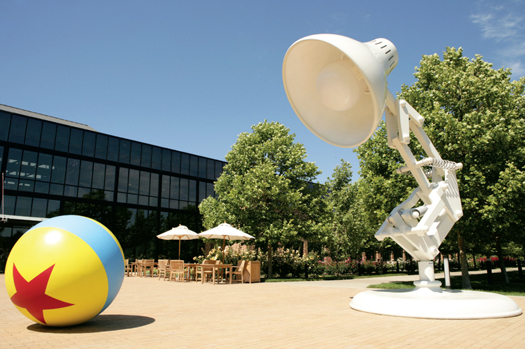
The Luxo Jr. sculpture—Pixar’s logo come to life—outside the main building in Emeryville, California. Copyright © 2008 Pixar. Photo: Deborah Coleman
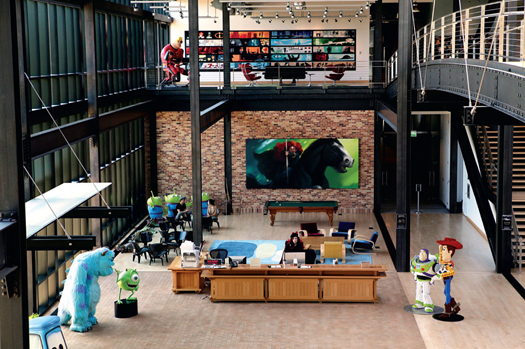
Inside the entryway of Pixar’s headquarters in the spring of 2012, featuring a painting from the movie Brave. Copyright © 2012 Pixar. Photo: Deborah Coleman
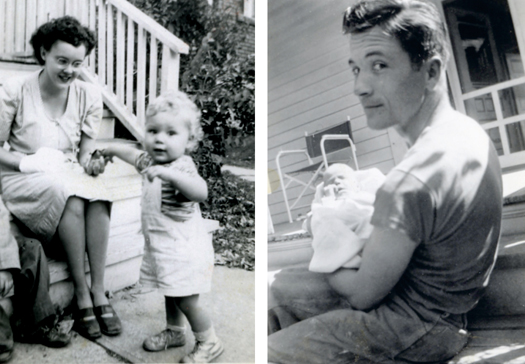
Ed Catmull as a toddler with his mother, Jean, and as an infant with his father, Earl. Ed Catmull Collection
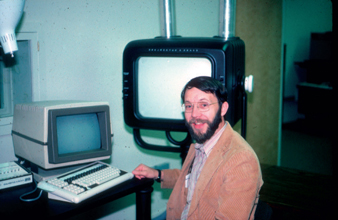
Ed at work in the original Lucasfilm offices, circa 1979. Ed Catmull Collection
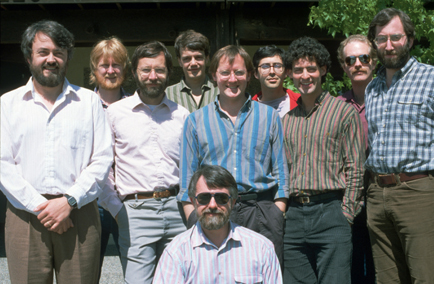
Members of the Lucasfilm Computer Graphics Group, circa 1985. Front: Alvy Ray Smith. Back, left to right: Loren Carpenter, Bill Reeves, Ed Catmull, Rob Cook, John Lasseter, Eben Ostby, David Salesin, Craig Good, and Sam Leffler. Copyright © 1985 Pixar
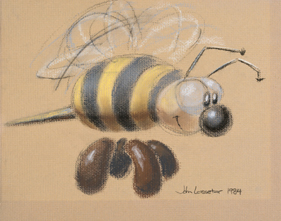
John Lasseter’s design sketch of the character Wally B., from the short film The Adventures of André & Wally B. Copyright © 1984 Pixar

The “wireframe,” or the underlying architecture of the computer model, of the character Wally B. Copyright © Pixar
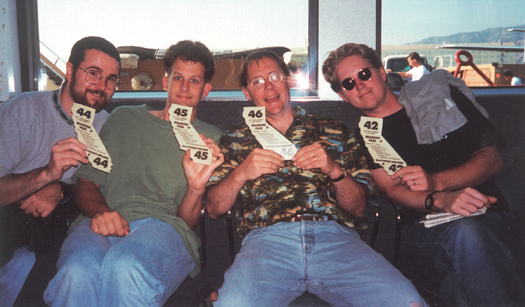
To consult regularly with Disney executives, Joe Ranft, Pete Docter, John Lasseter, and Andrew Stanton logged a lot of Southwest Airlines miles flying between Oakland and Burbank during the making of Toy Story , circa 1994. Copyright © Pixar
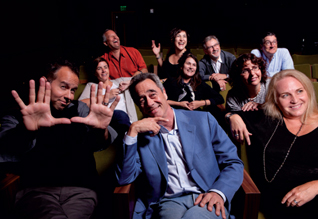
A group of producers in the Presto Theatre on Pixar’s campus, 2011. Front row: Jonas Rivera, Jim Morris, Darla K. Anderson. Middle: Lindsey Collins, Denise Ream, Galyn Susman. Back: Kevin Reher, Katherine Sarafian, John Walker, Tom Porter. Copyright © 2011 Pixar. Photo: Deborah Coleman
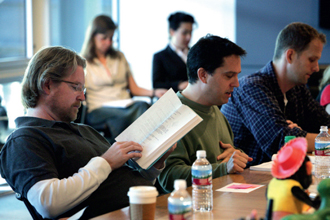
Members of Pixar’s development department and the Braintrust—including Andrew Stanton, Lee Unkrich, and Pete Docter—gather for the first script reading of Toy Story 3. Copyright © 2006 Pixar. Photo: Deborah Coleman
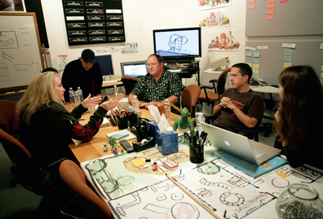
Left to right: Darla K. Anderson, Jason Katz, Dan Scanlon, John Lasseter, Lee Unkrich, and Susan Levin during a Toy Story 3 story review. Copyright © 2007 Pixar. Photo: Deborah Coleman
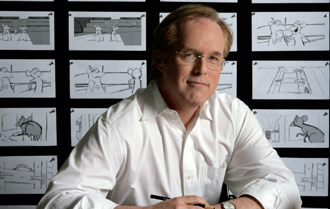
Ratatouille director Brad Bird working on storyboards for the movie. Copyright © 2011 Pixar. Photo: Deborah Coleman
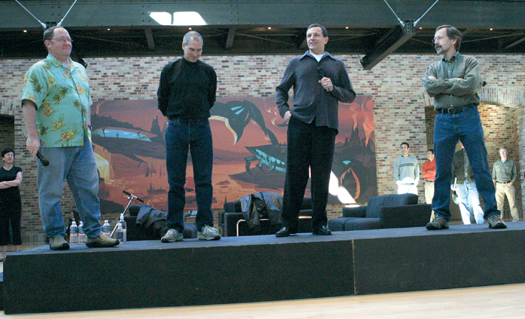
From left: Pixar Executive Vice President of Creative John Lasseter, Pixar CEO Steve Jobs, Disney CEO Bob Iger, and Pixar President Ed Catmull in the Pixar atrium, announcing Disney’s decision to buy Pixar, on January 24, 2006. Copyright © 2006 Pixar. Photo: Deborah Coleman
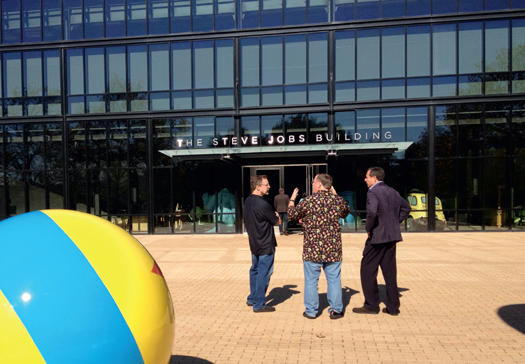
Ed, John Lasseter, and Bob Iger rededicate Pixar’s main building as The Steve Jobs Building on November 5, 2012, a little over a year after Jobs’s death. Photo: Andrew Tupman
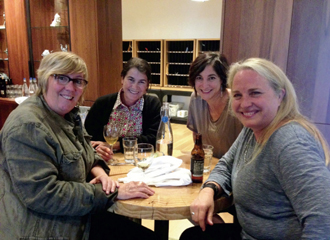
Producers Kori Rae, Denise Ream, Katherine Sarafian, and Darla K. Anderson in the Brooklyn building at Pixar Animation Studios, 2013. Photo: Ed Catmull
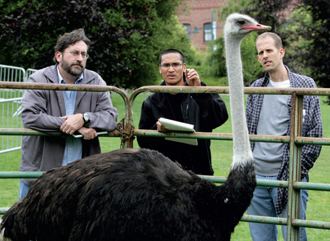
Up co-director Bob Peterson, production designer Ricky Nierva, and director Pete Docter observe ostriches to help them better animate Kevin, the giant bird in Up. Copyright © 2007 Pixar. Photo: Deborah Coleman
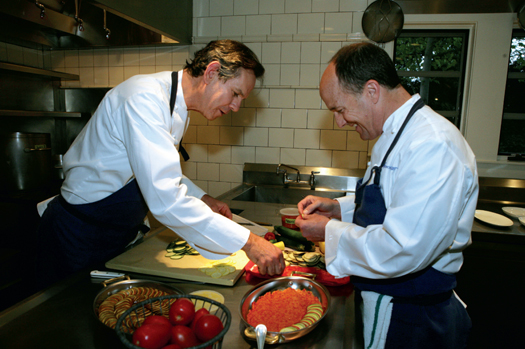
More research: Three-star Michelin-rated chef Thomas Keller (left) shows Ratatouille producer Brad Lewis the art of making ratatouille in the kitchen of his restaurant The French Laundry. Copyright © 2007 Pixar. Photo: Deborah Coleman
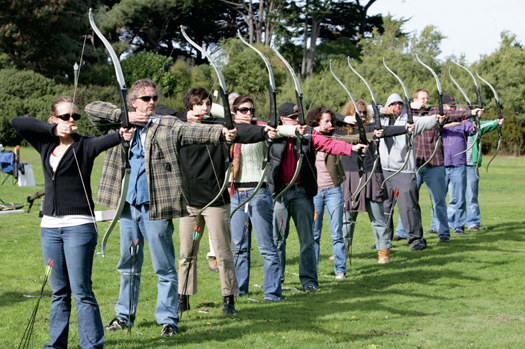
Pixar Animation Studio crew members for the film Brave take an archery class in Golden Gate Park in San Francisco. Copyright © 2006 Pixar. Photo: Deborah Coleman
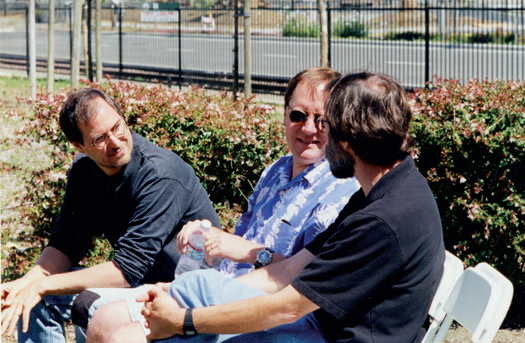
Steve Jobs, John Lasseter, and Ed chat after Pixar University’s graduation ceremony in September 1997. Copyright © 1997 Pixar .
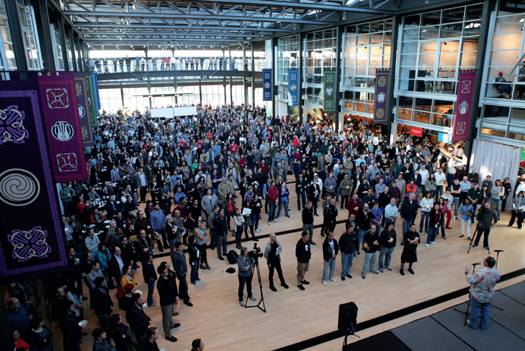
John Lasseter shares his thoughts about the value of honest feedback at the kickoff to Notes Day in the Pixar atrium. Copyright © 2013 Pixar. Photo: Deborah Coleman
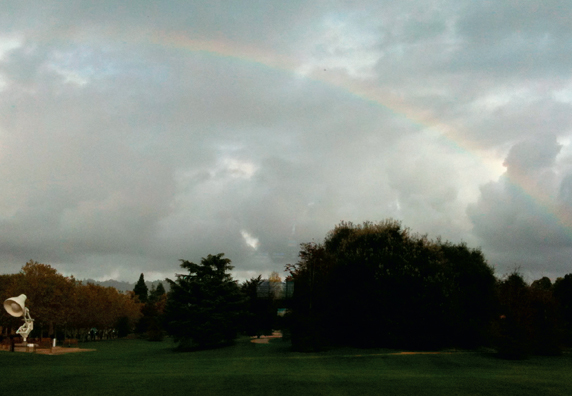
The rainbow that appeared over Pixar headquarters shortly after the announcement of Steve Jobs’s death on October 5, 2011. Photo: Angelique Reisch, taken with an iPhone
For Steve
ACKNOWLEDGMENTS
ED CATMULL
W riting a book like this one, which draws on so many years of learning and experience, would not be possible without the input of countless people. I’m going to call out several of them by name, but in truth this book benefited from the work of all of my colleagues and friends at Pixar and Disney. I am grateful to each and every one of them.
First, I must thank John Lasseter, chief creative officer of Pixar and Disney Animation and my longtime friend. John is open and generous to his core. He contributed many memories and insights. Bob Iger, the chairman and chief executive of the Walt Disney Company, supported this project from the beginning and his feedback made it immeasurably better. Alan Horn and Alan Bergman, the chairman and president, respectively, of Walt Disney Studios, have been wise leaders who have worked with me as we have gone through many changes.
I am lucky to have an incredible team of managers whom I work with every day: at Pixar, general manager Jim Morris and Lori McAdams, vice president of human resources; at Disney Animation, general manager Andrew Millstein and Ann Le Cam, the vice president of both production and human resources. All four are excellent partners who make me smarter.
This book never would have happened without my agent, Christy Fletcher, and my editor at Random House, Andy Ward. Andy has truly shepherded this project from its inception to its completion. He’s a great editor who made every page more readable, more compelling, and simply better. I must also thank Wendy Tanzillo, my assistant of thirteen years, without whose care and attention my life would veer toward chaos.
I’ve had many, many discussions over the years that have helped me wrestle with some of the more difficult concepts in this book. Among those whose willingness to engage aided me immeasurably are Michael Arndt, Brad Bird, and Bob Peterson. I also benefitted from particularly deep conversations with Phillip Moffitt, president of the Life Balance Institute.
I asked many people to read this book as it took shape. I approached that process much as we do screenings of our films, figuring that the more notes I got, from the most varied group of people, the better and clearer the book would become. Given the length of this book, I know this was no small favor I was asking, and yet each of these people gave me their time without hesitation. For that, I thank: Jennifer Aaker, Darla Anderson, Brad Bird, Jeannie Catmull, Lindsey Collins, Pete Docter, Bob Friese, Marc Greenberg, Casey Hawkins, Byron Howard, Michael Jennings, Michael Johnson, Jim Kennedy, John Lasseter, Ann Le Cam, Jason Levy, Lawrence Levy, Emily Loose, Lenny Mendonca, Andrew Millstein, Jim Morris, Donna Newbold, Karen Paik, Tom Porter, Kori Rae, Jonas Rivera, Ali Rowghani, Peter Sims, Andy Smith, Andrew Stanton, Galyn Susman, Bob Sutton, Karen Tenkoff, Lee Unkrich, and Jamie Woolf. Robert Baird, Dan Gerson, and Nathan Greno arrived in my office one day with an enormous white board; they were particularly helpful in structuring the book. Moreover, Christine Freeman, Pixar’s archivist, provided enormous research help, Elyse Klaidman and Cory Knox kept many of the pieces moving when I’d lost track of them, and Oren Jacob helped fill in important gaps.
I should also note that the ideas in this book were developed over a period of forty-five years, and innumerable characters participated in this journey. This is not a history book. While I do provide some chronological narrative to support the concepts I present, I am aware that some people—especially those who do technical work—are underrepresented, largely because describing what they do is complex and less accessible. For the record, then, Bill Reeves, Eben Ostby, and Alvy Ray Smith were essential to what I deem Pixar’s greatest triumph—the integration of art and technology—and this book owes them a debt of gratitude.
Finally, to my wife, Susan, and the seven children circling our lives—Ben, David, Jeannie, Matt, Michael, Miles, and Sean—I thank you for your patience, support, and love. Thanks also go to my ninety-two-year-old father, Earl Catmull, whose memory of my childhood remains clearer than mine, and whose descriptions of my earliest years were invaluable.
AMY WALLACE
T hanks go to my agent, Elyse Cheney, for bringing me this project. To Andy Ward, at Random House, for his all-around brilliance. To my son, Jack Newton, for being his insightful, funny, and inspiring self. To Mary Melton and Jim Nelson, my enormously supportive editors at Los Angeles magazine and GQ , for making it possible for me to take this book on. To everyone at Pixar and Disney Animation who helped nail down key moments, but particularly to Brad Bird, Pete Docter, Christine Freeman, Elyse Klaidman, John Lasseter, Jim Morris, Tom Porter, Andrew Stanton, and Wendy Tanzillo. To the historians and biographers whose books helped me ask better questions: Walter Isaacson (Steve Jobs ), Karen Paik (To Infinity and Beyond! The Story of Pixar Animation Studios ), David A. Price (The Pixar Touch: The Making of a Company ), Michael Rubin (Droidmaker: George Lucas and the Digital Revolution ), and James B. Stewart (Disney War ). To my parents, for teaching me that “If you want to write, read,” and to my dear friends who never stop giving good counsel: Julie Buckner, Karla Clement, Sacha Feinman, Ben Goldhirsh, Carla Hall, Gary Harris, Nancy Hass, Jon Herbst, Claire Hoffman, Beth Hubbard, Justin McLeod, J. R. Moehringer, Bob Roe, Julia St. Pierre, Minna Towbin Pinger, Valerie Van Galder, Brendan Vaughan, and Sherri Wolf. Finally, to Ed Catmull, for giving me a chance and for inviting me inside.
ABOUT THE AUTHORS
ED CATMULL is co-founder of Pixar Animation Studios and president of Pixar Animation and Disney Animation. He has been honored with five Academy Awards, including the Gordon E. Sawyer Award for lifetime achievement in the field of computer graphics. He received his Ph.D. in computer science from the University of Utah. He lives in San Francisco with his wife and children.
AMY WALLACE is a journalist whose work has appeared in GQ , Wired , The New Yorker , and The New York Times Magazine . She currently serves as editor-at-large at Los Angeles magazine. Previously, she worked as a reporter and editor at the Los Angeles Times and wrote a monthly column for The New York Times Sunday Business section.
