
CHAPTER 10
BROADENING OUR VIEW
I n the late 1970s, I took a road trip from New York City to Washington, D.C., with my wife and another couple. We rented one of those giant campers with two rear wheels on each side so that if one wheel blew, the other would still hold the camper up. Navigating this thing was a challenge, to say the least, and was only made more challenging by the fact that the other husband, Dick, had never driven a camper before. Instead of taking the New Jersey Turnpike, which probably would have been the prudent thing to do, we took an alternate route because it didn’t have tolls; we were being cheap. The problem was, this alternate route had a roundabout every few miles—one of those circular intersection substitutes that require vehicles to merge, drive part of the way around, and then exit in their chosen direction. Easy enough in a car. Not so easy in a camper.
As we approached one of these roundabouts, Dick clipped the curb, and I heard a rear tire blow out.
“Dick, you popped a tire!” Dick’s wife, Anne, said.
“No, I didn’t,” he shot back.
As we continued down the road, Dick and Anne engaged in a long, heated argument about the tire and his driving. “You need to be more careful,” Anne scolded, while Dick fumed (“I didn’t pop the tire!”) and defended himself (“These campers are hard to drive!”). It was evident to my wife and me that there was history fueling this exchange, but Dick and Anne’s backstory—whatever it may have been—wasn’t moving them any closer to the obvious and somewhat urgent conclusion that we should pull over and fix our flat. It was as if accumulated tensions about other, unrelated issues had made them blind to reality: We were hurtling along the highway on one less tire than our massive vehicle was designed for. We needed to stop and assess the damage.
After several minutes of listening to their bickering, I felt it necessary to interject and say that, in fact, the tire had blown. Because while Dick and Anne seemed to think they were talking about the tire, they clearly weren’t, and anyone else could see that our safety was not top of mind for either of them. Their mental models, forged by years of interacting with one another, altered their interpretation of straightforward events—we had dinged a curb and popped a tire—and blinded them to the danger we could be in if we didn’t pull over and take care of the problem immediately.
This story—the oversized vehicle, the oblivious couple, the shredded tire, the Honeymooners-l evel sniping that ensued—has an element of dark humor, for sure, but I tell it here because it demonstrates four ideas that inform the way I think about managing. The first, which I discussed in chapter 9 , is that our models of the world so distort what we perceive that they can make it hard to see what is right in front of us. (I’m using model somewhat generally here to mean the preconceptions we have built up over time that we use to evaluate what we see and hear as well as to reason and anticipate.) The second is that we don’t typically see the boundary between new information coming in from the outside and our old, established mental models—we perceive both together, as a unified experience. The third is that when we unknowingly get caught up in our own interpretations, we become inflexible, less able to deal with the problems at hand. And the fourth idea is that people who work or live together—people like Dick and Anne, for example—have, by virtue of proximity and shared history, models of the world that are deeply (sometimes hopelessly) intertwined with one another. If my wife and I had been traveling with just Dick or just Anne, he or she almost certainly would have responded appropriately, but because they were together, their combined model was more complex—and more limiting—than either of their models would have been on its own.
Now, consider this: The tire incident involved the interconnected models of just two people. In business, where dozens if not hundreds of people may work in close proximity, that effect multiplies quickly, and before you know it, these competing and often at-odds models lead to a kind of inertia that makes it difficult to change or respond well to challenges. The intertwining of many views is an unavoidable part of any culture, and unless you are careful, the conflicts that arise can keep groups of people locked into their restrictive viewpoints even if, as is often the case, each member of the group is ordinarily open to better ideas.
As more people are added to any group, there is an inexorable drift toward inflexibility. While we can agree in principle that an organization needs to be flexible in order to solve problems, living up to that principle can be extraordinarily difficult. Rigidity—by which I mean the determination that one’s own view is the correct one—can be hard to recognize at first. And just as individuals have biases and jump to conclusions because of the lens through which they view the world, organizations perceive the world through what they already know how to do.
This third section of the book is devoted to some of the specific methods we have employed at Pixar to prevent our disparate views from hindering our collaboration. In each case, we are trying to force ourselves—individually and as a company—to challenge our preconceptions. In this chapter I discuss several of the mechanisms we use to put our collective heads into a different frame of mind.
1. Dailies, or Solving Problems Together
2. Research Trips
3. The Power of Limits
4. Integrating Technology and Art
5. Short Experiments
6. Learning to See
7. Postmortems
8. Continuing to Learn
1. DAILIES, OR SOLVING PROBLEMS TOGETHER
In the fall of 2011, eight months before the release of Brave , a dozen or so animators ambled into the dailies meeting in the screening room at the far end of Pixar’s atrium and plopped down heavily on oversized couches. It was just after 9 A.M ., and more than a few attendees were sipping cups of coffee in an attempt to look alive. The director Mark Andrews, meanwhile, is not the groggy type. By the time he bounded into the room, he’d already spent an hour outside on the lawn, thrusting and parrying—he’s an avid fencer—with a thirty-eight-inch longsword.
Mark had stepped in to direct Brave midway through production at the request of John and myself, and he was widely seen as an inspiring leader. A proud descendant of Scotland, where Brave is set, Mark urged his crew to join him in wearing a kilt to work every Friday (he likes to say that men in skirts boost morale). Many viewed him as nothing short of a force of nature. “Mark talks to you as if he’s trying to drown out an F5 class tornado behind him—and winning,” is how one animator described him. “I suspect he consumes plutonium pills.” This dailies meeting would do nothing to disprove that suspicion.
“Good morning, everybody! Wake up!” Mark yelled, kicking off an hour-long session during which the assembled animators shared glimpses of the scenes they were bringing to life. Mark watched carefully and gave detailed notes on how to improve each scene and encouraged everyone else in the room—a rigging supervisor, the movie’s producer, its head of story, and the other animators—to do so as well. The goal of this meeting, as with all dailies meetings, was to see the shots, together, as they really were.
Dailies are a key part of Pixar culture, not just because of what they accomplish—constructive midstream feedback—but because of how they accomplish it. Participants have learned to check their egos at the door—they are about to show incomplete work to their director and colleagues. This requires engagement at all levels, and it’s our directors’ job to foster and create a safe place for that. Mark Andrews did this at the Brave meeting by being irrepressible: singing ’80s songs, reveling in people’s nicknames (Wu-dog! Dr. K!), and mocking his own drawing ability as he hurriedly sketched out suggested tweaks. “Is that all the energy you got for me today?” he teased one sleepy colleague. To another, whose work he deemed flawless, he shouted the words all animators yearn to hear: “Final that! Bang!” Whether or not all the animators would get that same go-ahead, everyone could count on this: When each finished his or her presentation, the room would burst into applause.
This wasn’t a pep rally, though. The critiques that were offered were specific and meticulous. Every scene was prosecuted relentlessly, and each animator seemed to welcome the feedback. “Is that stick big enough for everybody?” Mark asked at one point, referring to a flimsy-looking branch that was supposed to keep a heavy door propped open in one scene. Several people didn’t think so, and as Mark scribbled with a stylus on a tablet in front of him, a sturdier log appeared on the screen on the front of the room. “Better?” he asked. One by one, each scene that the group reviewed raised new issues. That old man who just ran up a flight of stairs? He should look more winded. The facial expression of a young spy? It could be more devilish. “Chime in!” Mark urged. “Sound off!”
For all the barking and levity, you could feel the focused concentration in the room. What these people were engaged in was the kind of detailed analysis—and openness to constructive criticism—that would determine whether merely good animation would become great. Mark bore down on ten frames in which Queen Elinor, the mom character who has turned into a bear, walks on stones while traversing a creek. “She looks like she’s stepping more catlike than heavy-bear-like,” he said. “I like the overall speed, but I’m not feeling the weight . She’s walking like a ninja.” Everybody nodded and—note taken—they moved on.
Dailies are master classes in how to see and think more expansively, and their impact can be felt throughout the building. “Some people show their scenes to get critique from others, others come to watch and see what kind of notes are being given—to learn from their peers and from me—my style, what I like and dislike,” Mark told me. “The dailies keep everyone in top form. It’s an intimidating room to be in because the goal is to create the best animation possible. We go through every single frame with a fine-toothed comb, over and over and over again. Sometimes there are full-on debates because, truly, I don’t have all the answers. We work it out together.”
I give this glimpse into a dailies session because sharing and analyzing a team’s ongoing work every morning is, by definition, a group effort—but it does not come naturally. People join us with a set of expectations about what they think is important. They want to please, impress, and show their worth. They really don’t want to embarrass themselves by showing incomplete work or ill-conceived ideas, and they don’t want to say something dumb in front of the director. The first step is to teach them that everyone at Pixar shows incomplete work, and everyone is free to make suggestions. When they realize this, the embarrassment goes away—and when the embarrassment goes away, people become more creative. By making the struggles to solve the problems safe to discuss, then everyone learns from—and inspires—one another. The whole activity becomes socially rewarding and productive. To participate fully each morning requires empathy, clarity, generosity, and the ability to listen. Dailies are designed to promote everyone’s ability to be open to others, in the recognition that individual creativity is magnified by the people around you. The result: We see more clearly.
2. RESEARCH TRIPS
I was once in a conference room at Disney in which two directors were pitching the latest version of a film they were developing. The walls of the room were covered with large corkboards, which were filled with illustrations of what happens in each act, as well as drawings of characters and collages of inspirational artwork. To give a sense of the overall flavor of the film, the directors had posted dozens of images from well-known movies that they felt were in a similar visual and contextual vein: panoramic shots they hoped to mimic, landscapes they found inspiring, character studies that showed costumes like the ones they planned to use. While they had hoped to convey the sense of their movie idea by displaying examples from other films, every single board was based on these iconic references, with the unintended result that everything presented felt terribly derivative. In one way, this made sense—every director gets into this business because they love movies; it is inevitable that references to other movies often pop up when talking about filmmaking. (At Pixar, we joke that only one mention of Star Wars is allowed per meeting.) References to movies, both good and bad, are part of the vocabulary of talking about filmmaking. And yet if you rely too much on the references to what came before, you doom your film to being derivative.
Brad Bird noticed a similar phenomenon when he was studying at the California Institute of the Arts. He remembers a group of students that simply aped the animation of the masters, an approach he dubbed “Frankensteining.” “They’d have a character do the kind of walk that animator Milt Kahl did for Medusa in The Rescuers ,” he says. “And then they’d have her wave her hands like Frank Thomas had Fauna do in Sleeping Beauty . And so on.… ”
When filmmakers, industrial designers, software designers, or people in any other creative profession merely cut up and reassemble what has come before, it gives the illusion of creativity, but it is craft without art. Craft is what we are expected to know; art is the unexpected use of our craft.
Even though copying what’s come before is a guaranteed path to mediocrity, it appears to be a safe choice, and the desire to be safe—to succeed with minimal risk—can infect not just individuals but also entire companies. If we sense that our structures are rigid, inflexible, or bureaucratic, we must bust them open—without destroying ourselves in the process. The question of how to do this must continually be addressed—there is no single answer—because conditions and people are constantly in flux.
Whenever filmmakers make a derivative presentation to John, he will often stop them, urging them to slow down, and look beyond what they think they already know. “You must,” he tells them, “go out and do research.”
It is impossible to overstate how strongly John believes in the power of research. At his urging, when Pixar was prepping a movie about a Parisian rat who aspires to be a gourmet chef, for example, several members of Ratatouille ’s team went to France and spent two weeks dining in extraordinary, Michelin-starred restaurants, visiting their kitchens, and interviewing their chefs. (They also trudged through the Paris sewers, where many a rat makes his home.) When it was decided that Carl Fredrickson’s balloon-propelled house would sail to the mountains of South America in Up , John sent a group of artists to see the tepuis in Venezuela up close; not only that, but an ostrich was brought into Pixar’s headquarters to inspire the animators who were modeling the giant bird character. And when a plotline emerged in Finding Nemo that required Nemo, who believed that all drains lead to the ocean, to escape from a dentist’s office by jumping into a sink, a trip was arranged to the San Francisco sewage treatment plant. (And yes, the filmmakers learned, it is possible for a fish to get from the drain to the sea without being killed.) Many of the crew on Finding Nemo also became scuba-certified.
These experiences are more than field trips or diversions. Because they take place early in the filmmaking process, they fuel the film’s development. Take Monsters University as an example. In December 2009, more than three years before the movie premiered in theaters, a dozen people from Pixar—the director, producer, and writers, as well as several people from the art and story departments—flew east to visit MIT, Harvard, and Princeton. “Monsters University was to be one of the most prestigious campuses for scaring, so we wanted to visit big-name, old-world, prestigious schools,” recalls Nick Berry, the film’s art department manager, who helped arrange that excursion as well as day trips to UC Berkeley and Stanford. They visited dorm rooms, lecture halls, research labs, and frat houses; they hung out on the campus lawns, ate pizza at dives that students frequented, and took a lot of pictures and notes—“documenting everything, right down to the details of how pathways integrated into the quads,” Nick says, “and what the graffiti scratches looked like on the wooden desks.” The finished film was loaded with these kinds of details—what letter jackets look like up close or those “Roommate Wanted” fliers (complete with rip-off tags) that students post on campus bulletin boards—all of which gave audiences a feeling of reality.
Ultimately, what we’re after is authenticity. What feels daunting to the filmmakers when John sends them out on such trips is that they don’t yet know what they are looking for, so they’re not sure what they will gain. But think about it: You’ll never stumble upon the unexpected if you stick only to the familiar. In my experience, when people go out on research trips, they always come back changed.
In any business, it’s important to do your homework, but the point I’m making goes beyond merely getting the facts straight. Research trips challenge our preconceived notions and keep clichés at bay. They fuel inspiration. They are, I believe, what keeps us creating rather than copying.
Here’s a curious thing about research: The authenticity it fosters in the film always comes through, even if moviegoers know nothing about the reality the film is depicting. Very few moviegoers have actually been inside the kitchen of a high-end French restaurant, for example, so you might think the obsessive specificity of Ratatouille ’s kitchen scenes—the chefs’ clogs clacking on the black-and-white tile floors, the way they hold their arms when they cut up vegetables, or how they organize their work spaces—would be lost on the audience. But what we’ve found is that when we are accurate, the audiences can tell. It just feels right.
Does this kind of microdetail matter? I believe it does. There’s something about knowing your subject and your setting inside and out—a confidence—that seeps into every frame of your film. It’s a hidden engine, an unspoken contract with the viewer that says: We are striving to tell you something impactful and true. When attempting to make good on that promise, no detail is too small.
3. THE POWER OF LIMITS
There is a phenomenon that producers at Pixar call “the beautifully shaded penny.” It refers to the fact that artists who work on our films care so much about every detail that they will sometimes spend days or weeks crafting what Katherine Sarafian, a Pixar producer, calls “the equivalent of a penny on a nightstand that you’ll never see.” Katherine, who was the production manager on Monsters, Inc. , remembers one scene that perfectly illustrates the beautifully shaded penny idea. It occurs when a bewildered Boo first arrives in Mike and Sulley’s apartment and begins, as toddlers do, to explore. As the monsters try to contain her, she wanders up to two towering piles of compact discs—more than ninety in all. “Don’t touch those!” Mike screams as she grabs a CD case from the bottom, sending the piles crashing to the floor. “Aw, those were alphabetized ,” Mike complains as she waddles away. The moment is over in three seconds, and during it, only a few of the CD cases are at all visible. But for every one of those CDs, Pixar artists created not just a CD cover but a shader—a program that calculates how an object’s rendering changes as it moves.
“Can you see all the CD cases?” Sarafian says. “No. Was it fun to design them all? Yes. Maybe it was an in-joke, but there was someone on the crew who believed that each one of those was going to be seen close-up, and so they were lovingly crafted.”
I don’t want to think about how many person-weeks this consumed.
Clearly, something in our process had broken—the desire for quality had gone well beyond rationality. But because of the way production unfolded, our people had to work on scenes without knowing the context for them—so they overbuilt them just to be safe. To make things worse, our standards of excellence are extremely high, leading them to conclude that more is always more. How, then, do you fix the “beautifully shaded penny” problem without telling people, in effect, to care less or to be less excellent? I knew that none of these people on Monster’s, Inc . thought that detail was so important that they should waste time to achieve it. And of course they knew that there were limits—they just couldn’t see them. This was a failure on management’s part; the truth is, we have consistently struggled with how we set useful limits and also how we make them visible.
Many of our limits are imposed not by our internal processes but by external realities—finite resources, deadlines, a shifting economy or business climate. Those things, we can’t control. But the limits we impose internally, if deployed correctly, can be a tool to force people to amend the way they are working and, sometimes, to invent another way. The very concept of a limit implies that you can’t do everything you want—so we must think of smarter ways to work. Let’s be honest: Many of us don’t make this kind of adjustment until we are required to. Limits force us to rethink how we are working and push us to new heights of creativity.
Another area where limits are invaluable is what we call “appetite control.” In Pixar’s case, when we are making a movie the demand for resources is literally bottomless. Unless you impose limits, people will always justify spending more time and more money by saying, “We’re just trying to make a better movie.” This occurs not because people are greedy or wasteful but because they care about their particular part of the film and don’t necessarily have a clear view of how it fits into the whole. They believe that investing more is the only way to succeed.
In any creative endeavor, there is a long list of features and effects that you want to include to nudge it toward greatness—a very long list. At some point, though, you realize it is impossible to do everything on the list. So you set a deadline, which then forces a priority-based reordering of the list, followed by the difficult discussion of what, on this list, is absolutely necessary—or if the project is even feasible at all. You don’t want to have this discussion too soon, because at the outset, you don’t know what you are doing. If you wait too long, however, you run out of time or resources.
Complicating matters is that frequently, neither the film’s leaders nor its team members know the true cost of the items on the list. The director may have only the fuzziest sense, for example, of how much extra work a particular tweak to the story will require. Likewise, an artist or technical director may think that the thing they are working on is essential and may pour his or her heart into it while having no sense of its actual value to the film. In my story of the camper and the blown tire, Dick found it difficult to separate the reality of events from what he wanted to be true. In a complex process such as making a film, that difficulty of separating out what you want from what you can achieve is exponentially larger. It is all the more important to have tools that enable us to see more clearly.
Brad Bird likes to tell a story about exactly this conundrum. During the making of The Incredibles , he became distracted by what he calls “mirages”—scenes or ideas he fell in love with but that, ultimately, didn’t serve the film. As an example, for a long time he was obsessed with a vision of some fish in an aquarium that would appear in the background of a scene. He wanted them to move and flicker in a way that evoked flames in a fireplace—he was fixated, in fact, on realizing the vision in his head. But the film’s animators were really struggling to make it look right, and after five months—and thousands of hours of work—Brad suddenly realized it didn’t improve the movie in any real way. A mirage had led him astray.
Luckily, Brad had a producer, John Walker, who came up with a system (in collaboration with a department manager, Laura Reynolds) that would help the crew see what was possible given the available resources. John’s system consisted of popsicle sticks stuck to a wall with Velcro. Each stick represented a person-week, which, as I’ve said, is the amount of work a single animator could accomplish in a week’s time. A bunch of sticks would be lined up next to a particular character for easy reference. A glance at the wall would tell you: If you use that many popsicle sticks on Elastigirl, you’ll have less to spend on Jack-Jack. And so on. “Brad would come to me and say: ‘We’ve got to have this done today,’ ” John recalls. “And I could point to the wall and say, ‘Well, you need another stick, then. Where are you going to take the stick from? Because we only have so many.’ ” I see this as a great example of the positive creative impact of limits.
However, some efforts to impose limits can backfire. When John and I arrived at Disney Animation in 2006, we encountered an interesting conflict. Production of animation is complex and costly, so the previous management thought that the best way to keep everybody operating within agreed-upon limits was to put in an “oversight group” that would, in essence, be the eyes and ears of management. Its sole mandate was to ensure that budget and scheduling goals were met. This group pored over all of the production reports on all of the films to make sure things were going as expected and then communicated what they found to the studio leadership. As a result, those studio bosses felt comfortable they were doing everything they could to avoid costly missteps.
However, from the point of view of those who worked in production on any given film, the oversight group was a hindrance, not a help. They felt they no longer had the flexibility they needed to respond quickly to problems because the oversight group nitpicked every decision—even the tiniest decision—to death. They felt powerless. In this case, the way limits were imposed impeded progress. Not only that, it created political problems: Increasingly, the oversight group was at war with the production group. And, as a result, morale plummeted.
To John and me, the solution was clear: We simply eliminated the oversight group. We believed that the production people were conscientious managers who were trying to bring a complex project in on time and on budget. In our view, the oversight group added nothing to the process but tension. The micromanagement they imposed was of no value, since the production people already had a set of limits that determined their every move—the overall budget and the deadline. Within that, they needed all the flexibility they could get. As soon as we made the change, the war ended and production began running much more smoothly.
The solution we implemented may have been obvious, but here’s something that wasn’t: It could never have come from the people in the oversight group, because that would have required them to recognize and admit that their group’s existence was unnecessary. They were not in a position to challenge the preconception that their group was based on. In addition, the solution could never have been suggested by the leadership we replaced, either, because they believed that the oversight group was performing an important function by creating more transparency and imposing discipline on the process. But here was the irony: Creating this layer to enforce the limits actually made the limits less clear, diminishing their effectiveness.
The oversight group had been put in place without anyone asking a fundamental question: How do we enable our people to solve problems? Instead, they asked: How do we prevent our people from screwing up? That approach never encourages a creative response. My rule of thumb is that any time we impose limits or procedures, we should ask how they will aid in enabling people to respond creatively. If the answer is that they won’t, then the proposals are ill suited to the task at hand.
4. INTEGRATING TECHNOLOGY AND ART
One of the best-loved instructors at CalArts in the 1980s was the legendary animator Bob McCrea, who took up teaching after forty years at Disney, where he worked closely with Walt himself. McCrea was as beloved as he was cantankerous—Andrew Stanton would later immortalize him in the character of Captain B. McCrea in WALL-E —and he helped shape the creative sensibilities of many of the people who would go on to define Pixar. Andrew remembers that he and his fellow CalArts students saw themselves as “animation purists,” determined to emulate masters like Bob from the early days of Disney. They were conflicted, therefore, about using certain newer technologies—VHS videotape, for example—that had not existed in the studio’s heyday. If Walt’s Nine Old Men didn’t use videotape, Andrew remembers telling Bob McCrea one day, maybe he shouldn’t either.
“Don’t be an idiot,” Bob said. “If we’d had those tools then, we would have used them.”
As I noted in chapter 2 , Walt Disney was unrelenting in his determination to incorporate the cutting edge and to understand all available technologies. He brought sound and color into animation. He developed matting for filmmaking, the multiplane camera, the Xerox room for animation cels. One of the advantages we had at Pixar, from the beginning, was that technology, art, and business were integrated into the leadership, with each of the company’s leaders—me, John, and Steve—paying a fair amount of attention to the areas where we weren’t considered expert. We have worked assiduously, ever since, to maintain a balance among all three legs of this stool. Our business model, our way of making films, and our technology continually changed, but by integrating them we let them drive each other. The impetus for innovation, in other words, came from the inside rather than the outside.
As John often says, “Art challenges technology, technology inspires art.” This is not meant to be some clever catchphrase—it articulates our philosophy of integration. When everything is functioning as it should be, art and technology play off each other and spur each other to new heights. Given how different the two mindsets can be, it can be tough to keep them aligned and engaged with each other. But in my view, the effort is always worth it. Our specialized skills and mental models are challenged when we integrate with people who are different. If we can constantly change and improve our models by using technology in the pursuit of art, we keep ourselves fresh. The whole history of Pixar is a testament to this dynamic interplay.
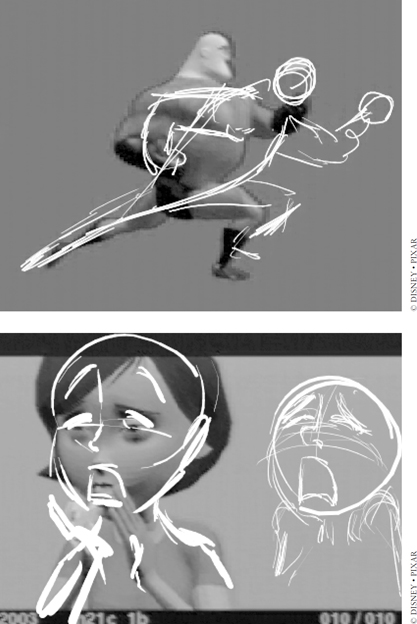
I have a couple of examples that demonstrate this point. While making The Incredibles , Brad Bird was frustrated by the imprecision—and thus the inefficiency—of giving feedback to animators verbally. If you were talking about how to draw a better scene, for example, didn’t it make sense to sketch out your thoughts? Wouldn’t that be more efficient? Brad asked if there was a way that he could draw on top of a projected image—a scene that was in the process of being animated—to communicate to animators the changes he wanted and to do so more effectively. Our software department went to work. The result: the Review Sketch tool, which gives directors a digital stylus to draw directly on top of an image, then saves those sketches and makes them accessible online to anyone who needs to reference them. In the years since its invention, it has become an essential tool, used by all of our directors. (This is what Mark Andrews used in the dailies session I described.)
Another key innovation occurred after a frustrated Pete Docter stopped by my office one day in 2002. What he really needed, he said, was the ability to splice together rough storyboards of a scene, time them out precisely, and then narrate over them in a Braintrust meeting, enabling him to convey the same enthusiasm and passion as he did in his initial live pitch and better approximating the desired end result: a film. I went to one of our software leaders, Michael Johnson, to see if he could put something together for Pete. Two weeks later, Michael came back with a prototype that would later become known as “Pitch Docter,” in homage to Pete.
The basic problem Pitch Docter sought to solve is one I’ve mentioned before—that when a director first pitches a movie, he or she is basically acting it out like a piece of performance art. A pitch is dynamic. The director is able to look the audience in the eye, see how the various elements are playing, and adjust on the fly. This performance, though, is not the film, and when the story is put up on reels and forced to stand on its own, it frequently falls flat. Conventional pitching was good theater, in other words, but it didn’t begin to simulate a movie. Pitch Docter did that.
Pitch Docter let artists seek criticism earlier, which is always better. It allowed those giving feedback to evaluate the material by simulating its presentation in film. Initially we didn’t know if the artists would accept this way of working—they had spent their careers working on paper, and if they were going to adopt this technology, they needed to discover and embrace it on their own. Soon, though, they saw its advantages. Since storyboards are frequently modified, having them on the computer simplified the process; the delivery of new versions to the team was as easy as a push of a button. As more artists adopted the tool, meanwhile, their requests for more features improved the tool itself. The software developers and the artists worked together to move the tools forward, and the model of how the artists did their work changed as the software evolved to meet their needs.
This process was driven both by requests from artists and suggestions from programmers—a back and forth that came about because of the integration of technology and art. Michael’s team, known as the Moving Pictures Group, meanwhile, has become an example of the mindset we value—a mindset that doesn’t fear change. We apply this concept throughout the studio—software people rotate in and out of production. This way of doing things is responsive; it is nimble—and it makes us better.
5. SHORT EXPERIMENTS
In most companies, you have to justify so much of what you do—to prepare for quarterly earnings statements if the company is publicly traded or, if it is not, to build support for your decisions. I believe, however, that you should not be required to justify everything. We must always leave the door open for the unexpected. Scientific research operates in this way—when you embark on an experiment, you don’t know if you will achieve a breakthrough. Chances are, you won’t. But nevertheless, you may stumble on a piece of the puzzle along the way—a glimpse, if you will, into the unknown.
Our short films are Pixar’s way of experimenting, and we produce them in the hopes of getting exactly these kinds of glimpses. Over the years, Pixar has become known for including short films at the beginning of our feature films. These three- to six-minute films, each of which might cost as much as two million dollars to make, certainly don’t yield any profits for the company; in the immediate term, then, they’re hard to justify. What sustains them is a kind of gut feeling that making shorts is a good thing to do.
Our shorts tradition began in the early 1980s, when John Lasseter joined us at Lucasfilm to work on The Adventures of André and Wally B . Our first wave of Pixar shorts—including Luxo Jr., Red’s Dream , and the Oscar-winning Tin Toy —were a way of sharing technological innovations with our colleagues in the scientific community. Then, in 1989, we stopped producing them. For the next seven years, we focused instead on revenue-generating ads and on our first feature film. But in 1996, a year after the release of Toy Story , John and I decided it was important to reinvigorate our short film program. Our hope was that making shorts would encourage experimentation and, more important, become a proving ground for fledgling filmmakers we hoped would go on to direct features someday. We justified the expense as R&D. If technical innovations could be honed on our short films, we figured, that alone would make the program worth the money. In the end, the payoffs would be many—but not necessarily the ones we expected.
Geri’s Game , which was screened in front of A Bug’s Life in 1998, was the first of what we came to call our second-generation shorts. It featured an old man sitting outside in the park in autumn and playing a cutthroat game of chess against himself. During the nearly five-minute film—which was written and directed by Jan Pinkava and would go on to win an Oscar—not a word is spoken other than the occasional “Ha!” that the old man utters when slamming down a chess piece with glee. The humor is located in the way the octogenarian’s personality changes as he switches from one side of the board to the other. When his meeker persona beats his gloating alter ego by (literally) turning the tables, you can’t help but laugh.
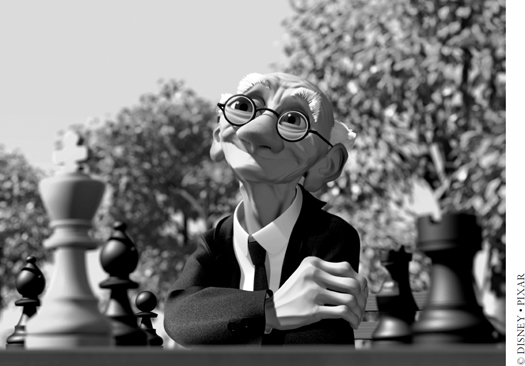
But here was what mattered: In addition to being a delightful film, Geri’s Game helped us improve technically. Our only directive to Jan before he made it was that it had to include a human character. Why? Because we needed to get better at them. We needed to work on rendering not only the smoothly irregular surfaces of faces and hands but also the clothes that people wear. At this point, remember, because of our inability to render skin and hair and certain curved surfaces to our satisfaction, humans had only been ancillary characters in our movies. That needed to change, and Geri’s Game was an opportunity to start working that out.
While we’d used R&D to justify the program initially, we soon realized that our feature films were the major drivers of technological innovation—not our shorts. In fact, in the years since Geri’s Game , not a single short until Blue Umbrella in 2013 had been instrumental in our technological innovation. And while we thought at first that directing a short would be superb preparation for directing a feature—a way to grow talent—we have come to believe we were wrong on this front, too. Directing a short is a terrific education, and some of what you learn will come in handy if you ever direct a feature. But the differences between directing a five-minute short and directing an 85-minute feature are many. Doing the former is merely a baby step on the road to the latter, not the intermediate step we thought it was.
And yet, for all our faulty assumptions, the shorts accomplished other things for Pixar. People who work on them, for example, get a broader range of experience than they would on a feature, where the sheer scale and complexity of the project demands more specialization among the crew. Because shorts are staffed with fewer people, each employee has to do more things, developing a variety of skills that come in handy down the line. Moreover, working in small groups forges deeper relationships that can carry forward and, in the long term, benefit the company’s future projects.
Our shorts also create a deeper value in two key areas. Externally, they help us forge a bond with moviegoers, who have come to regard them as a kind of bonus—something added solely for their enjoyment. Internally, because everyone knows the shorts have no commercial value, the fact that we continue to make them sends a message that we care about artistry at Pixar; it reinforces and affirms our values. And that creates a feeling of goodwill that we draw on, consciously and unconsciously, all the time.
Finally, we have learned that shorts are a relatively inexpensive way to screw up. (And since I believe that mistakes are not just unavoidable but valuable, this is something to be welcomed.) Many years ago, for example, we met with a children’s book author who wanted to direct a feature film for us. We liked his work and sensibility but sensed it would be wise to try him out on a short first to determine not only whether he had filmmaking chops but also if he could work well with others. The first sign of trouble? The film he delivered clocked in at twelve minutes—more of a “medium” than a “short.” But length is flexible; the real problem was that although the director was extraordinarily creative, he was unable to settle on a spine for a story. The piece meandered, lacked focus, and thus packed no emotional punch. It wouldn’t be the first time we would find someone who was able to invent wildly creative elements but was unable to solve the problems of story—the central and most important creative challenge. So we pulled the plug.
Some might have lost sleep over the two million dollars we expended on this experiment. But we consider it money well spent. As Joe Ranft said at the time, “Better to have train wrecks with miniature trains than with real ones.”
6. LEARNING TO SEE
In the year after Toy Story ’s release, we introduced a ten-week program to teach every new hire how to use our proprietary software. We called this program Pixar University, and I hired a first-rate technical trainer to run it. At that point, the moniker university was a little misleading, though, as this was more of a training seminar than anything resembling an institution of higher learning. It is easy to justify a training program, but I had another agenda, and in trying to accomplish it, we would find surprising bonuses.
While some people at Pixar already knew how to draw—and beautifully—the majority of our employees were not artists. But there was an important principle that underlies the process of learning to draw and we wanted everyone to understand it. So I hired Elyse Klaidman, who had taught drawing workshops inspired by the 1979 book Drawing on the Right Side of the Brain by Betty Edwards, to come in and teach us how to heighten our powers of observation. In those days, you’d often hear about the concepts of left- and right-brained thinking, later called L-mode and R-mode. The L-mode was verbal/analytic, R-mode was visual/perceptual. Elyse taught us that while many activities used both L-mode and R-mode, drawing required shutting the L-mode off. This amounted to learning to suppress that part of your brain that jumps to conclusions, seeing an image as only an image and not as an object.
Think about what happens when we try to draw a face. Most of us sketch out the nose, eyes, forehead, ears, and mouth but—unless we’ve learned to draw formally—they’re terribly out of proportion. They don’t resemble anybody in particular. That’s because, to the brain, all parts of the face are not created equal. For example, since the eyes and mouth—the loci of communication—are more important to us than foreheads, more emphasis is put on recognizing them, and when we draw them, we tend to draw them too large, while the forehead is drawn too small. We don’t draw a face as it is; rather, we draw it as our models say it is.
The models of three-dimensional objects that we carry in our heads have to be general; they must represent all variations of the given objects. Our mental model of a shoe, for example, must encompass everything from a stiletto heel to a steel-toed boot; it can’t be so specific that it excludes those extremes. Our brain’s ability to generalize is an essential tool, but some people are able to move from the general to the specific to see more clearly. To stay with our drawing example, some people draw better than others. What are they doing that most of us aren’t? And if the answer is that they are setting aside their preconceptions, can we all learn to do that? In most cases, the answer is yes.
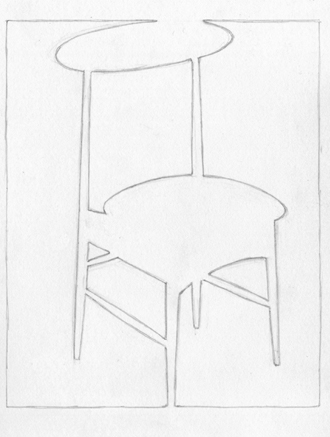
Art teachers use a few different tricks to train new artists. They place an object upside down, for example, so that each student can look at it as a pure shape and not as a familiar, recognizable thing (a shoe, say). The brain does not distort this upside-down object because it doesn’t automatically impose its model of a shoe upon it. Another trick is to ask students to focus on negative spaces—the areas of space around an object that are not the object itself. For instance, in drawing a chair, the new artist might draw it poorly, because she knows what a chair is supposed to look like (and that chair in her head—her mental model—keeps her from reproducing precisely what she sees in front of her). However, if she is asked to draw what is not the chair—the spaces between the chair legs, for example—then the proportions are easier to get right, and the chair itself will look more realistic. The reason is that while the brain recognizes a chair as a chair, it assigns no meaning to the shape of the spaces between the chair’s legs (and, thus, doesn’t try to “correct” it to make it match the artist’s mental model).
The lesson is intended to help students to see shapes as they are—to ignore that part of the brain that wants to turn what is seen into a general notion: a model of the chair. A trained artist who sees a chair, then, is able to capture what the eye perceives (shape, color) before their “recognizer” function tells them what it is supposed to be.
The same thing is true with color. When we look at a body of water, our brains think—and thus see —blue. If we’re asked to paint a picture of a lake, we pick the color blue, and then we’re surprised that it doesn’t look right on the canvas. But if we look at different points in that same lake through a pinhole (thus divorcing it from the overall idea of “lake”), we see what is actually there: green and yellow and black and flashes of white. We don’t let the brain fill in. Instead, we see the color as it really is.
I want to add an important side note: that artists have learned to employ these ways of seeing does not mean they don’t also see what we see. They do. They just see more because they’ve learned how to turn off their minds’ tendency to jump to conclusions. They’ve added some observational skills to their toolboxes. (This is why it is so frustrating that funding for arts programs in schools has been decimated. And those cuts stem from a fundamental misconception that art classes are about learning to draw. In fact, they are about learning to see.)
Whether or not you ever pick up a sketchpad or dream of being an animator, I hope you understand how it is possible, with practice, to teach your brain to observe something clearly without letting your preconceptions kick in. It is a fact of life, though a confounding one, that focusing on something can make it more difficult to see. The goal is to learn to suspend, if only temporarily, the habits and impulses that obscure your vision.
I did not introduce this topic to convince you that anyone can learn to draw. The real point is that you can learn to set aside preconceptions. It isn’t that you don’t have biases, more that there are ways of learning to ignore them while considering a problem. Drawing the “un-chair” can be a sort of metaphor for increasing perceptivity. Just as looking at what is not the chair helps bring it into relief, pulling focus away from a particular problem (and, instead, looking at the environment around it) can lead to better solutions. When we give notes on Pixar movies and isolate a scene, say, that isn’t working, we have learned that fixing that scene usually requires making changes somewhere else in the film, and that is where our attention should go. Our filmmakers have become skilled at not getting caught up in a problem but instead looking elsewhere in the story for solutions. Likewise at Disney, the conflict between production and the oversight group could have been addressed by insisting that everyone behave better, when in fact, the real solution came from questioning the premise on which the oversight group was formed. It was the setup—the preconceptions that preceded the problem—that needed to be faced.
7. POSTMORTEMS
T he phases we go through while making a movie—conception, protection, developmental planning, and production—unfold over a period of years. When the release date finally rolls around, everyone is ready to move on to something new. But we are not done yet. At Pixar, there is one more essential phase of the process: the postmortem. A postmortem is a meeting held shortly after the completion of every movie in which we explore what did and didn’t work and attempt to consolidate lessons learned. Companies, like individuals, do not become exceptional by believing they are exceptional but by understanding the ways in which they aren’t exceptional. Postmortems are one route into that understanding.
Our first postmortem was held in Tiburon, California, in 1998, a few weeks after we’d finished A Bug’s Life . We had made all of two films at that point and were hyperaware of how much we still had to learn. To keep anyone from going on too long (we had a fifteen-minute limit), someone brought in a kitchen timer in the shape of a rooster. Here we were, talking about some of the most high-tech animation ever done, and we were managing the process with an old kitchen utensil.
This postmortem, which took an entire day, delved into all aspects of the production. There was no “Aha!” moment, no epiphany that would turn our processes inside out. Instead, it’s the spirit of the meeting that I remember most. Everyone was so engaged in rethinking the way we did things, so open to challenging longheld ideas and learning from the errors we’d made. No one was defensive. Everyone was proud, not only of the film but of how committed we were to the culture from which the film had sprung. Afterward, we decided we should do this kind of deep analysis after every movie.
Achieving that same level of insight in subsequent postmortems, however, proved elusive. Over the years, some were profound, and others were a complete waste of time. Sometimes people showed up but pulled their punches. I understood that this was human nature—why poke a sleeping bear when you can just as easily move on to another campsite? In truth, to most people postmortems seem a bit like having to swallow some kind of bad-tasting medicine. They know it’s necessary, but they don’t like it one bit. This was another puzzle for us: What was it that made some postmortems so bad, while others had a great outcome?
Given that we all agree, in principle, that postmortems are good for us, I’m always struck by how much people dread them. Most feel that they’ve learned what they could during the execution of the project, so they’d just as soon move on. Problems that arose are frequently personal, so most are eager to avoid revisiting them. Who looks forward to a forum for being second-guessed? People, in general, would rather talk about what went right than what went wrong, using the occasion to give additional kudos to their most deserving team members. Left to our own devices, we avoid unpleasantness.
It isn’t just postmortems, though: In general, people are resistant to self-assessment. Companies are bad at it, too. Looking inward, to them, often boils down to this: “We are successful, so what we are doing must be correct.” Or the converse: “We failed, so what we did was wrong.” This is shallow. Do not be cowed into missing this opportunity. There are five reasons, I believe, to do postmortems. The first two are fairly obvious, the next three less so.
Consolidate What’s Been Learned
While it is true that you learn the most in the midst of a project, the lessons are not generally coherent. Any individual can have a great insight but may not have the time to pass it on. A process might be flawed, but you don’t have time to fix it under the current schedule. Sitting down afterward is a way of consolidating all that you’ve learned—before you forget it. Postmortems are a rare opportunity to do analysis that simply wasn’t possible in the heat of the project.
Teach Others Who Weren’t There
Even if everyone involved in a production understands what it taught them, the postmortem is a great way of passing on the positive and negative lessons to other people who were not on the project. So much of what we do is not obvious—the result of hard-won experience. Then again, some of what we do doesn’t really make sense. The postmortem provides a forum for others to learn or challenge the logic behind certain decisions.
Don’t Let Resentments Fester
Many things that go wrong are caused by misunderstandings or screw-ups. These lead to resentments that, if left unaddressed, can fester for years. But if people are given a forum in which to express their frustrations about the screw-ups in a respectful manner, then they are better able to let them go and move on. I have seen many cases where hurt feelings lingered far after the project, feelings that would have been worked through much more easily if they had been expressed in a postmortem.
Use the Schedule to Force Reflection
I favor principles that lead you to think. Postmortems—but also other activities such as Braintrust meetings and dailies—are all about getting people to think and evaluate. The time we spend getting ready for a postmortem meeting is as valuable as the meeting itself. In other words, the scheduling of a postmortem forces self-reflection. If a postmortem is a chance to struggle openly with our problems, the “pre-postmortem” sets the stage for a successful struggle. I would even say that 90 percent of the value is derived from the preparation leading up to the postmortem.
Pay It Forward
In a postmortem, you can raise questions that should be asked on the next project. A good postmortem arms people with the right questions to ask going forward. We shouldn’t expect to find the right answers, but if we can get people to frame the right questions, then we’ll be ahead of the game.
W hile I think the reasons for postmortems are compelling, I know that most people still resist them. So I want to share some techniques that can help managers get the most out of them. First of all, vary the way you conduct them. By definition, postmortems are supposed to be about lessons learned, so if you repeat the same format, you tend to uncover the same lessons, which isn’t much help to anyone. Even if you come up with a format that works well in one instance, people will know what to expect the next time, and they will game the process. I’ve noticed what might be called a “law of subverting successful approaches,” by which I mean once you’ve hit on something that works, don’t expect it to work again, because attendees will know how to manipulate it the second time around. So try “mid-mortems” or narrow the focus of your postmortem to special topics. At Pixar, we have had groups give courses to others on their approaches. We have occasionally formed task forces to address problems that span several films. Our first task force dramatically altered the way we thought about scheduling. The second one was an utter fiasco. The third one led to a profound change at Pixar, which I’ll discuss in the final chapter.
Next, remain aware that, no matter how much you urge them otherwise, your people will be afraid to be critical in such an overt manner. One technique I’ve used to soften the process is to ask everyone in the room to make two lists: the top five things that they would do again and the top five things that they wouldn’t do again. People find it easier to be candid if they balance the negative with the positive, and a good facilitator can make it easier for that balance to be struck.
Finally, make use of data. Because we’re a creative organization, people tend to assume that much of what we do can’t be measured or analyzed. That’s wrong. Many of our processes involve activities and deliverables that can be quantified. We keep track of the rates at which things happen, how often something has to be reworked, how long something actually took versus how long we estimated it would take, whether a piece of work was completely finished or not when it was sent to another department, and so on. I like data because it is neutral—there are no value judgments, only facts. That allows people to discuss the issues raised by data less emotionally than they might an anecdotal experience.
Lindsey Collins, one of our producers at Pixar, says that data can be nothing less than soothing. “It was such a relief for me, when I began in this job, to be able to look at historical data and see the patterns,” she says. “It took what felt like a very nebulous process and allowed me to break it down and start to put a loose structure on it.”
Having introduced the subject of data, however, I want to be clear about both its power and its limits. The power lies in the analysis of what we know about the production process—we have data, for example, on the time spent building models and sets, animating and lighting them. This data, of course, only gives a narrow glimpse into what happened while the models and sets were being built and lit. But it gives us something to work with to reveal potential patterns, which can be used to feed discussions that help us improve.
There are limits to data, however, and some people rely on it too heavily. Analyzing it correctly is difficult, and it is dangerous to assume that you always know what it means. It is very easy to find false patterns in data. Instead, I prefer to think of data as one way of seeing, one of many tools we can use to look for what’s hidden. If we think data alone provides answers, then we have misapplied the tool. It is important to get this right. Some people swing to the extremes of either having no interest in the data or believing that the facts of measurement alone should drive our management. Either extreme can lead to false conclusions.
“You can’t manage what you can’t measure” is a maxim that is taught and believed by many in both the business and education sectors. But in fact, the phrase is ridiculous—something said by people who are unaware of how much is hidden. A large portion of what we manage can’t be measured, and not realizing this has unintended consequences. The problem comes when people think that data paints a full picture, leading them to ignore what they can’t see. Here’s my approach: Measure what you can, evaluate what you measure, and appreciate that you cannot measure the vast majority of what you do. And at least every once in a while, make time to take a step back and think about what you are doing.
8. CONTINUING TO LEARN
I want to end this list by talking a little more about the founding of Pixar University and Elyse Klaidman’s mind-expanding drawing classes in particular. Those first classes were such a success—of the 120 people who worked at Pixar then, 100 enrolled—that we gradually began expanding P.U.’s curriculum. Sculpting, painting, acting, meditation, belly dancing, live-action filmmaking, computer programming, design and color theory, ballet—over the years, we have offered free classes in all of them. This meant spending not only the time to find the best outside teachers but also the real cost of freeing people up during their workday to take the classes.
So what exactly was Pixar getting out of all of this?
It wasn’t that the class material directly enhanced our employees’ job performance. Instead, there was something about an apprentice lighting technician sitting alongside an experienced animator, who in turn was sitting next to someone who worked in legal or accounting or security—that proved immensely valuable. In the classroom setting, people interacted in a way they didn’t in the workplace. They felt free to be goofy, relaxed, open, vulnerable. Hierarchy did not apply, and as a result, communication thrived. Simply by providing an excuse for us all to toil side by side, humbled by the challenge of sketching a self-portrait or writing computer code or taming a lump of clay, P.U. changed the culture for the better. It taught everyone at Pixar, no matter their title, to respect the work that their colleagues did. And it made us all beginners again. Creativity involves missteps and imperfections. I wanted our people to get comfortable with that idea—that both the organization and its members should be willing, at times, to operate on the edge.
I can understand that the leaders of many companies might wonder whether or not such classes would truly be useful, worth the expense. And I’ll admit that these social interactions I describe were an unexpected benefit. But the purpose of P.U. was never to turn programmers into artists or artists into belly dancers. Instead, it was to send a signal about how important it is for every one of us to keep learning new things. That, too, is a key part of remaining flexible: keeping our brains nimble by pushing ourselves to try things we haven’t tried before. That’s what P.U. lets our people do, and I believe it makes us stronger.
We begin life, as children, being open to the ideas of others because we need to be open to learn. Most of what children encounter, after all, are things they’ve never seen before. The child has no choice but to embrace the new. If this openness is so wonderful, however, why do we lose it as we grow up? Where, along the way, do we turn from the wide-eyed child into the adult who fears surprises and has all the answers and seeks to control all outcomes?
It puts me in mind of a night, many years ago, when I found myself at an art exhibit at my daughter’s elementary school in Marin. As I walked up and down the hallways, looking at the paintings and sketches made by kids in grades K through 5, I noticed that the first- and second-graders’ drawings looked better and fresher than those of the fifth-graders. Somewhere along the line, the fifth-graders had realized that their drawings did not look realistic, and they had become self-conscious and tentative. The result? Their drawings became more stilted and staid, less inventive, because they probably thought that others would recognize this “fault.” The fear of judgment was hindering creativity.
If fear hinders us even in grade school, no wonder it takes such discipline—some people even call it a practice—to turn off that inner critic in adulthood and return to a place of openness. In Korean Zen, the belief that it is good to branch out beyond what we already know is expressed in a phrase that means, literally, “not know mind.” To have a “not know mind” is a goal of creative people. It means you are open to the new, just as children are. Similarly, in Japanese Zen, that idea of not being constrained by what we already know is called “beginner’s mind.” And people practice for years to recapture and keep ahold of it.
When a new company is formed, its founders must have a startup mentality—a beginner’s mind, open to everything because, well, what do they have to lose? (This is often something they later look back upon wistfully.) But when that company becomes successful, its leaders often cast off that startup mentality because, they tell themselves, they have figured out what to do. They don’t want to be beginners anymore. That may be human nature, but I believe it is a part of our nature that should be resisted. By resisting the beginner’s mind, you make yourself more prone to repeat yourself than to create something new. The attempt to avoid failure, in other words, makes failure more likely.
Paying attention to the present moment without letting your thoughts and ideas about the past and the future get in the way is essential. Why? Because it makes room for the views of others. It allows us to begin to trust them—and, more important, to hear them. It makes us willing to experiment, and it makes it safe to try something that may fail. It encourages us to work on our awareness, trying to set up our own feedback loop in which paying attention improves our ability to pay attention. It requires us to understand that to advance creatively, we must let go of something. As the composer Philip Glass once said, “The real issue is not how do you find your voice, but … getting rid of the damn thing.”
CHAPTER 11
THE UNMADE FUTURE
M any of us have a romantic idea about how creativity happens: A lone visionary conceives of a film or a product in a flash of insight. Then that visionary leads a team of people through hardship to finally deliver on that great promise. The truth is, this isn’t my experience at all. I’ve known many people I consider to be creative geniuses, and not just at Pixar and Disney, yet I can’t remember a single one who could articulate exactly what this vision was that they were striving for when they started.
In my experience, creative people discover and realize their visions over time and through dedicated, protracted struggle. In that way, creativity is more like a marathon than a sprint. You have to pace yourself. I’m often asked to predict what the future of computer animation will look like, and I try my best to come up with a thoughtful answer. But the fact is, just as our directors lack a clear picture of what their embryonic movies will grow up to be, I can’t envision how our technical future will unfold because it doesn’t exist yet . As we forge ahead, while we imagine what might be, we must rely on our guiding principles, our intentions, and our goals—not on being able to see and react to what’s coming before it happens. My old friend from the University of Utah, Alan Kay—Apple’s chief scientist and the man who introduced me to Steve Jobs—expressed it well when he said, “The best way to predict the future is to invent it.”
This sounds like the kind of slogan you’d see on a bumper sticker, but it contains hidden depths. Invention, after all, is an active process that results from decisions we make; to change the world, we must bring new things into being. But how do we go about creating the unmade future? I believe that all we can do is foster the optimal conditions in which it—whatever “it” is—can emerge and flourish. This is where real confidence comes in. Not the confidence that we know exactly what to do at all times but the confidence that, together, we will figure it out.
That uncertainty can make us uncomfortable. We humans like to know where we are headed, but creativity demands that we travel paths that lead to who-knows-where. That requires us to step up to the boundary of what we know and what we don’t know. While we all have the potential to be creative, some people hang back, while others forge ahead. What are the tools they use that lead them toward the new? Those with superior talent and the ability to marshal the energies of others have learned from experience that there is a sweet spot between the known and the unknown where originality happens; the key is to be able to linger there without panicking. And that, according to the people who make films at Pixar and Disney Animation, means developing a mental model that sustains you. It might sound silly or woo-woo, this kind of visualization, but I believe it’s crucial. Sometimes—especially at the beginning of a daunting project—our mental models are all we’ve got.
For example, one of our producers, John Walker, stays calm by imagining his very taxing job as holding a giant upside-down pyramid in his palm by its pointy tip. “I’m always looking up, trying to balance it,” he says. “Are there too many people on this side or that side? In my job, I do two things, fundamentally: artist management and cost control. Both depend on hundreds of interactions that are happening above me, up in the fat end of the pyramid. And I have to be okay with the fact that I don’t understand a freaking thing that’s going on half the time—and that that is the magic. The trick, always, is keeping the pyramid in balance.”
So far in this section of the book, I’ve explored some of the mechanisms we use at Pixar to build and protect our creative culture. I’ve talked about specific techniques and traditions that broaden our viewpoints—from research trips to Pixar University to the Braintrust. I’ve talked somewhat abstractly about the importance of remaining open, not occasionally but all the time, as a route to self-awareness. Now I want to share some concrete examples of the kinds of mental models I believe are essential to fortify and sustain anyone engaged in the hard work of inventing something new. Let’s now examine several of the approaches that my colleagues and I use to keep our doubts at bay as we push toward originality—toward that unmade future.
W hen Brad Bird was directing The Incredibles , he had a recurring anxiety dream. In this dream, he was driving down a winding and precarious stretch of highway in a rickety old station wagon, with no one else in the car. Apparently, it was up to him to pilot the vehicle. “But I was in the backseat!” he says. “For some reason, I still had a steering wheel, but my visibility was terrible because of where I was sitting. Basically, all I could do is say to myself, ‘Don’t crash! Don’t crash! Don’t crash!’ ” The takeaway, as he puts it: “Sometimes, as a director, you’re driving. And other times, you’re letting the car drive.”
Whenever I hear Brad describe this dream, I’m struck by its familiar themes—blindness, fear of the unknown, helplessness, lack of control. These fears came to him in sleep, but during his waking hours, he sought to master them by rejecting the backseat driver analogy in favor of a different mental model: skiing.
Brad has told me that he thinks of directing the way he thinks about skiing. In either pursuit, he says, if he tightens up or thinks too much, he crashes. There are moments, as a director, where there is so much work to do and so little time to do it that he can’t help but feel fear. But he also knows that if he lingers too long in that frightened place, he will freak out. “So I tell myself that I have time, even when I don’t. As in, ‘Okay, I’m going to proceed as if I have time—I’m going to sit back and muse rather than looking at the clock—because if I sit back and muse, I’m more likely to solve the problem.’ ” This is where directing is a lot like skiing. “I like to go fast,” Brad says, before launching into a story about a trip he took to Vail when, “in the course of a week, I cracked the lens of my goggles four times. Four times I had to go to the ski store and say, ‘I need a new piece of plastic,’ because I had shattered it crashing into something. And at some point, I realized that I was crashing because I was trying so hard not to crash. So I relaxed and told myself, ‘It’s going to be scary when I make the turns really fast, but I’m going to push that mountain away and enjoy it.’ When I adopted this positive attitude, I stopped crashing. In some ways, it’s probably like an Olympic athlete who’s spent years training for one moment when they can’t make a mistake. If they start thinking too much about that, they’ll be unable to do what they know how to do.”
Athletes and musicians often refer to being in “the zone”—that mystical place where their inner critic is silenced and they completely inhabit the moment, where the thinking is clear and the motions are precise. Often, mental models help get them there. Just as George Lucas liked to imagine his company as a wagon train headed west—its passengers full of purpose, part of a team, unwavering in their pursuit of their destination—the coping mechanisms used by Pixar and Disney Animation’s directors, producers, and writers draw heavily on visualization. By imagining their problems as familiar pictures, they are able to keep their wits about them when the pressures of not knowing shake their confidence.
Byron Howard, one of our directors at Disney, told me that when he was learning to play the guitar, a teacher taught him the phrase, “If you think, you stink.” The idea resonated with him—and it informs his work as a director to this day. “The goal is to get so comfortable and relaxed with your instrument, or process, that you can just get Zen with it and let the music flow without thinking,” he told me. “I notice the same thing when I storyboard. I do my best work when I’m zipping through the scene, not overthinking, not worrying if every drawing is perfect, but just flowing with and connecting to the scene—sort of doing it by the seat of my pants.”
I’m particularly struck by Byron’s focus on speed—on “zipping through” complex problems of logic and storytelling—because it reminds me of what Andrew Stanton says about being a director. I’ve told you about Andrew’s belief that we will all be happier and more productive if we hurry up and fail. For him, moving quickly is a plus because it prevents him from getting stuck worrying about whether his chosen course of action is the wrong one. Instead, he favors being decisive, then forgiving yourself if your initial decision proves misguided. Andrew likens the director’s job to that of a ship captain, out in the middle of the ocean, with a crew that’s depending on him to make land. The director’s job is to say, “Land is that way.” Maybe land actually is that way and maybe it isn’t, but Andrew says that if you don’t have somebody choosing a course—pointing their finger toward that spot there , on the horizon—then the ship goes nowhere. It’s not a tragedy if the leader changes her mind later and says, “Okay, it’s actually not that way, it’s this way. I was wrong.” As long as you commit to a destination and drive toward it with all your might, people will accept when you correct course.
“People want decisiveness, but they also want honesty about when you’ve effed up,” as Andrew says. “It’s a huge lesson: Include people in your problems, not just your solutions.”
This is key to an idea I introduced earlier in the book: The director, or leader, can never lose the confidence of his or her crew. As long as you have been candid and had good reasons for making your (now-flawed-in-retrospect) decisions, your crew will keep rowing. But if you find that the ship is just spinning around—and if you assert that such meaningless activity is, in fact, forward motion—then the crew will balk. They know better than anyone when they are working hard but not going anywhere. People want their leaders to be confident. Andrew doesn’t advise being confident merely for confident’s sake. He believes that leadership is about making your best guess and hurrying up about it so if it’s wrong, there’s still time to change course.
There’s something else, too. If you’re going to undertake a creative project that requires working closely with other people, you must accept that collaboration brings complications. Other people have so much to recommend them: They will help you see outside yourself; they will rally when you are flagging; they will offer ideas that push you to be better. But they will also require constant interaction and communication. Other people are your allies, in other words, but that alliance takes sustained effort to build. And you should be prepared for that, not irritated by it. As Andrew says, continuing his nautical metaphor, “If you’re sailing across the ocean and your goal is to avoid weather and waves, then why the hell are you sailing?” he says. “You have to embrace that sailing means that you can’t control the elements and that there will be good days and bad days and that, whatever comes, you will deal with it because your goal is to eventually get to the other side. You will not be able to control exactly how you get across. That’s the game you’ve decided to be in. If your goal is to make it easier and simpler, then don’t get in the boat.”
Andrew’s mental model addresses the fear that inevitably comes when your boat is tossed by a storm or stalls for lack of wind. If one looks at creativity as a resource that we continually draw upon to make something from nothing, then our fear stems from the need to make the nonexistent come into being. As we’ve discussed, people often try to overcome this fear by simply repeating what has worked in the past. That leads nowhere—or, more accurately, it leads in the opposite direction of originality. The trick is to use our skills and knowledge not to duplicate but to invent.
In talking to directors and writers, I’m constantly inspired by the models they keep in their heads—each a unique mechanism they use to keep moving forward, through adversity, in pursuit of their goals. Pete Docter compares directing to running through a long tunnel having no idea how long it will last but trusting that he will eventually come out, intact, at the other end. “There’s a really scary point in the middle where it’s just dark,” he says. “There’s no light from where you came in and there’s no light at the other end; all you can do is keep going. And then you start to see a little light and then a little more light and then, suddenly, you’re out in the bright sun.” For Pete, this metaphor is a way of making that moment—the one in which you can’t see your own hand in front of your face and you aren’t sure you’ll ever find your way out—a bit less frightening. Because your rational mind knows that tunnels have two ends, your emotional mind can be kept in check when pitch blackness descends in the confusing middle. Instead of collapsing into a nervous mess, the director who has a clear internal model of what creativity is—and the discomfort it requires—finds it easier to trust that light will shine again. The key is to never stop moving forward.
Rich Moore, who directed Wreck-It Ralph for Disney Animation, envisions a slightly different scenario. He imagines himself in a maze while he’s making a movie. Instead of running through willy-nilly, frantically searching for his way out, he places the tips of his fingers along one wall as he moves forward, slowing down here and there to assess and using his sense of touch to help him remember the route he’s traveled so far. But he keeps moving so as not to panic. “I loved mazes as a kid,” Rich says. “But you have to keep your head to find your way out. When I see a movie go south, I think to myself, ‘Well, they went nuts in the maze. They freaked out in there, and it fell apart.’ ”
Bob Peterson, who has helped solve creative problems on almost every Pixar film, credits Andrew with giving him a model that has been invaluable to his career. On A Bug’s Life , Bob says, Andrew compared making a movie to an archeological dig. This adds yet another element to the picture—the idea that as you progress, your project is revealing itself to you. “You’re digging away, and you don’t know what dinosaur you’re digging for,” Bob says. “Then, you reveal a little bit of it. And you may be digging in two different places at once and you think what you have is one thing, but as you go farther and farther, blindly digging, it starts revealing itself. Once you start getting a glimpse of it, you know how better to dig.”
Bob and Andrew have heard me voice my objection to this particular metaphor many times. As I’ve said, I believe that when we work on a movie, we are not uncovering an existing thing that had the bad luck to get buried under eons of sediment; we are creating something new. But they argue that the idea the movie is in there somewhere—think of David, trapped in Michelangelo’s block of marble—helps them stay on track and not lose hope. So while I started this chapter by insisting that what moviegoers see on the screen does not emerge fully formed from some visionary’s brain, I have to allow for this idea: Having faith that the elements of a movie are all there for us to find often sustains us during the search.
If this model resonates with you, just recognize that it has its pitfalls. Even Andrew warns that during your excavation, not every bone you unearth will necessarily belong to the skeleton you are trying to assemble. (There may be the bones of several different dinosaurs—or stories—mixed up in your dig site.) The temptation to use everything you find, even if it doesn’t fit, is strong. After all, you probably worked hard to dig each element up. But if you are discerning and rigorous in your analysis of each piece—if you compare it to the bits you’ve found already to see if it’s a match—your movie or project will reveal itself to you. “After a while, it starts to tell me what’s there,” Andrew says. “That’s the place you’re looking for: when the movie starts to tell you what it wants to be.”
M ichael Arndt, who wrote Toy Story 3 , and I have had an ongoing dialectic about the way he envisions his job. He compares writing a screenplay to climbing a mountain blindfolded. “The first trick,” he likes to say, “is to find the mountain.” In other words, you must feel your way, letting the mountain reveal itself to you. And notably, he says, climbing a mountain doesn’t necessarily mean ascending. Sometimes you hike up for a while, feeling good, only to be forced back down into a crevasse before clawing your way out again. And there is no way of knowing where the crevasses will be.
I like a lot about this metaphor—except for its implication that the mountain exists. Like Andrew’s archeological dig, it suggests that the artist must simply “find” the piece of art, or the idea, that is hidden from sight. It seems to me to contradict one of my central beliefs: that the future is unmade, and we must create it. If writing a screenplay is like climbing a mountain blindfolded, that implies that the goal is to see an existing mountain—while I believe it should be the goal of creative people to build their own mountain from scratch.
But as I’ve talked to my colleagues who perform a variety of different jobs, I’ve come to respect that the most important thing about a mental model is that it enables whoever relies on it to get their job—whatever it is—done. The uncreated is a vast, empty space. This emptiness is so scary that most hold on to what they know, making minor adjustments to what they understand, unable to move on to something unknown. To enter that place of fear, and to fill that empty space, we need all the help we can get. Michael is a screenwriter, which means he starts with a blank page. That requires charting the path from nothing to something, and imagining himself as a blindfolded mountain climber serves him, he says, because it girds him for the inevitable ups and downs of his job.
I’ve now described several models, and the thing I believe they have in common is the search for an unseen destination—for land across the ocean (Andrew), for light at the end of the tunnel (Pete), for a way out of the maze (Rich), for the mountain itself (Michael). This makes sense for creative leaders who must guide so many people through the beats of a story or the production of a film. At the beginning, the director’s or writer’s destination is unclear, but he or she must forge ahead anyway.
Producers, however, have a different, more logistical job. If directors must summon their creative vision, and writers must impose structure and make a story sing, producers are there to keep things real. Their job is to make sure a project stays on track and on budget, so it makes perfect sense that their mental models differ markedly from those of their colleagues. Remember John Walker’s upside-down pyramid? His mental model focuses not on climbing a hill or reaching a destination but on balancing a multitude of competing demands. Other producers have their own ways of imagining their jobs, but to a one, they have this in common: Managing a multiplicity of forces, not to mention hundreds of people with minds of their own, requires balance.
Lindsey Collins, a producer who has worked with Andrew on several films, imagines herself as a chameleon who can change her colors depending on which constituency she’s dealing with. The goal is not to be fake or curry favor but to be whatever person is needed in the moment. “In my job, sometimes I’m a leader, sometimes I’m a follower; sometimes I run the room and sometimes I say nothing and let the room run itself,” she says. Adapting to your environment, like a lizard that blends into whatever background it finds itself in, is Lindsey’s way of managing the competing—and potentially crazy-making—forces she encounters in her job. “I’m a firm believer in the chaotic nature of the creative process needing to be chaotic. If we put too much structure on it, we will kill it. So there’s a fine balance between providing some structure and safety—financial and emotional—but also letting it get messy and stay messy for a while. To do that, you need to assess each situation to see what’s called for. And then you need to become what’s called for.”
How does one make such an assessment? Lindsey jokes that she employs “the Columbo effect”—a reference to Peter Falk’s iconic TV detective, who appeared to bumble his way through a case, even as he inevitably zeroed in on the culprit. When mediating between two groups who aren’t communicating well, for example, Lindsey feigns confusion. “You say, ‘You know, maybe it’s just me, but I don’t understand. I’m sorry I’m slowing you down here with all my silly questions, but could you just explain to me one more time what that means? Just break it down for me like I’m a two-year-old.’ ”
Good producers—and good managers—don’t dictate from on high. They reach out, they listen, they wrangle, coax, and cajole. And their mental models of their jobs reflect that. Katherine Sarafian, another Pixar producer, credits the clinical psychologist Taibi Kahler with giving her a helpful way of visualizing her role. “One of Kahler’s big teachings is about meeting people where they are,” Katherine says, referring to what Kahler calls the Process Communication Model, which compares being a manager to taking the elevator from floor to floor in a big building. “It makes sense to look at every personality as a condominium,” Katherine says. “People live on different floors and enjoy different views.” Those on the upper floors may sit out on their balconies; those on the ground floor may lounge on their patios. Regardless, to communicate effectively with them all, you must meet them where they live. “The most talented members of Pixar’s workforce—whether they’re directors, producers, production staff, artists, whatever—are able to take the elevator to whatever floor and meet each person based on what they need in the moment and how they like to communicate. One person may need to spew and vent for twenty minutes about why something doesn’t look right before we can move in and focus on the details. Another person may be all about, ‘I can’t make these deadlines unless you give me this particular thing that I need.’ I always think of my job as moving between floors, up and down, all day long.”
When she’s not imagining herself in an elevator, Katherine pretends she’s a shepherd guiding a flock of sheep. Like Lindsey, she spends some time assessing the situation, figuring out the best way to guide her flock. “I’m going to lose a few sheep over the hill, and I have to go collect them,” she says. “I’m going to have to run to the front at times, and I’m going to have to stay back at times. And somewhere in the middle of the flock, there is going to be a bunch of stuff going on that I can’t even see. And while I’m looking for the sheep that are lost, something else is going to happen that I’m not aiming my attention at. Also, I’m not entirely sure where we’re going. Over the hill? Back to the barn? Eventually, I know we will get there, but it can be very, very slow. You know, a car crosses the road, and the sheep are all in the way. I’m looking at my watch going, ‘Oh, my God, sheep, move already!’ But the sheep are going to move how they move, and we can try to control them as best we can, but what we really want to do is pay attention to the general direction they’re heading and try to steer a little bit.”
Notice how each of these models contains so many of the themes we’ve talked about so far: the need to keep fear in its place, the need for balance, the need to make decisions (but also to admit fallibility), and the need to feel that progress is being made. What’s important, I think, as you construct the mental model that works best for you, is to be thoughtful about the problems it is helping you to solve.
I’ve always been intrigued, for example, by the way that many people use the analogy of a train to describe their companies. Massive and powerful, the train moves inexorably down the track, over mountains and across vast plains, through the densest fog and darkest night. When things go wrong, we talk of getting “derailed” and of experiencing a “train wreck.” And I’ve heard people refer to Pixar’s production group as a finely tuned locomotive that they would love the chance to drive. What interests me is the number of people who believe that they have the ability to drive the train and who think that this is the power position—that driving the train is the way to shape their companies’ futures. The truth is, it’s not. Driving the train doesn’t set its course. The real job is laying the track.
I am constantly rethinking my own models for how to deal with uncertainty and change and how to enable people. At Lucasfilm, I had the image of riding bareback on a herd of wild horses, some of them faster than others, trying to keep steady. Other times, I’ve imagined my feet on either side of one of those balance boards that moves atop a cylindrical roller. No matter what image I come up with, questions remain: How do we keep from veering too far to one side or another? How do we follow our carefully laid plans yet remain open to ideas that are not our own? Over time, with new experiences, my model has continued to evolve—and is still evolving, even as I write this book.
One model that has been extremely helpful to me I found completely by accident. It came from the study of mindfulness, which has attracted a lot of attention in recent years, both in academia and in business. Those who write about it focus on how it helps people reduce stress in their lives and direct their attention. But for me, it has also helped clarify my thinking about how groups of creative people work best together.
Several summers ago my wife, Susan, gave me a gift that led to this insight. Sensing that I needed a break, she arranged for me to attend a silent meditation retreat at the Shambhala Mountain Center in Red Feather Lakes, Colorado. The week-long immersion was open to beginners, but of the seventy people there, I was the only one who’d never meditated. For me, the thought of spending several days in silence seemed unimaginable, even weird. I was intrigued and sort of bumbling along, when two days into it, we went into full silence. I wasn’t sure what to do. The voice in my head chattered continuously, and I wasn’t sure how to process it. On the third day, with my mind abuzz from all the nonspeaking I was doing, I almost bailed out.
Most people have heard of the Eastern teaching that it is important to exist in the moment. It can be hard to train yourself to observe what is right now (and not to bog down in thoughts of what was and what will be), but the philosophical teaching that underlies that idea—the reason that staying in the moment is so vital—is equally important: Everything is changing. All the time. And you can’t stop it. And your attempts to stop it actually put you in a bad place. It causes pain, but we don’t seem to learn from it. Worse than that, resisting change robs you of your beginner’s mind—your openness to the new.
At the Shambhala Mountain Center that summer, I didn’t bail. Even though the terminology was alien to me, it resonated with many of the issues I spent so much time thinking about at Pixar: control, change, randomness, trust, consequences. The search for a clear mind is one of the fundamental goals of creative people, but the route each one of us travels to get there is unmarked. For me, a man who has always valued introspection, silence was a path I hadn’t tried before. I’ve gone on a silent retreat every year since, and in addition to benefiting personally, I have done a lot of thinking about the management implications of mindfulness.
If you are mindful, you are able to focus on the problem at hand without getting caught up in plans or processes. Mindfulness helps us accept the fleeting and subjective nature of our thoughts, to make peace with what we cannot control. Most important, it allows us to remain open to new ideas and to deal with our problems squarely. Some people make the mistake of thinking that they are being mindful because they are focusing diligently on problems. But if they are doing so while subconsciously bound up with their worries and expectations, with no awareness that they can’t see clearly or that others may know more, they aren’t open at all.
Similarly, within organizations groups often hold so tightly to plans and past practices that they are not open to seeing what is changing in front of them.
My thinking about this was enriched further when I happened upon a podcast of a talk given in 2011 at an annual event called the Buddhist Geeks Conference. There, a woman named Kelly McGonigal delivered a talk called “What Science Can Teach Us About Practice.” McGonigal, who teaches at Stanford University, discussed how recent studies of the brain’s inner workings proved that the practice of meditation can lessen human suffering—not just the existential angst kind of suffering, which is bad enough, but actual physical pain.
First, she talked about a study done at the University of Montreal in 2010, in which two groups—one made up of experienced Zen meditators, the other of non-meditators—were given the exact same type of pain experience: a thermal heat source strapped to one calf. They were hooked up to monitors that tracked which areas of the brain were stimulated. What researchers later discovered by looking at the brain imaging was that even though the experienced meditators weren’t actively meditating in the course of the experiment, their threshold for pain was much higher than the non-meditators’. The meditators’ brains were paying attention to the pain, McGonigal explained, but because they knew how to turn off the inner chatter—the running commentary our untrained brains, or monkey minds, so happily serve up—they were better able to tolerate pain than those who did not practice meditation.
Next, McGonigal cited a similar study done at Wake Forest University that focused on a group of brand new meditators who’d undergone only four days of training. When they were brought into the laboratory and given the same pain test, some were able to tolerate greater levels of pain than others. Why? The temptation might be to surmise that these people were simply quick studies in the art of meditation, that they were better at it than others. Brain imagery showed, however, that in fact their minds were doing the opposite of what experienced meditators’ brains do. Instead of paying attention to the moment they were in, McGonigal said, “they were inhibiting sensory information—somehow shifting their attention to ignore what was happening in the present moment. And that was giving rise to less suffering: inhibiting awareness rather than carefully attending to it.”
I found this fascinating—and analogous to behavior I’d witnessed as a manager. McGonigal was talking about the brain’s tendency to suppress problems instead of facing them head-on. What makes this even more difficult is that the people who were suppressing thought that they were doing the same thing as the people who were addressing the problem. It is sobering to think that in trying to be mindful, some of us accidentally end up being exactly the opposite. We deflect and ignore. And for a while, at least, this behavior can even yield good results. But in the experiments McGonigal cited, people who’d made a practice of becoming mindful didn’t ignore the problem at hand—in this case, the painful heat source strapped to their legs. They saw and felt it for what it was but quieted their reaction to it—the brain’s natural tendency to amplify by overthinking—and thus coped much better.
This model of paying attention to what is in front of you, not hanging on too tightly to the past or the future, has proved immensely useful to me as I have tried to sort out organizational issues and to dissuade my colleagues from clinging to processes or plans that have outlived their usefulness. Likewise, the notion of acknowledging problems (rather than putting in place rules that seek to suppress them) has meaning to me.
Ultimately, it doesn’t matter if your model is different than mine. Upside-down pyramid or invisible mountain, stampeding horses or meandering sheep, what’s essential is that each of us struggles to build a framework to help us be open to making something new. The models in our heads embolden us as we whistle through the dark. Not only that, they enable us to do the exhilarating and difficult work of navigating the unknown.
PART IV

TESTING WHAT WE KNOW
CHAPTER 12
A NEW CHALLENGE
“ I ’m thinking about selling Pixar to Disney,” Steve said. To say that John and I were surprised doesn’t really begin to capture it.
“You’re what?” we responded in unison.
It was October 2005, and we’d just arrived at Steve’s house in Palo Alto, where he lived with his wife and his three youngest kids. He’d invited us over for dinner, but suddenly, neither John nor I had much of an appetite.
Just eighteen months before, after many fruitful years together, Disney and Pixar had had a very public falling out. Steve and Disney’s chairman and CEO at the time, Michael Eisner, had abruptly halted discussions to renew our partnership agreement, and there were bad feelings all around. Specifically, we were rankled by Eisner’s announcement of a new division within Disney Animation, called Circle 7, which he’d created to exercise the studio’s right to make sequels to our films without our input. This was hardball, an attempt to force our hand by wrenching control of our characters away from the people who’d created them. For John, it was almost as if Eisner were trying to kidnap his children. He loved Woody, Buzz, Slinky Dog, Rex, and the rest like he loved his own five sons and was heartbroken at the thought that he couldn’t protect them.
Now, Steve was thinking of joining forces with the company that had done this to him?
In retrospect, I should say that I’d had inklings that something major might be afoot. I knew that even when Steve and Michael’s relationship was at its worst, Steve still held the rest of Disney in high regard. For example, even when he didn’t agree with a proposal from Disney’s marketing folks, he would remind us privately that they knew more about that than he did. And Steve felt that Disney’s marketing prowess, its mastery of consumer products, and its theme parks had always made it the preferred partner for Pixar, hands down.
By the time Steve floated the idea of selling Pixar with John and me, I also knew that a lot had changed at Disney—Eisner was out, for one thing, having been replaced by Bob Iger. And one of Bob’s first acts as CEO had been to reach out to Steve in an effort to mend fences. They’d then struck a deal to make the top shows on ABC available on iTunes, and largely because of this, Steve trusted Bob. To Steve, that deal demonstrated two things: Iger was a man of action, and he was willing to buck the knee-jerk, industry-wide trend to oppose distribution of entertainment content on the Internet. The iTunes deal took about ten days to complete; Iger didn’t let entrenched forces get in the way. But the fact remained: Circle 7 was still up and running, and still preparing to put Toy Story 3 into production without any input from us.
As John and I sat there, trying to get our heads around a merger, Steve began pacing around his living room, laying out the reasons that it made sense. He’d studied all the angles, of course. Number one, Pixar needed a marketing and distribution partner to get its movies into theaters around the world—okay, that we knew already. Number two, Steve felt that a merger would help Pixar have more of a creative impact by allowing it to play on a bigger, sturdier stage. “Right now, Pixar is a yacht,” he said. “But a merger will put us on a giant ocean liner, where big waves and poor weather won’t affect us as much. We’ll be protected.” At the end of his pitch, Steve looked us in the eye and assured us that he would not go forward with the sale unless he had both of our blessings. But he asked us to do him a favor before we made any decisions.
“ G et to know Bob Iger,” he said. “That’s all I ask. He’s a good man.”
A few months later, in January of 2006, the deal went through. But Walt Disney Company’s acquisition of Pixar Animation Studios for $7.4 billion was not your typical merger. Steve had made sure of that. He proposed that John and I be put in charge of both Pixar and Disney Animation—I’d be president and John chief creative officer—because he thought, and Bob agreed, that if the leadership of the two studios were separate, an unhealthy competition would emerge that would eventually drag both studios down. (He also thought, frankly, that making us the stewards of both entities would guarantee that Pixar’s traditions didn’t get overtaken by those of the much larger corporation, the Walt Disney Company.)
The result was that John and I suddenly had the rare opportunity to take the ideas we’d honed over decades at Pixar and test them in another context. Would our theories about the necessity of candor, fearlessness, and self-awareness bear out in this new environment? Or were they peculiar to our own, smaller shop? Figuring out the answers—not to mention how to manage two very different companies in a way that benefited both—would fall largely to John and me.
John has always thought of Pixar as a studio full of pioneers who pride themselves on having invented a new art form while always aspiring to the highest level of storytelling. Disney Animation, by contrast, is a studio with a grand heritage. It’s the gold standard of animation excellence; its employees yearn to make movies that are worthy of Walt—as good as those he made but resonant in our time. To be honest, John and I had no idea whether our theories about how to manage creative people would hold up there. The challenge was to keep Pixar healthy while making Disney Animation great again.
This chapter is largely devoted to some of the ways we went about that, and it goes to the heart of one of the main reasons I wrote this book. You’ll recall that my new goal after the completion of Toy Story was to figure out how to make a sustainable creative environment. Pixar’s joining with Disney was our chance to prove—to ourselves, if not anyone else—that what we’d created at Pixar could work outside of Pixar. Both the run-up to the acquisition and its execution provided the ultimate case study, and as such, it was enormously exciting to be a part of. First, I’ll talk about how the merger came to pass in the first place, because I believe we did several things in the very early stages that put our partnership on a strong footing.
“Get to know Bob Iger,” Steve had said. So a few weeks later, I did.
We met for dinner near the Disney Studios in Burbank, and I liked him immediately. The first thing he did was tell me a story: A month earlier, at the opening of Hong Kong Disneyland, he’d had an epiphany. It happened as he was watching a parade of characters trooping by: Donald Duck, Mickey Mouse, Snow White, Ariel … and Buzz Lightyear and Woody. “It occurred to me that the only classic characters that had been created in the past ten years were Pixar characters,” Bob said. He told me that while the Walt Disney Company had many interests—from theme parks to cruise ships to consumer products to live-action films—animation would always be its lifeblood, and he was determined to see that part of the business rise again.
One thing that struck me about Bob was that he preferred asking questions to holding forth—and his queries were incisive and straightforward. Something unusual had been built at Pixar, he said, and he wanted to understand it. For the first time in all the years that Pixar and Disney had worked together, someone from Disney was asking what we were doing that made our company different.
Bob had already been through two major acquisitions in his career as an executive—when Capital Cities Communications bought the American Broadcasting Company in 1985 and when Disney bought Cap Cities/ABC in 1996. One, he said, was a good experience and the other a negative one, so he knew firsthand how destructive it could be when one culture was allowed to dominate the other in a merger. Should the Pixar acquisition go forward, he assured me, he was going to work hard not to let that happen. His agenda was clear: reviving Disney Animation while also preserving Pixar’s autonomy.
A few days later, John had dinner with Bob, and afterward, we sat down to compare notes. John agreed that Bob seemed to share our core values, but he was worried about the acquisition destroying what we held most dear: a culture of candor and freedom and the kind of constructive self-criticism that allowed our people, and the movies they made, to evolve into their best selves. John often likens the Pixar culture to a living organism—“It’s like we found a way,” he once told me, “to grow life on a planet that had never supported it before”—and he didn’t want anything to threaten its existence. We believed Bob had good intentions but were wary of the larger company’s ability—even inadvertently—to roll over us. Still, Bob had reassured John by indicating he wanted to work together to make sure that didn’t happen. The deal was going to be expensive, he told us, and in lobbying for it with the Disney board, he was putting his own reputation on the line. Why, Bob asked, would he endanger the value of the asset Disney was buying?
We had come to the fork in the road. A decision had to be made, and there were major factors to consider. What would the relationship between the studios really be? Could Pixar and Disney Animation flourish independent of one another, separate but equal?
In mid-November 2005, John, Steve, and I met for dinner at one of Steve’s favorite Japanese restaurants in San Francisco. As we discussed the challenges of the merger, Steve told a story. Twenty years before, in the early 1980s, Apple was developing two personal computers—the Macintosh and the Lisa—and Steve was asked to preside over the Lisa division. It was a job he didn’t want, and he admitted that he didn’t handle it well: Instead of inspiring the Lisa team, he basically told them that they had already lost out to the Mac team—in other words, that their work was never going to pay off. He’d effectively crushed their spirits, he told us, and that had been wrong. Should this merger happen, he continued, “what we have to do is to not make people at Disney Animation feel like they’ve lost. We have to make them feel good about themselves.”
The fact that John and I had such affection for Disney would certainly help with that. We had both spent our lives trying to live up to Walt Disney’s artistic ideals, so the thought of walking through the doors of Disney Animation, entrusted with the mission of reinvigorating its people and helping them return to greatness, felt daunting but also worthy and important. By the end of dinner, the three of us were in agreement. The future of Pixar, of Disney, and of animation itself would be brighter if we joined forces.
John and I understood that this news would come as a shock to our colleagues at Pixar. (“We figured that everybody would feel exactly the same as we did when Steve first floated the idea in his living room,” John recalls.) Before any official announcement, then, we needed to do everything we could to ensure that people felt safe and that we had taken steps to prevent change being made for the wrong reasons. With Iger’s blessing, then, we set about drafting a document that came to be known as “The Five Year Social Compact.” This seven-page, single-spaced list was an enumeration of all the things that had to remain the same at Pixar, should the merger go through.
The document’s fifty-nine bullet points addressed many topics you might expect: compensation, HR policies, vacation, and benefits. (Item number 1 ensured that Pixar’s executive team could still reward employees with bonuses, as Pixar has always done, once a film’s box-office receipts reached a certain benchmark.) Others were strictly related to personal expression. (Number 11, for example, stated that Pixar employees must remain free to exercise their creative freedom with their titles and names on their business cards; number 33 ensured that Pixar’s people could continue to exert “personal cube/office/space decorating to reflect person’s individuality.”) Some sought to preserve popular company rituals. (Number 12: “Event parties (holiday, wrap, various events) are prevalent at Pixar. Various holiday parties, end of film parties, the annual car show, the paper airplane contest, Cinco de Mayo festivities and the summer barbecue to name a few.”) Some sought to ensure the survival of Pixar’s egalitarian ethos. (Number 29: “No assigned parking for any employee, including executives. All spaces are first-come, first served.”)
We couldn’t say for sure that these items we sought to safeguard were what had propelled us to such success, but we felt strongly about them, and we were going to work hard to prevent them from changing. We were different, and since we believe being different helps us maintain our identity, we wanted to remain that way.
There was one other important factor that shaped the deal that was not reported at the time. It related to the issue of trust. As we were finalizing the merger, Disney’s board of directors didn’t like the fact that key Pixar talent was not under contract.
If Disney bought us and then John or I or certain other leaders left the company, they felt, it would be a disaster, so they asked that we all sign contracts before the deal went through. We declined. It is a tenet of the Pixar culture that people should work there because they want to, not because a contract requires them to, and as a result, no one at Pixar was under contract. But even though this rejection was based on a core belief, it made the deal feel questionable for Disney. On the Pixar side, meanwhile, there was considerable concern that the Disney bureaucracy would inadvertently destroy what we had built. Both sides, then, felt at considerable risk. The result, though, was that at the heart of this merger was an understanding that both companies had to trust each other. Each side felt a personal obligation to live up to the intent of the agreement—and I believe this was the ideal way to begin our relationship.
On the day of the sale, Bob flew up to Pixar’s headquarters in Emeryville, near Oakland, for the announcement, and once the documents were signed and the stock exchanges were notified, Steve, John, and I walked out onto a stage at the far end of Pixar’s atrium and greeted all eight hundred of our employees. This was a crucial moment for the company, and we wanted our colleagues to understand its genesis and how the deal would work.
One by one, John, Steve, and I spoke about the thinking behind the deal—how Pixar needed a strong partner, how this was a positive step in our evolution, and how determined we were, despite the changes, to protect our culture. Looking out into the faces of our colleagues, I could see that they were upset—as we knew they would be. We, too, were emotional. We loved our colleagues and the company they’d built, and we knew how big a change we were setting in motion.
We welcomed Bob onto the stage then, and our people greeted him with a warmth that made me proud. Bob told the Pixar staff exactly what he’d told us: that he loved the work we did, first of all, but also that he’d been through one bad merger and one good one in his life—and he was determined to do this right. “Disney Animation needs help, so I have two options,” he said. “One, to leave the place in the hands of the people who are already in charge; or two, to go to people who I trust, who have a proven track record of making great stories and characters that people love. That’s Pixar. I promise you that the culture of Pixar will be protected.”
Later, in an hour-long conference call with analysts, Steve and Bob moved to make good on that promise: They announced that Circle 7 would be shut down. “We feel very strongly,” Steve said, “that if the sequels are going to be made, we want the people who were involved in the original films involved.”
It was the end of the day before John, Steve, and I had a chance to take a breath, heading upstairs and ducking into my office. The minute the door shut behind us, Steve put his arms around us and began to cry, tears of pride and relief—and, frankly, love. He had succeeded in providing Pixar, the company he’d helped turn from a struggling hardware supplier into an animation powerhouse, with the two things it needed to endure: a worthy corporate partner in Disney and, in Bob, a genuine advocate.
The next morning, John and I flew to Disney headquarters in Burbank. There were hands to shake and executives to meet, but our main purpose that day was to introduce ourselves to the eight hundred men and women who worked at Disney Animation and to assure them that we came in peace. At three o’clock, we walked over to Soundstage 7 on the Disney back lot, a cavernous space that was packed with animation employees standing shoulder to shoulder.
Bob spoke first. He said that the acquisition of Pixar should not be seen as a sign of disrespect to Disney’s ranks but rather as proof of how deeply he loved animation and saw it as Disney’s core business. When it was my turn to speak, I kept it brief. I told my new colleagues that a company could only be great if its employees were willing to speak their minds. From that day forward, I said, every Disney Animation employee should feel free to talk to any colleague, regardless of position, and not be afraid of repercussions. This was a central tenet at Pixar, though I was quick to add that this would be one of the few times that I would import an idea from Emeryville without discussing it with them first. “I want you all to know I do not want Disney Animation to be a clone of Pixar,” I said.
I was eager to turn the microphone over to John, the kindred spirit whom so many of the artists in the room already revered. I sensed that John’s presence would reassure them about the transition, and I was right. John gave an impassioned speech about the importance of story and character development and how both got better when artists and filmmakers worked together in a culture of mutual respect. He talked about what it meant to be a director-driven animation company that made movies that sprung from people’s hearts and connected in a real way with audiences.
Judging by how the Disney employees were cheering, I gathered that—just as Steve had requested—John and I didn’t make them feel like they’d lost the battle. Years later, I would ask the director Nathan Greno—who had been at Disney Animation for a decade when we arrived—what was going through his mind that morning when the merger was announced. “Here’s what I thought,” he told me. “I thought, ‘Maybe now the Disney I wanted to work for when I was a kid will come back.’ ”
M y first day in Burbank, I arrived at Disney Animation before eight in the morning. I wanted to walk the halls before anyone else got there—just to get the lay of the land. I arranged to meet Disney’s facilities manager, Chris Hibler, for a tour. We started in the basement, and the first thing I noticed was the strange lack of personal items on employees’ desks. At Pixar, people’s work areas are virtual shrines to individuality—decorated, adorned, modified in ways that express the quirks and passions of the person who occupies that space. But here, the desks were sterile, cookie-cutter, utterly without personality. When I first mentioned this to Chris, he muttered something evasive and kept moving. It was so stark that I brought it up again a few minutes later—and again, he demurred. As we headed up the stairs into the heart of the building, I turned and asked Chris directly why it was that people in such a creative environment didn’t personalize any part of their work areas. Was there a policy against it? The place looked, I said, as if no one spent any time there. At this point, Chris stopped and faced me. In anticipation of my arrival, he confided, everybody had been told to clean off their desks in order to make “a good first impression.”
This was an early indication of how much work lay ahead of us. For me, the alarming thing wasn’t the lack of tchotchkes. It was the pervasive sense of alienation and fear that the total lack of individuality represented. There seemed to be undue emphasis put on preventing errors; even when it came to something as small as office decor, no one dared to put themselves out there, or to make a mistake.
That sense of alienation was also reflected in the design of the building itself. Its layout seemed to impede the collaboration and exchange of ideas that Steve, John, and I believed was so fundamental to creative work. Employees were spread out over four floors, which made it a chore to drop in on one another. The bottom two floors were dungeon-like, with dreary, dropped ceilings, very few windows, and almost no natural light. Instead of inspiring and fostering creativity, it could hardly have felt more stifling and isolating. Upstairs on the top floor, the “executive suite” was set off by an imposing portal that discouraged entry—creating a sort of gated community kind of vibe. To put it simply, it struck me as a lousy work environment.
One of our most pressing orders of business, then, would be some basic remodeling. First, we turned the off-putting executive suite on the top floor into two spacious story rooms where filmmakers could gather to brainstorm about their films. John and I put our offices on the second floor, right in the middle of things, and removed the secretarial cubicles that had functioned as a sort of obstacle to access (instead, most secretaries got their own offices). John and I made a point of leaving the shades on our office windows open so that people could see us and we could see them. Our goal—in our words and our actions—was to communicate transparency. Instead of a portal separating “us” from “them,” we installed a carpet whose brightly colored panels, like lanes of a road, guided people toward our offices, not away from them. We ripped out several walls to create a central gathering place right outside our doors, complete with a new coffee and snack bar.
These may sound like symbolic or even superficial touches, but the messages they sent set the stage for some major organizational changes. And there were many more to come. I told you in chapter 10 how we eliminated the “oversight group” that was charged with poring over production reports to make sure that films were progressing as expected—but really just ended up eroding staff morale. Unfortunately, that group was just one of several hierarchical mechanisms that were impeding creativity at Disney Animation. We tried as best we could to take each of them on, but at first, I’ll admit it felt like an uphill climb.
Since we didn’t know much of anything about the people, the directors, or the projects at Disney, we had to do a quick audit. John and I asked to be briefed on each film that was under way, and I interviewed every one of the studio’s managers and leaders, producers and directors. In truth, I couldn’t deduce much from those interviews, but they weren’t wasted time—since John and I were perceived as the new sheriffs in town, it was good to prove that I was human just by sitting there talking. Overall, we knew that the studio’s way of thinking about films wasn’t working, but we didn’t know if that was because its leaders lacked ability or if they were just trained poorly. We had to start by assuming that they’d inherited bad practices and that it was our job to reteach them. This led us to look for people who were willing to grow and learn, but this is the kind of thing that you can’t ascertain quickly, and there were about eight hundred people to assess.
Nonetheless, we moved forward with a strategy.
We needed to create a version of the Braintrust and teach the studio’s people how to work within it. While the directors liked each other, each movie at Disney had been set up to compete for resources, so they were not bonded as a group. In order to create a healthy feedback loop, we’d have to change that.
We had to figure out who the actual leaders within the studio were (that is, not assume the people in the biggest offices were leading).
It was clear that there was internal contention between productions and between technical groups. As far as I could tell, the contentiousness grew out of misconceptions rather than anything substantive. We needed to fix that.
We made the decision early on that we would keep Pixar and Disney Animation completely separate. This was a critical decision that was not obvious to most people. Most people assumed that Pixar would do 3D movies and Disney would do 2D. Or they assumed that we would merge the two studios or mandate that Disney use the Pixar tools. But the key, to us, was separation.
John and I began shuttling back and forth, at least once a week, from Emeryville to Burbank. At first, Pixar’s CFO joined us to help think through and implement procedural changes, and one of our technical leaders helped Disney reform its technical group. Other than that, we did not allow either studio to do any production work for the other.
With these strategies in place, we could dive into figuring out what to do.
O ne top executive at Disney got my attention right away by telling me that he didn’t know why Disney had bought Pixar in the first place. Apparently a lover of sports analogies, he told me that Disney Animation was on the one-yard line, ready to score. He felt Disney was on the verge of fixing its own problems—and finally ending its sixteen-year fallow period without a single number one film. I liked this guy’s moxie and his willingness to push back, but I told him that if he were to continue at Disney, he needed to figure out why, in fact, Disney was not on the one-yard line, not about to score, and not about to fix its own problems. This executive was smart, but over time I realized that to ask him to help dismantle a culture he had built was too much, so I had to let him go. He was so fixated on existing processes and the notion of being “right” that he couldn’t see how flawed his thinking was.
In the end, the person I turned to for leadership was the person many assumed I would let go right off the bat: the head of Circle 7, Andrew Millstein. Most people thought that John and I would automatically view anybody associated with those Pixar “sequels” as tainted, but in truth, that didn’t even occur to us. The Circle 7 people had nothing to do with the decision to make sequels to Pixar films; they were just hired to do a job. When I sat down with him, Andrew struck me as thoughtful and eager to understand the new direction we were headed in. “Our filmmakers had lost their voices,” he told me, summing up the problem. “It wasn’t that they had no desire to express themselves, but there was an imbalance of forces in the organization—not just within it, but between it and the rest of the corporation—that diminished the validity of the creative voice. The balance was gone.”
It’s easy to see that Andrew spoke my language. This was someone I could work with. Eventually, we’d make him general manager of the studio.
Another lucky break for us was that our head of human resources at Disney Animation was Ann Le Cam. Even though she was steeped in the old ways of doing things, Ann had an intellectual curiosity and a willingness to remake the Animation Studio in a different image. She became my guide to the inner workings of Disney, while I encouraged her to think in new ways about her job. For example, not long after I arrived, she sat down in my office and presented me with a two-year plan that laid out exactly how we should manage various staffing issues going forward. The document was specific about targets we would reach and when we would reach them. It was meticulous—she’d spent two months preparing it—so I was gentle when I told her it wasn’t what I wanted. To show her what I wanted, I drew a pyramid on a piece of paper. “What you have done in this report is to assert that in two years we will be here,” I said, putting my pencil lead at the top of the pyramid. “Once you assert that, though, it’s human nature that you will focus only on making it come true. You will stop thinking about other possibilities. You will narrow your thinking and defend this plan because your name will be on it and you will feel responsible.” Then I started drawing lines on the pyramid to show how I’d prefer she approach it.
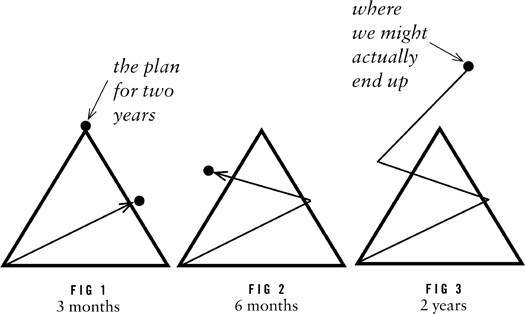
The first line I drew (Fig. 1, above) represented where we would aim to go in three months. The next one (Fig. 2) represented where we might be in three more (and you’ll note that it didn’t stay within the boundaries of Ann’s two-year plan). Chances are, I said, we would end up somewhere other than the top of the pyramid she’d imagined. And that (Fig. 3) was as it should be. Instead of setting forth a “perfect” route to achieving future goals (and sticking to it unwaveringly), I wanted Ann to be open to readjusting along the way, to remaining flexible, to accepting that we would be making it up as we go. Not only did she intuitively grasp what I was talking about, she also soon undertook a painful reorganization of her own group to align it with the new way of thinking.
Some things that needed fixing at the studio were glaringly obvious. For example, as we talked to Disney directors, we discovered that they were used to receiving three sets of notes on their films. One came from the studio’s development department, another from the head of the studio, and a third from Michael Eisner himself. The notes were not, in fact, “notes.” They were mandatory, delivered as a list, with boxes next to each item—boxes that had to be checked as each note was executed. Even worse: None of the people who were giving these notes had ever made a film before, and the three sets of notes often conflicted with one another, creating a sort of schizophrenic quality to the feedback. This concept, completely counter to what we believed and practiced at Pixar, could only result in an inferior product, so we made an announcement: From that day forward, there would be no more mandatory notes.
Disney Animation’s directors needed a feedback system that worked, so we immediately set about helping them create their own version of the Braintrust—a safe arena in which to solicit and interpret candid responses to developing projects. (This was made easier by the fact that they already liked and trusted each other. Even before our arrival, we were told, they’d formed their own under-the-radar group called the Story Trust, but the lack of management understanding for that concept had prevented it from evolving into a coherent forum.) As soon as possible, we flew about a dozen Disney directors and story people up to Pixar to observe a Braintrust session about Brad Bird’s Ratatouille . However, John and I told them they were only allowed to observe, not participate. We wanted them to be flies on the wall—to see how different things could be when people felt free to be candid and when notes were offered in the spirit of helpfulness rather than derision.
The next day, several Pixar directors, writers, and editors accompanied the Disney crew back down to Burbank to observe a Story Trust meeting on a film in the works there called Meet the Robinsons . Here, too, we insisted that the Pixar team observe quietly, saying nothing. I thought I noticed a bit more ease in the room that day, as if the Disney people were cautiously feeling for the limits of their new freedom, and the producer of the film later told me it was the most constructive notes session she had ever seen at Disney. Still, both John and I sensed that while everyone embraced the idea of organized candor on an intellectual level and could begin to approximate it when instructed, it would be a while before it came naturally.
A key moment in this evolution came in the fall of 2006, nine months after the merger, at a Story Trust meeting in Burbank. It happened after a fairly awful screening of American Dog , a film structured around a famous and pampered canine actor (think Rin Tin Tin) who believed that he was the superhero character he played on TV. When he found himself stranded in the desert, he had to face for the first time how his tidy, scripted life had not prepared him for reality—that he, in fact, had no special powers. That was all well and good, but somewhere along the way, the plot had also come to include a radioactive, cookie-selling Girl Scout zombie serial killer. I’m all for quirky ideas, but this one had metastasized. The movie was still finding its way, to say the least, so John started off the meeting, as he often does, by focusing on the things he liked about it. He also indicated he saw some problems, but he wanted to give the Disney folks the chance to take the lead on those, so instead of digging in and getting too specific, he threw the meeting open to the floor. Throughout the meeting the comments stayed at a superficial level, remaining strangely upbeat—judging by the commentary, you would have never known the film was in disarray. Afterward, one of the Disney directors confided to me that many people in the room had major reservations about the film but didn’t say what they thought because John had kicked things off so positively. Taking their cues from him, they didn’t want to go against what they thought he liked. Not trusting their own instincts, they held back.
John and I immediately arranged a dinner with the directors—and told them that if they ever resorted to that kind of thinking again, we’d be finished as a studio.
“Disney Animation was sort of like a dog that had been beaten again and again,” Byron Howard, the director, told me when I asked him to describe the mindset back then. “The crew wanted to succeed, but they were afraid of pouring their hearts into something that wasn’t going to succeed. You could feel that fear. And in notes meetings, everyone was so afraid of hurting someone’s feelings that they held back. We had to learn that we weren’t attacking the person, we were attacking the project. Only then could we create a crucible that boils away everything that’s not working and leaves the strongest framework.”
Earning trust takes time; there’s no shortcut to understanding that we really do rise and fall together. Without vigilant coaching—pulling people aside who didn’t speak their minds in a particular meeting, say, or encouraging those who seem eternally hesitant to jump into the fray—our progress could have easily stalled. Telling the truth isn’t easy. But I can say that today, Disney’s Story Trust is made up of individuals who understand not only that they must do the difficult work of leveling with one another but how to do it better.
In those first months, we also moved to bolster trust within the studio in another way: Just as we had refused to sign employment contracts, we now moved to eliminate contracts for everyone. At first, many people thought the move was an attempt to wrest power away from the employees and give them less security. In fact, my feeling about employment contracts is that they hurt the employee and the employer. The contracts in question were one-sided in favor of the studio, resulting in unexpected negative consequences. First and foremost, there was no longer any effective feedback between bosses and employees. If someone had a problem with the company, there wasn’t much point in complaining because they were under contract. If someone didn’t perform well, on the other hand, there was no point in confronting them about it; their contract simply wouldn’t be renewed, which might be the first time they heard about their need to improve. The whole system discouraged and devalued day-to-day communication and was culturally dysfunctional. But since everybody was used to it, they were blind to the problem.
I wanted to break that cycle. I believed that it was our responsibility to make sure that Disney Animation was a place that people would want to work; if our most talented people could leave, then we would have to be on our toes to keep them happy. When someone had a problem, we wanted it to be brought quickly to the surface, not to fester. Most people know that they don’t get their way on everything, but it is very important that they know they are being dealt with straightforwardly and that they, too, will be heard.
A s I have said, we decided early on that Pixar and Disney Animation should remain completely separate entities. What this meant was that neither would do any production work for the other, no matter how pressing the deadlines or how dire the situation. No exceptions. Why? Because mixing the two staffs would have been a bureaucratic nightmare. But there was an overarching management principle at work as well. Simply put, we wanted each studio to know that it could stand on its own and solve its own problems. If we made it easy for one studio to borrow people or resources from the other to help solve a problem, the upshot would be that we’d mask the problem. Not allowing such borrowing was a conscious choice on our part to force problems to the surface where we could face them head on.
Almost immediately, we had a crisis on Ratatouille that would severely test this policy.
I mentioned earlier that we switched directors on this film midstream—bringing in Brad Bird, fresh off The Incredibles , who came in and reworked the story in ways that required a serious technical reboot. Specifically, while in the earlier version all the rats had walked on two feet, Brad felt strongly that (with the exception of Remy, our hero) they should walk on four—like real rats. What that meant was that the rats’ “rigging”—a set of complex controls that let animators manipulate the shape and position of the computerized model—had to be changed significantly. Finding themselves way behind schedule, the production team at Pixar felt that it did not have the resources to do the rerigging that Brad’s four-footed decision required. The producer said that they couldn’t finish the film by the deadline unless they could borrow some people from Disney, which was in a lull between projects, to help out. We said no, not an option. We had already explained the logic to everybody, but I suppose they wanted to see if we really meant it. I can’t blame them; getting extra people was easier than having to solve the problems. But in the end, the Ratatouille team figured out how to make the film, on time, with what they had.
Not long after, Disney would have a crisis of its own on American Dog . I mentioned earlier the emergence of a serial killer storyline, which—while we prided ourselves on always remaining open to new ideas—seemed a tad dark for a family film. Despite our misgivings, though, we decided to give the movie a chance to evolve. Finding a movie’s throughline always takes time, we told ourselves. But after ten months of Story Trust meetings—and very little improvement—we concluded that the only option was to restart the project. We asked Chris Williams, a veteran story artist best known for Mulan and The Emperor’s New Groove , and Byron Howard, then a supervising animator on Lilo and Stitch , to step in as its directors. Immediately, they began reconceiving the movie. The serial killer was tossed, and the movie was renamed Bolt . One of the biggest problems, they felt, was that Bolt himself wasn’t appealing enough, visually, to carry the film. “He just wasn’t ready,” Byron recalled, adding that right before Christmas 2007, “we had a ‘This Dog Looks Bad’ meeting, where we said, ‘What the hell are we going to do about it?’ And two of our animators stepped forward and over their Christmas break, worked with our riggers to redo the dog. They spent their whole two-week vacation here, but when we came back, Bolt had gone from 20 percent appealing to 90 percent appealing.”
With much to do and little time to do it, Bolt ’s producer, Clark Spencer, asked if they could borrow some Pixar production people. Again, John and I said no. It was important, we felt, for each studio to know that when they finished a film, nobody had bailed them out—they’d made it themselves.
Chris later told me that to be at the helm of a production whose crew showed this kind of commitment, under such pressure, was energizing. “It was amazing to find myself in the middle of this thing that was so galvanizing for the whole studio,” he recalled. “In my fifteen years at Disney, I’d never seen people work so hard and complain so little. They were really invested in this thing—they knew it was the first movie under John—and they wanted it to be great.”
Which was good because, as it turned out, yet another crisis was looming.
Very late in the game, problems arose around Rhino the Hamster, our hero’s trusty—if deluded—sidekick and the funniest character in the movie. At the beginning of 2008, with only months left to go on the production, the animators reported that Rhino was proving prohibitively time-consuming to animate. The problem was, ironically, sort of the inverse of the one Pixar had on Ratatouille . The rebooted script required Rhino to be able to walk on two legs, but he’d originally been designed to walk on four. Which doesn’t sound like a big deal, but animating a two-legged character with a four-legged rigging design is extremely difficult to pull off without the character appearing distorted. This was a major setback. Rhino was key to the humor and exposition of the film, but the animators said that he was so hard to animate that it was impossible for them to finish on time. Desperate, we turned for help to the film’s technical directors and asked if they could simplify the character’s rigging to make it easier to animate. Their answer? Rerigging would take six months, which was all the time we had left to make the movie. In other words, we were screwed.
John and I called a company-wide meeting. We explained the situation and I gave what some at Disney still call “the Toyota Speech,” in which I described the car company’s commitment to empowering its employees and letting people on the assembly line make decisions when they encountered problems. In particular, John and I stressed that no one at Disney needed to wait for permission to come up with solutions. What is the point of hiring smart people, we asked, if you don’t empower them to fix what’s broken? For too long, a culture of fear had stymied those who wanted to step outside of Disney’s accepted protocols. That kind of timidity wasn’t going to make Disney Animation great, we said. Innovation would, and we knew they had it in them. We challenged them to step up and help us fix this problem.
After this meeting, three members of the crew took it upon themselves, over the weekend, to remodel and rerig Rhino. Within a week, the project was back on track.
Why was a problem that took a few days to solve originally projected to take six months?
The answer, I think, lay in the fact that for too long, the leaders of Disney Animation placed a higher value on error prevention than anything else. Their employees knew there would be repercussions if mistakes were made, so the primary goal was never to make any. To my mind, that institutional fear was behind the Bolt rerigging snafu. With the best intentions, the film’s production managers had responded to the crisis with a timetable that would ensure a character that was fully functional with no errors . (The irony is that if a solution only takes a few days to find, then you don’t care so much if there are errors because you will have plenty of time to fix them.) But seeking to eliminate failure was in this instance—and, I would argue, most instances—precisely the wrong thing to do.
In order for three people to decide to get together offline and dream up solutions, we had to instill an ethos at Disney Animation that made that behavior okay whether or not they were successful . That ethos had been at the studio once, but it was sadly absent when we arrived. It was nothing short of exhilarating to see it come back, full force, on Bolt . Chris and Byron and their creative team were open and responsive and, most important, able to move the focus away from the notion of the “right” way to fix the problem to actually fixing the problem—a subtle but important distinction.
Even before Bolt opened to positive reviews and solid box office, the impact of these internal victories had reinvigorated the ranks of Disney Animation. By pulling together, they’d turned a humdrum, stalled project into a compelling one—and in record time. By early 2009, when the film received an Oscar nomination for Best Animated Feature Film, it felt like a bonus. It’s difficult sometimes to tell the difference between what is impossible and what is possible (but requires a big reach). At a creative company, mistaking one for the other can be fatal—but getting it right always elevates. At Disney, Bolt was the movie that proved this truth. We were part of the way there.
I t’s not often talked about, but after the merger, there was some discussion of shutting Disney Animation down altogether. The argument for doing so, expressed by Steve Jobs among others, was that John and I would be spread too thin to do a good job at both places—and that we should focus our energies on keeping Pixar strong. But John and I dearly wanted the opportunity to help revive Disney Animation, and Bob Iger supported us in that goal. We believed, in our souls, that the studio could be golden again.
Still, Steve’s worry about our stamina—or, put another way, about our inability to be in two places at once—wasn’t unfounded. We had only so many hours in each day, and Pixar would by definition be getting less of them than it once had. From the moment the merger was announced, John and I had attempted to ease our colleagues’ fears by hosting several get-togethers for anyone who wanted to hear more about why we thought the merger made sense. Still, as we began to spend more time at Disney, the general feeling at Pixar, which many people articulated to John and me directly, was that our reduced presence in Emeryville, and our focus on Burbank’s needs, was a bad sign for the company. One Pixar manager likened the situation to the aftermath of a divorce, when your parents remarry and adopt the kids of their new spouses. “We feel like we’re the original kids, and we’ve been good, but the adopted kids are getting all the attention,” he told us. “We’re being punished, in a sense, for needing less help.”
I didn’t want Pixar to feel neglected, but I’ll admit I saw an upside to this new reality. Namely, it was an opportunity for other Pixar managers to step forward. Given how long John and I had been there, a dangerous mythology had been constructed around the idea that though we weren’t the only ones to recognize problems, we were an essential part of solving them. The truth, though, was that just as other people often recognized problems before we did because they were closer to them, they in turn raised the issues with us and helped us solve them. Our decreased presence in the office was a chance for Pixar’s people to see what I already knew: that other leaders at the company had answers, too.
Still, despite the protections we’d put in place, it took a while for the people of Pixar to trust that no one was coming over the hill to change us or that we were abandoning them. Eventually, though, the feeling we had hoped would emerge within Pixar—a sense of strong local ownership combined with a pride in what Disney, the parent company, had accomplished as well—led to a healthier relationship with Disney as a whole. The takeaway for managers is that this didn’t happen by accident. This corporate détente, if you will, wouldn’t have been possible, I think, without the Five Year Compact.
The document, while providing great comfort to Pixar employees, prompted several complaints from the Disney Studios human resources department. The complaints boiled down to the fact that they didn’t care for the exceptionalism that our carefully guarded policies implied. My response to this stemmed less from a loyalty to Pixar than from my commitment to a larger idea: In big organizations there are advantages to consistency, but I strongly believe that smaller groups within the larger whole should be allowed to differentiate themselves and operate according to their own rules, so long as those rules work. This fosters a sense of personal ownership and pride in the company that, to my mind, benefits the larger enterprise.
I n a merger of this scope, there are seemingly countless calls to make, every day, on issues big and small. One of the biggest decisions John and I made at Disney was actually to reverse a decision, made in 2004, to shut down the studio’s hand-drawn animation efforts. The rise of computer animation—and 3D in particular—had convinced Disney’s previous leaders that the era of hand-drawn animation was over. Watching from afar, John and I thought this was tragic. We felt the decline of hand-drawn animation was not attributable to the appeal of 3D but simply to lackluster storytelling. We wanted Disney Animation to return to what had made them great. So when we heard that our predecessors had opted not to renew the contracts of one of the studio’s leading directing duos, John Musker and Ron Clements, whose credits included the hand-drawn classics The Little Mermaid and Aladdin , this particular call seemed like a no-brainer.
As quickly as we could, we brought John and Ron back and told them to start pitching new ideas. Right off, they proposed a twist on a classic fairy tale—The Frog Prince —which would take place in New Orleans and feature, as its heroine, Disney’s first-ever African-American princess. We green-lighted The Princess and the Frog and began reassembling a crew that had been dispersed to the winds. We asked our team at Disney to propose three scenarios for rebuilding the hand-drawn production effort. Their first was to reestablish the old system exactly as it existed before we arrived, which we rejected as too expensive. The second scenario was to farm out the production work—subcontracting it to cheaper animation houses overseas—which we rejected for fear that it would diminish the film’s quality. The third scenario, however, felt just right—a combination of hiring key talent inside the studio while outsourcing certain parts of the process that wouldn’t affect quality. The number of staffers we’d need to make this happen, I was told, was 192. To which I replied: Done. But they couldn’t go over that number.
John and I were excited. Not only were we reviving the art form that the studio was built upon, this was the first movie at Disney that would be made, start to finish, on our watch. We could feel the energy in the building. It was as if everyone working on The Princess and the Frog felt that they had something to prove. We set about giving them some of the tools we used at Pixar and teaching them how to use them.
Research trips, for example. We talked our heads off about the value of research while hammering out the storyline of a new film. Frankly, it took a while to get the Disney folks on board with this idea. They seemed to want to lock down the story quickly so they could start making the movie, and they didn’t see at first how research would help them; they saw it as a distraction. “It’s like a math problem where they say, ‘Show your work,’ ” says Byron Howard, expressing how people at Disney Animation initially viewed John’s insistence that people leave the building as they conceived their stories. “John expects that if you have sketched out buildings from your movie, it isn’t just bullshit you’re throwing up on the screen. The same with characters, costumes, story. John really believes that genuineness come through in every detail.”
We persisted: This was something we knew was an essential component of creativity and we weren’t kidding about its importance. So during the prepping of The Princess and the Frog , the entire creative leadership of the film headed to Louisiana. Attending the Krewe of Bacchus parade on the Sunday before Mardi Gras gave them a vivid frame of reference when they animated a sequence based on that festival; their ride on the riverboat Natchez helped them block out a scene set on a similar river-going vessel; a tour of the St. Charles Avenue streetcar line ensured that they captured the distinct clang of the trolley’s bell and the sounds and the colors: All of it was right there in front of them. Upon their return, the directors, Ron and John, each told me that research inspired the production in ways they never expected. It was the beginning of a sea change: Today, directors and writers at Disney can’t imagine developing an idea for a film without doing research.
Leading up to the release of The Princess and the Frog , we’d had many conversations about what to call it. For a while we considered the title “The Frog Princess,” but Disney’s marketing folks warned us: Having the word princess in the title would lead moviegoers to think that the film was for girls only. We pushed back, believing that the quality of the film would trump that association and lure viewers of all ages, male and female. We felt a return to hand-drawn animation, done in the service of a beloved fairy tale, would pack ’em in.
Turns out, it was our own version of a stupid pill.
When The Princess and the Frog was released, we believed we had made a good film, the reviews confirmed that belief, and people who saw it loved it. However, we would soon learn that we had made a serious mistake—one that was only compounded by the fact that our movie opened nationwide just five days before James Cameron’s science fiction fantasy Avatar . This scheduling only encouraged moviegoers to take one look at a film with the word princess in the title and think: That’s for little girls only . To say that we are making a great film but not listen to the input of experienced colleagues within the company imperiled the quality we were so proud of. Quality meant that every aspect—not just the rendering and the storytelling but also the positioning and the marketing—needed to be done well, which meant being open to reasoned opinions, even when they contradicted our own. The movie had come in under budget, which is the rarest of achievements in the entertainment business. The quality of its animation rivaled the best ever done by the studio. The film was profitable, as we’d kept costs down, but it just didn’t make enough to convince anyone at the studio that we should pour more resources into hand-drawn films.
While we’d had high hopes that the film would prove that 2D could rise again, our narrow vision and poor decision-making made it seem like the opposite was true. While we thought then—and still think today—that hand-drawn animation is a wonderfully expressive medium, I realize now that I got carried away by my childhood memories of the Disney Animation I’d once so enjoyed. I’d liked the idea of celebrating, right out of the box, the art form that Walt Disney himself pioneered.
After The Princess and the Frog ’s somewhat lackluster opening, I knew we had to rethink what we were doing. Around that time, Andrew Millstein pulled me aside and pointed out that our double-barreled approach—reviving 2D while also championing 3D—was confusing the people within the studio we fundamentally wanted to encourage to focus on the future. The issue with 2D was not the validity of the time-honored art form but that Disney’s directors needed and wanted to engage with the new.
In the aftermath of the merger, many people had asked me whether we were going to have Disney do 2D and Pixar 3D. They were expecting Disney to do the old stuff and Pixar to do the new. In the wake of The Princess and the Frog , I realized how important it was to nip this toxic way of thinking in the bud. The truth was, Disney’s directors respected the studio’s heritage, but they wanted to build on it—and in order to do that, they had to be free to forge their own path.
D isney Animation’s embrace of the new would take on steam, ironically, when it finally figured out how to reframe and rethink something old: the fairy tale Rapunzel . This was a project that had languished for years in development hell, kicking around Disney, enduring a few false starts, and finally being left for dead. But now, the studio was becoming creatively healthier, and people were talking to one another. John often said that the problem at Disney Animation was never lack of talent, it was that years of stifling working conditions had made people lose their creative compasses. Now, even with the box-office disappointment of The Princess and the Frog , they were dusting those compasses off again.
For years, many at Disney had tried (and failed) to crack the story of Rapunzel—she of the famous mane of hair—in a way that seemed destined to make a terrific movie. The central challenge was that a girl locked in a tower is hardly an active scenario for a feature film. At one point, Michael Eisner himself had proposed updating the tale, calling it Rapunzel Unbraided , and setting it in modern-day San Francisco. Then, somehow, our heroine would be transported into the fairy tale world. The director of the film, Glen Keane, one of the greatest animators ever—known for his work on The Little Mermaid , Aladdin , and Beauty and the Beast —couldn’t make this idea work, which left the project at an impasse. The week before John and I arrived, our predecessors shut the project down.
One of our first acts at Disney was to ask Glen to keep Rapunzel going. It was a classic story, we reasoned, perfect for the Disney brand. Surely, there was a way to make it work as a film. Right around then Glen had a temporary health scare and was forced to reduce his role in the film to that of an adviser. In October 2008, we brought on directors Byron Howard and Nathan Greno, who were both fresh off their success with Bolt (Howard had directed it, with Chris Williams; Greno had been head of story). They took the story in a different direction, teaming up with the writer Dan Fogelman and the composer Alan Menken, who had done the music for the iconic Disney musicals of the 1990s. This Rapunzel was more assertive than the character in the classic tale, and her hair had magical healing powers, which she could activate by singing an incantation. This version of the story was familiar but sassy and modern at the same time.
Determined not to repeat the mistake we’d made with The Princess and the Frog , we changed the movie’s title from Rapunzel to the more gender-neutral Tangled . Internally, the decision was controversial, as some people felt we were letting marketing concerns dictate creative decisions, that we were bastardizing a classic property. Nathan and Byron rebutted that charge, saying that because their story focused on a female and a male character, a former thief named Flynn Rider, Tangled better captured the fact that the movie was about a duo.
“You wouldn’t call Toy Story ‘Buzz Lightyear,’ ” as Nathan said.
Released in November 2010, Tangled was a runaway success, artistically and commercially. A. O. Scott of The New York Times wrote, “Its look and spirit convey a modified, updated but nonetheless sincere and unmistakable quality of old-fashioned Disney-ness.” The movie went on to earn more than $590 million worldwide, becoming the second-highest-grossing film from Disney Animation ever, after The Lion King . The studio had its first number one hit in sixteen years, and the reverberations within the building were palpable.
I could stop there, but there is a coda to this story that will resonate with any manager, in any business. It involved John’s and my determination to use the success of Tangled as a healing moment for the studio, and we felt like we knew just how to do it.
We had learned long ago that while everyone appreciates cash bonuses, they value something else almost as much: being looked in the eye by someone they respect and told, “Thank you.” At Pixar, we’d devised a way to give our employees money and gratitude. When a movie makes enough money to trigger bonuses, John and I join with the directors and producers and personally distribute checks to every person who worked on the film. This jibes with our belief that each film belongs to everyone at the studio (and is related to our “ideas can come from anywhere” credo; everyone is encouraged to give notes and pitch in, and they do). The distribution of bonuses one by one can take a while, but we feel it’s essential to take the time to shake each person’s hand and tell them how much their contribution mattered.
In the wake of Tangled ’s success, I asked Ann Le Cam, our vice president of human resources, to help us do something along the same lines at Disney. She printed up personalized letters for each crew member explaining the reason for the bonus, and on a weekday morning in the spring of 2010, Disney Animation’s general manager Andrew Millstein, the directors Nathan Greno and Byron Howard, the previous director (and inspiration for the movie) Glen Keane, the producer Roy Conli, and John and I asked everyone who’d worked on Tangled to gather in one of the large stages at Disney. As they milled about, they didn’t know what was coming—we’d suggested to them that it was a general meeting. But when they saw the envelopes in our hands, they knew something was up. It was Ann’s idea to give each crew member a hot-off-the-presses DVD of the movie as well—a small gesture that made our gratitude feel even more genuine. To this day, some Tangled veterans still display framed copies of the letter they received that day on their office walls.
Would it have been easier simply to wire bonuses into employees’ direct deposit accounts? Yes. But like I always say when talking about making a movie, easy isn’t the goal. Quality is the goal.
The ship was beginning to turn—and it would only keep turning.
I mentioned before that Disney’s Story Trust has evolved into a strong, supportive group, but in our first years there, it lacked leaders who excelled at storytelling structure. Even though the group was very good, I wasn’t sure if any of its members would grow into the kind of facilitators that had emerged at Pixar. This worried me, because I knew how heavily Pixar relied on Andrew Stanton and Brad Bird’s ability to chart the beats of a story and to make things better. But all we could do at Disney, I knew, was create a healthy creative environment and see what developed.
I was enormously gratified, then, as the studio was making Wreck-It Ralph and Frozen (directed by Chris Buck and Jennifer Lee, who also wrote the script), when I noticed something changing from within. The writers at the studio had bonded with each other and, as a group, had begun to play a key role in the Story Trust meetings, especially when it came to structuring the films. This feedback group had become as good as Pixar’s Braintrust, but with its own personality. It was an indication of something larger that was happening: The studio as a whole was operating more smoothly. And I want to emphasize that it was still populated by most of the same people John and I had first encountered when we arrived. We had applied our principles to a dysfunctional group and had changed them, unleashing their creative potential. They had become a cohesive team, stocked with standout talents. This brought Disney Animation to a new level. Now we had a creative roster that was as good as the one at Pixar, yet quite different. The studio Walt Disney had built had become worthy of him once again.
CHAPTER 13
NOTES DAY
W hen I began this book, I hoped to capture some of the thinking that underlies the way we work at Pixar and Disney Animation. I also hoped that by talking with my colleagues, bouncing my theories off of them and reflecting on what we had built, I would clarify my own beliefs about creativity and how it is grown, protected, and sustained. Two years later, I feel like I’ve managed to do these things, but the clarity didn’t come easy. In part, that’s because while I was writing this book, I was also working full-time at Disney and Pixar, and the world did not stand still. Partly, too, clarity was elusive because I don’t believe in simple, prescriptive formulas for success. I wanted this book to acknowledge the complexity that creativity requires. And that meant wading into some murky areas.
During the period that I worked on this book, Disney continued to evolve rather dramatically, with its Story Trust becoming a candid and supportive feedback system and its production group reaching new levels of technical and storytelling sophistication. Each of Disney’s films had setbacks—which we expected—but we found ways to work our way through them. Frozen opened on the day before Thanksgiving 2013 and, like Tangled , became a worldwide box-office success—a victory made even sweeter because it came on the heels of the studio’s 2012 triumph Wreck-It Ralph . The creative culture at Disney Animation, I believe, is fundamentally different than when John and I arrived in 2006.
As all this was taking place, Pixar released Monsters University , which you may remember underwent a change of directors during its journey to the multiplex. The film—our fourteenth number one movie in a row—grossed $82 million on its opening weekend (making it the second biggest Pixar opening ever) and went on to make more than $740 million worldwide. The mood inside Pixar was jubilant. But as always, my focus was on the challenges ahead and on staying true to our goal of recognizing problems early and engaging them fully.
I have noted that there are forces at work in any company that are hard to see. At Pixar, those forces—among them the impact of growth and the reverberations of success—had sparked several problems. For example, as we’d grown, we had taken in quite a mixture of people. So in addition to the colleagues who had been with us from the beginning and who understood the principles that guided the company since they’d lived through the events that had forged those principles, we now had more recent arrivals. While some of these people learned quickly, absorbing the ideas that made our company work and becoming new leaders, others were in awe of the place—respectful of our history to the point that they could be hindered by it. Many brought good new ideas with them, but some were reluctant to suggest them. After all, this was the great and mighty Pixar, they thought—who were they to call for change? Some were grateful for the supportive environment—the subsidized cafeteria, the top-of-the-line tools—but others took them for granted, figuring that such perks came with the territory. There were many who loved how successful we’d been, but some didn’t understand the struggle and risk that success had entailed. Why couldn’t we just make things simpler, these people wanted to know?
In short, Pixar had the kind of diverse problems that any successful company has. But chief among them, to my mind, was that more and more people had begun to feel that it was either not safe or not welcome to offer differing ideas. This hesitancy was difficult to see at first, but when we paid attention, we saw many clues that people were holding back. To me, that meant one thing: We, as leaders, were allowing some faulty ideas to take hold, and that was bad for our culture.
There is nothing like a crisis, though, to bring what ails a company to the surface. And now, we had three crises brewing at once: (1) Our production costs were rising and we needed to rein them in; (2) External economic forces were putting pressure on our business; and (3) One of the central tenets of our culture—good ideas can come from anywhere, so everyone must feel empowered to speak up—was faltering. Too many of our people—and to my mind, “too many” is the same as “any”—were self-censoring. That needed to change.
These three challenges—and our belief that there was no single big idea that would solve them—led us to try something that we hoped would break the logjam and reinvigorate the studio. We called it Notes Day, and I see it as a stellar example of how to set the table for creativity. Managers of creative companies must never forget to ask themselves: “How do we tap the brainpower of our people?” From its genesis to its execution, from the goodwill it engendered to the company-wide changes it set in motion, Notes Day was a success in part because it was based on the idea that fixing things is an ongoing, incremental process. Creative people must accept that challenges never cease, failure can’t be avoided, and “vision” is often an illusion. But they must also feel safe—always—to speak their minds. Notes Day was a reminder that collaboration, determination, and candor never fail to lift us up.
I am often asked which Pixar movie makes me the proudest. My answer is that, while I take pride in all our movies, what makes me most proud is how our people respond to crisis. When we have a problem, the leaders of the company don’t say, “What the hell are you guys going to do about it?” Instead there is talk of “our” problem and of what “we” can do to solve it together. My colleagues see themselves as part owners of the company and of the culture, because they are. They are very protective of Pixar. And it was this protective and participatory spirit that led to Notes Day.
In January 2013, Pixar’s leadership—about thirty-five of us, including our producers and directors—gathered for a two-day off-site at Cavallo Point, a former army base–turned–conference center in Sausalito, just across the Golden Gate Bridge from San Francisco. On the agenda were two pressing issues. The first was the rising cost of making our films; the second was an unfortunate shift in the culture that all of Pixar’s leaders had noticed. As Pixar had grown, it had changed. No surprise there—change happens, and a 1,200-person company (Pixar now) is going to operate differently than one that employs forty-five (Pixar then). But many of us were concerned that with that growth had come an erosion of some of the principles that had made us successful in the past. The situation wasn’t dire—far from it, in fact, as we had some very exciting projects in the works. But as we gathered at Cavallo Point, there was an urgency in the room: Each of the thirty-five men and women there was engaged by the desire to keep Pixar on the right track.
Tom Porter—our head of production, who also happens to be a pioneer in computer graphics and one of the founders of Pixar—led off the day with an extended analysis of our costs. Distribution methods were changing rapidly, he noted, and so too were the economics of our business. That we were doing well as a company didn’t make us immune to these greater forces, and we all agreed that we needed to stay ahead of trouble by keeping our costs down. At the same time, we did not want to stop taking risks. We wanted always to be a company that would gamble on unusual films such as Up, Ratatouille , and WALL-E . Not every film had to tackle unconventional stories, of course, but we wanted every filmmaker to feel free to propose them.
These two issues were interconnected. When costs are low, it’s easier to justify taking a risk. Thus, unless we lowered our costs, we would effectively limit the kinds of films that we would be able to make. Moreover, there was another benefit of lowering costs. Cheaper films are made with smaller crews, and everyone agrees that the smaller the crew, the better the working experience. It’s not just that a leaner crew is closer and more collegial; it’s that on a smaller production it’s easier for people to feel that they’ve made an impact. Our first film, Toy Story , was made with our smallest crew, but as each successive film became more visually complex, the head count started to creep up. At the time of the off-site at Cavallo Point, making a Pixar film required, on average, about 22,000 person-weeks, the unit of measurement we commonly use in our budget. We needed to reduce that number by about 10 percent.
But we needed something else, as well, something that was harder to quantify. Increasingly, we sensed that our people, having enjoyed years of success, were under a great deal of pressure not to fail. Nobody wanted to have worked on the first movie that didn’t open at number one. And the result was a growing temptation to pour too much visual detail into each film—to make it “perfect.” That honorable-sounding desire—we call it “plussing”—was accompanied by a kind of paralyzing anxiety. What if we couldn’t achieve the expected level of excellence? What if we couldn’t break new ground, visually? As a company, our determination to avoid disappointments was also causing us to shy away from risk. The specter of past excellence was sapping us of some of the energy that we’d once used to pursue excellence. In addition to this, many new people had come into the company, people who had not experienced the ups and downs of our previous films. Thus, they had preconceived notions of what it was like to work at a successful company. As at many companies, one of the consequences of wild success is the pernicious distortion of reality. Increasingly we would hear that people had opinions about things they thought were wrong but were unwilling to express them. One of our greatest values—that solutions could come from anyone and that everyone should feel free to weigh in—was slowly being subverted under our watchful eyes. And only we could correct it.
“Sometimes I think people have gotten too comfortable,” John said when we gathered in a renovated chapel on the resort grounds. “They need to feel excited—to feel like we once did: on fire and buzzing with possibility!”
This wasn’t the first time John and I had wondered about how Pixar’s people were affected by being at the front of the pack for so long. Would they gradually begin to take success for granted? “There’s a lightness and a speed at Disney that I want to see more of at Pixar,” John said.
How, we all wondered, could we maintain Pixar’s sense of intensity and playfulness, beating back the creeping conservatism that often accompanies success while also getting leaner and more nimble?
That’s when Guido Quaroni spoke up. Guido is vice president of our Tools Department, and he spends a lot of time thinking about how to keep his 120 engineers happy. His challenge on that front is real: His department develops technology, but Pixar doesn’t sell technology. It sells stories enabled by technology. Which means that when a Pixar engineer develops a piece of software, it is deemed successful only insomuch as it helps our movies get made. I’ve talked about the problem at Pixar of people questioning how much of each movie’s success can be attributed to them personally. For engineers, that uncertainty can be particularly acute. Guido knows that if he’s not careful, that disconnect can lead to low morale. So to retain the best engineers, he works extra hard to make sure they enjoy their jobs.
When Guido had the floor, he told a story about something he’d instituted in his department called “personal project days.” Two days a month, he allowed his engineers to work on anything they wanted, using Pixar’s resources to engage with whatever problem or question they found interesting. It didn’t have to be directly applicable to any particular film or address any of production’s needs. If an engineer wanted to see what it was like to light a shot in Brave , for example, he or she could. If a group of engineers wanted to build a prototype using Kinect, Microsoft’s motion-sensing input device, to help animators capture characters’ movements, they could do that, too. Any idea that sparked their curiosity, they were free to pursue.
“You just give people the time, and they come up with the ideas,” Guido told us. “That’s the beauty of it: It comes from them.”
Guido had already told me about how, in just four months, personal project days had reenergized his staff. Privately, we’d even begun to brainstorm ideas about how similar efforts could be implemented company-wide. At one point, he’d suggested shutting down Pixar for a week at the end of a movie’s production cycle to talk about what went right, what went wrong, and how to reboot for the next project—a sort of super-postmortem. The idea wasn’t practical, in the end, but it was thought-provoking. Now, as we contemplated how to achieve our goal of cutting costs by 10 percent, Guido had a simple suggestion.
“Let’s ask Pixar’s people—all of them—for ideas about how to do it,” he said.
Looking at John, I could see his gears begin turning. “Okay, now that’s interesting,” he said. “What if we closed Pixar for the day? Everybody will come to work but all we’ll talk about is how to solve this problem. We dedicate an entire day to it.”
The room was instantly abuzz. “This is so Pixar,” Andrew said. “Totally unexpected. Yes! You want people to get excited? That’s going to do it.”
When I asked who in the room would be willing to help organize it, everyone’s hands shot up.
I believe that no creative company should ever stop evolving, and this would be our latest attempt to avoid stagnation. We wanted to explore issues big and small—to give candid notes to ourselves about the workings of the company, much like we would give notes on a movie in a Braintrust meeting. So it made sense, as we began to make Guido’s idea a reality, to invoke our shorthand term for candid feedback: notes . At some point, we decided that Monday, March 11, 2013, would be called “Notes Day.”
The exercise would be fruitless without the buy-in of our people, so we scheduled three town hall–style meetings to explain the idea to more than 300 employees at a time. Tom Porter presented an abbreviated version of his off-site talk to set up the problem, and then John and I laid out the plan. “It’ll be a day in which you tell us how to make Pixar better,” John said. “We’ll do no work that day. No visitors will be allowed. Everyone must attend.”
“We have a problem,” I said, “and we believe the only people who know what to do about it are you.”
We appointed Tom to preside over Notes Day and make sure that it was more than merely a feel-good exercise. From the start, he made clear what Notes Day was—and wasn’t. “This is not a call for working faster or doing more overtime or making do with fewer people,” he said in one town hall forum. “This is about making three films every two years with roughly the same number of people we’ve got today. We hope to rely on improvements in technology. We hope that productions can share resources and avoid reinventing the wheel each time. We hope that artists can benefit from greater clarity from the directors.” But to make good on these hopes—and to realize other areas in which we could improve—Pixar’s leaders needed everyone to speak up.
Tom got together with Guido, Lori McAdams, the vice president of human resources, and producers Katherine Sarafian and Galyn Susman to form the core of the Notes Day Working Group. That group would soon expand, drafting dozens of volunteers for specific assignments. First, it created an electronic suggestion box where Pixar people could submit discussion topics they thought would help us become more innovative and more efficient. Immediately, topic ideas began flooding in, along with suggestions about how to run Notes Day itself.
The suggestion box, in turn, prompted something that none of us had expected. Many departments, without any prodding, created their own wiki pages and blogs to hash out what they believed the core issues at Pixar really were. Weeks before Notes Day, people were talking among themselves in ways they hadn’t before about how, specifically, to improve workflow and enact positive change. When people asked for guidance on how to be involved, Tom nudged them along, sending this hypothetical prompt to anyone who asked: “The year is 2017. Both of this year’s films were completed in well under 18,500 person-weeks.… What innovations helped these productions meet their budget goals? What are some specific things that we did differently?”
In the end, four thousand emails poured into the Notes Day suggestion box—containing one thousand separate ideas in all. As Tom and his team read and evaluated them, they were careful not to dismiss the unexpected. “While we discarded the ones that felt like general grumbling, we also made room for interesting ideas that might, but might not, lead somewhere,” he told me. “I am sure we were biased toward ideas that would clearly help us get to 18,500 person-weeks, but there were many topics we picked with only a loose or non-obvious connection to that goal. I’d say our major criterion was, ‘Can you imagine twenty people talking about this topic for an hour?’ ”
Putting like with like, Tom’s team distilled the thousand ideas down to 293 discussion topics. That was still way too many for a single day’s agenda, so a group of senior managers then met and whittled those down to 120 topics, organized into several broad categories such as Training, Environment and Culture; Cross-Show Resource Pooling (we often call our movies “shows”); Tools and Technology; and Workflow.
The winnowing process was difficult, and it was made even more so by the diversity of the questions posed. Some were valid but highly technical in nature, such as, “Out-of-memory errors related to inadequately pruned sets consume a significant amount of computer and human time. What can be done to improve pruning?” Others were more sociological, as in, “How can we return to a ‘good ideas come from anywhere’ culture?” And then there was my favorite: “How can we get to a 12,000 person-week movie?” That’s right: 12,000. This was a discussion topic prompted by emails from several people whose reaction to the call for a 10 percent budget cut was, naturally, to ask whether a more drastic cut might be possible as well.
“Eighteen Five, Smaiteen Five,” said the header on one email received by the Notes Day Working Group. What, this writer asked, if of the three films Pixar made every two years, one of them was produced for a “reduced scope” of 15,000 person-weeks? Or even 12,500? “No skimping on story, just simplifying the rest?”
Another person emailed: “I, for one, would like to work on a ‘10,000 person-week film.’ I feel that the measures you’d design to enable it would inform efforts to make the 18,500 person-week film.”
Still another asked: “What kind of film would Pixar make with 12,000 person-weeks? Is there a creative idea that could live up to our reputation but be done for that little? Where would the cuts be? What would be different about the process?” The subject line for that email, by the way, was “GET RADICAL.”
Once the whittling process was complete, Tom needed to find out roughly how many people were interested in each discussion topic so that he could plan the day accordingly. To that end, the Notes Day Working Group circulated a survey, and what he learned was striking: The number one topic—the one that the most people wanted to talk about—was how to achieve a 12,000 person-week movie. In the end, Tom and his team would arrange seven separate 90-minute sessions on this topic alone. The people who signed up for these sessions weren’t martyrs. The problem of doing more with less was interesting to them, and they wanted to engage with it. (Think about that—the topic that captured my Pixar colleagues’ imagination more than any other was an attempt to be even more aggressive in trying to reduce the budget! They truly understood the problem and its implications. Can you see why I have so much pride in this place?)
The nitty-gritty of how all this was organized may seem a bit micro to describe here, but it couldn’t have been more vital to the way the day played out. It’s all well and good to gather people to discuss workplace challenges, but it was extremely important that we find a way to turn all that talk into something tangible, usable, valuable.
How the day was designed, we felt, would be the deciding factor in accomplishing that.
Tom and his team decided early on that people would determine their own schedules, signing up for only the sessions that interested them. Each of the Notes Day discussion groups would be led by a facilitator recruited from among the company’s production managers. The week before Notes Day, all facilitators attended a training session to help them keep each meeting on track and make sure that everyone—the outgoing, the laid-back, and everyone in between—was heard from. Then, to make sure something concrete emerged, the Working Group designed a set of “exit forms” to be filled out by each session’s participants.
Red forms were for proposals, blue forms were for brainstorms, and yellow forms were for something we called “best practices”—ideas that were not action items per se but principles about how we should behave as a company. The forms were simple and specific: Each session got its own set, tailored specifically to the topic at hand, that asked a specific question. For example, the session called “Returning to a ‘Good Ideas Come from Anywhere’ Culture,” had blue exit forms topped with this header: Imagine it’s 2017. We’ve broken down barriers so that people feel safe to speak up. Senior employees are open to new processes. What did we do to achieve this success? Underneath that question were boxes in which attendees could pencil in three answers. Then, after they wrote a general description of each idea, they were asked to go a few steps further. What “Benefits to Pixar” would these ideas bring? And what should be the “Next Steps” to make them a reality? Finally, there was space provided to specify “Who is the best audience for this idea?” and “Who should pitch this idea?”
The goal was meaningful engagement that would lead to action. And while Tom and his team had made room for a variety of topics, there was a consistency to the way they were framed. A best practices session called “Lessons from the Outside” had a yellow exit form that posed the question, “What can we learn from best practices at other companies?” Underneath, it had space for three lessons, each with the same “Benefits to Pixar/Next Steps” follow-up.
The red exit form for a proposals session called “Helping Directors Understand Costs in Story” gave the session’s attendees a jumping-off point: Introduce the concept of cost early in the story process. Build in scope discussions in the idea-generation phase. Story plays a role in the budget process when building reels . Then, in a space marked “Revised Proposal?” this form encouraged participants to improve on the stated approach. “How does this benefit the studio?” the form asked, and “What are the drawbacks?” At the bottom was another question, “Is This Idea Worth Pursuing?” with two boxes underneath: “YES! & Next Steps” or “NO, because.… ” The yes option asked: “Who’s the best audience for this proposal? (Be specific).” And again there was this: “Who should pitch this proposal?”
I think you’re getting a sense of how hard our team worked to make sure Notes Day took us where we needed to go. As Tom put it, “We didn’t just want to make lists of cool things we could do. The goal was to identify passionate people who would take ideas forward. We wanted to put people with clever insights in front of Pixar’s executive team.”
On the Friday before Notes Day, I got an email telling me that 1,059 people had signed up—nearly everyone in the company, given that some employees were on leave or away. The following Monday, we would discuss 106 topics in 171 sessions managed by 138 facilitators in 66 meeting spaces across our three buildings—from offices to conference rooms to common spaces like the Poodle Lounge, which has a painting of George Washington on the wall, a bean bag toss game on the floor, and a disco ball hanging overhead.
We were as ready as we were ever going to be to let this experiment unfold.
At 9 A.M . on March 11, everyone gathered in the atrium of the Steve Jobs Building. If the navy blue Pixar sweatshirt I was wearing didn’t make it obvious enough, the look on my face gave it away: I was enormously proud of how our people had already shown their commitment to making Notes Day a historic day for us. I told them as much as I welcomed them, and then I handed the mike to John.
John often plays the role of inspirer-in-chief, and the people at Disney and Pixar alike rely on his energy and optimism. But this was no rah-rah call to action. Ambling to the front of the stage, John proceeded to deliver the most heartfelt and emotional speech I had ever heard him give. He started by talking about candor, and how we spend a lot of time at Pixar talking about its importance. But candor is hard, both to deliver and to receive. He knew this firsthand, he said, because in preparation for Notes Day, the organizers had shared something else that had come in to the electronic suggestion box: A fair amount of feedback had focused on John himself, and not all of it was positive. In particular, people were upset that—because he was now splitting his time between two studios—they were seeing less of him. The bottom line was that they missed him, but they also felt that there were ways that John could better handle the inordinate pressure he was under.
John admitted that this hurt; still, he wanted to hear all of the specific criticisms. “So they prepared a list,” he said. “I thought it would be a page. Instead, I got two-and-a-half pages.” Among the things he learned: John was so tightly scheduled, and meetings with him were so precious, that people tended to overprepare to see him, which served no one. In fact, John said, “there were a lot of notes about my time management, and how I carry the emotion of one meeting into the next, making some people ask, ‘Why is he upset at us?’ I didn’t know I was doing any of this, and those two-and-a-half pages were really tough to read. But it was so valuable for me to hear, and I’m already working to correct those things.”
The atrium was quiet, despite the crowd.
“So, today, please be honest,” John continued. “And those of you in management positions, be aware that some of this is going to feel like it’s directed at you personally. I’m not kidding. It’s going to happen. But put your tough skin on, and for the sake of Pixar, speak up, and don’t stop the honesty. Trust me. That’s what today is about. It’s about making Pixar better forever, for all of you and for the next generations of Pixarians. This is going to fundamentally change the company for the better. But it starts with you.”
It was time to go to class.
F or the first hour of Notes Day, everyone at the company headed to their own departmental meeting—Story, Lighting, Shading, Accounting, what have you—where they shared ideas with their closest colleagues about how to be more efficient. These departmental meetings, we felt, would serve as a sort of warm-up for the day; it’s always easier to be candid with people you know than with strangers. But as John had urged, Pixar’s people needed to put their thickest skins and bravest faces on. Because beginning at 10:45 A.M. , when everybody headed to their first session, chances were good that for the rest of the day, no Pixar employee was going to find him- or herself sitting next to any of the people they knew best.
Why? Because the sessions weren’t organized by job or by department. They were organized by individual interest. During the lead-up to Notes Day, each person had been asked what they wanted to discuss, and Tom’s team had created enough sessions to accommodate everyone. While some topics were so specialized that interest was limited to a narrow subset of employees (for example, to take just one: “What range of solutions do we have for improving Lighting productivity?”), curiosity being what it is, many topics attracted all kinds of people from across the company.
If you showed up, for instance, to a brainstorming session called “Developing and Appreciating a Great Workplace”—It’s 2017. Nobody at the studio behaves as if they are entitled. How did we accomplish that? —you would have found Pixar’s executive chef, a woman who worked in Legal, a woman from Finance, a veteran animator, a man from Systems, and more than a dozen others. What had attracted such a cross-section? For that particular session, everyone said they picked it because of the word entitled in the descriptor. They’d all encountered people who acted entitled at Pixar—people who insisted on having their own piece of equipment, even if it could be shared, or who groused that they couldn’t bring their dogs to work. “This is a job,” one animator said. “A great job. We are well paid. These people need to wake up.”
What was most striking to those in attendance at the “Great Workplace” session was how much they had in common. The Systems guy told a story about answering a frantic call for tech support. He rushed over to assess the problem, only to be told by the aggrieved artist that the machine should be fixed during lunch—because that’s when it would be most convenient for her. “I need to eat lunch, too,” he told the group, as everyone nodded their heads. The chef told a similar story about a last-minute request to cater a working lunch that came without any acknowledgement of the hassle (and hustle) it would require of her staff. A character animator lamented that he didn’t know more about what people in other departments, like lighting and shading, did. “It makes it easy to vilify and resent each other,” he said.
One by one, the people in this session hit on the same themes. “We need to make people behave more like peers,” one person said. “I wish more people knew about the whole production pipeline—by which I mean, that they appreciated and understood what other people do,” said another. “We need to heighten people’s awareness of what they do not know.”
Among the ideas this group put on their exit forms: fostering more empathy between departments through a job-swapping program, establishing a lunch lottery that would match people at random to encourage new connections and friendships, and holding cross-departmental mixers designed to let far-flung colleagues get to know each other over a few beers.
I chose to describe that session in part because it’s broadly relatable—no matter what business you’re in, you’ve run across the scourge of entitlement. (Were I to describe some other Notes Day sessions—one on centralized rendering, say—I think I’d risk losing a few people.) But regardless of the topic that was being discussed, no matter where you were on campus, you could feel a frisson of energy. If you stepped into a Pixar restroom or stepped outside for some air, you couldn’t avoid overhearing people chatting about how exciting Notes Day was. The feeling was that we were engaged in something that would make a difference.
Midway through the day, Tom gathered the facilitators to check, briefly, how things were going and to encourage them to share their experiences thus far. At one point, he asked, “How many of you had suggestions in your sessions that could be implemented immediately?” Everybody raised their hands.
We’d made a decision to separate out Pixar’s executives, directors, and producers from the Notes Day sessions. Partly this was because it was vital that people speak freely, and we weren’t sure they would if we were there. Partly, too, we peeled off because there were particular topics that we needed to consider among ourselves: creative oversight (Are Braintrust sessions as useful as they were ten years ago?), leadership tone and temperament (How can we better foster a culture of inclusiveness in which anyone can suggest a labor-saving idea?), the need to spend money where it can do the most good (We have a system that is vulnerable to excess, that rewards perfectionists and pleasers. How do we manage perfectionism and the desire to innovate?).
I knew things were going well from the looks on our colleagues’ faces as they hurried from session to session. They were beaming. At day’s end, as the entire company gathered outside for beer, hot dogs, and some instant analysis, I noticed people from different departments continuing the discussions they’d begun inside. The energy on the whole campus was electric. This was the Pixar that they wanted, that we wanted. I made a point of stopping by several bulletin boards we’d erected to encourage people to share their impressions. Among those posted under a variety of categories were:
Favorite moment from Notes Day: “John Lasseter’s candor.”
Something new I learned today: “People care; people can change.”
How many new people did you meet today? “23.”
And then there was this: “Notes Day is the proof that Pixar cares about people as much as about finances.” And: “Do this again next year.”
The next morning, I received emails from hundreds of employees. One, from a storyboard artist, perfectly captured the feeling expressed by many. “Hello Ed,” it read. “I just wanted to say a post–Notes Day thank you. The day was truly amazing, inspirational, informative and as I heard many times throughout the day, from many people, cathartic. If there was any cynicism anywhere, I didn’t see it. Coming away from it, I felt as though the company shrank a little. I met new people, got completely new points of view, and learned what other departments struggle with, and succeed with. I don’t know if a metric exists to measure the impact of Notes Day, but from where I was standing, it was huge. In the end, I think we all walked away with a sense of ownership over this amazing place, and its future. A ‘we’re all in this together’ feel. If nothing else, this is a huge victory. John’s openness, and courage to speak about his feedback, set an unbelievable bar. His admission put the entire company firmly behind him, and was one of the finest instances of ‘leading by example’ I can think of. I think we can all learn from that and accept our own introspection/feedback with a similar grace and humility. Thank you so much for creating an environment where this kind of discussion can happen.”
Y ou’ll remember that the exit forms filled out by Notes Day participants weren’t shy about asking, “Who should pitch this proposal?” That was by design—we wanted the best ideas to be pushed forward, not to languish. So in the weeks after Notes Day, all those who’d volunteered to be “idea advocates” were called in to work with Tom and his team to hone their pitches. Then, they began making them to me, John, and our general manager, Jim Morris—and together, we immediately began moving to implement the ones that made sense.
The ideas that emerged on Notes Day, in other words, were not gathering dust in a drawer. They were changing Pixar—meaningfully and for the better. The specific procedural changes will sound mundane to anyone who doesn’t work in animation—we implemented a faster, more secure way, to cite a tiny example, of delivering the latest cuts of films to directors—but when you add them all up, they mattered. In the weeks after Notes Day, we implemented four good ideas, committed to five more, and earmarked still a dozen more for continued development. All of them stood to improve either our processes, our culture, or the way Pixar is managed.
Most importantly, though, we broke the logjam that was getting in the way of candor and making it feel dangerous. Some people might measure the day’s success by charting the concrete results that resulted from it, and in fact, we have paid attention to that too. But real improvement comes from consistent rigor and participation. For this reason, I believe the biggest payoff of Notes Day was that we made it safer for people to say what they thought. Notes Day made it okay to disagree. That and the feeling our people had that they were part of the solution were its biggest contributions.
What made Notes Day work? To me, it boils down to three factors. First, there was a clear and focused goal. This wasn’t a free-for-all but a wide-ranging discussion (organized around topics suggested not by Human Resources or by Pixar’s executives, but by the company’s employees) aimed at addressing a specific reality: the need to cut our costs by 10 percent. While the discussion topics were allowed—even encouraged—to stray into areas that might seem only vaguely related to this goal, the fact that it was there was key. It provided a framework—and it kept us from falling into confusion.
Second, this was an idea championed by those at the highest levels of the company. Had the enormous task of making Notes Day a reality been shunted off on someone who didn’t have the clout to throw muscle behind it—and not entrusted to Tom, who in turn recruited the most organized people in the company to help him—it would have been an entirely different experience. Employees wouldn’t have bought into the idea because they’d sense that management hadn’t, either. And that would have rendered Notes Day moot.
Third, and relatedly, Notes Day was led from within. Many companies hire outside consulting firms to organize their all-staff retreats, and I understand why: Doing them well is a monumental, enormously time-consuming undertaking. But that our own people made Notes Day happen was, I believe, key to its success. Not only did they drive the discussion in meaningful ways, but their involvement also paid its own dividends. Seeing themselves engage and cooperate, steering the agenda toward something that could make a real difference, they remembered why they worked at Pixar. Their commitment was contagious. Notes Day wasn’t an end point but a beginning—a way of making room for our employees to step forward and think about their role in our company’s future. I said before that problems are easy to identify, but finding the source of those problems is extraordinarily difficult. Notes brought problems to the surface—but we still had the hard work in front of us. Notes Day didn’t solve anything all by itself. But it shifted our culture—repaired it, even—in ways that will make us better as we go forward.
I’ve said it before, but it bears repeating: Things change, constantly, as they should. And with change comes the need for adaptation, for fresh thinking, and, sometimes, for even a total reboot—of your project, your department, your division, or your company as a whole. In times of change, we need support—from our families and from our colleagues. I’m reminded here of a letter written by one of our animators, Austin Madison, which I found particularly uplifting.
“To Whom it May Inspire,” Austin wrote. “I, like many of you artists out there, constantly shift between two states. The first (and far more preferable of the two) is white-hot, ‘in the zone’ seat-of-the-pants, firing on all cylinders creative mode. This is when you lay your pen down and the ideas pour out like wine from a royal chalice! This happens about 3% of the time. The other 97% of the time I am in the frustrated, struggling, office-corner-full-of-crumpled-up-paper mode. The important thing is to slog diligently through this quagmire of discouragement and despair. Put on some audio commentary and listen to the stories of professionals who have been making films for decades going through the same slings and arrows of outrageous production problems. In a word: PERSIST. PERSIST on telling your story. PERSIST on reaching your audience. PERSIST on staying true to your vision.… ”
I couldn’t have put it any better. My goal has never been to tell people how Pixar and Disney figured it all out but rather to show how we continue to figure it out, every hour of every day. How we persist. The future is not a destination—it is a direction. It is our job, then, to work each day to chart the right course and make corrections when, inevitably, we stray. I already can sense the next crisis coming around the corner. To keep a creative culture vibrant, we must not be afraid of constant uncertainty. We must accept it, just as we accept the weather. Uncertainty and change are life’s constants. And that’s the fun part.
The truth is, as challenges emerge, mistakes will always be made, and our work is never done. We will always have problems, many of which are hidden from our view; we must work to uncover them and assess our own role in them, even if doing so means making ourselves uncomfortable; when we then come across a problem, we must marshal all our energies to solve it. If those assertions sound familiar, that’s because I used them to kick off this book. There’s something else that bears repeating here: Unleashing creativity requires that we loosen the controls, accept risk, trust our colleagues, work to clear the path for them, and pay attention to anything that creates fear. Doing all these things won’t necessarily make the job of managing a creative culture easier. But ease isn’t the goal; excellence is.
