13
Three Headmen of Authority
It is not clear to me if the Yanomamö political leaders are aware of how important lineages are to their authority in the fertile crescent region of Yanomamöland. But there is no doubt that much of their authority derives from the comparatively larger numbers of patrilineally related adult males—the members of their mashi (their name for patrilineal group)—on whom they are able to call to support and enforce their political decisions.
In a de facto sense, Yanomamö political leadership is hereditary. The heritability of headmanship becomes apparent only by collecting the genealogies of all village members. When you group the headmen into genealogically defined patrilineages, the fathers of the current headmen were also headmen, and the current headmen will be succeeded by their older (or oldest) son. Thus, when a headman dies or is killed, the next leader invariably comes from the same patrilineal descent group, usually the oldest son or a brother of the previous headman. The only clear exception I documented occurred when the headman in a village comprised of two large lineages, Matowä, was killed by raiders, as discussed elsewhere. There were approximately equal numbers of adult males in each of the two numerically prominent lineages. The headmanship devolved to the most senior leader of the other large lineage, one of Matowä’s brothers-in-law. As I have mentioned several times, many villages have two prominent leaders and frequently both are considered to be “big.”
The Emergence of Odious Sanctions and Headmanship
I knew several Yanomamö headmen who have, perhaps unconsciously, built on the kinship on which their authority rests. I will focus on two men, but I will also refer to other political leaders I knew very well. All of these men became considerably more “chiefly” than most other headmen I have known. Their personalities contributed to this prominence; they had a kind of social presence conspicuous even to non-Yanomamö.
Villages can become large if their political leaders are strong and they eagerly seize upon their opportunities to command others. While headmen mostly lead by example, a few deliberately become quite despotic: they order people to do things and expect them to comply. This is a subtle step in the direction of law.
Much of this kind of authority and power is based on the odious sanction that defiance of the headman’s wishes will cause the disobedience. This comes close to what juridical scholars define as law: advisories issued by a sovereign authority who has the ability to legitimately punish offenders. The power behind law is almost always odious sanctions, that is, punishments like fines, stoning, beating, incarceration—even execution. The Yanomamö don’t practice capital punishment, but in larger villages under stress and military threats from neighbors, they have come close.
The Yanomamö in the fertile crescent have taken a step in the direction of greater social and political complexity, a greater ordering and institutionalization of authority. Institutionalized authority brings the tribal social design closer to the political state. The almost imperceptible tiny steps that tribesmen like the Yanomamö have taken along that path are frequently visible only through the comparative study of the various social designs that ethnographers report in their firsthand studies of tribes—and even in different communities and bands of the same tribe. You have to look for these small changes to the tribal design, which depends on knowledge of multiple communities.
If you ask a Yanomamö what the ideal size of a village should be, the answer, if they had a numerical system, would be something like 30 or 40 people because it is easier to get along with others in small villages. They frequently complained to me that they “fight too much” when villages get larger than about forty people.
The Yanomamö prefer living in relatively small villages where the diffuse sanctions behind kinship rules are sufficient to maintain social order. But because you cannot trust your neighbors who live beyond the walls of the palisade not to take advantage of you, villages must remain large and attempt to avoid fissioning into smaller more vulnerable units. Thus the tendency for villages to fall apart when they become large is opposed by the need to remain large for security purposes. This is the central dilemma of Yanomamö life. And this is where the presence and personalities of the leaders matter: a strong headman can keep the village larger. He can make it cohesive as well as secure by virtue of his strong personality and the implied threats that his demeanor and his waiteri (fierceness) communicate.
Ironically, one of the more important Yanomamö myths accounting for why neighbors differ in the strength of their political and military resolve has to do with how they conceive of themselves as a people. I recounted their myth of the origin of man from the blood of Peribo (Moon) in chapter 2 . The villages I have studied are in the heart of Yanomamöland and warfare is relatively intense here. As one moves away from the center of this area—particularly to the north, east, and south—warfare appears to diminish and becomes a more subdued dimension of their political relationships. To the west, however, the Yanomamö villages are recently fissioned groups from the more warlike central region and they seem to retain their belligerency.
Styles of Headmanship
I have visited and worked in some sixty or so Yanomamö villages and know a large number of Yanomamö headmen. They are sometimes called chiefs in popular articles written by journalists, especially Venezuelan and Brazilian journalists, but the word chief suggests a level of political organization and a formal election process that are absent in most tribal societies whose members live in small villages. The amount of authority and power a headman wields varies radically when village size is taken into consideration, as I have frequently emphasized. The integrative function of headmen in small villages largely emerges from the order and cohesion inherent in kinship amity and marriage ties—and the utter smallness of most Yanomamö communities. Many villages are comparable in some cases to large, extended families. In most of these smaller communities, as the saying goes, one word from the “chief” and everyone does as he pleases. But in larger villages, headmen often have considerable power and authority and can be quite tyrannical.
Political Status and the Myth of Primitive Egalitarianism
Pre-state societies—tribesmen like the Yanomamö—are described by many anthropologists as egalitarian: everyone is more or less interchangeable with any other person of the same age and same sex, so status differentials are essentially determined by age, sex, and occasionally the ephemeral characteristics of leaders. This is definitely not the case among the Yanomamö. If my teachers (and anthropology textbooks) got anything wrong, it was their misunderstanding of the notion of egalitarianism: they stubbornly insisted on tying it to “differential access to material resources.” Among the Yanomamö, tribesmen differ in their ability to command and order others around because of differing numbers of kinsmen they can deploy in their service, whether they are unokai , and other nonmaterial attributes.
I concluded that this myth about differential access to resources was so pervasive and unchallenged in anthropological theory because anthropologists come from highly materialistic, industrialized, state societies and tend to project what is “natural” or “self-evident” in this kind of world back into prehistory. In our world, power, status, and authority usually rest on material wealth. It follows that fighting over resources is more “natural” and therefore comprehensible to anthropologists than fighting over women. The traditional anthropological view of egalitarianism is remarkably Eurocentric and ethnocentric, that is, the argument that tribesmen are egalitarian because nobody has “privileged” access to “strategic” material resources. Such a view erroneously projects our own political and economic views into the Stone Age. Two of the most celebrated anthropologists who held such views were among my teachers in graduate school, Marshall Sahlins and Morton Fried.
I was present at a scientific conference when the speaker, a prominent and distinguished social scientist who was then the president of a major national academic society, concluded his rather unpersuasive arguments in a plenary talk with the following remark: “And, Professor X, the leading authority in this field, reached the same conclusion as I do. And who are we to dispute his authority?” A very skeptical and no-nonsense biologist named Richard D. Alexander then got up and “innocently” made the following devastating comment: “I see. That clears up in my mind what the difference is between the social sciences and biology. Your conclusions seem to rest largely on the unquestionable authority of some Professor X. In biology we reach our conclusions on the basis of the evidence.” He then sat down.
There are enormous differences in status among tribal communities. The differing abilities of headmen to govern does not rest on differential access to scarce strategic material resources, as it does in our society, but on differentials in the size of their respective kinship following. Because the general bias in anthropological theory draws heavily from Marxist sociopolitical theory, even “scientific” anthropological discussions of social status, primitive economics, political structure, and so forth tend to be viewed in terms of struggles over material resources (cultural materialism).
Struggles in the Stone Age, I am convinced, were more about the means of reproduction. That makes human biology and psychology central to a truly comprehensive scientific theory of how humans behave. Darwin’s theory of evolution is a theory about reproductive survival.
Sources of Power of Yanomamö Leaders
I knew two headmen who, compared to other men in their own villages, had differential abilities to persuade members of their communities to follow particular courses of action: they had authority as well as power.
They came from large villages, they were polygynous, were middle-age adults, and had killed enemies in other villages. One of them, Krihisiwä, was from Patanowä-teri, which had a population of about 225 people during most of my study of it. The other, Möawä, was from Mishimishimaböwei-teri, where the village size was closer to 300 people. Both men also belonged to two of the largest patrilineal lineages (mashi ) in their respective populations and had many biological (genetically related) kinsmen living with them within their village. Both villages were isolated and generally beyond the influence of the missions and the outside world. For much of my long-term study I was the only outsider who visited their villages on a regular basis.
Krihisiwä
I got along very well with Krihisiwä and found him to be likable, despite the fact that he was very dangerous and treacherous if you got on his wrong side.
I visited his remote village frequently between 1964 and 1987. His village was almost constantly at war with one or more neighboring villages during most of this time. Indeed, his village was raided more than twenty times by neighboring villages during the initial phase of my fieldwork, between 1964 and 1966. The raids seemed to follow the logic of a Machiavellian tactician: if your enemy is down and being harassed by all around, jump in and join the fray because he cannot possibly retaliate effectively against any particular village.
Krihisiwä was a headman who knew what Yanomamö wars were like because he started lots of them. From his perspective, they were no doubt “justified.” A good case can be made that the hostility of his neighbors toward his group had much to do with his own “foreign policy.”
One of the other prominent men in Patanowä-teri—a “co-headman”—was Krihisiwä’s older brother, Kumaiewä. Quite obviously he was a member of Krihisiwä’s patrilineal descent group, a man of the same mashi, as the Yanomamö would describe it. “Yamakö mashi!” means “We are all members of the same patrilineal descent group!” Kumaiewä and one of his adult sons were both killed by raiders with shotguns during my field studies (in about 1969), leaving Krihisiwä as the senior male member of that mashi .
Krihisiwä was only one of several prominent men in the village. Another was Rakoiwä, Krihisiwä’s brother-in-law (and cross cousin). Their respective mashis exchanged marriageable females over a number of generations, so the political core of Patanowä-teri basically consisted of two large mashis tied together by several generations of marriage exchanges.
From my first visit, the people in Krihisiwä’s village always welcomed me. One reason I was welcome was the fact that their wars had virtually cut them off from trading relationships with neighboring villages, particularly the village of Mahekodo-teri near the small Salesian mission post of Platanal. Krihisiwä’s group had obtained most of their steel tools—machetes, axes, knives, fishhooks, and other Western goods—from the Mahekodo-teri, which obtained them from the resident Salesian priest or brother, and before the Salesians, James Barker of the New Tribes Mission, who could not afford many of these costly steel tools. I was a new source of these valuable tools.
They welcomed me for a number of additional reasons. First, I had made my home base in Bisaasi-teri, a village that had fissioned away from them some fifteen or so years earlier. The headman there was Kaobawä, a brother-in-law to Krihisiwä. Bisaasi-teri was far away and it was now hazardous to visit. There were a number of hostile villages whose territories the Patanowä-teri would have to traverse to get there. Still, a trickle of Patanowä-teri visitors continued to brave the risky trip and periodically came to visit Bisaasi-teri to spend time with Kaobawä’s faction, which was still friendly to them.
But a sizable faction of the Bisaasi-teri—those living downstream from Kaobawä (Lower Bisaasi-teri)—were hostile to the Patanowä-teri and let it be known that they would kill them if the Patanowä-teri visited.
On one occasion that visitors arrived, I was lying in a hammock in Kaobawä’s house next to several of the visitors from Patanowä-teri, chatting with them. There were rumors and threats that some of the hotheads from downstream Lower Bisaasi-teri were going to attack them with axes and shoot them with arrows. Suddenly, about twenty hotheads appeared in the village in war paint, brandishing axes, machetes, and arrows.
Kaobawä’s brothers and supporters quietly picked up their bows and arrows and spread out, each standing in front of one of the house-posts adjacent to Kaobawä’s area. They were stoic and silent, showing no outward fear. Their arrows were not yet nocked, but they were ready and they stood resolutely with solemn looks on their faces. Kaobawä didn’t move a muscle, nor did the visitors. The hotheads pounded their axes on the ground and clacked their arrows against their bows as they walked swiftly across the plaza with their eyes fixed on the visitors. They had menacing looks on their faces. As they closed the last five yards the browähäwäs (politically important men) leading this pack raised their axes as if they were going to strike the visitors on their heads. Kaobawä and the visitors showed no fear and lay in silence. The would-be assassins then exploded with loud screams as they swung their axes down violently—stopping them just inches from the heads of the visitors. Kaobawä had told me once that you must never show fear, because if you do, that is when your enemies will kill you. I struggled to keep calm: I was now “representing” as an important political figure in Kaobawä’s group simply by being among his visitors and not fleeing.
The assailants were bluffing and immediately went into waiyamo chanting—in this case a ceremonial way of relating why they were angry with the visitors. But moments earlier, had anyone moved a hand to protect themselves, it could have turned out much differently. Visiting can be an apprehensive experience because you are never certain how you will be received.
Palisades, Raiders, and Headmanship
When the Yanomamö have an “active” war, they surround the village with a stout palisade some ten to fifteen feet high that has only a few openings. The palisade is made from upright tree trunks, partially buried in the ground for support and lashed together with strong vines that provide additional support. It is intended to prevent raiders from sneaking up to the village at night and shooting people inside through the partially open spaces between the lower structural posts or through the thatched low-hanging roof whose leaves are easy to part by an archer. However, any tampering with the palisade alerts the village dogs, who start barking and noisily swarm to the area whence the noise came. Their barking alerts the villagers, and the men quickly grab their bows and arrows to investigate further.
Krihisiwä’s village was almost always palisaded when I visited there. On one trip I made, not only had they erected a palisade, but they had meticulously removed every growing thing for an additional 150 to 200 feet outside the palisade and turned that area into barren ground. The stream where they got their water and bathed was also devoid of all growth for an additional hundred or so feet on the other side—and for several hundred feet along the course of the stream. I was very impressed with the amount of labor that must have been invested in this effort on behalf of security. The effort they expended was all the more remarkable because the Yanomamö don’t do unnecessary work or expend effort on labor-intensive tasks without some compelling incentive. The clearing of this large area of all brush and tree stumps was a costly task, and the efforts of many people had to be mustered and coordinated, most likely by Krihisiwä.
I arrived at midday and put my backpack in the house, near Krihisiwä’s, as was our custom. I spent the rest of the day visiting and chatting with the adults and explained what I wanted to do the next day when I went to “work” with my “leaves” (at first they called my notebooks and paper note pads “leaves”).
The men were edgy, nervous, constantly alert for signs of raiders. They carried their bows and arrows with them even when they were crossing the plaza and had them close at hand if they were visiting someone in another house that was more than a few yards from their own.
As the afternoon sun got lower, the women gathered their gourd containers and assembled to go to the nearby stream to get water and to bathe their infants. The men, all armed, went out first and cautiously explored the area around the stream, their long arrows nocked in their six-foot palm-wood bows, which were partially drawn. The men spread out, stood on the near bank of the stream where the women and children were arriving, and looked intently into the surrounding forest. The women filled their water containers and quickly washed their children and themselves. No time was spent, as is usual, on leisure playing in the water because wayu käbä (raiders, assassins) might be lurking in the nearby jungle.
Nobody left the village after the water was collected. The several exits through the palisade were covered over with dry, noisy brush and secured for the night with vines.
As darkness came we all settled into our hammocks for the night. The Yanomamö insisted that I put my backpack against the low-hanging roof where it nearly touched the ground as an added security measure in case a raider got through the palisade and tried to shoot at me with his arrow. Maybe my backpack would stop an arrow. Some of my Bisaasi-teri informants said that this is how Krihisiwä’s brother, Kumaiewä, was attacked and killed—his assailant shot him through the roofing leaves with his newly obtained shotgun.
Sometime during the night I was awakened when I felt a hand shaking me and a hoarse whisper urging me to be silent. It was Krihisiwä. He had crawled on the ground from his hammock to mine, some thirty feet away, because he heard a suspicious noise just outside the palisade. He whispered: “Siboha wayu käbä kuwa!” (“There are raiders just outside!”)
I sleep very soundly and am very groggy when I’m awakened in the middle of the night. Krihisiwä wanted me to load my shotgun and chase away the would-be raiders. I really wasn’t up to this, so I persuaded him that it would be enough for me to put one round into my shotgun and fire it up into the air. Any sane raider would immediately retreat on realizing that someone in the village had a shotgun. He agreed, so I loaded a round in my double-barreled twelve-gauge shotgun and fired a shot into the air. We listened. We heard no sounds from outside the palisade, and so we both went back to sleep, somewhat confident that there were no raiders lurking outside the village.
On a different visit, Krihisiwä asked me to go hunting with him for a tapir, one of the most desirable game animals in the Yanomamö cuisine. It tastes, to me, remarkably like beef—and I became fond of it. The tapir is distantly related to the horse and rhinoceros. It is a large animal, and can weigh as much as 500 pounds, with a longish snout, found in South and Central America and, a different species, in parts of Malaysia.
Krihisiwä had found a “lick”—a muddy wallow where the tapirs cover themselves with mud in order, I assume, to control ticks and other skin parasites. Tapirs also apparently eat some of the mud, which is said to contain salts and minerals. I’ve seen the Yanomamö bring quantities of this kind of mud back to the village, fling it up into the overhanging thatched roof, and let it dry out from the sun and the heat from the hearth. Then they eat it like smoked candy.
Again, the village was at war—and nobody wanted to go that far away from the village and spend the night waiting for a tapir to show up at the lick. It was dangerous to go hunting at all, let alone at night and so far from the village. (I can’t refrain from mentioning that during much of my Yanomamö research a small but prominent group of anthropologists associated with Columbia University, interested in tribal warfare, kept insisting that the scarcity of game animals caused Yanomamö wars, although none of them had been to the Yanomamö region nor did they have any data from any Amazonian tribe that supported this theory. A better case could be made that war caused a dietary shortage of meat, not vice versa, because nobody wants to go hunting in these dangerous circumstances, either at night or during the day.)
Krihisiwä and I started out in the late afternoon. The lick was at least an hour from the village. We chatted quietly as we went along.
We found a cacao tree with a large pod. He pulled it off, broke it open, and leisurely ate it, taking huge bites out of it. The pods, when ripe, produce the beans that are turned into chocolate. The Yanomamö eat the flesh of the pod when it is immature. The edible flesh looks like what you might find inside an immature watermelon. The seeds are green and tender, not black as they are in ripe watermelons or dark like coffee beans. The flesh is bland, like an uncooked cabbage, but it fills you up. The same can be said of palm hearts, which we consider to be a delicacy but are regarded as a hardship food by the Yanomamö.
We later came across a paruri —a large, edible, turkey-like Amazonian bird—high in a tree. Krihisiwä positioned himself, moving slowly so as to not alarm the paruri, to get a clear shot at it with the low sun behind the bird, silhouetting it. He slowly drew his bow back, holding his aim steady for a very long time, and released his arrow. It struck the paruri dead center. The bird plummeted to the ground, flapping its wings, mortally wounded. Krihisiwä extracted the arrow, pulled down a piece of vine from a nearby tree, and tied the bird to the bamboo arrow-point quiver that dangled down his back between his shoulder blades.
The tapirs didn’t come that night, although the lick was fresh and they had used it very recently. At dawn, shivering from the cold and dampness, we returned to the shabono with just a paruri bird. We had spent the long night peering into jungle, listening for tapirs and raiders, talking to each other in soft whispers.
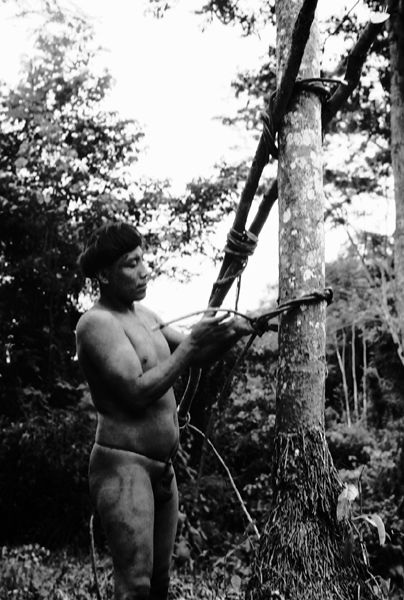
On one visit to Patanowä-teri in 1968 I was surprised at how much authority Krihisiwä wielded. The incident grew out of a request I made to film the process of harvesting peach palm fruit, an activity that involved the use of a set of ingenious climbing frames the Yanomamö have invented for this purpose. The climbing unit consists of a pair of triangular frames made from strong, light wooden poles. One of the frames is placed above the other and loosely lashed to the thorny peach palm tree. The climber squats on the lower frame and pushes the upper one up the trunk, then climbs onto the upper frame and pulls the lower one up, gets back onto that one and pushes the other one up higher, and so on. In this fashion the climber can slowly ascend the spine-covered tree, which can grow to forty feet tall.
Climb this tree or be banished.
Krihisiwä told a young man to make a pair of climbing frames and use them to climb the tree and harvest the now-ripe palm fruits. After Krihisiwä left, the young man refused to climb the tree, so I continued doing other work. Sometime that afternoon Krihisiwä asked me if I was satisfied with my filming of the young man climbing the peach palm tree. I said that the young man was unwilling to do it. Krihisiwä was furious and called the young man over and told him: “Either you climb that tree as I ordered you to or I will banish you from this village!” The young man promptly but nervously began to climb the tree as ordered. “Banishment” in this circumstance may have been a death sentence, since all the surrounding villages were at war with Patanowä-teri and the young man would have nowhere to go that would be safe.
Unokais
On a subsequent visit (in about 1986) I was checking details in a study I was doing on unokais. Long before then I knew the identities of every dead Yanomamö in my large sample of some four thousand people, and their causes of death as “diagnosed” by many informants in other villages. The Yanomamö attribute many deaths to various kinds of sicknesses and use a number of different words for these sicknesses. They also diagnose many deaths as the result of various forms of “harmful magic,” but some of these deaths are caused by ordinary things like snakebites.
All observers agree when someone dies violently at the hands of another. Most of the time it is something like “he was shot by raiders.” Less often, “He died in a clubfight” or “He died in a chest-pounding fight.” Further questioning quickly reveals the village that the assailants came from and what weapons they killed him with—and often the names of one or more of the assailants. When an informant in Mishimishimaböwei-teri tells me that a man named Matowä was killed with arrows by raiders from Patanowä-teri and an informant in Mömariböwei-teri, many miles away, also knows this from the news of killings and wars and tells me the same thing, not knowing what the other informant said, or even whether I had asked someone else about how the same man died, this means that there is great consistency among informants from different, widely separated villages on violent causes of death. I am careful to make these kinds of inquiries of informants in private, always asking people who are not close relatives of the victim.
The men keep accurate tabs on these mortal events because it goes into their calculus of what they might expect from dealings with their neighbors. They need to know who among them is to be treated deferentially (because he is a known unokai ) and who does not appear to be a threat. This kind of knowledge has obvious survival value. Members of a village in any given area know a great deal about the people in the next village over—and in many cases, had spent much of their lives living in the same village with the others before they split apart.
I eventually realized that the way I initially started collecting the information on causes of violent deaths did not permit me to exhaustively list the names of all of the assailants who shot fatal arrows into a victim. At the time I started doing this research I was primarily interested in documenting which village attacked which village and who was at war with whom. When I became interested in determining how many men were involved in the killing of every victim, my previously collected data listed only some of the killers. I had to fill in the missing names of all the killers of all the victims.
The task was relatively simple because I already knew the identities of who died at the hands of raiders, what village the raiders were from, and the names of at least some of the assailants. I had to revisit many widely separated villages by canoe and on foot to complete this work, but to have collected all of this data from scratch would have taken several years.
There is a Gary Larson cartoon that shows a couple of natives standing at the window of their thatched hut, grass skirts on, next to their TV sets. One says to the other: “Oh, damn! Here comes Margaret Mead. We’ll have to put those old bones back into our noses and invent some new stories about our kinky sex habits.” I could imagine a Gary Larson-style cartoon something like: “Oh, damn. Here comes that pesky Chagnon again . . . and this time his computer printout is three feet thick! He’ll be asking questions for a month!”
Krihisiwä’s Victims
Krihisiwä was easy to get along with and had indicated to me on previous visits that he was not reluctant to talk about the men he had killed. In fact, he seemed to be quite proud of these accomplishments.
When I began asking him privately about which men killed others he lit up and his eyes sparkled. This is how my conversation with him went that day.
Krihisiwä: Did I tell you how I killed three huyas from Ashidowä-teri? [A neighboring village that had been chronically victimized and dominated by Krihisiwä’s village. He had nothing but contempt for them.]
Chagnon: No, you never did tell me about that. What happened? (I suspected this would be a rather long story, so I settled in and got more comfortable in my hammock to take notes.)
Krihisiwä: These three huyas [holding three fingers up] showed up in our village wanting to trade for some of our things. They were all painted with nara pigment and decorated with their best feathers. They were very quiet and seemed to be nervous. My wife gave them some date [pronounced “dah-tay,” a sweet, boiled ripe plantain soup, rather like banana pudding, customarily offered to visitors]. That seemed to make them more relaxed.
Chagnon: What happened next?
Krihisiwä: Okay. I’ll tell you. They were sitting just under the roof overhang at the front of my house, squatting, and looking out over the plaza. They came to my house because I am the one who lives here! [A reference to himself as “the headman” here. He continued, becoming increasingly excited.] I could tell they were moyawe [alert, suspicious, apprehensive] and so I pretended that I was busy, straightening out my possessions, my hammock, my bow, cleaning the floor [ground] next to the hearth, rearranging things, etc. Without looking at them, I casually leaned my ax next to the front post . . . next to where they were sitting. [He stopped and looked expectantly at me, his eyes still flashing.] Well? Ask me what I did next!
Chagnon: [Going along with his request] Tell me, shoabe [father-in-law]: What did you do next?
Krihisiwä: I’ll tell you what I did next! I worked my way over to where my ax was leaning against the front post, pretending to ignore them. They looked back a few times to see what I was doing, so I continued to straighten my things out and moved away from the ax. [He paused to remove the large wad of tobacco he had tucked between his lower lip and teeth and placed the slimy wad between the roof thatch and an overhead roof pole. He leaned over and put his face up close to mine and whispered hoarsely, spittle and tobacco juice hitting my face.] Ask me what I did next!
Chagnon: Okay . . . what did you do next?
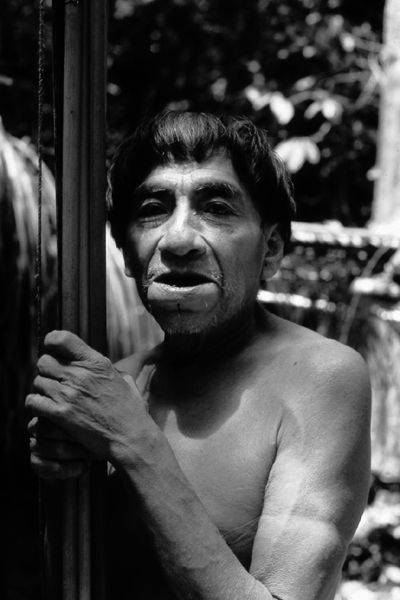
Krihisiwä, a Patanowä-teri headman
Krihisiwä: [Wiping the tobacco juice from his mouth and moving back where he had more room to act out the next scene, which would take more space] Let me tell you what I did next! Here’s what I did! [He moved over to the front post of the house we were in and pretended to pick up a make-believe ax.] They had become more relaxed and stopped paying attention to me. I moved over to my front post and clandestinely grasped the handle of my ax, like this. When they weren’t looking, I slowly raised it up! [He acted out the scene with great drama, and blurted:] Ask me what I did next!
Chagnon: [Feigning excitement and curiosity to go along with his increasingly dramatic actions, now sitting on the edge of my hammock] What did you do next?
Krihisiwä: [Taking a deep breath and then explosively shouting] Kraaashii! Kraaashi! Kraashi! I swung my ax down, burying the sharp edge of it into this huya’s skull! That’s what I did next! Kraaashi! Kraashi! [He paused, grinning excitedly.] Ask me what I did next!
When I asked him, he acted out, with equal drama, what he did to the other two Ashidowä-teri huyas. He buried his ax into the skulls of each of them in turn, as they frantically attempted to avoid his blows.
He killed all three of them where they were squatting, as visitors, in front of his house. He apparently did so for no reason other than the fact that he had contempt for their village because they were weaklings.
He calmed down after a few moments. We made small talk for a while, and then we called it a day.
I was trembling when I got up to leave, thinking about how convincing and deceptive a man like Krihisiwä could be while carefully calculating how he could brutally kill three innocent visiting Yanomamö youths he had put at ease—by treacherous deception—as they courteously visited his house as his guests, trying to show no fear. In some cases, showing no fear is fatal, even if it is prescribed by your culture and even admired as something that leads to higher prestige.
Several years later, in 1990, I was visiting the Ashidowä-teri, located several hours by trail upstream from the Dorita-teri (a Patanowä-teri faction). The Dorita-teri had threatened to kill me with axes on my last visit because a Yanomamö from Mahekodo-teri (a village at the Salesian mission of Platanal) had walked into their village and told them I was killing their babies with my photographs and poisoning their water.
On this subsequent visit to Ashidowä-teri I had some six medical doctors and two of my graduate students with me.
About a dozen or so Dorita-teri (Patanowä-teri) men, bristling with bows and arrows, unexpectedly showed up and marched dramatically, if not arrogantly, across the village to the house where I was staying, which belonged to the local headman. They pointedly ignored the Ashidowä-teri headman, a remarkable breach of Yanomamö rules of etiquette. The Patanowä-teri had received information that I was visiting there and had come to invite me to their village. I accepted their invitation. Then they left. The Ashidowä-teri were trembling after their brief and unexpected visit, which lasted less than a half hour or so. The Patanowä-teri completely ignored them, as if they were servants or untouchables.
There is a conspicuous pecking order among villages where I have worked: some groups are bigger, stronger, and more feared than others, and the reputation of headmen like Krihisiwä is a big part of the reason. Krihisiwä and several other “big men” in Patanowä-teri had the power and authority to compel followers to obey them because they would use sanctions to compel them to do so.
Möawä: A Tyrannical Headman
My first contact with Mishimishimaböwei-teri, a very large, isolated village in the headwaters of the Mavaca River, came in 1968. There were several prominent leaders in this village, but the most feared was a man named Möawä, whom I described earlier. From the very beginning I could tell that I would eventually have difficulties with Möawä. The success of my work would depend very heavily on how I got along with him.
Möawä was the son of Ruwahiwä, the Shamatari headman whose death at the hands of Husiwä I recounted earlier.
Möawä was forceful, intimidating, and downright tyrannical even with his own co-villagers. He took what he wanted when he wanted it, and few people in his village would resist him. People feared him because he was capable of great violence. When he spoke or commanded, people listened and obeyed, albeit with little enthusiasm and often grudgingly. When he threatened to take violent actions, everyone knew he meant what he said. When he was in a rare relaxed or happy mood, men obsequiously and cautiously gathered around him and directed their comments in his direction, as if they were hoping for—looking for—his approval. Men of great prestige and presence often command this kind of respect, but in this case it was more an expression of deference based on apprehension and genuine fear.
Möawä once visited Bisaasi-teri after the two groups made an uneasy peace in about 1968 or 1969. One incident that occurred then made his visit there remarkable.
It was not safe for some of the Mishimishimaböwei-teri to visit because many of the Bisaasi-teri could not forget their treachery at Amiana, where they held the 1950 nomohori —the treacherous feast—discussed earlier. After they had made peace on one visit by a small group of Mishimishimaböwei-teri, an enraged Bisaasi-teri man beat one of them so badly with the blunt end of an ax that he died en route back to Mishimishimaböwei-teri. Nobody avenged his death, which I found astonishing.
I was therefore stunned when Möawä showed up to visit Bisaasi-teri. Afterward, I asked the Bisaasi-teri headman, Kaobawä, why nobody molested him while he was there. Kaobawä explained that a notorious unokai like Möawä—who had killed twenty-one men—was fearless, and that other men, even his enemies, would be afraid to confront him face-to-face and would even cower in his presence.
As time went by I gradually came to know that Möawä’s reputation and authority were firmly grounded in his accomplishments as an unokai. In fact, there is no Yanomamö in my extensive records who had killed more men than he. Some of his victims had even been former residents of his own village who fissioned away from his group.
Because of his forceful bearing and martial abilities, Möawä was able to attract a large following and hold it together. This is what I mean when I say that a strong headman can help keep a village large—adding cohesion where kinship and marriage alliances alone fail to do so. His reputation as an unokai provided an increased level of security, or at least a stronger sense of security, for members of his village.
But the security he added was relative. There were visits I made when I had to put my pack and other containers between my hammock and the back of the roof lest raiders manage to get past the palisade and shoot me through the roof thatch. He might have been able to dominate men in his own village, but raiders from other groups were undeterred. He could not control the actions of enemies from other villages who would surreptitiously attack him when he was least able to deter their attack.
By 1972 Sibarariwä, a prominent man in Möawä’s village, had formed a new group that was located several hours southwest by trail from the main Mishimishimaböwei-teri group. It took on the name Ironasi-teri to emphasize that it was no longer to be identified by neighbors as a temporary group of the Mishimishimaböwei-teri. It varied in size as the families within it went back to the main group but then decided to remain with the Ironasi-teri and moved back again. This is quite typical when groups fission and families are torn between allegiances to kin in both groups.
Life for the obedient in Möawä’s village was secure but relatively apprehensive, but for the competitor, disobedient, or politically ambitious, residing in the same village with Möawä was dangerous. Competitors did not last long as co-residents because Möawä’s overbearing manner led to frequent disputes, arguments, and constant strife. Men with some measure of self-esteem sooner or later fissioned away to form their own village, or packed up and left to join some other village where they also had kin, or they would simply head into the jungle with their immediate families to cool off and get away from Möawä for a while.
At least three prominent men in his village—Sibarariwä, Nanokawä, and Reirowä—were like him, but not nearly so tyrannical or personally offensive. All of these men were related to Möawä through the male line and, accordingly, all of them also had many kin in the village. Many of the men related through the male line in all lineages tend to be competitors—except for lineage members who are either full brothers or half brothers. More remote lineage members are competitors for women and political status.
There was a complicated history of these three men joining and leaving Möawä’s village in recent years, a process of fission and fusion that hinged on how well they got along with Möawä.
My relationships to the village were largely predicated on my relationships with Möawä and his father-in-law, Dedeheiwä. Möawä called me “older brother” (abawä ) and Dedeheiwä called me “son-in-law” (hekamaya ). My relationships with Möawä were cold and strained, but with Dedeheiwä, friendly and relaxed. Dedeheiwä eventually became one of my most reliable informants as well as a good friend who frequently tried to smooth over my relationship with Möawä.
This was a situation unlike any other in my field experience. I was related as “brother” to many headmen in other villages and, with these headmen, I always enjoyed pleasant relationships. Möawä was a man I was never able to become friends with, but a man whom I could not avoid, even with deliberate attempts. He watched me constantly and demanded that I sleep in his section of the shabono, right next to his hammock. I always take up residence next to one of the headmen in every village I visit, but none of them have ever demanded that I do this.
He had an annoying way of demanding things that others would simply ask me to do, making it appear to others that I was obeying his command when I intended to do it anyway.
It was clear from the outset that he would have it no other way: I had to sleep where he could watch my every move, and to force the issue would have precipitated a premature crisis. Indeed, toward the end, virtually every conversation or social encounter with him was of the nature of a tense crisis.
My growing awareness of how unpleasant Möawä was, how selfish and self-centered, came on the first day during my visit in 1970. I always brought with me tubes of antibiotic eye ointment when I visited remote villages, and made a point to check each child’s eyes as soon as I arrived, treating those whose eyes were infected. When I left the village, I gave the leftover antibiotic tubes to selected adults around the village for future use by them and the children. Eye infections are very common among babies and, if untreated with antibiotics, cause great discomfort for months. Adults occasionally get the same infection, and the eye ointment was a welcome relief because it invariably cured the infections within a day or so.
On this visit Möawä had infected eyes and asked me to “cure” him as soon as I arrived. I did, and immediately the others began scurrying home to fetch their children. I began putting antibiotic ointment into the children’s eyes right where my hammock was strung—in Möawä’s house—whereupon Möawä barked a sharp, authoritative order and everybody scattered: “Get the hell out of here! That medicine is mine!”
He demanded all of the few tubes of eye ointment I had. At first, I thought he was joking, and I told him I was going to cure all the children and then give the adults the surplus tubes so they could continue to cure the children after I was gone. He was unflinching to the point of being obnoxious. He said he didn’t care about the others or even if all of them went blind, and he forbade me to give the medicine to anybody but him. He repeated that he wanted it all for himself. “Let them all go blind!” he hissed: “That mörösönö [medicine] is mine!”
So I gave him several tubes of the ointment on the spot, but I concealed and saved a few tubes for my final day in the village when I surreptitiously gave them to more socially responsible men for their families and other children.
My reaction to Möawä’s stinginess and cruel lack of concern for others in the village was not just my own appraisal of the situation. The Yanomamö themselves felt the same way about him and would privately let me know. Like parents everywhere, they are deeply concerned when their children are sick and when there is no available cure for the illness. They knew that my tubes of tetracycline ophthalmic ointment would cure their children and they were bitter when Möawä demanded it all for himself.
On another occasion I brought three triangular sharpening files with me on a trip to Möawä’s village. The files are used to sharpen axes and machetes and they are much desired by the Yanomamö, who would otherwise have to sharpen their blades against a rock outcropping, a very time-consuming process that does not produce a satisfactorily sharp edge compared to what a steel file can do.
I intended to give one each to Möawä and Dedeheiwä (Möawä’s father-in-law) and to keep the third one to loan to anybody who wanted to sharpen his machete. As soon as Möawä learned of the three files, he demanded that I give all of them to him—immediately. Seeing that this would possibly lead to a disagreement, I quickly gave one of them to old Dedeheiwä, to whom I had promised it, and one to Möawä, explaining publicly that the remaining one was mine, but I would happily loan it if someone wanted to borrow it.
Möawä immediately “borrowed” my file to sharpen his machete, even though I had just given one to him. After he finished sharpening his machete he announced publicly, with no small amount of authority and defiance in his voice, “This file now also belongs to me!” and stuck it into the rafters of his house above his head—next to the other one. He could not, however, appropriate the third one from Dedeheiwä because he was constrained by kinship prohibitions to respect his father-in-law.
Similar incidents developed around hallucinogenic seeds (hisiomö ) whenever I brought them to the village to distribute among the prominent shamans. This was a very large village—over 250 people—and had a large number of shamans.
They use these drugs in their curing ceremonies almost daily. While another hallucinogen, called yakowana, is found in their area, hisiomö seeds are more powerful and more desirable. They are abundant only in the Ocamo River area, far to the north.
Möawä always demanded all of the hisiomö I would bring, and I was obliged to clandestinely give portions of these seeds away to others before he discovered that I had them. I knew, as did the others, that he would claim them all and refuse to share them fairly with the other shamans.
After my first two visits to his village, each suggestion or request he made was more like a command that had no alternative but compliance. The more often I visited his group, the more annoying and outrageous were the requests and demands he placed on me. My relationship to him, in response, was one of attempted avoidance and carefully calculated compromises that were geared to satisfy the substance of his request, but to indicate in a delicate way that there was a point beyond which I could not or would not go, at least on that particular occasion. This behavior is straightforward Yanomamö politics, and I was very much aware of it as an anthropologist who had spent a good deal of time living with them.
Möawä was no different from other Yanomamö in his persistent requests and demands for my madohe. What was different was that I felt that the probability of his doing something violent if disappointed was much higher than for other Yanomamö because of his reputation for hotheadedness, ill-temper, and impetuosity. It was a contest that I knew from the outset I would ultimately lose. All I wanted was to buy time on each visit in order to satisfy my curiosity about his village and collect the data I felt were required to adequately describe the political history, genealogical ties, and demography of this and adjacent groups.
From 1968 to 1971 I was able to conduct my field study in Mishimishimaböwei-teri with a tolerable degree of success despite a gradually accelerating feeling that things were not going well between Möawä and me.
Like all headmen, Möawä carefully weighed his requests and rarely made one that did not turn out the way he wanted it to. I was at first startled and then very intrigued by this consistent pattern among headmen, since it took consummate skill and ability to size up each situation, day after day, and consistently appear to have one’s orders followed and requests satisfied. Kaobawä, the headman in Bisaasi-teri, where I began my work, was very accomplished at this and, in his dealings with me, he was very gracious and polite. Should there be any doubt in his mind that I might refuse one of his requests, it was never made in such a way that he asked for something and I refused. He would indicate, for example, that one of his friends from a distant village had arrived to visit and needed a machete, but he had none to give the man. Then he would pause, look at me, and say something like: “Dearest nephew, do you not have one lying around that you are not using?”
It worked every time, and I couldn’t refuse such a gentle, polite, and sincere request. Möawä, on the other hand, would use a different style, harsher and more coercive. He would say something like: “Older brother! Give that man your machete and be quick about it! Do it right now!” (An unstated “or else” was always implicit.)
My routine field procedure was to distribute the majority of the trade goods I brought with me on the last day of my visit to that village. Before then I would usually dispense smaller items like fishhooks and fish line so both the adult men and the smaller boys could use them while I was there. It is primarily the adult men whom one must satisfy with trade goods. Giving fishhooks and nylon fishing line to the children when I arrived enabled them to bring additional food home, which pleased everyone in the family.
In 1972, the third time I lived in Mishimishimaböwei-teri, Möawä’s patience had grown thin and he came to the point sooner than on previous trips: he bluntly ordered me, “Distribute all of your madohe right now and leave—but come back soon with more!” I was welcome in the village only so long as I had desirable items to give. Möawä insisted that I give them away immediately and almost all of them to him.
I tried to pace myself and nurse the situation along until it was time for me to leave the village so that my distribution of madohe came at a time when I had no more work projected and, therefore, I required no further approval from him or the people he could influence.
Even before my third trip to Mishimishimaböwei-teri, Möawä was constantly manipulating the status-establishing mechanisms, turning every conversation or personal interaction into a kind of contest to see if he could browbeat me into a new promise or to show me and, more important, show members of the village, where we both stood socially, demonstrating that he could order me and I would obey.
One annoying habit he fell into was to wait until a lesser individual made some request that I refused and then immediately make the same request. He seemed to seek out these opportunities, no matter how small and insignificant they were. They often began with my water supply. People would sit around my hut watching and listening to me interviewing people and periodically see what my reaction would be to a request for water. Nobody was thirsty, everybody had water, and the stream was just a few yards away. It was a pretext to test the relative status of individuals. If I complied with these innocent requests, the supplicant’s status would rise and mine would decline: his presence and authority were such that I, by complying, endorsed his higher status and my inferior status. Then all the others would immediately try the same thing.
I usually refused to give in to requests for drinks, not because my water was scarce and valuable, but because I knew that after the water came my food, then my matches, then my hammock, then the clothing off my back, and so on.
Möawä had the annoying habit of waiting for me to casually refuse a drink of my water to someone, then coming over to me and asking not only for a drink, but also for my personal drinking cup from which to drink it. It seems irrational now, even to me, but tiny, chronic events like these took on larger proportions in the field, where I had long since become aware of the acceleration of demands that would follow.
Whenever I lived in Möawä’s village (and in many other villages), I always had a crowd of cheerful, happy, and eager children in “my house” most of the day. They were a welcome contrast to the often-strained life in the adult world. I enjoyed chatting and joking with these cheerful children.
They became very fond of my salted crackers and other tidbits I gave to them. For example, I would ask them to wash my dishes and fetch water in the nearby stream and pay them with crackers. They enjoyed this and took turns. It didn’t matter who actually washed the dishes or carried the water; they all shared in the crackers, and we were all quite pleased with this arrangement. But after several days of this on one of my stays, Möawä rose suddenly from his hammock and drove the children away with angry threats, pelting them with hard fruit seeds, sticks, and whatever he could find on the ground near his hearth. He then turned to me and hissed: “If you have any crackers to give away, give them to me! These crackers shall be mine from now on, and don’t you ever give crackers to these brats again.”
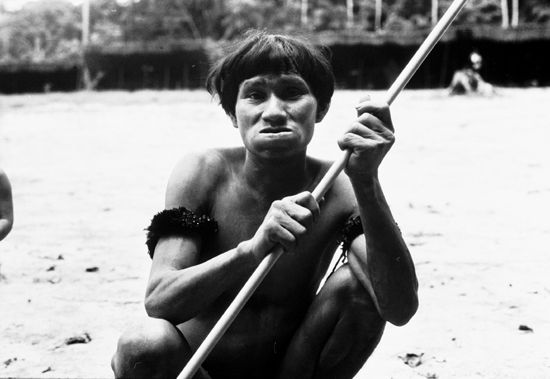
Möawä, the Mishimishimaböwei-teri headman
Möawä, too, had grown fond of my crackers and my other food, even though I was careful to share with him a portion of every one of the meals I prepared for myself. He now insisted on exclusive rights to all of the food I might share with others.
Möawä and My 1972 Blood-Sampling Trip
The last straw took place in 1972 when as soon as I entered the village, Möawä demanded that I immediately give away all of the madohe I had brought and go back downstream to Mavaca (a two-day trip) to get more.
Nineteen seventy-two was the last year I would be associated with Neel’s department and the team that did the blood sampling. I had decided to leave the University of Michigan at the end of this field season to take a position at Pennsylvania State University. But Neel had asked me to collect blood samples from about fifteen families of Mishimishimaböwei-teri who were not in the village when I took his biomedical team there a previous year. The missing people were primarily families living in Sibarariwä’s group in Ironasi-teri and had not been present when Neel’s team was with me.
I would do the sampling by myself and had brought with me the requisite number of Vacutainers, syringes, and disposable needles for this work, as well as “payment” to compensate the Yanomamö. The payment included some fifteen machetes for the male heads of the families from whom I would take blood samples. I had given machetes to the Mishimishimaböwei-teri male heads of families on the previous blood-sampling trip.
My plan on this trip was to visit Sibarariwä’s village for a short stay to collect the blood samples. I would take the blood samples back downstream and then return again to Mishimishimaböwei-teri. A special bush pilot flight had been arranged specifically to transport these blood samples. That meant I had to plan carefully around the date of the pilot’s arrival at the mission airstrip at Ocamo. Without a radio, I could not change this date. Taking the blood samples would require a long two-day trip from Mishimishimaböwei-teri downstream to Ocamo traveling ten hours per day in a voladora, a light aluminum boat powered by a relatively large outboard motor in the 25-horsepower range. And, after that, a long trip back up the same river to do my anthropological fieldwork.
My regular Yanomamö traveling companion was a young man named Rerebawä, as I have mentioned earlier. He enjoyed coming with me to visit the Mishimishimaböwei-teri—old Dedeheiwä was a renowned shaman, and Rerebawä was learning a great deal by just watching and listening to him. Rerebawä wanted to be a shaman as well and hoped that Dedeheiwä would be his mentor.
On our way to the village Rerebawä and I fortuitously encountered a number of Mishimishimaböwei-teri who were returning by trail from Iwahikoroba-teri, where they had just traded and participated in a feast. The feast had also included a large group of visitors from Yeisikorowä-teri, a remote and yet-uncontacted Shamatari village that lay several days to the south of Mishimishimaböwei-teri.
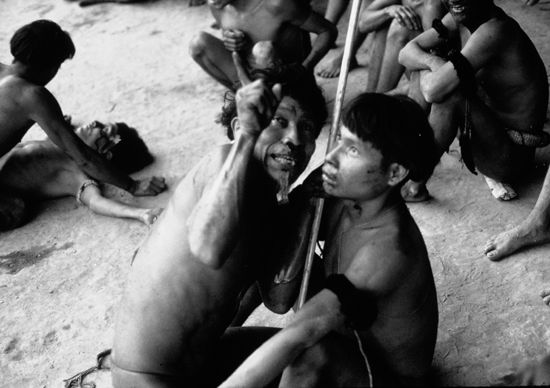
Dedeheiwä (center left), renowned shaman
Since the returning visitors would reach Mishimishimaböwei-teri before we did, I asked them to inform Möawä and Dedeheiwä of my plans, and that I intended to “live” with them in Mishimishimaböwei-teri after I collected the blood samples from Sibarariwä’s group. The visitors said they would also send young men in the morning to carry our equipment, for there was more than Rerebawä and I could carry in on one trip by ourselves. Although the medical research supplies were light, they were packed in very bulky Styrofoam containers.
It was already late in the afternoon so we decided to sleep next to the river to give us time to take the canoe, motor, and gasoline supplies out of the water, secure them, repack, and make camp. We gathered firewood, made a fire, strung our hammocks to trees, stretched a small tarp over them, and boiled some rice for dinner. I soon fell asleep. Rerebawä’s task was to add more wood to our small fire and to keep vigil for jaguars.
At dawn a party of men and boys arrived, many of them from Sibarariwä’s group. I had arrived at a time when Sibarariwä’s entire village was visiting Möawä’s group for a mortuary ceremony. That was good news because I would not have to walk another half day to reach their shabono. I could do the blood sampling in Möawä’s village.
When we reached the village, I had the carriers, as usual, put all of my possessions in front of Möawä’s house. Dedeheiwä’s house was the next one over from Möawä’s, which I always found somewhat puzzling because men should avoid their in-laws, particularly their mothers-in-law. Möawä was married to one of Dedeheiwä’s daughters, yet their respective houses were side by side. His mother-in-law, Dedeheiwä’s eldest wife, was already menopausal.
I explained my schedule and my plan to collect blood samples from the members of Sibarariwä’s village who had not been sampled the year before, and told Möawä that I would be taking the samples downstream immediately, explaining that I would return shortly after that for a much longer stay.
He appeared to understand and seemed to endorse what I was telling him, but his attention at that moment was fixed on the cluster of the fifteen machetes that were lying on the ground near my pack. The machetes were wrapped with vines to hold them together. He wanted to know what else I brought for him this year, whether I had any tobacco (their crop had failed) or any hisiomö seeds.
The machetes, I carefully and patiently explained, were intended for Sibarariwä and the others in his group, as payment for their blood samples, but I would immediately give one to him if he couldn’t wait for my second trip. I had no tobacco with me, but I would surely bring large quantities back with me when I returned and I would also try to get hisiomö for them as well because the plane I would meet would be landing at Ocamo, the center for trade in hisiomö.
While I was helping a few young men construct a temporary palm-wood shelf for my packs and supplies, Möawä decided that he wanted to examine the machetes, so he cut the vine bindings that held the three small packages together and laid all fifteen of them out on the ground before his hammock, examining each one carefully and admiringly. It was a discourteous and insulting thing to do—you don’t unpack and snoop through a visitor’s belongings. I told him again that they were for the other group but that I would soon be back with many more machetes, like the ones he was looking at, after I took the blood samples downstream: “The plane would bring me many machetes,” I said.
There was a crowd of men around his hammock, all of them from his group and none of them from Sibarariwä’s. His face turned solemn at the third repetition of my intended disposition of the machetes. He looked at me coldly and then bluntly informed me that the machetes were to be distributed to the men he designated and none of them were to be given to people in Sibarariwä’s group: they were thieves and liars, he said, and they were not to have any of these machetes.
I knew that matters were, after these several years, finally coming to a head. He went on. I was to give all of my madohe away immediately and not defer my distribution until I planned to leave. Moreover, the madohe was to be given to people that he named. If I had food to give away, he would see that it was eaten. He had also heard that in villages to the south, where the Yanomamö had foreigners living among them (from Brazil), the foreigners gave large numbers of shotguns to the Yanomamö. He informed me that he decided he wanted my shotgun and that I was to leave it and my ammunition with him when I left his village.
As he made demand after pointed demand I knew that this was going to be a delicate situation. I would not get any blood samples unless I was prepared to give trade goods in return, and I knew that as soon as I began paying for the blood samples according to my own plan, I might have a serious confrontation with Möawä.
Had I not promised Neel that I would collect these blood samples, the most appropriate course of action would have been to simply take my things and leave the village on the spot in view of Möawä’s outrageous demands and conditions. But I had too much medical equipment for me and Rerebawä to take back to the canoe without carriers from Möawä’s group.
To take blood samples or to make films with a filmmaking colleague, I needed as many as eight or ten local carriers into and out of the villages I visited. Collaborating with colleagues whose work entailed carrying large quantities of the items had reduced my own research goals. All I needed for myself was two backpacks and one guide.
That night Dedeheiwä and others again told Rerebawä of the attempt on my life in Iwahikoroba-teri the previous year (discussed earlier). Rerebawä once again whispered the story to me from a distance, over the jabbering in the village. I again heard that the Iwahikoroba-teri—Boraböwä and his brothers—had tried to kill me. It was annoying to be reminded of how plausible the threats to my life had become. They could be easily dismissed in the comfort and safety of Bisaasi-teri, but the Iwahikoroba-teri were possibly just a day or two away on a well-traveled trail linking them to the Mishimishimaböwei-teri.
I fell asleep worrying how I would be able to get the blood samples and still remain on good terms with Möawä. The unsuccessful attempt on my life by Boraböwä and his brothers the previous year had apparently impressed Möawä, and he had decided to drop any remaining veil of diplomacy and patience. Not only was I to distribute my possessions immediately, but I was to go back downstream to fetch tobacco and more trade goods for him.
I visited with old friends the next day, took a new set of ID photos of Sibarariwä’s group, and worked in the garden with Dedeheiwä, having him resolve questions that had arisen as a consequence of conflicting information obtained from several other informants the previous year—mostly informants from other villages. He also identified the Polaroid photographs of those members of Sibarariwä’s group—mostly children—that I did not yet know well, and filled in genealogical gaps and omissions in page after page of genealogies that I had converted to computer printouts.
I avoided Möawä all the next day and went to bed long after he retired. Just to let me know he was around and keeping track of me, he shouted at me occasionally to go to bed so he could get some sleep. I assured him I would be doing so very soon. He had developed the habit on the occasion of my last two visits of ordering me to go to sleep when he was weary of observing me. It was just one more way of letting me know that he gave the orders in the village. Objecting to the disturbance I made was a fairly thin pretext, since the village often would be rocking with loud arguments, chatter, and chanting to the point of being a din. But that noise didn’t bother him. The thin, silent beam of my flashlight on my notebook did.
Early the next morning Dedeheiwä told me that they were going to drink the remains of “someone” and I should get ready to take photographs if I wanted to do that. I was surprised by his suggestion because the Yanomamö don’t like outsiders taking pictures or tape-recording the passionate wailing and sobbing during a funerary ceremony. They do not even like outsiders to get close to the mourners. I asked him if he thought it would be advisable, and he assured me that it would. He would even stay at my side to make sure nobody became unduly hostile to me. He had apparently decided to make a stand on my behalf and let everyone know that he would protect me if I filmed the funerary ceremony.
For the few mortuary ceremonies I witnessed, I always remained at a comfortable distance and just watched. I think that Dedeheiwä was deeply concerned about Möawä’s unpleasantness toward me and did this to show me that he had considerable authority in this village, but perhaps more important, to remind Möawä and the others that he did.
The deceased had to be someone important. I asked Dedeheiwä in a soft whisper if the deceased were a man named Reirowä, a logical guess in view of the kinship ties among the assembled mourners, who were all prominent men in the same patrilineage. Dedeheiwä indicated quietly by nodding that my guess was correct.
Just before the ceremony began, Dedeheiwä came over to tell me to prepare my camera equipment. He told me he was increasingly concerned about the way Möawä was treating me and asked me privately to overlook it. He also urged me to take the blood samples in the afternoon, after the ceremony was over, because people would be dispersing and would not be going directly home. This was almost a full week earlier than I had planned to take the samples and would complicate the schedule for flying them out.
I quietly asked Dedeheiwä if he would come with me to Mavaca and work with me, away from the village, to reconcile a large number of questions that my premature departure would leave unanswered. He agreed to come.
I photographed and filmed the mortuary ceremony. Dedeheiwä remained at my side for most of it. A number of young men, emulating Möawä, made verbal objections while I filmed, but Dedeheiwä scolded them and told me to ignore them. Surprisingly, none of the patas (prominent men who were leaders) or browähähä (young men striving to be leaders but not as prominent as patas ) objected. When it was over, Dedeheiwä conspicuously escorted me back to my section of the village.
I told them that I would begin to collect the blood samples late in the afternoon and continue this work the following morning. Luckily, some of those to whom Möawä ordered me to give machetes were men whose blood samples I intended to collect.
I told these men that I wanted samples from them, their wives and their children, and would give only the heads of households machetes, as my “younger brother had instructed me to do.” The women would get small glass beads and the children fishhooks and fish line. While I prepared the equipment for sampling, most of the men of the village were by now busy taking hallucinogenic drugs and violently striking down hekura spirits sent from enemy villages. Everyone seemed to be in an unpredictable, surly mood after the mortuary ceremony.
There were over 400 people in the village at that time, the largest group of Yanomamö under one roof (shabono ) I had ever seen in an isolated and unacculturated village.
It was one of the most volatile situations I have ever been in. To make matters more tense, a terrible fight broke out between Dedeheiwä’s wife and several of the visiting women from Ironasi-teri. Dedeheiwä’s wife screamed at the Ironasi-teri women across the village, “You ugly bitches! Always demanding more than your share of the meat! You come here and eat us out of house and home, and insult the people who feed you by demanding more than what they themselves eat! We work while you lie around flirting with our men. Your foreheads are filthy! You are all shami [filthy, polluted].”
They replied in kind, the insults growing hotter and more vitriolic until some of the women began picking up pieces of firewood and threatening to attack their adversaries. Dedeheiwä, reeling from the effects of the hallucinogenic snuff, staggered all the way across the village plaza and shouted at his wife: “Shut up! Stop insulting them! I’ll have to beat you if you keep up that kind of talk!” He had to make several trips to convince her that he meant what he said.
He was well advised to stop the argument, for it was rapidly approaching the point where the women would start hitting each other with pieces of firewood, and then the fight would have extended to the men. In congregations of Yanomamö this large, and with most of the men high on drugs, such a fight would have been disastrous because there were many old, smoldering, personal grievances among the men, grievances that invariably involved previous illicit seductions or suspected seductions.
The fight among the women had to do with the distribution of the meat at the mortuary ceremony. The women from the visiting group felt that they had been slighted and had gotten less than the women from the local group, which was probably the case. There was a message in this manner of meat distribution, and it said that the visitors were no longer welcome and should return to their own village and eat their own food as soon as this event ended.
In the midst of this unhappy and volatile assembly, I pondered what to do about the blood samples. It seemed unlikely that I could persuade Sibarariwä and his group to remain at Möawä’s for another week to accommodate my schedule. He and the members of his group were now being openly insulted by the locals. I could leave Möawä’s village to go to Sibarariwä’s village except that his group planned to split into several smaller groups and go in different directions. From this remote village, there was no way to contact the pilot and change the schedule I had earlier established with him. I would probably have to take the samples early, as Dedeheiwä suggested to me. I knew the mission downstream had refrigeration and could make ice. I would have to rely on that to keep the samples from spoiling.
As I was pondering what to do, Möawä and a few of the lesser leaders told me that they had invited the Iwahikoroba-teri to come for a feast, which they had not mentioned to me until now. The Mishimishimaböwei-teri told me that the Iwahikoroba-teri would have to pass by the spot at the river where I had left my canoe and would then know that I was visiting Möawä’s village. Möawä reminded me how angry the Iwahikoroba-teri were with me, and how some of them might lie in ambush when I left and shoot me with arrows as I descended the Mavaca.
The Yanomamö sometimes fire volleys of arrows at people—strangers—in canoes even on the well-traveled Orinoco River. But, because the Orinoco is wide and the canoes are usually some distance from the bank, nobody gets hit—neither the Yanomamö nor the Europeans with them. I’ve been shot at this way a number of times, but it was likely that the archers were only expressing their frustration that I was bypassing their village to avoid the predictable begging from them. At least, that explanation was comforting to me at the time.
But the Mavaca River at this distance from the mouth was a tiny stream—hardly more than a canoe’s length wide for the first day’s travel. It would have been difficult for an archer to miss at that range.
Möawä could tell that this information annoyed and disturbed me. If I stayed for another week I would surely have to confront the Iwahikoroba-teri visitors. Initially, when such a possibility seemed to exist, Möawä and his supporters told me that they would make sure that the Iwahikoroba-teri would not harm me. Then Möawä began hinting around that while I might be safe within his village, there would be nothing he could do to prevent the Iwahikoroba-teri from ambushing me between the village and my canoe or downstream from it. When these hints became more pointed I decided to collect the samples immediately and leave Mishimishimaböwei-teri as soon as possible. Möawä calculated that he would get the fifteen machetes, as he planned.
When I moved my blood-sampling equipment over to an unoccupied section of the village, I was surrounded by about two hundred pushy, impatient, squabbling people—mostly older men and huyas, each determined to get a particular item of which I had very few to distribute.
They jabbed and poked me constantly as I worked, each person demanding items, while I methodically continued to draw the blood samples. It was very hot that day and there was no breeze. They were crowded in so close I could not move an inch in any direction. If I hunched over to take a close look at a vein in someone’s arm, the space I just evacuated was immediately filled with sweaty Yanomamö bodies.
To make matters worse, everyone was breaking wind, a characteristic reaction to the food at feasts and mortuary ceremonies. A hundred or so men were farting at very close range. Anxious as my situation was, I recall breaking up with uncontrollable laughter at one point when I complained about the foul odor they were eliminating in such cramped quarters.
One of them, a young guy I knew well, immediately stood up defiantly and retorted cynically: “Farting? Who’s farting? Why, we Yanomamö do not even have assholes in this village, so how could we fart?”
The genuine humor of his retort and my hilarious reaction started them all laughing, momentarily easing tensions. Tears were running down our faces we were laughing so hard.
When I began the blood sampling, Möawä had come over and repeated his instructions firmly: the machetes were to go to the men he specified, nobody else. He watched as I took the first few samples, so I deliberately chose local men that he had specified, but men whose samples I intended to collect anyway for the special paternity study. He seemed to be convinced that I was following his instructions and left to rejoin the drug taking, chanting, and calling to the hekura. He came back once again to check on me.
When I ran out of the men Möawä had chosen (and their wives and children), I then had to choose my patients very carefully. From my knowledge of past disputes in the group when Sibarariwä and his faction lived in the same village with Möawä, I knew who the men were that had stood up to Möawä in the past, men he could not easily dominate. I began calling them, in turn, gambling that Möawä would be less able to prevent me from giving my machetes to these men and hoping that these men would encourage the rest of their group to cooperate with me when the machetes ran out.
Instead of taking their families in turn, as I had done before, I quickly sampled the important men and paid them with machetes without sampling their wives and children at that time.
I was down to one machete when someone told Möawä what I had done. He trotted over in a rage and stared in disbelief at the single machete that was still lying on the ground at my feet. He glared at me with hatred in his eyes, and I defiantly glared back at him. He was clutching an ax in his hands and was trembling with anger. We stared at each other for some moments before he hissed: “You aren’t following my orders, you son of a bitch! And don’t you ever look at me that way!” He then raised his ax to strike, and I saw how white his lips and knuckles were. He hissed at me: “Either you give that machete to that man over there, or I’ll bury this ax in your skull!”
Needless to say, I gave the remaining machete to the man he specified, but not before leisurely taking his unneeded blood sample to make it look as if it were part of my intended routine.
I worked late into the night and went to bed long after Möawä was sleeping. I remember feeling somewhat confident that he wouldn’t try anything that night, since he was out of tobacco and he knew that I had promised to come back with a large quantity of it for him. After all, had I not invited Dedeheiwä to come along with me, and would I not have to bring the old man back up to the village?
The next morning I finished the blood sampling, but there were only odds and ends of trade goods left, so the crowd was much smaller. They were impatient to have me finish so that I could leave the village, go downstream, and collect more madohe for them. Möawä’s blatant display of hostility had impressed the younger men and even some of the yawäwä —adolescent boys who had only recently begun tying their penises to their belly strings. These young guys were now emboldened and openly insulted me. I know of at least one war that started when boys this young openly insulted an adult prominent man—Kaobawä—when he visited their village to ask for plantains.
They repeatedly told me to hurry or else the Iwahikoroba-teri would surely catch me between the village and my canoe.
It was noon and raining before I stopped drawing blood samples. Möawä was so desperate for tobacco that he asked me for some of my pipe tobacco to chew. I refused, saying I had run out, but told him I would give to him a whole can of it that I had left at the river. He refused to walk out to collect it, but sent a youth along to bring it back for him.
We walked to the canoe in a dreary rain, not quite a downpour but more than a mere drizzle. Everything was soaked by the time we made it to the canoe some four hours later.
I carefully loaded my things into the canoe and asked Dedeheiwä to get in. Just as I was about to push out into the current, my canoe prow pointed downstream, the youth whom Möawä had sent stepped forward and asked for the can of tobacco I had promised to Möawä. I told him that I needed it and had decided not to give it. If Möawä wanted it that badly, he should have come to the river to get it himself.
I knew that when this remark was passed along, it would anger Möawä. I had no intention of coming back to the village so long as Möawä lived there.
When we reached the mouth of the Mavaca and the village of Bisaasi-teri, I worked with Dedeheiwä for longer than I told Möawä I intended to. I figured that if anybody were going to lie in wait along the riverbank to take potshots at me, they would have to wait for some time. It was foolish to follow a schedule that I had announced in advance. After I had worked for about a week with Dedeheiwä, Rerebawä told the Bisaasi-teri how Möawä treated us and how he threatened to kill me with an ax. They were angry and kept telling me, “We told you so!”
Seeing that the Bisaasi-teri were growing openly angry at his own fellow villagers, Dedeheiwä told me that he wanted to go home. Although the Bisaasi-teri liked him because he had helped some of them escape the horrible 1950 treacherous feast, he felt uncomfortable.
I dreaded the trip back upstream and worried about it all that week. At night I would dream about raiders behind every tree, of ambushes at every bend in the river where Iwahikoroba-teri hunters had been periodically seen in recent years. I would have to pass through this area for at least six or eight hours of river travel with the fastest boat I could find and chop my way through new deadfalls; the river would be very narrow from that point on. The Iwahikoroba-teri probably knew by now that I would be bringing Dedeheiwä back upstream soon.
For the long trip back upstream I decided to leave my heavy dugout behind and mount my 18-horsepower motor on my small sixteen-foot aluminum rowboat. The dugout was too heavy and too slow for this trip. I had already left supplies of gasoline hidden along the riverbank, the only way that such a small boat could make such a long trip because it could not carry enough fuel to travel upstream and back without additional fuel.
I again asked Rerebawä to come along. He had grown to hate Möawä. He was very disturbed by Möawä’s threat on my life and did not care if he ever saw him again. He told me that when Möawä raised his ax as if to strike me, he had grabbed my shotgun and was prepared to shoot him if he tried to hit me with the ax. He probably would have had no choice, because if Möawä had killed me, he would also have killed Rerebawä because he was my friend.
Rerebawä, Dedeheiwä, and I set off for Mishimishimaböwei-teri and the upper Mavaca, where I would let Dedeheiwä off. I did not tell him, but I knew I would not be seeing him for a very long time.
It was a long, anxious trip for me. The river had dropped markedly during the week, and that high up in its course it was again choked with logs and new deadfalls. After chopping our way through many of them we finally came to one that could not be passed without several hours of chopping. It was only a few minutes by boat below our final destination, so I put Dedeheiwä ashore at this point and gave him the tobacco I had obtained from the Bisaasi-teri.
It was difficult for me to watch my old friend disappear into the jungle, perhaps never to see him again. He also seemed very sad. I couldn’t tell if it was because he suspected that I would probably not be back for a long time or because he accidentally dropped his large bundle of tobacco into the bottom of the canoe and got it wet. All he said when he got out of the canoe was: “Ya nobreäö.” It means something like, “I’m really bummed out about this.”
Sibarariwä
Sibarariwä was a legend among the Yanomamö in the Mavaca area. I knew quite a bit about him even before I met him because my local informants in Bisaasi-teri talked about him all the time. They despised him because he had engineered the infamous nomohori and, with his co-villagers and allies, killed many Bisaasi-teri, and abducted many of their women that day. Of all the Shamatari they wanted to kill, he was at the top of their hit list.
When I first decided to try to find his village and visit it, my local informants, genuinely concerned about my safety, tried to dissuade me. They assured me that he would kill me if I visited his group. He would probably kill me at night, when I was sleeping and off guard.
When I first contacted the Mishimishimaböwei-teri in 1968, Sibarariwä appeared from the forest, in a drizzle, and silently took up the hammock next to me. Nobody had to tell me who he was—I knew it was Sibarariwä by the hush that fell over the camp the moment he arrived and by the darting, nervous glances the other men made in his direction.
It took me almost twenty-five years to gain his confidence, probably because I started my field research career in a village whose members were his mortal enemies, Bisaasi-teri, and he identified me with these people and their headman, Kaobawä. I saw Sibarariwä periodically on my regular visits to his area after 1968, but he was always aloof and didn’t warm up to me like the others did.
The last time I saw Sibarariwä was in 1991, after I had made several trips by helicopter into the unexplored Siapa area. In 1991 he surprised me because he had never been openly friendly with me until then. It was a brief, hurried encounter. I was just passing through his village on my way back by helicopter from several extremely remote villages in the headwaters of the Siapa River far to the east of Mishimishimaböwei-teri. This was the area where Sibarariwä had been born some seventy or more years earlier and whose residents and history he probably knew better than any man I had yet spoken with. He came up to me for the first time, happy and excited, and said he had been watching me a long time. I knew, because I watched him watch me for a long time and he usually said nothing. He just watched me with no expression on his face, avoiding conversations whenever I would ask him something. Whenever I spoke directly to him he usually gave a simple one-word answer and then moved farther away to watch me from a distance.
But on this occasion he knew I had just returned from the Siapa headwaters and had just spent a month living among several villages whose oldest residents were his boyhood friends—and most of whom were his kinsmen. Now, he announced enthusiastically, he wanted to tell me the “truth” about all the things he had heard me asking others for such a long time. He promised me he would do so the next time I came back, quickly rattling off a dozen extraordinary facts just to whet my appetite. Unfortunately, we never saw each other again after that.
The few facts he volunteered on that brief meeting made it clear that he knew much more than I suspected he did and that he had thoughtfully identified aspects of his group’s history that he knew I didn’t quite have straight. I was disappointed that my 1991 field season was ending but I eagerly looked forward to my 1992 trip and hoped to spend several weeks in Kedebaböwei-teri, his current residence, working intimately with him about the history of his people and the history of those in the surrounding villages—including villages that had long since migrated far to the south into Brazil.
But by 1992 the Salesians had turned against me after twenty-five years of generally cordial relationships for reasons I will explain in the next chapter. Because of their influence, for the first time in more than twenty-five years of field research among the Yanomamö I was denied a research permit for the following year.
This clash was, perhaps, inevitable. The Salesians had been attempting since 1973 to relocate the Shamatari villages I was studying. The Salesians at their Mavaca mission persuaded about half of the Mishimishimaböwei-teri to move out to a navigable portion of the upper Mavaca River. I visited them when I returned to the area in 1974 and was both surprised and annoyed that the missionaries had enticed them to move from their safer location deeper in the interior with a promise to feed them with plantains they would transport by boat from their distant mission at Mavaca. The Yanomamö moved out to a navigable stretch of the upper Mavaca River without first clearing gardens. Ordinarily a Yanomamö village moved only after its gardens at the new location were producing reliable quantities of food.
There was great anguish and mourning when I arrived in 1974 at the new village without a garden. Many of the older men were chanting passionately to their hekura spirits to drive off the sickness that had just killed several infants the night before. Two or three funeral pyres were burning the tiny bodies. I solemnly approached one of them to express my personal grief and squatted silently near it and lowered my head to mourn for the dead child. I could see the infant’s tiny, lifeless hand and lower arm protruding from the stacked pieces of hastily gathered firewood that surrounded it. I watched the flames gradually grow, lick at, and then consume the little hand. It turned from talcum white to brown, split open, oozed bubbling fluid for a few seconds, and then disappeared in the flames.
It was Sibarariwä’s newest child, his twenty-third offspring, about two months old at its death. Sibarariwä had tears streaming down his tired, drawn face. He danced methodically around the pyre, chanting in despair, his face rhythmically turning from the funeral pyre upward, to the sky, his outstretched arms pleading and supplicating his personal spirits with mournful injunctions, punctuated with quieter melancholy incantations.
Our eyes met for a brief instant, long enough for me to communicate my sadness to him and for him to acknowledge it in a seemingly understanding momentary glance. He turned away and continued to chant sorrowfully. I squatted motionless until the pyre burned down while he danced in his despair around it. I then quietly left.
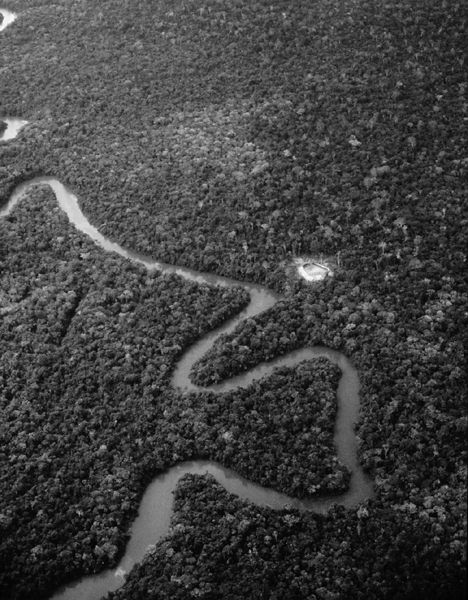
Shabono with no garden at Mishimishimaböwei-teri
He would come back later, when the ashes cooled, and recover the unburned bones of his child and grind them into a fine powder. He and the infant’s mother would solemnly consume them and weep. The child would never be mentioned again.
The short-lived group abandoned this place without a garden soon afterward for it portended sickness and death. They returned to their previous, more remote location, which could not be reached by boat.
Sometime in the early 1980s the Salesians again persuaded a faction of the Mishimishimaböwei-teri to move to a navigable portion of the Mavaca River and established a small mission post at a place they named Mavakita—“Little Mavaca.” It was about halfway up the Mavaca River from where it joined the Orinoco River. This small group took the name Haoyaböwei-teri, the name of the tiny stream where they settled. This stream flowed into the Mavaca just across the river and slightly upstream from the Salesian satellite post of Mavakita.
At approximately the same time another large faction of the Mishimishimaböwei-teri had moved to the northwest into the headwaters of a small affluent of the Mavaca called Kedebaböwei kä u and took the village name Kedebaböwei-teri. (These were the former Ironasi-teri.) Sibarariwä and his large family lived in this group.
In 1987 the Salesians at Mavaca persuaded the 175 or so residents of Kedebaböwei-teri to move out to the banks of the Mavaca, a short way upstream from where the Haoyaböwei-teri were living. I spent about a week with them in 1987 at this new location. The Salesians had persuaded them to plant nothing but bitter manioc and planned to have them grind it into manioc flour with machines the Salesians provided so the Salesians would be free of their dependence on the Ye’kwana, who provided the manioc flour used by the missions.
By 1992 my long-term good relationships with the Salesians had come to an end. The Salesians wanted the Yanomamö and the Amazonas territory all to themselves. And a growing number of pro-Yanomamö advocacy groups and the anthropologists who worked for or with them wanted to be associated with the now-famous Yanomamö. Their interests overlapped with the interests of the Salesians.
The Salesians had removed Padre Cocco from the Ocamo mission in about 1975, against his wishes, and offered him an administrative post in Caracas. They replaced him with another Italian priest, Padre José Bórtoli. It broke Padre Cocco’s heart to leave his beloved Yanomamö. He decided to go back to Italy. He was weary and in failing health from many years of exposure to malaria. I was a visiting professor at Cambridge University in 1980 when I received a handwritten note from a nun in Italy. She had been the mother superior of Padre Cocco’s mission at Ocamo and his lifelong friend. She had retired immediately after the 1968 measles epidemic in Venezuela, which struck first at Ocamo. The measles epidemic exhausted her physically because of her heroic and time-consuming efforts tending to the sick Yanomamö there.
A visiting Italian biologist at Cambridge translated her letter. She informed me that Padre Cocco had died. She said that she wanted me to know that he was very fond of me and that I would want to know of his death.
The Italian biologist who orally translated her letter to me had tears in his eyes as he read her letter to me because her letter, handwritten in nineteenth-century script, moved him very much.
14
Twilight in Cultural Anthropology: Postmodernism and Radical Advocacy Supplant Science
How I Became a Sociobiologist
My theoretical views on the anthropology of human behavior became increasingly affected by new discoveries in theoretical biology, including the rapidly growing awareness among biologists and some anthropologists that the “unit” on which natural selection operated most effectively was the individual, not the group.
The traditional anthropological view of natural selection emphasized the importance of the “group,” “society,” and “culture.” By the mid-1970s anthropologists in general were increasingly hostile to the works of E. O. Wilson, Richard Dawkins, George Williams, and William Hamilton, who represented the new thinking. In my research and publications, however, I became increasingly supportive of their work. Not surprisingly, a growing number of cultural anthropologists, including some prominent ones like Harris, Sahlins, and Clifford Geertz, began singling out my work for criticism because of my support for Wilson and the others.
By the 1980s and early 1990s, I began detecting a shift in the Salesian attitudes toward my fieldwork and my frequent returns to the Yanomamö area. While the Salesians had their own reasons to oppose me (such as my discovery of Yanomamö deaths caused by shotguns the Salesians provided and their concern that I might report this discovery to the authorities), I learned that they had begun using my “unpopularity” in academic circles for their own purposes. To the Salesians, subscribing to the theory of evolution meant, among other things, holding the view that humans could be compared to monkeys, apes, and other animals, and frequently were. They began to inform the Yanomamö at their missions that I wanted to show that the Yanomamö were comparable to monkeys. One of my long-time Yanomamö acquaintances at the Salesian mission at Ocamo angrily denounced me in the late 1990s, claiming that “. . . you think we Yanomamö are nothing but animals!” I was dumbfounded at this accusation and asked him what he meant by that claim. He replied, “Bórtoli showed us in your book where you said this about the Yanomamö!” Neither Bórtoli nor the Yanomamö understood English, so Bórtoli must have rather liberally reinterpreted something I said. Recall that the Yanomamö make a profound distinction between things that are wild, feral (urihi tä rimö) and things that are cultural, human (yahi tä rimö) . They find it offensive if you do not respect this distinction.
By the early 1990s, I was not welcome at the Salesian missions and took precautions to avoid them whenever I could. After all, a Salesian priest had announced in a prominent Caracas newspaper that the Salesians “could not guarantee Chagnon’s safety if he were to pass through one of their missions.”
Genealogies and Sociobiology
It was very clear to me that the Yanomamö were a “demographically pristine” population in the sense that they had not been subdued and decimated by some national military force, had not been forcibly settled on reservations, and had not been ravaged by introduced epidemic diseases. Moreover, their population was steadily growing, an indication of “demographic health.” Thus, my routine collection of genealogies followed what I regarded as the universal anthropological tradition as described in many discussions of the “genealogical method.”
My genealogical data could be used to express precisely what cultural anthropologists meant when they spoke of the intimacy and solidarity tribesmen felt for each other when they were “close kin” as distinct from “distant kin or non-kin.” I could, in fact, express precisely how closely or remotely any pair of Yanomamö were related to each other because genealogies, like pedigrees used by animal breeders, were susceptible to precise quantification. Indeed, I was astonished that cultural anthropologists had failed to use these quantitative measures when almost all of them solemnly endorsed the anthropological truths that (1) social relationships in the tribal world were “embedded” in kinship institutions, that (2) closeness of kinship was the central component in “social solidarity,” and (3) the political state emerged only when the “tribal design” based on kinship, descent, and marriage among related neighbors was supplanted by nonkinship institutions such as law, labor unions, police, armies, craft guilds, political parties, etc. In short, cultural anthropologists maintained that the political state and civilization were possible only when kinship-based social institutions were overthrown and replaced with these non-kin social institutions.
In my opinion there were two reasons why American cultural anthropologists in particular failed to take advantage of quantitative measure of kinship (and genealogies) and use them in their theoretical analyses.
One of the reasons—perhaps the more important one—had to do with the nature of the tribal populations that many of the founding theoretical figures in American anthropology studied. In general, they did their field studies in the Americas long after the tribes they studied had been decimated by epidemic diseases, defeated by the U.S. Army, forced to settle on reservations that often included remnants of other, unrelated tribes, had been exposed to the effects of colonial expansion and other forces of acculturation, and in the Southwest, hundreds of years of mission efforts by various orders of the Catholic Church whose practice was to attract Indians to live at their missions. Much of this work was “salvage ethnography”—a major attempt to document the last gasp of formerly large Native American tribes. Thus, in their own fieldwork it was probably futile to view kinship relationships as hardly more than a “polite” system of classifying mostly genealogically unrelated neighbors into categories that had, in most cases, no correspondence to genetic (biological) reality. The much touted “genealogical method” was, on closer inspection, more of a British colonial method: British anthropologists historically studied very large tribes in Africa that tended to be more demographically pristine than were the tribes in the Americas.
A good example of this comes from Marshall Sahlins’s fieldwork in Hawaii in the 1950s, where the surviving native Hawaiians had suffered the ravages of introduced epidemics, decimation by the violence of colonial invaders, and the excesses of both Christian missionaries and colonial governments. While Sahlins’s field research occurred much later than that of the “founding” anthropologists just mentioned, it was similar in the sense that the culture he studied was basically in shreds and patches compared to pristine tribesmen. It is not surprising to me that Sahlins and other anthropologists concluded that in their own field studies of tribesmen, kinship did not seem to be very important. But why, in their theoretical claims, did they emphasize how central it was to understanding the tribal social design?
The second reason for not valuing kinship studies is that cultural anthropologists—as distinct from biological anthropologists—trained in the United States eschew quantitative measures of genetic kinship because of the widespread biophobia built into cultural anthropological theory, which results in deep suspicion and contempt for biological ideas. This peculiar contradiction has been characteristic of anthropology for over a century. For example, many undergraduate textbooks in introductory cultural anthropology go to considerable lengths in their discussions of kinship to emphasize the “nonbiological” dimensions of it by giving such examples “that in many African tribes, people call their mothers by the same term they use for their fathers.” One of the acknowledged U.S. authorities on kinship, David Schneider, summed up this widespread attitude in anthropology by repeatedly arguing, in effect, that “whatever kinship is about, it is not about biology.”
In 1975 Edward O. Wilson, a world-renowned specialist in ants and a distinguished biology professor at Harvard University, published his book Sociobiology . It rapidly became controversial in the social sciences especially among a small number of mostly Marxist academics. It was a masterful and comprehensive overview of the history of evolutionary thinking, explanatory milestones achieved by scores of researchers in the recent histories of biology, demography, ecology, taxonomy, theoretical genetics, animal behavior, psychology, sociology, anthropology, and other fields. Apart from being stunningly erudite, it was a politically innocent book in the sense that it simply illustrated how recent ideas in evolutionary theory had developed and how they might be applied to better understand how human beings in particular evolved to have the social capacities and characteristics we see in ourselves.
A few of the ideas discussed were found in some of Wilson’s previous publications, but most of the book was about the accomplishments of others and how their findings and accomplishments were leading to a grand “synthesis of knowledge” that shed new light on human nature.
I remember having discussions with several senior anthropologists, Sherry Washburn among them, whose reaction to Wilson’s book was initially enthusiastic. But once the implications of the last couple of chapters were publicly discussed, prominent academics in anthropology began to distance themselves from Wilson’s book. One of the reasons was that Wilson over-simplified a number of features of tribesmen; this annoyed some anthropologists, but even more annoying to them was Wilson’s claim that sociobiology would most likely become the overriding and comprehensive theoretical framework in the life sciences, one that would subsume other sciences—including anthropology and sociology—as subordinate components in a new field he called sociobiology.
But because anthropology—here I specifically mean cultural anthropology—had always been suspicious of theories and ideas from biology, a negative reaction against Wilson’s new book spread swiftly in anthropology. The criticisms often had contemptuous undertones, almost as though Wilson had violated some sacred rule that cultural anthropologists held inviolate.
A classic example of anthropological arrogance and cynicism about Wilson’s work was a book by Sahlins titled The Use and Abuse of Biology: An Anthropological Critique of Sociobiology (1976). After reading Sahlins’s book I was embarrassed that he was one of my former professors.
Sociobiology soon became a term used by anthropologists as shorthand for almost everything hateful in the history of Homo sapiens: wars, fascism, racism, colonialism, capitalism, eugenics, elitism, genocide, etc.
The 1976 Meeting of the American Anthropological Association
As I mentioned, I left the University of Michigan in 1972 to join the anthropology faculty at Penn State. I was given considerable latitude in helping my new department develop a program devoted to the scientific approach in anthropology. Penn State already had outstanding scientific programs in archaeology, spearheaded by William Sanders, and in physical anthropology, chaired by Paul Baker, who founded the Penn State anthropology department and headed it for many years.
One of the first appointments I recommended to fill a vacant slot in cultural anthropology was Bill Irons, who had entered the graduate program in anthropology at Michigan in 1963 when I did. He had become a good friend who shared my view of anthropology as a science. We had both been trained to see “culture” as the prime determinant of human behavior, but we had become skeptical about this view and had begun exploring the new developments in theoretical biology, especially the works of George C. Williams and William D. Hamilton. I was particularly interested in Hamilton’s theory of “inclusive fitness,” also known as “kin selection,” because it laid a new basis for understanding why kinship relationships provided the rock-bottom source of social solidarity. Our training had emphasized the role that culture played in human social relationships while completely ignoring the evolution of human behavior. The view from anthropology was that psychologists studied human behavior and anthropologists studied culture. Ever since Durkheim, cultural anthropology was skeptical about not only psychology and biology, but any theory that emphasized the biological underpinnings of behavior.
Both of us were avidly interested in potential applications of what Edward O. Wilson had called “sociobiology” to a number of problems in cultural anthropology. We organized what would turn out to be the first formal sessions devoted to this topic in the history of the American Anthropological Association (AAA). Among the scholars we asked to give papers in our symposium, held in 1976 in Washington, D.C., was Edward O. Wilson.
By now Wilson’s book was widely condemned and denigrated by cultural anthropologists. Irons and I, plus all of the people we invited to give papers in our symposium, supported the ideas that constituted the field that Wilson defined.
Several anthropologists at Harvard University’s anthropology department contacted me and Irons and asked us to make room for a series of papers by them and their advanced students and to split the sessions into primate and human sessions, which we did at the last minute.
An astonishing and unprecedented crisis developed just as the 1976 meetings of the AAA began. The business meeting of the AAA was held the night before our sociobiology sessions were scheduled to take place. The ballroom in which the business meeting was held was full beyond capacity. A motion had been placed on the agenda by opponents of sociobiology aimed at preventing the sessions that Irons and I had organized.
Because sociobiology was an effort to apply Darwinian—biological—principles to human behavior, Irons and I—and the speakers we had invited—were dumbfounded that such an anachronistic and organized opposition to Darwin’s theory of evolution would blemish anthropology in 1976. It was as if the last two bastions of opposition to the theory of evolution by natural selection were fundamentalist fire-and-brimstone preachers and cultural anthropologists!
Heated debate and impassioned accusations of racism, fascism, and Nazism punctuated the frenzied business meeting that night. At one point I called for a vote to table the motion. Nobody heard me because Margaret Mead, the “Mother Goddess” of anthropology, stood up to address the motion to prohibit our sessions. A hush fell over the assembly. She began by expressing her opposition to Ed Wilson’s book and his whole idea of a “science of sociobiology” that would possibly subsume anthropology as a subordinate discipline. However, she said, in spite of her opposition to Wilson’s book and sociobiology, she felt that the motion as worded was essentially a “book burning” motion and, for that reason, she thought that it was not something our association should advocate and be identified with. She then sat down, somewhat regally, and the vote on the motion was taken almost immediately. The motion was defeated, but not by a wide margin. Our sessions on “sociobiology” were allowed to take place.
Nevertheless, anthropological opposition to sociobiology did not cease. It just operated from the shadows because many members of the AAA realized that day that a sizable faction of the association was tolerant of biological views in cultural anthropology.
The papers in the sessions were published in 1979 in a volume titled Evolutionary Biology and Human Social Organization: An Anthropological Perspective. It was the first volume to attempt seriously to bridge the gap between ethnography (anthropology) and the new developments in theoretical biology.
The Sociobiological Debates on U.S. Campuses
Shortly after the AAA meetings a number of debates about sociobiology were organized on several major U.S. campuses. The general themes of these debates was something like “What’s Dangerous About Sociobiology?”
I was invited to a number of these debates, as was Bill Irons. Two groups of academics debated each other: those who were opposed to sociobiology and those who defended it and the academic right to explore the scientific implications of this new approach. The “opposed” group had a larger pool to choose from because, by that time, the very word sociobiology had become a lightning rod in the social sciences on college campuses. The defenders were fewer (or less willing to debate this issue) but included some of the most distinguished academics in the field of biology and a much smaller number of social scientists.
One of the pro-sociobiology participants that I frequently ran into at these debates, Robert Trivers, said to me at one of them: “I’ve finally figured out what they mean by a ‘balanced’ debate. For every clear demonstration of how effective a sociobiological explanation is of some phenomenon, it must be ‘balanced’ by a completely nonsensical appeal to B.S., emotions and political correctness.”
The Ultimate Debate Sponsored by AAAS
After several such debates, the American Association for the Advancement of Science (AAAS), one of the most prestigious and authoritative scientific bodies in the country, sponsored its own debate in 1978 hoping to put an end to the squabbling and to the unreasonable and false accusations against those who wished to study human behavior with new theoretical insights into natural selection, ideas resulting from the works of William Hamilton, George Williams, and Trivers, to name a few.
The two conveners—George W. Barlow, a biologist, and James Silverberg, an anthropologist—invited well-known opponents and proponents of sociobiology for a nationally sponsored debate under the auspices of the AAAS. Margaret Mead was scheduled to be the moderator of the session but a few weeks before the meeting she was diagnosed with terminal cancer. Her replacement was an anthropologist from Columbia University, Alexander Alland.
Bill Irons and I gave papers early in the meeting. While giving my paper I noticed that the first two rows nearest the podium were filled with mostly sullen-looking young men who showed no signs of interest in the papers.
Earlier that morning Irons and I had spoken briefly with Ed Wilson, who was to present last. He mentioned that he was scheduled to debate Marvin Harris of Columbia University that evening at the Smithsonian Institution. Harris was by now my most outspoken anthropological critic. His reason seemed to be that my research on the Yanomamö had become widely known, and I was now identified with and promoted sociobiology. Harris was attempting to establish a “materialist” (biology-free) science of anthropology, and Wilson’s sociobiology was now a major rival to his theory. To have a prominent cultural anthropologist endorse sociobiology and include it in his papers about the Yanomamö was an added obstacle to Harris.
A number of heated arguments developed at the AAAS meeting before Wilson spoke. One of them focused on a recent publication by Hamilton that discussed pastoral nomads like the Mongols. One of the detractors in the audience pointedly and angrily demanded that Hamilton retract what he said in this paper. Hamilton, a very quiet, almost bashful man, solemnly replied: “I stand by what I published in my paper.”
Richard Dawkins was also annoyed by some of the obviously political content of some of the criticisms, and to my surprise, he got up, stood on his seat where everyone could see him, and delivered from that commanding position well-considered and highly informed responses to the criticisms of his own work, especially his recent book The Selfish Gene.
Finally, it was Wilson’s turn to speak. Wilson was a jogger and had taken a serious fall while jogging on an icy street in Cambridge. He had broken one of his legs and was now in a plaster cast from his foot to his hip. He was using crutches to get around with some noticeable difficulty. He got up from his seat and walked slowly with his crutches to the podium on an elevated stage some three feet high. He sat down, took out his paper, and began speaking. Suddenly the sullen people sitting in the first rows immediately in front of the podium exploded from their seats and jumped onto the stage, shouting angry insults at Wilson, jostling and pushing him around. They grabbed the pitchers of ice water from the table and poured them over Wilson’s head, continuing to shout angry and ugly epithets at him. The moderator, Alland, tried to calm them down to keep order, shouting “Please stop! Please stop! I’m one of you people . . . I’m also a Marxist! This is unacceptable!” Maybe Marxists had some kind of secret code I didn’t know about, but it didn’t work: the “Marxists” continued to attack Wilson.
I was in the back of the room, trying frantically to get to the stage to help Wilson, but the crowd was heading in the opposite direction, anxiously attempting to get out of the auditorium as quickly as possible. It was the most hateful, frightening, and disgusting behavior I’ve ever witnessed at an academic assembly—and all the more shameful because it took place at a meeting sponsored by a venerable and prestigious association.
We subsequently learned that the sullen and cowardly people who attacked Wilson were from a radical organization known as the International Committee Against Racism (InCAR).
When Irons and I met with Wilson for dinner about an hour later, he was still wet from the dousing that the members of InCAR had given him, but was otherwise unscathed and remarkably calm. Wilson cheerfully announced that he wanted to share some good news with me. He said he and Harris had met for lunch and discussed how they would conduct their debate, who would go first, how long each would speak, how long they should leave for questions from the audience, and how the questions would be handled in an efficient way. The questions would have to be submitted in writing on small pieces of paper that would be handed out to the audience prior to the end of the debate. Anyone wishing to ask a question was instructed to identify on the paper the speaker—Harris or Wilson—to whom the question was directed. Audience members would pass their questions toward the aisle nearest the center of the auditorium, where ushers would collect them, divide them into two piles, and present these to each speaker, who could quickly sort them into topics and choose which ones to answer.
Wilson’s “good news” for me went like this. He was certain he had done something in his discussion with Harris that would lead to greater understanding by Harris of what my publications on kin selection theory meant. He said that Harris believed that I was saying that the Yanomamö had specific genes for some of their social and political institutions and behavior, for example, their warfare and infanticide practices. Wilson beamed when he said that he explained to Harris that I made no such claims and went on to explain what the theory of kin selection meant. He added: “It was like seeing a lightbulb switch on inside someone’s head, someone who had suddenly been made aware of something he didn’t previously understand!” Wilson assured me that henceforth Harris and I would get along now that Harris understood what Hamilton’s theory of kin selection and inclusive fitness meant and how I was applying it to the Yanomamö.
Irons and I looked at each other and smiled. I thanked Wilson for taking the time to explain kin selection to Harris, but added that I thought that this would make no difference in how we got along. His constant repetition of false claims that I believed in genes for warfare and other behaviors seemed to be a way that many anthropologists—among others—establish false truths. And, of course, by voting on what is and is not true.
At the Smithsonian Wilson was the first to speak. He gave his standard talk on what sociobiology was, how it developed out of the work of many researchers, and how it shed new light on the behavior of many different organisms, including higher primates and Homo sapiens. Wilson explained how it provided a new synthesis of many different fields of learning and brought them together in the advancement of greater understanding of the world around us. I had heard this talk several times at other venues.
Then Harris took the podium. He began by saying that he could recognize three different kinds of sociobiology. First, there was the “good” or “nondangerous” kind that people like Professor Wilson were doing, but he had misgivings about it because it didn’t apply to humans, and those people who thought it did were simply wrong.
Then there was the second kind, the kind associated with several specific academics he named: David Barash, Mildred Dickemann, Richard D. Alexander, and others. This kind was badly misguided and bordered on being potentially dangerous.
Finally, there was the third kind, a kind that was not only wrong, but was also extremely dangerous. He paused, and then said dramatically: “Did you know that there is a certain anthropologist, a man who has become famous for his long-term studies of Amazon Indians, who claims, ladies and gentlemen, that this tribe not only has a gene for warfare, but he claims they also have genes for infanticide!” I looked at Wilson, who had visibly slumped into his chair on hearing Harris’s false accusations. I think that it was then that Wilson understood that the battle over sociobiology in cultural anthropology was being played by rules and tactics unfamiliar to a biologist, tactics outside the realm of rational academic debate. Indeed, such accusations could provoke organized and dedicated radicals to attack people on the podium even in enlightened audiences.
I quickly looked for a piece of paper to submit a question to Harris. I took a sheet from, I recall, a yellow notepad, tore it into the approximate size of the sheets the ushers had several minutes earlier handed out to the audience except to those who were guests of the speakers, as I was.
My question to Harris was: “Identify the anthropologist who claimed that the people he studied had genes for warfare and infanticide.” I passed it to the end of the aisle, where it was picked up by the passing usher. It was the only odd-sized piece of paper in the bundle passed to Harris and stood out also because it was the only one submitted on yellow paper.
Both Wilson and Harris took turns answering the questions on their sheets of paper, but there were far more questions than there was time to answer.
I could clearly see Harris repeatedly putting my question to the back of his package of questions as he looked for ones he preferred to answer. He had no intention of answering my question. Finally, the moderator called an end to the questions and began to thank the speakers for their participation in this wonderful, thought-provoking event.
I stood up and tried to get the attention of the moderator. A sizable number of people in the audience recognized me, probably from documentary films that I had made about the Yanomamö, and began to shout: “Let him speak! Let him speak!” The moderator finally gave me permission to speak. I demanded that Harris identify the anthropologist who had claimed that the people he studied had “genes for warfare and genes for infanticide.” He was a little embarrassed, but self-righteously defiant. It didn’t seem to bother him that his accusations were shameless lies. He replied something to the effect that if I actually don’t claim these things, then welcome back to anthropology. By then I had climbed up on the stage to continue my defense. I assured the audience (and Harris) that I had never left anthropology and that sociobiology and the evolution of human behavior were legitimate ways to shed new light on humans and their behavior. My disagreement with Harris would continue and would in fact worsen.
Opposition to Sociobiology over the Next Decade
In 1975 I received a grant from the National Institute of Mental Health (NIMH) for a three-year project to investigate kinship, kin selection, and “group selection.” I never used the word sociobiology to describe this project because the word was barely known to biology in 1975. But these are topics that sociobiology studied. Fortunately for me at that time cultural anthropology had not yet been systematically sensitized to the kinds of topics sociobiologists explored. In 1975, broad-minded cultural anthropologists would have found these topics rather typical research areas. Yet one of the NIMH administrators, a nonscientist, pointedly told me later that if they had known that I was doing “sociobiology” research, they would have tried to have my project terminated immediately. But prior to this remark, they invited me to Washington to discuss my funded research project before a group of administrators because it was an example of the kind of project that NIMH wanted to fund, one that they were proud of.
In 1981 I moved to Northwestern University in Evanston, Illinois, rejoining my friend and colleague Bill Irons, who had left Penn State and taken a position there in 1978. Both Irons and I left Penn State because sociobiological work apparently threatened faculty in our department who seemed to believe that cultural anthropologists should confine their interests to collecting anecdotes and myths and leave science (for example, biology) to “scientists.”
This move also put me back in direct contact with biologist Richard D. Alexander of the University of Michigan because Ann Arbor was a relatively easy drive from Evanston. The three of us—Irons, Alexander, and I—had trained a number of graduate students who were now promising young scholars doing cultural anthropology with a sociobiological perspective.
By the early 1980s, sociobiological cultural anthropological research was being discriminated against in granting agencies like the anthropology division of the National Science Foundation (NSF). Referees who held strong prejudicial views against sociobiological research would fault sociobiological applications for “methodological” deficiencies and give them very low grades. One “poor” grade was enough to kill a research application.
Irons, Alexander, and I suggested to the NSF that they create a list of potential referees who would be neutral in their evaluations of research applications that were sociobiological. In 1981 Steven Brush, head of the anthropology branch of NSF, visited the three of us in Evanston to listen to our concerns. NSF complied with our suggestion that a list of academically competent reviewers be created to evaluate proposals that had sociobiological goals. Success rates of sociobiological proposals increased accordingly.
Prejudicial views against sociobiological research were also a problem in publications submitted to important peer-reviewed academic journals, but evidence for this is more difficult to prove.
Unjustified and prejudicial views of a colleague’s research objectives also surfaced in tenure and promotion decisions in academia. Later, while I was on the faculty of the University of California, Santa Barbara, I was a member of a special committee that convened in cases where a faculty member was denied tenure and where there was some suspicion that prejudice was involved because of the theoretical perspective of the candidate. Several times I was called upon to participate in a specially appointed nondepartmental review committee to reconsider the candidate’s credentials to be granted tenure. In at least one case it was very clear to me that the candidate, an Asian female faculty member, was denied tenure because her work was sociobiological in nature, and one of her previous academic advisors was now a controversial figure because of his own sociobiological views. He had written a letter of support for the candidate. Our committee reversed the decision of the committee from her department and she was awarded tenure.
My 1988 Article in Science
Sometime early in 1987 I received a telephone call from Daniel Koshland, the editor of the journal Science , the official publication of the American Association for the Advancement of Science (AAAS). He explained that subscriptions to the journal were flagging and some of the AAAS members were complaining that there were fewer articles of general interest, for example, articles that bridged disciplines. Science was constantly under pressure from project directors in prestigious medical schools to publish esoteric articles by their teams of researchers in order to justify their large grants from federal agencies. Hence there were lots of technical articles on medical research appearing in Science.
My name had been recommended as someone whose research might be of interest to a more general audience and it bridged disciplines like anthropology, biology, and demography. He asked me to submit an article to Science from my research among the Yanomamö on a topic of my own choosing, but warned me that it would have to go through the same strenuous review process that all articles were subjected to, meaning Science would not publish it unless the peer review process found it worthy.
I was just at the point in my research where I wanted to get certain kinds of data published before they would no longer reflect the ethnographic present. For example, one body of my data had to do with Yanomamö warfare and revenge killings. If I waited much longer, I would have to make it clear that these data no longer applied to the “ethnographic present” but, instead, were more characteristic of the “recent past.” The introduction of shotguns at Salesian missions would most likely change traditional Yanomamö warfare patterns.
When I began organizing my data on differential reproductive success of male lineage members, I examined a number of possible variables that my earlier publications had identified—size of village, size of the lineage in the village and in the population, marriage success, etc. I also decided to check the possible correlation between a man’s military success and his reproductive success and, much to my surprise, there was not only a correlation, but it was very strong. (I discussed this subject in Chapter 9 .)
As my paper was going through the peer review process, a large number—upwards of forty thousand—of renegade Brazilian gold miners illegally entered Yanomamö territory in Brazil and began mining gold there, using hydraulic pumps that destroyed the pristine rivers and contaminated the water with mercury. There was great concern and outrage among native rights advocates and nongovernmental organizations that were advocating for the preservation of the pristine Amazon rain forests and the native people who lived there.
Almost all of the damage was being done in Brazil, where the history of the destruction of the rain forest was widely known in the international conservation community, as were the depredations inflicted on native Amazonian peoples, sometimes with the complicity of Brazilian “Indian protection agents” who worked for FUNAI, the Brazilian Indian Service, and its predecessor. By comparison, these kinds of destructive activities in Venezuela were more recent and also much less severe.
A small group of my persistent and academically jealous opponents in anthropology tried to link my research among the Yanomamö to the Brazilian gold rush. I found it astonishing because of my twenty or so different field trips to the Yanomamö by 1987, only one had been made to Brazil, in 1968. That one was a collaboration with a group of medical researchers who were working with Brazilian counterparts from distinguished Brazilian research centers. On that particular trip, my medical collaborator, James V. Neel, was able to show that the Yanomamö had no antibodies for measles, a disease that is especially lethal in isolated native populations. This single discovery probably saved hundreds if not thousands of Yanomamö because it led, the next year, to our efforts to thwart an epidemic of measles that broke out in the Venezuelan Yanomamö area (which I briefly discussed earlier).
One of my misdeeds, according to my detractors, was the fact that the subtitle of the first three editions of my college monograph was “The Fierce People”—a phrase the Yanomamö themselves frequently used to emphasize their valor, braveness, and willingness to act aggressively on their own behalf. My detractors claimed that this subtitle was demeaning and I was guilty of inflicting psychological harm on the Yanomamö and causing other evil people to do harm to them.
Thus, just at the moment that concerned anthropologists—particularly activist anthropologists associated with survival groups—were denouncing the garimpeiro invasion of Yanomamö territory, a lead article in the most influential American science journal appeared in March 1988 that documented the correlation between success at warfare and high reproductive success among Yanomamö men. To have the lead article in Science suggesting that “killers have more kids” was like pouring gasoline on a smoldering academic fire. My opponents argued and perhaps some of them actually believed that I was saying that “the Yanomamö have a gene for warfare and violence,” as Marvin Harris had claimed. This accusation was not only illogical and false; it was being used politically to discredit me.
Lead articles in Science are automatically sent out to members of the press. A few of these journalists wrote what I considered to be inappropriate and even reprehensible headlines for their stories, such as “when they are not out collecting honey, the Yanomamö are murdering each other.” They used words and phrases that my article (and all of my publications) carefully avoided, like murder.
My detractors immediately attempted to associate my article—and all of my work—with the depredations, real and imagined, that Brazilian gold miners inflicted on the Brazilian Yanomamö.
Outrageous Accusations of the ABA Published by the AAA
Shortly after my article in Science appeared a group of anthropologists drafted a list of accusations against me under the imprimatur of the Associação Brasileira de Antropologia (ABA)—the Brazilian Anthropological Association. The accusations appeared in a document that was a formal complaint to the Ethics Committee of the American Anthropological Association. It was forwarded to Roy A. Rappaport, then president of the AAA and chairman of the anthropology department at the University of Michigan. By coincidence I happened to be in Ann Arbor attending the annual meeting of the Human Behavior and Evolution Society (HBES). When Rappaport learned where I was, he appeared quietly in the auditorium where I was listening to a paper by William D. Hamilton, whose 1962 paper on “inclusive fitness” constituted one of few major modifications to Darwin’s theory of evolution by natural selection. Ironically, Hamilton was suggesting in this symposium, somewhat tongue-in-cheek, that we should become a “secret society” and not reveal our research findings to nonmembers and simply share our ideas among ourselves. Our findings, he said, simply annoyed and angered other academics, especially social scientists like Sahlins who earlier had written a scathing, book-length condemnation of what HBES was established to study: the applicability of Darwin’s theory of natural selection to human behavior.
I was surprised to see “Skip” Rappaport, whom I considered to be a friend and good colleague. He whispered that he wanted to talk with me about something urgent and asked me to step out of the auditorium.
I was surprised and a little annoyed that I would miss some of Hamilton’s talk, but I followed Rappaport out of the auditorium. He was clutching a letter-size document that I could see was addressed to the Ethics Committee of the AAA. He began by telling me that he had to get back to them by 3 P.M . I had no idea to whom “them” referred. I looked at my watch. It was about 2:40.
Rappaport asked me if I would agree to have the document he clutched in his hands published in the next issue of the official newsletter of the AAA. The deadline for submissions was three that afternoon. The next issue of the newsletter would not be published until after the summer break, several months from then.
He had not yet told me what was contained in the rolled-up document but I surmised that it was about me, most likely a new attack on me by my persistent detractors in cultural anthropology. He wanted my permission to approve publication in the AAA newsletter, adding: “The authors might send it to Science and we don’t want our dirty laundry being aired in Science for others to read about.”
I was dumbfounded. The president of my professional association and a former departmental colleague wanted me to approve the publication of something addressed to the AAA Ethics Committee, most likely a formal complaint about me, without even giving me a chance to read what it contained! What part of this laundry was dirty?
Needless to say, I told Rappaport that I would not give him my permission to rush this mysterious document into press where it might escape more serious scrutiny by scientists. He was disappointed, handed me the document, said he would be in touch soon, and departed.
The actual authors did send a “letter of complaint” to the editor of Science that was nearly identical to the one that reached Rappaport. It turned out that the complaint came from the Brazilian Anthropological Association, implying that a large group of Brazilian anthropologists were involved in drafting it. The document was signed by Maria Manuela Carneiro da Cunha, president of the Brazilian Anthropological Association. The complaint sent to the editor of Science had to be signed by the authors because Science does not accept anonymous complaints. That complaint was forwarded to me.
The authors turned out to be Bruce Albert, a French national, who was working among the Brazilian Yanomamö, and Brazilian anthropologist Alcida Ramos, who had earlier worked among a branch of the Yanomamö known as Sanema (Sanöma = Yanöma = Yanomamö). Albert sometimes worked among the Catrimani Yanomamö. His data came largely from Giovanni Saffirio, a Consolata priest who operated the Consolata mission on the Catrimani River. Both were known less for their ethnographic accomplishments than for their efforts as political advocates of Brazilian Indians in general and the Yanomamö in particular. Ramos once complained about me to the effect that “what Chagnon fails to understand is that doing anthropology in Brazil is a political activity.”
The document was not published by the AAA’s Anthropology Newsletter until January 1989 and was attributed solely to Carneiro da Cunha, who never worked among the Yanomamö. Carneiro da Cunha held an appointment in her Brazilian university as well as a courtesy appointment in the anthropology department at the University of Chicago. The article published by the Anthropology Newsletter was a mistake-ridden and intemperate condemnation of my 1988 article in Science and included the following accusations:
ABA Accusations
1. It was “racist,” an accusation often used by radical cultural anthropologists to deprecate anything that can be construed as having been inspired by sociobiology;
2. I was guilty of complicity in genocide;
3. I had faked my data;
4. I had deliberately concealed the fact that diseases were the primary source of mortality among the Yanomamö in order to make violent deaths appear to be the most common cause of death among them;
5. I was encouraging and abetting sensational, negative press coverage of the Yanomamö at a time when they were being invaded by miners;
6. My Science article was a major reason why Brazilian officials set into motion a plan to separate the Yanomamö into twenty-one “micro” reservations, a false accusation that was subsequently repeated so often by my anthropological opponents that it has become an unchallenged “truth” in the community of activist anthropologists.
The editorial comments by Rappaport to the ABA critique and his comment on my response to the critique included a reference to an AAA policy that I found puzzling. I had never heard of the AAA “doctrine” that Rappaport cited when he asked my permission to publish the Brazilian document without my even being able to read it. Rappaport claimed that sister anthropology organizations had the right to object in writing to anything published in an AAA journal and would automatically receive space in that AAA journal to respond. I am unaware of any other occasion where this “policy” was invoked. I suspected that Rappaport invented it to appease Brazilian anthropologists who controlled access to tribes there that certain prominent U.S. anthropologists were studying.
A New Direction for American Anthropology
The subject matter of the “social” sciences is not as easily delineated as the subject matter of the “natural” sciences—and some observers even regard the very phrase “social science” as a contradiction in terms. For example, a “social fact” like, “You should not eat fruit bats if they are your clan totem” is not the same kind of fact as, “The temperature at which water boils at sea level is 212 degrees Fahrenheit.” Nevertheless, most anthropologists attempt to follow rigorous conventions when they collect field data and publish them. They usually follow the procedures and methods of science to the extent they can. One fundamental rule is that you should not make claims that are not true and cannot be verified by independent researchers using the same or similar methods.
Archaeologists, physical anthropologists, and anthropological linguists are able to adhere more rigorously to the proposition that anthropology is a science because the stuff they deal with—pottery, house types, bones, grammar, etc.—are ontologically more factual than, for example, a taboo on eating your totem animal. They generally endorse the proposition that most disagreements can be resolved by independent observers collecting new data, by repeating the questioned observations, or by making sure that differences in results are not due to, for example, possibly real differences in the objects, items, communities, tribes, or whatever, that are the object of the disagreement.
However, cultural anthropology, as distinct from these other sub-branches of the field of anthropology, contains two mutually incompatible and often contending factions. Many cultural anthropologists do subscribe to the methods and procedures associated with science and, historically, cultural anthropologists were comfortable with the word science as a general description of the kind of activity they engaged in. But many others—possibly the majority of cultural anthropologists today—prefer to look at themselves as nonscientists and, in many cases, are outspoken in their insistence that cultural anthropology is not a branch of science, but rather of the humanities. For example, David Maybury-Lewis, head of Harvard’s Department of Social Relations, one of the outspoken advocates of anthropology as a branch of the humanities, nonetheless demanded an explanation from the National Science Foundation’s anthropology director when research proposals he and some of his students sent to the NSF were not funded in the 1970s. They were not funded because they were not scientific. When you want to do a “humanities” research project, you don’t send the proposal to the National Science Foundation.
Today the many cultural anthropologists (or social anthropologists, as they are known in Great Britain) who prefer to think of what they do as a branch of the humanities regard their movement as “postmodernism.” It is frequently associated with or said to have been inspired by several prominent French scholars, including Jacques Derrida and Michel Foucault. For some of them “truth” and “facts” are merely subjective categories, ideological constructs, inventions of a subjective observer. Science and the scientific method are viewed by these cultural anthropologists with skepticism, suspicion, and even disdain.
To actually see the River of Parakeets, confirmation of Yanomamö geographical knowledge, was one of the most exciting experiences of my fieldwork career. And to put together all the disparate pieces of information about the migration routes they followed to reach the high, vast Siapa Basin and see this information gradually build into a history of increasing political complexity is like a new chapter in the annals of the human quest for political order and security. While it differs in degree and scope from what happened in the Andes, Meso-America, Egypt, the Tigris-Euphrates region and China, it reveals probable details of the poorly known historical steps lying behind these developments.
I was trained in the scientific tradition in cultural anthropology. Most of my fellow graduate students were also trained in that tradition and viewed the scientific method as an inseparable dimension of anthropological research. To most of us, science was not just something one did in laboratories with petri dishes, microscopes, and micrometers. Rather, it was a general way of viewing things that emphasized the collection and analysis of empirical data following the scientific method.
But respect for science and the scientific method was beginning to weaken in many universities and colleges by the end of the 1960s. The French thinkers, Derrida and Foucault in particular, began to influence curricula in several fields of the social sciences. Postmodernism was incompatible with and often antagonistic toward the scientific approach. The very notion that the external world had an existence independent of its observer was challenged. Moreover, the scientific view was usually said to be exploitative and designed to keep the poor, the disenfranchised, ethnic minorities, and women in subordinate social positions.
Those who adopted the postmodernist intellectual stance and who disagreed with an observer reporting something that a postmodernist didn’t like could denounce the observer as racist, sexist, biological determinist, and fraudulent. Or he could claim that the objective observer invented politically incorrect data.
Increasing numbers of American cultural anthropologists—and many academics in other disciplines—began to view their role in the academy as one of advocacy of various causes having to do with the harm that industrialized nations, especially capitalist ones, were inflicting on the earth’s rivers, forests, ecological systems, and, most of all, the remaining tribesmen, ethnic minorities, illegal immigrants, the homeless, and others. In principle these genuine and meritorious concerns were not incompatible with the general historical traditions and accepted canons of ethics and behavior assumed by professionals in the sciences.
But somewhere along the way the anthropology profession was hijacked by radicals who constituted the “Academic Left,” an aphorism coined by biologists Norman Levitt and Paul Gross in their superb book, Higher Superstition.
For example, an anthropology professor at the University of California, Berkeley, named Nancy Scheper-Hughes argued in the Chronicle of Higher Education that cultural anthropology should henceforth be viewed as some kind of forensic activity. Anthropologists should become “witnesses” and “name the wrongs” that have been done to the peoples that their predecessors studied, that is, the wrongs done by fellow anthropologists. Field research locations were no longer exotic, distant places where some anthropologist did his or her field research, but rather they were crime scenes. Scheper-Hughes suggested that today’s cultural anthropologists should focus on the “crimes” committed by previous anthropologists and what they must now do to provide restitution to the victims of their “scientific” research.
Anthropologist Roy D’Andrade of the University of California, San Diego, in a prescient article in 1995 characterized these new anthropological trends in the following way: “The [postmodernist] model does not lead one to do anything positive about bad conditions. Instead it leads to denunciations of various social practitioners, such as social workers, doctors, psychiatrists, economists, civil servants, bureaucrats, etc. and especially other anthropologists. Isn’t it odd that the true enemy of society turns out to be that guy in the office down the hall?”
These new and decidedly political views caused faculty members in some traditional anthropology departments to choose one of several options. For example, at Berkeley those who viewed their research as scientific simply sought appointments in other departments or took positions at higher salaries at other major universities, where they were able to continue their work without political harassment or distraction. Other major departments split into two smaller departments—the scientific anthropologists remaining in one, the postmodernists and political activists in the other, as happened at Stanford.
The denunciation of me in an official publication (the Anthropology Newsletter , 1989a) of the AAA was something of a turning point not only in my own professional career, but also, I believe, in American anthropology. It seemed to legitimize unprofessional attacks on me and my research and other researchers like me. The “New Anthropology” seemed to legitimize the view that anthropology should be a forensic enterprise, that the Ph.D. degree in cultural anthropology was the equivalent of a license to identify and hunt for the bad guys, “in offices down the hall,” as D’Andrade observed.
As this trend became increasingly apparent, Paul Gross, a distinguished biologist from the University of Virginia, commented in 2001 on the damage that this trend was causing:
Thirty years ago the distinction between technical disagreements and moral-political warfare began to dissolve. A whole generation of students and teachers became convinced that everything, including scientific inquiry, is inextricably political because knowledge itself was inextricably a social—i.e., a political—phenomenon. Politics, meanwhile, is a matter too important for niceties. Berkeley anthropologist Nancy Scheper-Hughes exemplified these enthusiasms when she demanded from her colleagues, in 1995, a “militant anthropology, the education of a new cadre of ‘barefoot anthropologists’ that I envision must become alarmists and shock troopers—the producers of politically complicated and morally demanding texts and images capable of sinking through the layers of acceptance, complicity, and bad faith that allow the suffering and the deaths to continue . . .”
Gross concluded his essay by noting that “the barefoot anthropologists, the activists, will be teaching your children.” And in fact they are.
The Gathering Storm
A storm was brewing in cultural anthropology by the late 1990s. This storm seemed to presage something ugly and unprecedented because parties had already begun to publicly and sometimes clandestinely denounce and denigrate each other, even essentially sabotaging research projects, and shamelessly trying to ruin opponents academically. These storm clouds were characterized by the following trends:
Biophobia: the chronic opposition in cultural anthropology to ideas from biology that purported to help account for what humans in all cultures did. This issue emerged when Wilson published Sociobiology , as I have noted. Many cultural anthropologists then had to reconsider and rethink the question, Why was cultural anthropology so opposed to the notion that humans had an evolved biological nature as well as a learned cultural nature? Many responded with the standard but thoughtless answer that genes don’t determine culture. But the new biology (sociobiology) was more comprehensive and subtle than that, and perfunctory anthropological dismissals of it in the 1980s were ineffective.
Postmodernism and the notion that “facts” were merely “constructs” of the human mind and, consequently, that there was no “real world” independent of its observer. Objectivity could therefore not exist. What one person observed was not verifiable by another, and the repetition of empirically sound observations could no longer serve as the standard by which some kind of “truth” could be reached in anthropology. Thus science and the scientific method was just another arbitrary way to look at things, much like witchcraft, astrology, or dreams. Remarkable as it seems, many anthropologists seemed to prefer the latter approaches.
Activism and advocacy, the act of using your accumulated knowledge, prestige, education, deep commitment to some cause, and to direct the education, authority, and prestige normally associated with your position in society to advocate some political cause. This activism usually occurred with respect to causes that were “morally” or “ethically” correct in some absolute sense compared to the “immoral” or “ethically reprehensible” views of your competitors. Because your cause was moral and theirs was not, you could use false claims against competitors based on your presumed authority.
15
Confrontation with the Salesians
The Salesians Begin Their Opposition to My Fieldwork
In 1986 Joachim Bublath, a science producer for the ZDF television network in Germany, asked me to collaborate on a documentary film about my field research among the Yanomamö. The Yanomamö had become something of an international symbol of the last remaining “pristine” tribesmen, and many different groups had made films about them, or wanted to, for a variety of reasons. We agreed that he and his small film team would join me in the field in March 1988.
I met Bublath and his film crew at Padre Cocco’s airstrip at Ocamo. As I mentioned earlier, Padre Cocco had left Venezuela permanently nearly a decade earlier and returned to Turin, Italy, where he had been born. For some reason Bublath was interested in Padre Cocco and his legacy as a cheerful and gracious host to his many guests and visitors, not only in Venezuela, but also in Europe—especially in Italy and Germany.
In 1988 ZDF aired a two-part documentary in Germany on the Yanomamö and my research among them. They included footage of several Yanomamö films that I had produced with Timothy Asch from our field trip to Mishimishimaböwei-teri in 1971, including a film titled The Ax Fight, which was widely used in university classrooms. I was unaware that the ZDF film included, indeed emphasized, footage from The Ax Fight.
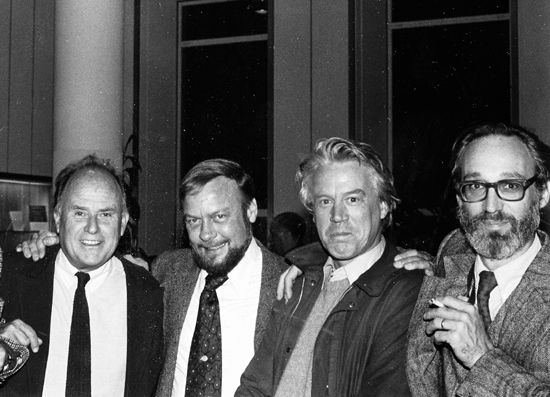
Jean Rouch, Napoleon Chagnon, John Marshall, and Timothy Asch at the Jean Rouch Film Festival on the Yanomamö in Paris
The ZDF film was shown on German television while one of the Salesian nuns from Mavaca happened to be in Germany visiting members of her family. She was furious with ZDF’s portrayal of Padre Cocco as essentially a saintly tourist guide. She apparently wanted him portrayed in a more traditional priestly way. Her anger was directed especially at me for having helped the Germans make their film.
I learned about all this in August 1988 when I visited Mavaca for a novel project I had suggested to the Salesians. I was afraid that the garimpeiro invasion of Yanomamö territory in Brazil was threatening to spill over into Venezuelan territory and might lead to the abandoning of the Salesian missions there. If that happened, the Venezuelan Yanomamö would have to fend for themselves against the depredations of the miners.
I contacted Padre José Bórtoli, who was in charge of the Yanomamö Salesian missions in Venezuela, and urged him to begin a project with me, using my extensive genealogical data on families, to assign Spanish family names to all the Yanomamö at their missions. The Salesians were haphazardly giving the Yanomamö Spanish names, but with no regard to lineage. Thus five biological brothers might be given five different “family” names, especially if they did not all live in the same village. The Salesians often did not know, for example, that a man in the village right next to their mission had a full or half brother in the village just across the river. This haphazard way of assigning Spanish names disregarded one of the few sources of solidarity and cooperation the Yanomamö could rely on. These names would become legal and official on their identity cards as the Yanomamö were gradually incorporated into Venezuelan society. The Yanomamö would be required to carry identification papers if they ever went out of the area to Venezuelan towns and cities.
Bórtoli agreed with me. I had roughly four thousand Yanomamö in my data files arranged by lineage and sorted into the villages that were found in the immediate area of the Mavaca mission. I brought with me my computer programmer, Dante DeLucia, who could quickly add the recently assigned Spanish names to my computer file. The Salesians would provide these names, and I would correlate the Spanish names to the Yanomamö names in my census data.
There was something unusual about the way Bórtoli was treating me on this trip. I asked him if I could expect the mission to provide food and lodging while we were there, something I never had to ask Padre Cocco all the years I visited his mission. The answer from Bórtoli was that Dante and I could string up our hammocks in an old tool shed among the broken outboard motors and gasoline barrels and sleep there. He mentioned that the shed had no light because the mission generator was not wired to this outbuilding, which was a crude palm-wood and palm-thatch hut. This also meant that we would have to use the nearby jungle for our sanitary purposes instead of the mission’s flush toilet. I mentioned that I no longer had cooking utensils because I had given them away to the Yanomamö on my last trip and asked if we could expect to be fed. Padre Bórtoli said we would have to provide our own food. He was definitely—if not deliberately—putting distance between us.
Up to this point, my relationships with the Salesians were still relatively amicable, but they were not as warm and friendly as they had been when Padre Cocco was in charge of the Salesian missions.
Although I never overnighted at a Salesian mission after Padre Cocco left the area, in this particular case I was traveling to Bórtoli’s mission to do something that should have been of value to the missions. Bórtoli routinely provided food and lodging to European strangers, including a French anthropologist, Jacques Lizot.
Lizot had arrived in the Yanomamö area in 1968 with the French/IVIC medical group and spent about a year doing biomedical tasks for this group, but, like me, he was interested in ethnography, not biomedical research. His ethnographic field studies focused on villages north of the Orinoco while mine focused on villages south of the Orinoco. Our early relationships were generally cordial and cooperative, but by 1972 he became very hostile to me and seemed jealous of my research and that of my several graduate students. I felt that he resented them . . . and me for bringing them into the Yanomamö area. And that he was possessive with respect to the Yanomamö and regarded other researchers as a threat. Indeed, his behavior toward me seemed very unprofessional, antagonistic, and vindictive.
When Dante and I arrived at Mavaca, Bórtoli called me aside and recommended that I explain the role I had in the film shown on ZDF because the German nun was angry and offended. I explained that I simply took the filmmakers to villages where they could shoot film, and the point of view was theirs, not mine. Bórtoli also complained to me about using the names of dead Yanomamö when I investigated deaths and causes of death for my demographic work. I suspected that what he was actually concerned about was not the use of the names of the deceased but the fact that I would inevitably learn that the shotguns the Salesians were providing to lure Yanomamö to their missions were being used to kill other Yanomamö. I had also discovered deaths caused by new diseases: Yanomamö were now dying from diseases like hepatitis, a new source of mortality in the Mavaca area. The demographic aspects of my field research—collecting data on births, deaths, causes of deaths, and so forth were apparently now threatening to the Salesians—so much so that I learned from one of my better informants that Bórtoli had privately forbidden the Yanomamö to tell me the names of dead people. The Yanomamö would clam up whenever Bórtoli or one of his favored Yanomamö was within earshot.
I remained focused on the task at hand and proposed to Bórtoli that we publish an article about the use of genealogies to assign names, hoping that other missionaries might be interested in doing something similar. He thought that was a good idea and suggested that one of the nuns be a co-author, a Spaniard named Maria Eguillor, who had published a monograph on the Yanomamö that drew extensively on my 1968 Yanomamö monograph and, incidentally, on the work of Jacques Lizot. The Salesians apparently wanted to establish her as an anthropologist. When we ended our work that week, we submitted an article to the local Salesian journal, La Iglesia en Amazonas (The Church in Amazonas ) based in the territorial capital, Puerto Ayacucho.
Salesian Nuns File a Complaint About Me
The German nun was not going to let go of her anger over the television program. She apparently convinced some of the other nuns to join her in filing a complaint against me with the Oficina Central de Asuntos Indigenas (OCAI)—the Venezuelan Indian Commission—sometime in 1988. It is unlikely that the Salesian priests were unaware of this action because they should have known this would lead to a major political incident.
Before they filed their complaint with the OCAI, the nuns published an article in La Iglesia en Amazonas , allegedly written by the leader they were grooming to be a chief and spokesman of the Yanomamö in the Mavaca area, César Dimanawä. Dimanawä’s letter claimed, preposterously, that he spoke for “all the Yanomamö in the Mavaca area” and that they did not want me ever to come back there. He cited as the reason that I made films about Yanomamö warfare and violence “or so a friend of his told him.” It wasn’t hard to guess who his “friend” was.
The Nova/BBC Film Project
At about the same time in 1988, I was approached by documentary producers at BBC England and the PBS science program “Nova” in the United States. They wanted me to participate in a jointly produced documentary film about my research among the Yanomamö. I tentatively agreed. BBC/Nova then applied for and received a permit from OCAI to make this documentary among the Yanomamö.
When I passed through Caracas en route to the Yanomamö area that year, I was unexpectedly contacted by Charles Brewer-Carías, who had been a member of the IVIC/Michigan biomedical research project between 1966 and approximately 1970. I had seen Charles only intermittently since 1970, perhaps two or three times. He had turned to national politics and had become a minister in the Venezuelan government.
He wanted to meet me for dinner. That evening he told me that he had been chosen by the government to be the “spy” in the BBC/Nova project. He was being facetious when he said this, but there was an element of truth to it: ministries of the Venezuelan government wanted to know what outsiders were doing in their various filming and research projects in the remote interior of their country, especially major media players like BBC and PBS, and they would sometimes “attach” Venezuelan participants to these projects. Charles also took the opportunity to suggest that we resume our previous research after the BBC/Nova project ended: he would focus on the biodiversity of the Amazon jungle while I would continue piecing together the history of Yanomamö migrations and their geographical, genealogical, and ecological parameters. I agreed in principle to collaborate with him the following year.
Not long after that I was notified by one of the BBC producers that they were having difficulty reaching an understanding with their American counterparts at Nova on the subject matter of their joint scientific documentary. The Americans wanted to build the documentary around my longtime and widely known academic dispute with Marvin Harris (which I discussed earlier) about his allegation that scarcity of meat in the Yanomamö diet was a possible cause of their wars. The BBC wanted to focus on how I was using my genealogical and demographic data on the Yanomamö to test hypotheses generated from sociobiological theories, especially William Hamilton’s theory of inclusive fitness (kin selection). Hamilton was an Englishman. The producer said this disagreement was causing a delay in their schedule and that he would contact me again when their disagreement was resolved.
Then I received a letter from Marcel Roche, who was the director of IVIC and the host of the Michigan/IVIC biomedical research collaboration between 1965 and 1972. He told me he was very concerned about an article that appeared in El Universal , a prominent daily newspaper in Venezuela, that he said described my participation in the forthcoming BBC/Nova documentary. Roche said the wording seemed deliberately inflammatory and would stir up opposition to me and the project because it described my return to the Yanomamö area to continue my studies of “Yanomamö warfare, violence, and fighting.” Roche knew how much Venezuelan anthropologists resented me, giving as one of their reasons that I exaggerated Yanomamö violence, even though no Venezuelan anthropologist had ever studied the Yanomamö.
Like Roche, I was surprised that the article emphasized these hot-button issues. I sent the article to my BBC contact, who responded that he also was surprised by this description of the project. He assured me that it was not the description that he had sent to the Venezuelan embassy in London and said that someone in Caracas must have deliberately distorted the BBC description of the documentary.
By now, my 1988 lead article in Science demonstrating that Yanomamö violence and male reproductive success were correlated had been published. It was getting a hostile reception from social-activist anthropologists because it described warfare, violence, and revenge in a Venezuelan tribe that they were trying to portray as peaceful and tranquil. My article also raised the possibility that human violence had something to do with the evolved nature of Homo sapiens.
Meanwhile, BBC and Nova were unable to reconcile their disagreement and notified OCAI that they were not going to make their proposed joint documentary.
Since I had plans to continue my own field research regardless of the BBC/Nova filming, I applied to OCAI for a new research permit. I received a formal response from Maria Luisa Allais, a new director of OCAI, saying that “OCAI could not grant me a research permit at this time” and listing the conditions under which they might grant me one. The conditions were basically, When hell freezes over. Maria Luisa Allais was the official whom the Salesian nuns had visited to file their complaint against me, bringing Dimanawä and several other “leaders” with them.
This was the first time that I had applied for a research permit from OCAI and been turned down. I had been studying the Yanomamö for almost twenty-five years by then. However, between 1975 and 1985 it was clear to me that if I had applied for a permit from OCAI I would have been turned down, so I never applied for one and as a consequence, I did not visit Venezuela during this time period. I knew from Venezuelan colleagues that a permit would not be awarded because the people who ran OCAI then were widely known to be opposed to me and to American anthropologists in general.
President Pérez Becomes Involved
Shortly after getting the letter from Allais, I told Charles Brewer that my application for a research permit had been turned down. He became angry and told me he regarded the denial of my request as if it were a denial of a request that he had personally made. Brewer asked me to consider a new way to continue my research. He had just attended a meeting with a woman named Cecilia Matos, the “mistress” of the president of Venezuela, Carlos Andrés Pérez (known as “CAP” in the press).
Matos knew that CAP’s political career was coming to an end soon and that he could not run for another term as president. She wanted to have some kind of visible social legacy after CAP left office and was attempting to create a charitable foundation to benefit the poor people of Venezuela, which included the country’s indigenous tribesmen. She called her new organization Fundafaci, derived from Fundación para las Familias Campesinas y Indígenas (Foundation for the Families of Farmers and Indians).
At the meeting Brewer attended, she asked those present to recommend experts in their respective fields for her to consider as advisors. Brewer recommended me as a prominent international authority on the Venezuelan Yanomamö Indians. He was asked to invite me to Caracas to discuss how I might work with Matos and her new Fundafaci staff, a group of politically prominent and wealthy Venezuelan women who had fund-raising skills and extensive political networks.
Brewer and I met with Matos, who asked us to propose an idea that we could discuss with CAP that Fundafaci might later cultivate and expand. At our first and only meeting with President Pérez, Brewer and I introduced the idea of creating a biosphere reserve to protect the virgin forests of Venezuela’s Amazon area and the Yanomamö and Ye’kwana people who lived there. The time to do this was now (1990). There was at present no pressure from Venezuelan colonists to enter this area. There were no commercial agricultural operations, no logging industries, no interest in cattle ranching, no known valuable subsurface minerals, and no mining operations. It would be relatively easy then for the Venezuelan government to simply declare this vast area as some kind of national park or special reserve because nobody would have to be removed from the area. The only people who seemed to be interested in this area were scientific researchers and missionaries to the indigenous people.
One of the first trips Brewer and I made to follow up on our proposal included a television crew from ABC. In November 1990, ABC aired a program hosted by Diane Sawyer about our new project among uncontacted Yanomamö villages. The program included footage of President Pérez promising to create a Yanomamö “reserve” of some kind within six months. ABC reran the program within a year and announced that the president had gotten his administration to approve the creation of a national park/biosphere reserve for the Yanomamö and Ye’kwana Indians—an area of some thirty-two thousand square miles. Shortly afterward, Brazilian president Fernando Collor de Mello announced that his government had also authorized an area about the same size intended for the same purpose for the Brazilian Yanomamö. The combined area was larger than the state of Florida.
This was a momentous event in the history of native peoples of the Amazon Basin, but my annoyed anthropological detractors claimed that my real intent in advocating for this reserve was “career aggrandizement,” that is, an effort to exclude other anthropologists from studying the Yanomamö. They claimed that the area was intended for Charles Brewer and “other crooked politicians” to exploit gold and other minerals in this area. But neither Brewer nor I was ever asked our opinions about what policies or rules were to be followed in administering this area. Indeed, the Salesian Missions were given considerable authority in this reserve, something that Brewer and I would have resisted had we been consulted. We both hoped that this reserve would be purely secular in administration.
During our brief meeting with CAP, he asked us if there was any specific thing he could do to help us with any government problems. Brewer brought up the denial of my most recent research permit request. CAP asked what ministry was involved. Brewer replied, the Ministry of Education. CAP picked up the phone next to him, spoke for a few seconds, put the phone back, turned to us and said, “You have a meeting with the minister of education in thirty minutes.” We then shook hands, thanked the president for meeting with us, and left for the offices of the minister of education.
The minister of education, Dr. Gustavo Roosen, was a courteous man, serious and professional. He asked us to explain the problem. After listening and asking a few questions, he asked that the head of OCAI be sent in. Maria Luisa Allais soon appeared, carrying an armful of files. She was well dressed, looked very nervous, and avoided eye contact with me and Brewer. The minister asked for the letter she had sent to me, read it, and diplomatically commented (apparently for her benefit) that her letter did not actually say that I would never get a research permit to continue my work among the Yanomamö, allowing her a face-saving way out of this situation.
Minister of Education Roosen made it clear to all of us that if the president of Venezuela approved of my request to continue my scientific studies of the Yanomamö, I had the permission, as did Brewer, of the highest authority of the Venezuelan government to proceed. The meeting then ended.
The Tragic Incident at Kedebaböwei
When we initiated our new research project in 1990, Brewer and I arranged to have a fuel depot cleared at a Yanomamö village called Kedebaböwei-teri some two hours up the Mavaca River from the main Salesian mission at the mouth of the Mavaca.
I knew the Kedebaböwei-teri people well. They had all formerly lived in Mishimishimaböwei-teri, a village I repeatedly visited after 1968. The Salesians had persuaded them to break away from the main group in the headwaters of the Mavaca and settle downstream on a navigable portion of the Mavaca across from the relatively new Salesian satellite mission called “Mavakita” (“Little Mavaca”). The Salesians had earlier enticed the Haoyaböwei-teri, a much smaller faction, to settle at Mavakita.
Charles and I wanted our valuable supplies, like fuel for our outboard motors and the helicopters, to be in a safe location and away from a permanent Salesian mission.
We asked the Yanomamö at Haoyaböwei and Kedebaböwei to clear the brush and small trees close to the Mavaca River for a place to store our fifty-five-gallon barrels of fuel, which they enthusiastically did. In the process, they also took out a small hut that Hermano Finkers at the Mavaca Mission had asked them to construct for a beehive he wanted to place there. Finkers was trying to get the Yanomamö to keep bees and sell the honey as a cash crop.
This trivial incident ultimately led to lethal consequences for several of my Yanomamö friends.
When Brewer and I arrived at Kedebaböwei, we were greeted by a large number of Yanomamö men who were extremely angry with Finkers. He had just visited them earlier that day and, on discovering that they had taken down the beehive hut, he berated them angrily, a young man named Ushubiriwä in particular. His anger may have also been increased because they did this in order to create a storage area for fuel supply. I was now an “enemy.”
There was a history of bad relationships between Finkers and Ushubiriwä. Ushubiriwä had been taught by the Salesians to read and was hired by Finkers to transport the local Yanomamö children daily across the river and downstream a short way to the recently established mission at Mavakita, where they learned reading and writing. The Salesians apparently gave or loaned Ushubiriwä a small outboard motor and canoe for this purpose, which he could also use for hunting and fishing when he was not transporting the children to and from the Mavakita mission. Ushubiriwä’s young wife, Nonokama, was also hired by the Salesians to prepare breakfast for the children, which primarily consisted of heavily sweetened boiled oatmeal and powdered milk.
Ushubiriwä and Finkers were apparently on strained terms over the small motor the Salesians had given to him. The motor had stopped working, and Ushubiriwä had stopped transporting the children, whether because of the disabled motor or for other reasons.
The Yanomamö told me and Brewer that they told Finkers that he had promised to pay them for making the beehive shelter but had never done so, and since it was not paid for, did not have a beehive in it yet, was easy to replace, and was in the way, they simply removed it with the other brush. They were extremely angry with Finkers for berating them so unfairly—and also because during the argument Finkers had accused me and Brewer of being garimpeiros. They probably didn’t know what a garimpeiro was and had never seen one, but they assumed it was something bad and was a slander against us.
Despite the disagreement, Brewer and I went to work. Brewer continued to collect animal, plant, and insect specimens, and I continued to collect data on Yanomamö village movements and genealogies.
In January 1992 I accompanied a medical research team from the Johns Hopkins University to the Mavaca area with the intent of taking them into Kedebaböwei-teri for a five-day research project on a “low-salt consumption” population. We were in a helicopter and landed at the Salesian mission at Mavaca. I didn’t get out—the Salesians had already declared their hostility toward me in the Venezuelan press, and I believed that the Yanomamö at their three missions where I would pass through had been encouraged by the Salesians to steal anything they could from me—without concern over possible reprimands.
One of the participants in this medical expedition, a Venezuelan medical doctor named Teodardo Marcano, went to the Salesian mission to talk with Padre Bórtoli. Marcano explained what we were doing in the area, that we planned to do the medical study in Kedebaböwei-teri. When he returned to the helicopter he said that Bórtoli told him that there were rumors that the Kedebaböwei-teri had gotten “sick,” but Bórtoli said that he didn’t send anyone from the mission to Kedebaböwei-teri to check on this. He dismissed the rumor as just another Yanomamö attempt to get the Salesians to take a two-hour motorboat trip so the Yanomamö could beg items from them, knowing that the Salesians invariably brought trade goods each time they visited.
We then flew up the Mavaca to the large Kedebaböwei-teri shabono , which I could tell had been abandoned very recently—the packed earth in the central clearing was still devoid of green weeds, a sure sign that it had been inhabited recently. We circled it several times to see if anyone would come out of the nearby jungle and wave at us. We then flew due east to my “backup” village for the study, a splinter group of the Iwahikoroba-teri that had been given the name Washäwä-teri by the Salesians, after the name of the small tributary of the Mavaca River on which their shabono was located.
Some hours after we had landed in Washäwä-teri two young men from Kedebaböwei-teri came into the shabono and headed straight for me. One of them carried a hand-scribbled note, which he gave to me. It was from Ushubiriwä. He addressed me as habemi —dearest father. It said that they were sick and dying and to please come and help them.
I immediately told Dr. Marcano what it said and asked him if he would walk out to Kedebaböwei-teri. Our helicopter had left right after we got out of it. One of the two Kedebaböwei-teri messengers would guide him to their shabono. Marcano quickly persuaded one of the other medical doctors to go with him, and they left immediately for the stricken shabono some five or six hours away.
I then asked the other young man, whom I had known since childhood, if he would stay with me and go through my recent census, name by name, to identify who was sick and who had died. When I asked if he would be upset if I said names of people who had died, he admonished me and said that he and all the others trusted me, I was now one of them, and this was an important life-and-death issue that involved our medical intervention. He would not get upset if I unknowingly whispered the names of dead people because he knew that I was trying to help them.
We found an isolated section of the shabono and got to work. After going through the list of names, I learned that twenty-one individuals had died within the span of the past week, all of them mature adults or older people. No children or infants had died, which I found very unusual for an introduced illness. Most depressing of all, one of them was their headman, Örasiyaborewä, and much to my shock and anguish, the fabled former headman, Sibarariwä, also died. This devastated me—and it angered me. A large number of the older political leaders in the villages immediately surrounding the Salesian mission at Mavaca had died in “epidemics” similar to this one, epidemics that spared the children but claimed the lives of the male political leaders.
The mortality in Kedebaböwei-teri amounted to 14 percent of a largely uncontacted Yanomamö village who perished in one week from some sort of upper respiratory infection, a sickness they might never have been exposed to if they had not been persuaded to move out to a navigable stretch of a large river. Here they could more easily be acculturated by the Salesian missionaries, who could now avoid the discomforts of walking inland to visit them. This was a continuation of a five-hundred-year-old colonial policy by the Catholic Church in the Americas to save the souls of native peoples by attracting them from the deep forest to living at their missions. When concentrated near the missions, the native people would, incidentally, be exposed to outsiders and new sicknesses. Such collateral damage began to be reported only when anthropologists like me started tracking these kinds of things, especially in demographically pristine tribes like the Yanomamö.
The most depressing and tragic aspect of this incident is that it appears that the Salesian missionaries at Mavaca, just two hours by boat from Kedebaböwei-teri, had heard rumors about the sickness shortly after it broke out a week earlier but had dismissed them. Yet it was they who urged the Kedebaböwei-teri to move to a site on the navigable lower Mavaca River where the Kedebaböwei-teri would be accessible and could more easily obtain medicines if they got sick.
I was also dumbfounded and anguished to learn that shortly after his argument with Finkers over the removal of the bee shelter, Ushubiriwä was killed by a small group of Yanomamö associated with the Washäwä-teri village and the Salesian post at Mavakita. In 1994 Finkers published an article in La Iglesia en Amazonas in which he publicly asserted that I was responsible for Ushubiriwä’s death because Ushubiriwä had defended me, which allegedly made the other Yanomamö angry.
On October 4, 1993, an article appeared in a prominent Caracas newspaper quoting a Salesian priest saying that the Salesians could no longer guarantee my safety if I passed through one of their missions on future field research trips. I had repeatedly passed through Yanomamö villages near the missions without incident long before the current Salesian priests and brothers arrived.
Massacre at Hashimo-teri
In July 1993, Brazilian garimpeiros crossed the border into Venezuela near the Orinoco headwaters in the Parima Mountains and attacked and brutally massacred a Venezuelan Yanomamö group at Hashimo-teri that they had been feuding with for some time. They shot and hacked to death some sixteen or seventeen people, mostly women and children.
Astonishingly, the brutal deaths of these Yanomamö was not the story that attracted the attention of the Venezuelan press and the activist anthropological community. Instead, the story was the fact that Charles Brewer and I were named to the official Venezuelan commission to investigate the massacre at Hashimo-teri.
Brewer was among those Venezuelans who urged the new interim Venezuelan president, Ramón Velásquez, to create a special commission to investigate the massacre. Brewer was named as head of this commission and in that capacity could suggest names of other people with expertise whom the president should consider as members of the commission. Several Venezuelan anthropologists agreed to participate, but none of them were familiar with the Yanomamö and none spoke their language. Primarily for these reasons I was named as one of the members.
When Brewer and I were made official members of the Presidential Commission to investigate this massacre, the frantic opposition to this announcement came not only from Salesians but also my detractors in the radical activist anthropology community. For the first time my anthropological detractors united with the Salesians who dominated the politics of Venezuela’s Amazonas and who were acquiring the secular functions of state in the entire Yanomamö/Ye’kwana area.
Some 600 articles were published in the major Venezuelan newspapers between August and December 1993 about this massacre, almost all of them sympathetic to the Salesians’ presumed privileges in Venezuela’s Amazon territory—which was on the verge of becoming a state. The Salesians strongly influenced much of the Venezuelan press and could suggest articles that the press would print. To me it was as if the Venezuelan press were just a widely distributed version of La Iglesia en Amazonas , the Salesians’ official journal.
Shortly after being appointed Presidential Commission members, Brewer and I were summoned to attend an urgent meeting in the office of the Fiscal General—the attorney general. The Salesians demanded this meeting and also demanded to be put on the Presidential Commission and that Brewer and I be removed from it. The attorney general defended the existing commission.
At one point during the meeting I was asked what I thought about having Salesians on the commission. I replied that I had no objections and would be happy to collaborate with whoever might be added. My response pleased the attorney general so much that he went out of his way to commend my statement and contrasted it to statements made at this meeting by the Salesians. (I must make an important point here, because it would come up repeatedly, usually in a false way: this commission was made official when its composition was approved by the president of Venezuela and then published as a presidential decree in the September 8, 1993, issue of Venezuela’s Gaceta Oficial. No other commission was announced in the Gaceta Oficial. )
Complicating this entire situation was the fact that the interim government of Venezuela was teetering on the edge of a military coup.
The Commission was able to go into the Hashimo-teri area and begin our investigation only two months after the massacre had taken place and several weeks after a Brazilian investigation team had been to the scene of the massacre—illegally, in Venezuelan territory.
Not long after we got to the Hashimo-teri shabono we heard another helicopter approaching from Parima to the north. I was mapping the abandoned and burned shabono when the helicopter landed and its passengers exited. I was startled to see that the first several men to emerge were in civilian clothes and carrying submachine guns. A woman emerged whom I recognized from the meeting in the attorney general’s office a week or so earlier. This group approached Brewer and me, and at gunpoint demanded that we leave the area because we were “contaminating” a crime scene. Brewer argued with the men with guns and a portly older man, who had been giving the others instructions. I later learned that he was the Salesian bishop of Amazonas, Bishop Ignacio Velasco.
While Brewer argued with them, I unobtrusively melted into the background and went back to our temporary campsite a few hundred yards away, next to a clear, sparkling creek. I had a Yanomamö companion with me who spoke a dialect of Yanomamö I could understand as well as the dialect of the Hashimo-teri. The Yanomamö in the Parima Mountains spoke a dialect that was difficult for me to understand at first, but after several days I could understand enough of it to be able to communicate with the people there.
At almost the same moment that we reached our makeshift camp, a small group of Yanomamö appeared—several young men and women—and followed us to our hammocks. They had come to harvest some of the local food that would now go to waste. They explained to us they were immediate neighbors of the Hashimo-teri and they knew them well.
I then spent the next several hours asking them for their version of the massacre, working without the distractions of the Salesian contingent and their armed guards. These Yanomamö told me that the Hashimo-teri and the miners had had several hostile interactions before the massacre and that the miners had killed five Yanomamö. The Hashimo-teri then retaliated and killed two miners. The Yanomamö informants said that when the massacre took place, the miners were guided to the Hashimo-teri shabono by Yanomamö from Brazilian villages to the east. They called them “Paapiu-teri” and “Vista-teri” (they probably meant “Boa Vista-teri”).
A helicopter returned to pick us up late that afternoon and took us back to Parima B for the night. The bishop and the lawyers discovered my notebooks and maps and without asking my permission brazenly took them from me and photographed the several pages of maps I had drawn as well as my handwritten notes, demanding to know how I learned these things. I told them about the Yanomamö visitors I had interviewed. Meanwhile, the bishop and the lawyers had gathered no information that day except for collecting a few worn aluminum cooking pots with bullet holes in them and pieces of broken machetes.
The next day the unpleasant female lawyer, now acting “officially,” asked me to appear at a room in the military compound where a desk had been provided for her. She demanded to know what I was doing there, a preposterous question in view of the fact that we had both met with the attorney general in his office a few days earlier. After I dutifully explained that I was an official member of the Presidential Commission, she claimed that I was not on the official commission, regardless of what the records showed.
She demanded my passport, which I provided to her. She looked it over very carefully, every page and every stamp, and there were many. She took an extraordinary amount of time. Most of the stamps were entry and exit stamps from Venezuela passport control at the Maiquetía International Airport. She then accused me of “illegally entering Venezuela.” We had an unpleasant argument that ended only when I suggested that when we got back to Caracas we should take this up with both the attorney general’s office and the U.S. embassy.
Brewer and I had requested that we be flown back to the massacre site on our second day, but our request was denied because, the military commander claimed, they didn’t have enough fuel. But we learned that the Salesian bishop, one of his priests, and their Yanomamö interpreter were flown back to the massacre site to look for and question the same informants I had spoken to the previous day. However, they couldn’t find them.
Brewer and I were sleeping at the New Tribes Mission facility at the other end of the airstrip from the military post at Parima B. I learned by accident that the helicopter we came in on was departing in a few minutes and the work of our commission was officially declared to be over by someone. The military commander didn’t bother to tell either me or Brewer that the helicopter was leaving. I scrambled to gather my equipment and get to the helicopter. I barely made it in time to climb aboard—the rotors were already turning and the Salesian team was already on board. Brewer did not even know about the departure and was left behind.
When we landed in Puerto Ayacucho some two hours later, the commander, who had taken my field notes and was reading them in the helicopter, approached me to ask if he could photocopy my notes. He assured me he would get them back to me within an hour, well before the commercial flight I would be taking to Caracas. I agreed.
While we were talking I asked him about rumors that a military coup was about to take place and it might be difficult for anyone to leave Venezuela because commercial airline flights would all be canceled. I thought who better to ask about an impending military coup than a high-ranking officer in the Venezuelan air force? His response was something to the effect that if he were I, he would take the next available flight out of Venezuela.
Later, my detractors and activist opponents in anthropology would characterize this episode by saying that after being expelled from the Hashimo-teri massacre site, I was ordered to leave Venezuela on the next flight out of the country by a high-ranking military officer.
A very annoyed Venezuelan minister of defense had to send a plane to fetch Charles Brewer the next day.
Aftermath of the Salesian Interference in Hashimo-teri
Salesian control over Amazonas was now so pervasive that I was shocked to discover that major political protests against Brewer and me were held in Puerto Ayacucho. When I asked Brewer how the people of this small city knew anything about us, let alone enough to “protest” what we were doing, he told me: “They don’t know anything about either of us. They were simply hired by the Salesians to carry already-made derogatory placards with anti-Chagnon and anti-Brewer slogans on them.”
I even saw graffiti with anti-Chagnon and anti-Brewer slogans spray-painted on bridge abutments and buildings when I returned to Caracas the next day.
Apart from being amazed that political accusations could simply be invented in Venezuela and made to look as if they came spontaneously from informed citizens, I was very angry about how we were treated. But I was even more disturbed that the Hashimo-teri victims were of much less concern to the Salesians and the activist anthropologists than the legitimate presence of Brewer and me attempting to determine what had happened to the Hashimo-teri and trying to achieve some semblance of justice for them. The Salesians had decided that the Yanomamö land was theirs to administer, and they would not tolerate interference by anyone, including even the government of Venezuela.