10
First Contact with the Iwahikoroba-teri
In 1971 I contacted the village of Iwahikoroba-teri, northeast of Mishimishimaböwei-teri and east of the Mavaca River. I had seen their trails next to the Mavaca River on several trips. On one occasion I saw one of their rickety pole-and-vine bridges where they had recently crossed the Mavaca.
It took me several attempts to contact this group. The Bisaasi-teri disliked them and had not seen them for twenty years. But the Bisaasi-teri had been wrong about how I would be received by the Mishimishimaböwei-teri and I unconsciously dropped my guard when I decided to find the Iwahikoroba-teri, assuming they would be just as friendly as the Mishimishimaböwei-teri had been.
First Attempt
In mid-January 1971, I learned that a hunting party from Bisaasi-teri had accidentally run into a group of Iwahikoroba-teri hunters about a half day inland from the middle course of the Mavaca River. It had happened in December 1970, a few weeks before I arrived for my annual fieldwork. Their meeting was nervous but peaceful, and the Iwahikoroba-teri indicated they would like to resume friendly contacts with the Bisaasi-teri.
I immediately decided to make an attempt to contact the Iwahikoroba-teri despite the hectic schedule planned for this year’s biomedical fieldwork with Neel’s group from the University of Michigan’s medical school and from IVIC. I carefully questioned one of the Bisaasi-teri men who had made the initial contact. He described to me where it had occurred and where I should start inland from the Mavaca River. Surprisingly, three Bisaasi-teri men volunteered to come with me. They seemed less concerned about possible chicane from the Iwahikoroba-teri than they had from the Mishimishimaböwei-teri on the occasion of my first contact with them, some three years earlier.
One of the men wanted to bring his elderly mother along: Hubemi, an old woman who had been abducted from the Iwahikoroba-teri many years earlier. This was, they apparently assumed, their insurance that their hosts would not receive them with hostility and treachery. Hubemi wanted to visit her relatives there, people she had not seen since her capture in the late 1940s. I was very surprised that Hubemi’s son, Shararaiwä, wanted to come—the Iwahikoroba-teri had killed his father’s brother in the 1950 nomohori at Amiana Mountain, discussed in the previous chapter.
On January 16, we began to ascend the Mavaca River for nearly two days, made camp on the right bank, stored the canoe and gasoline, and started inland. Since none of the men had been in this area for some twenty years, they became disoriented and lost the faint trail they were following. We wandered in a meandering pattern for two days and found no fresh signs of Yanomamö travelers. Hubemi and two of the men then came down with severe diarrhea and were reluctant to go on. Thus we turned back and returned to my base at Mavaca—in part because I had to meet Neel’s airplane at a mission airstrip in several days. Although I had to abort my first attempt to contact the Iwahikoroba-teri, I intended to make another try to contact them when my obligations to my biomedical co-researchers were done for the season.
After Neel’s team arrived I spent the next ten or so days taking them to villages up the Ocamo River, where we collected blood samples in some half-dozen widely dispersed villages in that area.
An unusual thing happened that aggravated Neel, who was constantly concerned about something going wrong. We were on the way down the Ocamo River in our two dugout canoes to Padre Cocco’s mission to get the blood samples on the airplane and out to Caracas to Layrisse’s lab at IVIC. I was in the lead canoe because I knew the river better than anyone else. Neel was in the canoe behind me protecting the blood and other samples, worried about making the plane. Because we had hired that plane and the plane’s owner would not get paid unless he could deliver the precious blood samples to Caracas, the pilot would remain at the airstrip until we arrived. But Neel still worried that something would go wrong.
As we rounded a bend in the river I spotted a tapir feeding quietly in a shallow pool on the inside of the curve. It didn’t hear the motor as I idled it down and slowly picked up my shotgun and loaded two rifled slugs into the barrels.
Tapir is the most desirable meat in the Amazon Basin—red, juicy, and tender. A tapir can weigh up to 500 pounds and, accordingly, provides enough meat for a large number of people, even all the members of a village for example. If you have spent a long time in the Amazon Basin and are dependent on hunting to get your meat, you don’t pass up a tapir. I would sear tapir steaks cut from the hindquarter in a small frying pan, cook them rare, and gobble them down. The Yanomamö always found this disgusting because blood from the steak would be dripping down my bearded chin. They would watch in horror and tell me that I “wanted to become a jaguar” because that’s how jaguars eat their meat, adding that I also “wanted to become a cannibal” and eat human flesh like their mythical ancestors.
I knew I would be on the river or helping to collect various samples for the next weeks and that I wouldn’t be able to eat the tapir, nor would Neel and any of his team, but I also knew that if I brought the tapir meat to the Yanomamö at Ocamo and Mavaca, they would very much appreciate this and reciprocate the favor at some future time. This was one of the reasons I got along well with the Yanomamö, even in villages I visited only occasionally—I always gave them most of the game I shot.
I cut the outboard engine and the momentum of my canoe glided me closer to the tapir. I shot once at its head and the tapir exploded out of the water, then fell back into it, motionless. I expected to see blood gushing from its head, but there wasn’t a drop of blood on the tapir or in the water. We dragged the carcass to the shore and I began gutting it. When I tried to find the place on its skull where my slug had entered, all I could find was a small bruised area between its ears—the slug killed it just by shock. I began to hear someone shouting angrily at me, turned around, and realized that it was Jim Neel. His canoe was just pulling into the lagoon where I had killed the tapir. He was furious with me for having taken the time to shoot a tapir and then spend another fifteen minutes dressing it and butchering it into quarters to take with us. Didn’t I realize that we had to make the plane and get the blood samples onto it? This wasn’t a hunting expedition and I was being irresponsible and wasting precious time!
We made the plane with plenty of time to spare. The Iyäwei-teri at Ocamo, to whom I gave half the meat, were very grateful. I proceeded to my base camp at the mouth of the Mavaca River, about two hours up the Orinoco from Ocamo, when the plane left for Caracas carrying the precious blood samples. I gave the remaining half of the tapir to the Bisaasi-teri, who were likewise grateful for this bounty.
Neel decided to leave one of his Ph.D. students with me for several weeks while he accompanied the other members of his medical group to the Parima Mountains, where New Tribes missionaries would help him by translating for the various members of the group.
The student, Ryk Ward, was from New Zealand and was working on his doctoral degree in human genetics under Neel’s supervision. Ryk wanted to travel with me and get some additional blood samples from a group of Shamatari (Mishimishimaböwei-teri) we had missed on our first trip to their village a year or so earlier. When Ryk learned I was going back up the Mavaca to try to contact the Iwahikoroba-teri he wanted to accompany me and collect blood samples from them. Neel immediately approved of this plan before he left for Parima because it meant that he would have two teams collecting blood samples at the same time.
I didn’t think it was a good idea to show up in an uncontacted Yanomamö group and immediately begin sticking needles into their arms. By then, however, the Iwahikoroba-teri were probably aware of who I was and that I usually came with people who collected blood samples. The Iwahikoroba-teri regularly visited the Mishimishimaböwei-teri and exchanged news with them about this strange foreigner called Shaki, almost certainly including information about blood sampling.
I thought it over and decided that blood sampling would not constitute a problem for the trip into Iwahikoroba-teri because I always asked whether they were willing to provide blood samples for payment in madohe. They could always say no, and we would therefore not take samples.
I easily found several Yanomamö guides who were not only willing to come with me but seemed enthusiastic. We left on February 6 for Iwahikoroba-teri. My companions were Ward and four Bisaasi-teri men, one of whom had been in the original hunting party that accidentally ran into the Iwahikoroba-teri two months earlier.
We traveled up the Mavaca River in my large dugout canoe with a 33-horsepower outboard motor—a motor that was considerably more powerful than the 18-horsepower outboard motor I normally used. I carried my light aluminum boat and a smaller motor on top of the large dugout. We camped once on the banks of the Mavaca and, the next day, reached the mouth of Örata Kä u (“Jaguar River”) not far below the place I used to begin my walk into Mishimishimaböwei-teri in 1968, when I made first contact with them.
We pulled the dugout a few yards into the Örata Kä u and unloaded what we would take with us: the blood-collecting equipment, food, our hammocks, and a few trade goods. We didn’t know how far it was to their village so we left the bulkier trade goods. We would have the Iwahikoroba-teri accompany us back to the canoe, where I would pay them with these trade goods.
The following is a nearly verbatim transcription from my 1971 fieldbook:
We set off this morning (February 7, 1971) at 10:00 AM from the mouth of the örata-u, a few minutes above our camp. We managed to reduce our equipment down to three packs and one Styrofoam carton, but the packs are very heavy. In addition, Ryk and I each have a small side bag. The Yanomamö managed to stick us with about 15 pounds of plantains each, which bounced around on our sides all day and were a nuisance to carry.
Our progress was slow. Ryk had a sunburn, so I carried his pack until 12:30, when we hit a large trail. Then I gave the pack to Koaseedema, who is our chief guide. He is the one who made personal contact with a heniyomou (an overnight hunting) party of Iwahikoroba-teri a few months ago. Shadadama was with him [on that trip]. He was to take us to the trail where he made contact, but unfortunately, he didn’t tell me very clearly where it was. Half way in on the first day’s walk I learned it was somewhere near the Bookona-u bora [a waterfall]. As it turns out, it will take us two days to reach these falls according to the prediction Koaseedema is now making, when we could have done it very easily in one day from my first camp [from my previous aborted trip]. In addition, Makaiyoböwei käkö (a mountain) is said to be very close to their village. Thus, today we wandered way to the south of our objective. [My notebook includes at this point a hand-drawn map of where we were and where we wanted to go.]
February 8, 1971. Woke up at 6:15 but lay in the hammock until 7:00. My ankle is sore from yesterday’s walk; I hope it holds out for the trip.
. . . .
Last night I got a charley-horse from walking all day—so I guess I’m getting some exercise. I do not look forward to the day’s march—it will be quite a shock to get into my soaked, cold clothing after sleeping in dry, clean ones.
. . . .
We walked until we hit a large, transverse trail that ran from Mishimishimaböwei-teri to Iwahikoroba-teri. At 4:00 we ran into a fresh yano (a temporary hut) that had been used this very day. The coals in the ashes were still hot enough for us to kindle our fire from. We camped there for the night and ate dehydrated soup. The first two nights we had [wild] duck and paruri [wild turkey] respectively. My arm was itching so I washed with Ryk’s Dial soap.
February 9, 1971. We were up and away by 8:30 and ran into fresh tracks heading in the opposite direction. Shortly after leaving our camp we ran into a large herd of boshe pigs. I shot at one but only wounded it. Rerebawä killed one [with arrows] and we took the lower back and hind legs with us. [The Yanomamö] complained about having to carry the meat—they were already tired. . . .
We made only about 5 to 6 hours actual walking this day—the third day inland. About mid-day I began feeling a little itchy under my left arm and had Ryk take a look at it to see if he could see anything unusual. He said that there were several small pustules, but also a large area of raised welts—hives—under both armpits. I then noticed that they appeared also between my legs where they were rubbing [together]. We camped early, having come by Bookona bora [Bookona Falls] late in the afternoon. That was the place I turned back after the first day’s march several weeks earlier! We had, after 3 days, succeeded only in getting slightly further than the 1st day’s march of my earlier trip.
That evening I began to break out all over with very itchy hives. They appeared up and down my arms and on my stomach. I could watch them move. A small blister would appear, then another and another until nearly my entire skin was covered. Then they would grow into each other and become hard, inflamed welts that burned and itched intensely. The sensation was excruciating. I could do nothing but writhe in my hammock and grit my teeth. That night all I could do was drink the broth of the wild pig . . . the only meal I had all day. I took a pyrabenzamine [tablet] at the time we camped and another at bed time. I woke up during the night intensely thirsty and nauseated. Mokahereiböwä went down to the creek to get me some drinking water, a whole bowl of which I drank in one attempt—about a quart-and-a-half. The night seemed like an eternity. I was dizzy—perhaps from the two previous pyrabenzamine pills. In any event, sometime during the night I took another one to relieve the misery. That was an error. I was stoned and delirious all night. . . . I also had contracted diarrhea. I dozed that way until dawn, when I had to defecate again. I could only stagger a few yards from the shelter before I discovered how weak and dizzy I was. I had to lean against a tree to keep from falling. I nearly fainted. . . . I told Ryk and the Yanomamö to plan to spend the day there; I couldn’t move.
A couple of hours later the Yanomamö woke me to tell me there were some Yanomamö in the distance, hunting. They wanted to know if I should call to them. I managed to shout a loud “Habo!” [Come over here!] At that, Koaseedema began shouting to them that ‘we were all foreigners [ nabä ] and friendly.’ Soon two young men [nervous but stoical] approached our camp and entered. They were nearly stark naked, their penises tied tautly to their waist strings, large wads of tobacco stuck into their lower lips. I sat up and managed to talk with them a few minutes. They were Iwahikoroba-teri and were seeing their first foreigner, a not very awe-inspiring sight at the time. I told them I was sick because hekura spirits sent by my enemies had sprinkled charms on me, causing me to be weak and delirious. I told them that my Yanomamö companions were tired from walking for two days with very little food.
They disappeared and came back within a few minutes with a man who I was later able to identify as Sebredowä, one of the big wheels in their village. They were camped a few hours away and were hunting wild turkeys ( paruri ). I sat up and chatted half-heartedly with them for a while and told them to come back at mid-day with fresh carriers. They nodded in agreement and disappeared silently into the jungle. I collapsed back into a fitful sleep, waking up at noon when I heard a large group of men approaching whence our earlier visitors came.
What happened next was something I will remember forever. Some 20 young men, as naked as the first two were, slowly entered our camp and stood silently in a semi-circle around us. Like the first two, they had only their bows and arrows with them. Their penises were tied to their waist strings like the first two. Their pudding-bowl haircuts and tonsures—small shaved spots on the crowns of their intensely black raven-colored hair—contrasted starkly with their exceptionally white skin. It was as if they had never spent any time on or near even a small river and therefore had never been exposed to the sun for any appreciable length of time. They looked almost ghostly, even slightly sinister in the diminished light of the interfluvial jungle. In a strange way they looked majestic. I was witnessing the last human participants in a world that was about to disappear forever. It was a moment that was both exhilarating . . . and sad.
I felt weak as hell and I was not enthusiastic about moving, but it was out of the question to remain there in the hammock. I got slowly to my feet, packed up and took down our tarps. The Iwahikoroba-teri just continued to stand there with mouths full of tobacco wads, staring passively at us, their upright bows and arrows clutched in their hands.
We left for their camp shortly after noon. I was very weak, but pleasantly surprised that I could walk without fainting, as I had done in the morning. Still, I had a dizziness that was unpleasant. We stopped twice for long rests—the second time I actually fell asleep for a few minutes. I also stopped to defecate water several times. At 3:00 we reached their camp in the woods, and they stepped aside for me to enter first. Ryk was behind me. We walked into the clearing and struck our visitor’s pose, but keeping a sharp eye peeled. I had enough energy left to turn on my small Sony tape recorder . . . to document the sounds of 1st contact.
They were a bit terrified at me, and I was a little apprehensive about them, in view of the rumors of the previous year that they intended to kill me. (In 1970 the Mishimishimaböwei-teri told me that the Iwakikoroba-teri were angry with me because I had not visited them when I visited the Mishimishimaböwei-teri. They said they would kill me and take my trade goods.) It was a very unusual welcome—it seemed as if they didn’t quite know what to do with us. For a while there were no men to greet us. At last a few older, braver ones came forward with bows and arrows, remained at a safe distance and began growling and howling at us. None was brave enough to intimidate [by pointing their arrows in our faces] or come close until an old man—Dokonawä—approached me cautiously with bow and arrows conspicuously at rest and began to speak softly to me to welcome me. They knew which one of us was Shaki, and they were looking at me. I asked him where I was to set up my hammock, and at that they seemed to be relieved. The men in the distance heard me and, without speaking, clacked their arrows against the house in the middle of the clearing. In it was a rather young but serious-looking man who had the poise and demeanor of a headman. He was lying in his hammock taking it all in, quietly observing our every movement. I walked over to the hut and sat in the hammock next to his. Ryk and the others followed, but the hut was so small that there wasn’t enough room for both me and Ryk. I then asked if we could use the hut across the way, which seemed larger. They agreed. It was also too small and very low . . . as are all of their temporary yano huts. I then asked them who the headman was so I could have a large hut made. They pointed to the young man in the hut I just left. I walked across [the clearing] and addressed him as shoriwä [brother-in-law], whereupon he “indignantly” cautioned me against using this kinship term, inviting me instead to call him younger brother.
I was pleased that he wanted to maximize kinship and friendship and immediately called him owas [my younger brother] to the approving clicks and hisses of the others. I asked him if he would have a large hut made for me. He barked out the command and very quickly several young men dashed off into the woods, one of them carrying a Brazilian-made machete. They reappeared in a few minutes with some large poles and vines for the hut. By then I had crawled back into my hammock in a state of near exhaustion and delirium. I vaguely remember the sounds of machetes hacking away at the poles and Mokaheriböwä laughing to himself at how clumsy they were with their dull machetes. Later, Ryk and Rerebawä put up our tarps and I went over and strung my hammock in the new hut. Someone had made a fire in it, and there was no way for me to hang my hammock without getting close to the fire, so I just resigned myself to my fate and lay there, roasting and half unconscious. I took a pyrabenzamine, the 3rd to the last one remaining.
I had eaten only a bowl of soup and a small piece of chocolate for two days. I told the Iwahikoroba-teri that I was sick and would “make friends” ( nohimou ) with all of them in the morning. They agreed that that was appropriate. I then fell asleep—into a very deep, restful sleep, waking only periodically for a few moments.
I did not wake up fully until dawn. I was very weak and very tired, but feeling good enough to chat with the Iwahikoroba-teri. I explained to the young headman what I was there for. I had advised Ryk a few minutes earlier to eat quickly and prepare to draw some blood samples.
[Here I skip over a long section of my notes on how the genealogies and names I had collected before getting to Iwahikoroba-teri were useless because of the Yanomamö name taboo . . . the names were in fact accurate, but I couldn’t use them aloud. I had to rely, for identifying them, on numbers I put onto their arms with a felt tip marker and putting the same number on the Polaroid photos I then took of each individual. I could later have other informants tell me their names from the photographs and match them to my genealogies.]
I had enough strength to only number about thirty people before returning to and collapsing in my hammock. The Polaroid shots were next to useless [because of the poor light in the jungle], but they will later help me match the people to the 35mm shots I also took at the same time. Ryk had sampled two or three by the time I came back, so I paid them immediately, and lay back down again. I fell asleep for a while, and Ryk called to me to number more people. I still had diarrhea and had to relieve myself at least four times during the morning. I gave up trying to number people by [the numbers on] my genealogy. I numbered to 75 before growing too weak to continue, and had to lie down again. I started to itch all over and began perspiring intensely. The blisters began to appear on my arms and stomach again and I almost went insane with the pain and itching. I had to take another pyrabenzamine, the second-to-last one. Within a half hour the itching began to subside and the welts on my body started to disappear. In an hour I felt almost normal, but weak and dizzy from the pill, and very sleepy. [The pyrabenzamine pills] seemed to distort my time perspective—things seemed to last forever. On the trail the day before, I recall looking at my watch several times at what I thought was at least 1 / 2 hour intervals—but the hand had barely moved two or three minutes.
I dozed for a while. When I woke up Ryk was nearly out of people to sample and I mustered enough energy to begin numbering more. By then they had lost some of their timidity and the women began talking to me—I had called one of them “little sister” and that delighted them, so all began to call me “older brother.” With that, I was able to number them all, up to 150. I missed a few babies, but not many. Ryk took blood samples from 133 people, so we got nearly 100% of the available people, mostly adults. They were separate from Hiakama’s group, which was not far away from where we were. Hiakama’s group is on the south side of the Washäwä-u, but I didn’t know how large it was.
[A section of my notes has been eliminated here.]
Thus, on the night of the 11th we slept again with the Iwahikoroba-teri. I was feeling quite good until late in the afternoon, when Ryk was just finishing the blood sampling. I was worried that the hives might return. Sure enough I began itching and had to take a half of a pyrabenzamine, the last one I had. The pill seemed to have no effect on me, and the itching continued to grow worse, so I took the other half. This left nothing for the trip back—a very grim prospect. I imagined myself arriving at Ocamo, bloated up from the rash after having floated all night in excruciating pain. The whole pill worked and I fell asleep. But I woke up at 3:00 AM and tossed and turned until 5:30 AM when I began packing. I woke Ryk and the others and we were ready to go at 6:00 AM on the morning of the 12th.
February 12, 1971. The young headman [Börösöwä] asked me if I wanted him to accompany me back to my canoe and I assured him that I did since he seemed to be very knowledgeable. The day before, I took a half-hour or so to check some bearings with him on rivers and gardens, and he was amazed that I knew the names of so many of them in the area. The others were also amazed, especially when I began asking about old abandoned gardens that the younger fellow did not know about. At one point an older man jumped from his hammock in wild excitement, frustrated that the young guy didn’t know where some of these places were. He rushed out to me and pointed to all of them.
We made a forced march on the 12th, stopping only very briefly and very seldom. The trail was very good for the first 3 hours—it was the same one we had taken into their camp. I knew before I even left camp that I would be strong on the trail that day, for when I rubbed my legs the muscles were hard and taut from the walk in, and the little food I had the night before had given my body a sufficient amount of energy. My first few steps assured me that I could take the marathon walk and my ankle felt rested. I guessed that I had lost about five pounds in the four previous days.
After about four hours we came to a spot where we rested. The young headman then told me from here on we would head straight for the mouth of the [Jaguar] river and we called for the more experienced men to come forward and baröwo —to lead the way on the trail. A particularly stocky and athletic man came forward and, without hesitating, plunged into the thicket, busting twigs [with his hands] as he went. There were at least 20 men with us. The next five and a half hours were pretty miserable, for we went through swamps up to our knees in mud, but more disagreeable, though, were the very low trees and brambles that hooked onto every part of your body.
We began our dead-reckoning at a spot where Bookona bora was audible, a spot that I reached in one day’s walk a few weeks earlier.
At 4:30 PM we reached our canoe. The river had gone down at least two feet. I immediately took a refreshing bath in the Örata river with soap, and drank deeply of its clear, refreshing water. I took my own guides and equipment down to our camp, leaving the Iwahikoroba-teri sitting there until I came back with the machetes. Wakewä wanted to have me give his rags (clothing) to them, which I absolutely refused to do.
They assured me they would cut a trail to the Mavaca in ten days time so I could reach them without having to sleep en route from the river to their village. They are to mark the spot—at Boremaböwei-u—with an arrow shaft stuck into the bank, a sign I could not miss, and a very friendly gesture on their part.
I had planned on having the moon to light the way for us, but the sky was clouding up. I had some peanut butter and crackers before starting the motor on my canoe. We had enough daylight to get about an hour and a half to two hours downstream.
Just before dark I hit several logs with the foot of the motor and cracked the transom—the thick, flat, hand-hewn board onto which the motor is secured to the bongo [a large dugout canoe]. Then, before I knew what was happening, we were sitting right on top of two partially submerged tree trunks, high and dry. It took us a half-hour to get off. It was then that I noticed that the transom was so loose that the motor was about to break off. I told Ryk I couldn’t take a chance—we might hit another sunken log and rip the whole back of the canoe out. So, we began floating and it began to rain. The moon never materialized.
Sometime about midnight Rerebawä shot at a caiman along the riverbank with one of my shotguns and it jumped into the water. We pulled up next to it and saw it with our flashlights lying under about a foot of water, refusing to surface. It was very big as iwäs [caiman] go—seven or eight feet long. Rerebawä got onto land and we shined our lights on it for a while. Finally it moved up and surfaced; I shot it in the head with my shotgun at five feet distance and it went wild, stood on its tail and began thrashing in every direction. I put in another cartridge and shot him again, and he rose up a second time, even more furious. Rerebawä got out of its way and Ryk seemed petrified as the monster began heading toward the canoe. I shot it yet a third time and still it would not die. Finally, it calmed down enough for Rerebawä to chop it behind the head and then at the base of its tail with a machete. It took two people to pull it into the canoe. It was big.
February 13, 1971. We floated with the current almost until dawn, when we were so exhausted that I just had to sleep for an hour. We pulled/paddled our dugout under a mud cliff to try to get out of the rain, but were not very successful at avoiding the rain. Then we went downstream until we hit a sandbar, where I made a campfire and erected a very poor tipi of tarps and a few poles I found. I lay down in the drizzle under the tarps in my poncho. It was about 4:00 AM. The Yanomamö kept wrapping themselves in my tarp until they had appropriated nearly all of it. I found myself lying in the open, in the rain. I managed to get about 30 minutes of sleep. At about 5:00 AM I got up and Wakewä, Ryk and I began packing my aluminum voladora, which we had now reached, for the trip down to Mavaca.
I noticed that my lower lip had swollen up, as had my feet—the only two parts of my body that had not been affected with hives until now.
We set off in the voladora at 6:10 AM, in a very dense fog. It was nearly 7:00 AM before it was light enough to see through the mist and fog and a drizzle pelted us for the first three or four hours. I was shivering all the way downstream. We reached Mavaca at about 10:00 AM.
I took Ryk downstream to the Salesian mission at Ocamo, where he got on a small plane with the blood samples and took them out to Caracas.
The Yanomamö later told me that a hekura spirit sent by an enemy shaman had sprinkled “fire” onto my skin, and that is what caused me to break out with hives and itching. None of my Yanomamö companions on this trip developed this condition, although some of them said they later had diarrhea.
Disturbing News in 1972
On my next field trip to the Yanomamö I was given some alarming information by the older men in Mishimishimaböwei-teri when I visited them again. The information made me physically ill.
They told me in some detail that during my visit to Iwahikoroba-teri several senior men there had decided to kill me while I slept. They were instigated by a man named Boraböwä, who was supported by two of his adult brothers. They had attempted to crawl up to my hammock as I slept and smash my skull with an ax. They tried several times to do this, but I kept waking up and, when I did, I would shine my flashlight around the camp as many Yanomamö had advised me to do when I visited a new village I had not been to before. When I did this, Boraböwä and his brothers realized that I was moyawe —alert, suspicious, and wary. I also had my shotgun next to me. They had never seen one before but knew it was a lethal weapon and they feared it.
There was apparently a difference of opinion within the village: the young headman, Börösöwä, and his close male allies wanted to accept me peaceably, but Boraböwä and his followers wanted to kill me because I was associated with the Bisaasi-teri and lived among them some seven years by now. The Bisaasi-teri were their mortal enemies and they wanted to kill as many of them as they could. Even the nabä who lived with them was fair game. I also learned from the Patanowä-teri, who joined the Iwahikoroba-teri on a raiding party at about this time, that they made a no owä (an effigy used in the wayu itou ceremony) of me and ceremoniously shot it full of arrows to symbolically kill me, further evidence that they wanted me dead. When I expressed some anger at the Patanowä-teri for participating in a wayu itou where I was the symbolic victim, they vigorously assured me that they only went along with it. Most certainly, they would not have shot me if they had seen me, they said, but opined that the Iwahikoroba-teri might have. I kept the name Boraböwä in my memory just in case I visited the Iwahikoroba-teri again.
11
Yanomamö Origins and Their Fertile Crescent
My field trips to the Venezuelan Yanomamö eventually resulted in stays in many different villages in different geographical zones. During these visits I collected meticulous data on the life histories of every person and their genealogies going back in time as far as the oldest people could recall. From these data I can fairly accurately reconstruct village histories for approximately 150 to 200 years. This was tedious, sometimes very boring work that, at any given time, seemed to yield just disconnected shreds of information. But patterns gradually emerged—for example, directions that people seemed to move—from the stories the old people told me. They passed their histories down to their children as they had learned them from their own parents and grandparents.
The overall picture was a fascinating story of the Yanomamö diaspora out of the Parima Highlands into the lower-lying regions to their south that offered new opportunities as well as new constraints affecting village size, leadership patterns, intensity of warfare, population growth, village fissioning, and the gradual development of increased political complexity as villages grew in size and were unable to fission into smaller villages. Key to everything was food and the concern for political security in a milieu of chronic warfare and each group’s ability or lack of ability to remain in the more desirable area.
Yanomamö Slash-and-Burn-Cultivation
In the region where I worked the Yanomamö were similar to other tribal slash-and-burn cultivators in the Amazon Basin and, for that matter, all over the world. Slash-and-burn or “swidden” agriculture is found among tribesmen in all corners of the globe where the climate permits cultivation. There is a large anthropological literature on this practice. It is, as most anthropologists view cultural types, the mode of economic production that marked the transition from Paleolithic hunter/gatherers to full-blown dependence on agriculture and domesticated animals.
Swidden cultivators usually follow a general pattern. In Yanomamö practice, they select a forested site, fell the large timbers with axes, let them dry for several weeks to several months, and then burn the larger timbers and the branches attached to them. The burned timbers add ash to the soil, fertilizing it. Unburned larger logs are used for firewood. The women split off pieces of firewood daily and take them to the village to cook with, to keep warm at night, and to illuminate their living areas.
After the initial burning, both men and women plant their crops—mostly plantains, bananas, and tubers—among and between the fallen trees.
In most regions swidden agriculture follows a fairly regular pattern such that old areas re-grow and then are eventually cleared once again following a long fallow period. The Yanomamö were one of the few peoples in the world that were still practicing “pioneering” slash-and-burn agriculture when I studied them. They rarely cleared the same area twice because they normally moved a considerable distance away from their previous gardens, usually because they were pushed out by enemies. Warfare plays a significant role in the long-term settlement patterns of all Yanomamö groups.
Yanomamö pioneering slash-and-burn agriculture is comparable to the practices of, for example, the Iban of Borneo (Sarawak) who were described as historically having open, unoccupied frontiers into which they could expand.
In addition, the Yanomamö are somewhat unusual in the Amazon Basin in that their primary subsistence crops are bananas and plantains—cooking bananas of several varieties. Both of these crops were introduced into the New World after Columbus, after about 1500 AD. These introduced crops spread very rapidly thereafter, but so far as I know, no Amazon Basin tribesmen approach the Yanomamö in the degree to which they depend on banana and plantain crops.
All the Yanomamö groups I’ve visited—now some sixty-plus different villages in both Venezuela and Brazil—are highly dependent on cultivated foods, bananas and plantains in particular, but their food crops also include many indigenous Amazonian crops like maize, manioc, and a variety of tubers. They most likely cultivated some, possibly all, of these native crops well before bananas and plantains reached them. Their current economic emphasis probably goes back at least two hundred to 250 years in the histories of most Yanomamö groups . . . perhaps even longer.
Early casual visitors to the Yanomamö region thought that the Yanomamö were hunters and gatherers. One reason most observers believe that cultivation is, historically speaking, relatively “new” in their culture is that the Yanomamö have a technology—their collective repertoire of material items—that is more consistent with a hunting/gathering people than it is with an agricultural people. For example, they have so few material possessions that the members of even a large village—say some 150 people—can pack up and carry everything they own within a few minutes, completely and quickly vacating the village, effectively “abandoning” it. An archaeologist might easily and erroneously conclude that such an abandoned site was left by “typical” hunter/gatherers.
The men have just a bow and several arrows; a bamboo “quiver” to hold extra arrow points, which they carry on a neck cord behind their shoulders; a fire drill attached to the quiver; a small light hammock—made of split vines—that crumples and folds down to a small package not much bigger than their bamboo quiver; and perhaps a machete (or a piece of a machete). Male clothing consists of a few cotton strings—one to tie their penises to their waist string; string “bracelets” around their ankles, biceps, and wrists; and sometimes a string that is worn on the upper torso that crosses at the chest and goes over the shoulders and crosses in the middle of the back.
Women’s possessions are only slightly more numerous and bulky—several kinds of baskets, also made from split vines. One kind is a shallow basket—like a platter—used primarily to serve food. The other kind of basket is much larger, a densely plaited and deep pack basket about 24 to 30 inches high and 18 to 24 inches in diameter. These larger baskets are used to carry firewood, garden produce like plantains, and large quantities of seasonal wild palm fruits from the jungle when these ripen. Women’s clothing is basically like the men’s: thin cotton strings around the wrists and ankles and, less commonly than men, the string that is worn on the upper torso that crosses at the chest and goes over the shoulders and crosses in the middle of the back. In addition to these strings, sometimes—usually on the occasion of a feast—girls and younger women wear a plaited cotton apron that covers their pubic area but is open at the back.
But the “garden produce” for the most part involves plants that have no seeds—just a lot of immediately perishable things like banana peelings, which decay quickly. Thus the several “garbage” piles just outside the houses in a typical shabono would yield very little preservable material, other than some animal skulls and bones, to cause an archaeologist who visited a Yanomamö village while it was occupied to realize just how dependent these people are on cultivated foods. Indeed, the relative abundance of animal bones after the village was abandoned would probably cause another archaeologist, who hadn’t visited the village before it was abandoned, to overemphasize the importance of game animals—hunting—in their economy.
When I first arrived, most families also had a heavy clay pot used to boil food. It was pointed at the thick bottom and the 10- to 15-inch flaring sides tapered to almost nothing at the top edge. It was poorly fired, very fragile, and considerable care had to be taken when it was transported or even moved a few feet to cook food. The men were often reluctant to let the women use or even move the fragile pots—lest they break them in their alleged clumsiness. On camping trips the pots were invariably transported inside a large pack basket with vine hammocks used as padding, or with hand-plaited cotton hammocks. Or they were often left behind, hidden in the forest, when people left their shabonos for short periods of time. The pots would have been the only unusual item in a Yanomamö archaeological site, since shards of pottery usually imply some kind of sedentism and, in turn, sedentism implies food cultivation. Such an archaeological site would be ambiguous because the single unusual artifact, crude pottery, could have been left by typical hunter-gatherers that had sporadic contact with cultivators and had acquired a few pieces of pottery from them. Very little else would suggest that the Yanomamö were highly dependent on cultivated foods.
Within a few years of starting my fieldwork in 1965, I found their indigenous clay pots were rapidly replaced by aluminum cooking pots, even in the most remote villages. The aluminum pots came from either the Ye’kwana Indians or, more frequently, the missionaries, who gave them away in very large numbers. Constantly shifting trade networks quickly brought the pots to more remote villages. It is doubtful that any Yanomamö today have clay pots—or even remember how to make them anymore—an “art” and memory of that art that was lost in the brief span of fifty years, well within the span of the fieldwork of a single anthropologist.
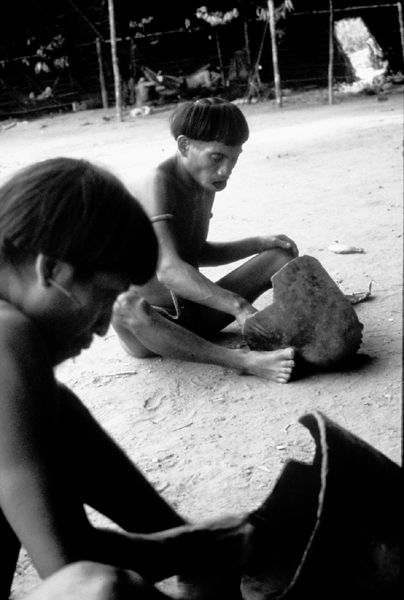
When the clay pots broke, the men saved the larger pieces and used them either as a surface on which they ground their hallucinogenic snuff, or as “toasting platters” on which they prepared small manioc cakes about the size of large pancakes. For this they placed the larger pieces of broken pottery on the hot coals of a hearth and toasted the manioc cakes on both sides, very different from how these manioc cakes are produced in most other Amazonian tribes, who cook them on only one side.
Yanomamö clay pots
Finally, there are a few optional material items in all villages, things that are so easy to make or produce that they are sometimes left behind when the villagers move. These include small plaited fire-fans, hollow bamboo tubes (called toras ) men use to blow hallucinogenic drugs into each others’ nostrils, gourds (or half gourds) used to hold water or as spoons, small cotton aprons worn by young girls, and other easily replaceable items.
In short, Yanomamö material culture—their worldly possessions—is more typical of Amazon Basin hunters and gatherers like, for example, the Siriono of Bolivia, than it is of Amazon Basin gardeners, who usually have elaborately decorated, well-fired pottery, a more elaborate food-processing tool kit, carved wooden objects, woven and decorated cotton garments, and dugout canoes that can be as long as sixty feet and can transport scores of people and their possessions along large and small waterways of the Amazon Basin.
But despite their limited repertoire of material items, in the Yanomamö villages where I worked in the lowlands, the people were highly dependent on their immense gardens. As elevation increased in the foothills, Yanomamö gardens seemed to become smaller—as did their villages.
The Yanomamö cultivate a very large number of varieties of both cooking plantains and eating bananas—which is basically how plantains are distinguished from bananas: you normally cook the former when they are green but eat the latter when they are ripe. The “banana soup” the Yanomamö use during feasts is actually “plantain soup” since it is prepared from ripe plantains. Most villagers where I worked had at least a half-dozen varieties of plantains and another half-dozen of bananas, and the Yanomamö, in general, over their entire distribution, must have upwards of 50 varieties of plantains and bananas. While these were all introduced into the Americas after 1500, the Yanomamö probably cultivated a variety of indigenous crops well before 1500, particularly the two widely distributed Amazon basin varieties of manioc (cassava): “sweet” manioc and “bitter” manioc, the latter requiring the removal by leaching and squeezing out of a toxin, cyanic acid, before it is safe to eat. In addition to manioc, the Yanomamö also cultivated maize and a number of different potato-like tubers (kabiromö and ohina ) indigenous to the Amazon Basin as well as sweet potatoes, various species of gourds, arrow cane, cotton, papaya, tobacco, the red pigment used to decorate their bodies (Bixa orellana ), several varieties of hot peppers, and several species of “magical” plants.
The various Ecological Zones shown in the graph here indicate that village size is also a function of both elevation and the degree to which warfare is more likely to play a role in the politics of intervillage social relationships. In the lowlands the threat of war makes leaders seek out and find reliable allies, which necessitates holding elaborate feasts for them and this requires increased garden size in order to produce a “surplus” of plantains and bananas that are gluttonously consumed by the visitors in these feasts.
One region of the Yanomamö area far to the north was, according to a few evangelical missionaries I spoke with in the 1960s, populated by extremely small groups they called the Kobariwä-teri, who seemed to be much more dependent on hunting/gathering than the Yanomamö I knew. The missionaries said these people were more nomadic and had much smaller gardens that were barely visible from the air. The Kobariwä-teri were very poorly known at that time, and I am not sure if anyone has yet managed to study the small groups in this rugged area. If the fragmentary reports are true, the Kobariwä-teri might still be living under circumstances that all Yanomamö lived under around two hundred or so years ago.
The Yanomamö Diaspora
I use the word diaspora advisedly to emphasize that a Yanomamö village is more of a temporary, plastic, and ephemeral process than some rigid and fixed entity that remains the same over long periods of time: village size and composition are in a constant state of flux because of the politics of upheaval, internal dissent, and fissioning.
The map below shows the general direction of Yanomamö migrations for approximately the past 150 years. Seven major populations are shown here, indicated by A–G. I established these migration patterns through interviews with Yanomamö informants on visits to villages in each area. What is not apparent from this map is that the Yanomamö have moved out of higher mountainous terrain into lower-lying adjacent areas.
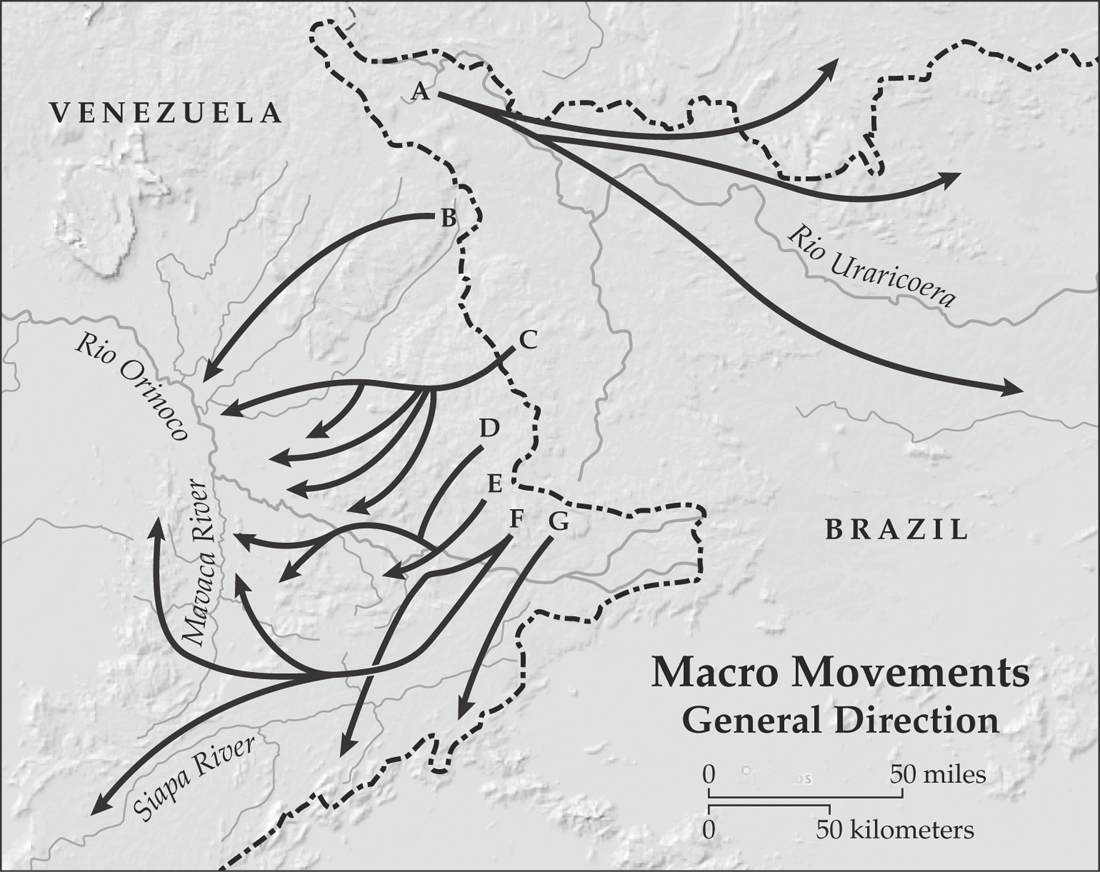
Yanomamö migrations from the 6th edition of my Yanomamö monograph, p. 82: Migration Patterns of Seven Clusters of Villages
The border between Venezuela and Brazil consists of a chain of low mountains known as the Parima Highlands or Parima Mountains. The Parima rises to elevations of approximately 2,500 to 2,800 feet and, in the higher elevations includes some treeless savannas. The border also defines major watersheds: all rivers that flow to the east in the map eventually merge into the Amazon River and those that flow to the west drain into the Orinoco River. There is one exception, one geographical anomaly: the Orinoco splits into two parts in Venezuela’s Amazonas territory and each part flows into the Atlantic by its own separate route, one part by way of the Amazon River, the other by way of the Orinoco River.
Ecological Zones Model
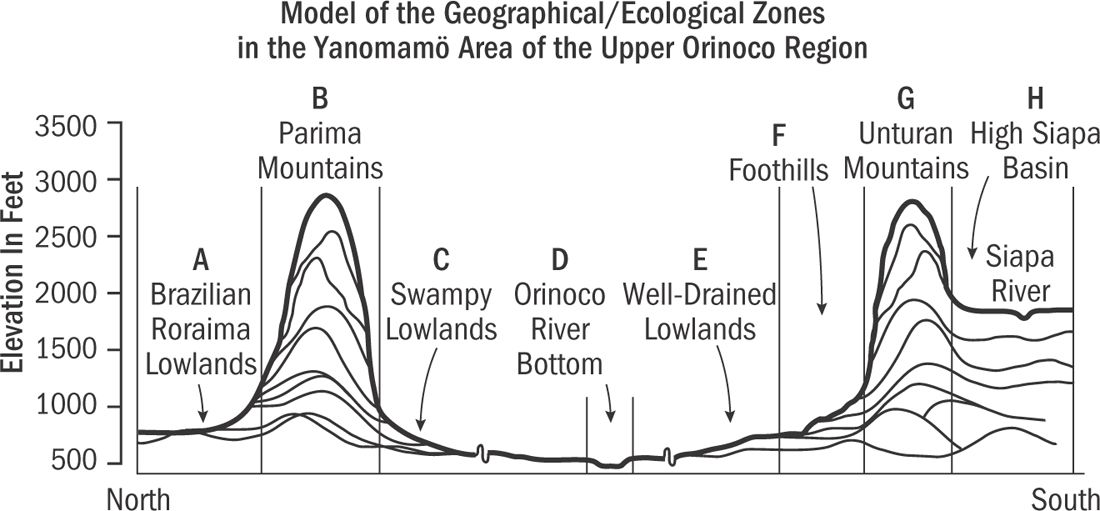
It was not until 1990 that I developed the final version of the geographical model shown below. I was able to arrive at this conception only after I had had opportunities to fly over the area and only after accurate maps that were based on satellite imagery began to appear. The ecological zones model below helps explain geographical and ecological aspects of recent population movements of large numbers of Yanomamö groups and sheds a great deal of light on why some villages are able to become larger and politically more complex.
The Ecological Zones Model is schematic in the sense that it distorts the horizontal aspects of Yanomamö terrain—the several regions (A, B, C, D, etc.) vary significantly in width and detail, depending on the location of each cross section of Yanomamö territory. The model best fits a cross section along a north-south axis passing approximately through the village of Patanowä-teri. (The vertical aspect showing elevation is more accurate than the more schematic width areas.) The model shows reasonably well that different regions lie at different elevations and present different ecological, geographical, political, and economic opportunities and constraints to the Yanomamö groups living in them.
Once the Yanomamö left the Parima highlands and established themselves in the lowlands, some groups were forced by their enemies back into higher elevations in a different chain of mountains to the south, a group of mountains that lies immediately to the north of the Siapa River. This chain of mountains is called Sierra Unturan on some Venezuelan maps. As explained earlier, this narrow escarpment defines the boundary between the Orinoco watershed and the Siapa watershed, which eventually flows into the Amazon.
The historical origins of the populations I studied almost certainly lie in the Parima Highlands. The dozen or so villages that I knew best were from two different groups, each of which I could trace back to a single earlier village whence they fissioned within the past one hundred years.
People in these villages spoke slightly different but closely related dialects. One group was the Shamatari (Southern Yanomamö) and the other Namowei-teri. Their origins and migration routes are shown here as D, E, and F.
The key informants I spoke with in the 1960s were very old at that time and could reliably trace their political histories and genealogies back only to villages that were already approaching the banks of the Orinoco, that is, back to about 1850. In other words, their immediate ancestors had already left the Parima Highlands prior to 1850. Informant accounts of their settlement histories earlier than 1850 blend into the “mythical” past and are less reliable.
Two sites kept cropping up in their oral accounts. One was a mountain called Aramamisi käkö, where the Shamatari are said to have come from (shown here on the north side of the upper Orinoco River). The other was a place called Konata, where Namowei-teri informants said their ancestors originated. Konata lies just west of Aramamisi käkö. All informants said their ancestors came from farther to the northeast, in the direction of the Parima Highlands. They insisted that the Yanomamö already had “big gardens” at that time. In other words, my oldest informants in the mid-1960s believed that the Yanomamö had always been slash-and-burn cultivators and had no recollection of a time that this was not the case.
In the Parima Mountains, narrow strips of jungle immediately adjacent to the small rivers are called gallery forests. Yanomamö gardens in the highlands are cleared in these gallery forest areas.
Importance of Political Security in Yanomamö Culture
Contemporary villages in the Parima Highlands are usually located in or near these gallery forests, frequently just outside them where the open savanna offers clear vision for a long distance and the residents can see enemies approaching long before they reach them. Even here intervillage warfare is relatively frequent and the villages are often surrounded by stout palisades. As in all Yanomamö areas, political security appears to have been a major concern for a relatively long time. For example, when I first visited villages in 1967 at Parima B (the location in the highlands where a New Tribes mission was established in the 1960s), the local missionaries were already concerned about food shortages in the Yanomamö villages that were beginning to gravitate to their mission. By 1994 the food shortage was even more critical: there were over five hundred Yanomamö living near this one New Tribes mission!
This is a very large population concentration for the Yanomamö. The missionaries had turned to agricultural consultants to help solve the growing Yanomamö food problem there, a problem caused by choosing political security over subsistence needs. The missionaries explained to me that Yanomamö groups kept coming closer and closer to the mission to avoid raiding from other Yanomamö groups on their periphery, mostly from adjacent villages in Brazil whose residents were acquiring shotguns, first from missionaries, but later, in the late 1980s, from Brazilian illegal miners known as garimpeiros. The Yanomamö were willing to suffer hunger for the increased safety and security that the mission seemed to provide.
As one moves west from the Parima Highlands to lower elevations, one crosses rugged foothills that are very difficult to traverse. This area is occupied by villages that have left the highlands and are moving toward the more productive lower elevations, but their attempts are resisted by groups who have already established a foothold in the more desirable regions at lower elevations that do not flood.
As elevation decreases further, several important general changes seem to occur. First, villages become larger. Second, intervillage hostilities appear to increase, that is, warfare seems to become more frequent, more chronic, and more costly in terms of deaths. Third, the Yanomamö gradually become more dependent on cultivation because periodic “feasting” with allies appears to have begun. This means that gardening must do more than provide subsistence; it must also provide surplus cultivated food to feed large numbers of guests who arrive en masse from an allied village and who might stay for up to a week. Thus, gardens must become larger to accommodate the food costs of political alliances. In a sense the Yanomamö subsistence economy starts to become a political economy.
Lying at yet lower elevations are the river bottoms surrounded by lowlands, an area where gardening is more productive, where villages become even larger, and conflict between villages increases further. Although the lowlands seem, at first glance, to be more desirable places, living there entails a considerable degree of risk to cultivators. The river bottoms are subject to unpredictable but devastating flooding near larger rivers like the Orinoco and some of its larger tributaries, such as the Mavaca, Ocamo, and Padamo. I know of many groups whose gardens have been ruined periodically by floods during years of especially intense rains. I recall one year during my early field research actually being able to paddle my canoe right up to the entrance to the shabono I was visiting! The shabono is usually located on the highest ground, often within the garden. Needless to say, the gardens of the members of this village were underwater and their crops ruined. Hardship and hunger usually follow when the gardens are flooded. The residents then have to break up into smaller groups, move to higher terrain, and depend more extensively on wild foods and on garden produce obtained from their allied neighbors. Herein lies one of the more important aspects of intervillage alliances: food sharing between allied villages in times of privation.
Thus, the area labeled here as Zone D, “Orinoco River Bottom,” is avoided because of unpredictable flooding and also because the Yanomamö cannot cross large rivers without canoes.
The most desirable area in the Ecological Zones model is “Well Drained Lowlands,” Region E. Most of the lowland areas here are far enough inland from and at a slightly higher elevation than the larger rivers, so that the risk of flooding is greatly reduced. The most desirable lowland areas are gently sloping, well drained, and embrace a fairly large expanse. Food collecting and hunting are generally very productive in these areas and, combined with food cultivation, provide an excellent economic adaptation, one that spreads subsistence risks over a broader range of calorically productive subsistence activities.
What Yanomamö Land Might Tell Us About the Origin of Civilization
Even small amounts of food production confer military advantage on “transitional” societies. They can grow slightly larger in population size and therefore better resist incursions and potentially disastrous raids by their neighbors.
Jared Diamond argued that agriculture was “the worst mistake” in the history of the human race. I can agree with him only for the major civilizations, which depend heavily on starchy monocrop agriculture such as cultivation of rice, maize, potatoes, wheat, etc. However, the Yanomamö type of economic adaptation is an exception to Diamond’s argument: food production enabled them to achieve larger, more defensible villages while retaining variety in their diets because of the ability to hunt and gather wild foods.
This Yanomamö type of economic adaptation was a crucial step in the development of more complex societies. People like the Yanomamö, historically speaking, moved step by subtle step from small-scale farming in order to maximize group size to thwart their aggressive neighbors. This historical/evolutionary direction ended, for many societies, with near complete dependence on just one or two staple cultivated foodstuffs that possibly lacked sufficient nutritional variability to maintain good health. Perhaps choosing the security of village size over the benefit of more nutritional variety is what drove people in Egypt, Mesopotamia, India, China, Mexico, and the Andes to take the nutritiously maladaptive step of cultivating only a few food crops.
The lowland area of Yanomamöland is flat enough that intervillage visiting is frequent because walking is easier. For the same reason intervillage raiding is also easier, so villages tend to be more widely spaced just in case the neighboring village turns hostile. This is especially significant in terms of adaptation to the social and political environments. Villages in these well-drained lowlands also claim and defend much larger areas of the lowlands than they need purely for subsistence. They create safe havens into which they can retreat if wars become frequent and costly (in deaths). These safe havens are areas they temporarily go to at a safe distance from their permanent shabonos to avoid raids. The sociopolitical strategy characterizing these movements is different from, but easily confused with, fighting over scarce resources such as cultivable land, where hunting and collecting are also highly productive. These are two different issues at the theoretical level: one view argues that human conflict, including war, reduces to somatic survival (food, nutrition). The other argues that human behavior and conflict are driven by an even more compelling issue, individual survival and the survival of one’s kin group (close kin). When the bombs start falling—or the arrows—whom does one turn to for reliable support? Kinsmen, or the unknown strangers in the next valley over?
The “Fertile Crescent” of the Yanomamö Lowland
I did most of my fieldwork where there were at least three lowland regions south of the Orinoco River that comprised what we might call a Yanomamö fertile crescent. They were areas of expansive, gently sloping, well-drained lowlands where it was easy to clear gardens. They were characterized by an abundance of and a large variety of wild vegetable foods, game animals, and materials needed for shabono construction—especially roofing leaves, saplings, and vines (Zone “E” on the Ecological Zones Model ).
One of these special areas is the drainage of the Shanishani River, another is the upper reaches of the Washäwä and Örata rivers, and the third is the headwaters of the Mavaca River (see here ).
When the first pioneering groups of Yanomamö entered this area over one hundred years ago their populations appear to have exploded. This region became the fertile crescent of Yanomamö culture, a veritable population pump that further dispersed the Yanomamö into the Siapa River basin and thence south into the headwaters of many of the rivers in Brazil’s Amazonas State. I estimate that some 25 percent of all Yanomamö currently live in—or their parents or grandparents were born in—the villages whose members came from these three fertile crescent areas of Venezuela. Perhaps as many as 30 to 40 percent of the Brazilian Yanomamö are recent immigrants from this area and from the Parima Highlands, at least half of which lies in Venezuela. Many Yanomamö moved north and northeast into the Brazilian state of Roraima in very recent times.
The Shanishani kä u and Similar Micro-Niches in the Fertile Crescent
I was always surprised when I walked inland from the Orinoco River to villages located on or near the Shanishani River (near the village of Patanowä-teri in the map on page 5 ). At its mouth, where it drains into the Orinoco, this small river was always clogged with sandbars and fallen trees in the dry season, seemingly too shallow to navigate during any season. Yet upstream from there, even miles inland, the river seemed full of water, even in the dry season—almost enough water that one could ascend it in a small canoe. I even considered buying a small, collapsible boat for this purpose. It appeared to me that the adjacent terrain was bleeding its spill-off rainwater into the Shanishani, keeping the adjacent terrain relatively dry but the Shanishani full of water. I have never seen another small river in Yanomamöland that was impassable at its mouth yet potentially navigable by canoe in its middle and upper reaches. There was something very special and unusual about this river and the gently sloping lowlands it traversed and drained.
Several major Yanomamö populations passed through the Shanishani and the similar adjacent regions of this ecological zone. They made many gardens and shabonos here. The Namowei-teri occupied the easternmost portion of this area after about 1900 but, before they got there, several earlier populations had also been there—the Aramamisi-teri, a group that fissioned into what is now at least three major Yanomamö groups: the Karawatari, the Kohoroshitari, and the Shamatari. The first two multivillage groups are now located on the Brazilian side of the border far to the south, but several Shamatari villages I studied in this area might include large numbers of individuals who the others in the village claim are really Karawatari. One of my best Shamatari informants, an older man named Dedeheiwä, lived in Mishimishimaböwei-teri in the Mavaca headwaters and had many brothers and descendants through the male line there. He told me several times that he was actually an Aramamisi-teri as well as a Karawatari. Many of the gardens the Mishimishimaböwei-teri cleared where they lived during the past fifty years were at the same locations (and sometimes had the same names) of earlier gardens that the Karawatari originally cleared before they moved into and across the Siapa Basin and eventually into Brazil.
The fertile crescent area has had a long history of occupation by several major Yanomamö populations and through population growth has generated large numbers of villages. As we would expect, it has also been an area of comparatively high levels of warfare and violence.
Looking Back Up the Parima Mountains
Once migrating Yanomamö reached the fertile crescent area, their villages grew and subsequently fissioned. Initially the subgroups spread out within this desirable area, but as these groups grew and fissioned, not all of them could remain within the fertile crescent. Some of them were forced out of the area by their larger, more powerful neighbors, moving into the higher elevations of the foothills (Zone F on the Ecological Zones Model ), where conditions are harder due to the ruggedness of the terrain and the diminished resources.
It is a general rule in the biology of ecosystems that species variety and density diminish as elevation increases. Thus, as Yanomamö groups were forced to move higher up into the hills certain species of game animals and plants become less abundant—and some, like the caiman and tapir, are not found at all. In addition, it is much easier to clear gardens on relatively flat terrain in the lowlands than on hilly or mountainous terrain where fetching water and collecting firewood become energetically costlier tasks for both men and women.
Groups thus peripheralized try to get back into the lowlands, but their attempts are usually thwarted by the successful lowland occupants, whose villages are considerably larger. The peripheralized groups are sometimes forced to flee to even higher elevations, where making a living is even more difficult. Some are forced up the mountains separating the Orinoco drainage from the Siapa drainage (Zone G on the Ecological Zones Model ). It is clear from the village histories I collected that many groups crossed these mountains and moved into the Siapa Basin (Zone H on the Ecological Zones Model ). The Kohoroshitari and Karawatari did exactly this sometime in the recent past, perhaps as recently as 1900 to 1920. One large Shamatari group I visited in Brazil in 1995, the village of Abruwä-teri, moved to its location from the banks of the Siapa River in the early 1960s. They had fissioned from a village called Doshamosha-teri, presently located on the banks of the upper Siapa River. They had brothers and sisters still living in Doshamosha-teri and were extremely excited when I showed them Polaroid photographs of all the residents of Doshamosha-teri that I had taken some four years earlier. They could name all of the adults and tell me how they were related. In addition, they were sporadically visited by people from Doshamosha-teri, who lived several days’ walk to the Abruwä-teri’s northeast in Venezuela.
But the Siapa Basin is less desirable than the well-drained lowlands of the Orinoco Basin (Zone E on the Ecological Zones Model ) because important Yanomamö resources are less abundant. As I described earlier I was very surprised to discover that the Siapa River immediately south of the headwaters of the Shanishani River lies at an elevation of 1,800 feet, more than 1,200 feet higher than the Orinoco Basin at that latitude! Such a difference in elevation is very large for people who hunt, gather, and garden. Although I did not take an inventory of game animals the people here were hunting, I did notice that they ate snakes, which the lowland Yanomamö I had lived with never did. One man demonstrated his catch for me one day, a very large bushmaster, one of the most poisonous snakes in the Amazon Basin. The only other area I spent time in where the Yanomamö regularly ate snakes was in the Parima Highlands. There they also ate deer and jaguars—meat that the lowlanders I studied would find unpalatable, even a bit disgusting. It got much colder at night in the Siapa Basin because of the higher elevation. I had to wear my clothes, put on a wool sweater, use an insulated blanket, and sleep close to the hearth to keep warm at night. I also had to do these things when I visited villages in the Parima Highlands. There they also drape large banana leaves down from the shabono rafter poles to help retain warmth from the ever-tended hearth fires. But this practice also inhibited the escape of smoke, so in the mornings I smelled and felt like a partially cured Virginia ham.
Social Circumscription and Theories of Increasing Social Complexity
One of the first professional papers I presented at an anthropology meeting was an attempt to account for the reasons why some Yanomamö villages I was studying were larger, more warlike, and seemed to be politically more complex than the many other Yanomamö villages I had visited by 1968. I noted that villages tended to be larger and more warlike in what I call the fertile crescent. Headmen in these villages—the political leaders—were reluctant to move past or around neighbors on their periphery. I drew attention to the importance of the purely social component of their environment with regard to determinants of their overall settlement pattern strategies. This was an unusual theoretical distinction at the time because cultural-material theorists viewed the environment basically in terms of the material items found in it, not the social/political dimensions of the groups occupying it. I also noted that headmanship seemed to be more highly developed than in other areas. Although the Yanomamö fertile crescent was not sharply bounded by geographical barriers, the fact that the village leaders there were reluctant to leapfrog over neighboring groups suggested that these neighboring groups constituted, in effect, a kind of social wall or barricade impeding expansion. I argued that villages here were “socially” circumscribed, drawing a parallel to arguments first proposed by Robert L. Carneiro about the social and political effects of “environmental” circumscription in the Andean area.
Carneiro had earlier noted that societies that were environmentally circumscribed by mountains, deserts, and oceans, particularly in the western Andean area of Ecuador and Peru, eventually developed the political state. He argued that in these areas, the initial small communities of agriculturalists could simply retreat from neighbors in times of war and move elsewhere within the valley. Many Yanomamö groups do just this in their safe havens. As populations grew in Andean valleys, this option to move disappeared because the available land was used up. Over time, Carneiro observed, with increasing conflict and population growth, smaller communities were forced to amalgamate into fewer but larger communities for self-defense, a process that eventually culminated in the appearance of yet larger complex societies called chiefdoms, characterized by formal chiefs, hereditary rank, the appearance of specialized artisans, social classes, and the beginning of public works like temples and irrigation systems. Eventually one of the chiefdoms dominated the others by military conquest. Valley-wide political integration then took place: all outlying villages within the valley were now subordinate components in a larger political entity: the state was born. As these small states emerged in each valley, warfare between valleys began, culminating in the Inca Empire about 1000 AD. The Inca ultimately controlled an empire that ran 2,500 miles along the Andes Mountains.
Social circumscription contributes to increased political complexity by impeding population expansion and migration and forcing villages to deal with hostile neighbors by increasing village size and making alliances with some neighbors. For the Yanomamö fertile crescent region, populations were able to move westward while simultaneously remaining in the same kind of ecological niche—the more desirable lowlands.
Since 1968 I have done much more research on settlement patterns, village histories and size, social patterns, and, in particular, geography. Social circumscription could have only limited effects on the development of increased political complexity among the Yanomamö villages in the fertile crescent. Once the area of the Shanishani River had been filled with competing large villages, some of them left this desirable niche and moved into the basins of the Washäwä and Örata, thus relieving population pressure in the Shanishani Basin and reducing the effects of social circumscription. In turn, as these two new areas filled up, some of the groups then occupied the headwaters of the Mavaca—a similarly rich zone. From there they crossed the mountains into the Siapa Basin, moving southward across the high Siapa plateau and into Brazil, into the lowlands drained by affluents of the Amazon River like the Rio Negro. A few large villages remained in the high Siapa plateau, but these are very widely spaced, possibly because resources there are less abundant and less predictable.
In the early 1990s I collected some comparative sociopolitical data in eight villages that had been pushed out of the more desirable lowlands in the Shanishani drainage into the foothills and Unturan mountains separating the Orinoco and Siapa drainages. These are “refugee” villages, unable to successfully compete with the larger, more aggressive villages in the lowlands. Three of these eight villages have been pushed into higher elevations very recently and retain some statistical characteristics acquired in the lowlands (villages 71, 64, and 72 below). In general, these refugee villages are smaller, men have lower rates of polygynous marriage, there are fewer abducted women in these villages, and fewer men who are unokais —the honored men who have killed others.
The table below summarizes my findings, which support the social and political consequences of the general cultural-ecological model I just described. The average percent of abducted females in these villages that have been pushed out of the most desirable lowlands is 11.4 percent, and the average percent of unokai males is 22.3 percent. By comparison, in more desirable lowland villages approximately 17 percent of the women have been abducted and approximately 44 percent of adult males are unokais. The contrast between the fertile crescent lowlands and the less desirable highlands is striking.
|
Certain Characteristics of “Refugee” Villages Compared to Lowland Villages Found in Zones F and G on the Ecological Zones Model |
||||
|
Village |
Size |
Number Men
|
% Abducted
|
%
Unokai
|
|
69 |
53 |
1 |
14.3 |
7.7 |
|
71 |
43 |
1 |
33.3 |
36.4 |
|
64 |
99 |
2 |
14.5 |
27.6 |
|
72 |
28 |
1 |
0.0 |
57.1 |
|
59 |
81 |
2 |
0.0 |
21.4 |
|
57 |
81 |
1 |
15.0 |
15.4 |
|
68 |
54 |
1 |
14.3 |
0.0 |
|
67 |
40 |
0 |
0.0 |
12.5 |
|
TOTAL: |
479 |
9 |
— |
— |
|
AVERAGE: |
59.9 |
1.1 |
11.4 |
22.3 |
12
Yanomamö Social Organization
Reproduction
The fundamental key to Yanomamö social organization and the social organization of all tribesmen is the reproductive success of adult men and women. In most tribal societies one will find that a few men have enormous numbers of offspring. They have (or have had) many wives because of polygyny.
By comparison, most women over their lives have pretty much the same number of children on average. If they start having children soon after their first menses and live to the age of menopause, all women in noncontracepting populations achieve about the same level of reproductive success.
The Yanomamö, like all tribesmen, also have ideas and notions about both kinship relationships—how one is related to people around them—and whether kin on father’s side of the family are the same as or different from kin on mother’s side. While kinship is very important in all tribal societies, descent through one line of relatives (males for example) is often more important than descent through the other line of relatives for many socially and reproductively important identities.
Anthropologists have studied and documented thousands of different tribesmen and, indeed, one prominent school of anthropology, associated with the anthropologist George Peter Murdock (1897–1985), has focused on the frequencies of various kinds of social arrangements that tribesmen have developed all over the world. For example, in how many societies is marriage with parallel cousins permitted? (“Parallel” cousins are cousins whose related parents are the same sex.) I have spent my entire professional career doing fieldwork in just one society, the Yanomamö. I report that the Yanomamö emphasize descent through the male line and have what I describe as patrilineal lineages. Researchers at HRAF draw on this sort of information to investigate more broadly into social arrangements, following Murdock’s classic 1949 pioneering work, Social Structure. So, a researcher interested in how frequently “patrilineal” descent occurs in the ethnographic record, for example, consults the HRAF database.
I believe that patrilineal descent is far more common than matrilineal descent in the ethnographic record because warfare and intergroup conflict have been a chronic political condition in human history. In other words, I believe that the “Yanomamö model”—if we can say that the Yanomamö constitute a cluster of social, demographic, and military characteristics such that they represent a “type case”—was frequently found in human history and was probably common in the Paleolithic and Neolithic eras.
Patrilineal societies tend to keep the men in the same group they were born into, giving such groups advantages in hunting game animals because they have lived in the same general territory all of their lives and are intimately familiar with it and the movements of game animals.
But I believe the more important advantage that patriliny confers on groups of males who are closely related through the male line is that they tend to be able to cooperate more effectively and reliably in times of conflict. In short, they make a more cohesive fighting group because they are related closely. If anthropologists have learned anything from 150 years of studying tribesmen it is that closeness of kinship is a good predictor of social solidarity, cooperation, and amity. Indeed, it is closeness of kinship that appears to hold Yanomamö villages together when tensions develop and allows them to grow larger. Larger villages, of course, are better able to defend themselves when threatened by neighboring groups.
The fact that patrilineally organized societies are much more common in the ethnographic record is most likely the consequence of the constant threat of conflicts with neighbors that were very common in our Paleolithic and Neolithic past.
Differential Reproductive Success by Males Compared to Females
A man with ten wives can produce more offspring than a woman with ten husbands. Thus patrilineages can grow in size more quickly than can matrilineages. This fact has profound implications in a society organized by lineages. Another way of saying this is that there is very little variance in the reproductive success of women; all women who reach the age of forty-five will have about the same number of offspring, as I mentioned earlier.
By contrast, there is enormous variance in the reproductive success of Yanomamö men—one might even call it spectacular variance. Some men will successfully acquire many wives (polygyny), but many men will have only one (monogamy), a few will have to share a wife (polyandry), and some men will have none (celibacy). These anthropologically “standard” forms of marriage all occur among the Yanomamö so it is inaccurate to classify their marriage rules as either polygyny or monogamy or their culture as being characterized by just one of these various forms of marriage.
Regardless of their marital status, most Yanomamö men are trying to copulate with available women most of the time, but are constrained from doing so by the rules of incest and the intervention of some other man with proprietary interests in the same women.
This is why there is so much club fighting and why villages split into two or more groups so easily. Conflicts over the possession of nubile females have probably been the main reason for fights and killings throughout most of human history: the original human societal rules emerged, in all probability, to regulate male access to females and prevent the social chaos attendant on fighting over women. Males in this persistent kind of social environment sought the help of other related males—brothers, sons, cousins, uncles, nephews—and formed male coalitions to pursue their selfish reproductive goals as well as to minimize lethal conflicts within their own groups. Male access to females—usually “heroes” attempting to secure the love, affection, and proprietary reproductive potential of heroines—is the constant theme of myths, legends, and historical accounts of just about all cultures and societies known to historians and anthropologists.
Reproduction in the Yanomamö Fertile Crescent
Here is an example of what I have been discussing from the fertile crescent of Yanomamöland. In the beginning of Yanomamö habitation in the fertile crescent where I worked, a man named Matakuwä had ten siblings. His father was very successful at begetting. Matakuwä (“Shinbone”) himself begat twenty sons and twenty-three daughters by eleven different wives. Shinbone probably died sometime in the late 1930s. I knew several of his children who were then in their late fifties when I began my fieldwork in 1964. For example, Sibarariwä was one of Shinbone’s twenty sons and one of the few who were alive when I did my fieldwork. Another was Ruwahiwä, the Shamatari headman who was bludgeoned to death by the Patanowä-teri. One of my best informants, Dedeheiwä, was married to one of Shinbone’s daughters, who was still alive during the years I was studying Mishimishimaböwei-teri, that is, between approximately 1968 and 1988.
So, following the narrative convention found in sacred texts and a few secular ethnographic monographs, Shinbone begat Sibarariwä, Shihewä, Shabreiwä, Shikomi, Shoshomi, Shiribimi, Shörökariwä—and thirty-six more children.
In turn, two of Shinbone’s brothers had twenty-two children and nineteen children respectively, not because fecundity ran in their family but because they had many sisters and daughters to give away in marriage and they “traded” them to get extra wives for themselves and their sons. A Yanomamö without sisters and daughters to give away is most likely a bachelor and nobody’s ancestor. People in the Stone Age to the time of the Bible had begetting as well as eating in mind.
How Does Such a “System” Start?
The short answer to this question is that it results from the long-term consequences of short-term decisions that tend to be made with immediate reproductive interests in mind. Yanomamö men probably do not consciously think about maximizing their reproductive success when they agree to give a young sister or daughter away in marriage. But Yanomamö men tend to give away females to men who can reciprocate by giving back their own sisters and daughters as wives. Think about this as investing in a capitalistic economy: deploying valuable resources (nubile females) in the most likely way to get an equal or better return on your investment, an equal or greater number of nubile females in return.
Once started, both parties benefit if they continue doing it every time a young man needs a wife and the other family has a young daughter to give away and vice versa. Soon the two “families” are locked into a marriage system wherein each gives marriageable females to the men in the other extended family.
While the concept of family is close to what I mean, the more precise word is patrilineal descent group (or patrilineage ). It is a group of people who are descended from a particular man and can trace their genealogical relationship back to him exclusively through male links. On page 321 is an “ideal model” that represents the Yanomamö system of marriage and how two groups (X and Y patrilineages) reciprocally give marriageable females to each other over several generations.
The “ideal model” of Yanomamö society is a marvel of simplicity once the specific elements are understood. I will describe them here. These are also the basic elements that Claude Lévi-Strauss, the famous French anthropologist (1908–2009), identified in his approach to early human societies, an approach that is now widely known in anthropology as structuralism.
In Lévi-Strauss’s approach, human societies can be described by a few general diagrams in which males are represented by triangles and females by circles (see Figure 1-A ). A minimal number of elements is used. For example, the family has a father (triangle), a mother (circle), and one child of each sex (triangle for the son, circle for the daughter). A horizontal line above the two children indicates that they are genetically related as brother and sister. Marriages are shown by a horizontal line underneath the couple that connects the spouses, and a vertical line down from the marriage line shows the connection between the parents and their (two) children. (Parents can and often do have more than two children, but the “ideal model” shows only the minimal number of individuals needed to illustrate the important elements of the ideal models.) The parents constitute “generation 1” and the children “generation 2,” a younger generation.
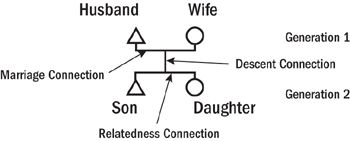
Figure 1-A
Let us now make the ideal model a little more complicated by showing that the “husband” in Figure 1-A has a sister, and the “wife” in Figure 1-A has a brother, as shown in Figure 1-B :
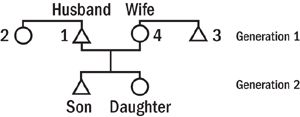
Figure 1-B
They are all in “Generation 1.”
Things get a little bit complicated here: we are giving numbers to individuals, but the numbers appear to be illogical in the sense that instead of the expected 1, 2, 3, 4 order, I have put them in a different order: 2, 1, 4, 3. Thus, in Figure 1-B the husband is number 1 and his sister is number 2. The wife is number 4 and her brother is number 3.
Next, let us assume that people of marriageable age have siblings who are also of marriageable age, so, the sister of the husband and the brother of the wife in Figure 1-B are of marriageable age and both of them are married, as shown in Figure 1-C . Now the somewhat odd choice of numbers begins to make more sense:
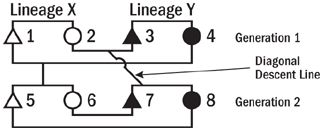
Figure 1-C
The Yanomamö make alliances with other families such that a man who marries takes another man’s sister for his wife. In return he gives his sister to that man as his wife. This is sometimes called “brother/sister” exchange. Once this exchange starts, it tends to persist generation after generation.
As I said earlier, the Yanomamö have the most commonly found system of descent in the tribal world: patrilineal descent, which means that children are members of their father’s patrilineage. So, to indicate this fact, I have darkened the circles and triangles of one of the patrilineages: all members of the “darkened” group, which I label as the “Y” patrilineage, are shown on one side of Figure 1-C . The other side of the figure represents a group that I have labeled the “X” lineage (they are not darkened).
Note that the “descent” line in the X lineage is perfectly perpendicular to connect the children (individuals 5 and 6) to their father (individual 1). But because the members of lineage “Y” all have to be in a different patrilineal group on the other half of the ideal model, their descent line has to be drawn diagonally to keep them on the other half of the diagram as shown.
What we have now is an “ideal” model that illustrates the following “rules” that guide many Yanomamö social actions, marriage in particular.
1. Men get their wives from some other lineage, i.e., a man must marry a woman who is not in his own lineage. Thus patrilineages are exogamous–-meaning that both men and women must marry outside their lineage.
2. Men exchange their sisters to get wives from other men. Thus, these men are brothers-in-law–-or as the Yanomamö say, “shori” or “shoriwa.”
3. The most certain way to find a wife in a world where women are scarce (because some men have several wives) is to repeat this kind of “brother/sister” exchange generation after generation.
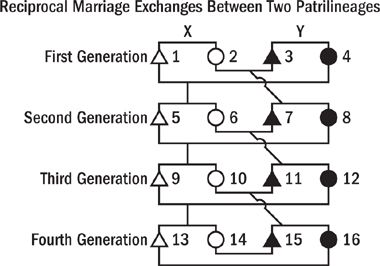
Figure 1-D
The logical and inevitable consequence of marriage exchanges, generation after generation, between males from two different lineages (lineage exogamy) is that every man will be marrying a woman who is simultaneously his mother’s brother’s daughter (MBD) as well as his father’s sister’s daughter (FZD), i.e., what anthropologists call his bilateral cross-cousin. This can be shown for every man in Figure 1-D after generation 1. Thus, individual 7 in generation 2 is marrying his mother’s (individual 2) brother’s (individual 1) daughter (individual 6). She is simultaneously his father’s (individual 3) sister’s (individual 4) daughter (individual 6).
This pattern continues for every male after generation 1 in both lineages in this diagram. See for yourself.
The resulting “ideal model” of Yanomamö society is a society that essentially has two “halves” because the Yanomamö rules about social behavior and marriage obligations imply that, ideally, villages are comprised of two lineages, i.e., they have what anthropologists call “dual organization.”
However, the “ideal model” simplifies a more complicated real world. For example, it assumes that each man has one wife and one sister, that each marriage has two offspring, one of each sex. Also that each man has one wife and each wife has one husband. Real villages deviate from the ideal village in the model. In the real world, families have more than one son, wives have more than one husband, individuals die before marriage, etc.
The short-term desire of men to acquire marriageable females develops into a long-term pattern of reciprocal marriage exchanges wherever men control the marital destinies of their sisters and daughters. Men give away their women in marriage in almost all tribal societies and have probably done so throughout human history. I know of no society where women give away their brothers in marriage, nor any human society where females from one group raid other groups and abduct males for husbands. Romantic love had nothing to do with mating and reproduction in the Stone Age. In the tribal world marriage was too important to be managed by lovestruck juveniles.
Reciprocal marriage exchange between two groups is probably the most effective marital strategy in a milieu where females are scarce and valuable—as they invariably are where polygyny occurs. In this situation the most common resulting pattern or system is the one shown on page 321 —the system found among the Yanomamö in an ideal sense. This system was probably common in the pre-agricultural past and may have dominated most of human social evolution. Page 321 shows an “ideal model” of how things work. In reality things are more complex: people have more than two children each, both children do not always survive to age of marriage, not all families have one female and one male child, men often have more than one wife, and so on.
Dual Organization
The Amazon Basin is famous in anthropology for the frequency of societies characterized as having so-called dual organization.
What this generally means is that a large number of societies found there tend to have social halves, often two lineages like the ones shown on page 321 . However, these lineages usually have social functions and attributes in addition to regulating marriages, such as the obligation of members of one of the groups to bury the deceased members of the other, privileges and responsibilities regarding the sponsorship of ceremonial events and feasts, a prescribed location within the village where they must live, etc.
These social accoutrements can be so elaborate and complex in some Amazonian tribes that an early prominent anthropologist, A. L. Kroeber, characterized them as “luxuriant developments” in the social calculus of the domestic, ceremonial, and political lives of native Amazonian tribesmen (Kroeber, 1948: 395–97). “Dual organization” is not confined to the Amazon Basin and is, in fact, commonly found in many tribal societies all over the globe where reciprocal exchange of marriageable females occurs.
If you examine page 321 , you will discover that after the first generation of exchanges, continuation of reciprocal exchanges of women has what I consider to be profound social and political consequences.
First, everyone falls into one of two categories—“own group” and “other group”—with regard to where men get wives. Moreover, your wife’s brothers (not shown on page 321 ) become your social, political, and reproductive allies because you and your brothers give them your sisters and they and their brothers give you theirs (also not shown on page 321 ). Consequently, your respective political and reproductive interests overlap. A male coalition whose members have their own reproductive self-interests in mind emerges. In a sense and at some analytical level, it is not “lineages” that should be viewed as the primary focal point in models of tribal social structure, but pairs of matrimonially bound lineages whose male members constitute a coalition with common reproductive interests and goals. These reproductive interests entail political and military interests.
Second, incest prohibitions probably develop quickly in an evolutionary sense: men cannot marry/mate with females in their own group, which basically includes their mothers, sisters, and daughters. Thus, men must get marriageable females from the other group.
To regulate the very important problem of making sure that men married (mated with) females who were young enough to bear offspring, in other words, females that had high reproductive value, the notion of generation developed.
The most logical categories for generations would be Parental, Own, and Offspring, or Older, Mine, and Younger. This becomes clearer if we focus for a moment on who arranges the marriages of whom. Adult males arrange the marriages of their (younger generation) children, largely through negotiations with adult males in the other group whose (younger generation) children are yet unmarried (or unpromised). Young females are easy to give away—all the males want them. It is more difficult for adult males to find young eligible females for their sons. In these negotiations, men who have some prominence do better than other men in getting their sons and other male dependents married off. This enhances the amity and solidarity between older and younger men: the latter are dependent on the former in finding a mate.
What makes a man “prominent”? It is not simply brute force and being fierce. Rather it is the number of kinsmen he has, which reflects how men in previous generations handled their own marriage negotiations, and which in turn depended on luck at having sisters to give away to get extra wives for themselves, who then reproduced large numbers of offspring, which in turn made it increasingly easy for any given male descendant to find wives for their own sons, and so on. This puts a premium on continuing to reciprocate women with as few reliable lineage heads as possible, thus keeping the marriage system as close to an efficient dual organization as possible.
The profound consequences of these patterns can be seen by examining more carefully the ideal model shown on page 321 of two lineages (X and Y) whose members give women to each other in marriage. If you pick any marriage that occurs after the first generation you will find that all males marry women who are related to them simultaneously as mother’s brother’s daughters (MBD) and father’s sister’s daughters (FZD). This fascinating outcome is empirically demonstrated in the statistical data I have collected for all Yanomamö marriages in all the villages I have studied. Thus, when two groups—patrilineages, for example—begin to reciprocally exchange females over several generations, this practice invariably leads to a system in which the males marry females who are other group, own generation, and not sisters. These women are a special kind of cousin that anthropologists call cross cousins.
Cousins are people in your own generation who are related to you because one or more of your and their parents are siblings. If the parents in question are of the same sex, then by anthropological convention the cousins are called “parallel” cousins. If the relevant parents are of the opposite sex, their children are called “cross” cousins.
Thus your mother’s sisters’ children and your father’s brothers’ children are your parallel cousins. By contrast, your father’s sisters’ children and your mother’s brothers’ children are cross cousins.
“Cousin marriage” has been significant in the history of anthropological theory as well as in the ethnographic descriptions anthropologists have made in their studies of tribesmen.
A number of mammal species expel sexually maturing young males from either the mother’s territory if the species is nonsocial (for example, brown bears), or from the cooperative female group if they are highly social (for example, African lions). Among higher primates, the large chimpanzee (Pan troglodytes ) generally expels young adult males. The net result in each case is the formation of “matri-focal groups” within which the incoming mate is a male from some other nearby group. If one were to draw a diagram of what happens, it would look just like the one on page 321 but the groups would be matrilineages and the males from one group mate with—“marry”—the females of the other, a kind of “husband” exchange system. The major difference between a human system and, say, the African lion system is that humans are able to assign names to the categories within which mating is legitimate and have, through language, developed more elaborate ways to constrain and limit sexual conflicts, such as by defining and prohibiting incest between close relatives.
In many primitive societies like the Yanomamö the rules that must be followed in marriage are often very specific and defined by the kinship terms that are used to address and/or refer to kinsmen—terms like niece, cousin, brother (of course, in the language used in the society). For example, the word we use for our genitor is father. The Yanomamö word is habe. Our word for our mother’s brother’s daughter is cousin. The Yanomamö word is suaböya. However, our word for our mother’s sister’s daughter is also cousin, but the Yanomamö word is yaöya. It is identical to their word for sister(s): they regard their female parallel cousins as sisters, which of course we do not. But like us, they cannot marry a female they classify as a “sister.”
Here is where it becomes very interesting: the Yanomamö word for a female cross cousin, Suaböya , is also their word for wife. Thus they call female cross cousins “wife.” Not only can they marry them, they must marry a woman they classify as Suaböya , wife.
Wherever various kinds of cousins are legitimate marriage partners in a society, the most common marriage rule found among tribesmen all over the globe is a rule or prescription that states, in effect, that males must marry their female bilateral cross cousins (females who are cross cousins through links via both the mother and the father). The reciprocal of this rule, from the female’s vantage, is that females must marry their father’s sister’s sons or their mother’s brother’s sons. This is what the graphic on page 321 shows us.
One of the twentieth century’s anthropological great works in fact focused on the marriage systems of primitive peoples all over the world. This is, of course, French anthropologist Claude Lévi-Strauss’s The Elementary Systems of Kinship.
This work and the themes he raised in it about the inherent ability of “primitive societies” to hold together—to generate internal social solidarity—dominated the second half of the twentieth century in the cultural anthropology literature about tribesmen, and a great fraction of my own work focuses on this theme as well. Without what the French social scientists called “social solidarity” human societies tend to fall apart or fission into smaller groups.
One might liken the concept of “social solidarity” to some kind of “social glue.” Marriage between groups provides one kind of glue, descent from a common ancestor another kind of glue, how closely you are related to your kinsmen a third kind of glue, and how you are related to your kinsmen (for example, through father or through mother) yet another kind of social glue.
Whereas Lévi-Strauss’s “structural” approach largely concerned “ideal models” of tribal societies, his more fundamental interest had to do with the ability of social groups represented by these models to promote or hinder social solidarity, in other words, that somewhat mysterious quality that allowed social groups in the tribal world to grow in size and complexity. In my view, the evolution of social complexity in human societies was the result of increases in the size of local groups (villages, for example). The problem was how to develop more “glue” to enable increasingly larger groups to develop and hold together.
Under conditions of chronic warfare, there is safety in numbers. The proximate evolutionary end was to maximize group size, which in turn maximized individual reproductive survival—the ultimate end. The most persistent obstacle to the size to which local communities could grow was the sexual jealousy and proprietary ambitions of adult males within the group for the females in the group. The goal of men in tribal societies was to regulate such ambitions and jealousy.
Yanomamö Hypothetical Example of a “Little Bang” Theory
The development of the Bilateral Cross Cousin Marriage (BCCM) system was of sufficient moment in the evolution of human social systems that it might be regarded as the “big bang” in developing cooperation within human societies. It is cooperation that makes social life possible in all social species.
At the time Shinbone lived there were, of course, other men like him, men with immediate reproductive interests who wanted to marry and have offspring. Nobody knows the precise decisions made by these individuals to obtain wives and make sure there would be a reliable supply of them in the future for their sons, but I can draw attention to several of them because I spent many years collecting genealogies and documenting family sizes as meticulously as I could while I was trying to define and understand the Yanomamö reproductive rules. It is highly unlikely that these individuals had anything other than a short-term, even selfish, goal in mind: get women, copulate with them, and guard them from other men to make sure that only you fathered their offspring.
Cultural anthropologists like me arbitrarily refer to men like Shinbone as “lineage founders” because they are the male apex point of, for example, a patrilineal lineage from which all others in that lineage are descended. In the great scheme of things, of course, some Adam would be the “founder” if knowledge were perfect and anthropologists existed at the beginning of Homo sapiens, that is, at “Creation.” All of this is to say that genealogies account for only the most recent historical sequence of individuals in any society. So in most societies, the “founder” turns out to be the first person in a long list of individuals who can be identified by a name, the most remote named ancestor about whom something is known (or believed). The founder of Shinbone’s lineage, in my field records, is not Shinbone, but a man I have labeled “Shinbone’s Father” because Shinbone had several known genetic/biological brothers and sisters who had the same father.
A man by the name of Yamirawä was an approximate contemporary of Shinbone, perhaps antedating him by a half or a full generation. Yamirawä was not demonstrably related to Shinbone, but he and his male relatives married Shinbone’s female relatives. In my schematic, Shinbone could be considered the founder of lineage “X” and Yamirawä the founder of lineage “Y.” Both men were major “founders” in the Shamatari—that is, southern—population of Yanomamö.
Yamirawä was one of three brothers whose immediate descendants married women in Shinbone’s patrilineage and became matrimonially locked into marriage exchanges as represented earlier.
Initially, Yamirawä did not do as well reproductively as Shinbone did. He managed to marry two women and had six children by them. However, three of his sons did extremely well—and acquired multiple wives: one of them had 21 children, another had 32 children, and the third had 12 children. Indeed, by the time I began my field studies in 1964, Yamirawä’s descendants were numerically the largest single lineage in half of the Shamatari villages and Shinbone’s descendants the largest in the other half of the Shamatari villages. The political leaders in these villages came from one of these lineages, and in cases where both lineages were numerically predominant, there were two headmen—one from each lineage—and they were married to each other’s sisters in most cases. That is what is implied by the term shoriwä or its abbreviation, shori— what we call “brother in law”—and why the men greet any strangers as “Shori! Shori! Shori!” to indicate intimacy and a desire for friendship.
It is in this somewhat random fashion that large lineages—almost accidentally at first—start, develop, and then dominate the immediate social and political destiny of whole tribes and nations. When they achieve their grandest scope and potential, they fundamentally shape just about every aspect of their tribal communities.
Shinbone’s Descendants
In a patrilineage, the male founder has two kinds of descendants: lineal and cognatic. The first kind can trace their connection to the founder through male links only—sons of the sons of the sons, etc. of the founder. Daughters of the founder are his lineal descendants in the first generation, but their offspring are not lineal descendants and by definition, not members of his lineage. In patrilineages the father’s lineal identity determines the lineage to which all of his children belong. Thus, when a female of lineage X marries, her children will belong to her husband’s lineage, which cannot be X because both men and women must marry someone who is not in their lineage. This is called lineage exogamy by anthropologists and is a near-universal characteristic of marriage rules in societies that have lineages.
A simple way of thinking about patrilineal descent and lineage identity is the way most people of Western European ancestry pass on their family names through the father’s line. My father’s last name was Chagnon, and therefore my brothers and I are Chagnons and our immediate offspring are also Chagnons. Our sisters had the same last name as we did, but they changed their last names to their husbands’ last names when they married. Their children’s last names are no longer Chagnon because their fathers’ last names are not Chagnon.
The children of our sisters are related to and can trace descent back to our father just as the children of my brothers and me can, but they are not his lineal descendants: they are what anthropologists define as cognatic descendants.
Shinbone’s Other Descendants
The chart seen below is a truly remarkable empirical summary of how polygyny sets into motion the genealogical structures often found in demographically intact tribal populations, structures that are often unknown or even undocumentable in tribal populations that have been ravished by introduced diseases, depopulation, defeat by state-organized militaries, or forced resettlement, often with remnants of other tribes, on small reservations or mission posts. Anthropological research in these kinds of refugee communities cannot, for obvious reasons, demonstrate the same principles I am discussing. Not all anthropological field research is equally useful to understanding the evolution of human societies because this understanding depends in large measure on genealogies obtained from demographically intact tribesmen.
Cognatic Descendants of Shinbone (EGO 1221)
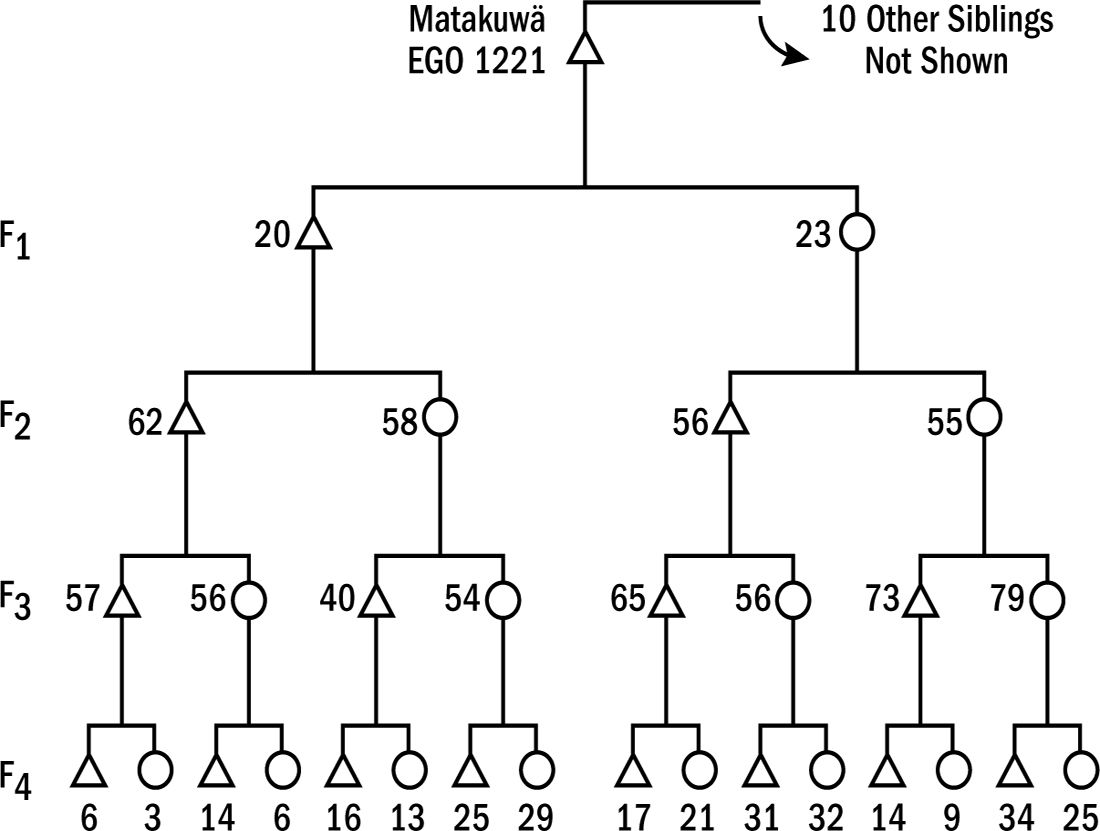
All descendants of ‘Shinbone’ (EGO 1221) grouped by sex. He had 20 sons and 23 daughters (F1 generation). The 20 sons in turn had 62 sons and 58 daughters, and so on. (Overlap in the F3 and F4 generations is not removed; descendants in generations F5 and F6 are not shown.)
The following discussion highlights the final component of Yanomamö marriage practices that persistently reinforce the social solidarity that enables their villages to grow larger than, say, one hundred people. The causal chain might be summarized as follows and explained in more detail below:
1. Their marriage rules prescribe marriage with bilateral cross cousins.
2. This form of marriage requires lineage exogamy (patrilineal identity).
3. High variation in male reproductive success implies strong competition for scarce females.
4. Men tend to continue to give their sisters and daughters to men in the same “other” lineage and expect to get the sisters and daughters of these men in exchange.
5. Within two generations some categories of the lineal descendants and the cognatic descendants will be eligible mates to each other, leading to “inbreeding,” that is, closeness of kinship relatedness between spouses.
Look at Shinbone’s grandchildren through his sons, the F 2 generation, 62 males and 58 females. As discussed above, the Yanomamö have a rule of “prescriptive bilateral cross cousin marriage,” which means men are supposed to marry either their father’s sister’s daughters (FZDs) and/or their mother’s brother’s daughters (MBDs) or a female who is simultaneously both. This means that the 62 males in the F 2 generation, for example, are eligible to marry any of the 55 females shown on the other portion of the diagram in the F 2 generation: they are all FZDs to these 62 males. By extension and Yanomamö kinship rules, the 58 females in the F 2 generation on the left portion of the diagram are also eligible as spouses to the 56 males on the right side of the diagram: these men are their father’s sister’s sons—the reciprocal of the above rule: if a man can marry his FZD, his wife is related to him as her mother’s brother’s sons.
This logic extends, of course, to all the generations depicted page 330 . For example, in the F 3 generation, the 57 great-grandsons of Shinbone can marry the 54 females shown on the left half of the diagram and the 40 males on the same side of the F 3 generation can marry the 56 females on that side of the generation because in the first case the females are related as FZDs to the males and, in the second case, the females are MBDs to the males.
Much of the “social glue” that keeps Yanomamö villages cohesive is the result of such marriages with bilateral cross cousins (FZD and MBD marriages). This practice explains why the Shamatari villages (dominated by Matakuwä’s descendants) became larger than the Namowei-teri villages: more of the Shamatari individuals marry their “close” cross cousins because the Shamatari are more closely related.
Indeed, the genealogical structures set into motion by polygyny, high variance in male reproductive success, patrilineal descent, and lineage exogamy result in a situation in which the men in some villages might even find it difficult to locate a potential spouse who is not a bilateral cross cousin—unless they appropriate them by abductions in distant villages!
One of the first things that Christian missionaries usually do when they evangelize tribesmen is to prohibit polygyny and intervene wherever they can to discourage men from having two or more wives, as if monogamy were natural and polygyny were the “work of the Devil.” The likelihood is that humans have been polygynous for most of their social evolution. Polygyny then is more natural in humans and the single most important element lying behind whatever social solidarity emerged in our prehistoric past. Marrying closely related cross cousins promotes cooperation between all members of a lineage. Polygyny explains why these descendants are able to cooperatively live in villages that exceed two to three hundred people.
Male Coalitions, Warfare, and the Distribution of Women
Despite the skepticism widely shared in the now politically correct anthropological profession, the ethnographic and archaeological evidence overwhelmingly indicates that warfare has been the most important single force shaping the evolution of political society in our species. Warfare has been chronic, with the few possible exceptions where humans migrated so far out from their home ranges that they had no neighbors. Probably the biggest threat to early human local groups came from neighbors—the people in the next valley over.
Because intragroup conflicts over local resources (such as females) increase with local group size, continued growth in community size was constantly limited by these conflicts. Such conflicts are most easily resolved by group fissioning: making conflicts less likely by reducing the size of the group. But since there is safety in numbers, there were countervailing pressures to continue to grow. The result was constant pressure for adult males to develop kinship-defined coalitions that peaceably distributed females and pooled their collective abilities to wield force against other groups.
As I see it, the most probable long-term evolutionary scenario in the development of human sociality was constant but slow growth of community size followed by fissions of communities once they reached sizes of 50 to 75 people—the numbers mentioned in Richard Lee and Irven DeVore’s classic treatise, Man the Hunter.
It seems that the primary source of conflict within stateless human groups is young females of reproductive age who have neither fathers nor husbands to safeguard them. They constitute a major cause of potential instability and strife among the Yanomamö: aggressive adult males between the approximate ages of 15 and 40 constantly want to copulate with them and/or appropriate them for their exclusive reproductive interests. They are a source of conflict in Yanomamö communities and in many other tribally organized societies that lack the institutions associated with the political state—law, police, courts, judges, and odious sanctions.
I suggest that conflicts over the means of reproduction—women—dominated the political machinations of men during a vast span of human history and shaped human male psychology. It was only after polygyny became “expensive” that these conflicts shifted to material resources—the “gold and diamonds” my incredulous colleagues alluded to—and the material means of production. By that time, after the agricultural revolution, the accumulation of wealth—and its consequence, power—had become a prerequisite to having multiple mates.