7
From Fieldwork to Science
As early as the summer of 1966, after my first collaborative field study with James V. Neel and his biomedical researchers, I could see signs of change taking place in the Yanomamö area. In 1965 Padre Cocco had hired the Yanomamö men from several nearby villages along the Ocamo upstream from his mission to clear the jungle for an airstrip. They came for a week or so at a time and stayed at Ocamo, where Padre Cocco fed them with sardines, plantains, and manioc flour purchased from the Ye’kwana. After working for a few weeks they went home. They came back again and again, cutting trees and pulling stumps by hand until the dirt airstrip was long and wide enough for a small plane to land on and take off from his mission at the mouth of the Ocamo.
Neel and his research team joined me in the Yanomamö area for their first field studies in January 1966, the peak of the dry season. They flew in to Padre Cocco’s new airstrip at Ocamo in a small Cessna, the first plane to land on this new airstrip. Neel had hired Boris Kaminsky, the Yugoslavian immigrant who would later fly me over the Siapa River. I picked them up at Ocamo and brought them to Mavaca, my base camp. My wife and children had returned to Ann Arbor a few months earlier.
Padre Cocco continued to expand and lengthen the airstrip with Yanomamö labor. Within a year, the Venezuelan air force was landing DC-3s (C-47s) and, eventually, larger twin-engine Barrigones —“fat-belly” cargo planes, C-123s.
The airstrip made it possible for other visitors to conveniently and easily fly into the Stone Age from large cities like Caracas and even farther away. Padre Cocco soon discovered he had many well-to-do friends in Venezuela who had private airplanes, and they began to visit him. He was a cordial and accommodating host. He would, for example, take visitors to nearby more isolated villages, and they would usually express their gratitude by leaving generous cash contributions to his mission work as they departed for home. I once counted five light airplanes on Padre Cocco’s airstrip, all Venezuelan visitors with their families who had come to see “wild” Indians.
The Role of the U.S. Atomic Energy Commission in Yanomamö Research
During Neel’s first visit in 1966 I was still a graduate student and still being supported entirely by my predoctoral NIMH research grant. I became a salaried member of Neel’s department in January 1967, just after I was awarded my Ph.D. in December 1966, as I have mentioned.
Neel had a large multiyear research grant from the U.S. Atomic Energy Commission, which supported human genetics research projects in many other universities as well. Neel had founded the Human Genetics Department at the University of Michigan Medical School and was its longtime chairman. Prior to that, he was part of the U.S. Atomic Bomb Casualty Commission, the medical division of the Atomic Energy Commission, which was formed after World War II. It was composed mainly of medical doctors and researchers, and its assignment was to treat the survivors of the Nagasaki and Hiroshima atomic bombings and, in Neel’s case as a geneticist, monitor the offspring of the survivors for possible long-term genetic consequences. Neel designed research projects to fulfill this assignment.
Neel was a masterful grantsman, the kind of academic who is able to persuade funding agencies to support new kinds of research that extend and build on his previous research. For example, administrators of his AEC grant were pleased with the results of his earlier grants to investigate possible genetic effects of the atomic bombings in Japan, so Neel approached them with a new large project. Since the traditional “marriage structure” of the residents of Nagasaki and Hiroshima was literally destroyed, the best way to understand the possible ramifications of long-term genetic damage in Japan would be to make a comprehensive study of the traditional Japanese family and its reproductive customs—courting, engagement, marriage, etc. To understand what might be happening in Hiroshima and Nagasaki, he proposed a major study of some Japanese population not affected by these bombings, ideally a Japanese population that was minimally affected by World War II. The AEC funded his proposal to study the entire population of a small (but populous) island off the main Japanese islands. This study would pay a large part of the salaries of many of his department’s faculty, research associates, and secretarial staff for several years, sparing the University of Michigan’s Medical School much of the expense of paying these people from general operating funds.
I met Neel just as his research grants from the AEC were in their final phases. But he managed to secure additional funding for a small pilot study of South American Indians before his AEC funds ran out. He argued that because we now knew a lot about the population that was exposed to the atomic bombings of Hiroshima and Nagasaki, and we increased our understanding by studying the marriage and reproductive systems of an unaffected large Japanese population, what was now needed was a study of a primitive baseline human population that was not Japanese and not affected by a world war. Since the proposed size and costs of this study were very small, the AEC permitted him to include this study in his annual grant renewal.
My initial participation in Neel’s pilot project was funded by my own grant from the U.S. National Institute of Mental Health, not the AEC. NIMH was traditionally a major source of funding for predoctoral anthropological field research like mine. My NIMH predoctoral grant lasted from 1964 until about November 1966, when I finished the formal requirements for the Ph.D.: finishing all required course work, passing language examinations in two foreign languages, submitting an acceptable doctoral thesis, and defending it before my thesis committee. My first field collaboration with Neel took place in 1966, while I was still on my NIMH grant and working on my Ph.D. I didn’t begin receiving a salary from Neel’s department until late 1966.
The Brazilian Yanomamö Villages
In 1967, about three months after I joined Michigan’s Human Genetics Department, I went to Brazil as part of a collaboration with one of Neel’s former Brazilian Ph.D. students, Francisco Salzano. Neel and Salzano had collaborated previously on a brief study, also funded by the AEC, of the Xavante Indians of Brazil’s Mato Grosso region, a study that included David Maybury-Lewis, a British anthropologist associated with Harvard University. It was because of the initial publications of this collaboration that I became aware of Neel’s interests in South American Indians and decided to contact him, as discussed in chapter 1 . The Xavante Indians were Gê speakers, as were the Suyá, the tribe I initially planned to study before switching to the Yanomamö.
Our Brazilian trip would take us to a large number of Yanomamö villages along and immediately east of the Parima Mountains, which defined the border between Venezuela’s Amazonas territory and Brazil’s Roraima state. I would get to see how varied the Yanomamö were and what other kinds of terrain they lived in. It became immediately apparent to me that the government in Brazil was much more aware of the Yanomamö than was its Venezuelan counterpart.
We stayed in each of several villages for only about a week. Most of them were smaller than the villages I had gotten to know across the border in Venezuela, and many of them seemed to have nearby shabonos with satellite communities living he borara and from whom they had recently fissioned. This usually happens when the members of the several groups are on strained terms, which is to say, squabbling with each other.
Neel’s medical and scientific goal in studying Amazonian Indians was to document the magnitude of genetic variability that was used to distinguish one “tribe” from another, and the amount of genetic variation that existed between villages of the same tribe, an empirical question that had not been adequately discussed in the medical and genetics literature about indigenous peoples. Other observations on the Yanomamö he and his medical team made were secondary and, to a certain extent, a kind of showmanship for anthropological onlookers. Medical doctors do better and more “scientific” research than physical anthropologists do.
Neel often scoffed at and showed no small amount of contempt for studies done on native peoples by an underfunded, isolated individual researcher (often an anthropologist) working on a Ph.D. in some remote tribal place. His Yanomamö expeditions by contrast were very well funded and involved highly trained medical experts from several different medical fields. He took immense pride in making an admirable and comprehensive biomedical study of tribesmen—and he largely succeeded in outshining his competitors in this new and rapidly developing biomedical field of studying native peoples. He was able, because of an abundance of funding, to outshine those similar anthropology projects that were typically underfunded.
By the mid-1960s there were several biomedical research groups beginning to make elaborate studies of native peoples all over the world—in Melanesia, sub-Saharan Africa, Polynesia, and the Amazon Basin. Previous inadequately funded anthropological studies of indigenous peoples were being replaced by elaborate well-funded studies by researchers from prominent medical schools at major universities whose extramural grant access was heavily weighted in favor of research in the medical, biological, and mathematical sciences as distinct from the social sciences.
Most of the genetic markers of interest were alleles that could be identified in various components of blood samples. Neel was also interested in other measures that would help define a biomedical baseline that could be used to understand pre-industrial human populations who yet lived in relative isolation, by helping to answer questions about population migrations, “genetic distances” between various “tribes,” and a variety of questions concerning individual versus group differences.
Research into the demography of small-scale populations like the Yanomamö was also a growing field in anthropology at the time. This was the “overlap of interests” that I shared with Neel that made our collaboration desirable from my perspective. But Neel’s biomedical interests could be satisfied with short field trips and a collection of blood and other medical samples. Indeed, Neel himself didn’t even have to go on these field trips: anybody could collect blood samples for his laboratory. For example, Miguel Layrisse, our Venezuelan collaborator, left the field after one day and collected none of the blood or other samples in our collaborative multiyear study of the Yanomamö. But Neel wanted a hands-on intimate experience with “the American Indian” and enjoyed the added authority that such experience afforded him. That, I suppose, was the reason he stayed in the field for at least two weeks each year. However, I got the impression that the “American Indian” seemed to be, for him, an idea about Indians more than the highly variable individuals he was systematically documenting with the meticulous data his various team members were compiling.
My interests in anthropological-demographic data required long-term residence among the Yanomamö—learning their language, gaining their trust and acceptance, and spending hours, weeks, and months painstakingly speaking in whispers to many informants from many villages, piecing together genealogies, histories of wars and their mortality consequences, deaths by various diseases identified by Yanomamö informants, village fissions, and so forth, and placing much of this information on the questionable maps I had to work with while making my own, more accurate maps. This was not the kind of research effort one could send an assistant into the field to do.
But in many respects Neel seemed to regard me as just another assistant, subordinate in the field as well as in his department after I accepted a position in the latter. Neel had a decidedly patronizing and condescending view of anthropology compared to what “scientists” like him did. In his view anthropologists should confine their interests to things like taboos, customs, beliefs, myths, how to live in the jungle. They should learn the native language in order to assist the scientists in the expedition. When, however, the anthropologist collects important data like statistics on births, deaths, marriages, mortality rates, etc., as I did, he should dutifully turn them over to the scientist he is working for.
Technically, after I joined his department Neel was paying my salary, and I agreed to do many of these things. But there was a fundamental misunderstanding between us from the outset. Much of my data was demographic information that “scientific” anthropologists like me collected in order to explain social patterns and longer-term historical trends. I regarded these data as mine and whatever similar data I collected after becoming a member of his department as something we should share in joint publications.
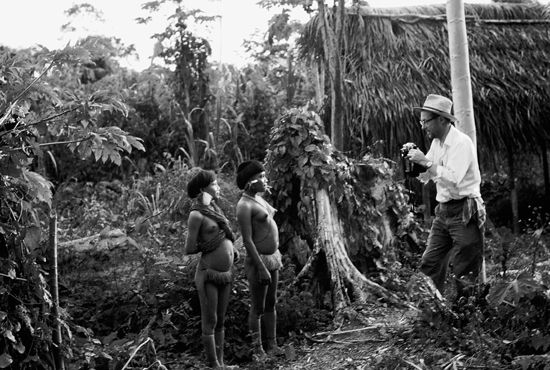
James V. Neel photographing two Yanomamö girls.
Our collaboration also and quickly began to get lopsided in terms of the amount of time I could spend on my own research interests and data collecting. A pattern emerged. Each year when Neel and his medical team were exhausted after about two weeks of intensive fieldwork among the Yanomamö, they would leave the field, taking the most recent set of blood and other tissue samples with them on the plane out of the jungle from Esmeralda or Ocamo. But that same plane would bring in a new , fresh group of biomedical researchers from Neel’s department who were eager to spend the next two weeks furiously collecting additional blood samples at other, more remote Yanomamö villages and, of course, I would have to be their guide and gofer. So I had to spend much of my field time attending to the interests of the various medical people associated with Neel who came in fresh waves. Our collaboration did not leave me much time to do my anthropological fieldwork and collect new data on topics that were important to me—and to anthropology as a science.
Finally, Neel expected all the members of his “team”—regardless of their own religious convictions or absence thereof—to participate in group singing of evangelical gospel songs when we were invited to do so at New Tribes missions. I refused to do this. I also refused to participate in Salesian religious activities. Although I was on friendly terms with the missionaries (and continued to be for years after leaving Neel’s project), I did not want to compromise my independence in the eyes of the Yanomamö by appearing to be identified with mission groups, whether New Tribes or Salesian. I felt that my own work and relationships with the Yanomamö had to be sharply distinguished from the objectives of the mission groups. I insisted on remaining neutral in what would predictably become an uncomfortable competition between católicos and evangélicos.
A Trip to the Brazilian Yanomamö
The first of the Brazilian Yanomamö villages I visited under Neel’s auspices was Yaröhä-teri, on the Toototobi River. These Yanomamö were similar to the Venezuelan Yanomamö I had studied, but their dialect was different enough to make it a bit difficult for me to communicate easily with them during the first several days. The other villages we visited that year spoke Yanomamö dialects even more difficult for me to understand at first, but we managed to understand most of what we said to each other.
We spent about a week in the Yaröhä-teri group—it was actually several small villages living he borara along the Toototobi River. The blood samples we collected in this and other Brazilian Yanomamö villages that year led to the discovery in Neel’s lab that almost none of the Yanomamö had measles antibodies in their blood and had never been exposed to this devastating disease. When Neel returned to Ann Arbor in late February 1967 he contacted Parke-Davis pharmaceuticals, which had a facility in Ann Arbor, and persuaded them to contribute two thousand measles vaccines for our scheduled January 1968 return to Venezuela. But when we arrived in the Yanomamö area in January 1968, an epidemic of measles had already started. We spent many days attempting to vaccinate a barrier around the places where it most likely would spread.
Neel had sent half of the two thousand doses to Brazil, along with a sufficient amount of gamma globulin to ameliorate the reaction to the vaccine, with William J. Oliver, head of the Pediatrics Department at the University of Michigan Medical School. Oliver hand-carried them to make certain they did not get lost or left unrefrigerated en route. Those of us going to Venezuela carried the remaining measles vaccine and the gamma globulin for those. Our vaccine was Edmonston B, which had been administered to some 15 million people by that time, including many third-world isolated groups and native peoples.
Our team that year split into two groups when we reached Caracas and we repacked our equipment and supplies accordingly. Neel took most of the members of the biomedical team into the upper Caura River, a Ye’kwana area, on one plane with approximately half of the medical supplies and vaccines, while I proceeded alone to the Yanomamö area with the other half. By sheer coincidence, all of the gamma globulin was packed in a container that went with Neel’s group. I had half of the measles vaccines, but none of the gamma globulin.
Our field trip in 1968 happened to coincide with a Venezuelan/French expedition that Dr. Marcel Roche, the head of IVIC, had organized. They brought their own anthropologist, a Frenchman named Jacques Lizot. This was his first trip to the Yanomamö.
Neel had also arranged for one of the young men in the New Tribes Mission, Danny Shaylor, to work with his medical team and help with translating both Spanish with the creoles we would run into at the Salesian Missions and Yanomamö when we were in their villages. It turned out that Danny couldn’t meet us as scheduled because he had to take back to a village midway on the Ocamo River the cremated remains of a young man who had just died in Tama Tama of measles—one of the first fatal cases. Information had reached us even before we left Ann Arbor that a measles epidemic had broken out in some Brazilian Yanomamö villages, including the one in which Neel’s team had discovered that the Yanomamö had never been exposed to this disease.
The origin of the epidemic was in the rural Brazilian population along the Amazon River, with one known focus at the city of Manaus. An evangelical missionary family visited Manaus in early 1968, and their young daughter was unknowingly exposed to measles there. Because there is an incubation period, she did not exhibit the clinical signs of measles until after the family reached Yaröhä-teri. Apparently the Yaröhä-teri then got measles from this child.
Measles then rapidly spread along the riverways by Brazilians coming from the Rio Negro area. These Brazilian men had sought out the Salesian missions in the Upper Orinoco that were known to provide work, even if just short-term. As a consequence, the epidemic reached Tama Tama, Ocamo, and Platanal in nearby Venezuela before we got there in early 1968.
The Brazilian Yanomamö had many more—and more serious—threats to their cultural and demographic survival than the Venezuelan Yanomamö after approximately 1970. In Brazil, the colonists, gold miners, lumbermen, cattle ranchers, military, and land developers seemed poised to pounce at the boundaries of the Yanomamö area after the mid-1960s, when the construction of a major road through uncharted Amazon jungle, the Perimetral Norte, was underway. In Venezuela the situation was far different, because the Venezuelan Yanomamö were not threatened by lumbermen or gold miners. The Venezuelan military did not establish a sustained presence in Yanomamöland until about 1987, when Brazilian garimpeiros (gold miners) suddenly overran the Yanomamö area on the Brazilian side of the border and a few of them reached the headwaters of Venezuelan streams and rivers in the Upper Orinoco region before being repelled by the Venezuelan military.
Anthropologists who worked in each country were differently affected. On the Brazilian side, they were politically radicalized. They became militant as native rights activists and seemed always to be fighting the forces of acculturation rather than actually studying the Yanomamö. Anthropologists who worked among the Yanomamö on the Venezuela side seemed to be more focused on purely anthropological issues. Ironically, none of these anthropologists was Venezuelan.
Most Venezuelan anthropologists were not interested in doing fieldwork, even though their country contained some of the least acculturated native peoples in South America. Some of the Venezuelan anthropologists seemed to resent the presence of anthropologists from other countries, especially the United States. In my case, many of them put political obstacles in my way to prevent me from getting research permits to continue my fieldwork among the Yanomamö in Venezuela. This went on almost constantly throughout my research career.
My Expanding Theoretical Interests
One technological advantage in Neel’s department in the late 1960s was that it had one of the few computers on the University of Michigan campus. This enabled me to enter my growing demographic and genealogical information into an easily accessible form. Two people in Neel’s department, William J. Schull and his graduate student Jean MacClure, helped me with a specific program to analyze my genealogies, a formula developed by geneticist and statistician Sewall Wright, to calculate “inbreeding” or “relatedness” from genealogies, a so-called “f” statistic or “inbreeding coefficient.” Schull and MacClure were already using this statistic in their studies of the Japanese survivors of the atomic bombings.
To put this issue in simple terms, you share (approximately) half of your genes with your brothers or sisters—and also with your parents and children. One half is 50 percent, or 0.5000, the “f” value of your relationship to them. But, you only share one-fourth of your genes with a half brother or half sister because you have only one parent in common. The corresponding “f” value is 0.2500. It is thus possible to express the degree of relationship between any two genetic relatives by the “f” statistic. For your full siblings, f = 0.5000, for half siblings f = 0.2500, for first cousins f = 0.1250, etc. Thus, in complex genealogies like those I collected among the Yanomamö, any known common ancestor contributes to how closely you are related to your (genetic) kinsmen, both to your ancestors and to your descendants.
The principal reason I wanted to analyze kin relationships was the fundamental role that kinship has played in societies, as understood in anthropology. For example, one of my former professors, Elman Service, published a book in 1985 titled A Century of Controversy: Ethnological Issues from 1860 to 1960. It addressed what kinship means in the primitive tribal world and, by extension, what earlier anthropologists did or did not do with the genealogies they collected. The so-called genealogical method in anthropological research was much touted but seldom practiced in a serious quantitative way.
Astonishingly, almost none of the kinship studies that Service wrote about used a metric like Sewall Wright’s “f” statistic or some other measure to characterize “closeness” and “remoteness” of kinship ties in tribal societies that anthropologists had studied. Yet many anthropologists explained things in the societies they studied by invoking such variables as “closeness of kinship” or “distant or non-kin.” I intended to put kinship “closeness and remoteness” into a precise, quantitative, standard form.
Yanomamö men are very concerned about paternity and spend a great deal of time “mate guarding” to prevent other men from impregnating their wives. Often, men take their wives along with them while they, for example, clear and burn timbers to make gardens, especially if the wives are young and nulliparous (have not had a child), or they make sure their wives are in a large group of people most or all of the time. If the man goes away on a several-day trip, he asks some trustworthy man—a brother, for example—to keep an eye on his wife. They seem to assume that women will be seduced or raped if left unguarded for long. Much of the mistreatment of women is caused by male sexual jealousy. A man may beat his wife when she has been alone and out of sight for more than an hour or so because he suspects that she has been seduced by some co-villager. Women who married into the village and women abducted from other villages are especially vulnerable to seduction attempts because they have few or no male kin in the village to look after their interests.
Smaller villages have fewer such problems because they tend to be composed of close kinsmen who cooperate more reliably. By “close kinsmen” I could specify, using the “f” factor, precisely how close the degree of kinship relatedness is within a village.
My field research and analytical approach were part of what anthropologist Robin Fox and sociologist Lionel Tiger referred to as the “zoological perspective” in the social sciences, a reawakening of interest in man’s evolved nature as distinct from his purely cultural nature.
I hadn’t fully realized in the late 1960s that the mere suggestion that Homo sapiens had any kind of “nature” except a “cultural nature” caused most cultural anthropologists to bristle. What Tiger and Fox—and a small but growing number of scientific anthropologists—were interested in was the question of how precisely evolution by natural selection—Darwin’s theory of evolution—affected Homo sapiens socially, behaviorally, and psychologically.
Long-term studies of nonhuman primates and primate social organization were affecting cultural anthropology. Many earlier anthropological “truths” were beginning to crumble, such as claims that Homo sapiens alone among animals shared food, made tools, or cooperated with other members of the group who were genetically closely related. More generally, findings from the field of ethology and animal behavior were beginning to work their way into the literature of anthropology. Predictably, cultural anthropologists began to resist these trends, often by denigrating the academics who were taking the first steps in that direction or by attempting to discredit the emerging contributions by criticizing the most sensational work, often by nonexperts (for example, Robert Ardrey’s African Genesis ).
My hope in the 1960s was to make a contribution to a major controversy that was then important in cultural anthropology by “quantifying” kinship relatedness and descent patterns using my F statistic, where the subscript “g” means that the coefficient “F” is calculated on genealogies resulting from informant interviews.
One approach to understanding the basis of social solidarity or social amity that holds groups together is often called structuralism and is identified with French anthropologist Claude Levi-Strauss. This approach emphasized marriage exchanges between groups and regarded descent from some ancient ancestor as the most important source of solidarity in tribal societies. Another approach, often frequently associated with South African–born anthropologist Meyer Fortes, emphasized that “kinship” was the irreducible, rock-bottom foundation of social amity and solidarity. The assumption by partisans of both sides seemed to be that larger communities of tribesmen had a tendency to fall apart if they became too large. My Yanomamö data seemed to be a perfect test case of marriage versus kinship because their villages fissioned into smaller groups once they reached a certain size and the number of villages on which I had data was large for comparative purposes.
I contributed a number of papers to this interesting issue. I originally believed that lineage and descent were important in holding together tribal communities like the Yanomamö, but as I examined my extensive genealogies, I began to change my mind. Kinship, especially closeness of genetic kinship, seemed to be more important than descent. I could demonstrate with my genealogies that some individuals were related to many of their kinsmen by up to a dozen different ways! (My first presentation on this issue occurred at the annual physical anthropology meeting in 1974 and was published in 1976.) But there was something new looming on the horizon, something called sociobiology. Without my knowing it, much of my work attempting to understand and explain the solidarity generated by Yanomamö kinship relationships was subsequently considered to be sociobiology.
I will discuss this subject further in a later chapter, because my innocent and early association with sociobiology became inextricably linked to controversies and criticisms of my Yanomamö research. These controversies became complex because they became largely political and nonscientific. These were early days in what would soon become a controversy and eventually a virtual war over the role of evolutionary science within the field of anthropology.
The Measles Epidemic
I went to the Yanomamö area in a plane that carried a French research team led by Dr. Roche, the head of IVIC. We landed at Padre Cocco’s Ocamo mission and spent the night there. We planned to go on to Mavaca the next day, some two hours upstream by large dugout.
That night the Salesian nuns asked me, Roche, and some of the French medical doctors to come over to the building where the Yanomamö lived because several of them were running high fevers and were sick. Roche examined several of the adults and concluded that they appeared to have measles. He decided that the Ocamo Yanomamö had to be vaccinated immediately, even though I had no gamma globulin to reduce fevers. The French doctors vaccinated all of the adult Yanomamö and the older children in the village.
I took the group to Mavaca the next day. They would stay on the side of the Orinoco River where the Salesian mission was located. Roche made sure the French researchers had everything they needed or wanted, including their own shortwave radio and a Venezuelan radio operator.
Roche had also arranged with the Venezuelan military to have one flight per week flown into Ocamo with supplies for the French team, including fresh green vegetables, bread, steaks, and cases of beer that would be cooled in two large kerosene refrigerators that IVIC had also supplied for their “research.”
My small mud-and-thatch hut was on the opposite side of the Orinoco, a few yards up from where the Mavaca River entered the Orinoco. Since Neel’s group had already done its study of the Upper Bisaasi-teri village located there in 1966, my hut was merely a jumping-off point for our planned 1968 work of vaccinating the local Bisaasi-teri and vaccinating and sampling the Yanomamö groups farther up the Orinoco and inland, ending up in Patanowä-teri. By the time we reached Patanowä-teri we had used most of the thousand vaccines and gamma globulin injections that Neel had brought in for the vaccination program. We planned to use our remaining measles vaccines and gamma globulin at the Salesian mission at Platanal, from whose residents, the Mahekodo-teri, Neel’s team had collected blood and other tissue samples in 1966. Because the exposure to outsiders and the diseases they might unknowingly carry is greater at mission posts, Neel’s priority was to vaccinate those at the missions first. But when we reached this Salesian mission at Platanal—the most remote one on the Orinoco River—we discovered that the Yanomamö residents had all departed because they were en route to visit the Patanowä-teri to participate in a feast there. We spent the night at the mission, then left for Patanowä-teri the next day. I had taken guides who had been vaccinated for measles at Mavaca, but they couldn’t find the trail into Patanowä-teri, so I had to go back to Mavaca to get another vaccinated guide who knew the way. When I got Neel’s medical team into the village, they immediately vaccinated some ninety adults and older children and began taking blood, stool, urine, and other samples. After a few days I took Neel’s team back to the mouth of the Shanishani River, some four hours away, where we arranged to have a large dugout waiting to take Neel, his medical team, and their samples to Esmeralda to fly to Caracas. Tim Asch and I remained in Patanowä-teri to film The Feast.
Several days after Neel’s team left, I had to make a quick trip to Platanal to pick up supplies and mail. While I was there, Padre Sanchez, a Salesian priest who was temporarily assigned to Platanal from his regular post at Esmeralda, asked me to look at a Brazilian man who had just arrived there from the Rio Negro area looking for work.
I took a deep gulp when I looked at this man. He showed all the signs that I had seen at Ocamo several weeks earlier when Roche and I looked at the sick Yanomamö there, signs that he was coming down with measles.
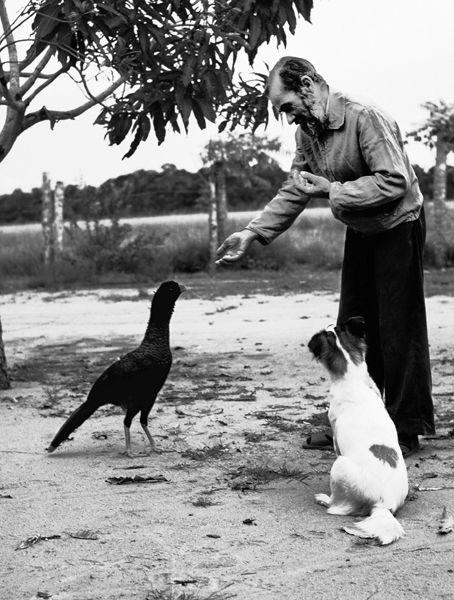
Padre Sanchez.
I urged Padre Sanchez to send this man downstream to either Mavaca or to Ocamo, where we had vaccinated everyone; nobody there now had active, communicable cases of measles. I had heard on the short-wave radio that measles was still spreading to remote inland Yanomamö villages north of the Orinoco, but by now I had also heard on the radio that the Venezuelan health officials were acquiring measles vaccines and were reportedly sending them into the Yanomamö area along with medical personnel. I repeatedly emphasized to Padre Sanchez that the Mahekodo-teri would be coming home after the feast was over, and, if this Brazilian man had measles, he would communicate it to the Yanomamö. Everyone would get sick, and possibly many of them would die.
Padre Sanchez assured me that he would send the sick Brazilian man downstream on the next voladora that he would be sending to Mavaca. I then returned to Patanowä-teri to continue filming The Feast. When the filming was finished, Asch and I packed our equipment and had a few Patanowä-teri carry it out to my canoe. Any reactions from the vaccinations that Neel’s team had administered two weeks earlier were so mild that we didn’t detect them. Nobody complained of fevers that sometimes accompanied measles vaccinations. We then left for Mavaca, some six or seven hours downstream. As we approached Platanal en route, we stopped to let Padre Sanchez know we were leaving the area. I asked about the Brazilian man who was sick with what appeared to be measles. Much to my horror, Padre Sanchez had failed to send him downstream and now he had an active case of measles! I insisted that Padre Sanchez allow me to take the man with me, explaining that the Mahekodo-teri were now en route to their home near Platanal. Padre Sanchez refused my offer.
As soon as I reached Mavaca I went to the Salesian mission and urged Padre Berno to contact Padre Cocco or someone at Ocamo to explain that there was a Brazilian man at Platanal with an active case of measles. Between these two Salesian missions, I hoped that they could persuade Padre Sanchez to send the sick Brazilian downstream to prevent a new outbreak of measles at Platanal.
But not long afterward Padre Sanchez showed up in the mission at Mavaca, and I learned that the Mahekodo-teri had contracted measles from the sick Brazilian. Some of them fled to Patanowä-teri and exposed many in this village to measles, although Neel’s team had vaccinated as many of the Patanowä-teri as the remaining vaccines permitted. French medical personnel who were at Mavaca immediately sent a team to Platanal to treat the sick, but many Mahekodo-teri had died by that point.
Padre Sanchez did not act, despite several warnings from me that the Brazilian man he harbored at Platanal would start a measles epidemic if he didn’t send him out. He may have been responsible for the measles epidemic at Platanal that took as many as twenty-five or thirty lives, mostly residents of Mahekodo-teri.
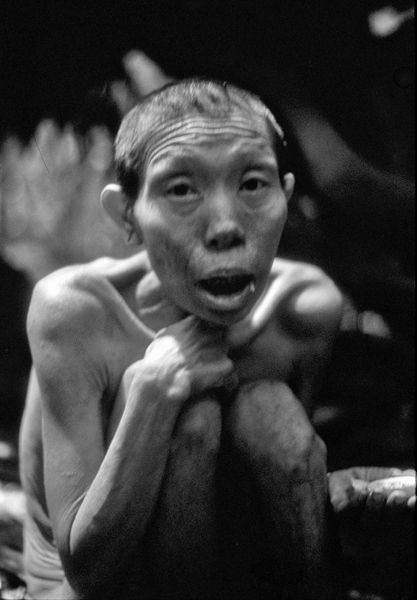
Yanomamö woman with measles, Manaviche area.
I don’t know if Padre Berno at Mavaca or any of the Salesians at Ocamo contacted Padre Sanchez by radio to demand that he get the sick Brazilian out of his mission. If not, then these Salesians could bear the responsibility for these deaths. Later that year Padre Cocco confided in me that he was angry with rumors, which he blamed on the New Tribes Mission, that the Salesians were guilty of complicity in Yanomamö deaths from measles. I never heard these rumors and assured Padre Cocco that I doubted that the New Tribes Mission spread them. But if the rumors referred to the actions of Padre Sanchez at Platanal, as far as I was concerned they were unfortunately true.
8
Conflicts over Women
Archaeological Evidence That Earlier People Fought over Women
The archaeological record reveals abundant evidence that fighting and warfare were common prior to the origin of the political state and, in much of the Americas, prior to the coming of Europeans. Females appear to have been prized booty in those cases where large numbers of skeletons—victims of massacres—have been found together.
One of the most important archaeological sites containing this kind of evidence is located in South Dakota—the Crow Creek site. The site was excavated in the late 1970s. A terrible massacre occurred there in about AD 1325, some 175 years before Columbus reached the Americas.
The Crow Creek people lived in a large village on the Great Plains and, like the Yanomamö, were heavily dependent on cultivated foods, especially corn, beans, sunflowers, and squash. At the time of the massacre they must have suspected something ominous because they were erecting a new palisade around their village next to a newly excavated fortification ditch. (The Yanomamö, about 70 percent of whose food is cultivated, also palisade their villages when they suspect raids from their neighbors.)
The community consisted of a large number of houses (lodges) made from earth, packed over wooden pole frames. These probably contained extended family units consisting of a senior married couple and their children and, perhaps, adult brothers or sisters and their families. The village was defensively located on a bluff overlooking the Missouri River. The residents had to climb down and then back up a steep bank to reach their gardens and bring produce, firewood, and water back to their lodges.
It is believed that a large force of enemy warriors appeared on foot without warning one day, breached the unfinished palisade, burst into the village, and showered the residents with arrows, stones, and firebrands.
The raiders might have been a temporary coalition of a number of smaller, more nomadic groups: nomadic groups tend to collaborate periodically and victimize more sedentary, larger farming groups in the Plains area. The raiders killed most of the residents and burned their houses to the ground. Dismembered and mutilated corpses were strewn amid the burned lodges. Their enemies were clearly very vicious, the kind of neighbors you would like to keep on the other side of your palisade and moat.
Later, wolves and dogs came to scavenge the bodies. The survivors eventually returned cautiously and dragged the mutilated corpses of their kinsmen into the fortification ditch and hastily buried them there. They apparently never returned to this tragic place.
There were approximately five hundred victims. Their cultural artifacts indicate that they were the immediate ancestors of the Arikara Indians, one of the major Upper Missouri tribal groups, presently located in North Dakota.
The attackers mutilated many of the bodies and took trophies from them, such as scalps, hands, and feet. One of the skulls showed lesions from an earlier scalping, but the wounds had healed prior to this massacre. Many of the skeletons indicated that nutritional deficiencies were common. That their village site was chosen with defense in mind is also suggested by the many broken bones that had healed, probably caused by falls when climbing down and then back up the steep bank to and from their gardens. Or, perhaps, these injuries were caused by fights with other members of their own group—or neighboring groups.
On that fateful day the raiders took more than just scalps, hands, and feet as trophies after the massacre. A demographic analysis of the some five hundred skeletons indicated that many young women between the ages of twelve and nineteen years and young children of both sexes were missing, most likely having been taken away as captives. The young women presumably became extra mates for their captors, as would the pre-reproductive female children.
A More General Pattern?
We don’t know directly how common fighting over women or the practice of taking females as captives was in the past—archaeological sites like Crow Creek are rare and ethnographic accounts are often silent about fights over women even if they take place while the anthropologist is there.
But eyewitness accounts by early travelers and accounts by Europeans who lived many years as captives of tribesmen suggest that the practice was rather widespread. For example, the early Spanish conquistadors commonly reported that on the larger islands in the Caribbean the men spoke the Carib language and their wives spoke Arawak—because a large fraction of the women had been captured from the weaker Arawakan tribes on nearby, smaller islands.
On the other side of the globe, in Australia, capturing women from other tribes was a nearly universal practice and the cause of much fighting prior to European colonization. A particularly gripping account of how chronic this practice was can be found in the very readable, if not sensitive, biography of William Buckley, an English convict who was sent to Australia, then an English penal colony, at the beginning of the nineteenth century to serve out his sentence.
Buckley managed to jump ship in about 1803 and escape into the then-unknown and unexplored interior, where he lived for the next thirty or so years with many different groups of aborigines. When he was eventually discovered and repatriated, he told his life story to one John Morgan, who subsequently published it.
Violence, treachery, and killings were common, almost everyday occurrences in the many groups among whom Buckley lived. In a very high fraction of the cases the conflicts began over women, sexual jealousy, and abductions of women, who, according to Buckley, were the “source of almost all of the mischief in which the men engaged.” A man’s status and prominence were measured, according to Buckley, by the number of wives he had. His account makes it clear that aboriginal men actively competed to acquire them and took many of them by force from weaker neighbors whenever possible—whenever the apparent costs were lower than the perceived gains.
Warfare in the Stone Age: An Evolutionary Assessment
Acquiring additional females of reproductive age has probably always been the most prized outcome of intergroup conflict in the long history of our species and the purpose for which these conflicts most often arose. Polygyny was relatively inexpensive for most of that history because acquiring the material ability to support extra wives or mates depended less on first obtaining wealth itself and more on the ability to manipulate male alliances that effectively deployed lethal violence and the threat of lethal violence to this end. Perhaps if we viewed the human ability to harness, control, and prudently deploy violence for reproductive advantage, we could consider this skill the most important of all strategic resources. In my view, recent emphasis in the social sciences on wealth and control of scarce, strategic material resources in the political evolution of Homo sapiens applies only to the most recent era of human history, perhaps only the last eight thousand or so years. Indeed, the whole purpose and design of the social structures of tribesmen seems to have revolved around effectively controlling sexual access by males to nubile, reproductive-age females: the purpose or function of “social organization” among tribesmen (and many nonhuman animals) seems to have been the efficient regulation of sexual access to females by males and the role that male coalitions play in this process. Most of this regulation and control is expressed by the systems of descent, kinship classifications, marriage rules, and incest proscriptions that humans have developed, practices that have been the central—and increasingly ignored—subject of cultural anthropology.
My many hours of taped interviews of old Yanomamö informants who told me about their immediate and distant past and of the many wars they fought before they moved to the villages in which I found them are very clear about the importance of women in their conflicts. One of my old informants, Dedeheiwä, a renowned shaman from Mishimishimaböwei-teri, is typical. After days and days of interviews during which I kept asking him about the cause of the fight at every place where a village split into several hostile villages, he said in exasperation: “Don’t ask such stupid questions! Women! Women! Women! Women! Women! They screwed all the time and made a noise like wha! wha! wha! when they screwed. Women!”
Yanomamö Conflicts, Fighting, Warfare, and Abductions
Most outside observers notice that the Yanomamö fight a lot, particularly in villages that number a hundred or more people. In small villages they don’t fight nearly as much because there are usually just two or three extended families that have gotten wives from each other for generations and most of the residents in a demographically normal village are children or teenagers.
Many people are also surprised to learn that some Yanomamö men often mistreat their wives—they beat them with pieces of firewood, shoot them with barbed arrows in a nonfatal part of their bodies, chop their arms and upper bodies with axes and machetes, press burning chunks of firewood against their bodies, and do other things that most of us would find revolting and vile.
Yanomamö men are intensely jealous of their wives and always seem to be tracking them, always aware of what they are doing—and what sexually active males in the village are also doing. The men spend a good deal of time mate guarding, especially when their mates are not pregnant and the husbands might be cuckolded. The married men are especially concerned about the possibility that one or more huyas —young men—might sexually molest their wives or they imagine that their wives might be easily and willingly seduced by them. The men seem to have the fatalistic view that an unguarded woman will invariably be seduced by some huya if left unattended for very long, and therefore the men assume the worst if their wives are out of sight and not with groups of other women.
Throughout history and in many societies men have been sexually jealous of their wives, so these Yanomamö practices should not surprise us. There is a large literature on female claustration—what men do and have done to prevent their women from being inseminated by other men.
One of the well-documented accounts of fighting over women comes from New Guinea. After World War II, many eager young anthropologists flocked to New Guinea to do field research among the very primitive tribes of the Highlands, an area with large numbers of completely unknown peoples and where tribal warfare was known to be common. When I was considering my own field plans in 1963, the Highlands of New Guinea was the only part of the world other than the Amazon where relatively unacculturated tribesmen could be found. One of the major Highlands tribes that received considerable anthropological attention in the late 1950s and early 1960s was the Dani. The percentage of adult male deaths due to warfare among the Dani is approximately 25 to 30 percent.
One subgroup of the Dani, the Dugum Dani of the Grand Valley, held spectacular “fighting tournaments” that entailed masses of elaborately painted and decorated warriors charging against and retreating from each other on grassy hillsides, shooting arrows and hurling insults at each other. Their warfare was indelibly and artistically captured in one of the most stunningly beautiful and elegant ethnographic films ever made: Dead Birds. Karl Heider, the principal ethnographer for the filming and research team, attributed Dugum Dani conflicts to three basic causes: “Among the sources of conflict, pigs and women are primary, and land rights run a poor third.”
In 1987 Gordon Larson, an anthropologist and missionary associated with the Summer Institute of Linguistics (SIL), filed his doctoral dissertation at the University of Michigan. By that time he had lived among one of the subgroups of the Dani for some thirty years and had collected very detailed data on their “disputes” and the stated causes of the 179 cases he investigated. He broke these down into four causes: women, loss of life (revenge), property, and land. The most frequent cause of these disputes was women, some 73 of the 179 cases (41 percent).
Of these disputes 104 were resolved by some form of violence: brawls, feuds, and feuds that led to war. Again, the most common cause of fights in each of these four categories was women, which accounted for 40 percent of them. Surprisingly, fighting over land was the least common reason given by Larson’s informants for their violence, accounting for only 6 percent of it.
In any event, there is ethnographic evidence of the role that “fighting over women” plays in the political lives of unacculturated tribes. Indeed, the ethnographic evidence that a major cause of warfare among tribesmen is the desire for women is so obvious that it is remarkable that so many anthropologists dismissed my reports that most Yanomamö fights start with arguments over women.
While fighting over women is common among the Yanomamö, the frequency and severity of the disputes are basically a function of village size. The Yanomamö characteristically want to appropriate young women from neighboring villages and, if their village is stronger (that is, they have a larger village), they will coerce smaller groups into giving women, usually in exchange for the promise of a woman in return at some indefinite time in the future. But they sometimes forcibly take women from their weak neighbors.
Disputes and fights over women are a major cause of Yanomamö fighting and warfare, but they are not the only causes. If I had to specify the single most frequent cause of lethal conflicts, it would be revenge for a previous killing. However, what constitutes a killing is a matter of forensic opinion. If a snake bites a man and he dies, this is not necessarily an unfortunate bit of luck. The Yanomamö sometimes decide that the death was caused by witchcraft—an enemy in a distant village sent the snake, and therefore this enemy is now a legitimate target for a revenge killing.
In order to understand what tribal conflicts are like, one must take a broader view of violence and warfare than social scientists are accustomed to doing. Warfare, club fights, wife-beating, etc. are conflicts over resources that are useful or necessary for survival and reproduction, which is to say, useful in an evolutionary sense. The theory of natural selection is not simply a theory about survival, but a theory about reproductive survival.
Humans have conflicts of interest because, like all creatures, we must appropriate resources from our immediate environment to survive and reproduce. Consuming or using an item necessarily deprives another creature from utilizing that item. Thus conflicts are inevitable. For humans, conflicts of interest change over time as cultures become increasingly complex and evolve; the available relevant resources are affected by many variables. These include the physical environment, the political and social environment, population density, sex ratio of the adults, maximum sizes of permanent groups, history of previous conflicts, and many other factors. Some are “natural” and some are “social.”
Human conflicts throughout history can be traced to conflicts over two fundamentally different kinds of resources: somatic resources and reproductive resources. The first kind satisfy bodily needs like growth and physiological maintenance; the second—members of the opposite sex—make it possible to leave descendants.
Putting it crudely, “somatic” resources are the near-exclusive focus of attention of those who try to explain war in terms of scarcities of strategic material resources—“gold and diamonds,” for example. This social science approach focuses heavily on group survival in the physical sense.
A more sophisticated—and comprehensive—approach draws attention to the biological dimensions of natural selection and the importance of individual survival. Reproductive resources include not only members of the opposite sex (mates) but also those immediate neighbors and allies who take risks (and sometimes suffer costs) helping you to acquire and protect your mates. These allies are useful, if not crucial in a social sense. Historically, these useful allies have mainly been kin: genetic relatives or individuals whose reproductive interests overlap with your own. Brothers (genetic kin) and brothers-in-law (wife givers) are two examples. They sometimes pool their abilities to wield violence on your behalf and, in this sense, cooperative violence and its deployment can be thought of as a kind of biosocial or sociobiological resource that differs from purely somatic resources.
The Yanomamö have frequent fights over women but it would be inaccurate and misleading to say that they “go to war” over women. They also fight when someone’s honor or status is challenged or called into question, but it would be inaccurate to claim that they go to war over breaches of honor. They sometimes kill an innocent visitor to their village because of suspicion of witchcraft, but it would be equally misleading to say that their wars are caused by witchcraft. Their wars are generally the result of cumulative grievances of many kinds that pit specific men against each other (and their kin), starting sometimes with trivial disagreements, and then escalating into increasingly more serious confrontations. These can include incidents like stealing bananas or tobacco, accusations of sorcery, and suspicion of infidelity. For example, a discovered (or suspected) affair leads to a club fight. The village splits into two new ones. Suspicion of the new group grows and resentments build and smolder. An untimely and inexplicable death is sufficient evidence that your neighbors are practicing harmful magic against you. An innocent visitor from the suspected village visits and is killed. Revenge killings follow and a new cycle of war begins, sometimes pitting now distantly related kin against each other. Unless you know something about the etiology of this particular war, it would be misleading to leap to the conclusion that it was caused by, say, witchcraft. The process of trivial incidents growing into a war is long and complex and an inattentive or uninformed observer might not even be aware of the many connections, especially if one’s observations are short-term and occur in a small village.
In my opinion, it is best to consider war as one kind of conflict, very often a conflict that has grown out of and is an extension of many earlier and often trivial disagreements. While it is possible to find a specific cause—an insult, a failure to repay an earlier favor, theft of an object, assumed or real illicit seductions, etc.—for each of the intervening and sometimes trivial conflicts, it is usually a gross oversimplification of the complex developmental process of conflicts to cite the immediate provocation as the reason for an act of lethal violence between groups. (This approach goes back to F. Barth and some of the British sociologists.)
Sex Ratios
There are more males than females in the Yanomamö population. I became aware of this during my first year of fieldwork. Not only were there more Yanomamö males than females in the overall population, but especially in the younger age categories. I made this demographic finding a theoretical issue for understanding social and political relationships in tribal societies in most of my early publications.
Sex ratio deviations from an even split are characteristic in all human populations. For example, the sex ratio at birth in most large postindustrial populations is about 105 to 107 males to every 100 females. Among the Yanomamö the overall sex ratio is in the range of 125 to 130, depending on which clusters of villages are used to calculate it. In small populations like Yanomamö villages, short-term mortality rates can have significant effects on sex ratio. At one time, a village of a hundred people might have an adult sex ratio of 130, but an epidemic (or a sudden war) in a small population might change it to, say, 110 overnight, because there are so few adults and the deaths of just a few of them can have a great effect on the sex ratio.
The study of sex ratio and the reasons why there are more males than females in human populations (and among sexually reproducing species in general) is a complex problem in biology.
I initially believed that the imbalance that I observed and recorded was caused by preferential female infanticide, that is, that the Yanomamö killed more female babies at birth than male babies. What I knew for sure by my own observations was that: (1) there was a demonstrable shortage of females, (2) the Yanomamö engaged in infanticide (which I will discuss later in this chapter), and (3) informants said they preferred male newborns to female newborns because “male babies are more valuable.” Preferential female infanticide was frequently reported in the technical anthropological literature. I postulated this theoretical model of Yanomamö warfare in one of my early publications.
But I soon backed away from this explanation once I began reading the literature in theoretical biology and discovered how flexible and malleable sex ratio was in human populations. I assumed that an at-birth sex ratio of 105 was a biological universal, but I was wrong.
The main difficulty in sex-ratio studies is population size. Although I included a number of villages in my study sample and thought this was statistical overkill, I was still studying a small population of Yanomamö: 4,000 is a small population for sex-ratio studies. To statistically demonstrate that a sex ratio of 115 was significantly different from a sex ratio of 107 would require a much larger population size—and I would have to interview women simultaneously in every one of the widely scattered, difficult-to-reach villages even to get the necessary census data.
It is for these kinds of reasons that demographers and sex-ratio researchers use very large populations. In many countries, Venezuela being one of them, a national census is produced in a single day: everyone is required to stay at home that day to be counted by hordes of census takers employed by the government. Try doing that among the Yanomamö. (Their numbers in Venezuela and Brazil are still only “estimates” in the current censuses of both countries.)
However, the shortage of females among the Yanomamö is real, apart from the absolute numbers of the two sexes. The reason has to do with polygyny, the marriage of one man to two or more women. Many Yanomamö men have multiple wives—as many as five or six wives simultaneously. This means that many other men will have no wives.
Therein lies the principal reason why there is so much fighting among the men for the available women. This would be true even if the Yanomamö at-birth sex ratio were 100, or even if there were a modest excess of females.
Discovering the shortage of females was a surprise to me, but I was intrigued by this discovery. I didn’t recall any anthropological study of a tribal people where a shortage of females was discussed in terms of its potential impact on social and political relationships among men and women, let alone its implication in warfare and politics. I became keenly aware that first year that many of the club fights in each village and arguments and disagreements between men in different villages revolved around women: failure to cede them in marriage as promised, illicit sexual trysts involving a married woman and her short-term lover, or attempts to recover some woman who had been seized earlier by men in a neighboring village. Fighting over women might appear to be a “lurid activity” to some cultural anthropologists, as Marvin Harris put it, but it has important implications for understanding wars in pristine tribal societies. Biologists think that acquiring females is an effective reproductive strategy in sexually selected populations— including humans—and is not just “lurid speculation.”
Yanomamö Abduction of Females
“Dragging away” is how the Yanomamö describe some abductions and it is an apt characterization in many cases: the victim is grabbed by her abductors by one arm, and her protectors grab the other arm. Then both groups pull in opposite directions. Even other women get involved, particularly women from the victim’s group who don’t want strangers to take her. The victim invariably screams in agony, and the struggle can last several long minutes until one group takes control of her. But in the majority of cases women are taken when they, with their husbands and children, are visiting a different village. The perpetrators simply force the females into a group of local males who, brandishing their weapons, tell their husbands to leave “or else!” This usually happens when a small group of men and their wives and children visit some large but untrustworthy ally and are woefully outnumbered. The husbands have very little choice but to head for home—and try to recruit a large group of male supporters who are willing to go back and help them recover the abducted women. This almost always leads to violence, usually club fights or shooting with arrows.
It is always strong groups taking women from weak groups, that is, men in large, powerful villages taking women from men in smaller, politically weak villages—even on the occasion of feasts that one group has invited the other to. This possibility is universally understood among the Yanomamö, at least by their political leaders, and it is the reason why the men of each group attempt to convince the others by boasting or acting waiteri (fierce) to show that their group is at least as large or as fierce as the other.
When both groups are of approximately the same size and therefore have approximately the same potential for inflicting harm on each other, the temptation or likelihood of an abduction is greatly reduced. It is always a good idea to be as big as your neighbors, and if you are not, to accept their invitations to feast or trade with considerable caution. Such an invitation might be a trap. Because of the ever-present possibility of raiding, allies need each other, but they cannot trust each other.
When a Yanomamö group is starting a new alliance with another whose members they do not know well (or might even suspect), usually in the context of a ceremonial feast, the men sometimes hide their women and children deep in the jungle near their own village and attend the feast by themselves. They do this in order to get to “know” their potential allies better. But this is a potentially hazardous course of action because the hosts immediately confront them with accusations that their guests are “suspicious” and “wary” and don’t trust their friends: “We are sincere people, your trustworthy friends! You offend us by implying that we have bad intentions!” But the costs of not accurately detecting a village of cheaters are potentially very high. The hosts might even have a sinister long-term plan. They might invite the other group to several feasts, be friendly to them, make them feel confident, and encourage them to bring their women the next time. And then when the others bring their women, they turn on them, they pull a dirty trick, a nomohori.
A small fraction of abducted women are taken by raiders who are at war. This is usually an unexpected “bonus”: the raiders go to kill male enemies and retreat for home before the victim’s body, riddled with arrows, is even discovered. On their retreat the raiders sometimes come across a group of women at a distance from the village and if the risks seem low they will take one or more of them. Women abducted this way are usually gang-raped by the raiders en route home, and once reaching the home village, gang-raped by any and all willing males there, sometimes by visiting men from allied villages if any are present. The raping can go on for many days.
The unfortunate captives are eventually taken as wives by local men. Headmen frequently take them as wives and, I discovered, sometimes do so to terminate the raping and eliminate this disruptive source of sexual frenzy and chaos in the village. Headmen sometimes “share” them with younger brothers for a while and might later give the women to them as their own exclusive wives.
Rapes also occur independently of abductions. Men from larger, more powerful villages—a group of hunters for example—will occasionally find a man and his wife in the jungle and, while some of them restrain the husband, the others rape her. Subsequent retaliation depends, once again, on the relative sizes of the two villages. It would be imprudent for a group of hunters from a small village to do this to a man and his wife who are from a much larger nearby village.
A very curious thing about abductions is that in the majority of cases the victim is well-known to her abductors—and might even be related to them. This is an expectable consequence of how the kinship-dominated Yanomamö villages grow and fission. In most areas, the members of neighboring villages were once members of the same village some years earlier—but were separated when the larger group subdivided and went different ways. Even though they are kin, over time their respective groups become estranged and sometimes even hostile to each other, and with passing generations, they become less closely related. Another way of saying this is that the Yanomamö frequently abduct women they know—and may even have grown up with as children. Indeed, they even abide by their incest prohibitions when the captive female is given to some man as a wife—the man who acquires the woman should not be related in ways that violate their incest prohibitions. (I do know one case, however, where a village fissioned and separated a man from his half sister. They grew up in different villages. She was later captured and, ultimately, taken in marriage by her half brother, who was the headman of the new village.)
If a man is really fierce, as most headmen are, he can commit incest with impunity. One of my dearest friends among the Yanomamö once boasted to me about his five-year-old son: “He’s going to be fierce when he grows up! He’ll even commit incest!”
Measuring or calculating the rate or frequency of abductions is difficult because one must know the history of each village accurately, including when specific families separated when the village split apart. Village size and relative political strength at any given point in its history complicate the matter. For example, a large, powerful village of 225 people might, over time, abduct a relatively large number of women from its smaller neighbors and then fission into two or three smaller villages of 70 or so people each. You might be able to determine that before it fissioned 20 percent of the adult females were abducted from neighboring groups. After it fissioned into three groups, disproportionate numbers of the abductees may end up in the respective new villages: one of the three might have few, the two others might have most of them. Or, for example, a large village might have spent a long period of time in one area and include many abducted women, but it is gradually forced out of the area into a less desirable peripheral area and must fission into smaller groups. It “carries” its history of previous abductions for a while—and might be conspicuous among its neighbors for having disproportionately more abducted women compared to them.
Frequency of Female Abduction
In my early publications I reported that some 20 percent of the adult women in the “core” villages I worked in were abducted from other villages. This estimate did not change appreciably as a consequence of the fieldwork I did after that. The core villages I studied had a total population of 769, and an average of 22.6 percent abducted females in them.
General Treatment of Women
The life of an abducted woman is not invariably worse in the village of her captors than it was before. In some cases, her life is even happier, more tranquil, and most important, safer and more secure. Yanomamö women who are battered by their husbands have no authorities to which they can turn for protection except relatives in the village who are bigger and nastier than their husbands. The lives of a few women are so miserable, in fact, that they willingly run away from their home village and seek refuge in another village where a new husband might treat them better.
A woman who does this is called a shuwahi —she flees, usually from a cruel husband, and throws herself at the mercy of the men in a different village. In many cases she knows these men and might even be related to them. Since her previous husband and his friends are almost certain to pursue her and punish her severely—perhaps even kill her—the woman tries to flee to a village that is more powerful than the one she leaves behind.
Not much scientific attention has been given to the role that brutality and battering of women probably played in human behavioral evolution or “the environments of history,” as Richard Alexander called this era. Even sociobiological theory, now frequently called evolutionary psychology, seems to have a very Eurocentric flavor to it—implying that women in the Paleolithic wanted or sought basically the same kinds of things that women today want: a handsome man with lots of material resources; a man who has no other wife; a man who won’t philander and will put all his efforts into being faithful to the wife and invest heavily in her offspring; a man with good genes; a man who has prestige and commands power. Most of the data behind such beliefs were collected from female college students from middle- and upper-class homes, not from Stone Age women. This view that we can project such contemporary attitudes into the past is probably also somewhat Rousseauian because it assumes an equality of the sexes that likely did not exist in historical environments but is approximated to varying degrees on contemporary large college campuses.
The Yanomamö women I interviewed seemed to want only to be free from beatings and severe punishment by their husbands, who sometimes only “suspected” them of the deeds for which they were being mistreated.
Many Yanomamö women bear horrible scars from injuries inflicted on them by their husbands, as I mentioned earlier. I witnessed several such incidents. In one that was particularly revolting a man bludgeoned his philandering wife with a piece of heavy firewood, delivering many sickening blows to her head and face. Even after she was lying unconscious on the ground with blood streaming from her ears, nose, and scalp, he continued to bash her with potentially fatal blows while all in the village ignored the scene. Her head bounced off the ground with each ruthless blow, as if he were pounding a soccer ball with a baseball bat. The headman and I intervened at that point—he was killing her. I later sewed up her wounds after getting permission to do so from her still violently angry husband.
This woman had a tragic life in other respects. Some years after the beating just described, her newborn infant slipped from her arms as she slept in her hammock over her hearth. The infant burned to death in the glowing embers before the mother heard her faint cries and woke up. Not long afterward the mother was bitten by a snake and died.
In some cases, a violently angry man will shoot his wife with an arrow, usually aiming at a nonfatal part of her body such as her thigh or buttocks. But in his rage and with her attempts to protect herself, he sometimes will hit her in a vital spot and kill her. The arrow of choice is tipped with an adari point—a long barbed point (ten to twelve inches) to the tip of which is attached a sharp sliver of monkey femur. It is difficult and very painful to extract this type of arrow point from your flesh. In the area I lived in during most of my research career, some 30 percent of the deaths among adult males was due to violence, mostly victims shot with arrows, many like these. About 5 percent of the deaths among adult females were also due to violence, mostly from husbands who beat them to death or shot them with an adari -tipped arrow that missed its mark.
But the most horrible of wounds inflicted on women are from steel tools, like axes and machetes, or from glowing pieces of firewood held against some part of their body. The assailants are almost always their husbands.
A number of my anthropological detractors accused me of inventing or exaggerating Yanomamö violence—and a few of them even claimed that I was the cause of much of it. They argued that my allegedly unpleasant demeanor provoked the Yanomamö to do violent things they never before did. But often I witnessed violence directed at wives whom I barely knew, and I frequently saw many horrible scars that resulted from machete blows or arrow wounds. Missionaries and Malarialogía employees described to me similar instances in Yanomamö areas I only occasionally visited.
Mark Ritchie describes an episode of Yanomamö male violence toward women in his fascinating 1996 book Spirit of the Rainforest. Ritchie is a businessman who befriended a group of evangelical missionaries working among the Yanomamö just north of the area I worked in. Ritchie visited the Dawson Mission on the Padamo River six times over the course of thirteen years, beginning in the early 1980s. He documented, with the translation help of one of the missionaries, the life of one of the political leaders in the group.
Yawalama was out of the garden and onto the jungle trail when Longfoot caught her and threw her to the ground. She jumped to her feet and he chopped one leg out from underneath her. With her back on the ground she used her arms to protect herself from his machete. He chopped her like a mad animal and left her to die . . . It took five people to carry her because so many extra hands were needed to hold the parts that were nearly cut off. . . . Keleewa [a missionary] and his wife and sisters spent the rest of the night cleaning her wounds and putting muscles back on arms and legs. . . . The knee cap was cut off and tendons stuck out. They stuck it back and taped it together. (Ritchie, pp. 221–22)
This girl was only thirteen years old at the time.
In a different incident among the same group of Yanomamö, one of them reflected on an incident during which a brutal husband punished his wife with a glowing piece of firewood:
He remembered that horrible smell the day a man got mad at his wife. He had knocked her to the ground and stood on one of her ankles. Then he picked up her other ankle with his hands and with her legs apart he held a stick from the fire up between them. “If you don’t want to have me, you won’t have anyone for a while.” . . . He held it there until it made the whole place stink from the burning flesh. (pp. 223–24)
Ritchie’s description of violence in Yanomamö culture is consistent with my own reports. There are other observations, too, that fit the general theoretical framework that violence and warfare play a central role in Yanomamö culture.
These accounts lead to the same conclusion: life in the tribal world is hard and often punctuated with extreme violence. The Yanomamö are probably a typical example of what life is like in a state of nature, in the absence of the institutions of the political state, what Hobbes characterized as the “Powere that keeps men in Awe.” While it is also true that tribesmen spend many happy hours hunting, fishing, gathering, and telling wonderful stories and myths around the campfire, one of the most salient features of their social environment is the threat of attack from neighbors. Seemingly ubiquitous in this social environment is the avarice men display for the women in both their own group and those in neighboring groups. Women in the contemporary tribal world—the so called ethnographic present—are the objects of male possessiveness and aggression, and I suspect that they were always so in our Paleolithic past.
The tokens of wealth that we civilized people covet are largely irrelevant to success and survival in the tribal world and were irrelevant during most of human history. But women have always been the most valuable single resource that men fight for and defend. As Aristotle Onassis, who married Jackie Kennedy after President Kennedy was assassinated and was one of the twentieth century’s wealthiest men, noted, “If women didn’t exist, all the money in the world would have no meaning.”
Anthropologists who collect the traditional kinds of data among tribesmen now find themselves in the peculiar position of being censured simply for reporting their observations in academic journals because these data will offend some group that believes in the concept of the Noble Savage. Never mind that this concept is inconsistent with ethnographic facts. This virtual Noble Savage is a construct based on faith: in that respect anthropology has become more like a religion—where major truths are established by faith, not facts.
The Sexual Life of Yanomamö
Field-working cultural anthropologists are (or should be) aware of two kinds of “truth” that they eventually report from their field studies: (1) what the natives say they do, and (2) what the natives actually do. Sometimes these are nearly identical, but more often the discrepancy between them is very large.
Our own Ten Commandments might illustrate my point. The Ten Commandments do not accurately describe how most people from a Judeo-Christian heritage go about their business in daily life. Many people lie, cheat, and covet when they think they can get away with it. These are cost-benefit kinds of activities: if the benefits are high and the costs or penalties small (or if they are unlikely to be caught), people often violate society’s rules. The Yanomamö are just like us—not only rule makers, but rule breakers.
Let’s examine how this works in Yanomamö culture and society. Let’s see how, for example, Yanomamö rules about sex and reproduction comply with or deviate from observable practices.
Let me first summarize some of the more general statements I have published that illustrate the differences between what the Yanomamö say they do and what they actually do. Most Yanomamö men and women would agree with my statements about the following several Yanomamö customs.
Rule 1: Yanomamö women are not supposed to have sex when they are pregnant.
Both men and women have occasionally mentioned to me that the unborn fetus would be harmed or in some way jeopardized if the woman ignored this proscription. Although they all knew of women who had sex during pregnancy, I had the impression that they disapproved of this.
Rule 2: Yanomamö women are not supposed to have sex when they are nursing infants, a period that lasts up to two years.
The occasional discussions I had with women in particular about this rule indicated that resumption of sex too soon after the birth of a child was dangerous for the health and survival of the child. I have also heard, in unrelated contexts, women speculate that a recent death of some woman’s nursing child was a consequence of her violating this rule.
On the other hand, some women become pregnant and have babies while they are still nursing a previous child, so, clearly, the proscription is sometimes violated. In addition, a number of infanticides were explained to me in the following terms: the mother elected to kill the newborn because she could not nurse two offspring and, in effect, elected to save the older one, whom she dearly loved and into whom she had already put a large amount of maternal investment.
Rule 3: Pre-pubescent girls should not engage in sexual activities.
This rule seems to be fairly robust, but I know that it is occasionally violated. There appears to be no odious sanction for the females, but a male allegedly has to go through a somewhat rigorous act of ritual purification in a ceremony called unokaimou if he has sex with a pre-pubescent girl. I know of no instance of this happening where I worked. The only unokai ceremony I witnessed followed the killing of another human being, which happens when raiders attack members of another village or when an intravillage club fight turns lethal. I have documented many of these killings and have witnessed several unokai ceremonies. Some Yanomamö allegedly claim that someone who kills a harpy eagle (mohomö ) must also go through the unokai purification ceremony. I have never heard about or documented cases of men going through the unokai ceremony for killing a harpy eagle.
Rule 4: Marriage for females is almost universal after puberty; that is, nearly all post-pubescent women are married for nearly their entire reproductive life spans.
This rule is in part derived from what the Yanomamö say, and what I as an observer have documented. In that regard it is different from the first three rules above. In general, when I ask broad questions like “who do you marry?” their answers are not specific about the age people have to be when they marry, but their answers indicate that females can be married at very young ages—and even be promised in marriage before they are born. Thus the married life of females begins when they are very young—toddlers in some cases—and can last until they are very old. Most women have had a large number of husbands—upwards of five or six—during their lifetimes, in part due to high mortality rates among males and in part due to the dissolution of marriages, what we would call divorce. The table below shows the comparative “divorce” rate among the Yanomamö in the area where I worked.
|
Yanomamö Divorce Rates Compared with Those in Other Societies (from Chagnon and Hames, 1984) |
||
Group |
Rate |
Location |
Kanuri |
64 |
Africa |
Ndembu |
61 |
Africa |
Kofyar |
* 48 |
Africa |
Malaysia (rural) |
48 |
SE Asia |
Java (rural) |
47 |
SE Asia |
Yoruba |
46 |
Africa |
Konda Valley Dani |
45 |
New Guinea |
Luvale |
45 |
Africa |
Lamba |
42 |
Africa |
Bakweri |
42 |
Africa |
Irigwo |
* 40 |
Africa |
Herero |
40 |
Africa |
Gonga |
38 |
Africa |
Ngoni (Fort Jameson) |
37 |
Africa |
Yao |
35 |
Africa |
Soga |
* 35 |
Africa |
Huli |
** 33 |
New Guinea |
Raiapu Enga |
** 33 |
New Guinea |
Ngoni |
29 |
Africa |
Elti |
29 |
New Guinea |
Somali |
28 |
Africa |
Mambwe |
28 |
Africa |
Tonga (Plateau) |
28 |
Africa |
Ganda |
27 |
Africa |
Tonga (Gwembe) |
26 |
Africa |
KyakaEnga |
* 23 |
New Guinea |
Yanomamö |
20 |
S. America |
Kawelka |
19 |
New Guinea |
South Fore |
** 14 |
New Guinea |
Telefolmin |
** 15 |
New Guinea |
Shona |
11 |
Africa |
Palestinian Arabs |
8 |
Middle East |
|
|
|||
United States Rates |
|||
Year |
Rate |
Source Author |
Source Date |
1920 |
*** 13 |
vandenBerghe |
1979 |
1940 |
*** 17 |
vandenBerghe |
1979 |
1960 |
*** 26 |
vandenBerghe |
1979 |
1970 |
*** 33 |
vandenBerghe |
1979 |
1975 |
*** 43 |
vandenBerghe |
1979 |
|
|
|||
Notes: |
|||
* Our estimate based on available quantitative data. |
|||
** Mean of male and female rates. |
|||
*** Proportion of divorce rate per 1000 to marriage rate per 1000. Barnes’s ‘C’ ratio is rarely, if ever, calculated for modern societies. Our measures here should very closely match a ‘C’ ratio. |
|||
Rule 5: Yanomamö women should be faithful to their husbands.
This rule is the most frequently broken. Yanomamö men are like men in almost all other societies: they are excessively proprietary about their wives and are intensely jealous, often to violent extremes. Most disputes, fights, and wars can be ultimately traced back to conflicts among men over alleged or actual infidelity by wives. Yanomamö social order (and disorder) is shaped primarily by the sexual relationships and reproductive interests of adult men and women.
Statistical Findings from My 1986 Expedition
The table below shows how well my proposed rules compare with the empirical data summarized in the chart.
This chart is based on information provided by individuals whose reliability as informants I had established on multiple previous trips. Many of them were men who were familiar with (and were co-villagers of) the females about whom I inquired, and to whom most of them were related and whom they had grown up with. The majority of my informants were adult men between thirty and forty years old, although I also asked the same questions of a smaller number of female residents. I mention this because the gender/sex of the anthropologist might introduce a bias into the inquiry; that is, the reported answers to some questions might be different if the anthropologist had, in this case, been a woman. I doubt that this is true for most of the kinds of questions because these are simple matters of observation—the sex of the person, approximate age of the person, marital status of the person, whether the person was post-pubescent, pregnant, or lactating. These facts are observable.
The only question that might prompt a different response to a male anthropologist is the question “Is this female sexually active at the present?” I do not know for sure if responses to the same question asked by a female anthropologist would change the results I report below, but my hunch is that they would not. A male anthropologist working with male Yanomamö informants might get more reliable information on this question because male Yanomamö are keenly interested in this topic. It is central to their reproductive and sexual interests and so they “track” this part of their social environment attentively.
|
Reproductive Status of 302 Yanomamö Females (Based on Unpublished Data from 1986) |
|||||
|
AGE CATEGORY |
0–10 |
11–19 |
20–44 |
>45 |
TOTALS |
|
NUMBER OF FEMALES |
91 |
53 |
118 |
40 |
302 |
|
SEXUALLY ACTIVE |
1 |
43 |
93 |
25 |
162 |
|
MARRIED |
10 |
46 |
116 |
22 |
194 |
|
POST-PUBESCENT |
0 |
39 |
118 |
40 |
197 |
|
PREGNANT |
0 |
4 |
9 |
0 |
13 |
|
CURRENTLY NURSING |
0 |
15 |
77 |
3 |
95 |
The data summarize the answers that male (and a few female) informants gave me to a series of inquiries I made regarding all the females in twelve small villages—which amounted to 302 females, ranging in age from newborn infants to the oldest living female residents, some of whom were in their seventies.
Let’s compare these data to the five rules I mentioned above.
Rule 1. Pregnant women should not have sex.
The data in this table indicate that only thirteen women (about 4 percent) in the sample were pregnant at the time of the sample.
Pregnancy rates at any given time are very sensitive to immediate health and morbidity patterns, particularly the sometimes irregular and unpredictable appearance of a sickness that sharply increases infant deaths. Not all of these should be defined as “epidemics” as such. Malaria, for example, is endemic in Yanomamöland. Its incidence waxes and wanes, depending often on rainfall. Thus after a period of high malaria infection rates that lead to larger-than-average numbers of infant deaths, women who have lost infants tend to become pregnant in “clusters” and the pregnancy rate after such period of infant mortality might be very high. At other times in the same population, the pregnancy rates might be much lower. This is one reason why a once-only short-term visit to a single community might result in data that misrepresent the larger pattern. Therefore, the thirteen pregnant women in this sample might reflect a rate that is near the low end of a fluctuating rate. While 302 females constitute a relatively large sample for many anthropological studies, for biosocial inquiries it may be too small.
The thirteen pregnant women fall exclusively in the two middle age categories: women who are at least eleven years of age but no older than forty-four years of age.
Eleven of the thirteen pregnant women (85 percent) are currently engaged in sex, so the proscription against sex during pregnancy is not very robust. The only two pregnant females who were not having sex were the two youngest pregnant females, leading one to suspect that some sexual taboos are intended to apply only to the youngest, least experienced, or most naïve. I think the sample size is too small to warrant anything other than the recommendation that “further research is needed”—as all scientific findings implicitly invite us to do. Another possible explanation for what I observed is that the stage of pregnancy affects this proscription—sex early in pregnancy, for example, might not be as strenuously proscribed as it is in late pregnancy.
Rule 2. Nursing females should not be sexually active.
Again, this rule does not seem to be followed in a rigorous fashion and the statistical evidence indicates that it is often ignored:
1. In the second age category (ages 11–19) there are 15 nursing females, 10 of whom are actively engaged in sex—67 percent of them.
2. In the third age category (ages 20–44) there are 77 nursing females, 49 of whom are actively engaged in sex—64 percent of them.
3. Of all the nursing females in these two age categories, 59 of 95—also 64 percent—are engaged in sex.
Finally, of the 40 females in the oldest age category (45+), there are 3 nursing females—and all of them are sexually active.
These statistics do not indicate whether the nursing females have newborn infants or older infants, which might affect the high levels of sexual activity of most nursing females.
Rule 3. Prepubescent girls should not be sexually active.
As mentioned above, the youngest age category (0–10) includes most of the pre-pubescent females, and only one female in this category is sexually active, a girl of nine years.
But 9 prepubescent girls in category 11–19 are having sex. There are only 14 pre-pubescent girls in this second age category, so 64 percent of them are violating the taboo.
Rule 4. Marriage for females is almost universal.
The table here indicates that some of the females in all age categories are married: 194 of 302 total females, or 64 percent. This count includes infant females.
One of the reasons that Yanomamö females are “universally” married is that, after about eleven or twelve years of age, they constitute a potential political problem in any village if they are unprotected by fathers or husbands; that is, if there are no adult males to protect them from sexual harassment.
“Early marriage” can be seen as a father’s way of shifting the responsibility of guarding the daughter to a younger man who is so eager to accept it that he pays the father-in-law for this onerous privilege by “bride service.” Thus the young daughter is protected and guarded by the new husband, and the father-in-law also gains by having a young son-in-law produce game animals (meat) for the family.
The percentage of married females is lowest in the youngest age category—girls who range from newborn to ten years old. If we ignore this age category, the percentage of females over ten years of age who are married rises to 87 percent. The universality of female marriage is essentially correct (some women are “between” marriages due to the death or divorce of a spouse) if we confine this claim to females over age ten.
Women over fifty who lose their last husband are less likely to find a new one: only about half of the Yanomamö females in this sample (55 percent) over age fifty have husbands, compared to 80 percent of the women in the two younger age categories. Here we must consider “ultimate” versus “proximate” causes. The ultimate reason has to do, in a purely biological sense, with declining female reproductive value with age: older women are increasingly less likely to have children in the future. A shorthand way of expressing this would be the answer to the question “Would you risk your life to save your fifteen-year-old daughter when the ship sinks, or ignore the daughter to save your sixty-year-old mother?” While you share the same fraction of your genes with both, the fifteen-year-old daughter has high reproductive value and her potential output of offspring lies yet ahead. The mother’s reproductive value has already been spent. (This answer regards the question in only an evolutionary sense, irrespective of emotional ties.) The traditional injunction apocryphally given when the ship is sinking “Women and children first!” really boils down to: “Women with higher reproductive value and all children first!” (Children of both sexes have high reproductive value.)
Percentage of Women That Are Sexually Active
Of the 302 females in this sample, 162 were sexually active at the time of this census: approximately 54 percent. Again ninety-one of these females are ten years old or younger, and only one female less than ten years of age was sexually active. If we remove the females who are in the first age category then the percentage of sexually active females jumps to 76 percent. It would be reasonable to say, therefore, that regular sexual activities by Yanomamö females do not begin until girls are older than eleven years of age. Only four of the youngest girls in the next age category (11–19 years) are not sexually active, and most of the older ones are pregnant or nursing newborns.
This high percentage (76 percent) surprised even me: what few comments I have published in the past about female sexual activities were based heavily on what the Yanomamö claimed were rather rigid proscriptions specified in their (unwritten) “rules” about sexuality, which led me to have the overall impression that the sexual activities of males in particular was extremely restricted by the scarcity of sexually active females (of the correct kinship category). These new data put Yanomamö male and female sexuality into a different statistical light: adult males have more opportunities to have sex than I presumed from how sternly they expressed the proscriptions about sex with pre-pubescent, lactating, pregnant, and postmenopausal women (see below for a discussion of the sexual activities of older women).
I once received a somewhat testy letter from a man who was certain that I had either overlooked or was reluctant to report on the amount of homosexuality among Yanomamö men. His argument was based on my statements that: (1) there was an excess of males in the younger age categories, which I have shown in many publications; (2) that this “scarcity of females” was compounded by Yanomamö proscriptions on sex by pre-pubescent, pregnant, and lactating women; and (3) therefore, men, he argued, would naturally turn to homosexuality to satisfy their sexual needs. He insisted that I either missed this or was concealing evidence of male homosexuality. But these data show that the alleged scarcity of sexually active females is not supported by what my informants say when asked about each individual female’s sexual activities.
What about the older and postmenopausal women? The statistical answers to my inquiries about them also surprised me and differed from what my impressions were.
Sexual Activities of Yanomamö Women over Age Forty-five
Since the Yanomamö do not have numbers or calendars like we do, they cannot tell me how old they are. I had to guess their ages. The more often I went back to a particular village and the longer I had to know the people there, the more accurate my age estimates became. For example, I learned more about the deceased and living children of each woman and could adjust my age estimate of women’s ages to be more consistent with their reproductive histories. A woman I initially estimated to be twenty years old is unlikely to have a child who is eleven or twelve years of age, so I would adjust her age upward on a subsequent visit to this village when I discovered that she had such a child.
Of the several age categories shown on here , ages of the women in the oldest category are probably less accurate than my age estimates in the other categories, and this should be kept in mind. I could be wrong by as much as eight to ten years for older women in some villages. But since my field research covered a span of some thirty years, my age estimates for people in their mid-40s and younger were likely to be more accurate.
Of the 40 women estimated to be forty-five years old or older, 25 of them were sexually active—about 63 percent. Seventeen of these were women under the age of fifty years.
Some of the related social patterns are interesting. For example, 4 of the 23 women over fifty years were “single,” that is, had no living current spouse, but were actively engaged in sex, some of them with young men—huyas, as the Yanomamö call them. Several of my male informants, younger huyas, smirked and giggled when I asked about the oldest sexually active women, just as younger female informants giggled when they were asked to comment on marriages between young girls and old men.
None of the 40 women older than forty-five years was pregnant, but 3 of them were still nursing young children; all of these women were younger than fifty years and might have been even younger than I estimated.
Finally, only 7 of the 23 women fifty years or older had a current husband. My informants usually responded to my question “Who is she married to?” with the following kind of answer: “She is too old . . .” to have a husband. Although a fifty-year-old Yanomamö woman might not remarry, her sexual activities do not end, as the data confirm. And a small number of adult women in the 20–44 age category were said to be unmarried or unable to bear children. Their sexual activities were said to be mostly with men younger than they.
1986 Data on Infanticide
As I have mentioned, the Yanomamö engage in infanticide. This practice is very difficult to document in a statistically acceptable way because it is the mother who is most often the only reliable source of information on how many babies she killed and what the sex of each child was. Mothers are extremely reluctant to discuss this topic because it causes them enormous grief and anguish. And I was extremely reluctant to ask them and their close relatives about it. Thus one must ask others —other women and men in the mother’s village who are not immediate close relatives. Since most Yanomamö villages are highly inbred and most people are closely related, the problem is compounded. Village members of both sexes are usually knowledgeable about the numbers of births of all the women and there is a high degree of consensus among them in identifying the women who have committed infanticide. But there is little consensus among informants of either sex regarding the numbers of newborns terminated by each woman through infanticide and even less consensus on the sex of the children that were terminated.
The sex of the murdered infant must be known to determine whether infanticide is “sex preferential.” It is sometimes alleged by anthropologists that more female infants are killed than male infants in tribes that practice infanticide, a fact rarely documented in the anthropological literature. My initial fieldwork drew attention to an important theoretical problem: the Yanomamö population had an excess of males in the junior age categories. For some areas I worked in the male/female sex ratio was upwards of 135, that is, for every 100 females there were 135 males. I developed a theoretical model that attempted to explain how population variables like preferential female infanticide led to a shortage of women in the population, a shortage that was intensified by polygyny, and how these conditions in turn led to variations in the intensity of Yanomamö conflict. I called my model the Waiteri Complex ( “Fierceness Complex”). My model rested on the demonstrable facts that the Yanomamö practiced infanticide, had high levels of polygyny, the population (all ages) sex ratio was upwards of 135, and warfare was an important phenomenon that entailed high adult male mortality rates. But the weakest link in my model was the question of whether Yanomamö infanticide was female preferential.
My attempts to collect more data on the sex of these dead infants continued, but by the mid-1970s I had begun reading more widely in the biological literature and started backing away from my initial Waiteri Complex model as I learned more about the complex issues that were involved in the theory of sex ratio selection. Males in some species, for example, kill all of the nursing offspring of females when they “take over” and replace the dominant male(s) in order to cause the females to go into estrus so they can mate with them. African lions, several species of rodents, and various prosimian, monkey, and ape species are notable examples. Humans appear to be unusual in that it is the females—the mothers—who commit infanticide. Reasons given for human infanticide include the mother’s inability to care for two closely spaced highly dependent offspring, preference for a male offspring over a female, a taboo against twins, and other reasons.
One other reason I ceased my field efforts to collect more data on Yanomamö infanticide was that I was told that a Venezuelan diputado (a member of congress) had learned that some Venezuelan Indians killed newborns and threatened to punish the people who did these things.
The Yanomamö say that the mothers are the ones who actually kill the newborn, usually by placing a stick across the infant’s throat and pushing down or standing on the stick to suffocate the baby. I have spoken to men who were angry that their wives killed a newborn without first discussing it with them. I had the impression that in many cases the mother decides sometime before the child is born to keep it or kill it and may not discuss her decision with others. On the other hand, informants have given me accounts that imply that some infanticides are decided after the infant is born, in particular those infanticides that were explained by saying that the newborn had an obvious defect at birth. For example, there was a man in one of the Shamatari villages who was an achondroplastic dwarf—his head and torso were normal in size, but his arms and legs were very short. When I asked about his marriages, the Yanomamö chuckled and said he didn’t have a wife because he was “ugly,” that is, malformed. However, they did point out that one of his brothers allowed him to have sex with his own wife, but when she gave birth to a child that might have been sired by the dwarf, she decided to kill it because it might have been born with the same condition, which is difficult to identify at birth.
Among some tribesmen, where the father plays some role in infanticide decision making, the suspicion that the wife has been impregnated by some man other than the husband might require that the newborn be killed. I know of no reliably documented cases of this situation for the Yanomamö. Some informants did tell me that they knew of cases where the mother killed an infant because the husband suspected cuckoldry, but they could not identify the women by name.
I knew of no cases of direct participation by adult male Yanomamö in infanticide from my own work. The eyewitness account by Helena Valero during her early captivity among the Yanomamö (in about 1938 or so) is exceptional in this regard. I have no reason to doubt it since I have verified so many of her other observations while living in the same groups among whom she also lived. Here is one of her accounts on infanticide:
One woman had a baby girl in her arms. The men seized the little child and asked: “Is it a boy or a girl?” and they wanted to kill it. The mother wept: “It’s a little girl, you mustn’t kill her.” Then one of them said: “Leave her, it’s a girl; we won’t kill the females. Let’s take the women away with us and make them give us sons. Let’s kill the males instead.” Another woman had a baby boy only a few months old in her arms. They snatched him away from her. “Don’t kill him,” shouted another woman, “he’s your son. The mother was with you and she ran away when she was already pregnant with this child. He’s one of your sons!” “No,” the men replied, “he’s a Kohoroshiwatari child. It’s too long since she ran away from us.” They took the baby by his feet and bashed him against the rock. His head split open and the little white brains spurted out on the stone. They picked up the tiny body, which had turned purple, and threw it away. I wept with fear.
I did see two newborn infants that the mothers attempted to kill at birth. Both were rescued by missionaries who happened to be living in the villages at the time. The face and head of one of the infants was badly bruised, suggesting that the infant had been taken by the ankles and smashed against a tree or rock. The other had no obvious contusions or bruises. Both infants were subsequently adopted by non-Yanomamö families in large communities outside the Yanomamö area.
Thus detailed information about Yanomamö infanticide is not abundant and is difficult to obtain. When I did my short-term study of sexuality in 1986 (see here ), my main purpose was to get a cross-section at one point in time of what was going on in the sexual and reproductive lives of Yanomamö females at various stages in their life histories. My questionnaire was designed primarily with these specific objectives in mind and included a column I simply called Comments. It was in this column that I made notes on additional information my informants volunteered as I discussed each female’s reproductive attributes and sexual activities.
The Comments column was unstructured in the sense that it was not intended to solicit any specific information about individual females, but simply a column where I would write additional information that my informants gave me. My informants seemed to conclude that I wanted to know about infant deaths and volunteered additional information about some of the females that tended to center around two themes in particular: infant mortality and infanticide.
The information on the table below is therefore not to be taken as a systematic survey of Yanomamö infanticide practices. Nevertheless, these data give at least a partial view of the significance of infanticide in the lives of some Yanomamö women.
At least 38 of the 211 females eleven years old or older have terminated one or more of their live births by infanticide: a rate of 18 percent. This is almost certainly an underestimate of the number of females who commit infanticide as well as an underestimate of the number of infants so killed.
About 4 percent of women between 11 and 19 years are reported to have killed at least one of their own infants at birth, and approximately 20 percent of females over age 19 have done so.
|
Number of Infants Killed by Mother, by Age of Mother |
||||
|
Mother’s Age |
0–10 yrs |
11–19 yrs |
20–44 yrs |
45 yrs + |
|
Number of Mothers |
91 |
53 |
118 |
40 |
|
One |
0 |
1 |
10 |
4 |
|
Two |
0 |
1 |
5 |
4 |
|
More than Two |
0 |
0 |
8 |
5 |
|
% of Mothers Who Have Committed Infanticide |
0 |
3.8 |
19.5 |
32.5 |
Infanticide is an important subject in the comprehensive understanding of Yanomamö demographic and reproductive systems, but it is very difficult to document accurately or reliably and cannot be done in Venezuela because the researcher’s findings might be used to do harm to the Yanomamö.
9
Fighting and Violence
The Several Forms of Yanomamö Fighting
The Yanomamö engage in several different kinds of fights or conflicts, increasing in seriousness and potential lethality. While one can rank their various forms of violence along a scale from “less serious” to “more serious,” they do not necessarily follow that developmental progression in actual situations. Thus a particularly serious argument can immediately erupt into a potentially lethal club fight without first being preceded by more innocuous, less serious forms of fighting. Also, some forms of Yanomamö violence require a lengthy period of planning and preparation—like an agreement to have a chest-pounding duel at the next feast. This form of ritualized violence cannot happen spontaneously, that is, cannot break out immediately when some perceived wrong occurs.
Nevertheless, in a general sense, the Yanomamö can “scale” the nature of their fighting to the relative importance of the breach that provokes it and do not have to immediately escalate a dispute to lethal contests.
I will not consider the frequent verbal and sometimes angry disagreements that are constant in larger villages but will confine the discussion to events in which blows are exchanged.
Wrestling and Side-Slapping Melees
Wrestling combined with some side slapping is the least serious kind of fighting. The object is not to hurt someone seriously, but to show him that you are willing to fight, often just to save face, in other words, to protect your reputation or status or the reputation of your kin group or even your village.
The contestants usually take a squatting position at first, but this shortly turns into a kind of free-for-all as they slap each other with open palms, pull hair, and struggle for advantage in the dirt—or the mud if it is raining. Occasionally someone gets in a blow with a closed fist, but that is considered unfair. These fights are noisy and boisterous but only relatively minor injuries result from them.
Women mix with the bystanders, and add their screams and shouts as well, but in more serious fighting they tend to remain in the background to protect their children because serious fights sometimes lead to shooting with arrows. Women are never contestants in these or most other kinds of fights. They do, however, engage in vicious and animated shouting matches, and occasionally a woman will bash another woman on the head with a piece of firewood. But women’s fights rarely get beyond the occupants of two or three households—or women from two or three families when a group is visiting. I would say that if you see 100 fights, 97 of them will involve only men.
In the side-slapping events the older men and other bystanders form a loose ring or gallery around the actual contestants, who are mostly boys in their adolescent years, teenagers, and a few of the huyas —younger men. These fights usually occur on the occasion of a visit by members of some neighboring village, such as a prearranged feast. Such fights are agreed to beforehand.
This kind of fighting is a form of expressing mild annoyance at something done by otherwise friendly neighbors, such as accusations of stinginess or suggestions that these neighbors are less than manly, perhaps even a bit timid or cowardly. This kind of gossip can spread to other villages and the Yanomamö are quick to take offense at allusions to their putative weakness or timidity. These offensive rumors can be easily squashed if they are immediately addressed by a “we’ll show you” melee.
The few free-for-alls I’ve seen like this were preceded by the taking of hallucinogenic snuff by the older contestants, a few of them being rather high when they entered the brawl. It usually starts out slowly, with a pair of young men slapping or hitting each other on the chest and flanks from a squatting or kneeling position, with the other potential contestants milling around in a circle nearby, surrounded by the older men, who keep them within the circle of fighters lest they try to sneak out.
The older men usually brandish their bows and arrows, clacking and waving them over their heads, or if they have axes and machetes, wave them menacingly at the general assembly of fighters and onlookers and often pound them ominously on the ground as if they would pound them on someone’s head with equal likelihood. This is, however, mostly bluff. They scream instructions to the young fighters of their own group, urging them to fight harder.
Some blows are obviously painful, and those who get slightly hurt angrily want to escalate the fighting to a more serious level. The older men try to prevent this . . . largely to avert the possibility that they themselves might have to fight if it escalates.
The fight eventually dies down after some thirty or forty minutes as the panting young men, often caked with dirt and mud, tangled together in pairs on the ground, grow increasingly exhausted. Nobody is declared a winner. The whole purpose of the fight just seems to be to set the record straight as far as rumors of cowardice or unwillingness to fight. When the young fighters regain their breath and composure, they quietly and unceremoniously get to their feet, go outside the shabono to clean up and wash their bodies, maybe even take a leisurely swim in the nearby creek. There seem to be no obvious hard feelings afterward and the more ceremonial events like eating, trading, chanting, and dancing proceed as though the fight had never happened.
But they have now sized up each other and are better informed regarding just how far they can push or intimidate each other in the future without triggering an unanticipated and more serious reaction. And they usually learn the possible costs of spreading false rumors about people who are feasting with them.
Formal Chest-Pounding and Side-Slapping Duels
Chest pounding and side slapping are more dangerous because, among other things, the contestants are older, mature men and usually experienced fighters. Men can get badly injured or even killed in these fights, although they are supposed to be nonlethal and designed to redress some affront that is normally not serious enough to settle by potentially lethal means.
Like the more harmless wrestling brawls described above, many of these fights are over somewhat more serious accusations of cowardice that one group has spread to the members of other villages. Such fights normally occur among members of two different villages and, like the above-described melees, are often prearranged and take place within the otherwise friendly atmosphere of feasting and trading.
This is not always the case. People from different villages can be angry with each other and agree to settle their dispute immediately in a chest-pounding duel without an associated feast, usually because they want to redress the immediate wrong and do not have the time or patience to wait for a feast. It takes a rather long time to plan, prepare, hunt for appropriate meat, and carry out a feast.
Ideally, the groups assemble at one or the other village on the chosen day. If there is no associated feast, usually the men from the visiting village arrive without their wives and children; they have come only to fight and are usually in a confrontational and belligerent mood.
The patas (the “big ones,” the headmen) usually engage in long, vituperative arguments before the fighting begins, giving their respective points of view on the provocative incident or the offensive rumor. The accused party, if the dispute concerns a rumor of cowardice, denies having spread this rumor. The aggrieved party recites incidents, conversations, and events where people from other villages have confidentially related in detail these provocative accusations to them.
When it comes to rumormongering, the Yanomamö are experts—and experts at getting people in different villages all roiled up. They sometimes deliberately start rumors to provoke fights and instigate suspicion between neighboring villages. Often the rumors are spread to garner temporary favor with one of the groups, as in this hypothetical example: “Did you know that the Iwahikorobä-teri are telling everyone that you are cowards? We defended you against these vile accusations. We are your true friends!”
If the argument is over some specific incident that happened in the recent past and involved members of the two groups, nobody can deny that the initial disagreement or argument took place, but each insists that the other one started it.
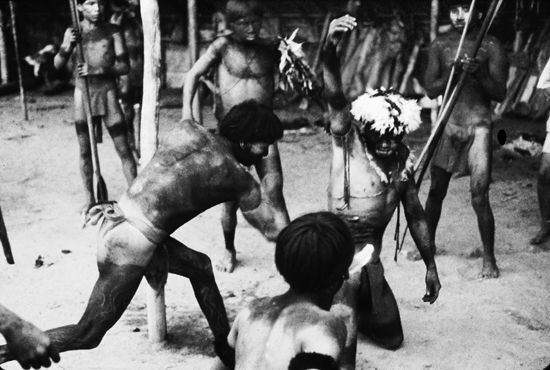
A side-slapping duel
Considerable bluffing and threatening punctuate these noisy arguments among the more senior and usually well-armed men—who normally are not engaged in the actual fighting when it begins. The huyas —strong, healthy, younger men in the prime of life—actually do almost all of the chest pounding. Cultivating a reputation of being a good fighter in these kinds of contests is a good thing, and most huyas are usually more than willing to take a few punishing blows on their pectoral muscles if they can, in turn, deliver as many on their opponent—and fell him. As the huyas get more fighting experience, their reputations as good fighters grow and the respect they command increases. Yanomamö men are incessantly trying to increase their social status through prowess in fighting, which usually leads to increased ability to sway public opinion and public action.
One man agrees to take the first blows from an opponent. He stands alone, arms held back, chest exposed, and stoically gazes into the distance, head held a bit upward. His opponent can make adjustments to the man’s stance, tugging an arm forward, pushing an arm back a little, etc. When his opponent’s body is adjusted and positioned to the satisfaction of the man who will deliver the blow, he may take a few practice runs to position his own body at just the right distance to deliver the most effective blow. Positioning the opponent may take several minutes and adds to the suspense and excitement.
The aggressor then delivers a powerful overhand blow to his opponent’s chest—to one of his pectoral muscles—with a motion similar to that used by baseball pitchers. His powerful blow usually produces a dull thud sound and sets off howls and bursts of excited hooting by onlookers. The victim usually wobbles and reels from the blow or, if it was a particularly effective one from a strong fighter, he may actually be knocked down, usually to his knees, and sometimes from there collapses to the ground. The man who struck him usually lets out loud growls and shouts, and prances in place—or in a tight circle—like a ruffed grouse exhibiting his attractiveness in a mating display.
The victim may take two or three such blows in succession. For each blow he receives he can deliver as many back when it is his turn. The fighters usually alternate positions after three or four blows.
A fighter cannot simply hit someone without allowing his opponent to hit him back the same number of times. If his opponent is unable to hit back, the victorious man cannot retire from the fight—another man from the fallen victim’s group will eagerly replace his downed comrade and take his turn for him. Particularly good, courageous replacement fighters might even allow the original fighter to strike more blows because the new fighter can then return the previous and the new blows while he is fresh. His opponent may be sore if earlier blows were inflicted to his chest by the now-fallen fighter.
Although it is against the rules, some men conceal stones in their clenched palms, which gives their blows even more force. In villages to the north of where I usually worked, I saw some men with multiple scars on their pectoral muscles. When I asked them about the scars, they said they got them in chest-pounding duels, implying that the use of stones is more common there and that the stones were large enough to protrude from their clenched fists and cut into the flesh of their opponents. This suggests that the stones were not concealed and their use was legitimate. However, none of the men where I normally worked had such scars, but almost all of them had been in many chest-pounding fights and some of them admitted they sometimes illegally concealed small stones in their clenched fists in these fights.
The blows delivered in chest-pounding duels are tremendous and sometimes do a considerable amount of damage to internal organs like the lungs and the heart. After such a fight all the participants are extremely sore and invariably have badly swollen pectoral muscles. Some of them even cough up blood for a period of time because lung tissue was damaged. A few men die from the blows they received, usually not immediately, but within a few hours or days, although such fights are not intentionally lethal. Deaths in chest-pounding duels almost always start wars.
A variant of the chest-pounding duel is side slapping. The fighters generally follow the procedures just described, but strike each other from a squatting or kneeling position. But in this kind of fighting, the opponents are supposed to slap each other on the flanks between the rib cage and the pelvis, with an open hand. But fighters sometimes deviate from the ideal rules and close their fists, and some even conceal stones in their clenched fists as described above.
More men get seriously injured in these kinds of fights because the blows are delivered to softer parts of their bodies, where no bones protect internal organs like the kidneys. As a consequence, fatalities are somewhat higher, although like the chest-pounding duels, the alternating side slapping by contestants is intended to avoid inflicting lethal blows.
Club Fighting
The next level of conflict is more severe and more likely to lead to fatal consequences: fighting with clubs. The Yanomamö call their clubs nabrushi. They are long saplings cut down to some seven or eight feet in length (see here ). Club fights can be prearranged between the members of different villages or might break out spontaneously between two men in the same village. In the several villages where I lived, club fights frequently started among the local men over such things as suspicion that some man was trying to seduce (or actually had) one of the other’s wives, tobacco or food theft, a younger “low-status” man being impolite or sassy to an older “high-status” man, publicly insulting a man by giving him a small or undesirable cut of meat during a local ceremonial meat distribution, denigrating a rival by malicious gossip. Once started, club fights often escalate and involve more men. The contestants end up in a more chaotic fight where everyone tries to club opponents on any part of the body he can hit, sometimes breaking shoulder and arm bones.
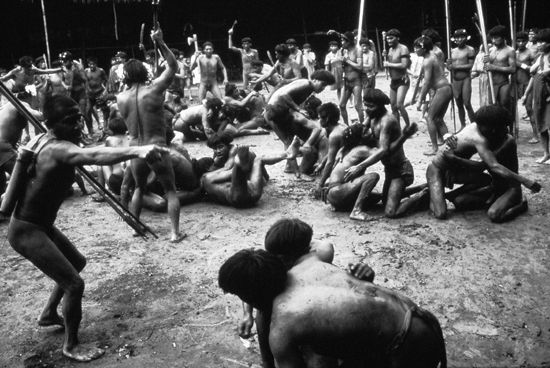
A side-slapping duel and wrestling match in a Yanomamö village
“Clubs” might not be the best description of the nabrushi. They are thinner at the end the fighters hold in their hands, quite springy, shaped more or less like very long pool cues, and about the same or slightly larger diameter. Because poles like these are used to support the overhanging roofs every thirty or so feet, they are immediately available if a club fight breaks out: a man simply pulls out a roof support pole, chops it with a machete to a suitable length, and then is ready for immediate action. I have never seen a section of a shabono roof collapse when support poles for the roof overhang are pulled out and used for an impromptu club fight, but I have seen the roof overhang sag conspicuously when too many support poles are pulled out, and I have heard Yanomamö express alarm that the roof might collapse if even more poles are pulled out. But more often they are concerned that if a wind were to develop during a club fight the roof might blow off—the support poles are buried several inches in the ground to prevent the roof from lifting up in a sudden wind and then blowing off.
Such fights sometimes escalate to fighting with even deadlier clubs, called himo, made of heavy, rigid, hard palm wood. They have sharpened edges on the business end of them, intended to cut flesh as well as fracture cranial bones. These himo clubs have to be fashioned before a club fight, and if the fight is slowly simmering, the man who makes such a weapon is basically announcing that he intends to inflict harm that is likely to be lethal, perhaps as a threat to dissuade his opponent. Himo clubs are only about six feet long, shorter than the wiry nabrushi clubs.
Club fights can even escalate to fighting with machetes and axes. If this happens the fights can result in severe chop wounds that can sever or badly damage a hand or arm, permanently crippling the victim. If delivered to the head they are almost always fatal.
As in the chest-pounding duels, the assailant is allowed to adjust the position of the man he will hit on the head with his club. (It is considered unfair to hit an opponent with a blow to the side of the head.) The assailant’s club starts from behind him and is swung in a long arc and brought down with great force on top of the victim’s head. Imagine someone grabbing the small end of a pool cue, putting it on the ground behind him, and then swinging it with all his might so that the thick part of it lands on top of your head. That is what happens in a typical Yanomamö club fight.
The victim is supposed to remain motionless during this process and expose his head to the assailant, usually bracing himself on his own club, stuck into the ground in front of him.
The resulting wounds to the scalp are nothing short of spectacular and grotesque (see here ). I’ve seen men in such fights with large chunks of their scalp bashed loose, flapping up and down on their crania, and still fighting. Many accomplished and persistent club fighters have scalps that are crisscrossed with as many as a dozen huge, protuberant, lumpy scars two or three inches long after their scalps healed. Men with numerous club-fighting scars like these are not bashful about displaying them prominently. They shave the tops of their heads in a tonsure and then rub red pigment into their numerous deep scars, to exaggerate them. Such a man, if he lowers his face and head to you, is usually not showing deference: he is conspicuously advertising his fierceness.
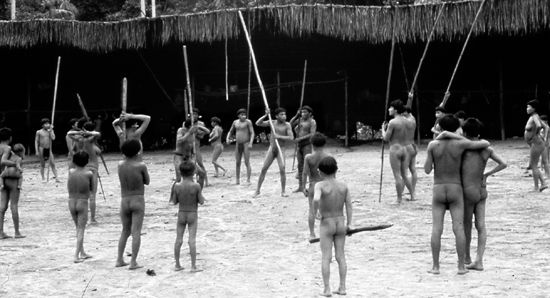
A clubfight in a large village that escalated to an ax fight in which one man was seriously injured when he was struck from behind with the blunt side of an ax
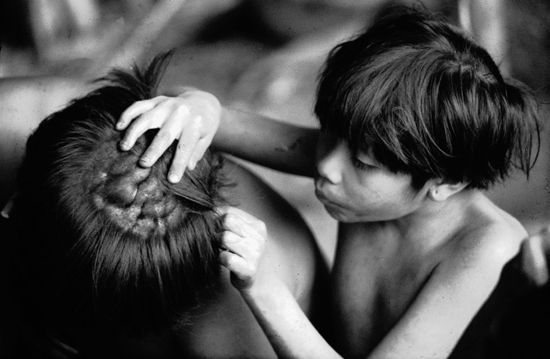
An example of clubfighting scars
Since the Yanomamö cremate their dead, nobody has had an opportunity to examine the crania of adult men to determine how many have depressed skull fractures that have healed, or to estimate how much damage might have been done to fighters’ brains. One Yanomamö man I knew seemed to have a perpetual glazed-eye look and seemed a bit slow-witted. He had an extremely severe scar on the top of his head that made a visible indentation into his skull. One of my late colleagues, Phillip Walker, had at one time a large collection of Amerindian skeletal material from the immediate ancestors of the local Chumash Indians of Southern California. His studies of their crania indicated that they, too, must have been club fighters or fought with weapons that delivered severe blows to the top of the head. A large fraction of Chumash adult male crania indicated sustained blows severe enough that skull bones had been broken but had healed over.
I once heard a Yanomamö cynically comment that the nabä (non-Yanomamö) men they knew, like anthropologists and missionaries, would not be able to survive a Yanomamö club fight—their skulls were too thin and it would be like hitting birds’ eggs with a himo club. Some, but not all, studies show that crania of American native peoples are more robust and thicker than the crania of most individuals in Caucasian populations.
Raiding
None of the fighting described above is intentionally lethal, despite the fact that fatalities sometimes occur. Indeed, one might classify these fights as deliberately sublethal “alternatives” to warfare.
The motive the Yanomamö give for lethal raids almost always has to do with revenge for the death of some person. As emphasized elsewhere, the previous killing is often a result of some fight over women. A much less common reason is revenge for deaths caused by sorcery or witchcraft, which involves blowing charms on distant people to kill them.
Some lethal raids occur for no logical reason at all. For example, one particularly aggressive headman led a raid on a very distant village and killed a man with a shotgun he had recently obtained from one of the Salesian missionaries. Rerebawä, one of my informants, told me, when I asked why the man did this, “When you give a fierce man a shotgun, he will want to use it to kill people. He killed this man badao [without reason, for no reason at all].”
In another strange case where I did almost all of my fieldwork, raiders attacked a distant village they had no previous contact with because they suspected them of harmful magic. It is noteworthy that the leader of this raid had also just recently obtained a shotgun from the Salesian missionaries. Although shotguns did not make the Yanomamö warlike, I believe that they probably caused an increase in mortality rates in areas near Salesian missions. Shotguns may have even made the Yanomamö more willing to attack their enemies because the shotguns were more efficient killing weapons than their bows and arrows.
Raiding is conducted with the explicit purpose of inflicting fatal injuries on people, almost always men, who live in other villages.
Some clarification is needed here regarding the usual definition in anthropology that warfare is armed conflict between people in different, territorially-defined, political groups with the intent of inflicting lethal harm on each other. This definition emphasizes the importance of “politically defined” groups, but the degree to which “warring” Yanomamö groups are territorially defined, politically distinct groups is a major problem.
Although Yanomamö villages are usually geographically separated from each other, their membership often overlaps because individuals in both groups have kinsmen in the other, and these individuals sometimes move back and forth between villages. Indeed, they may have all been members of the same village some years earlier as was the case with some villages I discussed earlier.
I’ve heard Yanomamö men say something like “If I see my ‘brother’ [or some other close kinsman] on this raid I won’t shoot him.” In only a few modern wars—the U.S. Civil War, for example—have members of the same nuclear or extended family ended up on opposite sides of a lethal conflict.
Some Yanomamö men refuse to go on raids against villages where they have many kinsmen and friends. They do not suffer any disgrace or stigma because of this decision. This is very different from, say, a “conscientious objector” in our society who would, on moral or religious principles, refuse to go on any raids or shoot anyone in any other group.
On the other hand, intervillage killings are not simply homicides comparable to killing someone in your own village, for example in a club fight, nor are they just blood feuds, because the Yanomamö also raid and kill people in other villages to whom they are not related and whose members may not have inflicted lethal casualties on their own village.
Finally, it would be difficult to characterize a Yanomamö village as a political entity that is “territorially defined” because defending a “territory” would be foreign to the Yanomamö, who move their villages from time to time and whose individual villagers move more often as noted above.
These definitional caveats should be kept in mind when comparing Yanomamö warfare to modern warfare.
But Yanomamö warfare exhibits many elements that are generally characteristic of primitive warfare in other tribal societies. One of these is the extensive use of deceit and subterfuge. It would be difficult to equate these practices with, for example, “intelligence” in our own recent wars. Military “intelligence” I take to mean the often clandestine, usually long-term acquisition of information that is potentially vital and/or useful to efforts leading to the successful defeat of some persistent opponent. Yanomamö deceit and subterfuge are more like practical tactics in a typical warfare incident. They are Machiavellian and, in general, these deceitful actions have short-term blunt and bloody outcomes, as in the occasional massacres of large numbers of men at “treacherous” feasts or nomohoris.
Nomohori
The word nomohori means something like “a malicious trick,” a “deception,” or “a dastardly, deceitful act.” In the context of Yanomamö violence it means to invite someone to an otherwise friendly event, like a ceremonial feast or trading get-together, and then kill them. It is an extreme form of lethal violence and usually results in the deaths of upwards of a dozen men from the victimized village. Women are never the intended victims in a nomohori, although sometimes they may be taken captive during one.
If the captured women have older male children—usually older than about eight to ten years—they are sometimes killed, too. One man I knew shot and killed a young boy of about ten years of age with an arrow after he and his mother were captured during a raid and brought back to the village. The boy was swimming in the stream with the other children at the time. The man said that the boy reminded him of the death of his own close kinsman who was killed by raiders from the boy’s village—the very reason for the raid that resulted in the capture of him and his mother. As he watched the boy play in the water, his anger welled, he nocked one of his arrows, and shot the boy dead.
Groups that instigate a treacherous feast for another group must often enlist a putatively neutral third party as accomplices. The neutral party must be on friendly terms with the intended victims and often hosts the fateful event at its own shabono. The others hide themselves in the nearby garden or forest and join in the killing once the hosts begin it. Needless to say, the “friendly” accomplices who hosted the feast immediately become mortal enemies of the victimized group and may suffer more retaliation than those who put them up to betraying their friends.
Thus groups allied to each other can suddenly turn on their former friends. One must be very cautious about accepting feast invitations when your presumed friends are known to be in regular contact with your known enemies. This caution gives a distinctly sinister quality to Yanomamö politics.
A more difficult way to trick some group to come to a nomohori is to engage in extremely persuasive but insincere assurances that former hostilities are now forgotten and it is time to resume friendship. Those invited, while being suspicious of foul play, then face a dilemma. If they decline the invitation they thereby indicate that they do not trust the hosts and risk offending them. This might provoke renewed hostilities at a time when the invited group needs allies and perhaps can ill afford more enemies. The alternative is to throw caution to the wind, go to the feast, and risk being massacred.
That the Yanomamö do not casually accept feast invitations and are usually wary of the motives of their allies is illustrated by the numerous examples I learned about during my field research where the intended victims refused to accept feast invitations. I recall one trip I made to Mishimishimaböwei-teri in the late 1960s when two young men from Mömariböwei-teri enthusiastically volunteered to come with me. I found this unusual because their respective villages were enemies at that time. They told me they wanted to invite the Mishimishimaböwei-teri to a feast in order to “resume friendship.” I later discovered that their feast was to be a nomohori, instigated by one of the Bisaasi-teri groups, a third party, with whom I was then living!
Nomohoris are relatively rare, but when they occur, many fatalities result. Long-term political relationships between villages have, in most cases, been shaped by these rare but unforgettable events. The surviving victims never really forget about nomohoris, and their desire for revenge is sometimes very difficult to conceal, even after many years.
I did not witness the nomohoris that I describe below. These are eyewitness descriptions by individuals who were there when they happened.
The first of these accounts comes from New Tribes missionaries who have lived with members of these villages for many years. This example occurred in the lower Padamo River area some years before my fieldwork began, an area that fell outside the region where I usually worked. However, I knew many of the older people involved in this incident, whom I met some years later at Padre Cocco’s Salesian mission at the mouth of the Ocamo River. They are known to their neighbors as the Iyäwei-teri and, less often, as Ocamo-teri.
The second example also happened before my fieldwork began but involved people and villages that I later studied in what I call the “fertile crescent” of Yanomamöland—the Upper Shanishani River area. This account comes from Helena Valero’s captivity among the Yanomamö as documented by an Italian parasitologist, Ettore Biocca, who was doing research in the Rio Negro area of Brazil and interviewed Valero after she was repatriated in the mid-1960s.
Let me draw attention to the fact that these nomohoris incidentally mention steel tools like axes and machetes. The Yanomamö narrators or observers discuss them in matter-of-fact terms, indicating that they possessed steel tools many years prior to my first field trip. I mention this because a number of my persistent critics claim that I introduced or provided such tools, provoking the violence that I reported in my own publications.
I will briefly describe a third nomohori , this one among the Bisaasi-teri, that also took place before my fieldwork began.
Nomohori on the Padamo River
The first nomohori is described in Mark Ritchie’s Spirit of the Rainforest. This nomohori on the lower Padamo River took place not far northwest from the villages I studied.
The informant is an old man from the village of Koshirowä-teri who related his life story to Ritchie through one of the local New Tribes missionaries, Gary Dawson. His father, Joe Dawson, was one of the first New Tribes missionaries to contact the Venezuelan Yanomamö in the early 1950s and was one of James Barker’s companions in the early history of the New Tribes Mission in Venezuela. (Joe Dawson died in 2011.)
Ritchie apparently follows the Dawson family’s use of an English translation of the Yanomamö village name Koshirowä-teri. This name can be translated as “Honey” or “Honey Village” because koshiro is the Yanomamö word for a type of honey made by a bee of that name.
The Koshirowä-teri found an accomplice from a friendly village, a man who was also on friendly terms with “Ocamo Village”—the village of the intended victims, known today as Iyäwei-teri. Members of this (unnamed) intermediary group invited the members of Ocamo Village to a feast at Koshirowä-teri, a feast that would also involve a mortuary ceremony during which the cremated and pulverized bones of recently deceased people would be consumed in a thick, sweet plantain soup. Afterward, they would all take ebene (hisiomö ), an hallucinogenic snuff that is made from the seeds of a tree that grows abundantly in this region.
The Koshirowä-teri clandestinely sent invitations to some of their own close allies in other villages, revealing to them their sinister plan and inviting them to join in.
Ocamo Village had, a few years earlier, pulled the same kind of dirty trick on the Koshirowä-teri. This is noteworthy, since the Koshirowä-teri were closely related to at least some of the people of Ocamo Village. Both groups had been members of the same village some time in the recent past. They had subsequently fissioned into separate, now mutually hostile villages. But it is rare for recently separated related villages to nomohori each other. This is one of the few examples I know about. I got the impression from many different Yanomamö informants that villages whose members were related to each other should not nomohori each other, a proscription that appears to be, like other Yanomamö proscriptions, not always observed.
When the invitation was delivered, the people in Ocamo Village were immediately suspicious. The women frankly advised the men that they thought this would be a treacherous feast to avenge the deaths they had previously inflicted on the Koshirowä-teri in their own nomohori. Ultimately, the women decided to remain at home and only the men traveled to the shabono of the Koshirowä-teri.
I often wondered why the Yanomamö are willing to take such risks, but I concluded that part of the reason is that failure to do so communicates a message that could eventually lead to even more predation and intimidation. Other villages will begin to view the village that declines an invitation as timid or cowardly and will take advantage of them, that is, take their women. In addition, showing fear is an extremely dangerous thing to do if you are a Yanomamö. For example, one of my best Yanomamö friends, Kaobawä, asked me why I wouldn’t bring shotgun shells for the people in his village who had, by then, begun to obtain shotguns from the Salesian missionaries at Mavaca. As a matter of principle, I refused to provide either shotguns or cartridges to the Yanomamö, but I didn’t want to tell the Bisaasi-teri this. I made the excuse, on one occasion, that there were policía at the airport in Maiquetia, where I arrived in Venezuela. They had guns and searched my possessions carefully, and if they caught me with shotgun shells they would punish me. I mentioned that I was afraid of them, which I was. Kaobawä stopped me, somewhat angrily but showing genuine concern for my safety, and said: “Son-in-Law! Never ever show fear in the presence of your enemies. If they know you fear them, that is when they will kill you!”
The following is the conversation between the intermediary who delivered the invitation and the Yanomamö informant telling Gary Dawson his life story that Ritchie reports in his book.
“I don’t think they believed me, but they said they would come,” he told us when he came back. “Their women know it’s a trap. They don’t want their men to come. So even if the men come, the women might not.”
“Of course the men will come,” I said. “I told you they’d come. They won’t want us telling everyone that they are cowards. But now that the women know it’s a trap, we’ll have to come up with a trick so we can catch the men off guard.”
The men finally arrived after what appears to have been a several-day walk. They had no women or children with them and were tired from the long walk. They made their camp in the woods, just outside the hosts’ shabono. As they approached the shabono , one of the local men, Tiger-Ear, whose father had been killed in the earlier nomohori, couldn’t contain his desire for revenge and angrily approached the visitors with an ax, but the others disarmed him and calmed him down:
“When our enemies saw the axe-swinging vengeance in Tiger-Ear’s eyes and our people holding him back, they knew that we were serious about wanting peace. We all feasted together like friends and drank the bones of our dead. They were tired from the long trip on the trail, but we promised them that we would all share ebene tomorrow. . . . ‘Sleep well,’ Shoefoot’s father said, to make them feel comfortable. ‘We’ll all have a great time taking ebene tomorrow.’ Our constant talk of ebene ‘tomorrow’ began to make them nervous. They knew that it was the ebene that had helped them kill us the last time. I saw the fear in their eyes as we talked about tomorrow. We knew they would be on their guard.
“ ‘We’ve had a great feast and shared the bones of our relatives,’ I said to our new friends. ‘Why don’t you all stay with us here in the shabono tonight instead of going back out in the jungle? Then we’ll end our festival tomorrow with ebene.’ They decided it would be safe to stay with us because they knew that they would only pretend to take the ebene anyway. They weren’t going to fall into the same trap as we had.
“So they hung their hammocks among ours all around our shabono and we talked together in small groups late into the night. We began to feel like friends again.
“I woke before dawn. It was so dark that it didn’t help to open my eyes, I felt the hard dirt under my hammock and got up slow. I couldn’t hear a sound. Our fires had died out. I knew right where all our hammocks were hung so I was able to keep from disturbing any of our visitors as I moved around the shabono waking our men. We all slept with a weapon in hand. We had machetes, axes, clubs, and spears. I put my hand over each man’s mouth and shook his head just a little.
“I moved one step at a time. It took a long time for me to get all the way around the shabono and back to my hammock. Then I gave the loud whistle of a tapir and each of us attacked the new friend in the hammock next to us. It was so dark we had to feel for our enemy with one hand. The other hand held a killing weapon. Jaguar Spirit was with us that morning, and a scream went up from our shabono that sent a charge of lightning through the body of every one of us. It was a slaughter that we will enjoy as long as we live.
“Some of them escaped in the dark, and because we couldn’t see, we hid and waited until light to see how many we killed. In the early light of dawn we saw that most of them died in hammocks full of blood.”
Shanishani Area
This second nomohori was witnessed by Helena Valero, a Brazilian woman who had been captured by the Yanomamö in about 1932, when she was just a young girl. She died relatively recently. I last saw her in 1991 when her oldest son, José, accompanied me on a trip into the village of Patanowä-teri, where he had been born. His father was the headman of Patanowä-teri, Husiwä, one of the several Yanomamö husbands Helena had over the course of her long captivity.
While José had been born in this area he had never returned there after his mother and her children were repatriated in about 1955. His closest Yanomamö relatives still lived in Patanowä-teri and I knew them well from my many trips there. José was very grateful that I had invited him to come with me on this trip. I was pleasantly amused when he took photographs of the Patanowä-teri with a Polaroid camera. They were only slightly more cooperative with him than they had been with me.
In about 1932 Helena and several members of her family were gathering forest products and hunting in an extremely remote area of Brazil, very near the southwestern corner of Venezuela, the spot where a mountain rises almost straight up, ten thousand feet into the clouds. U.S. military maps available in 1965 indicated “hazardous flying reported under 12,000 feet.” They didn’t specify the hazard, which turned out to be the highest point in Brazil: Pico da Neblina. Half of the peak lies in Venezuelan territory because its crest is the boundary between the two countries.
Helena’s family, like most of the rural Brazilian backwoodsmen who lived in the Amazon Basin, was poor, eking out a living by cultivating small plots of cassava and other crops. They got much of their food and most of their necessities in general from the jungle, like poles and thatching for their houses. Her native language was Lengua Geral, an Amazon Basin language spoken in the Rio Negro region, a mixture of Portuguese, Spanish, and a native Amazonian language, Tupi. She subsequently learned a more standard form of Spanish by the time I first met her in the early 1970s at Ocamo, but I always spoke to her in Yanomamö. By then she lived with her son, José, near Padre Cocco’s Salesian mission at Ocamo. Her Brazilian relatives seemed to shun her because, I was told by Venezuelan locals, she was tainted by her captivity among the Yanomamö. Many American women in our own history who had been captured as young girls by Native Americans were similarly rejected by their families in the few cases when they were returned to them.
On that fateful day the Valeros weren’t aware that they had entered the southwestern edge of Yanomamö territory and were very far away from any outpost of Brazilian (or Venezuelan) culture. In fact, my settlement pattern research shows that the Yanomamö were slowly migrating in this direction and had only recently arrived in this area themselves.
Helena’s family was attacked by a group of Kohoroshitari Yanomamö hunters. Her father was shot with some eight arrows, but he managed to pull all of them out. Helena herself was shot with an arrow that passed through the skin of her stomach and buried itself deep in her thigh. Her father tried to carry her, but his own wounds were too serious. He put her down and disappeared into the jungle, carrying Helena’s younger brother. Her mother also escaped. The parents wandered separately through the jungle for two days before finding each other.
They came back some days later to where the attack had occurred after they found and got help from a group of Brazilian soldiers, but they could not find Helena. She was then just a pre-pubescent young girl, some twelve years of age.
She lived among the Yanomamö for the next twenty-four years as a captive and was able to get away from them only in about 1955, when a local Venezuelan man, Juan Eduardo Noguera, who worked for Padre Cocco, took her in his canoe and fled downstream to Padre Cocco’s mission.
She subsequently told the history of her captivity to an Italian parasitologist, Ettore Biocca, who was doing research in the Rio Negro area. He published an account of her captivity in Italian in 1965, which immediately became a bestseller in Italy. It was later published in several other languages, including English in 1970.
Helena’s account is remarkably detailed. The accounts of the same events my Yanomamö informants told me differ slightly from hers in a number of details. However, the remarkable richness of her eyewitness account conveys a sense of “participant observation” that very few anthropologists can duplicate.
Much of her captivity was spent among the same people I studied, the Mishimishimaböwei-teri in particular. I recognized most of the individuals by the names she used for them, although her spelling of most of them differs from mine, as does her (i.e., Biocca’s) spellings of place names like Yanomamö garden and village names. Some of these differences stem in part from Biocca’s attempt to render them into Italian (carried over into the English translation), but some stem from the fact that the last few years of Helena’s captivity were spent in an area where the Yanomamö speak a slightly different dialect from the Shamatari dialect spoken by the people who first captured her—the dialect that I also learned. For example, she uses Fusiwe for the name of her long-time husband in the Patanowä-teri area, but his name (transliterated into my orthography and pronounced the way I spell it) was Husiwä. The h and f sounds in English are, to the Yanomamö, the same sound. In the Shamatari dialect it sounds more like h to English speakers, but in the Ocamo dialect, it sounds more like f to an English speaker.
By 1965 I had spent almost a year with the Yanomamö, who told me about this woman. My Yanomamö informants called her Nabäyoma —Woman From the Foreign People: nabä: foreigner, non-Yanomamö; -yoma: a woman from. By linguistic extension, the name Shamatariyoma means “a woman from the Shamatari people.” Aramamisiteriyoma: a woman from the village of Aramamisi-teri. To me, Helena Valero was a “foreign woman,” but I knew nothing at the time about her captivity or her roots—she could have been a Ye’kwana, Pemon, or Hiwi Indian. Women from all these tribes would be called Nabäyoma by the Yanomamö.
The Nomohori According to Helena Valero
Among the many fascinating things Helena discusses is a nomohori that resulted in the death of a prominent Shamatari headman named Ruwahiwä. This was, by Yanomamö standards, a rather small-scale nomohori , but it involved very prominent political leaders in villages that I later studied during many repeat visits.
I later got to know one of Ruwahiwä’s sons, Möawä, intimately well. He was the nastiest man I have ever met in any culture anywhere. I will say more about him later.
Ruwahiwä was the headman of a village then called Konabuma-teri, some several days by trail south of the village of Patanowä-teri. Patanowä-teri is still a remote village, but in recent years has had an increasing amount of intermittent contact with missionary personnel at the Salesian mission at Platanal on the Orinoco, where the Yanomamö village of Mahekodo-teri is located.
The villages I initially studied included the Patanowä-teri, but it fissioned several times after the event described here occurred.
As mentioned, Helena Valero was an eyewitness to this nomohori. When this nomohori took place she had lived among the Yanomamö some fifteen or so years and by then knew their language with near-native fluency.
The nomohori took place prior to 1950, maybe several years earlier. One of the specific provocations of this nomohori was the accusation that a man from Ruwahiwä’s village “poisoned” a brother of Husiwä (Fusiwe), the headman of Patanowä-teri, and Husiwä therefore wanted to avenge this death. “Poison” in this context most likely means to “blow magical charms” on a victim, who allegedly dies from this nefarious act.
Both Ruwahiwä and Husiwä were extremely accomplished warriors and each had killed numerous men by then. At the time of this incident both had well-earned reputations for violence.
There were rumors circulating in Konabuma-teri that the Patanowä-teri intended to kill Ruwahiwä on this visit, but he defiantly ignored this information and would show no fear. So, he and just a few others accepted the invitation to trade with the Patanowä-teri. They left their wives and children at home, implying that they were suspicious of possible Patanowä-teri treachery.
I will put into brackets some of the words used by Helena Valero that may not be familiar to most readers. Some of them are Portuguese words. I quote Valero’s account starting after Ruwahiwä’s group had arrived at Husiwä’s village:
It must have been seven o’clock [ A.M .] and still the Shamatari [Ruwahiwä’s group] had not moved. Fusiwe’s Aramamisiterignuma [Woman from Aramamisi-teri] wife said: “The Shamatari are still silent; they ought to leave at once, before they kill them.” Fusiwe was still lying in his hammock; about eight o’clock Rohariwe [Ruwahiwä], the Shamatari tushaua [headman, “chief”], came up to him and asked him for tobacco. He did not answer, but made a sign; I got up, took a little tobacco from a box [most likely some kind of container made of leaves], put it in a piece of banana leaf and gave it to him. Fusiwe passed it to his enemy, still lying in the wide cotton hammock. Rohariwe asked him: “Shori, brother-in-law, are you ill?” “A little,” he answered. “Your Hekura [personal spirits] are sad and is this why you feel ill?” and he began to blow upon him [to comfort him]. Fusiwe looked at him: “Get up, Shorï [brother-in-law].” “No,” replied Fusiwe, “I am very ill.” I was alarmed; I kept my head down low.
Another Shamatari came up to Fusiwe asking for arrows. Fusiwe’s younger brother answered. “I don’t give my arrows; with this I will kill you and keep the others to avenge myself if any one of our men dies.” The Shamatari did not answer and his other companions looked at each other; perhaps they thought he was joking and they laughed—At last Rohariwe said: “Go there all of you, on the other side of the shapuno [shabono], where they told us they would give us the machetes.” He too went; he was tall and strong, well painted all over and adorned with feathers; he had his son near him; his dogs followed him.—The tushaua [headman] Fusiwe took black urucú [a pigment worn by raiders or men who intend to kill or threaten to kill others] and rubbed it on his forehead and chest, then said to my companion: “Rub plenty of black on my thighs and calves.” The Shamatari were on the other side of the square, squatting down, waiting for the machetes. Fusiwe approached them and said: “Here are the machetes,” and he threw them towards them. “Now give me the dogs.” He took the first and second dog . . . ; at that moment the tushaua’s younger brother struck Rohariwe with a heavy axe-blow on the head. The axe did not cut, but split open his head. Beside him, the tushaua’s brother-in-law struck on the head with another axe Rohariwe’s brother, the very one who had come to warn them and whose name was Sherekariwe. I was bending down, cooking something on the fire and I heard the shout of the Shamatarignuma, wife of the tushaua’s brother: “Ahi! They have killed him, my father!”
The two men fell. While their companions tried to take their bows and arrows, the Namoeteri [Namowei-teri, an earlier name for Husiwä’s village] were ready and shot them. I saw a youth running with open arms and I saw an arrow transfix his back and quiver there, while he was running. Then another, with an arrow sticking in his chest, and yet another with an arrow in his flesh. . . . no wounded man shouted; only falling arrows and running people could be heard. . . . Rohariwe was not yet dead: he was full of arrows, he stood up, fell, stood up again. Fresh arrows, tak [a Yanomamö sound for an arrow piercing flesh], pierced his flesh, which trembled under the blows; the man did not die, and did not shout. They pulled the arrows out of his body and continued to strike him. He had arrows in his stomach, his chest, his face, his neck, his legs.
Meanwhile Sherekariwe, whose head was split open, was not dead and tried to stand up. . . . An arrow came and hit him in the stomach, passing through from one side to the other; the man fell again. . . .
The tushaua Rohariwe did not die; he fell and got up again. He tried to pull the arrows out of his body, but he was no longer able to do so. When a new arrow hit him, he only cried: “Ahh!” A man came up and stuck his bow into Rohariwe’s body, as if it had been a spear. Rohariwe then slowly, very slowly, stood up; his body looked like a trunk with many branches. He walked ahead swaying, gave a horrid growl like a mad dog, lurched and fell forward on top of all those arrows. And so he died.
Fusiwe meanwhile had run in pursuit of the Shamatari who were fleeing. He told later how he saw a wounded youth under an embauba tree; it was the son whom Rohariwe had brought. The youth said to him: “Do not shoot me,” but Fusiwe shot him. The youth repeated: “Do not shoot me again, father; let me die, for you have already struck me a death blow.” He shot him again and killed him. Then he killed another in the forest. A few days later vultures could be seen circling around; it was the corpse of another which smelled.
Valiant leaders like Ruwahiwä sometimes sustain what are apparently—or even certainly—lethal blows to their heads from heavy axes, but still rise, stagger forward, and somehow are able to keep on their feet despite being mortally wounded. My own Yanomamö informants, who were also eyewitnesses to Ruwahiwä’s death, described the first ax blow to his head as a fatal blow from which no man could possibly recover. One of my informants was the man who delivered this fatal ax blow to Ruwahiwä’s head—a man named Mamiköniniwä, whose son was one of my first regular informants. Yet Ruwahiwä managed to stand up and fall down several times—all the while being shot multiple times with arrows to his face, neck, stomach, and chest.
Many years later, one headman I knew—Matowä—was killed shortly after I arrived, as described earlier. He probably also sustained as many lethal arrow wounds as Ruwahiwä, but defiantly stood his ground and cursed his assailants until he could no longer stand. He, too, never acknowledged the pain—nor the terror of knowing that his wounds were fatal—but stoically taunted his assailants with defiant declarations of his valor and fearlessness until he fell, dead, from his many wounds. He died with many six-foot arrows stuck helter-skelter through or into his neck, chest, and stomach. One of my informants, who was part of the raiding party that killed him, told me in whispers that this valiant warrior Matowä bragged about his valor and ferocity even as the raiders continued to shoot arrow after arrow into his body.
The Revenge Nomohori at Amiana
The nomohori for Ruwahiwä of course led to an inevitable retaliation: his village was large and powerful and would seek retribution. They got their revenge several years later, at a place called Amiana, in approximately 1948.
Amiana is the name of a mountain in the headwaters of the Washäwä River, where some of the Shamatari, led by a headman named Riakowä, settled after the killing of their kinsmen Ruwahiwä and Sherekariwä. Several gardens were cleared by these new Shamatari arrivals.
The period from about 1948 to 1951 is a confusing one in the histories of both the Patanowä-teri and Konabuma-teri, since both populations split into multiple smaller ones, rejoined, then split again. One of the splinter groups of the large village of Patanowä-teri took the name Bisaasi-teri, another took the name Wanidima-teri, and yet a third one kept the original name. The Bisaasi-teri began moving farther to the west into the Washäwä drainage and eventually became neighbors of one of the Shamatari groups—relatives of Ruwahiwä—who had themselves just moved into and settled in that area.
Apparently the Bisaasi-teri faction had nothing to do with the previous nomohori in which Husiwä’s group of the Patanowä-teri killed Ruwahiwä and Sherekariwä, but they were nevertheless now an inviting target for revenge: they were closely related to Husiwä and members of his faction but had fissioned away from his group and now lived in a much smaller and vulnerable village. Their culpability is one of the inevitable dimensions of “blood revenge” in tribes like the Yanomamö.
The Konabuma-teri—Ruwahiwä’s group—had also fissioned into several smaller groups. As mentioned, Riakowä’s group settled on the upper Washäwä near a small mountain called Amiana, but other Konabuma-teri splinter groups apparently remained in the Upper Shanishani drainage and began moving toward the Mavaca headwaters following a route to the south of the Washäwä. One of these groups was led by Sibarariwä—a younger brother of Ruwahiwä and a man I got to know very well. Sibarariwä, whom I discussed earlier, was considered by the Bisaasi-teri to have been the chief architect and instigator of the nomohori that followed.
My description of this nomohori is rather frugal because my information came from Bisaasi-teri informants who lost many close kinsmen in that event and who, quite understandably, were reluctant to discuss this fairly recent tragedy in detail with me because their fathers, brothers, and husbands died in this nomohori.
Sibarariwä persuaded his close relative Riakowä, who was friendly with the Bisaasi-teri, to invite them to a feast at his village near Amiana. Sibarariwä’s men would lie in wait outside Riakowä’s shabono, along with a group of men from Hasuböwä-teri, Sibarariwä’s allies, who were already on hostile terms with the Patanowä-teri.
The Bisaasi-teri arrived at Riakowä’s village for the feast. Shortly after they arrived Riakowä and his men began attacking them with clubs, axes, and arrows. Some managed to escape by breaking through the palisade, but many of those were then shot by archers from Sibarariwä’s group and his Hasuböwä-teri allies. Kaobawä, one of the survivors and a man who eventually became the leader of the Upper Bisaasi-teri, told me that some of the Shamatari from Riakowä’s group took pity on them and helped them escape through the palisade, saving their lives. Dedeheiwä, the renowned shaman of Mishimishimaböwei-teri and a dear friend of mine, was one of the men who helped some of the Bisaasi-teri escape.
Eleven Bisaasi-teri men were killed in that nomohori and many more were wounded but recovered. Kaobawä’s father was killed in this incident. Seven Bisaasi-teri women were also captured.
The survivors retreated to their village and new garden a day or two to the northwest, Kreiböwei, where the wounded could recover.
While recovering from their wounds they were visited by the headman of Mahekodo-teri, who had learned about the nomohori. He invited them to live temporarily in his village on the banks of the Orinoco, some three days to the north. The Bisaasi-teri accepted his invitation and moved into Mahekodo-teri. As usual, this invitation was not altruistic: the Mahekodo-teri hosts had designs on the Bisaasi-teri’s now poorly defended women.
James P. Barker had just established contact with the Mahekodo-teri a few months earlier. He told me he witnessed the arrival of the Bisaasi-teri survivors of the nomohori when they reached Mahekodo-teri. He said the year was 1950.
Scientific Summary of Yanomamö Warfare
In 1988 I published an article in the prestigious academic journal Science that summarized my twenty-five years of findings on Yanomamö warfare. My summary identified 137 living men in the villages I was studying who were unokais, that is, warriors who had killed someone.
Sixty percent (83 of the 137) of the unokais in this sample had participated in the killing of only one person (see above). The others had participated in the killings of two or more people. One man had participated in the killings of sixteen people. The most “accomplished” unokai in my records, Möawä, one of Ruwahiwä’s sons, had participated in the killing of twenty-two people, but he is not included because he had died a few years earlier. There probably have been other unokais as successful at killing as Möawä.
Number of victims for which living killers unokaied
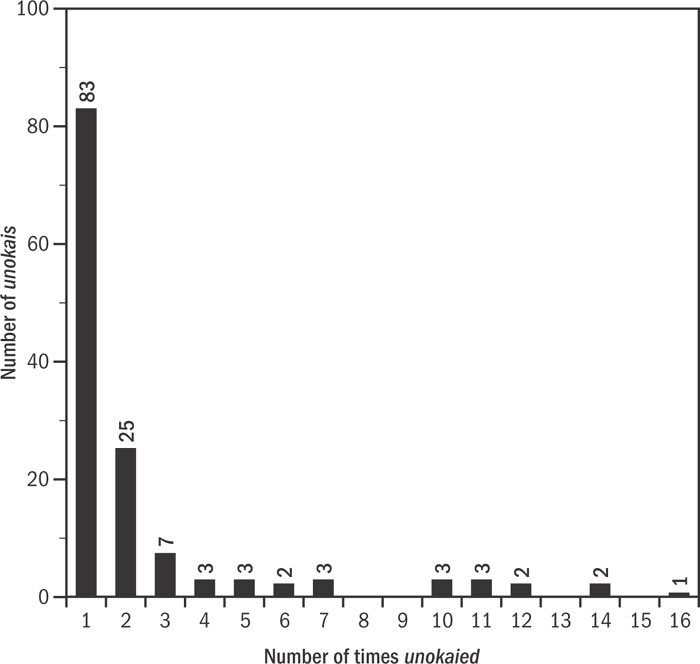
I have meticulous data on how many kinsmen each person has in his/her village, the population bloc that village belongs to, and the overall area that I studied intensively—which contained nearly forty villages. In other words, my information on the prevalence of violence among the Yanomamö relies on extensive documentation. The Yanomamö may be the only warring tribal society in the world for which such data have ever been collected.
In my 1988 sample two-thirds of all living Yanomamö over the age of forty have lost one or more close genetic kinsman—a father, brother, husband, or son—to violence. This fact should underscore the importance that blood revenge plays in the Yanomamö population. I emphasized this point in my 1988 Science article to try to illustrate the percentage of people who are aggrieved at the violent death of “a kinsman” in their village.
Approximately 45 percent of all the living adult males in my study were unokais , that is, had participated in the killing of at least one person. That is an extraordinarily high percentage, but this statistic might not be unusual among pre-contact tribesmen had they been studied by anthropologists when they were demographically intact.
The Differential Reproductive Success of Yanomamö Unokais
My Science article included a number of additional findings that disturbed, even offended, a number of my colleagues in cultural anthropology, colleagues who clearly favored the Noble Savage view of tribesmen. But these findings were empirical.
Had I been discussing wild boars, yaks, ground squirrels, armadillos, or bats, nobody in the several subfields of biology would have been surprised by my findings. But I was discussing Homo sapiens—who, according to many cultural anthropologists, stands apart from the laws of nature. They say that the only “nature” Homo sapiens has is a “cultural nature.”
|
Marital success of unokais and non- unokais |
|||
|
|
|||
|
Unokais |
|||
|
|
|||
Ages |
n |
Number |
Average |
|
|
|||
20-24 |
5 |
4 |
0.80 |
25-30 |
14 |
13 |
0.93 |
31-40 |
43 |
49 |
1.14 |
> 41 |
75 |
157 |
2.09 |
Total |
137 |
223 |
1.63 |
|
|
|||
|
Non -unokais |
|||
|
|
|||
Ages |
n |
Number |
Average |
|
|
|||
20-24 |
78 |
10 |
0.13 |
25-30 |
58 |
31 |
0.53 |
31-40 |
61 |
59 |
0.97 |
> 41 |
46 |
54 |
1.17 |
Total |
243 |
154 |
0.63 |
|
|
|||
In my article I first summarized the reproductive success of unokais compared to non-unokais of their same approximate age. The previous table and the table below provide these results.
These two tables break down the adult males into four age categories. The age categories begin with men who have reached the approximate age when their active raiding careers begin—about twenty years old.
The numbers of men who are unokais in each age group are shown on the left and the non-unokais on the right. The numbers of wives these men have or have had and the average number of wives for their age category are in the two columns adjacent. Thus there were five unokais (see here ) between twenty and twenty-four years of age and these five young men had a total of four wives—yielding an average number of wives per man of 0.80. Continuing across the same row, there were seventy-eight same-age non-unokais , who had a total of ten wives among them, for an average of 0.13 wives each. The conclusion, for this row, a very small portion of the larger sample, is that men who are unokais have a higher average number of wives compared to their non-unokais , same-age peers.
This same pattern continues throughout the data table for all age categories: unokais have, on average, more wives than non-unokais. For all ages pooled, unokais have an average of 1.63 wives compared to an average of 0.63 for non-unokais.
|
Reproductive success of unokais and non- unokais |
|||
|
|
|||
|
Unokais |
|||
|
|
|||
Ages |
n |
Number |
Average |
|
|
|||
20-24 |
5 |
5 |
1.00 |
25-30 |
14 |
22 |
1.57 |
31-40 |
43 |
122 |
2.83 |
> 41 |
75 |
524 |
6.99 |
Total |
137 |
673 |
4.91 |
|
|
|||
|
Non- unokais |
|||
|
|
|||
Ages |
n |
Number |
Average |
|
|
|||
20-24 |
78 |
14 |
0.18 |
25-30 |
58 |
50 |
0.86 |
31-40 |
61 |
123 |
2.02 |
> 41 |
46 |
193 |
4.19 |
Total |
243 |
380 |
1.59 |
|
|
|||
The more interesting finding has to do with the comparative reproductive success of unokais and non-unokais. It should be intuitively clear that if unokais are more successful at acquiring wives, they are likely to have more children as well. This chart provides this comparison:
The bottom row reveals that unokais have, on average, 4.91 children compared to same-age non-unokais , who average only 1.59 offspring each, that is, unokais have three times as many offspring as non-unokais.
These findings are almost unique in cultural anthropology reports, not so much because the Yanomamö are unique but because they managed to survive demographically intact long enough for a Darwinian field working cultural anthropologist to document this aspect of their lives. It should have been done—and could have been done—among other groups by anthropologists even a generation earlier than me.
There have been some thirty or more anthropologists who began fieldwork among the Yanomamö after I began. They all could have easily collected comparable data on unokais and variations in reproductive success similar to the data just described. Not one of them did this. Yet some of these anthropologists claim that I have “exaggerated” Yanomamö violence even though they have not produced their own data, if they even collected these data, on causes of death among the various groups they studied. They could have demonstrated their statistical findings on how much violence and violent causes of death took place while they were studying the Yanomamö in the areas they worked in. Unfortunately, this is not how cultural anthropology now operates. Those among my anthropological colleagues who openly and frequently criticize my findings without providing comparable data on the Yanomamö groups they studied only convince academics in adjacent disciplines that cultural anthropology is not only not scientific, but it is not capable of being scientific. The finger, instead, should be pointed at those who never collect relevant data but simultaneously condemn their colleagues whose hard-won data sometimes lead to conclusions they find uncomfortable.
Neither field biologists nor intelligent laymen find my results strange or unusual. But a small, highly vocal number of cultural anthropologists seem to be very upset by my data. One anthropologist, as mentioned earlier, even accused me of suggesting that the Yanomamö “had a gene for warfare.” In cultural anthropology, when you want to pour scorn on an adversary, you suggest that he is claiming that “genes” cause “culture” and he is therefore a “genetic determinist.” For good measure, you can call him a “biological reductionist” as well. One of my former professors cynically observed that anthropologists really don’t have colleagues—they just have co-conspirators.
My 1988 Science article led to a number of highly critical responses. Some ad hominem criticism of this article persists to this day. I will discuss the ramifications of this article later in this book.
