4
Bringing My Family to Yanomamöland and My Early Encounters with the Salesians
My Wife and Children Among the Yanomamö
I planned to bring my wife, Carlene, and our two young children into the jungle during my fieldwork. Our son, Darius, was three years old and our daughter, Lisa, was eighteen months in late 1964 when we arrived in Venezuela. Naturally, I would go in ahead of them and scout things out and, so to speak, set up camp for a year’s stay. Our plan was that my family would join me after I had been there a few weeks.
While my graduate studies didn’t cover things like family living while doing fieldwork, I knew of a few anthropologists who took their wives into the field with them, but few of them had families with young children. I also knew from a two-day meeting with James P. Barker in Chicago before I went to Venezuela in November 1964 that some of the New Tribes missionaries, including Barker himself, who worked in Venezuela’s Amazonas region had their families with them at a few of their remote posts.
Soon after I made my first trip to Mavaca I contacted my wife by shortwave radio from the Salesian Mission at Ocamo and explained the field situation to her (except for the green snot and club fighting). I informed her that conditions were a little more “primitive” than I had initially expected and that it would take me some extra time to make improvements—like building a mud-and-thatch hut just outside the village where we could live close enough to the Yanomamö to hear them, but far enough from their shabono so we could have some privacy when we wanted it. I added that Barker, the New Tribes missionary, said we could share his outhouse—I was trying to put an optimistic twist on his generous offer.
The field situation during that first year didn’t improve to the extent that I was willing to bring Carlene and our children in for a protracted period of time like six or seven months. Malaria, for example, was especially bad that year, and many of the Yanomamö were suffering from it. Several of them died, despite the efforts of the Malarialogía, whose personnel had abundant quantities of antimalarial pills and who were ever-willing to go to the widely scattered shabonos and treat the sick Yanomamö. Dysentery and diarrhea, especially among the Yanomamö children, was also a serious problem, as were periodic outbreaks of upper respiratory infections like common colds. All of these were present when I reached the field and, according to Barker, were a constant hazard of life in the jungle, not to mention the very serious problem of the diurnal gnats that made life hell by day and the thousands of malaria-carrying mosquitoes that made it hell by night.
Padre Cocco
After the first day I was alone with the Yanomamö. Barker had returned to Tama Tama downstream, and I would not see him for three months.
Padre Cocco
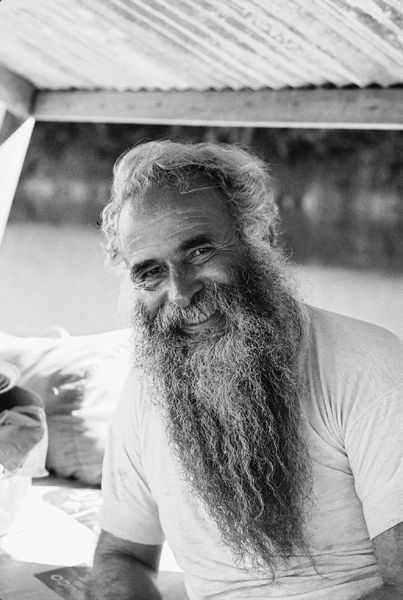
I found it very difficult to live among the Yanomamö at first. I was the only non-Yanomamö in the Upper Bisaasi-teri village, which had some 130 or so people in it. For the first month I could not even cross the river to visit with the Malarialogía personnel because I had no dugout canoe or motor. I finally purchased both of these. This made it possible to go downstream some two hours to the Salesian Mission at Ocamo to make contact by shortwave radio with my wife, who was now staying at IVIC, the Venezuelan Research Institute in the mountains above Caracas. The one civilizado I could talk to at that point in my fieldwork was Padre Luiz (Luigi) Cocco, the Italian Salesian priest who had established the mission at the mouth of the Ocamo. He was a jolly, kind man who looked a bit like Santa Claus. He spoke by radio every morning at six to an older Venezuelan man who lived in Caracas, named Don Teodoro. Padre Cocco would contact Don Teodoro, who would patch me through by telephone to my wife’s apartment at IVIC, but these attempts were successful only about half of the time. Then I would have to spend another night at Padre Cocco’s mission and try again the next morning.
Later my first year another Salesian priest, Padre José Berno, arrived at Mavaca about two hours by motorized canoe upstream from Ocamo to start another Salesian mission. He brought his own shortwave radio with him. Padre Berno offered to help me contact my wife via Don Teodoro, an opportunity that I enthusiastically and gratefully accepted. But the first time I tried to take advantage of his offer, he attached a condition: he wanted me to take Yanomamö language materials from James Barker and give these items to him. Barker had developed a Yanomamö dictionary and a basic grammar in order to produce school materials to teach Yanomamö children how to read and write in their own language, and in Spanish as they learned it from the Salesians. I never saw these language items, but Barker mentioned them to me.
I refused to do this for Padre Berno and preferred to take the inconvenient trip downstream to continue to use Padre Cocco’s radio. Because of my regular visits, Padre Cocco and I got to know each other quite well, and I overnighted at his mission regularly that first year.
We would have long talks, and my command of Spanish improved. Although Padre Cocco’s native language was Italian, he spoke Spanish quite well. He said he was writing a book on his experiences as a missionary among the Yanomamö and asked me to help him with some of the aspects of Yanomamö culture, settlement patterns, and how the group near his mission—Iyäwei-teri—was related to the villages farther up the Ocamo River. He also wanted to use some of my color photographs to illustrate his book, which I happily provided.
He was astounded, for example, when I told him the Yanomamö called their female cross-cousins by the same term they used for “wife” but distinguished their female parallel cousins from their cross-cousins and called them by the same term they use for “sister.” At first he didn’t believe me and insisted that we go to the shabono, where he questioned one of the young Yanomamö men, “Carlito.” Padre Cocco was flabbergasted when Carlito corroborated what I had told Padre Cocco. Padre Cocco had spent ten years with the Yanomamö and had never noticed this practice.
Padre Cocco told me a story about his life as a young priest in northern Italy. He was from Turin. During World War II, he said, he took great risks to save downed Allied pilots from the Germans, hiding them in his church and helping them eventually to get to safety. Later, he told me how he saved Axis pilots by hiding them in his church and helping them to get to safety. In both cases he said he could have been executed by firing squad for what he had done. Then, with a twinkle in his eye, he whispered to me that after the war ended he began receiving a pension from both the Allied and Axis powers for what he had done to save their respective pilots.
On one occasion he told me that he had just read in his recent Salesian newsletter a message from the pope that Catholic priests could have fruitful social dialogues with people of other faiths—including atheists. He added, “This means that I don’t have to feel guilty for being friendly with you.” Padre Cocco had correctly decided that I was an atheist.
The Sinister Side of the Salesians
During 1965 a disturbing incident took place that became an intricate component in later problems that developed between the Salesians and me. It was something Padre Cocco asked me to do. One day in 1965 Padre Cocco paid me a visit at my mud-and-thatch hut at Mavaca. I was surprised but delighted to see him—he had never visited me although I had visited him many times.
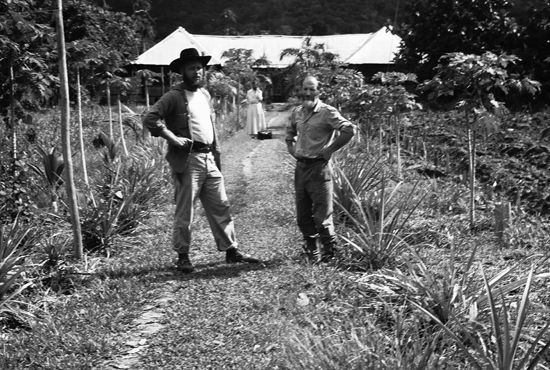
Napoleon Chagnon (left) with Hmno. Iglesias (right). An unidentified Salesian priest stands in the background.
He was very disturbed when he showed up. He told me that he had just learned that Hermano (Brother) Iglesias, who had been sent to the most remote Salesian Mission post, had been having an affair with a Yanomamö woman for several years. In fact he had sired several children by her at the mission in Platanal. (This was the village of the Mahekodo-teri.) Padre Cocco was angry, ashamed, and bitterly disappointed, not so much because Iglesias had violated his vows of celibacy but because he had brought great shame on the Catholic Church and created a potentially embarrassing public scandal. Padre Cocco seemed desperate to keep this shameful act out of the Venezuelan media. Hermano Iglesias would eventually be dismissed from his duties, would return to Spain, and would no longer be affiliated with the Salesian Missions.
I listened quietly. Then Padre Cocco proposed a solution to the problem that would avert publicity and spare the church any embarrassment. He told me that Iglesias spoke very highly of me and trusted me because he and I shared an interest in photography. Padre Cocco suggested that I approach Hermano Iglesias and invite him to go fishing with me. He was an avid fisherman. But this would be a very special fishing trip. I would be the only one to come back from it and I would report that a tragic accident had taken place: Iglesias had bumped his head on a tree branch, had been knocked out of the boat, and drowned in the swift current.
Padre Cocco then said, with pointed emphasis: “I can assure you that there will be no investigation of the accident, neither by the Venezuelan National Guard nor by the territorial government.”
He left shortly after that and returned to Ocamo. I was a bit shaken by this suggestion but concluded that Padre Cocco was upset and didn’t expect me to do as he proposed. I assumed that the issue would eventually be quietly handled when Padre Cocco’s anger subsided.
But several days later Padre Cocco paid me a second visit, traveling at night from Ocamo to my hut. Since it is not safe to travel alone in a motor-driven dugout canoe at night, the trip had to be about something important. Astonishingly, he repeated his proposal and again emphasized that there would be no investigation by the military and territorial authorities.
I declined his invitation, preferring to believe that Padre Cocco’s anger and concern had still not dissipated.
Despite my affection for Padre Cocco, my view of the Salesian Missions changed markedly. I realized that they were not an entirely benevolent group but that they were capable of some rather draconian actions so long as these actions were surreptitious.
I was at Ocamo the day that Hermano Iglesias left Amazonas with his children by the Yanomamö woman. He was defiant, complaining about how much money the Salesian organization owed him for services rendered. Padre Cocco and other representatives of the missions were obviously angry with him. I avoided them and departed as quickly as I could.
IVIC and My Family
IVIC (Instituto Venezolano de Investigaciones Científicas) was the Venezuelan academic research facility that served as my “institutional” host. It was the official institutional host and Venezuelan collaborator of the University of Michigan medical researchers from the Department of Human Genetics, James V. Neel’s group. Although I had no formal relationship to Neel’s department for the first seventeen months of my fieldwork and had my own National Institute of Mental Health research grant, I was considered by Neel’s Venezuelan medical collaborators at IVIC as part of the official “Michigan team.” Miguel Layrisse, Neel’s most important collaborator at IVIC, had already sent one of his lab technicians, Esperanza Garcia, to Ann Arbor, where she was getting special training in new laboratory techniques in Neel’s department. This interinstitutional agreement was very fortunate for me, because my family could stay in one of IVIC’s faculty apartments while I was in the jungle. The downside of this arrangement was the severe logistics problems my wife had as a near prisoner in this mountainous redoubt that had no grocery store. She had no transportation to go shopping in Caracas for household necessities. Fortunately, there was a family there from Switzerland—the Munzes—who graciously and generously invited her and the children to go shopping with them in Caracas about once a week.
I managed to get out of Amazonas twice during my first year in the jungle and was able to spend about a week each time with Carlene and our children. During these brief trips I replenished my food and other supplies, had my film processed, and ate ravenously of green tossed salads, French baguettes, cold beverages like beer and fruit juices—and other foods for which I hungered and dreamed regularly during the long months in the jungle.
But the longer I spent with the Yanomamö, the more I failed to notice the inconveniences and difficulties of living among them.
For example, I had become so accustomed to the constant stinging bites of the bareto —the diurnal gnats—that I barely noticed them anymore. Their bites no longer left burning, red, itchy welts on my skin because my body had grown accustomed to them, as everyone does after a month or so. When I finally brought my wife and children into Mavaca they reacted strongly to the bites, and it would be weeks before their bodies would adjust. Consequently they immediately became sick and feverish from the bareto bites.
Bringing one’s wife and children into Amazonas in the mid-1960s involved major logistics and planning problems. For example, travel to the interior, especially to Venezuela’s Amazonas, had to be by river and involved very long trips using native dugout canoes.
Few people in the United States realize how difficult and frustrating it can be to do routine things in a country with few large cities, where most of the country is referred to with some kind of word that means outback, interior, campo, or forest. The more improbable it is that some routine task can be done in such a place, the more sincerely it is promised by Venezuelans, who find a need to think of their country as being everywhere a highly developed, civilized, and modern republic.
There was only one landing strip in the Yanomamö area when I first arrived in 1964. It was an unimproved dirt airstrip at a place called La Esmeralda, a natural savannah that was underwater—or too wet to land on—during the peak of the wet season (April to August). At most other times large airplanes could land at Esmeralda, including C-47s (the military equivalent of the commercial DC-3) and C-123s, military transports with a drop-down door large enough to load and unload jeeps, small trucks, bulky cargo, or airborne troops, who could parachute out of the rear of this cargo plane. In 1964 La Esmeralda had a resident Salesian missionary, Padre Sanchez, who had a tiny chapel and living quarters, and a small Ye’kwana community of some fifty people who had previously been converted by members of the New Tribes missions. They ignored Padre Sanchez and never attended services at his chapel.
By 1965 the Salesian Missions in Amazonas had persuaded the Venezuelan government to provide them with regular military flights to fly in certain kinds of bulky and heavy supplies to their more remote missions. Otherwise, the only other way to bring in supplies was by hiring Venezuelans in Puerto Ayacucho to bring them up the Orinoco in large dugout canoes, which the missions also did for transporting things like gasoline, diesel fuel, metal roofing, cement, etc.
The Salesian bishop in Puerto Ayacucho, the territorial capital, wanted the government to promise them at least one flight per month to La Esmeralda during the times of the year when the rains did not interfere with these cargo flights. La Esmeralda (or simply Esmeralda, as the Venezuelans called it) was just on the edge of Yanomamö territory, about two to three hours by motorized canoe downstream from Padre Cocco’s mission at Ocamo.
At Esmeralda a gigantic basalt mountain, Cerro Duida, rose abruptly from the savannah to some ten thousand feet, and beyond Duida there were other, even taller craggy basaltic mountains. This area was the heartland of the Carib-speaking Ye’kwana, whose territory lay mostly north of the Yanomamö region but overlapped with it in places. The military flight negotiations between the Salesian bishop and the Venezuelan air force were under discussion about the time I began my work among the Yanomamö.
The air forces of most Latin American countries at this time were used primarily to provide freight services to their remote interiors—and especially to the various groups of the Catholic Church in the several countries. In Venezuela, this meant the Salesian Missions. The Salesians boasted, for example, that “every President of Venezuela was educated in a Salesian Catholic School.” In a sense in the remote interior region, the Venezuelan air force might be regarded as the “Salesian air force.” Ironically the Salesians cynically viewed the evangelical New Tribes missionaries as mostly American, mostly capitalistic, and always seditious: one of the proofs of their sedition, for example, was that “they even had their own air force.” The “New Tribes air force” was actually a group of civilian pilots belonging to the Mission Aviation Fellowship (also known as Alas de Socorro in some countries) who flew mostly for evangelical mission groups—but were always willing to make flights for functionaries of the national governments where they operated and in some countries afforded the only safe and reliable air transportation into the remote areas of those countries.
The Salesians in Venezuela were politically powerful, especially in rural areas like the Federal Territory of Amazonas and in its capital city, Puerto Ayacucho. The highest civil office was held by the governor, who was appointed by the president of Venezuela. But the Salesian bishop of Amazonas was easily as powerful politically as the governor, if not more powerful. In fact, the territory of Amazonas was basically a theocracy—a political entity ruled by the Catholic Church. I met one of the former governors of Amazonas many years later at a reception in New York. He mentioned that his chronic problem as governor was carrying out his policies when the Salesian bishop was opposed to them. He added that “this was the single most important problem of all of my predecessors as well.” (In 1996 Amazonas ceased to be a federal territory and was granted statehood.)
Early in my career the Salesians considered me harmless (after they determined I had been raised as a Catholic) and thus I got along amicably with them. I would bring them, for example, special foods—like large ten- to fifteen-pound pieces of Parmesan cheese and bottles of rum or Scotch whisky. In addition to allowing me to use their radio at Ocamo, they permitted me to store some of my gasoline at their missions when I was away from the Yanomamö area.
New Tribes Mission and Salesian Politics
The serious battle for Yanomamö souls in the Venezuelan Amazon had begun in the 1950s. The area was ignored by the Venezuelan government because of its remoteness from the capital, Caracas. In fact, the national government left many of the social services that are normally a function of the secular government, such as education, or recording of marriages, births, and deaths, to the Catholic Church. It was probably much cheaper to do it that way and, of course, the church was granted some important legal privileges. The 1915 Venezuelan Law of the Missions gave the Salesians extraordinary powers with respect to the native peoples in Venezuela’s remote areas. This law enabled the Salesians to “attract” and “reduce” the Indians to their mission by just about any means they could.
In 1964 when I arrived, Puerto Ayacucho had only a few paved streets and a population of about three thousand. A very large fraction of the people were government employees and military personnel. Puerto Ayacucho was essentially a government administration town.
The Salesian bishop’s headquarters in Puerto Ayacucho was large. It had various buildings for schools and dormitories for resident students from more remote areas who lived there during the academic year. Most of the children were from nearby tribes.
The Salesians ignored the tribes whose members lived more than forty miles or so from Puerto Ayacucho because they were too difficult to reach and lived in widely scattered small villages. Most of these native villages were far up small rivers that eventually joined the Orinoco, for example, the Carib-speaking Ye’kwana. The Yanomamö were not even known to most residents of Puerto Ayacucho until the 1950s, and the Salesians ignored them until the New Tribes Mission began to establish contact with them in the Upper Orinoco.
In 1950 James P. Barker started the first permanent New Tribes station among the Yanomamö. He told me that he had been in the U.S. Army and, when he got out after World War II ended, decided to become a missionary for the New Tribes Mission, an organization that focused on some of the world’s most remote, little-known tribal groups in places like highland New Guinea, the Amazon Basin, and other remote areas.
Barker said that he decided to work in Venezuela and specifically on the Upper Orinoco River where a few New Tribes missionaries had begun to evangelize a few years earlier. There were no Yanomamö villages on or even close to a navigable portion of any Venezuelan river in those days, so he and a colleague named Gene Higdom eventually paddled a canoe up the Orinoco from the last outpost of civilization, probably at the rapids where the Ventuari River flows into the Orinoco. There was a small community of Venezuelan creoles there—settlers of mixed ethnic background—European (Spanish and Portuguese), African, and Native Amazonian. Their tiny community there was called Santa Barbara.
Barker and Higdom paddled upstream many miles in a small dugout canoe until the Orinoco River was narrow enough for people to cross it without canoes. By that time they had paddled their canoe past three major tributaries of the Upper Orinoco—the Padamo River, the Ocamo River, and the Mavaca River, in that order. None of these sites was occupied in 1950. Where the Mavaca entered the Orinoco they found a Yanomamö community of approximately 125 people, the village known as Mahekodo-teri. They established their mission at this village.
Thus began the first sustained European contact with any Yanomamö village in Venezuela.
Higdom apparently remained for less than a year, leaving to get married in August 1951. Barker left Mahekodo-teri some time after that and returned to the United States to try to raise money for his mission and to rest and recuperate.
Until then the Salesians had ignored the Yanomamö, but the thought of a non-Catholic religious mission anywhere in this vast territory seemed to be unacceptable to them. They immediately dispatched one of their brothers to Mahekodo-teri to establish a Salesian presence and stake their claim to this and all surrounding Yanomamö villages. When Barker returned to Venezuela he learned that the Salesians had started a Catholic mission and had given it the Spanish name Platanal. Barker could not return there.
Barker was relatively fluent in the Yanomamö language at that point. He was aware that a village on the lower Ocamo River called Iyäwei-teri was keen on having a nabä —a non-Yanomamö—come and live with them. They wanted the steel tools that nabäs almost always brought with them, as well as other manufactured items. Thus he established a new New Tribes Mission post among the Iyäwei-teri, who were eventually persuaded to move down the Ocamo several miles to where it flowed into the Orinoco. That place was subsequently named Boca Ocamo —the “mouth” of the Ocamo.
When Barker left for the United States a few years later, the Salesians once again sent one of their missionaries to establish a mission among the Iyäwei-teri at the mouth of the Ocamo River. This was Padre Luigi Cocco.
When Barker returned, he had to find yet another Yanomamö group to evangelize.
This time it was the Yanomamö village of Bisaasi-teri. Some ten years earlier they had been massacred in a devastating nomohori —a “dirty trick”—instigated by their Shamatari enemies. In 1950, while still at his original mission at Mahekodo-teri, Barker had witnessed the procession of the Bisaasi-teri survivors of that massacre move into Mahekodo-teri, where he got to know them.
The Bisaasi-teri, as Barker explained to me, were willing to move out to the mouth of the Mavaca River where it joins the Orinoco, and that is where I found the Bisaasi-teri in 1964, some five years after Barker had persuaded them to settle there.
Bisaasi-teri was a large village and it was experiencing growing pains and internal political struggles. When the village moved to the mouth of the Mavaca, it subdivided into “Upper” and “Lower” as previously described. The Lower Bisaasi-teri made gardens and their shabono on the west side of the Mavaca River, where it joins the Orinoco, that is, a few hundred yards down the Orinoco from the other group. The Upper Bisaasi-teri made their gardens and shabono on the east side of the Mavaca River—up the Orinoco. The downstream group referred to themselves as koro-teri (downstream village) and the other group called themselves ora-teri (upstream group). But they both called themselves Bisaasi-teri. Together they numbered some 250 people, one of the larger Yanomamö villages known at that time.
The New Tribes Mission took steps to safeguard its Bisaasi-teri mission: they had New Tribes families living in both groups lest the Salesians try to establish their own mission in one of the Bisaasi-teri groups.
Barker built his mud-and-thatch house next to the shabono of the upper group, and a different New Tribes family, the Janks (from Canada), built their house on the southwest area next to the shabono of the Lower Bisaasi-teri group. Several other New Tribes Mission families also stayed periodically among the Lower Bisaasi-teri to make it difficult for the Salesians to move in if any of the evangelical families left for longer than a few weeks.
Sure enough, the Salesians showed up at this New Tribes Mission location almost immediately. They located themselves across the Orinoco River from the two communities of the Bisaasi-teri where the few thatched huts of the Malarialogía families were located. The Salesians began first by establishing a comedor (a communal eating place), and then by sending a Dutch lay brother, Hermano Pedro, and subsequently one of their priests, Padre José Berno, to Mavaca to build a church and a mission compound.
These activities were just beginning when I arrived in 1964. Padre Berno had not yet arrived, but Pedro was there. The comedor was not functioning yet, but for a time Pedro lured some of the Yanomamö children from the two villages across the Orinoco to his comedor with food, particularly highly sugared oatmeal. However, they stayed only for breakfast and returned across the river. Hermano Pedro had a Venezuelan employee—a motorista —who would pick up and return the Yanomamö children.
Not long after that the Salesians became even more aggressive in their mission efforts—what the 1915 Law of the Missions called atrayer y reducir: attract the native people to the mission and reduce them to living there. Sometime in the early 1970s the Salesian missions at Ocamo, Mavaca, and Platanal began removing Yanomamö children from their villages—often isolated villages at some distance from these three missions—and sending them far downstream to Isla Ratón, a small island in the middle of the Orinoco near Puerto Ayacucho. There the children were put into dormitories, taught Spanish, and discouraged from using their own language. They were away from their parents and their villages for months at a time.
The Salesians would “persuade” the parents to give up their children by offering them steel tools, like machetes and axes. Since the Salesians were only minimally competent in the Yanomamö language and could not clearly explain to the Yanomamö what they were doing, and since the Yanomamö in these remote villages knew no Spanish, this activity effectively amounted to purchasing the children and taking them away from their parents.
Eventually complaints by the Yanomamö provoked the Salesians to change their policy. The Salesians then built the same kind of dormitory facility at Esmeralda and lodged the Yanomamö children there, once again against their will and against the wishes of their parents.
Eventually, in the mid-1970s, the Salesians provided schooling for the Yanomamö children at their Ocamo, Mavaca, and Platanal missions so the children could at least remain in their own villages close to their parents.
By then I had long since committed myself to studying the several villages south and west of Mavaca and away from the Salesian missions. These were the groups that the Yanomamö referred to as Shamatari because they had a slightly different migration history and genealogical origins. I tried to ignore the changes that were going on in and near the Salesian missions because there were so many Yanomamö villages that were remote and largely outside the sphere of the mission influence. I felt that studying these more remote villages was my best opportunity for understanding the issues on which I focused my research.
The New Tribes Mission decided to abandon their mission at Mavaca about 1973 and concentrated their efforts on Yanomamö communities that were more difficult to reach and where the Salesians were unlikely to follow them and force them to leave.
Guns and Germs
But even the remote Yanomamö villages were not outside the range of Salesian influence. As early as 1960 the Salesians were providing shotguns to the Yanomamö at Ocamo. They may have given shotguns to the Mahekodo-teri at about the same time. By 1967 Padre Berno had introduced shotguns at Mavaca, using them to lure about half of the Lower Bisaasi-teri to “his” side of the Orinoco. To the Yanomamö, shotguns are powerful incentives to move. Guns are more efficient at killing game—and defenseless neighbors—than arrows.
I first became aware of the shotguns in 1965 while collecting genealogies and making a census of several remote villages north of the Orinoco and east of Padre Cocco’s mission at Ocamo. Part of my demographic efforts entailed obtaining causes of death of all deceased people I encountered in the genealogies I collected. Several very recent deaths were attributed to raids by the Iyäwei-teri at Padre Cocco’s mission. My Makorima-teri informants insisted that Padre Cocco’s group used shotguns to kill several of their village’s men.
I made a special trip to Padre Cocco’s mission and told him what my informants said about the shotgun killings by men from his village. He readily admitted that he had provided the shotguns and ammunition but vehemently denied that “his people” would use them to kill other people. He insisted they used them only for hunting game, the purpose for which he had provided them. He was, in fact, incensed that I would even suggest that the shotguns were used in lethal raids against others.
As we were talking about this, one of the adult men was walking by and Padre Cocco called him over to ask him about my outrageous account. Padre Cocco had given him the Spanish name Carlito. In the mission pidgin he asked Carlito if they had gone to the distant villages along the Höräta River and killed people with their shotguns. Carlito responded in a matter-of-fact way: “Sí, Padre. We killed this many with our shotguns,” holding up several fingers.
Padre Cocco was shocked, then outraged. He read the riot act to Carlito and immediately went to the shabono with Carlito and confiscated all the shotguns he had given to them, some half-dozen or so as I recall.
Padre Cocco thanked me for making him aware of this situation and we continued to be friends. But he later returned the shotguns to the Iyäwei-teri, who solemnly assured him that they would use them only for hunting, a promise that was soon and predictably broken. The Iyäwei-teri just became more secretive about their raids.
When I returned to Venezuela in 1968 to do fieldwork and reached Mavaca, I learned about Padre Berno’s decision to give the Lower Bisaasi-teri several shotguns, the first of many, along with dugout canoes and several outboard motors. He had “purchased” half of the Bisaasi-teri to get them to move to his side of the river. I remember the haughty and conniving headman named Paruriwä (also known as Hontonawä) swaggering down to my canoe as I pulled up to the riverbank to give my regards to Padre Berno. He carried his shotgun conspicuously across his shoulder, making sure I could see it.
I got out of my canoe and walked up to the mission. Padre Berno came out to greet me. Next to him were a Yanomamö man and his wife, friends of mine. They were now fully clothed with used garments that some charitable organization had contributed to the Salesians. The garments were filthy and in tatters. The man didn’t know how to use the zipper on his trousers, so he cut a large hole in the crotch of his pants. His wife had a young baby and was breastfeeding it. Since her dress was not designed to breastfeed an infant on demand, she had cut holes where her pendulous breasts were more accessible to the baby. There they stood, grinning at me, delighted to see me: he with the crotch cut out of his trousers exposing his genitals and she with holes cut out for her breasts. The parts of their anatomy Padre Berno most wanted to conceal with the new clothing were now more prominently visible.
It was not long before Padre Berno’s faction of the Lower Bisaasi-teri put their new weapons to use in their wars. Over time they harassed, threatened, and intimidated the Mömariböwei-teri, a day’s walk to the south, so mercilessly that the latter fled from the area and made an extremely long migration to the Casiquiare River and, from there, upstream to where it met the Orinoco close to Tama Tama. There they were now within sight of the New Tribes Mission headquarters settlement and effectively outside the mainstream of Yanomamö politics, alliances, and warfare.
Over the next several years the Salesians gave more shotguns to the Yanomamö. In about 1969 the Lower Bisaasi-teri now living at Padre Berno’s mission raided the Patanowä-teri and killed one of the two headmen there, Kumaiewä, and one of his adult sons. They shot Kumaiewä at very close range, nearly blowing his head off. The previous year I had made my first documentary films on the Yanomamö. Kumaiewä is shown in this film ceremoniously chanting with Shinanokawä, the headman of Mahekodo-teri, who, along with his co-villagers, were guests at this feast in Kumaiewä’s village.
Two other Mahekodo-teri men were also prominent in this film, both sons of Shinanokawä: Asiawä and Heawä. Both of these men now had obtained shotguns from the Salesian mission at Platanal and they used them ruthlessly in raids against their enemies. For example, Asiawä killed the headman of Makorima-teri, Säsäwä, by shooting him in the head. Asiawä’s younger brother, Heawä, once raided a distant village and killed a man there with his shotgun. When I asked one of my informants, Rerebawä, about this shooting and why Heawä would raid a village so distant and kill someone he didn’t seem to know and whose village had done nothing to him or anyone in his village, Rerebawä replied: “Heawä is very fierce. When you give a fierce Yanomamö a shotgun he wants to use it. He killed this man bädao ,” meaning “without cause.”
Heawä and Asiawä killed a large number of people with their shotguns, including a woman in Lower Bisaasi-teri, where I worked when I first arrived. I only know the details on Heawä’s and Asiawä’s shotgun victims who lived in villages that my own work focused on, but the Bisaasi-teri claim that they killed many other people in other villages with their shotguns.
My demographic research was beginning to annoy the Salesians. I was not attempting to discredit or denigrate them or their efforts to convert the Yanomamö, but my investigations invariably uncovered things they would have preferred to be left undocumented. I could feel the tension build between me and the Salesians at Mavaca.
Getting My Family In
Late in 1965 I came out to IVIC to get my wife and children and took them with me to my base of operations at Bisaasi-teri at the mouth of the Mavaca River. Before this, I built a small mud-and-thatch house for us. Before we reached Mavaca, though, we stopped at Ocamo. The Yanomamö village of Iyäwei-teri was at Ocamo, some 120 people. They had gotten to know me quite well because I regularly passed through Ocamo and spent nights at Padre Cocco’s mission.
It was here that my wife saw the Yanomamö for the first time. They were quite excited to see her: “Möbraö! Shakiwä bä suwabö kuwä kure! Kama käkäba ihirubä akai!” (“Look! There stands Chagnon’s wife! And his two children as well!”) They caressed and fondled the children and immediately wanted to know their names. I said their names softly, as is the Yanomamö way of being polite and circumspect when the person whose name is being used is within earshot. This custom is usually not observed for young children, but it was my way of informing them that my children had so much “value” that even I, their father, was circumspect in their presence and would only whisper their names to others. Loud, excited tongue clicks and gasps filled the air as they repeated their names aloud softly, acknowledging the high status I conferred on my children and wife by simply whispering instead of saying their names aloud.
I wanted to push on to Mavaca by nightfall. I had left my dugout canoe, gasoline tanks, and outboard motor at Ocamo when I had gone to Caracas nearly two weeks earlier to pick up my family. I hurriedly mounted the motor on the canoe and loaded it with our possessions. My wife carefully got into the canoe and made sure the children were securely fastened in, then we departed upstream. Mavaca was some two hours away and would be my family’s new home in the jungle.
I was quietly anxious to see my wife’s reaction to the marvelous hut I had built for her and the children, sheltered from the elements and more-or-less safe from the hazards of the jungle. In fact, I secretly felt a bit smug about—indeed, even proud of—the handyman accomplishments I could soon reveal to her. I even privately thought to myself, Not many wives of anthropologists enjoy such luxuries on the field trips they take with their husbands!
I had long since forgotten how pleasant and relaxing a river trip in a dugout canoe could be, but Carlene several times told me afterward how much she enjoyed that trip.
When you sit near the front of a long dugout canoe, the incessant drone of the outboard motor is barely noticeable. What is more audibly apparent is the constant and soothing whisper of the dugout’s prow cutting through the water. The speed of the canoe creates a cooling breeze on your body and the bareto are swept away with the wind. It is usually quiet enough to hear the exotic calls of macaw parrots and the jabbering of the parakeets as they wing overhead in pairs or in small flocks, seemingly in a hurry to cross over the river. Colorful swarms of yellow and white butterflies flitted around the emerging sandbars. The dry season was beginning, the sky was clear, and the air was pleasantly warm.
By contrast, much of the time I had spent on the rivers of Yanomamöland was at the helm of, and therefore right next to, a noisy outboard motor. Most of the time I was in narrow, winding rivers, crouched over in an uncomfortable standing position so I could quickly raise the propeller out of the water, searching the ripples for telltale signs of hidden rocks or submerged deadfalls immediately ahead of my prow. Most trips in my dugout were usually hard work for many boring hours on end, but river travel was always better than hacking your way through the jungle on foot.
The soothing, pleasant trip for my wife and children came to an end when I slowed my canoe and eased it into my landing, a tiny machete-hewn niche I had had the Yanomamö dig into the muddy bank of the Mavaca River some twenty-five yards from where it joined the Orinoco.
The hordes of bareto appeared as soon as I stopped the outboard motor. We got out of the canoe and walked up to the house that I had glowingly described to my wife many times by radio and in letters to her from the field. Several dozen Yanomamö were there to greet us, mostly women and their babies; the men were in the shabono taking hallucinogenic drugs and chanting to their personal spirits—their hekura —as they did every afternoon. As at Ocamo earlier that day, the local Bisaasi-teri women were excited and pleased at long last to meet my wife and children. They knew them only by the photographs I had shown them and by their names.
The Bisaasi-teri women felt my wife all over, marveling at her fair complexion and complimenting her on how riyahäwä (beautiful) she was. The women ran their hands under her blouse to make sure she was built like them and had breasts. They also affectionately fondled the children and kept exclaiming about their blond hair. They wanted me to give the children to them—especially our daughter.
It was the second day of November 1965 when my family moved into my mud-and-thatch home adjacent to the Yanomamö village of Bisaasi-teri.
Although it never became a specific point of conversation, I knew that my hut was somewhat less elegant than I had led my wife to believe. But that’s only because it is quite difficult to make an elegant mud hut.
Life in Our Mud-and-Thatch Hut
The hut was of simple design—a rectangular structure about 20 feet by 20 feet. I had built it as an extension to Jim Barker’s much larger house by prior agreement, primarily to save me the effort of building one of the walls. Barker was delighted to have it as an extension to his own house and said he would later use it as a guest quarters when other mission families visited. He himself had moved back into his own house about six months earlier, bringing his wife and young daughter with him.
I made my walls with a line of log posts buried upright into the clay earth, spaced about two feet apart and connected horizontally with many narrowly spaced thin strips of palm wood—makeshift lath—that were lashed to the upright logs with vines. Ordinary clay soil, mixed with sufficient water to make the consistency of wet concrete, was packed into the spaces between the upright logs. After this mud dried for a week or so, an initial finish coat of thinner mud was applied to the inside and outside surfaces. When this mud dried out in a few days, it would shrink and leave a rough, cracked surface that looked like what a pool of muddy water leaves behind when it dries up. A second and third coat of thin mud eventually produces a more-or-less smooth surface, but the inside walls of the house—where the sun can’t get to—are usually very dark and this surface never gets completely dry. Mold and mildew are big problems in an equatorial mud house because of high humidity.
My floor was made from crumbled moist clay pounded flat with a heavy log to compact it and make it relatively smooth. Needless to say, any liquid that spills onto such a floor produces a lingering, slippery mud puddle. As flooring goes, a mud floor is more difficult to keep clean than, say, linoleum or tile. Washing the floor with a mop is not an option.
My house had only one entrance; there were no windows on the ground floor. My single window was in the 6-foot-high end-gable in the roof area, that is, in the thatch. My door was standard in dimensions, but made from round poles and a few scraps of rough-sawn boards that I obtained from Barker. I put two latches on it so I could lock it from both the inside and outside. Nevertheless it wouldn’t have taken much effort to break through it, as the Yanomamö would easily do several times while I was away on some trip to visit other Yanomamö villages.
I partitioned the ground floor into two rooms by erecting another wall of logs and mud daub. The partition created a small, enclosed space that was basically a storage area where I kept canned foods, motor oil, tools, canoe paddles, and other goods, as well as the kinds of possessions the Yanomamö coveted: my small cache of “trade goods.” These were the things like small spools of thread for making arrows, small knives, fishhooks, fish line, etc. I paid the Yanomamö for informant work, for roofing thatch, and for helping me cut and haul the timbers, collect the vines, and do the mud work that went into constructing my house.
There were few architectural luxuries, but one I did include was an indoor shower. I made a privacy mud wall in one of the corners to box off a small area to stand in. I ran a plastic hose through the roof thatch into an empty but clean gasoline barrel, which I supported on a stout scaffold. The shower end was a cheap plastic showerhead that had a pinch-type stopcock. I had older Yanomamö boys fill the barrel with buckets of river water, which would become pleasantly warm in the barrel in the sun. I finished the shower stall with a small platform to stand on, made from vines and small sticks, and fashioned a drain of sorts in the mud floor. The drain was just a small but rather deep hole directly underneath the stick-and-vine platform to stand on and keep your wet feet elevated above the mud.
One had to be careful to not leave the water trickling for very long or else the small shower area would fill up and overflow into our living quarters. Primitive, dank, mildew-covered, and disagreeable as it was, the shower allowed my wife and children to keep relatively clean in privacy, and it was much safer to bathe the children in the shower than in the deep, swift Mavaca River. Several years before I arrived, a Yanomamö child disappeared while bathing in the Mavaca River right in front of where my hut stood. The grief-stricken Yanomamö concluded that an anaconda had taken him.
But by far the best part of my house was the troja (pronounced “tro-ha”). There is no English word that accurately conveys what this Venezuelan Spanish word means. It refers to the large area immediately above the ceiling of a room, what we might roughly translate as an “attic.” But our “civilized” houses have many supporting rafters separating the ceiling from the attic, whereas my mud hut had, instead of multiple two-by-eight rafters spaced two feet apart, just a few stout, round logs spaced some six feet apart that served to hold the outer walls together. Most huts built like mine leave these round logs exposed, and from the packed mud ground floor, a person normally sees the bottom side of the leaves that are used to thatch the roof. But if you place some kind of wood or other rigid material across these round logs, you have a troja : an aboveground storage (or living area) with a dry floor. Access to my troja was a crude ladder I made from poles and vines.
My troja floor was made from long pieces of split palm wood. Several of the many palm tree species in the Amazon can be easily split lengthwise into strips. When you shave off the interior pithy material with a machete you get a long, springy board that is relatively flat on one side and rounded on the other, rather like wide pieces of lath. Palm wood is brittle but extremely hard and durable. It is also hazardous to handle because the edges are extremely sharp and can cause painful cuts and even more painful splinters. It is also difficult, for example, to pound nails into. But, when one places these long pieces flat-side down, the palm wood perpendicular to the round rafter logs and lashed together with vines, one can fashion a perfectly suitable wood floor. The sharp edges are on the lower edges of the rounded hump that sticks up.
The troja floor is a bit springy if the round supporting logs are far apart, but it certainly beats a mud floor. You can actually put things down on the palm wood floor and they won’t get damp.
We slept in our troja, separated from the elements above and outside by scores of thin rafter poles to which the palm thatching of our roof was attached. These rafter poles were stout enough to tie our hammocks to, so we slept suspended, just above the manaca palm wood floor, dry, relatively cool, and protected from malaria-transmitting mosquitoes by our mosquito nets.
Our youngest child, Lisa, was not yet two years old, too small to sleep by herself in a hammock. I borrowed a “cage” for her to sleep in from Barker, a box that was covered on all sides with metal mesh screen to keep out the mosquitoes and other biting things.
Almost all cultures distinguish sharply between nature and culture, a theme elaborated in many ways in the works of the famous French anthropologist Claude Lévi-Strauss. The Yanomamö, for example, focus on this distinction in their conception of their villages and the very nature of man as distinct from animals. Their word for house is yahi, a place where human beings dwell. Their word for jungle is urihi, the place where wild things—things that are not human—live. Their communal dwellings—shabonos —are a collectivity of individual yahis —individual houses. Thus a shabono represents culture and cultural things—things that they call yahi tä rimö. In sharp contrast, wild things—nonhuman things—are natural, components of nature: urihi tä rimö. For them, culture ends at the outside surfaces of the shabono roof and walls. My house was supposed to embody this inflexible Yanomamö principle and keep the jungle outside of our personal, cultural area.
After several days I noticed that my wife was dozing off frequently during the day. It was then that I discovered that she was not sleeping at night. She said she was keeping the rats away from the children by shining her flashlight on them all night long. I had forgotten that, by night, a dozen or so jungle rats would come into the house and live in the roof thatch, moving from place to place along the many poles that held the thatch, rustling the thatch as they moved. The boundary between culture and nature represented by my mud hut was not as firm as it was supposed to be.
My wife could see and hear the rats in the thatch, but when they reached the hammock ropes and began to climb down to our hammocks, she became especially alarmed. I had gotten used to them during the year and ignored them much as New Yorkers learn to ignore sirens when they sleep at night. I simply thought of them as jungle rats, just part of the background noise.
Rats, of course, are sometimes reported in our newspapers as attacking sleeping children and chewing on their faces and extremities, but these reports are invariably from the slums in crowded industrial cities. But my poor wife was staying awake at night to make sure the rats wouldn’t harm the children, maintaining vigil over them with her clutched flashlight, shooing them away if they got too close to the children.
I solved this problem by hiring several young Yanomamö boys to sleep in the troja with us. They were delighted to provide a rat-exterminating service, using their miniature bows and arrows; to their amazement and delight, they also got to use our prized flashlights. Flashlights were still novel in 1965 and regarded by the Yanomamö as extremely useful and almost magical.
I paid these intrepid young hunters per rat with fishhooks, fish line, and other small items. Their two-foot arrows were made of the rigid, stiff spine of a palm leaf, sharpened to a needle point at one end and fletched with two tiny feathers at the other end. Their tiny bows were fashioned from a wiry branch about thirty inches long. The arrows had enough velocity to go completely through the body of a rat when they actually hit one, causing it to fall from the rafters, to be dispatched with a stick by the gleeful young hunters when it hit the troja boards. They didn’t get many rats, but their constant shooting harassed the rats enough to keep them nervously moving about.
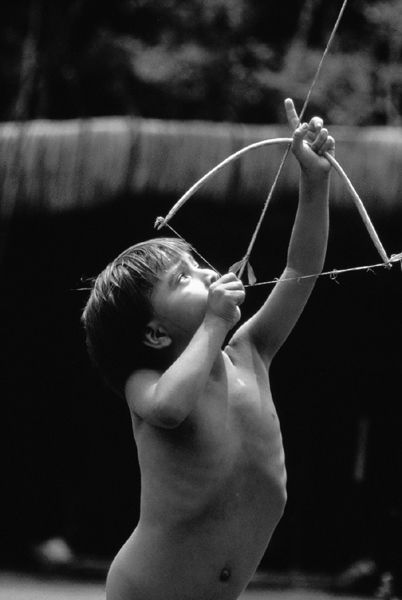
A child with a small bow and arrow of the kind our troja “hunters” used.
My Magnificent Shower and Other Disasters
For reasons that still baffle me, the arrival of my wife and children coincided with a particularly dramatic increase in the insect problem. I always had insect problems, but some very unusual ones materialized when my family joined me.
The first time my wife took a shower she let out a shriek: she found herself face-to-face with a large, hairy black spider about the size of a small saucer. It was crawling down the wall from the thatch just above her. It wasn’t a tarantula, but it was almost the size of one, but skinnier. I dispatched it with a stick. It made one of those yucky squish sounds when I did, like the sound when you step on a very large, juicy cockroach. (We had an abundance of large, juicy cockroaches.)
The next morning when I put on my damp trousers I felt something crawling in them—and scrambled to get out of them as quickly as possible. There were three or four spiders inside the pants legs, similar to the one my wife had confronted the previous day, but not as large. While I always gave my trousers and long-sleeve shirts a vigorous shaking before putting them on to rid them of insects and vermin, these spiders had a more tenacious grip on the inside of my trousers than ordinary spiders and did not dislodge with an ordinary shake.
We always had to carefully examine our clothing before putting anything on and were especially diligent about our children’s clothing. Shoes, of course, had to be examined carefully, pounded on a rigid surface and shaken before putting them on: spiders and scorpions crawl into them at night, perhaps because they are attracted to the warmth. Once, when I took a long trip on foot between two villages, a sizable colony of termites decided to make my soaked tennis shoes their new nesting place. I had hung my shoes on a tree limb before retiring for the night, as I always did. The next morning there must have been several hundred termites in my shoes; it took me about fifteen minutes to reclaim them and get all the termites out of them. Fortunately, my mud hut didn’t have termites.
Not only did we have to be careful when dressing in the morning, but we also had to be careful about eating. Small insects and maggots invariably appear in all your foods when you bring them into the jungle and try to store them there for more than a few days, as I had already discovered. Meals took a great deal more time in the jungle than they did back home because we had to carefully spread the food apart and search each spoonful of oatmeal, rice, beans, etc. before allowing the children to take it into their mouths and swallow it.
Daily Circumstances for the Family
In general, it was very unpleasant to be outside during the day—for anyone, and especially for the Yanomamö, who had no clothing and were at the mercy of the bareto. The Yanomamö traditionally avoid large rivers, and I suspect that the bareto problem is one reason why they do. I once took some 16 mm motion picture film of Yanomamö children playing at the riverbank, and when I later had it developed and viewed it I was astonished at what I saw: the children were incessantly striking their arms, legs, faces, torso, and bodies to keep the bareto from biting them, like child flagellants engaged in some ritual. In general, the larger the river, the more the bareto are a problem, especially in the dry season. There are accounts by early anthropologists and explorers of tribes along the Amazon River who would only come out of their smoky huts for a few hours a day to work and hunt—just after dawn and just before dusk. The reason? Biting insects were so much of a problem and these people had no clothing. A few hundred yards inland from the larger rivers—like the Mavaca—the diurnal bareto are much less of a problem.
Cold, frozen regions like the Arctic could not have been colonized by humans until warm clothing was invented. My hunch is that most of the Amazon Basin adjacent to large rivers was uninhabitable until some kind of clothing—like tunics made from woven cotton or twined bark fibers—was eventually developed, as it was in pre-Columbian times in the Andes and some parts of Amazonia.
The Children’s Playground
Our hut was too close to the river to let our children out of the house without constant supervision. The Mavaca River was deep and swift, not a place you would want your small children to be near unattended.
The small yard of sorts between the river and our hut was cleared of trees but had lots of knee-high weeds covering it—the kind of place where poisonous snakes would be difficult to see. And there were lots of poisonous snakes. Several Yanomamö were bitten and died the first year I lived at Mavaca. Before I arrived, snakebite victims, if they survived, usually lost an arm or a leg. The limb would become gangrenous, wither, and finally just fall off. Sometimes the bone would have to be cut or chopped off, without anesthesia. One of my early informants, a young man named Karödima, had only one leg. He had lost the other to a snakebite and had to hop around on one leg, supported with a long stick he always carried.
Barker had a side yard that he invited us to use so our children could play in it. It was fenced off from the jungle with chicken wire and the surface was covered with about two inches of sand. He had had the Yanomamö haul sand up from the river during the dry season when sandbars would appear. Thus his sand-covered small side yard was safe in the sense that snakes would be immediately visible so long as the children remained where the sand was.
But Barker had several chickens that also used this fenced-off area—it was primarily to keep the chickens in, but served also as a safe but small play yard for his daughter. When my wife examined the sand that the children were playing in she discovered that it was full of gooey chicken droppings—and so the “sandbox” was now off-limits.
The only relatively clean area for our children to play in was our hut with mud walls and mud floors that were always damp and covered with mildew or mold. It was not a suitable place to let the children crawl around, and we had no furniture to speak of for them to play in and keep off the damp floor. In addition, a sizable area of our hut was walled off for the Yanomamö who came to visit us every day. They had to stay on their side of the low wall for a number of reasons, the main one being that without this barrier our tiny house would become home to forty or fifty Yanomamö whose sense of what we call personal space was essentially nonexistent.
Another reason was that some of the Yanomamö were not frequent bathers and many of them had open sores and lesions on their bodies. Finally, the Yamomamö had a sense of personal hygiene that would disgust most Westerners and not a few non-Westerners. They were constantly chewing tobacco—men, women, and children—and, of course, spitting frequently on our floor. They also had the rather unpleasant habit of blowing large quantities of slimy snot out of their noses into their hands and then wiping it onto any nearby surface, as I described earlier.
While the troja was cool and pleasant after dark and an ideal place to sleep, it was hot and uncomfortable during the day, so the children couldn’t play there, either. In short, our children didn’t have much fun at Mavaca.
By contrast, the Yanomamö children had much more fun, but they paid a price in terms of dysentery, insect bites, and skin infections.
Getting Out of Yanomamöland
Within a day of getting my wife and children into the field I realized that I had made a colossal mistake. They were miserable from the heat, insect bites, unsanitary conditions, sheer boredom, anxiety, and frustration at not being free to move around as a normal space would have afforded them.
I did almost no fieldwork while they were with me. My mud hut was not the pleasant, clean sanctuary I thought it would be, mainly because I hadn’t considered the part of the equation that the Yanomamö represented. In an empty jungle or a jungle with just about any other tribe living in it, our situation might have been tolerable and possibly even pleasant. If my house had been larger—or if I had made the floor out of cement and the walls from wood—things might have been more tolerable and the children would have had more clean space in which to play. But it was almost immediately clear to both my wife and myself that the conditions were unsuitable.
Mistake or not, in the Venezuela of 1965 you couldn’t just decide to get out and go back to Caracas—or anywhere else, for that matter—unless you planned to travel by canoe and had a huge amount of fuel cached along your intended route. You were at the mercy of scheduled or unscheduled airplane flights into this area. Sometimes the flights were separated by many weeks or months, as they were when I brought my family into the area.
I learned on my small shortwave radio receiver that—to my immense relief—there was another military flight scheduled to come into Esmeralda in about three weeks. And so not many days after joining me at Mavaca, my wife and I were planning—and hoping—to get her and the children onto that military flight.
A day or two before the plane was scheduled to land the Yanomamö discovered and captured three infant river otters. The parents had probably been illegally killed for their fur by employees of the Venezuelan Malarialogía, who could sell the pelts to Colombians at one of the several border outposts near Puerto Ayacucho. We persuaded the Yanomamö to give us the baby otters to take back to Caracas and give them to the national zoo, where they would be properly cared for and might survive. The otters were still nursing, so my wife had to fashion some kind of makeshift baby-otter bottle—and a powdered whole milk mixture—and feed them almost hourly. Ironically and mercifully, efforts to save the baby otters took our minds off our own situation.
I loaded my canoe with the supplies and items she needed to get back to Caracas with our children—and the baby otters. By now, the missionaries at Ocamo knew I was putting my family on the military flight and they thoughtfully contacted people at IVIC by shortwave radio to have them send transportation to pick her and my children up at the military base at Palo Negro.
I would have—and probably should have—gone back with Carlene to deal with any unanticipated problems that might come up. But nobody knew when another flying opportunity would arise to get me back to the Yanomamö area. It might be many weeks. My first year of fieldwork was drawing to an end, and I still had many things to do.
We arrived at Esmeralda, three hours downstream from Ocamo, several hours before the flight landed. It was difficult saying good-bye to my wife because I felt very guilty, even ashamed, for having brought her and our children into the Yanomamö area in the first place and then not escorting her back. They were now exhausted and sick from the many insect bites. I was relatively certain that her flight back to Palo Negro would be routine, and she would be safely back at IVIC by nightfall. Somebody from IVIC would be there to meet her.
I later learned that the military flight was not routine. It seems that the cargo plane had landed at some very muddy airstrip earlier in the day and one of the retracting landing gears had gotten clogged up with mud and was jammed. The pilots discovered this as they tried to land at Palo Negro and had to abort the first attempt at landing. As the plane circled to make another attempt, the crew struggled to free the landing gear and, ultimately, had to crank it down by hand. My wife later said all the members of the crew were very nervous—they weren’t sure the landing gear would lock and hold up for the landing. She said they were furiously and rapidly making repeated signs of the cross as the plane touched down—safely—at Palo Negro.
The baby otters died the next day at the Caracas zoo.
5
First Contact with New Yanomamö Villages
The probability is close to zero that any contemporary anthropologist will have the opportunity to be the first representative of his or her culture to contact tribal peoples who have never seen outsiders before or who have had fleeting encounters with outsiders. In the Amazon Basin, for example, remaining uncontacted tribes consist of a few families who are hiding out in the remaining hidden pockets of unexplored difficult-to-reach areas. The Yanomamö were the last large, multivillage tribe left in the mid-1960s when I went there. At that time they were about 25,000 people living in 250 or more separate villages.
Fewer anthropologists study tribesmen anymore. The very mention of the word tribe in anthropology has, in the past fifteen or twenty years, become an embarrassment to politically correct cultural anthropologists.
Into the Mysterious Interior
As I said earlier, my intent from the very beginning was to study the Shamatari groups to the south of the Bisaasi-teri. Although many of the Shamatari were uncontacted, members of two Shamatari villages—Mömariböwei-teri and Reyaboböwei-teri—sporadically came out of the jungle and visited the Bisaasi-teri on the Orinoco River to acquire steel tools after about 1960. The first village was a full day’s walk inland through swamps, mud, and steep hills; the second was another whole day beyond that over escarpments that were two thousand feet or so high.
I got to know many of these people from their visits to Bisaasi-teri—and my own several visits to their villages on foot. As with the vast majority of Yanomamö villages, the only way to get to them was by walking.
My original plan in 1964 was to spend sufficient time in Bisaasi-teri to learn enough Yanomamö to communicate with and then initiate work among the two Shamatari villages. I wanted to get away from villages that had direct contact with the outside world, even though Bisaasi-teri was just entering into regular contact with the “civilized” world when I began my fieldwork. There were so many pristine Yanomamö villages when I began my work, why should I study the ones who were already being acculturated?
I made no attempt to conceal my interest in the Shamatari, and this, I later came to realize, bothered the Bisaasi-teri because they did not want me to visit these villages, convinced that I would bring some of my valuable trade items, or madohe, to them. They also considered it rather discourteous: they had received me amicably and why, therefore, should I want to go live with lesser people?
It soon became known to the members of the two Shamatari villages that I was interested in living with them for a lengthy period and that I intended to visit other, even more remote Shamatari villages farther to their south. I was especially interested in a village that was rumored to be very large, one that everybody referred to as “Sibarariwä’s village”—which I eventually discovered was called Mishimishimaböwei-teri. It was also known by several other names as well, making it difficult to know whether there was just one village or several interrelated villages. I gradually learned to sort through the problem of multiple names of villages by focusing on who the headmen were.
Sibarariwä was the acknowledged headman of the Mishimishimaböwei-teri group, and a man with a reputation for duplicity and ferocity. He was said to have been the mastermind of a treacherous feast that claimed the lives of many Bisaasi-teri men. This was the reason that the Bisaasi-teri despised him and wanted to kill him.
I eventually discovered that most of the men in the two closest Shamatari villages also despised Sibarariwä, who had begun raiding them because they tried to help the Bisaasi-teri get revenge on Sibarariwä’s group just before I arrived in 1964 . . . and would try again later, about 1969. I was initially puzzled by the fact that these three villages had, until very recently, been one village—just as Bisaasi-teri, Monou-teri, and Patanowä-teri had been a single village. In both cases the villages split because of fights among them over the possession of some woman.
Thus, while the people in all three of these Shamatari villages were closely related, chicane and treachery had turned them against each other because of the ambitions of a few political leaders.
It was not difficult for me to get guides in Bisaasi-teri to take me to the first Shamatari village, Mömariböwei-teri, since a considerable number of young men from that village were living in Bisaasi-teri as sons-in-law (known in Yanomamö as siohas ) while they were doing bride service—working for and living with their in-laws. Moreover, the Bisaasi-teri had managed to obtain a number of young women from Mömariböwei-teri by, for want of a more delicate description, political coercion verging on outright theft: stronger villages constantly try to coerce women from smaller weaker allied villages.
The young in-married Shamatari men were more than willing to take me to their natal village if the pay were a machete or a knife. But once I reached the first Shamatari village—about a ten-hour walk—my guides would be coerced by their elders in that village to terminate the trip there: they did not want me to continue on to the second, more distant village of Reyaboböwei-teri because they were certain that I would give valuable madohe to them.
The avariciousness of the Yanomamö is immediately apparent to all outsiders in their constant begging for your possessions, begging that becomes annoying, coercive, and very depressing if you are the target of the demands, as I was during almost all of my fieldwork. Because I visited and studied so many villages, the constant begging became so oppressive that to escape it I had to periodically get into my canoe, go out into the middle of the river, and just float for an hour or so away from the Yanomamö. I was living alone with them and had no one else to talk to or listen to.
Thus, once I reached the first village, the older men usually told me that the second, more distant village was very far away, the trails were terrible, the jungle was flooded and, besides, nobody was home: “They all went on a long camping trip far, far away . . .” was a common story, and it usually worked. The thought of walking nearly two more days through hills, swamps, and jungle to an abandoned village is not an exciting one. In fact, the only way I managed to get to the second village was to hire young men in Bisaasi-teri who were from that village and who would not be persuaded to stop at the first village.
During my first year in the field I managed to accumulate a rather large amount of demographic, historic, and genealogical information on the two closest Shamatari groups by talking with visiting Shamatari from these two villages and by conducting long, private interviews with the in-married residents from those villages. In addition, there were several old women in both Bisaasi-teri groups who, as young women, had been abducted from these Shamatari villages or the predecessors of these villages.
It soon became clear from these data that I had to visit Sibarariwä’s village, far to the south, to fill in many gaps. My genealogies showed that the residents of Sibarariwä’s group were intimately related to the residents of Reyaboböwei-teri and Mömariböwei-teri, and informants repeatedly told me that the three groups had a common origin, which the genealogies clearly confirmed. It was also becoming clear that following the standard field research model in anthropology—residing in a single village for the duration of your fieldwork—would have yielded an inadequate understanding of the Yanomamö. Every village was intimately tied to other villages by genealogy, political history, language dialect, common settlement patterns, and the constantly changing patterns of alliance, feasting, and raiding as groups betrayed each other—and then were forced to ally again as circumstances changed.
The Bisaasi-teri and the two closest Shamatari groups used an additional ploy to discourage me from visiting Sibarariwä’s village, which was said to be located somewhere on the Shukumöna River, not far beyond the headwaters of the Mavaca. They recited to me gruesome tales of treachery and violence that characterized their own dealings with Sibarariwä’s people and assured me that Sibarariwä would surely kill me and my guides if I ever went there.
These stories impressed and sobered me enough to cause me to reconsider my intentions, particularly because these tales were borne out in the life-history data I collected on causes of death. Sibarariwä’s village had a well-deserved reputation for violence and raiding. Many Bisaasi-teri, Mömariböwei-teri, and Reyaboböwei-teri had died at the hands of Mishimishimaböwei-teri archers.
In any event, I knew in advance that I would have difficulty finding guides to take me to Sibarariwä’s village. Most of the young men from Bisaasi-teri would find it too risky because they might get shot by the Mishimishimaböwei-teri. The in-married young Shamatari men would be under pressure from the Bisaasi-teri to decline my invitations to take me to contact Sibarariwä’s village. The Bisaasi-teri began putting pressure on the in-married Shamatari siohas to clam up whenever I tried to discuss a visit to the more remote villages.
I finally found a candidate named Wakarabewä, about eighteen years old, from Mömariböwei-teri. He had been promised a young wife in Lower Bisaasi-teri and was doing his bride service there—some five hundred yards downstream from my mud hut in Upper Bisaasi-teri. As a son-in-law—a sioha —he was expected to do all manner of onerous tasks for his parents-in-law, and as a Shamatari he was also subjected to a considerable amount of derision and insult: the Bisaasi-teri had a low opinion of the Shamatari and treated them as inferiors.
Wakarabewä’s father-in-law was particularly unpleasant to him and, coincidentally, was also the headman of Lower Bisaasi-teri. He denied Wakarabewä sexual access to his daughter while at the same time he allowed some of the local men of the village to have sex with her. Wakarabewä could not complain publicly about it, but he privately related his bitterness to me.
He eventually told me in private that he didn’t think Sibarariwä would kill me if I went to his village, provided I was with him or his father—who, it turned out, was one of Sibarariwä’s many brothers! I concluded that a trip there was possible, but I had an uneasy feeling about accepting the word of a young lad when the consensus of the older male Bisaasi-teri was precisely the opposite.
About ten months after I had been in Bisaasi-teri a group of young men from Reyaboböwei-teri visited. As usual, when their visit was over they stopped at my hut to beg for madohe. They mentioned that a group of men from Sibarariwä’s village had recently visited them. They also told me that Sibarariwä’s group had recently moved north, away from the Shukumöna River, had crossed the mountains, and was now living very close to the headwaters of the Mavaca River. After carefully questioning them I concluded that it was possible to ascend the Mavaca in my dugout canoe to a point very close to the putative new location of Sibarariwä’s village. The rivers were high now because of recent rains, so I decided to plan immediately for the trip.
I was very excited about this. It was in late 1965, in the first year of my work, and I felt comfortable enough with my Yanomamö language skills to risk a visit into the unknown and unexplored large area to the south.
Wakarabewä agreed to come with me and suggested the names of a few more young Shamatari men who might be amicably received by the Mishimishimaböwei-teri. I then spoke privately with these young men and secured their promises to come with me.
Enter the Dragon
Word soon spread through Bisaasi-teri that I was planning to ascend the Mavaca to try to find Sibarariwä’s village. My hut was then visited by party after party of concerned Bisaasi-teri who strongly advised me against such a foolish thing. When their stories of lethal treachery failed to frighten me into canceling my plans, they began a new tactic: they told me about the much-dreaded raharas.
Raharas , they explained to me, were created when Man (Yanomamö) was in his infancy. Few living Yanomamö have ever seen a rahara up close, but they all knew of men who met other men who had allegedly seen them from a great distance, men who tremble even today when they speak in whispers about these sightings. Raharas are associated with the Great Flood and with deep, enchanted water. When the Great Flood receded, the raharas —terrifying, dragon-like serpents something like the Loch Ness Monster—originally took up residence in the Orinoco River, somewhere near its headwaters. But since they have never been seen in the Orinoco, the presumption is that they migrated to other rivers after the Flood and now live in those rivers.
Even though few people admit they have ever actually seen raharas, their behavior is quite well-known to the Yanomamö. They rise up out of the water and devour those who are foolish enough to attempt to ascend or cross the rivers, especially the headwaters of lesser-known larger rivers. Furthermore, it is alleged that an underground river connects the Orinoco with the Mavaca headwaters, and that a number of the raharas migrated into the Mavaca headwaters and now lie in wait for unsuspecting travelers who innocently come in canoes up this river. My guides and I would almost certainly fall victim to these savage and voracious beasts.
The rahara story nearly sabotaged my intended trip up the Mavaca. Since none of the Bisaasi-teri or Shamatari had ever ascended the Mavaca very far in a canoe, the assertion that it teemed with raharas was as good as true in the imagination of my Bisaasi-teri hosts.
Delegations of Bisaasi-teri repeatedly came to my hut to dissuade me. Kaobawä, the headman, and Shararaiwä, his youngest brother, took it upon themselves to relate to me the dangers posed by the raharas. For example, Shararaiwä told me (and my Shamatari guides) that the raharas would surely rise up and devour us—canoe, motor, gasoline, and paddles. The others nodded and clicked their tongues to indicate their agreement with Shararaiwä’s claim, the clicking of tongues being the Yanomamö way to endorse and underscore a claim made orally. My would-be guides, who were also being privately badgered in the village by the Bisaasi-teri, looked gloomily at the ground and remained silent. I could see that the rahara story was eroding their confidence.
I was growing very annoyed with the Bisaasi-teri for going to what I considered to be ludicrous ends to prevent me from reaching Sibarariwä’s village. I had a long, heated argument with Kaobawä and Shararaiwä on the existence of raharas but concluded that any further discussion along this line would be fruitless. Just as you don’t argue with the missionaries about the existence of God, you don’t argue with the Yanomamö about the existence of raharas. Some things are simply a matter of faith.
I thought about it for a while and decided to change tactics. “Yes,” I conceded, “there probably are raharas near the Mavaca headwaters!” Moreover, I already knew that raharas existed in other regions and I had, in my youth and in my native Michigan-urihi-teri, seen many of them and had killed my fair share of them with my shotgun. I had just not been aware that they were also found in the headwaters of the Mavaca River and my skepticism was initially based on this misunderstanding.
Yanomamö logic, fortunately, permits such inconsistencies: it is not so much a matter of what you assert as it is how you assert it and the kinds of details you give to support your claims. Take the upper hand, give particulars, be assertive, talk about specific raharas you have known.
I knew raharas very well indeed. As a matter of fact, I was also known in Michigan-urihi-teri as a good shot when it came to raharas and I would most certainly be able to employ these skills should we run into any raharas on the upper Mavaca. I would keep my double-barreled shotgun loaded at all times with my special rahara shot to be ready for them.
My young guides perked up, listened attentively, and seemed less gloomy as I continued my argument.
“Didn’t I explain these magical cartridges to you?” I went on. I knew from my vast experience while hunting raharas in Michigan-urihi-teri precisely where one had to hit a rahara in order to kill it with just one shot. I gave an anatomical demonstration to underscore my authority, pointing my finger below my right ear: “You’ve got to shoot it right here, in the neck! Just below the head! This area is especially lethal if you shoot the rahara there!”
I assured them that I also brought with me a very special kind of cartridge called rahara brahaishaömodimö (“something made for killing raharas at a long distance”) and showed them several cartridges with rifled slugs protruding from the plastic jackets. They clicked their tongues in amazement, for they had never seen a rahara brahaishaömodimö until now.
Shararaiwä flushed with annoyance and chagrin when I shifted my argument and asserted that I had special knowledge about the fabulous beasts. He and Kaobawä held the advantage only so long as they had a monopoly on knowledge, and since neither of them had ever seen a rahara, let alone killed one, I immediately gained the upper hand. Shararaiwä stalked off in a huff, muttering that he was sure the raharas on the Mavaca were bigger and fiercer than those in Michigan-urihi-teri.
One of my several guides backed out the next morning and another asked me if it wouldn’t be more prudent for him to come on my second trip, after I exterminated all the raharas found in the waters of the upper Mavaca.
My canoe was already loaded for the trip, and I knew I had to get under way immediately: the risk of losing the rest of my guides increased the longer I remained in Bisaasi-teri.
Thus we hurriedly left Bisaasi-teri with my dugout canoe heavily loaded with provisions, the roar of my outboard motor drowning out the shouts and rejoinders of the men who were still attempting to prevent me from finding the Mishimishimaböwei-teri. They were annoyed with me and with my guides: “You’ll see! They’ll kill you all! They will pretend friendship at first, and when you are off your guard they will fall on you with bow staves and spear you to death!”
We ascended the Mavaca River for two full days, chopping our way through logs and deadfalls for much of the second day. We were now in unknown Shamatari territory. When we pulled up along the bank to make camp for the second night, the river was so narrow that it was difficult to negotiate the hairpin curves in the current without touching the riverbank on one side or the other.
When my guides set about collecting vines, leaves, and poles for our temporary hut, they returned hastily to the canoe where I was cleaning game, their faces ashen with fear. They had found a recently traveled trail a few yards away from the river. It was a Shamatari trail.
I was elated about the discovery and quickly went to investigate. As we examined the trail and speculated about its origin and terminus, two of my three guides anxiously insisted that we leave for home immediately: they were sure we were very close to the village and they were not going to go any farther. Only Wakarabewä indicated that he was willing to go on. The two others were adamant about going home and were visibly frightened. I had no choice but to turn back.
I was furious with them and later asked why they decided to come in the first place. Their answer? “For a machete, an ax, and a large cooking pot!” They had been so certain that we would never get close to the village that they came along just for the payment I had promised them, and it was an extremely large payment! They also knew that on such trips I always shot a great deal of game and gave most of it away to the families of my guides. For them, the trip was basically a paid hunting trip and they had no intention of reaching the Shamatari village or, incidentally, allowing me to do so.
Perhaps I was foolish and perhaps it was fortunate that I did not make it to the Shamatari village. Maybe the Shamatari were every bit as treacherous as the Bisaasi-teri made them out to be and I was not experienced enough to predict their behavior. I decided to put Sibarariwä’s village out of my mind for the remainder of my first field trip and concentrate on improving the data I had on the Bisaasi-teri and the two closest Shamatari villages.
Just before I left for home at the end of my first field trip I was again visited by young men from Reyaboböwei-teri. They told me that a small group of men from Sibarariwä’s village had visited them shortly after my aborted trip with Wakarabewä. They had learned about my trip through the jungle grapevine. I asked the Reyaboböwei-teri what the reaction was among them, and their reply was, in effect, that Sibarariwä’s group wanted me to come and visit them. The visitors from Sibarariwä’s group had, in fact, asked the Reyaboböwei-teri to pass this information on to me. Unfortunately this information got to me too late to do anything about it that field season because I was already making plans to go home.
My 1967 Field Research
My fieldwork the following year, in January 1967, took me to Brazil and to some dozen or so Yanomamö villages that were located immediately across the border from Venezuela in the Brazilian state of Roraima. I had just gotten my Ph.D. degree in anthropology from Michigan’s Rackham School of Graduate Studies a month earlier and now held a joint appointment as assistant professor in Michigan’s Anthropology Department and as a research associate in the Department of Human Genetics in the University of Michigan Medical School, James V. Neel’s department.
It was on this field trip that Neel and his biomedical team determined that the Yanomamö had little or no exposure to measles, a disease that has caused lethal epidemics in many Amerindian populations. (Thus began the fieldwork that more than thirty years later would lead to horrible accusations against Neel and me, which I will discuss in the final chapters of this book.)
When my Brazilian trip ended in March, I returned to Venezuela again to make an attempt to contact Sibarariwä’s village. This time I intended to have Wakarabewä’s father, Shabreiwä, guide me. Because he was one of Sibarariwä’s many brothers, he was able to move freely between Mömariböwei-teri and Mishimishimaböwei-teri, despite an overall condition of hostility between the two villages. But, as luck would have it, he had been bitten by a snake recently and could not walk. So, I again had to postpone my attempt to contact the Mishimishimaböwei-teri.
While I had been thwarted twice, these setbacks filled me with an even greater resolve to visit Sibarariwä’s group.
1968 and Karina
I returned to Venezuela in 1968 to resume my fieldwork, which had now become an annual January-to-March routine by agreement with Neel.
I had met a boy named Karina in the closest Shamatari village in 1967. Karina was then about eleven years old. He had lived all of his life in Sibarariwä’s village, but in 1967 he and his mother had returned to Mömariböwei-teri—her natal group. Karina’s mother had been abducted from Mömariböwei-teri years earlier and had decided to return. Karina had never seen a foreigner before and he was then frightened of me, avoiding me all the time I was in Mömariböwei-teri.
When I saw Karina again in 1968 he had lost his fear of foreigners, most likely because he had met Neel and members of his expedition. Karina even seemed to seek out opportunities to be around them, to get to know them, and, perhaps, do some favors-for-pay for them. He had become a long-term visitor in Bisaasi-teri by early 1968.
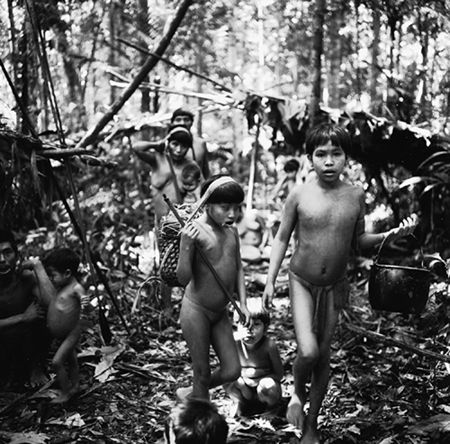
Karina (right) as a 10-year-old boy.
He was now about twelve years old, about that age when pubescent Yanomamö boys like to show their elders that they are bold and fearless. At this age they begin to show resentment when people use their names in public—especially those who are younger, lesser Yanomamö—which is how they advertise their increasing maturity and, they hope, their growing political importance.
I knew that Karina had grown up in Sibarariwä’s village. When I casually asked him if he was willing to take me to Sibarariwä’s village, I was giving him an opportunity to show the others that he was important, an opportunity that he enthusiastically accepted. I planned to have one or two older guides, young men who were huyas, bachelors who liked to show their keenness for adventure, perhaps even adventure with some exciting risks involved—as young men everywhere are wont to do.
I worked privately with Karina for about a week on genealogies and the identities of the village residents. I had already collected names and partial genealogies on Sibarariwä’s group during the previous two years, but it was clear that Karina was very knowledgeable—he had lived there for ten years, almost his entire young life. There were more than two hundred people living in Sibarariwä’s village by my count from the genealogies, and I knew from experience that this had to be an underestimate: collecting these kinds of data “from a distance” invariably leads to underestimates of group size. It was clear that Karina knew everyone there, but probably did not tell me the names of all of them because even the most willing, cooperative informants invariably forget to mention some of the people who live there.
My two guides and I left for Sibarariwä’s village several times shortly after I got to the field in 1968, but we had to turn back every time. Once it was bad gasoline. Another time it was a motor problem. A third time something else went wrong with the motor. On two of these aborted attempts we had traveled two full days up the Mavaca River before turning back, which was annoying and frustrating to all of us because it was so time-consuming. When I made yet another attempt, my older guide failed to show up, leaving me with just Karina.
At dawn the day we left my hut at the mouth of the Mavaca River, Karina said he wasn’t feeling well and didn’t feel like coming. He was getting frustrated because of our several false starts. I covered him with my shirt to keep him warm and set a small aluminum boat over the top of the larger canoe to protect him from the rain and the sun, reassuring him that he would feel better in a day or so. We would eventually leave the larger dugout behind and make the last part of the trip in the smaller aluminum boat that was perched on top of our dugout.
I was also feeling a little under the weather from a severe skin infection—a fungus—around my groin. Some three weeks earlier I had visited the village of Patanowä-teri and, as is customary, entered the village as a Yanomamö visitor, resplendent with feathers, red paint, and a scarlet loincloth. Unfortunately I did not have my own loincloth with me, so I borrowed one from a Yanomamö. He happened to have a contagious and virulent fungus infection of his crotch. Soon afterward I didn’t need a red loincloth: I was naturally scarlet from my knees to my navel, itching and burning like crazy. My skin infection was further aggravated by sitting in the rain in wet clothing for days, operating the outboard motor. The only remedy I had with me was a can of Desenex foot powder. You can’t imagine the hilarious reaction of the Yanomamö watching the resident fieldworker in a most indescribable position trying to sprinkle foot powder onto his crotch, using gravity as the propellant.
By now I was down to the last of my gasoline supplies and I was very tired. I had spent countless hours running an outboard motor during the past several weeks and had not gotten enough sleep. I vowed that this would be my last try at reaching the village. If I did not make it this time, I decided I would give up. I had wasted far too much time chasing this phantom, and my luck up until this point was unbelievably bad.
I had never gotten to the headwaters of the Mavaca on previous trips, so I did not know if I would encounter rapids or waterfalls. If I did, I would need another guide because Karina was too small to help drag the heavy dugout canoe over logs or through rapids.
A few young men appeared at the canoe to see us off for the umpteenth time. I asked one of them, Bäkotawä, a huya of some eighteen years, if he would be interested in coming along with us. He thought about it for a second and then said he would be willing to—provided I would pay him an ax, a machete, and a cooking pot. I agreed to his price and added, “Will you be afraid—like my guides were before—and want to turn back when we get close to the village? If you do get frightened, I am not turning back and you will have to walk home if you refuse to come with me to the village.”
He scoffed and said, with an air of annoyed defiance, “I am not capable of being afraid!” He went on and said that he was already a man, and a fierce one at that. He added that he would deceitfully tell the Mishimishimaböwei-teri that he was actually from Patanowä-teri, not from Bisaasi-teri, to thwart any possible harsh treatment once we got there.
I then asked Karina if he would go along with Bäkotawä’s story. He somewhat sullenly indicated by a whimpered grunt that he would. So, Bäkotawä hastily went back to the shabono, got his weapons and hammock and joined us, and we three intrepid explorers set off for the headwaters of the Mavaca River.
We traveled eight hours the first day and made camp on the right bank of the Mavaca. Karina was feeling much better that evening. He was hungry and mischievous—and began teasing Bäkotawä, reminding him that he was a real Mishimishimaböwei-teri, not a mere Patanowä-teri, as Bäkotawä would deceitfully claim to be.
The second day brought an unwelcome surprise. We had gone only about two hours when we ran into two huge, partially submerged trees that blocked our passage. The river had dropped enough during the week to expose about a foot of the immense trunks above the water, far too large an obstacle to drag the heavy dugout over. Moreover, the trees were submerged too deeply in the river to try to cut through them with axes. We reluctantly had to leave the bigger dugout canoe behind at this point and transfer the outboard motor and our gear to the smaller aluminum canoe, which had been, up to now, tied to the top of my dugout. We couldn’t go as fast in the aluminum canoe as we had been going in the dugout because the aluminum craft was overloaded with our equipment, food, and gasoline, and was not nearly as streamlined as a long, heavy dugout.
We traveled nine and a half hours the second day. The river had dropped at least five feet since my trip of a week earlier, but we had fewer problems with deadfalls. One advantage the small canoe had was that it was light enough so that we could easily drag it by hand through or over most of the obstacles or unload it and portage around them.
At about eleven o’clock on the third day, after we had been traveling since dawn, Karina suddenly turned around and motioned me over to the right bank, shouting: “There! Over there! I know this place! I’ve been here before!”
He excitedly jumped out of the canoe and disappeared into the jungle. Bäkotawä and I followed quickly behind him. There was a large, conspicuous trail a few yards from the river. Karina calculated that we were within a day’s walk of Sibarariwä’s village, and that this was a trail they used when they visited the Iwahikoroba-teri, who, he said while pointing, lived almost due east of this spot.
I suddenly got goose bumps: I was definitely now in unknown Shamatari territory and my chief guide knew where their village was!
Karina also said that the river turned west from here and that it would be quicker for us to walk to the village from this spot than continue in the boat. Sibarariwä’s village, he said, lay to the south of us. Karina and I were very excited and pleased about reaching this familiar point, but Bäkotawä became strangely moody and said nothing.
The riverbank was steep and high. I was afraid that if we left the boat in the river, a sudden rain would swell the river enough to wash it away. I insisted that we put the boat and motor up on the bank, knowing that we would have been in serious trouble if our boat got loose and floated away while we were inland trying to find Sibarariwä’s village.
The load in the boat had been reduced considerably by this time. We had used up much of the gasoline and had periodically dropped off most of the remaining fuel along the way for the trip home. We were essentially down to our food, hammocks, trade goods for Sibarariwä’s people, my cameras, tape recorder, notebooks, film, two shotguns, and a small transistor shortwave radio receiver.
Everything but the bulky trade goods (several aluminum cooking pots and some dozen machetes) fitted comfortably into my two backpacks. Since Karina assured me we were within a day’s walk of the village, we decided to leave all but a few trade goods behind and later send the Shamatari down to the canoe to get them. We also decided to leave some of the food here for the trip home since it would be silly to carry it into the village and then carry it back.
In making a quick inventory at this point I was surprised to discover how little food we actually had with us. I had been so preoccupied with motor problems, gasoline, and guides that I had paid too little attention to our food. The box was the same one I had packed for the first trip, and I had not added anything to it after the three aborted attempts, yet several of us had eaten on those aborted attempts for several days. Our food at this point consisted of about three pounds of rice, two pounds of manioc flour, one pound of sugar, a dozen or so cans of sardines, two chocolate bars, three cups of powdered milk, a quarter pound of salt, and one pound of coffee. It was not anything to worry about if Sibarariwä’s village was only a day away: we could expect to be fed by our hosts. And, as long as I had shotgun cartridges, meat would be no problem if it took us longer to get to the village. I still had all of my rahara cartridges left over from last year (some half-dozen twelve-gauge rifled slugs for tapir), plus the more numerous No. 4 birdshot cartridges I always carried for small game like pajui , the ubiquitous wild turkeys. I left the sugar, milk, manioc, coffee, some rice, and half of the sardine supply at the river for the trip home, bringing some rice, chocolate, and the remaining sardines with us plus a small cooking pot in which I could cook the rice.
It took us about an hour to store our supplies and load the packs. We started off shortly after midday.
Although it had not rained much downstream for the past week, the trail here was unusually slippery and wet. We followed the base of a large hill most of the time, gradually getting higher and higher. I was surprised to find swamps and water-filled potholes so high above the river elevation. At about three o’clock a violent thunderstorm hit and we huddled together under a small nylon tarp for almost an hour trying to keep the packs from getting soaked. We resumed walking after the rain stopped, eventually reaching a Yanomamö resting place on the trail. We stopped there.
Well-traveled Yanomamö trails have these resting spots every three hours or so. They are usually flat places where the trees are thin and widely scattered and, ideally, some of the sky can be seen so the Yanomamö can tell the time. The Yanomamö stop to rest on long trips and usually fall into the habit of using the same places over and over. Some even have names. As they sit around and chat, their hands are always busy, breaking branches, chopping on logs with machetes or axes, snacking, repacking the loads in their baskets, etc. The resting stops soon take on the character of Paleolithic junkyards: battered, hacked trees, worn-out baskets, empty seedpods, wilting banana and plantain peelings, and other debris scattered around.
Karina told us about the last time he was at this spot, on a trip from Iwahikoroba-teri. He showed us the log that Börösöwä, the most prominent Iwahikoroba-teri headman, sat on, where the others sat, what they talked about, who threw away the worn-out pack basket that was lying there rotting, and so on. For the first time since I had been trying to contact these Shamatari groups they seemed real. The people were no longer just names in a genealogy or a dot on my field maps. I was certain for the first time that I was actually going to reach Sibarariwä’s village.
Karina told us that there was a large, more permanent camping site ahead of us and, a few hours beyond that, the village of his people, who were now known as Mamoheböwei-teri—after the name they gave to their most recent garden.
It was around four o’clock by the time we reached the second camping site. It had not been used for at least a year. Karina said that Sibarariwä made this camp after a fight in the village with Möawä, his younger rival and nephew. Afterward part of the group moved here temporarily until tempers cooled off. It was a fairly large campsite, large enough to accommodate over a hundred people. What impressed me most were the mildew and dampness of the area, and the thousands of termite grubs that were now hatching in the dilapidated, rotting yanos —the temporary huts the Yanomamö make for short stays.
We decided to sleep here for the night. If we pushed on, we would arrive at the village after dark. I preferred to have as much daylight as possible during my first day’s visit to a hitherto uncontacted village, a general Yanomamö policy when they themselves visit a group for the first time.
We were famished. Our only meal that day had been some dry, smoked caiman left over from the day before. We decided to eat a big meal before pushing on, knowing that our visit would cause such a sensation in the village that we were not likely to have much time for cooking or eating. We boiled enough rice for both supper and breakfast and gorged ourselves with it.
As dusk gathered Karina was in a mischievous mood and began bantering and teasing Bäkotawä. He recounted from hearsay, for example, the treacherous feast in 1950 that Sibarariwä had engineered for the Bisaasi-teri, and the revenge event that the Bisaasi-teri held in return. He told him of the anguish of the Shamatari over the deaths that resulted, and implied that he might accidentally let it slip that Bäkotawä was actually from Bisaasi-teri, not from Patanowä-teri. He talked about how sneaky the people in this village were, how many raids they had gone on, who they killed, and how much they hated the Bisaasi-teri. I finally had to shut him up because Bäkotawä was becoming visibly frightened.
When I turned in for the night I made the mistake of not hanging my shoes or the packs up off the damp ground, over the fire. The next morning they were covered with squirming termite grubs inside and out. It took me fifteen minutes to get them all out by banging my shoes against trees, each other, or throwing them on the ground to knock the termites loose.
And on that gloomy dawn Bäkotawä announced that he was too frightened to go on and said he wanted to go back to the boat. I was angry, mostly about Karina’s mischief, but I was determined not to turn back this time. Silently, so as to not reveal my anger, I unpacked the food and gave Bäkotawä a share of the rice in a waterproof small plastic bag. There were matches and cooking pots at the boat and he could use these when he made camp there. I had two shotguns, although neither Bäkotawä nor Karina knew how to use one. I had brought the extra one along to make them feel more secure. I gave one of them to Bäkotawä along with a dozen or so cartridges and a quick lesson in how to load and shoot a shotgun. There were also fishhooks at the boat, so he would be able to keep himself fed while Karina and I pushed on. I sternly warned him not to put my boat in the water for any reason, including fishing. He explained that although he was frightened now because we were so close to the village, he would not be frightened at the boat. He said he would make a camp there and wait for us to return. I told him we would be gone about three or four sleeps, and he assured me that he would wait for us.
Karina and I left for the village about 7 A.M. We soon began running into fresh signs of Yanomamö travelers: we saw footprints in the mud that were made after the previous day’s rain and found several ripe rasha fruits on the trail. Someone had passed through the area the day before while carrying bunches of rasha. After about an hour we came upon an abandoned garden and an old village site, one that had been deserted for many months. Someone had been foraging in the nearby garden and had cut the rasha from the still-producing trees. My skin began to tingle: we were very close to Sibarariwä’s group.
At nine-thirty we crossed a small stream at the base of a hill. Karina said it was the stream that the villagers bathed in and got their water from, but since there were very few footprints in the sand he was sure the village was deserted. A few minutes later we crossed over the peak of the hill and found ourselves in a modestly large Yanomamö plantain garden. We cautiously stopped and listened but heard only the raucous sounds of black kobari birds in the distance. Karina pointed out the ridgeline of the shabono roof over the tops of the banana plants. We continued down the trail and walked into the village. It was completely deserted and all but one small section had been burned down. We walked over to this section and laid our packs down in the shade.
Karina seemed more disappointed than I was. We sat there, discussing the possible location of the group. Karina pessimistically suggested that they had gone to one of their several camping areas on the Shukumöna River but hesitated to guess which one. The Shukumöna was a long walk from here, across a steep mountain ridge.
We decided to look around in the garden to see if anyone had returned to it recently. We soon found many fresh signs of life: the residents could not be very far away because they were periodically returning to the garden to fetch food. We found a stalk of ripe plantains and ate several of them.
We decided to follow their trail along the Mavaca River to the southwest, toward a camping area Karina said they preferred to others. We left everything behind except our hammocks and our weapons and traveled quickly. It was soon apparent that we were on the right trail, for the signs became fresher and more numerous as we went along. We had followed the trail for about an hour and a half when Karina suddenly stopped and motioned for me to be quiet. Ahead of us we could faintly hear babies crying and people talking and we could see the smoke of their fires wafting through the trees. We had found them!
I suddenly felt very limp and helpless. What the hell had I gotten myself into? I was down to my hammock, my sneakers, my Speedo-style swimming trunks, a borrowed loincloth, my shotgun, and a small hip pack to carry my shotgun cartridges. The farther I had come, the fewer accoutrements of civilization I had to distinguish me from Adam. I felt naked and, as a matter of fact, I very nearly was.
Karina hissed at me as I reflected on my pitiful situation: “Stay here. They will be frightened of you—they have never seen a nabä before and they might shoot you with arrows! They will be scared of your shotgun, so give it to me and take my arrows.” Not thinking clearly and without hesitation I gave him my shotgun and took his bow and arrows. We quickly washed the mud from our legs to look presentable and I put on my borrowed loincloth and stashed my swimming trunks in my hip pack. Before I could think about what I had just done, Karina was gone. Now I really felt naked and defenseless, clutching a few skinny arrows and a palm wood bow.
Karina disappeared down the trail a few score yards, entered the temporary camp, and announced himself with a series of short, high-pitched whistles. The voices stopped for a second and the jungle was quiet. Then explosive loud cheering and hooting erupted as they recognized him and welcomed him into camp. He had left them as a boy, a yawawä, but returned as a young man, a huya , now some twelve years of age and more mature.
It suddenly got very quiet again. Then there was a moment of excited buzzing and I knew they had been informed of my presence. I suddenly felt very self-conscious. I wiped the mud off my legs and straightened my loincloth. Karina soon reappeared and beckoned me toward him. I nervously walked into the clearing in proper Yanomamö fashion and stood there in the formal visitor’s pose, clutching Karina’s bow and arrows while the men ran screaming about me, waving their own bows and nocked arrows, pointing them at my face. My head was whirling and I felt dizzy. My mouth was dry, but I knew I was one of very few anthropologists who were privileged to experience this custom. Out of the corner of my eye I could see women and children frantically running, making for the jungle and safety. It was simply too much for them. Finally, one of the older men cautiously grabbed me by the arm and led me to a hut, motioning me to lie down in the empty vine hammock that was strung there.
They were as nervous and apprehensive as I was. Each time I moved, even slightly, they jumped away from me. I lay in the hammock as a visitor should, one hand behind my head and one hand over my mouth, with my legs crossed and eyes fixed on some invisible object above the heads of everyone, staring blankly into space, pretending that this is how I normally lay in a hammock when I was in strange, new villages whose residents had never before seen a foreigner.
In the hammock next to me lay a man of obvious importance—visitors are always given a hammock next to someone of rank. He was about thirty-five years old and his face showed no emotion, hard and cold. He was far too young to be Sibarariwä.
After a while I managed to attract Karina over to my hammock and whispered softly to him: “Is this Sibarariwä?” Karina whispered back: “No! He is someone else. But he is very big!”
I later learned that his name was Möawä and his renown had eclipsed that of Sibarariwä—his father’s brother. They had fought recently, perhaps within the past year. Sibarariwä left the village with the largest faction following him. Möawä, because of the sheer force of his character, was now beginning to attract them back into his fold and back to his village. At this point he had most of Sibarariwä’s followers in his own group. Thus the old leader whose name and reputation had struck fear and hatred in the minds of the Bisaasi-teri was replaced and eclipsed by a younger, even fiercer man. One could only imagine how terrible the younger man must be to have replaced such a renowned leader.
By and by Karina told them that we had left our packs at the shabono, and two men were dispatched to get them.
It is impossible to describe the noises they made on seeing me for the first time. The Yanomamö are noisy people to begin with, but when they are excited, they are really noisy. They hissed, clucked, clicked, hooted, and screamed. The adult men shooed the younger ones away and crowded around my hammock, each trying to elbow his way in for a better look. Soon they were all around me and I was surrounded by a large mass of sweaty, painted bodies.
According to their own courtesy protocols, they are not supposed to approach a visitor for several minutes, or at least a time long enough to be polite, and they should not stand upright directly over the hammock where the visitor reclines. The Yanomamö etiquette system collapsed completely on that day. Only Möawä in the hammock next to mine remained aloof and silent, eyeing us all with an expressionless, indifferent, cold stare.
Finally, one of the squatting men duck-waddled closer to me and cautiously reached out and touched my leg. He jerked his hand back, as if he had touched a red-hot cast iron stove. He clicked his tongue and let out a long, low growl. Another tried it, and then another. They all grunted and clicked their tongues, implying that just touching my skin was a weird and sensational experience.
They kept exclaiming “Whaaa! Look at how hairy he is! He is covered with hair, like a basho monkey!” They gradually got bolder and soon there were dozens of hands rubbing up and down on my body, feeling the hair on my legs, arms, and chest. Finally, one of the men in the front row yelled at a young man: “Go out to the other camp and get your father and the others! Your father has to see this!” The young man quickly bolted out into the jungle but reappeared within seconds with a sheepish look on his face: he had forgotten his bow and arrows in his excitement.
The examination went on for nearly an hour as new people duck-waddled in closer and wiggled in to have their feel. I felt like a plump chicken being pinched and rubbed by dozens of chefs to determine how I might taste when cooked.
At first they observed some of the code of etiquette by not asking me any direct questions, but finally their excitement and curiosity just overwhelmed them and they began to ask me things, trying to be as courteous as they could. Until now I had remained completely silent.
The first thing they wanted to know: “Why did it take you so long to come and visit us? We’ve been waiting for you a very long time!” They said that they had repeatedly sent me messages via the Reyaboböwei-teri and Mömariböwei-teri who came to visit Bisaasi-teri—ever since they learned that I was trying to ascend the Mavaca to find them for the past two wet seasons.
They also had an incredible repertory of stories about me and my activities from the very first year I came to the Yanomamö four years earlier. Some of their stories were hilarious, and I marveled at what must have been an extraordinary system of selective retention of the facts available to them. For example, they related to me in considerable detail an incident that happened about a year earlier on a two-day inland trip I had taken into Reyaboböwei-teri. They acted out in detail how I had slipped on a rock, fallen backward into the river, and injured my arm. They even mimicked amusingly well the explicative I blurted out: “Oh shit!” They wanted to see the scar they knew I had on my arm from the fall and, when I showed it to them, they hooted and growled with approval. Then they rubbed it gently and told me they knew how much it must have hurt and whined how “sad” they were when they learned of my mishap. I was dumbfounded.
Then they asked me a strange thing. They wanted me to take the “skins” (tennis shoes) off my feet so they could examine my feet. I didn’t understand why they would make such an unusual request, but it quickly became apparent. They had heard through the jungle grapevine that I wore sneakers “to cover up my tender feet.” When they saw them they exclaimed: “Whaaa! Wa mami kä duku no modahawä! ” (“Your feet are really and truly tender and pink, just as we heard they were!”)
They sent for the women who had fled into the jungle—and scolded them for running away. A few of the older women apprehensively came over and touched my arms, legs, and pink feet because the men made them do it—to show me that everyone there was friendly. The women weren’t very enthusiastic about having a hairy nabä in the camp, because he frightened the children.
Finally, Karina interrupted the discussion and suggested that I might be hungry, knowing that I hadn’t eaten since dawn. A few of the huyas quickly left and returned a few minutes later with ripe bananas and plantains and other leftover vegetable morsels.
I had barely begun to eat when I heard shouting and hooting just outside the camp. A dozen or so well-armed naked men marched into the camp, looking and searching excitedly with their eyes: “Where is he? Where is he? Where’s the hairy nabä? ” By this time the Yanomamö had heard the evangelical missionaries, the Salesians, and the employees of the Malarialogía use my names—Napoleon and Chagnon, but in Venezuela my last name was pronounced the French way—“sha-ñon” which the Yanomamö could not pronounce, because it did not end with a vowel. The closest they could come to “sha-ñon” was shaki, their word for a particularly noisome bee that would crawl on one’s perspiring skin. So, that’s what they called me: Shaki or, with a masculine ending, Shakiwä.
They, of course, had to do their own examinations of me. The new examinations took well over an hour, at the end of which most of my body was covered with nara —the red pigment they smear on their own bodies. It gets on everything and is difficult to get off your body and, if you have any, your clothing.
It was getting late. The crowd began to thin out as people went to their own huts to prepare food for the late-day meal. The din of excited conversation kept on as they went about these tasks.
Thus the people of Mishimishimaböwei-teri had finally seen their first foreigner. He was larger and hairier than they imagined.
A steady rain began falling, slowly but growing more intense as darkness fell. People scurried to find extra leaves from the nearby jungle to patch leaks in their roofs. I was relieved that their attention had turned back to humdrum activities and away from me. I got up, opened my pack, and slung my own hammock. This caused a minor sensation because my hammock was made of nylon mesh, and they had never seen one like this. It was also about three times as large as their hammocks, which amazed them. They all wanted to try it out, red pigment and all.
A lone figure approached the camp. He emerged quietly from the rain, an older man. He was carrying a long walking stick but was not hobbling. He made directly for my hut. A man in a nearby hammock quickly got up and left. The older man leaned his walking stick against the hut. He wiped the rain from his face, unceremoniously got into the vacated hammock, and settled in without saying anything. A woman in the next hut over immediately brought him some roasted plantains and departed quietly. The camp became strangely silent.
I knew immediately that it was Sibarariwä, the fabled and notorious headman of the Mishimishimaböwei-teri.
Karina had told me earlier that I should address him as either shoriwä (brother-in-law) or shoabe (father-in-law, grandfather, or mother’s brother). This would relate us to each other in the best possible way according to Yanomamö kinship principles. It would automatically create between us a bond that implied certain modes of behavior and mutual obligations that other kinship terms did not convey. I decided that I would call him shoabe , since it implied more obligations on my part, and put him in a superior social position, a generation above mine.
The village was no longer the same after Sibarariwä entered. It had become tense and strained, and I began to feel uncomfortable. The few stragglers who were sitting around my hammock got up and left, saying nothing, leaving the two of us lying in adjacent hammocks conspicuously trying to ignore each other, each waiting for the other to make the first move. Since I was the visitor I expected him to break the ice. But he was silent and poker-faced and pretended I was not even there.
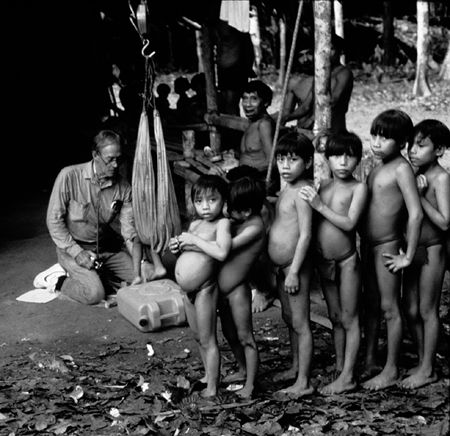
Sibarariwä, sitting in background, behind the line of children, and William Oliver, University of Michigan pediatrician, 1987.
So I decided I would initiate the conversation. I turned in his direction, and called to him: “Father-in-law! I have come to your village to visit you and bring madohe. Is it true that your people are poor and in need of machetes?” I could hear low whispers of excitement around us after I spoke—the very word madohe stirs people. After a while he replied sarcastically: “Yes! We are poor in machetes,” implying that I ought to know better than to ask such a stupid question when I could plainly see that they were poor in machetes.
I remember being surprised by the sound of his voice—it was rather high-pitched for a man of such great renown, sounding almost like the voice of a child or a woman.
Apart from that, his tone of voice did not inspire any warm feelings in me. We chatted halfheartedly for a while. I could tell that things were not going too well and that this old goat was not going to be friendly. I concluded by telling him that I would give him the small cooking pot I had with me and one of my small knives, but that I would bring him a big gift on my next visit. I explained that this visit was primarily to discover if they were friendly and if they were in need of madohe, as the rumors had it.
Sibarariwä’s solemn arrival and cool demeanor threw a cloud of gloom over an otherwise enthusiastic welcome. After a while I decided to ignore him and struck up conversations with people in the other huts.
He and Möawä ignored each other as well. Eventually a modestly large crowd of men was around my hammock again, and the mood reverted to the excitement of mid-afternoon.
I explained to them that I came to see how many people there were in their village and told them I already knew what their names were, and who their wives and children were, but I wanted to see them with my own eyes. I would speak to each of them in the morning and find out what kind of small gift he or she would like me to bring on my next visit.
I showed them my field ledger and where their names were written. They would point to a name and ask me who that was. I would whisper the name into the ear of one of them and he would relate it to the others by some teknonymous or kinship reference, and they would roar with laughter, amazed that my scribbles were their real names.
That night I got my shortwave transistor radio out of my pack and tuned in a news broadcast. They were fascinated by the strange contraption but immediately recognized male and female voices. They insisted on listening to a station with a female voice, and crowded around attentively to hear a woman talking in a language they did not understand. (As I recall, it was a missionary broadcast in Dutch, and I didn’t get much out of it, either.) Every once in a while I would try to find a station more to my liking but they insisted on hearing a female voice. Most of them went home when I turned the radio off, but a few of them hung around just to stare at me—and periodically ask me if I were sleeping yet. They had the annoying habit of waking me to ask if I were sleeping yet.
I fell asleep worrying about what Bäkotawä would do when he got back to the boat. What if he were so frightened that he could not bear to wait for us to come back? What if he took the boat and left us? I decided that I had to go to the river soon and check on him. Thanks to Karina the Mishimishimaböwei-teri already knew about Bäkotawä and insisted on inviting him to the camp, assuring me they would not harm him.
The next morning I began the task of identifying everyone by name, writing a number on their arms with a felt-tip marker to make sure each person had only one name and one identity number. More accurately, I had to associate the names I had learned from Karina and other informants with the faces I could now see in the flesh.
I estimated their ages and identified their spouses if my information was incomplete in this respect. Some of them had gotten married since Karina last lived there. I found out where everyone had been born (the name of the garden and/or village) and where post-pubescent females had their first menses. I had the names of 270 living people in my field ledger, but the camp contained only about eighty people. There had been a recent fight over a woman, and the village had temporarily split into two. I had found only the smaller part. The others were across the mountains on the Shukumöna River, living in another garden. My hosts were mad at them and did not want to take me there. But they were not mad enough to raid them.
I systematically identified everyone on my list, whispering the names into Karina’s ear, who then translated them into kinship circumlocutions so as to avoid as much as possible saying their names aloud.
By ten o’clock I had numbered everyone in the group and the census was as complete as I could make it for the time being. I had also noted after each name the item that person wanted me to bring on my next visit, and they were surprised at the total recall I had when they decided to check me. I simply looked at the number I had written on their arm, looked the number up in my field book, and then told the person precisely what he had requested me to bring for him on my next trip. They enjoyed this, and then they pressed me to mention the names of particular people in the village they would point to. I would look at the number on the arm, look it up in my field book, and whisper his name into someone’s ear. The others would anxiously and eagerly ask if I got it right, and the informant would give an affirmative quick raise of the eyebrows, causing everyone to laugh hysterically: they didn’t even have to have the name mentioned aloud—all that was necessary was to have the person into whose ear I whispered the name confirm it by raising his eyebrows to indicate, “He got it right!”
With this task finished, I had essentially completed the major objective of this first trip and passed the remaining time visiting with my hosts, doing what they wanted me to do—strange and exotic things that nabä are rumored to do.
They wanted me to shoot my shotgun, as they had never seen one before. I had them fill a gourd with water and throw it up into the air and I would blow it to pieces at fifteen yards, splattering water and shattered gourd all over. This really impressed them, especially the loud report of the exploding cartridge.
They wanted to see how strong I was, and we lifted each other, or bent arms to show our muscles, and made other silly displays. They also wanted to show me how close the Mavaca River was to their camp, so we went for a walk to the river. The path we took terminated at a small, shallow rapids. When I asked what it was called, they replied, “It has no name. We just call it ‘the rapids.’ ” They decided, on the spot, to name it for me to commemorate my first visit to them.
By mid-afternoon we were back at the camp, and it was raining hard.
They now knew I had madohe at the boat and were anxious to have it. They badgered me constantly until I agreed to go to the boat to check on the trade goods. This meant, of course, that I had to leave for home because visitors distribute their trade goods immediately before departing.
Most of the adult men decided to come along just to see my boat, but Sibarariwä was not among them. He had quietly left at dawn and returned to the small camp he and a few others had made some distance away, taking the small cooking pot and knife I had given him as gifts.
We left for the canoe about three o’clock, using a much better trail than the one Karina and I had followed to get to their camp. It rained hard all the way, and we traveled at a very fast pace, suspecting that we would not make it to my boat by dark. We intercepted the trail I had come in on about an hour before reaching the river.
There we found spent cartridges every few hundred feet. Bäkotawä had been playing around with the shotgun, probably shooting at everything from tiny birds to strange sounds. There was no telling how many cartridges he had shot before he got to this point, but at the rate we were finding the spent hulls he was probably out of ammunition by the time he reached the boat.
None of the men brought food or their hammocks with them. They apparently planned to take me to the boat, trade bows and arrows for the machetes I had cached there, and return home early the following morning. They would be hungry, but they were too excited to think about food. They could make hammocks from bark strips in a few minutes and would sleep in these makeshift contraptions for the night.
Karina was in the lead, followed by several men and me. The main body followed behind us. About 6:30 P.M . darkness fell, and we had trouble following the trail well before we reached the spot where I left the boat.
My greatest fears were realized. Bäkotawä had taken the boat, motor, trade goods, food—everything.
At first I refused to believe my eyes. Bäkotawä did not know how to run the motor, so why would he want to take the motor? Besides, the motor was not even mounted on the canoe. And why take the trade goods? He knew that the villagers would be furious if I had promised them fifteen machetes and then been unable to deliver them. It was as if he were trying to get me into the most unpleasant of all possible jams. He had not even spent the night there. There was no sign of a temporary hut, no fire, nothing. At first I thought we were at the wrong place, but on close inspection and after Karina insisted, I agreed. I was suddenly very depressed because I knew that I was in a very difficult situation, a possibility that I had been trying to suppress in my mind, but one that I secretly feared would be realized.
The river had come up several feet since we had left the boat three days ago and the spot did not look the same. But our tracks were there. My first suspicion was that Bäkotawä had moved everything across the river and downstream a little to get off the main trail and conceal himself. I fired my shotgun two times, but no reply came. Perhaps he knew I had Shamatari with me and he was too afraid to return my signal.
We made our camp in darkness and in a cold drizzle. I had a piece of nylon tarpaulin with me and draped it over some branches. When the drizzle changed to rain all twenty of my companions huddled and squatted together around my hammock and spent the night in that position, shivering, naked, slumped over, and partially in my hammock.
At dawn I gave Karina my shotgun and two cartridges and a quick lesson in how to fire each chamber. I told him to walk along the river until midday and then fire the cartridges just before he turned back. He was to wait to see if Bäkotawä would reply. Meanwhile, some of the young men were sent back to the garden, some four hours behind us, to fetch food. I spent the morning in my hammock, contemplating my plight and trying to weigh the alternatives in the event that Bäkotawä could not be found. I was almost out of food and had only five or six cartridges left. I could get vegetable food from the Yanomamö in case I had to walk back, but I would have to have them carry it: our packs already contained just about as much as two men would want to transport over that distance—my notes, medicine, food, tape recordings, our hammocks, etc.
My base of operations was due north of us at the confluence of the Mavaca and Orinoco rivers, a fact that I also confirmed with the Mishimishimaböwei-teri. I had no idea how long it might take to walk there from here.
There were two possible ways to walk out. The trail to the northeast would take us to Iwahikoroba-teri, two or three days’ walk from our present location. The Iwahikoroba-teri were uncontacted and, according to the Bisaasi-teri, a very treacherous group. My Mishimishimaböwei-teri companions were not anxious to have me find out where the Iwahikoroba-teri lived, probably because they suspected that I would visit them in the future and bring my madohe there. From Iwahikoroba-teri it was another four or five days’ walk to a new garden made by the Patanowä-teri. I had spent two weeks with them a month earlier, but at their old garden. I knew that if I reached their village I could get some of them to take me to Bisaasi-teri, a further three- or four-day trip.
The arguments against this plan, besides the reluctance of my potential guides to consider going this way, were several. First, the rainy season had now started and most of the jungle was inundated. Many detours would be required and walking would be slow through the swamps. If it were eight or ten days’ walk in the dry season, it could easily become fifteen or more days’ walk in the wet season. Second, my only pair of tennis shoes would not last that long, and my feet were too “soft” to make such a trip barefooted. I never imagined that a Yanomamö guide would abandon me in some unexplored area, steal my canoe and supplies, and leave me to fend for myself. If I could have predicted this I would have packed more tennis shoes! Third, if anyone heard about my plight and tried to find me, I would be too far away from the river to hear them and an embarrassingly large “rescue” operation might develop unnecessarily.
The alternative trail was to the northwest, to Reyaboböwei-teri. It was almost a week’s walk to that village in this weather, according to my companions, and two or three days from there to Bisaasi-teri, depending on how fast you walked. I had made this trip in two and a half difficult days earlier in the year.
All of the above arguments applied against the second alternative, in addition to two further disadvantages. The distance between reliable provisions was greater and there was a war developing between my present hosts and the Reyaboböwei-teri. Wadoshewä, a prominent Mishimishimaböwei-teri man, told me that he had recently visited the Reyaboböwei-teri and was chased out of the village by their headman, Idahiwä, who threatened to kill anyone from Mishimishimaböwei-teri who visited there in the future.
The possibilities of walking out seemed remote at best, and I would consider doing so only as a last resort. I could, after all, live indefinitely with the Mishimishimaböwei-teri if I had to, and I was confident that someone would sooner or later realize I was missing and come looking for me. But I was not sure that anyone among the missionaries knew that I had left to try to contact the people in Sibarariwä’s village and had taken only two Yanomamö guides with me.
While waiting for Karina to return, and convinced that Bäkotawä was gone for good, I had what I thought was a splendid idea: I would make a bark canoe with the help of the Mishimishimaböwei-teri and descend the Mavaca River in that!
Whenever the Yanomamö have feasts they make bark troughs to hold the many gallons of plantain soup consumed at these feasts. The troughs are similar to crude canoes and are occasionally used that way. They are so clumsy and poorly made that they are usually discarded after a single voyage, almost invariably a downstream trip because you can’t paddle them against the current. The bark softens, deteriorates rapidly, and loses its resiliency after a few days. It then collapses like a post-Halloween jack-o’-lantern and rots quickly. But such a canoe would last long enough for me and Karina to make it back to the large dugout canoe I had left downstream.
When I asked my companions to help me find an arapuri tree, the tree whose bark is used for the trough, they insisted that arapuri trees could not be found in this area.
This was depressing news. Making the bark canoe and going downstream in it would have been merely an inconvenience and I was largely viewing my plight as exactly that. Now that I learned that the bark canoe idea was completely out of the question, I began to realize that my situation was likely a bit more serious.
I thought about it for a while and it hit me: I’ll make a log raft! The Yanomamö groups near the Orinoco all know how to make them, and I assumed that the Mishimishimaböwei-teri would also know how to do it. The Mishimishimaböwei-teri knew what I meant when I asked about log rafts but confessed that they had never made one.
Log rafts are simple to make, and I knew that they could do it with a little help. In fact, the palisades they erect around their villages for defensive purposes are essentially vertical log rafts.
We had my single machete to work with and spent most of the morning cutting logs and collecting lianas with which to lash them together. I was not exactly happy about this alternative, since any raft is very clumsy compared to a boat, and Karina was by no means an accomplished gondolier. We would have great problems guiding a log raft through the snags and curves in the river, but it was still a much better option than walking.
I instructed them to cut only light, pithy trees. I helped pick out the trees, measured off the proper length, cut them, and hauled them to the river. My companions took turns chopping with my machete. By midday we had assembled the logs at the river’s edge and were ready to lash them together. My spirits lifted a bit as we tied the logs together with vines. By early afternoon the raft was as wide as I dare let it get and still be navigable. I called the work to a halt.
The Mishimishimaböwei-teri gathered at the bank to witness the test run. I gingerly stepped onto the crude craft—and it promptly sank! It would not even hold my weight, let alone mine plus Karina’s. My companions tried hard to look concerned and disappointed, but many of them turned their faces so I could not see their grins.
I went back to my hammock to wait for Karina to return and thought once again about walking out. I wondered out loud: perhaps we could make it back to the spot where we had left the large canoe, which I calculated to be about halfway between our camp and Bisaasi-teri. But we would have to follow the river for the greater part of the way in order to be sure that we did not inadvertently pass by the canoe without seeing it. The major argument against this plan was that I could not predict Bäkotawä’s behavior: since he took with him virtually everything I left at the river, there was little reason to believe that he would pass the big canoe by without also appropriating that as well.
Later in the afternoon Karina and his companions returned silently to the camp and flopped into their hammocks. They eventually explained that they had walked all day, reaching the spot where Karina, Bäkotawä, and I had made our last camp. Karina told all of us that not only was Bäkotawä not there, but he had even stopped there to collect the empty gasoline tank we left behind! Karina had fired the shotgun twice but Bäkotawä had not returned the signal.
The rest of the Mishimishimaböwei-teri learned of my situation and people began streaming into our camp all day long, bringing food and hammocks. A more substantial camp gradually took form. All the huts were covered with kedeba leaves to keep the rain out. At least everyone would be dry, fed, and rested.
While I was lying in my hammock contemplating my situation, one of the men confronted me with the following proposition. He was very logical and began his argument as follows:
“You are a nabä. Don’t nabäs know how to make canoes?”
“Yes,” I replied, adding, “but I don’t have the right tools to make a canoe. You need axes to make canoes and Bäkotawä took my axes.”
He then excitedly exclaimed: “We have two axes back at the village! We could use these to make a canoe!”
My spirits lifted once again. I told him that if he would send for the axes and help me hollow out a tree, we could make a canoe. In fact, I was the best damned canoe-making foreigner they would ever meet!
Several young men were immediately dispatched back to the village to fetch the axes and more bananas. They must have run all the way to the village and back, for they returned a few hours after dark. They covered the round-trip distance in about six hours, almost the time that it took Karina and me to walk it just one way! While they were gone we went looking for a suitable canoe tree.
The Ye’kwana Indians, who live just north of the Yanomamö, are superb dugout canoe makers. The Yanomamö do not know how to make canoes—they live in the interior and avoid larger rivers, so they don’t need canoes. The Ye’kwana are a “river people” and the Yanomamö a “foot people”—a standard ethnographic classification for Amazon Basin tribes.
I knew what kinds of trees the Ye’kwana used for canoes but had no idea how to identify them in a forest or whether this was the kind of forest where such trees were found. I decided that the safest bet would be to ask the Mishimishimaböwei-teri to find a tree about “this big around” (about thirty inches in diameter) that was pithy on the inside; it would be easer for us to hollow it out if it were pithy. They soon found one that they claimed had pithy characteristics. We marked it and would return to fell it when the axes arrived.
We all retired that night in much better spirits, listening to female voices on my shortwave transistor radio, munching on roasted plantains and boiled rasha fruits that the women had brought to us.
We began working on the tree about eight in the morning. The axes were so badly worn and dull that progress was quite slow. These axes had been traded inland to the Mishimishimaböwei-teri after having been used by many previous owners until they were nearly worn out and had been reduced to only half their original size.
The good news was that the tree indeed was pithy in the center, a factor that contributed as much to our progress as the axes did.
I measured off the length I thought would be sufficient to carry Karina and me—about twelve feet—and we cut off the trunk at that point. Next I scratched an outline of the area we were to hollow out and we set about removing the pith.
It was hot and humid, and we soon were puffing and sweating profusely. The men were in excellent spirits and cooperated happily, making a game out of the project. I was delighted with their enthusiasm, but I had to watch them diligently since, in their enthusiasm, they chopped recklessly, making the canoe too thin at spots.
By early afternoon it was taking shape. It resembled a giant cigar with a deep gouge cut out of its center, but it looked as though it might float. I decided that I did not know enough about canoe making to attempt to spread it open with heat, as the Ye’kwana do. This would have made it flatter on the bottom and therefore less likely to roll over, but flattening it with fire would risk splitting the log in half.
At about 2 P.M. I concluded that any further effort to make it thinner with the axes and machete would risk splitting the log in two. There were already several serious cracks appearing in the bottom. To correct this we had to wrap vines tightly around the ends of the log.
We dragged it to the river, some hundred yards away, where we planned to test its seaworthiness. I was a little worried that the canoe would be like the raft—buoyant enough to float by itself, but not buoyant enough to hold me and Karina.
We had gotten almost to the river when the lead man spotted a tree with honey in it and the work came to an immediate halt. There is nothing that will excite the Yanomamö more than a cache of honey, and they immediately set about smoking the bees out of the nest and digging the sweet liquid out of it with sticks and leaves. A crude basket was made from leaves and the honey was put into it and mixed with water. The Yanomamö are not very particular about what gets into their mead. They end up with a brew that is about 5 percent honey, 80 percent water, and 15 percent debris consisting of half-dead bees, wiggling larvae, leaves, honeycomb, and dirt. It is consumed with great gusto, the container being passed from hand to hand, each man taking a deep draught before having it snatched by the next man. They usually blow most of the debris off the surface and drink under it, using their lips like shallow straws.
As luck would have it the honey tree was right next to the spot where we planned to launch the canoe. Most honeybees in this area are stingless, but these were not. Soon the canoe and the riverbank were covered with groggy insects that attacked us furiously, but the men didn’t seem to mind. They just swatted their ankles and dipped larva-filled honeycombs into the mead and munched on them. The bees were too much of a nuisance for us to do much more work on the canoe that afternoon.
I wanted to see if the canoe would float and so cautiously put it into the river. To everyone’s delight—especially mine—it stayed on top of the water. However, like any round log, it promptly rolled over. We even tested it with one man inside while the others held it to keep it from rolling. I breathed easily for the first time: it still floated.
I managed to talk a few of the more enthusiastic workers into cutting two long poles for an outrigger, and to find one of the buoyant trees we used earlier for the raft. I cut two pairs of notches on each gunwale and tightly lashed in the outrigger poles with vines across the canoe. Then we lashed the outrigger log to the end of these outrigger poles and tried the canoe once again. This time it remained afloat without rolling over, but the outrigger log was not very buoyant and would sink if too much weight was put on that side of the canoe. I called for a volunteer to find a more buoyant log. But by this time my companions were understandably tired of raft and canoe manufacturing and insisted that there was not a more buoyant log in the jungle.
I had difficulty talking them into helping me make canoe paddles, but some of the older men volunteered to help me and ordered a few young men to join in. That night we whittled three crude paddles by the dancing firelight, one being a reject that had been thinned too much on the handle. I decided to take it along anyway as a spare.
I listened to the mission broadcasts in the morning, but still no word about Bäkotawä or any evidence that the missionaries were aware that I was missing. Bäkotawä had been on the river for over four days by now.
We went to the new canoe, which was moored with vines a few hundred feet below our camp. We carried the packs to it, including a number of bamboo arrow point cases (toras ), bows, and arrows for which I had traded some small knives with the Yanomamö.
The bees had regained their strength overnight and inflicted revenge on us for robbing the honey. Karina wanted to be the first to try the canoe, an honor I conceded to him without argument. One of the men swam the short stretch across the Mavaca with the long vine that was tied to the canoe. Karina got in with one of the paddles and the man pulled him out into the river and across by the vine. Trying unsuccessfully to look like an expert boatman, he paddled the clumsy log with his equally clumsy paddle. From the difficulty he had keeping his balance in the canoe I could tell that this was going to be a very challenging trip.
Karina weighed about seventy pounds and the canoe was just barely afloat. I weighed more than twice as much, and our gear—not counting the bows and arrows I obtained in trading—probably accounted for another fifty pounds. With some difficulty Karina managed to maneuver the canoe back to port, and we carefully loaded the equipment in, tying everything down with vines, including my shotgun.
The cracks that I noticed yesterday were worse, and my friends tried to caulk them with mud. I managed to convince them that mud would quickly wash out and gave them one of my shirts to tear up and use as caulking. The repairs took just a few minutes and seemed to be temporarily adequate.
The moment of truth was now upon us: would it keep us afloat? I bade my companions good-bye and told them I would be back in the following dry season with many trade goods to repay their kindness. They assured me that they would reunite with the others who had separated from them and rebuild the shabono at the spot where the old one was burned down. I instructed Karina to sit in front and to exercise great caution when paddling: the canoe was very unstable. I then climbed into the back.
Much to my disappointment I discovered that the water came to within a half inch of the gunwales. We were floating, but just barely. Then Karina took one small dip with his paddle, shifting his weight over so slightly from center. The left gunwale dropped below water level—and we sank instantly, not having gotten one foot offshore. Everything got soaked except the few items—cameras, lenses, tape recorder, film, field notes, etc.—that I had put into a waterproof rubber bag. We frantically tried to grab the packs before they went under, but it was too late. The canoe slowly sank and settled on the bottom; only our heads were above water. We must have looked very stupid indeed.
Again, our friends turned their faces to conceal their grins. But it was funny, and I had to laugh, too.
We dragged the canoe out to the bank again, bailed it out, unpacked everything, and resorted it. The toras full of curare arrow points were the first to go. Möawä ordered a number of young men to make a small hut across the river in which I could store the items I would leave behind. I took only those items that were absolutely essential for survival and those that had scientific value, keeping my field notes and leaving behind things like antivenin for snake bites. The Mishimishimaböwei-teri transported the excess equipment to the other side of the river, using the canoe as a ferry. They were wise enough to swim alongside the canoe rather than try to ride in it.
After reloading the canoe, we went through the motions of farewell one more time, but this time only halfheartedly. We all expected that the canoe would capsize as soon as we got into the current and we’d have to bail it out again.
Karina and I climbed into the canoe for the second time. The water came to within two inches of the gunwales and my hopes revived slightly: we were a whole inch and a half higher than before!
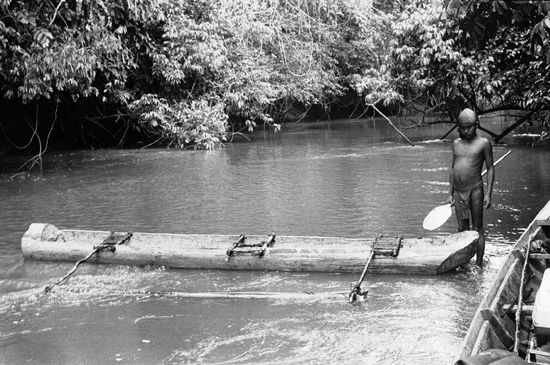
My hand-hewn canoe, Karina standing next to it after we reached our camp downstream and our second canoe.
The canoe was in a shallow backwater adjacent to a sharp bend in the river. There were several large logs blocking the way, but we pushed off into the current anyway—and promptly got hung up in the snags and again sank instantly. Fortunately, we were able to stand on a sunken log and refloat the canoe while the others chopped the logs out of our way. I could tell that paddling was going to be almost out of the question: Karina was too clumsy. Each time he took a stroke, he leaned way over, and the water rushed into the canoe. While we were waiting for the Shamatari to clear this deadfall, I asked one of them to cut us two long poles.
I tied the paddles down with vines and bailed the canoe with a gourd, which its friendly former owner had suggested I might find useful for this purpose and presented to me as a farewell token. I tied that down, too.
We climbed into the canoe again and were immediately caught up in the current. We were so precariously balanced that we couldn’t turn around to wave farewell to our companions. We were off in the swift current and our friends disappeared from sight when we rounded the first bend.
I do not know how many times we swamped that first day. I had no idea that a boy so small could be so inept and so clumsy. Each time he moved his weight he caused the canoe to ship water. But, instead of trying to rebalance the canoe or jumping out when he saw that we were sinking, he froze up, hung on for dear life, and sank both of us with the canoe. Had he jumped over the side, as I was doing when water started coming in, the canoe would have continued to remain afloat and we could have bailed it out with no problem before it filled up and sank.
It turns out that there may have been a logical reason for Karina’s reluctance to jump out of the canoe into the river. He explained to me earlier that he was afraid of yahediba —electric eels. I insisted that there were none, like there were no raharas, and urged him, whenever the canoe started to swamp, to jump out to keep the canoe from going under.
About midday, as we were bailing out after one of our mishaps, I stepped on a log beneath which was hiding an electric eel. I didn’t know what hit me, but I felt a sharp pain in my leg and was knocked flat on my back from the jolt. When I got to my feet I saw the eel swim slowly into deeper water. The electric shock was remarkably strong—strong enough to knock me down. And so I forgave Karina under my breath.
My outrigger was a good idea but had one built-in disadvantage: it acted as a snag-catcher and caused us to sink many times. We invariably capsized whenever it got caught on a snag, which would hold us fixed to some tree branch. The current was strong enough to turn us sideways in the river; the water would then rush over the edge of the canoe and swamp us.
Sharp bends were a problem, too. Unless we managed to keep to the inside of the bend, the current would force us against the bank on the opposite side. When the outrigger touched the bank we would go under again—in the deepest water. It is a hopeless feeling to see a sharp bend ahead of you and try to delicately pole such a clumsy canoe to the inside of the curve. The immediate reaction is to pole harder, but when you do, your weight shifts just enough to cause you to ship water. Once water starts coming over the edge, you almost always swamp and sink.
The natural hazards were not nearly so frustrating as the one sitting in the canoe with me. Yanomamö are not river people, and if Karina may be taken as a typical example, they might have gone extinct had they opted for canoes instead of foot travel. By the end of the first day of travel Karina still did not know which side he had to pole on to make the canoe go to the left or right. By the time it was dark that first day I was so hoarse from screaming “to the left,” “to the right,” and so on, that I could barely talk. He would sulk conspicuously but then turn away as an uncontrollable smile lit his face, a soaking wet Indian dwarfed by the undershirt I had given to him. I had to choke down an occasional smile myself.
It rained most of the day, and the river was rising quickly. Most of the exposed sandy spits and sandbars were now underwater. We had to be careful to make our camp that night well above the current water level, for the river could rise as much as five or six feet overnight and carry away our camp and any equipment that wasn’t stashed in the canoe, which I carefully lashed to a stout tree on the riverbank.
When it came time to cook our rice for supper, another unfortunate realization hit me. I had been conserving the rice for the trip home and had not eaten any since the evening before contacting the village. But, I had given my only cooking pot to Sibarariwä! There we were—no pot to cook our only food in. Fortunately, I had stored our rice in a small powdered milk tin, so we could at least use that as a makeshift pot. It was nothing but luck that I had given Bäkotawä his share of the rice in a plastic bag. We would have gotten pretty hungry had I kept the plastic bag and given Bäkotawä the tin.
Our hammocks and clothing were soaked, and it was uncomfortable even to be in them. But the fire soon warmed us up and the steaming hot rice drove the shivers away. The thing that really picked up our spirits was the evening broadcast from the New Tribes Mission reporting that Bäkotawä had arrived in Bisaasi-teri late that afternoon and that he had apparently abandoned me and Karina in the Mavaca headwaters. So, at least I knew that someone was aware that I was missing. The mission also reported, for my benefit in case I could hear it, that Bäkotawä had lost much of my equipment but did save the motor and dragged it out of the river onto a bank somewhere. They also mentioned that when he got to about an hour above Bisaasi-teri, he unloaded all my axes, machetes, and cooking pots and hid them in the jungle “because they were heavy” and he was tired of paddling their dead weight. He had paddled them four and a half days and decided, one hour away from his destination, that they were too heavy for the canoe to transport or for him to paddle their weight?
I decided that it was best to push on the next day. It might be some time before help came and we were getting low on food. Our fire went out during the night and at dawn we woke up shivering, cold and still wet. We ate the leftover rice, packed the radio and hammocks, and pushed off once again.
The river was broader and deeper now, and our poles were only marginally useful. It was not long before we had to abandon them entirely—we could no longer touch the bottom with them. When we switched to our paddles we had a rapid series of misfortunes. We had gotten fairly efficient with the poles and could keep from tipping the canoe after some practice, but the paddles required more exertion, and as a result we capsized several times before we could get the hang of it again. Then we lost our spare paddle on one of our sinkings. Later in the day we got snagged in an overhanging tree and capsized again, losing another paddle. At about three o’clock that afternoon, shortly after losing the second paddle, we reached the big canoe and were immensely relieved that it was still there. Even the nest of cooking pots I had left in the canoe was still there, so we could now cook a meal larger than a cupful.
I had hoped that Bäkotawä would have put the motor in the big canoe as he went by, but he had discarded it somewhere upstream from here. We transferred our equipment to the big canoe and cut more poles for pushing.
The river was now very deep, but the poles enabled us to keep away from the banks and overhanging brush, keeping the bugs from falling onto us as they had been doing for the past two days. Our single paddle was too short and the blade too small to be of much help in the big canoe. We were thus largely at the mercy of the current. I remembered that our original first camp was only about two hours downstream by motor from the big canoe. I had hoped we could reach it by nightfall because if help did come, they would probably camp there at the end of their first day. It was one of those inviting camping places—well above the normal river elevation and with a wide, appealing, sandy beach.
Now that we were in the big canoe, we could stand up, walk around, and in general, revert to our old, clumsy ways. More important, we could unlash the shotgun and shoot game for supper.
I had not looked at the shotgun for almost three days. I had tied it under my seat and it had spent much of the past three days underwater. The barrels were badly rusted and the breech opened with considerable difficulty. I loaded it and kept it handy. Before long we floated past a relatively large caiman, which I killed with one shot.
Caiman meat is pretty grim fare. Its white, firm flesh looks like boiled lobster and it even slightly resembles lobster in taste. But caiman is as tough as shoe leather, no matter how you cook it. However, we were both pretty hungry for meat at that point, and the thought of even a piece of roasted caiman made our mouths water. The Yanomamö eat a lot of caiman meat, since the animals are found in even tiny streams.
By nightfall we could see that we were not going to reach our earlier campsite, so we made camp at the mouth of a small creek. I shot another, smaller caiman, so we had plenty of meat for the remainder of the trip. The last few hours with the big canoe convinced me that we would have to whittle another paddle before going on in the morning. The canoe was just too heavy to control with our single small paddle or with our poles.
We were now at a point on the Mavaca where we could make it all the way back to Bisaasi-teri in about twenty-four hours of continuous floating. From here on the river was broad, and all we had to do was keep the canoe in the middle of the stream and the current would do the rest.
We boiled rice and roasted more of the caiman for supper. We were both dog-tired and fell asleep as soon as we finished eating. And, at last, we were finally dry.
The next morning I learned by radio that one of the New Tribes missionaries and a Ye’kwana Indian were planning to come up to look for us right away. The radio message also gave the approximate location of the spot where Bäkotawä had put my motor. We had already gone past it and would have to go back upstream to get it when the missionary got here. We decided that it was better to remain in our camp all day, since we had to go back upstream to find my motor anyway.
We spent the day lying in our hammocks. I was not feeling very well and needed some rest. My numerous scratches and insect bites were infected and the fungus on my groin was flaring again. The combination of starchy food, tropical fungi, and hard work was wearing me down physically.
We came to life when we heard the soft humming of wild turkeys in the jungle behind us. Karina went ahead of me and quickly pointed one out. I shot it and ran on to see if there were more. Karina was still ahead of me, excitedly pointing out another bird. I was down to my last cartridge. When I closed the badly rusted breech the chamber fired accidentally: the firing pin had rusted so badly that it did not retract when I opened the breech after the previous shot.
Karina stood there in shock, gaping at me as a three-inch sapling toppled over—just a few feet from his head. I had almost shot him. I was very badly rattled from this experience.
By late afternoon we had forgotten about the close call and were waiting for the turkey and rice to cook. We dined in great comfort and style that evening, although we were both disappointed that the boat had not reached us. Perhaps we were farther upstream from my old campsite than I thought.
By nine o’clock that night we were convinced that the boat would not reach us until the next day, so we went to sleep. But a shotgun blast just a few feet from our hammocks got us to our feet in a second: it was the Ye’kwana Indian named Antonio, and Rerebawä, my Bisaasi-teri friend. They had made it to my old camp and were out hunting for their supper. They were unaware that Karina and I were sleeping just a few feet above the caiman they had just shot, and our shouts to them were as startling as their shotgun blast was for us. They paddled over to us, and Rerebawä and I hugged each other happily. He was nearly convinced that the Shamatari had killed me and was relieved to see me alive and well. He told me that he would never let me go on another trip without him, despite the dangers to which he might be exposed. Karina begged half of Rerebawä’s wad of chewing tobacco and collapsed back into his hammock, sighing. “I nearly died of poverty!” he exclaimed as he lay in his hammock, contentedly sucking on the used wad of tobacco.
I was so delighted to see the “rescue” team that I presented Antonio and Rerebawä with my cooking pot of boiled pajui : turkey and rice. They took it back to their own camp, a few minutes downstream, to share with the missionary. As it turned out, I had as much food as they! They had left in such a hurry that they brought only enough manioc flour to last them one day, plus the shotgun I had loaned to Bäkotawä. Had I remained upstream, they would have gotten pretty hungry within the next day, especially if I had remained in the village. They could have eaten caiman or turkeys for a long time, but meat without vegetable food is not very satisfying. I fell asleep thinking about the Yanomamö verbs that describe eating, particularly the verb dehiaö: “to eat a bite of meat and then a bite of vegetable food and chew both together and swallow them.” Their language captures so many interesting and fundamental aspects of life.
The next morning at dawn they returned the empty cooking pot, and we left to collect the equipment I had left behind and to look for my motor. We found the motor late that morning. It was in poor condition from being submerged in the river several times. Both cylinders were full of water. We worked for about an hour before we got all the water out. In attempting to start it we accidentally set it on fire, but we put the fire out before too much damage was done to the wiring. It finally started, and we were on our way again.
We were able to travel at full throttle most of the way up to the cache of equipment I left behind where Karina and I had launched our hand-hewn dugout canoe. By dusk we had found the cache, turned around, and were on our way back home. The river was now full enough that we could safely travel by the motor at night.
When we reached the spot where we met our rescue team, Karina and I transferred my motor over to the large dugout and we came the rest of the way down to Mavaca—and home—by ourselves.
Thus, in the wet season of 1968 I came to visit and begin to know the people of Mishimishimaböwei-teri, who were located in a distant place that was difficult to reach. With the passing years I visited them many times and got to know them even better and grew very fond of almost all of them. But there was one man that I never grew fond of, indeed, I grew to dislike intensely. That was Möawa. He would later try to kill me.
6
Geography Lesson
Maps of the Yanomamö Region in the 1960s
I first reached the Yanomamö area by boat, which was, at that time, the only way of getting there. There were no airstrips closer than Esmeralda, and that one was just an unimproved dirt strip and too wet to land on for some six months of the year.
I could not have picked a location in the Western Hemisphere that was more poorly mapped in the mid-1960s than southern Venezuela and adjacent portions of northern Brazil.
I sought and got copies of the standard maps that were publicly available from sources like the major encyclopedias, government mapping services in both the United States and Venezuela, and the authoritative National Geographic Society in Washington, D.C.
Most of the maps I assembled from these various sources generally agreed on major items such as geopolitical boundaries, large rivers, general terrain, and large cities. But the devil must have been in charge of many important details because either these were not found on the maps or no two maps agreed on them. Most depressing were the cases where they were wrong on all maps regarding key features of T. F. Amazonas in Venezuela.
One of the major problems was that I never saw this area from an airplane and had only a vague notion of elevation differences. I knew the eastern border of southern Venezuela adjacent to Brazil was a chain of low mountains called Sierra Parima. Because of the way I entered the area and the way I traveled—by dugout canoe—I could canoe right by a mountain and not even realize it was there. From a canoe in a relatively narrow river, you can’t see beyond the immediate treetops on either side.
Consequently I had the naïve impression that the Yanomamö area was basically a flat, featureless, low-lying jungle, except for the Parima Mountains.
The largest river in Venezuela is the Orinoco—one of the world’s major rivers—whose largely unknown (in the mid-1960s) upper reaches lay in the heart of the Yanomamö tribal distribution. One of the sizable tributaries of the Upper Orinoco is the Mavaca River, the southernmost of the major Orinoco tributaries. It was here at the confluence of the Mavaca and Orinoco that I made my “base camp”—my mud hut—and from this citadel I would intrepidly make the Yanomamö known to anthropology and the world at large.
The mouth of the Mavaca River was accurately represented on all the maps. But when I began making trips up the Mavaca or walking inland to hunt game with the Yanomamö, I suspected that something was wrong with my maps. At first I could easily ignore my suspicions so long as I didn’t wander too far inland or ascend smaller streams in my canoe. But the more I traveled and visited isolated Yanomamö villages and tried to map them, the harder it was to ignore my suspicions: either the Yanomamö didn’t know where they lived—a preposterous idea—or the best maps were dead wrong.
For example, the National Geographic Society map indicated that the Orinoco River split into two streams in the Yanomamö area. One of the streams flowed northward through the heartland of Venezuela, turned to the east, increased in size, and then flowed into the Atlantic Ocean near Trinidad. But the other stream turned to the south and was named the Casiquiare Canal. After winding and snaking its way some 250 miles, it joined the Rio Negro—a large tributary of the Amazon River.
This meant that most of Venezuela, Guyana, Suriname, French Guiana, and the northeastern portion of the Brazilian Amazon—the entire northeastern portion of South America—was technically a very large island. One could enter the Orinoco River at its mouth from the Atlantic Ocean and canoe all the way to the Amazon River, to emerge again in the Atlantic Ocean again near the Brazilian city of Belém.
Even more astonishing was the fact, shown in very small print on the National Geographic Society map, that the Casiquiare Canal changed directions every season: in the wet season it flowed in one direction, but in the dry season it flowed in the opposite direction. I found that alleged fact preposterous.
But, nevertheless, I had to check it out. Who knows what wonders the earth conceals? You can’t imagine how stupid I must have seemed to the local Ye’kwana Indians, the few local Venezuelan creoles, and the Yanomamö whom I repeatedly asked, in all sincerity, “Does the Casiquiare change directions in the wet season?” The polite ones pretended they didn’t understand such a stupid question; those who did understand it would sarcastically say things like “Of course! And at other times of the year it goes straight up—into the sky!” and turn their faces to conceal their cynical grins.
An even bigger problem for me was that all of the most authoritative maps showed the Mavaca River headwaters originating near the Orinoco headwaters, flowing to the west, then gradually changing directions and flowing almost due north until it joined the Orinoco.
The Yanomamö insisted otherwise: they invariably told me (by pointing when I asked) that the Mavaca’s headwaters were due south of my mud hut at the mouth of the river.
Thus I had to figure out a way to determine where the several villages south of the Orinoco—which meant all of the then-known Shamatari villages—were located on my map, and, more important, where they were located with respect to each other and with respect to my base camp at the mouth of the Mavaca.
My Initial Mapmaking Efforts
Astonishing as this sounds, I had to try to make my own maps of this area and ignore the published maps. Satellite imagery, GPS instruments, and Google Earth were yet some thirty years into the future.
I had worked my way through Michigan’s undergraduate program as a college-trained route surveyor, initially for the state and later for a private road construction company. This background turned out to be very useful in my efforts to make reasonably accurate field maps.
There were a number of reasons why accurate maps were important—and even central—to my work. No existing map of the day showed the locations of any Yanomamö village in either Venezuela or Brazil and yet there were more than two hundred fifty such villages. Minimally, I had to know how to map the locations of those villages that were important in my fieldwork.
While there were Yanomamö villages at the mouth of the Ocamo and the mouth of the Mavaca, not even these Yanomamö villages were shown on any maps, nor were the Catholic or evangelical missions found on the maps. One had to go there in person to know that there were any human beings there at all.
Since these river junctures—where the Ocamo and Mavaca rivers joined the Orinoco—were accurately shown on all maps, it was easy to indicate on the same maps the names of the Yanomamö villages located there. The Yanomamö village at the mouth of the Ocamo was called lyäwei-teri and the village at the mouth of the Mavaca was called Bisaasi-teri, as I have mentioned.
There were a few other Yanomamö villages located on or near the Orinoco. Once I had canoed up and down the local stretch of the river I could more or less accurately locate them on a map. I would guess that they were, for example, “about halfway by canoe between Ocamo and Mavaca,” and so forth.
Inland Areas Away from the Rivers
One of the villages I discussed earlier was Patanowä-teri, the group from whom the seven women were abducted on the first day I was in the field. I visited them at their inland location several times during my first year of fieldwork. This involved taking a trip up the Orinoco in my dugout canoe, portaging around a rapids known as Raudal Guaharibo (shown on some maps), and proceeding upstream several more hours to the mouth of a tiny stream known as Shanishani kä u (rarely shown on any maps and never with the Yanomamö name). The men who worked for the Malarialogía called it Caño Bocon after a fish by that name that was commonly found there. I pulled my canoe into the mouth of this small river and secured it to a tree with a rope. Then I would call my guides over to determine how far away and in what directions various villages and abandoned gardens were, especially, on the initial trip, where Patanowä-teri was.
One of my favorite traveling companions was Rerebawä—the man who helped me learn the Yanomamö language. I would take out my handheld surveyor’s compass and ask him to point to the direction of the Patanowä-teri village. Then I would write down the magnetic bearing from the point where I was standing to the village. I would then ask him to tell me how far away the village was, as well as other abandoned gardens and village sites used in the recent past by the Patanowä-teri. He knew this village well, having gone there frequently with Bisaasi-teri visitors.
The Yanomamö express distance by the number of “sleeps” it takes to get somewhere. If a place can be reached without sleeping, they point to where the sun comes up and describe an arc with a slow sweep of their arm and stop where the sun would be when they reached their destination. If the sun is straight up, one would reach it by midday, around noon. Since they begin traveling as soon as there is enough light to see, that would mean about five or six hours of travel. But there is a lot of inaccuracy in this measuring system. For example, midday might be anytime from 10:30 A.M. to 1:30 P.M. Or if the trail is wet and crisscrosses small streams and rivers, travel takes extra time. If the Yanomamö run into a game animal and chase after it, that also adds to the travel time. But by and large, they tended to give average travel times based on a large number of trips to that village. After I made the trip myself, I would know how long it took to get from place A to place B under normal circumstances.
But when you ask about distant villages that you will probably never walk to, you have to rely on what your informant(s) tell you about distances in sleeps. Sometimes the village is so far away that the informant would sit down in order to use his toes to supplement his fingers to indicate that it is “more than twenty sleeps” away. However, the Yanomamö cannot count accurately beyond 2. They do not have “numbers” for anything larger than 2. So, when they have to sit down to express a long distance by using their toes, it could be a long way away or it might be a shorter distance away, but they don’t want to take you there because they don’t like the people there or don’t trust them, or they don’t want you to give them your valuable trade items that they themselves covet.
I would also ask my guides to point to locations that I knew well just to check on the accuracy of their spatial awareness. I was always stunned by how accurate their pointing was over even very large distances. For example, I once took Rerebawä to Caracas, more than five hundred air miles away, and then later asked him to point to Caracas when we got back to his village. Without hesitation he pointed accurately in the correct direction.
On the many hunting trips I took with the Yanomamö—sometimes in areas they had never been in before—they would rarely get lost. If we shot some kind of game animal early in the day and they didn’t want to carry it all day, they would conceal it in some thicket or high tree branch and we would then hunt for five or six more hours. When it was time to return to our camp, they would walk directly to where the dead animal was concealed, retrieve it, and take it back to our camp. Their sense of direction and ability to navigate in otherwise unexplored jungle is nothing short of phenomenal. I’d be willing to bet that I could take a Yanomamö man into the heart of the Congo in Africa and he would be as skilled as any Congo native at finding his way around after just a few days and a few trips in the local jungle.
There were other reasons I needed accurate maps. One was that a large portion of the history of each individual and of each community was remembered by them in terms of where they lived at particular times in their lives. Thus geographical space, not time, seemed to be their calendar.
There is a branch of human theoretical biology that deals with “life histories” and much of the data I wanted was of this kind. This is nongeographical data that covers significant biological life events, such as birth, puberty, marriage, child-bearing, death, etc. Place of birth, places where females had their first menses, places where people died, were the things I learned to ask about when I took my censuses. The Yanomamö are extraordinarily aware of specific geographical locations where important things happened to them as individuals and as members of some group. I realized this early in my fieldwork and began recording in my notes every reference they made to geographical locations, which were always named: old gardens or earlier villages, waterfalls, specific hills, etc. Thus, in the absence of an accurate time scale, I used what they used: a geographical framework to relate to others the significant events in their lives. In their scheme the significant life-historical events for every individual were associated with specific locations.
When I inquired about group locations like old villages and tried to get the histories of where they originated, where they moved to after abandoning gardens, where they split into two or more groups, etc., these histories were always expressed as places and the sequence of “placed events” was usually confirmed by informants from other villages. Geography was central to the lives of the Yanomamö in a way that time was not.
Hunting, Traveling, and Camping with the Yanomamö
During my first year in the field I spent a lot of my time learning about the life-historical events in the personal histories of every Yanomamö I met—as well as the personal histories of their living and deceased ancestors. When I wasn’t at Mavaca, I was traveling with groups of hunters, or groups of young men going to some distant village, or groups of people on waiyumö —extended camping trips that could last several days or several weeks. But I was always recording or writing things into my notebooks about people and places and documenting what people were doing while we traveled.
On one trip with the Bisaasi-teri we were camped about a day south of the village, hunting game and collecting seasonal palm fruits. Kaobawä, the headman, ran across some obo (armadillo) dens that were fresh. There was a cluster of small flying insects hovering around the entrance hole. When I asked about the insects, they said something like, “You wouldn’t understand this.” They assumed that I would not be able to understand the notion of specific parasites that are attracted to certain animals and how the Yanomamö use this information to decide that the animal is at home in the burrow. The specific flying insects are always present when there are armadillos in a den, so the Yanomamö do not waste their time digging up what looks like a fresh burrow if these insects are not flying around the entrance.
The Yanomamö were excited at the prospect of fresh meat for dinner. Several young men scurried around to find old termite nests. The brittle, dry termite nest material gives off dense clouds of smoke when set on fire, and it burns and smolders for a long time. They stuffed the burrow entrance with the material, lit it, and then looked around the nearby jungle. After a while the other entrances to the underground burrow began giving off smoke. They quickly plugged up these entrances with dirt to keep the smoke inside the burrow and proceeded to crawl on their hands and knees between the burrow entrances with their ears to the ground, listening for armadillo movements. They put little sticks in the ground each time they heard noises, which would give them a general idea of where the armadillo was. Eventually the smoke would asphyxiate the animal and it would die underground.
The little sticks used to mark the approximate place they heard the last armadillos burrowing noise belowground was not necessarily the exact place where the animal died. It might have moved back or forward from the last spot that they detected its noise. So, to determine the exact spot to dig down into the dense clay to the burrow, they cut a long vine from a nearby tree. They then tied a knot at the end of the vine and began spinning the vine into the burrow entrance with their palms after removing the smoldering termite nest materials. They slowly spun the vine—knot first—into the long burrow: the knot, as it thumped against the sides of the burrow, was audible to the Yanomamö, whose ears were pressed to the ground, following it as it inched along. When it would go no further, they marked the place on the vine where the mouth of the burrow was and withdrew the long vine. They laid the vine on the ground along the general axis of the subterranean burrow, following the sticks that stuck out of the ground. The knot told them where to start digging into the dense clay. Using their bow staves, they dug into the ground some eighteen inches to two feet and hit the armadillo on the first try and dragged him by the tail out of the den. They found several more by the same techniques that afternoon.
The Yanomamö gutted the armadillos and placed them onto a babracot —a small platform made from sticks about three feet above the campfire. There the armadillos smoked and slowly roasted for several hours.
I had never eaten armadillo before. I found smoked armadillo to be delicious; tender and succulent. Later that year I spent the night at Padre Cocco’s mission and joined him in a delicious meal of something I couldn’t identify. The nuns had prepared it in a light cream sauce, maybe with some wine. After dinner I asked him what kind of meat we had just eaten. Cachicama, armadillo. It was even more delicious than the smoked version I had shared with the Yanomamö.
Spider monkey (basho ) hunting is one of the most rigorous activities I engaged in while living with the Yanomamö. This species is the largest monkey they hunt—and a very desirable game animal. Basho travel through the jungle canopy at amazing speeds, so the hunters must be constantly on the run to keep up with them. I always hoped that we would not run into a troupe of bashos when I traveled in the jungle with the Yanomamö because if we did, the Yanomamö would shout at me, urging me to keep up with the monkeys so I could shoot some of them with my shotgun. The Yanomamö used curare arrow points, which would usually break off inside the monkey, then slowly paralyze and eventually kill it.
The points are made from a pencil-like piece of thin palm wood about a foot long. The points are weakened every few inches by transverse cuts made from a steel knife or machete so they will break and lodge in the animal. About a dozen of the points are stuck into a tight bundle of leaves and propped over a bed of glowing wood embers. They are then painted with multiple coats of thin curare liquid while positioned over the bed of glowing coals until the curare thickens and becomes sticky. The curare itself is derived from plants that grow in the Yanomamö homeland.
Three other species of monkey are also hunted for their meat: the red howler monkey (iro ), the black monkey (wisha ), and the capuchin monkey (howashi ). These species are not as difficult to hunt because they tend to stay in the same group of trees and do not flee like the spider monkeys. The Yanomamö frequently keep young capuchin monkeys as pets and let them roam around the shabonos at will. They are very mischievous and pesky and seemed to perceive that I was a stranger. They usually focused their attentions on me—swatting me on the head as I passed under the pole they were sitting on, and then scurrying just out of range to watch me. When I turned away they would quickly come back and swat me again.
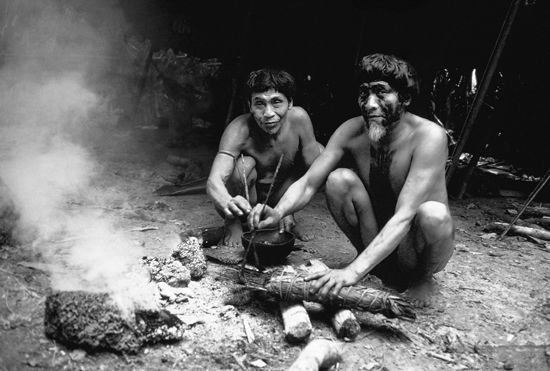
Dedeheiwä (right) painting curare on palmwood tips.
The tail of the black monkey has an important ceremonial use. The Yanomamö take the bone out of the tail, open the tail to spread the skin, dry it, and fashion it into a furry headband that is usually worn by men for festive occasions. I think my first attempt at humor among the Yanomamö occurred early in my fieldwork on the occasion that I shot two black monkeys. I usually gave the meat to the Yanomamö, but in this case I wanted to keep the tails to make headbands. A disagreement ensued. They thought I should just keep one of the tails and give the other to one of them. I managed to get the point across that the reason I wanted both was that I intended to give them both to Pau (Jim Barker) so he could be properly decorated for feasts. Their response: “But Pau only needs one of them!” I then replied: “He needs two of them. He is bald!” They thought about this for a second and broke into hysterical laughter. They retold the story back in the village because they thought it was clever. I’ve never seen a bald Yanomamö, although some older men often have thinning hair. Among the Yanomamö, it is somewhat impolite to allude to another person’s head, especially the forehead. Indeed, the most vile and vulgar insult you can utter in Yanomamö is “Wa bei kä he shami!” (“Your forehead is filthy!”) Any allusion to blemishes, warts, pimples, etc., on someone’s skin, especially on or near the forehead, is potentially insulting.
I was shocked the first time I saw how they prepare monkey meat. They smoke almost all their game—birds, fish, reptiles, and mammals—if they have more than they plan to eat when they bag it. They build a frame from slender poles stuck into the ground. They then build one or more horizontal platforms of smaller saplings—strong enough to hold the game animals they plan to cook—as I described above for the armadillos. Then they place the animals on these racks and let them cook slowly over a smoky fire until the meat is well done. They can preserve meat in this fashion for about seven or eight days, but it becomes charred and dried if left on the smoke rack long enough to preserve that well.
On the first day I entered a Yanomamö village—the day after the clubfight over women—I saw a half-dozen charred monkeys on the babracot , their dried smoked hands sticking out. I immediately thought, My God! They’ve killed some babies and are cooking them over a smoky fire! Barker must have anticipated my reaction. He calmly noted that they would be having smoked monkey meat for dinner.
The Yanomamö would beg me to go hunting with them, especially when they wanted to get a lot of game in a short time immediately prior to a feast they would be holding for their allies from another village. They knew that I always gave almost all the meat to them and kept only a small amount to last me a day or so. This had some implications for their own self-interests because there are only a few kinds of “ceremonial quality” meat that are worthy enough to give to visitors at a feast. These are: (1) tapir (shama ), the most desirable game animal of all; (2) wara , the large-collared peccary; (3) boshe , the smaller white-lipped peccary; (4) obo , the armadillo; (5) basho , the large spider monkey; (5) paruri , the wild turkey–like bird (guan ); (6) iwa , the caiman. These are the most desirable meats in the Mavaca area where I worked, but there might be others in the highland areas like the Parima Highlands to substitute for the lack of some species, like caiman and tapir, which are more commonly found in lowland areas.
The Anaconda
One of these hunting trips turned out to be especially productive. We had to leave one of the men at camp to tend to the meat smoking and keeping enough firewood handy because after our first day we had an abundance of meat.
At midday on the second or third day we stopped to rest at the bank of a small stream. It was humid and hot. Walking, stalking, and running to shoot at game had gotten all of us—some ten young men and me—sweaty and thirsty.
The small streams that eventually fed the larger streams and rivers were mere trickles in the dry season, but they usually carried enough water to flow all year long. In the wet season, many of these small streams would become deep and swift, sometimes even too violent to cross safely by trying to walk armpit-deep across or through them.
We were at an outside bend in the stream where, in the wet season, the force of the rushing water had cut a deep hole adjacent to the bank, a hole so deep that in the subdued light of the deep jungle one could not clearly make out what was at the bottom. It was perhaps six feet deep compared to the six or so inches depth across the stream on the other side.
I laid my double-barrel twelve-gauge shotgun on the bank next to me and bent over to take a drink from the otherwise sparkling, gently flowing stream. As I was drinking I noticed something moving deep down in the murky bottom. I sat up to take a better look, and as soon as I moved my face and head away from the stream the water exploded in front of me: a very large anaconda head shot out of the water and whizzed just inches away from my face. I immediately went into a rage: this son-of-a-bitch of a snake was trying to kill me!
I can’t explain why my first reaction was anger and rage instead of fear. I grabbed my loaded shotgun and fired both barrels into the huge snake at nearly point-blank range. While these rounds were probably fatal, the snake was still writhing and twisting violently in the water. I reloaded my shotgun and fired another volley into the snake, reloaded, fired another, and reloaded again. I think I shot this snake some ten or twelve times, maybe more. All that I recall was how angry I was that this powerful snake had hidden at the bottom of a murky hole and tried to grab me, drag me into the water, and kill me. For some reason I felt that it wasn’t “honorable” to kill someone by deceit.
After I calmed down I decided to take the skin and asked my Yanomamö companions to give me a hand at skinning the anaconda. It was about fifteen feet long.
I got out my hunting knife and instructed my several helpers to hold the snake as straight as they could so I could cut a straight line along its belly from its anus to its head. As soon as my blade touched the serpent it twitched and coiled abruptly. Several of the men holding on to it went flying off into the stream because of this tropistic but relatively minor twitch. After some effort I managed to skin the snake and took it back to Mavaca after the hunt was over.
The Yanomamö ignored the 150 or so pounds of perfectly good snake meat and left it to rot. They did, however, scrape off and put into leaf packages some three or four pounds of anaconda belly fat. They brought this back to camp and tossed the leaf packages into the edge of the glowing coals of our fire. At dinner that evening they dined on roasted plantains dipped in the hot, liquified belly fat of the anaconda. Plantains au jus.
The more serious snake problem the Yanomamö face is from poisonous snakes. I had my fair share of close calls with these. Perhaps as many as 50 to 60 percent of all Yanomamö get bitten by a poisonous snake at some time in their life, but most of them recover. I never made an attempt to quantify this problem precisely although early in my fieldwork I did gather statistics on how many died of snakebite in one of the populations I studied. Some of my Yanomamö friends tragically died from snakebite. One who survived was a young man named Karödima, who lived in Upper Bisaasi-teri. His leg got gangrenous, withered, and rotted off. I hoped to get him a prosthetic device, but the medical people I consulted at the University of Michigan Medical School told me that he would have to be fitted in person, which was impossible for me to arrange.
On one trip during the wet season I was nearly bitten by a Bothrops atroy (the fer-de-lance, the most common snake that causes fatalities among the Yanomamö) that had fallen unnoticed into my dugout canoe when I brushed through an overhanging tree limb. The snake slithered underneath my gasoline tank next to my bare feet. I reached down to shake the gas tank to see how much fuel was left and, when I lifted the tank, I was staring at a relatively large, coiled poisonous snake about twelve inches from my bare feet. I carefully and slowly placed the gasoline tank back over the snake, stepped up onto my higher seat, slowly picked up my machete, and then again lifted the gasoline tank carefully, my machete poised to strike. As soon as I saw the snake I chopped the machete down on him with as much force as I could. The tightly coiled snake became a bunch of writhing snakefurters.
After what I considered to be too many close calls I decided to shoot every snake I saw. When you regularly travel in very remote jungles and are many miles from possible help this is probably a good adaptive strategy.
Jaguars
I once took Rerebawä with me far up the Mavaca River to get compass bearings from a known spot to a large number of old garden sites and former village locations. The known spot was the mouth of a small river that flowed into the Mavaca from the east. It wasn’t named but several maps showed its location. I planned to ask Rerebawä to give me directions and estimated distances from this location to a lot of places that my accumulating data on “places of birth” and so forth had revealed. We decided to make camp on a small island in the middle of the Mavaca adjacent to the mouth of this small river.
We had to cut some poles on the nearby bank to make a triangular Yanomamö hut from which to hang our hammocks. We covered the pole frame with a small tarp in case it rained that night, collected some firewood, and made camp under the tarp. It was the beginning of the rainy season and the river was rising; I was worried that a sudden heavy rain would swamp the sandbar and our campsite, in which case we would have to jump into our nearby canoe and find a new sleeping place on higher ground.
As darkness came we settled in for the night. We kept feeding wood into the fire, lazing in our hammocks and chatting.
At about 10 P.M . we heard the first ominous noise. It was a muffled cough, between the riverbank and our flimsy hut: the animal was on our tiny island. Rerebawä quickly got to his feet and moved our small supply of firewood closer to the fire. He whispered hoarsely, “Öra.” Jaguar. I immediately loaded my double-barreled shotgun and kept it on my lap for the rest of the night. The beast didn’t go away and he knew we were there. We heard him emit low coughs periodically during the night, always between us and the riverbank, always very close by. Only our fire kept him at a distance. Needless to say, we didn’t get any sleep that night. It is when you can’t hear jaguars, though, that you are probably in the most danger.
The Mavaca Basin seems to have more than its share of jaguars or I tended to run into them more frequently than others. On one trip into Mishimishimaböwei-teri, again with Rerebawä as my guide, we were followed all the way from our canoe to the edge of the village by a jaguar, a walking distance of four hours. Rerebawä thought he heard something shortly after we left the canoe and began walking. We therefore retraced our footsteps and almost immediately found jaguar tracks in the muddy path, right over our own tracks that we had made just minutes before. We then kept looking back—jaguars attack silently from behind and kill an unwary human with one bite to the back of the head. We retraced our steps every fifteen or so minutes and kept finding fresh jaguar tracks on top of ours. We never saw it, but it stalked us all the way to the village.
On another occasion, a group of visitors from the remote village of Yeisikorowä-teri were approaching Mishimishimaböwei-teri. They were walking single file, maybe some ten yards separating each man in the visiting party. A single jaguar managed to silently kill three of the men in rapid succession—within minutes—and was about to pounce on a fourth when the intended victim turned, saw the jaguar, and shot him with an arrow.
One time I was almost attacked in my hammock by a large jaguar. I was traveling up the Mavaca River with two young men from Mömariböwei-teri. We were going to Mishimishimaböwei-teri. When we camped the first night one of them woke me to ask if he could borrow my flashlight to go off in the woods to urinate. He had never seen a flashlight before and was fascinated with it. It took him a long time to come back and when he did, the batteries were almost dead. He had been shining it on every insect, tree frog, etc. and wore down the batteries. Shortly afterward my other companion woke me up and asked to borrow my flashlight for the same reason.
We camped again a second night, this time close to the trail from the river inland to Mishimishimaböwei-teri. Anticipating their nocturnal bodily needs I gave them my flashlight (with new batteries) as we were settling in for the night so they didn’t have to wake me up to ask for it.
At about dawn I felt several strong tugs on my hammock rope and heard one of my guides frantically and hoarsely shouting at me: “Öra! Öra! Öra!” My hammock was strung so low that my back was nearly touching the ground. My nylon mosquito net was about two feet above my face and illuminated by the bright beam of the flashlight I had given to one of them. The beam also showed the head and face of a very large jaguar peering down at me with his enormous canine teeth bared. As soon as I shouted at him, the jaguar bounded off into the jungle and disappeared.
During the night our fire had died down to embers and the jaguar walked into our campsite. He apparently stopped at my hammock intending to attack me, but my mosquito net puzzled him when his whiskers touched it. At this same instant the guide with my flashlight turned it on, saw the jaguar, frantically tugged on my hammock rope, and awakened me.
It was sheer luck that the jaguar didn’t kill all three of us and sheer luck that I had given my flashlight to one of my guides before going to sleep.
The Yanomamö have two cautionary sayings about dangers after the sun sets and mididi (darkness) comes. Mididiha Wayu käbä huu, and Mididiha Öra käbä huu. Raiders go by night. Jaguars hunt by night.
These incidents happened along or near a river called Örata kä u, Jaguar River. I concluded that this river is aptly named.
River of Parakeets
The Yanomamö told me as early as 1965 that there was a high but narrow mountain ridge separating the Mavaca headwaters from a “very big river called Shukumöna-kä u, ” river of the Parakeets, a river they insisted was as large as the Orinoco at the place where the Mavaca flowed into it. They claimed that this river was very close to the Mavaca headwaters.
This constituted the major geographical problem that plagued my research during the first year because this river was not indicated on maps of this region.
On one of the few trips I made back to Caracas during my first year of fieldwork, I sought out and met with an American cartographer associated with the U.S. embassy and told him about this “large river” I had learned about from the Yanomamö. He listened politely and commented something to the effect that this was highly unlikely, but he would “look into it” as more geographical data became available.
Then in early 1968 I had an opportunity to fly up the Mavaca to its headwaters with a bush pilot hired by the University of Michigan’s Human Genetics Project to take out the Yanomamö blood samples that were collected in the third season of that project.
I recall how nervous and excited I was. I would at last be able to confirm or reject the huge amount of information the Yanomamö had given me by then about the more significant geographical locations that described their migrations, population expansion, and occupation of new lands. They had told me that their migrations out of the Parima Mountains took them down into the Orinoco Basin, and then into the “Parakeet” river basin they had mentioned on the other side of the ridge of mountains I was about to see with my own eyes.
They didn’t know that the Parakeet River—the Shukumöna—had a foreign name: Siapa. But this name was used only for the downstream portion of the river near the Casiquiare. The rest of the Siapa was thought to be the headwaters of the Mavaca River.
It was a clear day. We took off from the newly completed dirt airstrip at Ocamo, flew up the Orinoco to the mouth of the Mavaca River, then flew due south up the Mavaca.
I was giving directions to the pilot and owner of the light single-engine Cessna, a Yugoslav expatriate named Boris Kaminsky. My instructions were what the Yanomamö had told me during the previous eighteen months about this area. The Mavaca eventually narrowed to a stream so small that it became difficult to follow as it disappeared into the misty vegetation. The jungle canopy started to obscure its course the farther south we flew—but to my delight, its course was consistently almost 180 degrees due south, just as the Yanomamö had insisted.
A ridge of mountains immediately to our south appeared dead ahead—it was perpendicular to our bearing and ran east-west. The Mavaca below appeared only occasionally as shiny strips of water between increasingly large areas of jungle canopy. Kaminsky turned to me and said, “We have to climb—those mountains ahead are pretty high.” I knew the elevation of the confluence of the Mavaca and Orinoco was approximately five hundred feet above sea level, but we were now some hundred miles south. I had repeatedly taken elevation readings with a precision altimeter during the year. The main course of the Mavaca through its entire length was a meandering, slow river with no waterfalls until near its headwaters. I would guess that these small falls were no more than about six hundred feet in elevation and they were very near the looming mountains ahead of us. As Kaminsky climbed high enough to clear the mountains, he mentioned to me that we were at about 2,700 feet.
I looked down out the window and suddenly began screaming aloud, over and over again: “There it is! There it is! The Shukumöna ! Just like the Yanomamö said! And it is bigger than the Orinoco!” I frantically shot pictures of it with my Nikon, frame after frame. I jabbered excitedly into my tape recorder as if I had discovered a new planet or moon. Everything was just as the Yanomamö repeatedly told me it was! And the facts were entirely different from what the published maps said. What these maps showed as the headwaters of the Mavaca River were actually the headwaters of a different and poorly known major river. The Venezuelans know the lower reaches as the Siapa. The Yanomamö know the entire river as Shukumöna-Kä-u—River of Parakeets.
The Siapa appeared immediately at the base of the ridge of sharp mountains that separated the Mavaca headwaters from the Siapa Basin. Kaminsky commented: “The land below is pretty high.” His altimeter indicated that it was at about 1,700 feet above sea level. This was a broad plain, lying some 1,200 feet higher than the Mavaca and Orinoco basins.
The Siapa flowed in a nearly straight line from the east-northeast to the west-southwest along the ridge of low mountains labeled Unturan on the few Venezuelan maps that showed them. This geography explained why those Yanomamö groups that had crossed over the mountains into the Siapa Basin remained there for only short periods of time before they moved farther south into the adjacent lower lying areas of Brazil. The highlands did not contain the environment that was familiar to the Yanomamö.
We flew just a few hundred feet above the Siapa River heading upstream toward the east northeast. After about fifteen or so minutes we spotted a Yanomamö shabono on the south bank of the river. I asked Kaminsky to circle it so I could get some photos. We flew around it twice. Naked Yanomamö men, women, and children ran out of the traditional shabono, apparently frightened of the airplane, perhaps the first one they had ever seen. Given the size of the shabono, I guessed that it housed approximately ninety to one hundred people. They must have been completely uncontacted. I knew eventually I had to go there.
In my excitement at seeing the river for the first time I apparently stripped the sprocket holes on the roll of film I had hurriedly put into my Nikon, so the roll was completely blank—it had not advanced a single frame as I was furiously taking pictures. My next discovery was that my tape recorder’s batteries were dead and not a single comment I made was recorded as I thought it was when I was documenting one of the most exciting moments of discovery in my fieldwork.
I have thought about this irony on the several times since then that I have flown over this ridge of mountains separating the Orinoco and Siapa basins. It both saddens and pleases me. This was one of the last major geographical-ecological mysteries that my research on the Yanomamö investigated and solved. I felt strangely empty because I had learned a secret, and once this secret was known, the unexplored Amazon seemed to be a little diminished.