Thank you for downloading this Simon & Schuster eBook.
Join our mailing list and get updates on new releases, deals, bonus content and other great books from Simon & Schuster.
C LICK H ERE T O S IGN U P
or visit us online to sign up at
eBookNews.SimonandSchuster.com
Contents
Introduction
1. Culture Shock: My First Year in the Field
2. Discovering the Significance of the Names
3. Raids and Revenge: Why Villages Fission and Move
4. Bringing My Family to Yanomamöland and My Early Encounters with the Salesians
5. First Contact with New Yanomamö Villages
6. Geography Lesson
7. From Fieldwork to Science
8. Conflicts over Women
9. Fighting and Violence
10. First Contact with the Iwahikoroba-teri
11. Yanomamö Origins and Their Fertile Crescent
12. Yanomamö Social Organization
13. Three Headmen of Authority
14. Twilight in Cultural Anthropology: Postmodernism and Radical Advocacy Supplant Science
15. Confrontation with the Salesians
16. Darkness in Cultural Anthropology
Acknowledgments
About Napoleon A. Chagnon
Notes
Bibliography
Index
I dedicate this book to two biologists who have been my colleagues and friends for many years and whose view of life on earth—and how we go about explaining and understanding it—ultimately rests on the scientific method and on Darwin’s theory of evolution by natural selection. They are
RICHARD D. ALEXANDER
of the University of Michigan, whose career was largely spent studying crickets, and
EDWARD O. WILSON
of Harvard University, whose career was largely spent studying ants.
But they both eventually applied their understanding of the principles of evolution by natural selection to humans and raised questions in my mind about my own profession, anthropology, the study of man. Anthropology had no meaningful answer to the fundamental question about the very subjects of their profession: Why are humans social?
That question cannot be answered by anthropology because it is a biological question. Anthropologists simply assume that it is “natural” to be social. But sociality is something that itself must be explained because not all animals are social.
Once a cultural anthropologist begins thinking about this question, he or she has taken the first bite of a forbidden fruit.
As I write these words, a new issue is reemerging over the level at which natural selection most effectively operates. In several recent publications, especially his 2012 book, The Social Conquest of Earth, E. O. Wilson has argued in favor of group selection, thus calling into question some of the most widely accepted views of Hamilton, Williams, Dawkins, Alexander, Trivers, and many others. He has provoked a major reaction by prominent theoreticians in evolutionary biology.
Introduction
In the Beginning
This is a book about the Yanomamö Indians and my lifelong study of them, particularly their culture, ecology, demography, and their social and political behavior. They were the last major tribe living free from interference of any government when I lived among them. Some of their 250 villages have yet to be visited by outsiders even today, but the number of such villages is dwindling.
The Yanomamö straddle the largely unexplored border between Venezuela and Brazil. Indeed, most of the time I lived among the Yanomamö these governments had very little information about them and paid them no attention.
Until the 1940s and 1950s the Yanomamö were largely unknown to the outside world because they were so isolated, difficult to reach, and lived in an unexplored pocket of the Amazon Basin. There were over twenty thousand of them living in some 250 different, small, independent villages but it took many years and many field trips for me to discover this. During my time among the Yanomamö the Venezuelan and Brazilian frontiers gradually expanded into the Yanomamö area and exploration by adventurers, explorers, missionaries, and a few anthropologists slowly began.
When I arrived among the Yanomamö in 1964, the Venezuelan government’s only representation in this remote area was a handful of frontiersmen who worked for the Venezuelan malaria control service (Malarialogía). These men—many of Native Amazonian ancestry themselves—lived in tiny thatched huts with their wives and children and made very long canoe trips up small rivers to dispense antimalaria pills to the Yanomamö they would encounter.
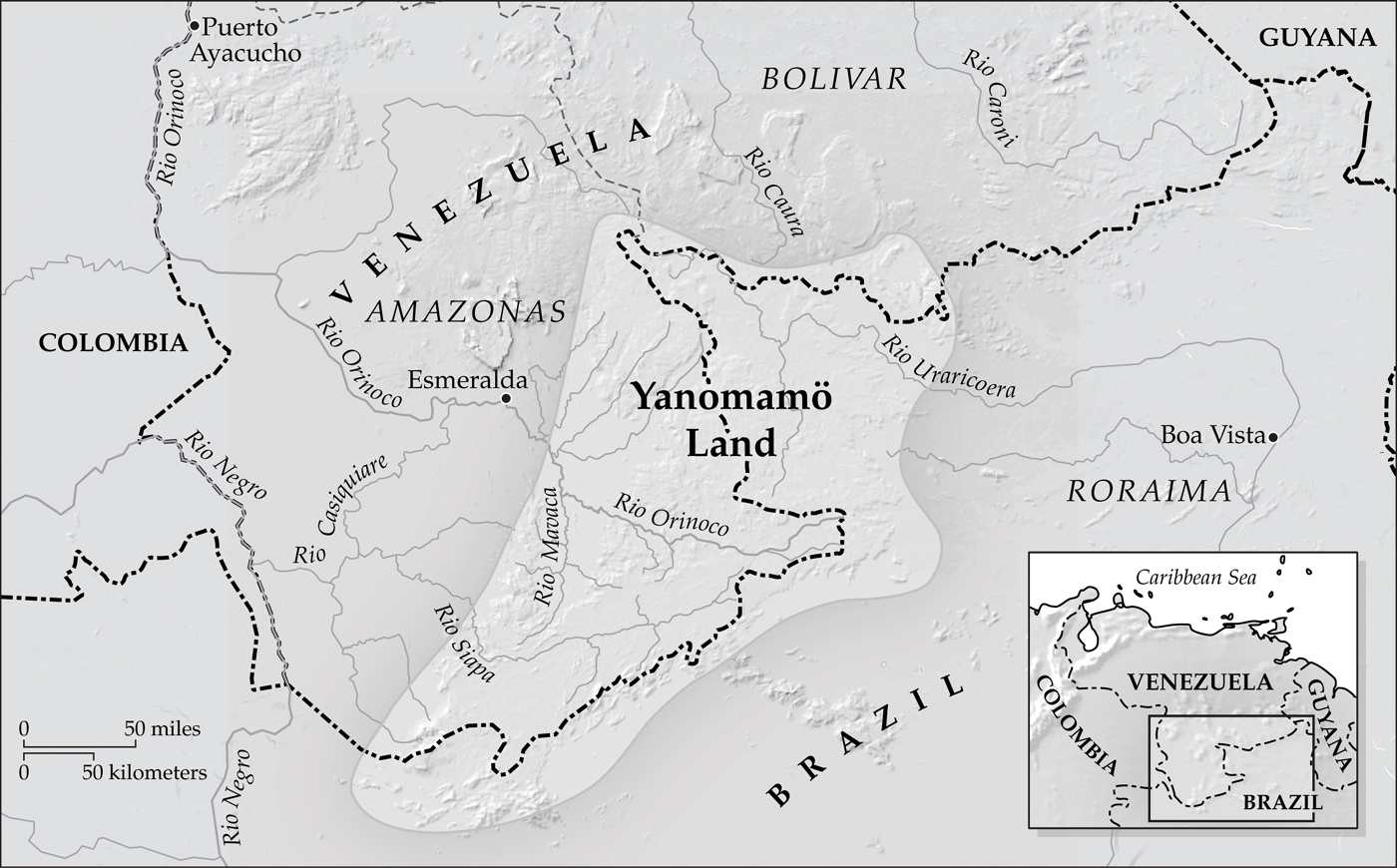
Almost all the Yanomamö lived away from the larger rivers, so the initial contacts with them necessitated travel up smaller rivers and streams in native Ye’kwana dugout canoes, followed by walking deep into the interior. (The Ye’kwana are a different and neighboring native people.) It was this aspect of Yanomamö cultural geography that kept them isolated and uncontacted for so long and that explains why most of them were still demographically intact when I began studying them.
By 1964, when I arrived, members of a few Yanomamö villages had been attracted out to navigable stretches of some of the larger rivers in the southernmost portion of Venezuela and had settled next to the newly arrived mission groups who came to convert them to Christianity. There were other Yanomamö villages at various distances from these mission posts—a day’s walk, two days’ walk, or even several days’ walk—whose members began visiting the newly contacted villages to see the strange foreigners from the outside world.
When I first arrived I made a small mud-and-thatch hut next to one of the recently contacted villages and started to learn the Yanomamö language. After a few months I began visiting the more remote villages, reaching them either by walking directly from my hut or by taking my small dugout canoe upstream via the smaller rivers and then walking inland from there.
Since that time I have spent some thirty-five years of my academic life studying the Yanomamö in the jungle and writing academic articles and books about them. Anthropologists normally have teaching appointments in colleges and universities. Most of us try to get back to the field at least once to revisit the tribesmen we originally studied for our doctoral research. The field research was the aspect of anthropology I most enjoyed because it was a constant process of discovery and learning. Thus I returned to the Yanomamö some twenty-five or so times over the course of my thirty-five-year research career and I ultimately spent a total of approximately five years living with them. The longest single stretch of time that I spent was my initial field trip, from November 1964 through March 1966, some seventeen months. Thereafter my trips were much shorter, usually two or three months at a time. A few trips were just a couple of weeks or so. I visited and lived among them during all months and seasons, but I preferred to take my field trips during the months of January through early April, the dry season, because travel through the jungle on foot was much easier and more comfortable.
My fieldwork entailed many adventures and risks not commonly encountered in typical anthropological field situations. Today most anthropologists can call home regularly, but I was completely isolated for months at a time with no contact with the outside world. My communication with the outside world was sporadic or, in some cases, not even possible, as when I went inland to visit the more remote villages. While I was at my hut at the mouth of the Mavaca River where it joined the Orinoco, I was able to take occasional trips downstream several hours to a Salesian mission post at the mouth of the Ocamo River and get brief messages out to my wife by shortwave radio. To do this I had to travel six hours in my canoe and stay overnight at the mission. Frequently there was no time left for me to talk to my wife because their contact in Caracas was only able to help them make phone contacts for an hour or so.
The Yanomamö were fascinating, wild, and very difficult to live with, especially when you were the only one of your kind in one of their isolated villages. At one of the three mission posts in Venezuela, at Mavaca, Platanal, and especially at Ocamo, where a few permanent mission personnel lived, they quickly learned to modify their habits and could be very cooperative and even charming in small numbers when visitors from Caracas and other cities occasionally visited the charismatic, jovial priest stationed there, an Italian named Padre Luigi Cocco.
I originally intended to do what most graduate students in anthropology do: spend about a year doing my doctoral research to collect data for my Ph.D. thesis, write it up, publish a few articles, maybe a book for the academic audience, and then do the routine and conventional thing by going back a few years later for a week’s visit. That would be the topic of my second book: a popular book about my reflections on how their culture had lamentably changed for the worse since my first visit and how they were now being ruined by creeping civilization and increased contact with the “outside world.”
But when I walked into my first Yanomamö village, I realized that these were very special people and that I would have to spend a long time among them learning and documenting their social behavior, their population expansions and migrations, their oral history as the older people recalled it, and the many wars they had fought with their neighbors. The Yanomamö were one of the last remaining large tribes that were still locked in intervillage warfare, struggling to maintain their independence, security, and safety from the ever-possible unexpected attacks by their Yanomamö neighbors. They sometimes made a stand and fought, but other times they fled and settled in adjacent, unpopulated new areas that were safer, gradually moving outward from the center of their homeland.
I would be one of the last eyewitnesses to the political, social, and military struggles that repeatedly occurred among the Yanomamö while I lived with them, but I also learned about many more wars that had occurred in the recent and distant past. I discovered that over time their culture was getting more complex and their villages were growing larger and more cohesive. This process undoubtedly occurred many times in human history as tribal peoples elsewhere—Europe, Africa, the Middle East—made the transition from a hunting-and-gathering way of life to one based on agriculture. Each step they took in that direction made it more likely they would never revert back to how they lived in earlier times. These people were involved in a barely perceptible transition from “primitive” to “complex.” This crucial transition is known only from historical archaeological studies in most parts of the world, but in the Yanomamö area I could actually detect and try to document it. This was the last chance for an anthropologist to observe this fascinating social and political transition that terminated with the development of the political state and “civilization.”
That is why I decided very early in my fieldwork that I would have to go back repeatedly to continue documenting this rare event.
My initial fieldwork among the Yanomamö began in the mid-1960s when few Yanomamö had any enduring contact with the outside world. Today things are very different. A great deal of change has taken place. Latecomers denounce me because the Yanomamö they visit at Salesian or other missions today are not the same kinds of Yanomamö I first met. And anthropology itself has changed politically. It is now acceptable to denounce earlier anthropologists in the name of political advocacy of native rights and to deny what earlier anthropologists like me saw because this older image of the Yanomamö does not conform to what the activists want to see. I will discuss this important development in the final chapters of this book.
What I Discovered
The Ubiquity of Terror. We now live in a world where anxiety about terrorists and terrorism are facts of life in many countries, including the United States. We might think that this is something new in human history, an evil inflicted on us because civilization has broken down. Some might even lament the loss of pristine innocence and wish we could recapture some of the virtues that were lost when cultures became more complex and evolved into nations, empires, and industrialized states. We might even lament how good it would be if we could return to the innocent condition when people were Noble Savages as Jean-Jacques Rousseau and his followers imagined them.
Rousseau never used the phrase “noble savage” (or “the good savage,” as it is sometimes translated) in his best known work, The Social Contract (1762), but the concept he described—that humans in the state of nature were blissful, nonviolent, altruistic, and noncompetitive and that people were generally “nice” to each other—was soon given that name.
One point I emphasize in this book is that our assumptions about the alleged social tranquility of the past may be idealistic and incorrect. Worse yet, these assumptions appear to be increasingly unsustainable the further back in time we go. Life in the societies of ancient past—the “Stone Age”—appears to have been decidedly uncertain and fraught with danger, mostly from neighboring peoples who seemed to be ever willing to fall upon you when you least expected it—and this possibility was never very long out of your mind. The distant past of humanity may have been more like what Thomas Hobbes had in mind, a life that was short, nasty, and brutish. Perhaps we might want to consider this possibility as we learn more about the nature of human life in a “state of nature.”
Security. There are many “maximizing” theories in the social and biological sciences that argue about functions or ultimate purposes of institutions, human motivations, even life itself. In economics, for example, maximizing profit is one example and maximizing access to strategic material resources is another. In political philosophy it might be maximizing the greatest good for the largest number of people. In biology it might be maximizing reproductive survival.
I discovered that maximizing political and personal security was the overwhelming driving force in human social and cultural evolution. My observation is based not only on what we have thus far learned from political science and anthropological field reports, but also on a lifetime of experience living with native Amazonian tribesmen who chronically live in what Hobbes called in his major treatise, Leviathan (1651), a condition of war. He likened war to foul weather—not just a shower or two, but a persistent condition for extended periods of time, something chronic. The Yanomamö among whom I lived were constantly worried about attacks from their neighbors and constantly lived in fear of this possibility.
Neither Hobbes nor Rousseau ever saw people like Yanomamö tribesmen living in a “state of nature.” Their philosophical positions about Man in a state of nature were derived entirely from speculation. It is therefore astonishing that some cultural anthropologists cling to the Noble Savage view of human nature when ours is the profession that collected almost all of the empirical data on tribesmen and what social life was like under “pristine” or “Stone Age” conditions. Thus anthropologists should be the most likely people to arrive at a highly informed, empirically defensible view of human nature using the evidence from generations of anthropological research.
But most anthropologists have never lived among people who are really primitive. Many learn about such people the same way the readers of this book do—by reading about them in the ethnographic reports written by the anthropologists who have actually lived among these people.
During most of my fieldwork the Yanomamö lived as close to the “state of nature” as one could in the twentieth century. I have chosen to call this book Noble Savages in part because the Yanomamö I lived among had a certain kind of nobility that most anthropologists rarely see in acculturated and depopulated tribes that have been defeated by and incorporated into the political states in whose jurisdiction they reside.
For many anthropologists who cling to Rousseau’s view of mankind rather than Hobbes’s, I am a heretic, a misanthrope, and the object of condemnation by politically correct colleagues, especially those who identify themselves as “activists” on behalf of native peoples because I describe the Yanomamö as I found them.
Sociality and the demographic facts of life. The ability to live cooperatively in social groups is not “natural” and therefore not something to be taken for granted or merely assumed. Rather, it is something that must be explained.
Not all organisms live permanently in socially organized groups. Why some do is a fascinating question, one that cannot be explained by the social sciences. It is a biological and evolutionary matter, so it falls outside the scope of this book, outside the scope of cultural anthropology. This does not mean, however, that anthropologists can ignore this question.
Several major theoretical breakthroughs in evolutionary theory occurred just prior to or during the time I began studying anthropology at the University of Michigan. One of these breakthroughs should have had a major impact on anthropological theory but, puzzlingly, it did not. The longtime reluctance of anthropological theoreticians and field researchers to take ideas from biology seriously was the most likely reason.
This breakthrough in theoretical biology consisted of a pair of papers that William D. Hamilton, an English biologist, published in 1964 in the Journal of Theoretical Biology , a journal that most anthropologists were not familiar with and did not read. But Hamilton’s papers quickly entered the more general literature in biology and evolution and at least some scientific anthropologists who were prominent in the profession should have recognized their importance for understanding the frequently noted amity and favoritism characteristically found in kinship interactions among tribesmen in a kinship-dominated society. In a very real sense, these “kinship behaviors” were in fact reproductive behaviors.
Hamilton called his new concept “inclusive fitness,” but it is now generally known as “kin selection” in today’s literature. His general argument was that since related individuals share genes with each other, an individual could get copies of his or her genes into the next generation by favoring close kinsmen and not reproducing sexually at all. For example, individuals share on average half (50 percent) of their genes with their siblings, they share one-fourth (25 percent) with their half-siblings, an eighth (12.5 percent) with their full cousins, etc. Thus if they engage in certain kinds of “favors” that enhance a full cousin’s reproductive success, then, to the extent that those favors enabled that kinsman to find a mate and produce offspring, their favoring of that kinsman helped them to get some of their own genes into the next generation. As one theoretical geneticist, J. B. S. Haldane, is rumored to have said: “I’d lay down my life for eight cousins. . . .” That’s because eight cousins would carry, on average, 100 percent of the genes that the person who laid down his life carried.
This oversight in anthropology is all the more astonishing in view of the fact that much of the first one hundred years of anthropology as an emerging academic and putatively scientific discipline was given over to discussions of the important role that kinship and the “meaning” of kinship played in the formation of that discipline. Accordingly, I will include here some of the relevant demographic facts of Yanomamö life and show how these relate to their struggles to maximize political security. It is easy to get along with your neighbors when there are only a few dozen of them in your band or village and most of them are close kin—brothers and sisters, or dependent juveniles like your children, nephews, and nieces. But it is not so easy to get along when your village grows to be several hundred people and includes people whose kinship ties are increasingly remote—second and third cousins, or strangers who join the village. Arguments and fights then become chronic. Some people have to leave and form their own new, tiny communities because the only rules of cooperation and social amity are kinship rules, and kinship rules cannot maintain social order in large groups.
Large, politically complex societies emerged only after—or as a consequence of—the replacement of kinship institutions and nepotism by other institutions, by what Hobbes called the power that keeps men in awe, namely, the political state and law. That is also why almost all early anthropologists were lawyers or were interested in the development of law from vague customs. They were appropriately astonished by the obvious fact that most of the peoples in the newly discovered worlds of central Africa, Polynesia, Melanesia, Australia, and the Americas lacked what we have come to know as the political state and the law.
But what if when you move there are other people “over there” who don’t want new neighbors and who oppose you with violence and threats of violence? This is the problem the Yanomamö face, as have human communities throughout our history. Thus the presence of potentially hostile neighbors inhibits village fissioning, keeping people at home where disputes and arguments increase, but also helping the village to survive as a group in a political situation where an advantage in village size—larger villages are more secure than smaller ones—is valuable whenever other groups are a constant threat.
Leadership and social cohesion. The internal cohesion of a small group of co-resident kinsmen derives mainly from rules, obligations, and expectations about kinship. But as the group increases in size from, say 40 to 80 people, the role that political leaders (headmen) must play in keeping order increases. Since the headmen come from the largest kinship group, most of their “subjects” are blood relatives and their tasks are relatively easy. The tasks become more difficult as village sizes get larger—150 people or so—and headmen must then become more insistent in their injunctions and begin to use threats and physical coercion to maintain order and peace within the group. When villages get even larger, say 200 people, headmen can become oppressive and tyrannical. Some of the Yanomamö villages I lived in contained close to 300 people and one group contained nearly 400 people immediately before I first visited them. The political leaders in these villages were extremely harsh men, and I shall describe some of their activities and characteristics in the pages that follow.
Political evolution. It is unusual—and perhaps even unwise—for an anthropologist to attempt to relate his own ethnographic fieldwork to broader issues like the evolution of political society. Part of the reason is that a study of a specific culture like the Yanomamö Indians represents just a single example in a much larger set of existing ethnographic examples that, collectively, compose the larger picture. However, I would argue that there are two general exceptions to this rule. The first is that selected data from specific ethnographic studies like mine are often (and legitimately) used in traditional anthropology to inform general theoretical issues and guide further research in many other cultures. The second exception is that some tribal societies are larger, include multiple communities, and therefore this larger sample of villages of the same tribe can indicate probable cultural evolutionary trends. Variations found in these villages strongly suggest how socially adaptive features within the larger sample of communities might logically lead toward increased social and political complexity. Thus the relatively small but distinctive differences among the wider spectrum of Yanomamö villages I have studied can plausibly be interpreted as “micro-evolutionary” changes toward greater social and political complexity in a relatively unacculturated, multi-village, large tribal society.
The key variables and causal factors among the Yanomamö that I am referring to include:
1. Isolation and independence from political states
2. Demographic integrity—a “healthy” age/sex distribution with continuing population growth
3. Geographic and ecological features that provide both constraints on and opportunities for political change
4. Multiple villages that show political and social differences that correlate with local group size, ecological features of their landscape, and the “personality” characteristics of charismatic leaders
5. The chronic threat of lethal attacks from other groups
The Yanomamö I studied seem to have made a few halting steps toward greater social complexity in what I describe as the fertile crescent region of Yanomamöland (chapter 11 ). Understanding how and why larger, more complexly organized Yanomamö villages came into existence from smaller, less complexly organized villages will shed light on how some of the first steps toward the political state may have been taken by many other tribesmen and, I hope, this will improve our understanding of the evolution of cultural and social complexity in general.
I have written, co-authored, or co-edited five books, some one hundred articles, and some twenty-one documentary films, most of them about specific and technical aspects of Yanomamö culture, demography, and social behavior. Few of my publications were intended for the general public, such as my several contributions to the National Geographic and Natural History magazines.
This book is my first publication on the Yanomamö for a wider, more general reading audience. While it contains many of the facts and incidents I have discussed elsewhere in technical publications, especially in my college-level monograph, they are presented here in a less technical and, I hope, more easily comprehensible way. Some of the information presented here has never been published before, such as data on female sexuality, infanticide, and statistical aspects of the abductions of females.
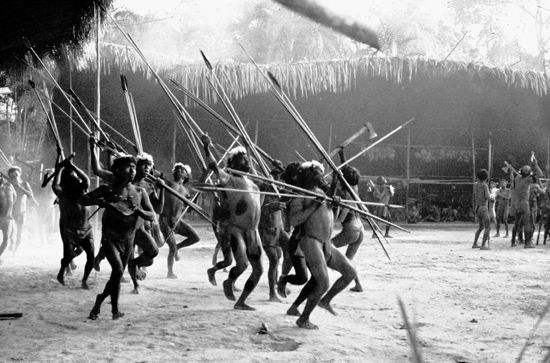
Visitors at a feast, dancing for their hosts
1
Culture Shock
My First Year in the Field
The First Day
My first day in the field—November 28, 1964—was an experience I’ll never forget. I had never seen so much green snot before then. Not many anthropologists spend their first day this way. If they did, there would be very few applicants to graduate programs in anthropology.
I had traveled in a small aluminum rowboat propelled by a large outboard motor for two and a half days, cramped in with several extra fifty-five-gallon gasoline barrels and two Venezuelan functionaries who worked for the Malarialogía, the Venezuelan malaria control service. They were headed to their tiny outpost in Yanomamö territory—two or three thatched huts. This boat trip took me from the territorial capital, Puerto Ayacucho, a small town on the Orinoco River, into Yanomamö country on the High Orinoco some 350 miles upstream. I was making a quick trip to have a look-see before I brought my main supplies and equipment for a seventeen-month study of the Yanomamö Indians, a Venezuelan tribe that was very poorly known in 1964. Most of their villages had no contact with the outside world and were considered to be “wild” Indians. I also wanted to see how things at the field site would be for my wife, Carlene, and two young children, Darius (three years old) and Lisa (eighteen months old).
On the morning of the third day we reached a small mission settlement called Tama Tama, the field “headquarters” of a group of mostly American evangelical missionaries, the New Tribes Mission, who were working in two Yanomamö villages farther upstream and in several villages of the Carib-speaking Ye’kwana, a different tribe located northwest of the Yanomamö. The missionaries had come out of these remote Indian villages to hold a conference on the progress of their mission work and were conducting their meetings at Tama Tama when I arrived. Tama Tama was about a half day by motorized dugout canoe downstream from where the Yanomamö territory began.
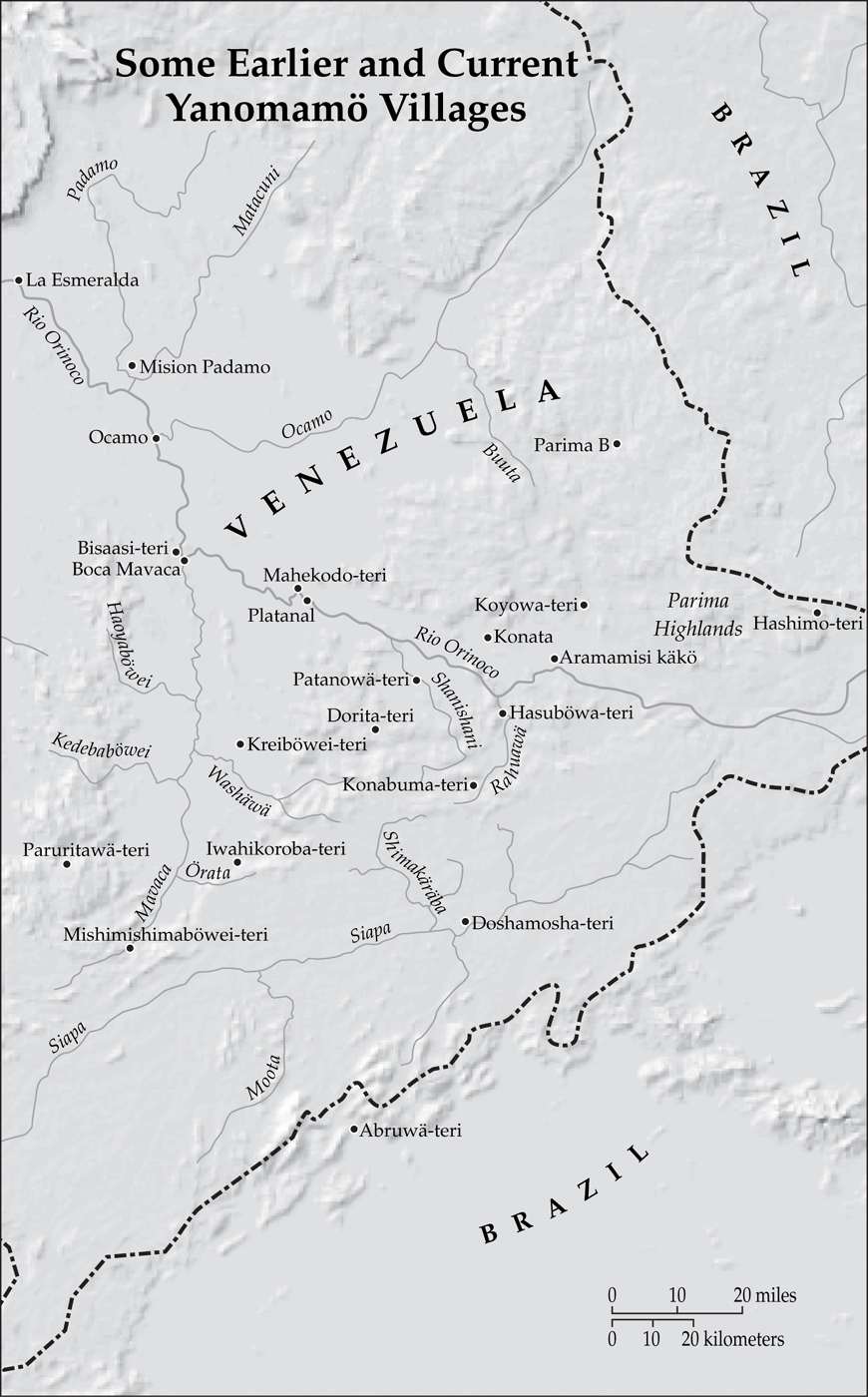
We picked up a passenger at Tama Tama, James P. Barker, the first outsider to make a sustained, permanent contact with the Venezuelan Yanomamö in 1950. He had just returned from a year’s furlough in the United States, where I had briefly visited him in Chicago before we both left for Venezuela. As luck would have it, we both arrived in Venezuela at about the same time, and in Yanomamö territory the same week. He was a bit surprised to see me and happily agreed to accompany me to the village I had selected (with his advice) for my base of operations, Bisaasi-teri, and to introduce me to the Indians. I later learned that bisaasi was the name of the palm whose leaves were used in the large roofs of many Yanomamö villages: -teri is the Yanomamö word that means “village.” Bisaasi-teri was also his own home base, but he had not been there for over a year and did not plan to come back permanently for another three months. He therefore welcomed this unexpected opportunity to make a quick overnight visit before he returned permanently.
Barker had been living with this particular Yanomamö group about four years at that time. Bisaasi-teri had divided into two villages when the village moved to the mouth of the Mavaca River, where it flows into the Orinoco from the south. One group was downstream and was called Lower Bisaasi-teri (koro-teri ) and the other was upstream and called Upper Bisaasi-teri (ora-teri ). Barker lived among the Upper Bisaasi-teri. His mud-and-thatch house was located next to their village.
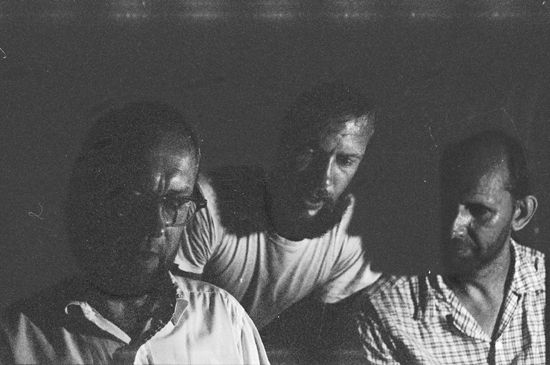
Left to right: James V. Neel, Napoleon Chagnon, and James P. Barker, 1966
We arrived at Upper Bisaasi-teri about 2 P.M. and docked the aluminum speedboat along the muddy riverbank at the terminus of the path used by the Indians to fetch their drinking water. The Yanomamö normally avoid large rivers like the Orinoco, but they moved there because Barker had persuaded them to. The settlement was called, in Spanish, by the men of the Malarialogía and the missionaries, Boca Mavaca—the Mouth of the Mavaca. It sometimes appeared on Venezuelan maps of that era as Yababuji—a Yanomamö word that translates as “Gimme!” This name was apparently—and puckishly—suggested to the mapmakers because it captured some essence of the place: “Gimme” was the most frequent phrase used by the Yanomamö when they greeted visitors to the area.
My ears were ringing from three dawn-to-dusk days of the constant drone of the outboard motor. It was hot and muggy, and my clothing was soaked with perspiration, as it would be for the next seventeen months. Small biting gnats, bareto in the Yanomamö language, were out in astronomical numbers, for November was the beginning of the dry season and the dry season means lots of bareto. Clouds of them were so dense in some places that you had to be careful when you breathed lest you inhale some of them. My face and hands were swollen from their numerous stings.
In just a few moments I was to meet my first Yanomamö, my first “primitive” man. What would he be like? I had visions of proudly entering the village and seeing 125 “social facts” running about, altruistically calling each other kinship terms and sharing food, each courteously waiting to have me interview them and, perhaps, collect his genealogy.
Would they like me? This was extremely important to me. I wanted them to be so fond of me that they would adopt me into their kinship system and way of life. During my anthropological training at the University of Michigan I learned that successful anthropologists always get adopted by their people. It was something very special. I had also learned during my seven years of anthropological training that the “kinship system” was equivalent to “the whole society” in primitive tribes and that it was a moral way of life. I was determined to earn my way into their moral system of kinship and become a member of their society—to be accepted by them and adopted as one of them.
The year of fieldwork ahead of me was what earned you your badge of authority as an anthropologist, a testimony to your otherworldly experience, your academic passport, your professional credentials. I was now standing at the very cusp of that profound, solemn transformation and I truly savored this moment.
My heart began to pound as we approached the village and heard the buzz of activity within the circular compound. Barker commented that he was anxious to see if any changes had taken place while he was away, especially how many Yanomamö died during his absence. I found this somewhat macabre, but I later came to understand why this was an important concern: among the Yanomamö it is offensive—and sometimes dangerous—to say the name of a dead person in the presence of his close relatives, so it is important to know beforehand, if possible, who is no longer living to avoid asking about them.
I nervously felt my back pocket to make sure that my nearly blank field notebook was still there, and I felt more secure when I touched it.
The village looked like some large, nearly vertical wall of leaves from the outside. The Yanomamö call it a shabono. The several entrances were covered over with brush and dry palm leaves. Barker and I entered the opening that led to the river. I pushed the brush aside to expose the low opening into the village.
The excitement of meeting my first Yanomamö was almost unbearable as I crouched and duck-waddled through the low passage into the open, wide village plaza. I looked up and gasped in shock when I saw a dozen burly, naked, sweaty, hideous men nervously staring at us down the shafts of their drawn arrows! Immense wads of green tobacco were stuck between their lower teeth and lips, making them look even more hideous. Strands of dark green snot dripped or hung from their nostrils—strands so long that they drizzled from their chins down to their pectoral muscles and oozed lazily across their bellies, blending into their red paint and sweat.
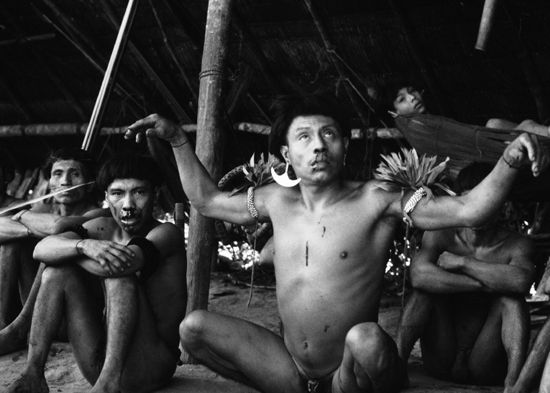
Green nasal mucus laden with hallucinogenic hisiomö snuff powder
We had arrived at the village while the men were blowing a greenish powder, a hallucinogenic drug called ebene , up each other’s noses through yard-long hollow tubes. The Yanomamö blow it with such force that gobs of it spurt out of the opposite nostril of the person inhaling. One of the side effects of the hallucinogen is a profusely runny nose, hacking and choking, and sometimes vomiting. The nasal mucus is always saturated with the green powder, and the men usually let it run freely from their nostrils.
My next discovery was that there were a dozen or so vicious, underfed growling dogs snapping at my legs, circling me as if I were to be their next meal. I stood there holding my notebook, helpless and pathetic. Then the stench of the decaying vegetation, dog feces, and garbage hit me and I almost got sick.
I was shocked and horrified. What kind of welcome was this for the person who came here to live with you and learn your way of life, to become friends with you, to be adopted by you? The Yanomamö put their weapons down when they recognized and welcomed Barker and returned to their chanting, keeping a nervous eye on the village entrances.
We had arrived just after a serious fight. Seven of the women from this shabono had been abducted the day before by a neighboring group, and the local men and their guests had just that morning recovered five of them in a brutal club fight that nearly ended in a shooting war with arrows. The neighboring abductors, now angry because they had just lost five of their seven new female captives, had threatened to raid the Bisaasi-teri and kill them with arrows. When Barker and I arrived and entered the village unexpectedly, they suspected or assumed that we were the raiders.
On several occasions during the next two hours the men jumped to their feet, armed themselves, nocked their arrows, ran to the several entrances, and waited nervously for the noise outside the village to be identified. My enthusiasm for collecting ethnographic facts and esoteric kinship data diminished in proportion to the number of times such an alarm was raised. In fact, I was relieved when Barker suggested that we sleep across the river for the evening, adding “because it would be safer over there.” I disconsolately mumbled to myself, “Christ! What have I gotten myself into here?”
As we walked down the path to the boat, I pondered the wisdom of having decided to spend a year and a half with these people before I had even seen what they were like. I am not ashamed to admit that had there been a diplomatic way out, I would have ended my fieldwork then and there. I did not look forward to the next day—and months—when I would be alone with these people. I did not speak a word of their language, and they spoke only their own language. Only a few of the young men knew a handful of words in Spanish—not enough to utter even a short comprehensible sentence.
The Yanomamö were decidedly different from what I had imagined them to be in my Rousseauian daydreams. The whole situation was depressing, and I wondered why, after entering college, I had ever decided to switch my major to anthropology from physics and engineering in the first place. I had not eaten all day, I was soaking wet from perspiration, the bareto were biting me, and I was covered with snot-laden red pigment, the result of a dozen or so complete examinations I had been given by as many very pushy, sweaty Yanomamö men.
These examinations capped an otherwise grim and discouraging day. The naked men would blow their noses into their hands, flick as much of the green mucus off as they could in a snap of the wrist, wipe the residue into their hair, and then carefully examine my face, beard, arms, legs, hair, and the contents of my pockets. I asked Barker how to say, “Don’t do that. Your hands are dirty.” My admonitions were met by the grinning Yanomamö in the following way: They would “wash” their hands by spitting a quantity of slimy tobacco juice into them, rub them together, wipe them into their hair, grin, and then proceed with the examination with “clean” hands.
Barker and I crossed the river, carried our packs up the bank, and slung our hammocks in one of the thatched huts belonging to a Malarialogía employee. When Barker pulled his hammock out of a rubber bag, a heavy, damp, disagreeable odor of mildewed cotton and stale wood smoke wafted out with it. Even the missionaries are filthy, I thought to myself. But within two weeks, everything I owned smelled the same way, and I lived with that odor for the remainder of my fieldwork. My several field hammocks still smell faintly like that—many years after my last trip to the Yanomamö and after many times through a washing machine.
After I had adjusted to the circumstances, my own habits of personal cleanliness declined to such levels that I didn’t protest anymore while being examined by the Yanomamö, as I was not much cleaner than they were. I also realized that it is exceptionally difficult to blow your nose gracefully when you are stark naked and the invention of tissues and handkerchiefs is still millennia away.
I was now facing the disappointing consequences of what, at the time, was a logical conclusion to a sequence of decisions I had made in college. When I had decided to study anthropology, I had to pick a specialization within it. I chose cultural anthropology. The next choice was to pick some kind of society—tribesmen, peasants, or industrialized existing cultures. I picked unknown tribesmen, which limited the parts of the world I could study: there are no unknown tribesmen, for example, in the United States, so I would have to consider more remote places. One of the possible places was South America, and there most of the unknown tribesmen were in the Amazon Basin.
So, here I was, my blank notebook in hand, preparing to dig in for seventeen more months of fieldwork. I was the proverbial blank slate incarnate.
My Life in the Jungle
It isn’t easy to plop down in the Amazon Basin for seventeen months and get immediately into the anthropological swing of things. You have been told or read about quicksand, horrible diseases, snakes, jaguars, vampire bats, electric eels, little spiny fish that will swim into your penis, and getting lost. Most of the dangers—diseases, snakes, jaguars, spiny fish, eels, getting lost—are indeed real, but your imagination makes them more ominous and threatening than many of them really are.
Most normal people have no idea how many of the simple things in life just do not exist in the field—something as simple as a flat surface to write on or put your coffee cup on. What my anthropology professors never bothered to tell me about was the mundane, unexciting, and trivial stuff—like eating, defecating, sleeping, or keeping clean. This, I began to suspect, was because very few of my professors had done fieldwork in uncomfortable circumstances remotely similar to what I now faced. These circumstances turned out to be the bane of my existence during the first several months of field research. After that they became merely the unavoidable, inconvenient, but routine conditions of the life of a fieldworking anthropologist who unwittingly and somewhat naively decided to study the most remote, primitive tribe he could find.
I initially set up my household in Barker’s vacant mud-and-thatch house, some thirty yards from Bisaasi-teri, and immediately set to work building my own mud-walled, thatched-roof hut with the help of the Yanomamö. Meanwhile, I had to eat and try to do my field research.
I soon discovered that it was an enormously time-consuming task to maintain my hygiene in the manner to which I had grown accustomed in the relatively antiseptic environment of the northern United States. Either I could be relatively well fed and relatively comfortable in a fresh change of clothes—and do very little fieldwork—or I could do considerably more fieldwork and be less well fed and less comfortable.
I quickly learned how complicated it can be to make a simple bowl of oatmeal in the jungle. First, I had to make two trips to the river to haul my water for the day. Next, I had to prime my kerosene stove with alcohol to get it burning, a tricky procedure when you are trying to mix powdered milk and fill a coffeepot with water at the same time. My alcohol prime always burned out before I could turn on the kerosene, and I would have to start all over. Or I would turn on the kerosene, optimistically hoping that the stove element was still hot enough to vaporize the fuel, and start a small fire in my palm-thatched hut as the liquid kerosene squirted all over my makeshift table and mud walls and then ignited. Many amused Yanomamö onlookers quickly learned the English expletive Oh shit! They actually got very good at predicting when I would say this: if something went wrong and I had a clumsy accident, they would shout in unison: “Say ‘Oh shit!’ ” (Oh Shit a da kuu! ) Later, and once they discovered that the phrase irritated the New Tribes missionaries, the Yanomamö used it as often as they could in the missionaries’ presence, or, worse yet, mischievously instructed the missionaries to say “Oh shit!” whenever they also had a mishap.
I usually had to start over with the alcohol prime. Then I had to boil the oatmeal and pick the bugs out of it. All my supplies were carefully stored in rat-proof, moisture-proof, and insect-proof containers, not one of which ever served its purpose adequately. Just taking things out of the multiplicity of containers and repacking them afterward was a minor project in itself. By the time I had hauled the water to cook with, unpacked my food, prepared the oatmeal, powdered milk, and coffee, heated water for dishes, washed and dried the dishes, repacked the food in the containers, stored the containers in locked trunks, and cleaned up my mess, the ceremony of preparing breakfast had brought me almost up to lunchtime!
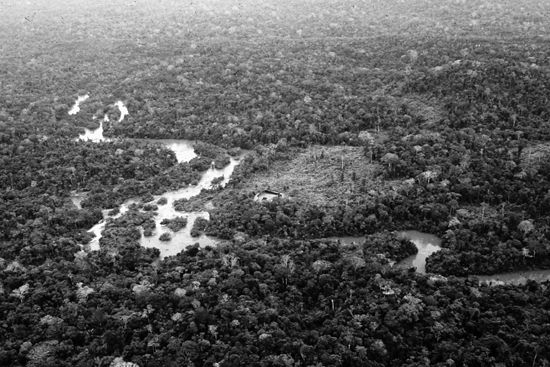
Medium-size village on the banks of the Siapa River
I soon decided that eating three meals a day was simply out of the question. I solved the problem by eating a single meal that could be prepared in a single container, or, at most, in two containers; washed my few dishes only when there were no clean ones left, using cold river water; and wore each change of clothing at least a week to cut down on my laundry, a courageous undertaking in the tropics. I reeked like a smoked jockstrap left to mildew in the bottom of a dark gym locker. I also became less concerned about sharing my provisions with the rats, insects, Yanomamö, and the elements, thereby reducing the complexity of my storage system. I was able to last most of the day on café con leche —heavily sugared espresso coffee diluted about five to one with hot milk reconstituted from powder. I would prepare this beverage in the evening and store it in a large thermos. Frequently, my single meal was no more complicated than a can of sardines and a package of salted crackers with peanut butter. But at least two or three times a week I would do something “special” and sophisticated, like make a batch of oatmeal or boil rice and add a can of tuna fish and tomato paste to it. I also ate a lot of food that I obtained from the Yanomamö—especially bananas, plantains, and potato-like tubers—by trading fishhooks and nylon fishing line.
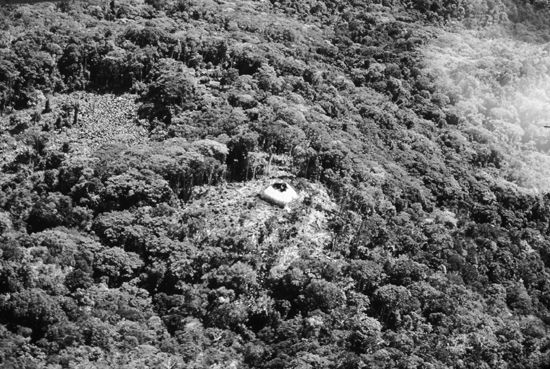
A small village in a remote area
As to recurrent personal needs let me just say that the Yanomamö have not yet worked out a suitable sewage system. Barker mentioned to me on the first day that people just go off a ways into the jungle to do number two, and to watch where I stepped. “If you run into some of it you’ll probably run into a lot of it,” he added. The environs immediately surrounding a Yanomamö village of two hundred people are a hazardous place to take an idle stroll. We’ve all been on camping trips, but imagine the hygienic consequences of camping for about three years in the same small place with two hundred companions without sewers, running water, or garbage collection, and you get a sense of what daily life is like among the Yanomamö. And what it was like for much of human history, for that matter.
I barely recall these things now. They come to mind only when I read over old notes taken in the early days of my fieldwork, or the early letters I wrote to my wife from the field. They also come to mind when I take out one of my old, smoky field hammocks to string between two trees in my yard.
Beginning to Doubt Some Anthropological Truths
There were two things I learned that first day that would dominate much of my field research life for the next thirty-five years.
The first discovery was that “native warfare” was not simply some neutral item on an anthropological trait list, equivalent to other traits like “they make baskets with vines” or “the kinship system is the bifurcate-merging type.” Among the Yanomamö native warfare was not just occasional or sporadic but was a chronic threat, lurking and threatening to disrupt communities at any moment. The larger the community of people, the more one could sense its foreboding presence.
Warfare and the threat of warfare permeated almost all aspects of Yanomamö social life: politics, visits between villages, tensions among people, feasts, trading, daily routines, village size, and even where new villages were established when larger communities subdivided, a process I called village fissioning. This martial condition is not often discussed in the anthropological literature because there were few places in the world where populations of tribesmen were still growing by reproducing offspring faster than people were dying and were fighting with each other in complete independence of nation states that surrounded them. Yanomamö history is a history of wars, as Karl Marx claimed of the history of all peoples.
The second discovery I made that first day was that most Yanomamö arguments and fights started over women. This straightforward ethnographic observation would cause me a great deal of academic grief because in the 1960s “fighting over women” was considered a controversial explanation in “scientific” anthropology. The most scientific anthropological theory of primitive war of the 1960s held that tribesmen, just like members of industrialized nations, fought only over scarce material resources—food, oil, land, water supplies, seaports, wealth, etc. For an anthropologist to suggest that fighting had something to do with women, that is, with sex and reproductive competition, was tantamount to blasphemy, or at best ludicrous. Biologists, on the other hand, found this observation not only unsurprising, but normal for a sexually reproducing species. What they did find surprising was that anthropologists regarded fighting over reproductive competition as ludicrous when applied to humans. Competition among males vying for females was, after all, widespread in the animal world.
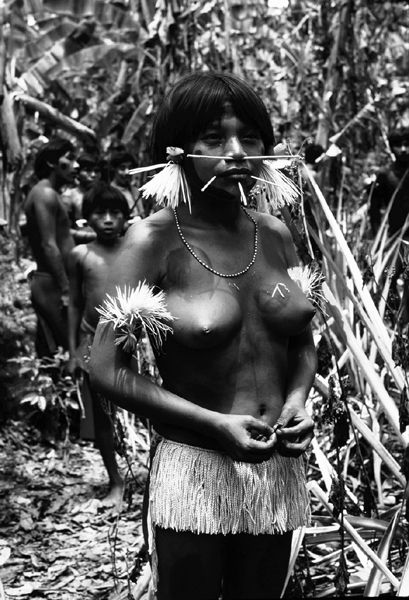
Young, beautiful moko dude (post-pubescent girl)
I was stunned by the reaction to this finding by some of the most famous anthropologists of the day. There was immediate and serious professional opposition to my rather innocent description of the facts when I published them in 1966 in my doctoral thesis. I was still wet behind my ears in an academic sense, and found myself, at the ripe age of twenty-eight, already controversial for saying that the Yanomamö, a large, multivillage Amazonian tribe, fought a great deal over women and marital infidelity.
That’s when I started to become skeptical about what senior members of my profession said about the primitive world. I began suspecting that senior anthropologists believed that it was their solemn responsibility to “interpret” for the rest of the world what they regarded as the recondite meanings of the customs of other cultures.
In other words, what I didn’t know then was that if some serious, well-trained anthropologist who spent more than a year living in the midst of a warring tribe reported that much of the fighting he witnessed was “over women,” that is, was rooted in reproductive competition, then such an informed conclusion opened the possibility that human warfare had as much to do with the evolved nature of man as it did with what one learned and acquired from one’s culture. Most anthropologists, by contrast, believed that warfare and fighting was entirely determined by culture. My fieldwork raised the anthropologically disagreeable possibility that human nature was also driven by an evolved human biology. This idea was extremely controversial in the 1960s and angered many cultural anthropologists.
Thus, my very first published statements and descriptions of Yanomamö violence would constitute an allegedly dangerous challenge to the received wisdom of many senior cultural anthropologists. More immediately worrisome for me was that some of the most prominent of these anthropologists were my own teachers at the University of Michigan and several of them would serve on my doctoral committee.
The Intellectual and Political Climate of the 1960s
It is a truly curious and remarkable characteristic of cultural anthropology, as distinct from other subfields of anthropology, that any time native people are said to do something risky for reasons other than “maximizing access to material resources,” leading figures in the profession grow uneasy and suspicious. One well-known cultural anthropologist—an Englishman named Ashley Montagu—wrote angry book-length rebuttals whenever someone prominent made such a claim. He seemed convinced that people might get the wrong impression that biological factors help explain what humans do, or, worse yet, that humans might have something called “human nature” as distinct from a purely cultural nature or, more precisely, that their behavioral characteristics might have evolved by some natural process, such as what Darwin called “natural selection.”
My career began with the uneasy feeling that cultural anthropology was one of the last bastions of opposition to Darwin’s theory of evolution by natural selection. The University of Michigan’s anthropology department was, however, the major center of the Theory of Cultural Evolution, whose proponents distinguished it sharply from biological evolution or organic evolution, that is, the evolution of biological organisms.
The standard, almost solemn, epistemological position in cultural anthropology when I was in graduate school was that humans have only a cultural nature. Thus, our physical or biological characteristics as an evolved primate are irrelevant to whatever we do as members of society. The biological properties of humans, as my professors taught me, have to be factored out of any anthropological explanation of what we do.
Among my professors were Leslie A. White, Elman R. Service, Marshall D. Sahlins, Eric R. Wolf, and Morton H. Fried, who were among the most prominent cultural anthropologists of the day and important architects of the anthropological view I have just described.
Anthropology by definition is the science of man. Isn’t it strange that this science factors out its central subject’s biology in pursuit of understanding its subject?
This rather odd but axiomatic view has deep—and widespread—roots in several of the social sciences, sociology and anthropology in particular. Briefly put, the distinguished nineteenth-century French sociologist Emile Durkheim struggled to establish a “science of society” (what today we call sociology) at a time when it was intricately bound up and intertwined with psychology and social psychology. He felt that there were irreducible facts that were purely and exclusively social in nature and could be studied in their own right, divorced from any psychological and/or biological attributes of the human organisms whose activities were the subject of study. The study of these facts, he argued, deserved to have its own science.
A similar rebellion occurred in cultural anthropology, beginning with the efforts of Herbert Spencer and perhaps culminating in the works of Leslie A. White, one of my major professors, and, later, Marvin Harris, who would become one of my most outspoken critics. White and Harris spent their lifetimes trying to create a “science of culture” (“Culturology” as Leslie White called it: the study of cultural facts). And, like Durkheim before them, they insisted that the biological aspects of human beings were not relevant to “the culture process.”
My observation that Yanomamö men fought mostly over women, and, equally important, that these conflicts and their outcomes had important consequences for understanding Yanomamö culture and society, disturbed some of my fellow cultural anthropologists. Why? As I look back on the history of my research, I was saying not just one, but two things that deeply concerned these anthropologists and that were considered to be controversial at the time.
The first was that warfare was common among the Yanomamö and that it was apparently not caused by capitalist exploitation, nor was it a reaction to oppression by Western colonial powers. This raised the possibility that warfare was, in a sense, a “natural” or “predictable” condition among tribesmen who had not been exposed to or corrupted by capitalistic, industrialized, and/or colonial cultures.
The second possibility my research raised was that lethal conflicts between groups might not be explicable by citing “shortages of scarce strategic material resources,” considered by anthropologists and other social scientists to be the only legitimate “scientific” reason for human conflict and warfare.
On my return to Ann Arbor in 1966 from my first field trip, a University of Michigan professor, Norma Diamond, invited me to give a lecture in her large introductory class. I spoke about my field research and how important warfare was in Yanomamö culture. The students were fascinated. After my lecture Diamond thanked me for my presentation in front of her class. But, as we walked back to the Anthropology Department, she cautioned me: “You shouldn’t say things like that. People will get the wrong impression.” When I asked her what she meant, she added: “About warfare. We shouldn’t say that native people have warfare and kill each other. People will get the wrong impression.”
When I reported in one of my first articles that the Yanomamö fought a great deal over women, one prominent anthropologist, David Schneider, then at the University of Chicago, wrote a sarcastic letter to me that said something to the effect, Fighting over women? Gold and diamonds I can understand. But women? Never! And, as a last-minute addendum to a major book he was about to publish on the history of anthropological theory, prominent anthropologist Marvin Harris described my 1966 doctoral dissertation as giving credence to “the more lurid speculations” of John McLennan, a nineteenth-century Scottish anthropologist and jurist who wrote a book about primitive marriage and viewed “marriage by capture” as a “primitive stage” in human social history. I would ultimately debate this issue with Harris from 1968 until his death in 2001. Several of his disciples try to carry on this debate—or some version of it—today. Harris defended a Marxist “cultural materialist deterministic” anthropological view, while I was among a small minority of anthropologists struggling to develop a more Darwinian, more evolutionary view of human behavior. I saw no difficulty in incorporating both views into a comprehensive theory of human behavior, but Harris (and many other anthropologists) adamantly insisted that a scientific theory of human behavior had no room for ideas from biology, reproductive competition, and evolutionary theory. Many of these anthropologists argued that cultures and societies were not merely analogous to living, sexually reproducing organisms, but were homologous with them and therefore interchangeable in Darwin’s theory of evolution by natural selection. Biologists found this argument implausible and unpersuasive. One of the participants in this long debate who held to the biological point of view asked his opponent in exasperation: “Does your piano menstruate?”
Ironically, Harris and I both argued for a scientific view of human behavior at a time when increasing numbers of anthropologists were becoming skeptical of the scientific approach and were even antiscientific. However, Harris was adamantly opposed to a Darwinian perspective on human behavior—which I thought was itself an antiscientific view.
During the weeks, months, and years I spent among the Yanomamö I began to explore and document their lives in statistical and demographic ways—and my doubts about much of what I had learned about anthropology from my professors only grew.
One lesson that I eventually learned from the history of my own anthropological research and the controversies it caused was that cultural anthropology did not fit a traditional scientific definition where facts are established by observations that are verified by others to establish patterns and, if empirical observations by others do not verify the original observations, then efforts must be made to account for the differences in the observations. Instead, anthropology is more like a religion. Indeed, the organizational and intellectual structure of a large fraction of cultural anthropology is best understood if viewed as an academic fraternity that intimidates and suppresses dissent, usually by declaring that the dissenter is guilty of conduct that is unethical, immoral—or Darwinian.
Many cultural anthropologists today are afraid to make even timid challenges to this authority and are very careful to describe their findings in cautiously chosen words that are frequently vague so as not to give people “the wrong impression” or, more important, not to invite the suspicion or condemnation of the ayatollahs of anthropology, the Thought Police who guard the received wisdoms.
How I Chose to Study the Yanomamö
The Yanomamö were not my initial choice for fieldwork. I wanted to study a newly contacted tribe in the central Brazilian highlands, a group called the Suyá, one of several tribes whose members spoke a native language belonging to the Gê language family. I did the necessary library research to write a grant proposal and focused on several of the then-timely theoretical problems in anthropology. I applied for and was awarded a National Institute of Mental Health research grant on the basis of this proposal, a small grant that would cover my travel and living expenses for one year.
Unfortunately, a few weeks after I learned that my NIMH grant was awarded, the Brazilian military overthrew the democratically elected government. From talking with experienced field researchers who had worked in the Amazon area I learned that it was a bad idea to try to get anything done in a country that had just undergone a military coup. Furthermore, it might even be dangerous to try to get into some areas of the country.
I decided to pick a different tribe in a different country, ideally a tribe that straddled the border between two countries. I figured that if one of the countries had a revolution, I might be able to get into the same tribe from the other country and continue my fieldwork there. Hence, the Yanomamö, who live in Venezuela and Brazil.
Human Genetics
About the time I was doing the library research for my NIMH proposal on the Suyá tribe, I made an appointment to meet with Dr. James V. Neel, head of the University of Michigan Medical School’s Department of Human Genetics. Neel was the founder and the chairman of that department and an internationally prominent figure in human genetics. He and several of his colleagues, Dr. William J. Schull in particular, had studied the long-term genetic effects on survivors of the atomic bombings of Hiroshima and Nagasaki. Also, Neel had collaborated in the field with Dr. Frank Livingston, who was now on the faculty in the Anthropology Department and one of my teachers. Their study focused on several native African tribes and the phenomenon of sickle-cell anemia.
I was more intrigued by some of Neel’s recent research among the Xavante (Shavante) Indians in collaboration with anthropologists, in particular, David Maybury-Lewis. The Xavante were a Brazilian tribe in the Gê-speaking language group located close to the area where I intended to study the Suyá tribe. I was interested in learning whether Neel would consider a similar collaboration with me after I had lived with the Suyá for a year or so. Many of my own anthropological interests were compatible with and even overlapped extensively with his—genealogies, marriage patterns, demographic patterns, and the social organization of reproduction. His interest in these topics was medical, while mine was anthropological and behavioral. For example, Neel wanted to know the amount of genetic variation that existed between tribes and, more important, between communities of the same tribe, a scientific question that was just starting to be explored in the mid-1960s as human geneticists and anthropologists began to document in a more sophisticated and comprehensive way the extent of human variability by using newly discovered genetic markers in, especially, easily collected blood samples.
I had taken human genetics courses in the Anthropology Department from James Spuhler, whose graduate course included some of Neel’s own graduate students and, to my surprise, even a few faculty members in Neel’s department.
After an initial and fruitful discussion, I agreed to collaborate with Neel in a short-term biomedical/anthropological research study after I had spent a year among the Suyá and learned their language and the intricacies of their social organization.
However, Neel was also in the process of developing a collaborative relationship with Venezuelan colleagues who were doing similar research among several native tribes in that country, Dr. Miguel Layrisse in particular. Layrisse was internationally known for his serological studies among Venezuelan Indians, much of it done in collaboration with the German-born cultural anthropologist Johannes Wilbert. Layrisse had, for example, discovered a genetic marker known as the “Diego factor,” a group of genes found only in people with Native American ancestry and in certain Mongolian populations in Asia. The Diego factor was initially used tentatively to classify Native American tribes into putative “early arrivals” to the New World and “later” populations. Layrisse and Wilbert had begun collecting blood samples to document the genetic characteristics of all the tribes in Venezuela and the variations found among them.
In view of the practical difficulties I would face as a result of the military coup in Brazil, Neel suggested that I consider doing my field research in a Venezuelan tribe that was close to the Brazilian border, a possibility that, as I mentioned, I was already considering. Such research was suddenly all the more possible and attractive because of Neel’s recently established connections with Layrisse in Venezuela.
There were a number of Venezuelan tribes whose territories extended into Brazil—the Pemon in the savannah region and the Amazon tropical forest Ye’kwana, for example. There were yet other Venezuelan tribes on the Colombian border that were found in both countries that I also considered, but because they were relatively easy to get to, they were more acculturated by contact with Venezuelan and Colombian nationals. I wanted to study a tribe that had had minimal contact with Western culture.
The most attractive group to me was the apparently numerous but largely unknown group, then known as the Waika. In my general reading in preparation for my comprehensive examinations for the anthropology doctoral program I had read the scant literature that existed on the Waika Indians, who were rumored to be very numerous, warlike, and isolated in the largely unexplored area on the border between Brazil and Venezuela. There were a few recently published firsthand accounts for the Venezuelan Waika, among them several articles by an American missionary named James P. Barker, who had recently begun evangelical mission work in this area.
Layrisse and Wilbert had also recently done blood-sampling work among almost all of the tribes in Venezuela, including a few visits to small villages of Waika (sometimes called Sanema) Indians who periodically moved out of the deep forest and were in sporadic contact with the Ye’kwana Indians and the missionaries who were working with the Ye’kwana. Both the tribal names Waika and Sanema turned out to be other names for the Yanomamö. Johannes Wilbert had published brief descriptions of his encounters with these somewhat mysterious Indians, but apart from Wilbert’s initial and brief reports, there was nothing substantial from anthropologists on any groups of Venezuelan Waika Indians. Indeed, the field of cultural anthropology based on fieldwork in Venezuela was scarce in the mid-1960s.
After a few meetings with Neel and discussions of his developing collaborative agreements with Layrisse in Venezuela, I decided to take Neel’s recommendation and begin my research among the Waika in the headwaters of the Orinoco River, a region of Venezuela called the Territorio Federal Amazonas. It was not yet a state, but rather a federal territory. In a strange sense, I felt a little like Lewis and Clark accepting Thomas Jefferson’s commission to explore the newly purchased Louisiana Territory.
Things then happened very quickly. In November 1964, my wife, our two small children, and I departed from New York on a Venezuelan freighter. We had a large amount of personal and field equipment packed into five large fifty-five gallon metal barrels, so taking a freighter was much less expensive than flying. I was among the Yanomamö (“Waika”) Indians about two weeks after we reached Venezuela and remained there for the next seventeen months, except for two trips of ten or so days out of the jungle to see my wife and our children.
The Waika called themselves Yanomamö, but so little anthropological research had been done among them that this fact either was overlooked or people simply continued to call them by a somewhat derogatory name that had been used by the few locals who came into occasional contact with them. (The word Waika seems to be derived from a Yanomamö word, waikäo , meaning to “dispatch a wounded animal (or person),” in other words, administer the death blow.)
My contact with the world outside ceased almost entirely for the next seventeen months. For example, I was vaguely aware when I went into the Yanomamö area in late 1964 that the United States had sent several hundred military advisors to South Vietnam to help train the South Vietnamese army. When I returned to Ann Arbor in 1966 the United States had some two hundred thousand combat troops there.
In early 1966, as my initial anthropological field research drew to an end, Neel and a team of his medical researchers joined me in the Yanomamö area for some two weeks as we had planned. Layrisse brought them into the Mavaca area, where I had my mud-and-thatch hut, and we worked from there. Apart from Layrisse, the only Venezuelan in the medical group that initial year was a young dentist, Dr. Charles Brewer-Carías, who had published a short monograph on the dentition of the Ye’kwana Indians. Brewer was also an avid explorer, a self-trained naturalist, and a gifted photographer.
Layrisse left the next day and returned to Caracas while Neel and a small team of medical doctors and Ph.D. candidates from his department and in other departments of the University of Michigan Medical School remained with me for some two weeks. They collected blood samples, urine, feces and saliva samples, made dental casts, and performed physical and dental examinations of all the Yanomamö in each village we visited, including detailed anthropometric information. To make certain that everyone’s data records could be pooled, I used a black felt-tip marker to put on everyone’s arm an ID number that was linked to the genealogies I had collected during my fieldwork.
The medical team began every day by attending to those Yanomamö who were sick and could be treated in the village with antibiotics and other medications found in the supplies Neel’s team brought with them from the University of Michigan.
The analytical results from the blood and other samples the medical team obtained during the brief time they spent with me in 1966 pleased Neel immensely and he subsequently offered me a position in the Department of Human Genetics to participate in additional future field trips to the Yanomamö. Although this kind of postdoctoral position would be an academic dead end for an anthropologist, the short-term benefits were very desirable: I could analyze my field data and publish extensively without the time-consuming tasks of simultaneously preparing and teaching courses—the standard career trajectory of new Ph.D.s in anthropology.
But an additional attractive aspect to the appointment was that it provided me with the opportunity to return to the Yanomamö as a member of a well-funded research program and continue my own anthropological field research. Finding money for relatively costly social science research—especially for foreign travel, as is common in anthropology—was a time-consuming and frequently disappointing process. Sometimes a young, unknown researcher had to apply to several different agencies several different times to obtain funding.
When I returned to Ann Arbor I wrote my doctoral dissertation, took two foreign language examinations (German and Spanish), completed the remainder of my doctoral course requirements (two courses in statistics), and successfully defended my thesis before my doctoral committee in time for the December 1966 university commencement. I was already on the University of Michigan Medical School faculty by the time I received my Ph.D. degree.
2
Discovering the Significance of the Names
I knew immediately on that first day among the Yanomamö that they were different from what my academic training had prepared me to find. The Yanomamö were unusual, and I knew I couldn’t describe their society adequately by doing the minimally acceptable fieldwork characteristic of the 1960s. They were too pure, too pristine, and too special. They had not been decimated by introduced diseases nor by colonists on the fringe of an expanding frontier. Not even Christian missionaries had had an impact on them beyond a handful of their numerous villages. Most of their villages were so isolated that nobody knew for sure how many there were, let alone the total number of people in them. It was an almost unique anthropological situation at the time—an extraordinary opportunity to study possibly the last large, warring, isolated tribe left on the planet.
They were special in many other regards. For example, they struck me as being more self-confident—even somewhat arrogant—and startlingly indifferent to the “outside world” shortly after seeing it—or parts of it—for the first time. I would have expected that they would be more shocked and the shock would last longer on seeing some remarkable new thing for the first time. For example, they were not awed for very long by some of our technology, such as outboard motors, machetes, or flashlights. To be sure, they found them curious and remarkable at first, but they quickly became very matter-of-fact about them.
They also had a very noticeable quality that is hard to explain, a “subjective” quality that my professors and the anthropology books I read never mentioned—nor seemed to even be aware of. For example, I knew immediately when I saw my first Yanomamö what “wild” Indian meant compared to an “acculturated” one. The wild ones had a kind of glint in their eyes and a haughty look about them that the acculturated ones had seemingly lost. There is a wonderful scene in the film version of Peter Matthiessen’s fine book At Play in the Fields of the Lord that conveys what I’m trying to say. An evangelical missionary couple are working among some recently contacted Amazonian natives and trying to make first contact with the more remote, uncontacted “wild” ones. They string up trinkets, steel tools, and other items, hoping to lure the uncontacted ones to their mission. They wait for days, weeks, months. One day their young son suddenly rushes into his parents’ hut, eyes very large, and blurts out in apprehensive, hoarse whispers: “They’re here! They’re here! The wild ones are here!”
My anthropological training probably would have served me adequately had I chosen a native Amazonian group to study that was already accustomed to many years of contact with Venezuelans, Brazilians, or other national populations and could speak some European language tolerably well. But the people I was now living with knew only a few words of Spanish, like sí and no , and most of them didn’t even know these two words. James P. Barker, the New Tribes missionary who came with me the first day, left the following day, and I would not see him again for several months.
I was nevertheless grateful for the small list of phrases he had given me—common phrases that would be useful as I began learning the Yanomamö language, phrases like “Stop that!” or “No, you can’t have my machete!” or “Help me find firewood!” or “Give me bananas and I will give you these fishhooks!”
I didn’t realize until he left that his phrasebook really was not the language learning aid I expected that it would be. It might have been adequate if I were sitting in a room alone with some sympathetic, cooperative Yanomamö who was interested in teaching me his language, but this kind of situation almost never occurred. Rather, I would usually be surrounded by groups of Yanomamö—dozens—each clamoring to be heard and, when I didn’t respond to them in a normal Yanomamö fashion, they assumed that I was hard of hearing and would speak louder, more emphatically, or simply shout impatiently at me.
The field notes I took during the early days and weeks of my fieldwork are very peculiar, incomprehensible, and, frankly, embarrassing as I now look at them. In an effort to learn the language, I would write down what some individual said to me and have him repeat it several times until I had the whole statement. But a phrase uttered in a language you don’t understand comes out, in written form, something like this (using English as the example):
tomorrowiplantotakeatripdownstreamin
mycanoetocatchsomefishandiwillgiveyou
someifyougivemesomematchesinreturn.
Imagine trying to make sense of a phrase like this in Yanomamö or any unknown language. My early field books contained “sentences” that sometimes ran for a whole page.
How do you separate a jumble of phonemes—sounds—into minimal meaningful elements, morphemes or grammatical units? Or, to put it in simple terms: where does one word stop and the next word begin?
One of my major ethnographic “triumphs” during the first several months of my work was to teach a young man named Rerebawä, who eventually became one of my best informants, what a word was and have him help me break the long strings of Yanomamö sounds I would write down into discrete words. This might seem like a trivial accomplishment, but it is huge when you are trying to learn an unwritten language from people for whom notions of verb, adjective, noun, tense, and so forth don’t exist.
Rerebawä was a young man who had recently taken a wife in Bisaasi-teri and moved into the village from Karohi-teri, his own village some six or so hours upstream and across the Orinoco. Young men from distant villages who marry into another village must work for the wife’s parents for around six months to a year before they can take their new wife back home. This is called bride service in the anthropological literature. The Yanomamö name for it is siohamou. Rerebawä was a sioha in Bisaasi-teri, that is, a young man doing compulsory bride service.
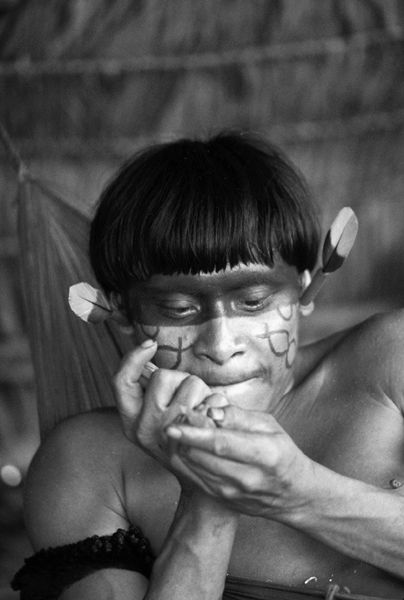
Rerebawä
He was not enthusiastic about bride service, so he often hung around me all day and gradually began helping me with the Yanomamö language and other tasks. He eventually became my nearly constant companion, guide, and friend during my initial seventeen months of fieldwork.
Rerebawä would say a sentence in Yanomamö, and I would write it down as I heard it. Then I would ask him to say it slowly. Gradually the boundaries between the sounds would appear, what I assumed were separate words. I would ask Rerebawä to repeat the whole phrase several times slowly, hoping that by doing it slowly, he would pronounce each word separately for me so I knew where the word started and ended.
He, of course, knew where each Yanomamö word began and ended, but he had no formal concept of what a word was because Yanomamö did not have a written grammar or dictionary—or a system of writing.
Rerebawä was one of the few informants who realized what I was trying to do and caught on quickly. He was an exceptionally bright young man.
Despite the fact that Yanomamö is not a written language, I had to adopt some alphabet—linguists call it an orthography —that represented the basic sounds of the language. My course work in anthropological linguistics was helpful to me here. An anthropologist or missionary with basic training in linguistics can develop a writing system for any unwritten language and after discovering its underlying grammar and structure, can write it on paper. This was an essential requirement before I could even begin the anthropology part of my field research.
The Yanomamö language had a few sounds that do not occur in the English language, so I had to decide on symbols for them. For example, the Yanomamö have a frequently used phoneme that sounds to English speakers like the oe
or ö
in the name of the famous German poet Goethe. This sound is, however, difficult for speakers of the Romance languages to hear. What they hear is more like the sound /e/ in the English words tree, me,
or see.
At least that is how they choose to write this phone: I chose to use ö
for this sound because this symbol was more frequently found in publishers’ fonts than the more standard  (i with a slash through it) that is used in international linguistics conventions.
Thus, I not only had to learn the Yanomamö language, I also had to develop a way to write it so I could, for example, make a dictionary and take notes in their language, or at least write down their names for things so I could refer to a dictionary when I forgot some word in their language.
Some years after I had gotten my Ph.D., I met a prominent American anthropologist who had done his fieldwork in India using native informants who were fluent in English. He casually mentioned that his major informant decided to earn his own Ph.D. in anthropology at Cambridge University. His informant, no doubt, had long since lost the glint of wildness in his eye.
This chronic fact of my fieldwork had an indelible effect on me: I had recurring dreams for two or three years in which I would accidentally stumble upon a Yanomamö who spoke fluent English. I would detain him for hours, bring out my dictionary, and ask him if I had translated their words accurately into English! Hell, I would have settled for one who spoke fluent Spanish or Portuguese.
There is also an unusual problem with the Yanomamö language: it is not apparently demonstrably related to any of the indigenous languages found in the Americas.
The fact that no other native group speaks a related language seems to suggest that the Yanomamö have lived in isolation for a very long time, hidden away in a remote pocket of the vast Amazon jungle that was explored by Europeans only in recent times and only after the Yanomamö themselves began expanding out of their mountainous redoubts into the adjacent lowlands.
The process of learning the Yanomamö language was further complicated by the fact that I was also learning Spanish. I would say things to Venezuelans, for example, that would include words from four different languages in the same sentence. Most of the sentence would be in Spanish, but it would sometimes include words from English, Yanomamö, and German. My mind seemed to have a module that told me the word you are trying to say is not Spanish and, therefore, it must be a non-Spanish word from one of the other languages I knew (English and German) or was just learning (Yanomamö). People would look very puzzled whenever this happened but in most cases I never even realized what I had said because it sounded perfectly intelligible inside my brain.
The Physical Appearance of the Yanomamö
On my initial trip into Yanomamö territory we stopped periodically along the Orinoco River. At each stop the communities were smaller and the people began to look more like Amazonian Indians. In fact, many of them were of mixed Spanish and Native American ancestry. Some places where we stopped had hardly more than a couple of families with a few chickens that were kept for the eggs they produced. These people lived primarily on the manioc and plantains they cultivated and the fish and local game they hunted. Their chickens were so wild that on one occasion we purchased one for our dinner: our motorista had to chase it around the homestead and shoot it with his shotgun.
I gradually got to know some of these creoles, the ones who worked for the Venezuelan Malarialogía. They were always courteous to me, but when they realized that I was interested in the language and customs of the Yanomamö and treated the Yanomamö with respect, a few of them confidentially told me they were Baré or Kuripako Indians from the Rio Negro area. When they realized that I was enthusiastically trying to learn Yanomamö kinship usage and didn’t think it was quaint or backward, some of them, also somewhat secretly, told me they still used kinship terms in their own native language. Their cautious attitudes were understandable. A not uncommon request I periodically got from middle-class Venezuelans in Caracas, when they heard I spent a good deal of time in “Indian country,” was, “Bring me back an india if you have room in the plane! I could use another domestica !” It was as if they thought that Native Venezuelan Indians could simply be taken against their will and put into the domestic employ of someone’s household.
The New Tribes Mission post of Tama Tama was approximately the beginning of Yanomamö territory. When I first reached Tama Tama I saw a young man standing on one of the giant rocks that jutted into the Orinoco. I knew as soon as I saw him that I was looking at my first Yanomamö. He had not lost the “wild” look in his eyes.
He was rather stocky but had slender legs and arms. He wore badly faded and tattered pants and a shirt and both were much too large for his frame. He was slightly shorter than the people we had met along the Orinoco on our trip, perhaps five feet, four inches tall. He looked like he weighed about 120 pounds. His jet-black hair was cut pudding-bowl-style. What I could see of his skin was surprisingly light compared to that of the people we saw along the river who spent much of the time fishing in canoes, their skin exposed to the equatorial sun many hours per day.
The Venezuelan men in the boat tried to ask him questions in Spanish. He seemed to understand them, but his responses consisted of mostly nods, two Spanish words (sí and no ) and pointing toward the houses up on the hill above the rocks. I later learned that he was from Mavaca, where I was going. His name was Wakarabewä and he became a good friend during the fieldwork that followed.
The other Yanomamö I met during my first year of fieldwork were, like Wakarabewä, very handsome people. A few of the men even resembled some North American Indians whom I had seen in photographs taken by Edward S. Curtis.
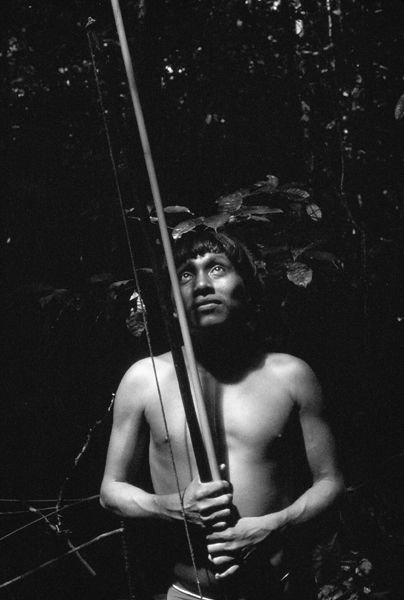
Wakarabewä
My anthropology training and common sense made me aware of the fact that certain kinds of anthropological data like myths could not be collected immediately and would have to wait until I learned more of the Yanomamö language. However, there were things I could see with my own eyes and describe without knowing much of the language—things like how the Yanomamö cleared gardens, collected roofing materials, when they ate, how they made material items like bows, arrows, or bamboo quivers to carry extra arrow points, what they did to various kinds of game animals to prepare them for eating, etc. These activities did not require a sophisticated ability to communicate with the Yanomamö, who would often hold up objects as they worked so I could see them as they would tell me what they were. I happily jotted these names down—or recorded them on my small tape recorder and later entered them into my three-by-five vocabulary cards and, eventually, into my growing dictionary.
Discovering the “Name Taboo” and the Structure of Yanomamö Society
There were things I could try to learn as I learned new words and phrases, but this was somewhat hazardous in the sense that (1) the Yanomamö were practical jokers and would play mischievous tricks on me, and (2) they would sometimes get me into trouble by having me repeat things aloud that angered others within earshot.
Let me give some examples to illustrate one dimension of Yanomamö humor. Their word for pubic hair is weshi —the word means to have substantial amounts of hair in your pubic area. It is not something that is taboo to discuss if you are talking about men, no more so than discussing the fact that some men have more hair in their armpits than others do. But whenever I showed them photographs of women—even photos of women from their own village—the first thing that drew their attention was the relative amount of hair the women had around their pubic area. They found women with an abundance of pubic hair sexually provocative.
The Yanomamö have another word that is similar to weshi that can easily be confused with it, especially when you are just learning the language. That word is beshi , which means “to be horny.” You don’t admit in public that you are horny and you don’t ask people in public if they are horny.
One day a young man asked me what I thought was a question about the hair on my body, especially the hair on my pubic area. We were resting on a trail en route to a nearby village. He knew that I sometimes confused these two words. He asked me, “Wa beshi rä kä?” (“Are you horny?”), which I mistakenly heard as “Wa weshi rä kä?” (“Do you have pubic hair?”). There was a small crowd of young men with me. They all watched and listened attentively. When I said, “Awei! Ya beshi!” (“Yes, I’m horny!”) they broke into uproarious laughter because they had set me up to confuse the two words—and I fell into their trap.
Strangely—at least to me—the Yanomamö think it is appropriate to verbally insult a nearby person by having someone else —a stranger—say the offensive words. The offended person then becomes angry with the person who was commanded to utter the insult or offensive word. For example, if Kumamawä wanted to tell Wakupatawä that he is really ugly, Kumamawä would say to me, the stranger, “Say to Wakupatawä, ‘Wa waridiwa no modahawa!’ (‘You are really ugly!’)” I, of course, would have no idea what I was told to say and would innocently repeat what Kumamawä told me to say to Wakupatawä. But instead of getting angry with Kumamawä, Wakupatawä would get angry with me ! It is as if getting someone else, especially a stranger, to say the insulting phrase the initiator of the insult is mysteriously invisible and not culpable: he is not an active agent in the sequence of verbal events that results in the insult.
The most common way they did this to me was to tell me to say someone’s name aloud in front of them, especially very early in my fieldwork. Someone would say to me, “Say to that guy next to you, ‘Buutawä! Koa asho a dahiyo! ’ (‘Fetch me some firewood!’),” I would say that. Buutawä would get angry at me because I used his name publicly. He would become angry because I disrespected him in public and failed to acknowledge his high status (I will explain the complicated subject of names shortly).
For the better part of the first year I focused on learning how to speak Yanomamö and making my dictionary of words and phrases as I learned them, as well as observing and describing things that did not depend on an intimate knowledge of their language.
As my language proficiency increased I gradually began collecting facts about their kinship rules, beliefs, social relationships, and, generally, the kinds of things you can’t learn simply by looking with your eyes.
What I really had to find out was how the Yanomamö organized themselves socially and how their “political system” worked.
The one thing I learned in my anthropology classes that was absolutely true was that tribal societies are fundamentally kinship-based societies and that for tribesmen like the Yanomamö “social organization” was embedded within the complex matrix of kinship, descent from common ancestors, and marriage arrangements.
This might be more easily understood if you imagine a Yanomamö village as a large spiderweb. Where any two strands of the spiderweb cross, imagine that this little node is a person. Let’s say the vertical strands of web are “lines of genetic descent” and the horizontal strands of web are “ties caused by marriage.” Then imagine that some pieces of the web are thicker and stronger than others and can pull or restrain each node with different amounts of force, that is, sometimes the marriage pieces of web are thicker (stronger) than the crisscrossing lines of descent and the node has a tendency to be pulled more by marriage ties than by descent ties. Finally, imagine that the spiderweb is constantly exposed to the wind, which varies over time and fluctuates by direction, and it is anchored to rigid sticks. So, the web is constantly being stretched by the forces of the wind and restrained by the rigid sticks that sway and bend in the wind, putting different amounts of stress on portions of the web—and the nodes within it.
Therefore in order to discover how each individual in the village—each node in the spider web—was pulled or restrained socially, I had to determine the genealogies of each person to show the constraints set by descent from ancestors and the marriage histories of each adult—to show the constraints and obligations established by marriages.
This rather complex task required that I know the names of every individual, as well as the names of each parent, each grandparent, etc. Then I had to determine who married whom and, when multiple spouses were found, the sequence of the marriages (which was first, which second, etc.), as well as the names of each child by each set of parents. This information would constitute only a portion of the matrix about the human nodes: just the ties of descent, kinship, and marriage among them.
Both men and women remarry when their spouses die or are killed. In addition, many men have several wives at the same time (polygyny) or several wives that they divorce (“throw away”) and then replace. Finally, in some cases, a few men share the same wife (polyandry) until one of them can find a wife for himself.
I will discuss Yanomamö polygyny in more detail later, but a brief comment is necessary here. All Yanomamö men would like to have multiple wives but not all of them are able to. Marriage success is largely dependent on how many ascending generation patrilineal male relatives a young man has: these men can help younger men in their own lineage find wives—usually after the older men find wives for their own sons. Although the father is probably the most important person in helping a young man find a wife, the size of his father’s patrilineage—and thus its prominence in village politics—is also important because other men want or at least prefer to give their daughters to men in prominent lineages. Village size also plays a role in a man’s marital success—larger villages are able to retain more of their women because they have to promise fewer of them to allies and they are able to coerce more women from smaller allied villages.
Ties of kinship, descent, and marriage were only part of the puzzle of how their social and political system worked. I also had to establish two additional dimensions of this puzzle: the spatial or geographical dimension and the historical dimension.
Geography: I had to collect the names of the villages (or abandoned gardens) where each life historical event took place, that is, where each person was born, where older females had their first menstrual period, where each person lived when each marriage took place, and where, if dead, they died.
History: Over time the members of any given Yanomamö village have moved from one garden to another as they construct new shabonos , meaning establish new villages. Relationships among villages are an important political fact of life for the Yanomamö, as I discovered soon after my arrival at Mavaca.
Social Intricacies of Name Avoidance
Within a few months of settling in at Mavaca I learned specialized phrases to collect genealogies—phrases like “what is his/her name?” or “what is the name of X’s father (mother)?” or “what is the name of X’s spouse?” or “ what garden was he/she born in?”
I soon realized that I could not have picked a more recalcitrant and uncooperative group of people to study.
The Yanomamö have what anthropologists call a name taboo. Not many anthropologists have had to deal with such a taboo, and I was surprised when I later realized how few anthropologists knew what it actually meant in specific cases, how widely it varied from tribe to tribe, and the “sociopolitical” content it had in specific tribes.
Among the Yanomamö, strangers are generally suspect and viewed with distrust because the Yanomamö believe that they are likely to inflict supernatural harm on them. To know someone’s personal name is, in a sense, to “possess” some kind of control over that person, so the Yanomamö initially do not want strangers to know their personal names. However, the Yanomamö name taboo is a very complex set of practices and expectations, not just a simple prohibition on the use of someone’s name in public, as many anthropologists assume. For example, there are some circumstances where using another’s name publicly is both permissible and commonplace. The longer the stranger remains among them, the less concerned they are about the outsider learning their names and, of course, the less able they are to prevent him from learning them. By that time the stranger will have caught on to the fact that, to be courteous and polite, one should generally avoid using someone’s name in public and, instead, use the kinship term that inevitably is adopted between the stranger and every individual in the village.
For example, if some Yanomamö decides to call me by the term that means “brother,” then I am expected to call him brother in return. I must also call all of his brothers by the same kinship term—and all of his sisters by the kinship term used for sisters.
What frequently happens is that the headman of the village adopts some fictitious kinship relationship with you. Usually (if you are male) it is the kinship relationship that means brother-in-law that is most frequently chosen. In the Yanomamö language this term is shori or, more formally, shoriwä. It is an especially “friendly” relationship, because it implies that you must be generous with your possessions with your shori because you and he are expected to give each other your respective sisters in marriage. Thus, on first meeting male strangers, the Yanomamö males keep shouting repeatedly “Shori! Shori! Shori!” to emphasize their friendly intentions, expecting the strangers to reciprocate in a friendly way by yelling back “Shori! Shori! Shori!” This occurred so frequently when early contacts were being developed between strangers and the Yanomamö that outsiders began calling the Yanomamö the Shori tribe. Most of the Catholic missionaries and their Venezuelan employees up to about 1990 referred to the Yanomamö as los Shoris, as did some of the evangelical missionaries I knew.
So, when someone comes into a Yanomamö village to live there for a long period of time—as I did—they must somehow or other become incorporated into the social group by an extension of kinship ties. This does not mean that the Yanomamö “like” you or accept you in some special way. It simply means that they have their own way of dealing with you on their own terms—their kinship terms. Naïve visitors often report that “The natives ‘liked’ me so much that they adopted me.” The natives, however, extend this practice even to people they dislike. It has nothing to do with liking someone or “adopting” someone.
Yanomamö villages comprise a small number of what we would call very large extended families. Nearly everyone in the village is a blood relative to everyone else. The example I just used for brothers and sisters applies across the board for other kinship relationships. If I call someone “sister” then her children must call me “uncle” and I must call them “nephew” and “niece.”
Every time I went to a village I had not visited before, the headman would greet me with the term shori and I would respond by calling him shori in return. Then for the next hour or two most of the members of the village would make it a point to announce who they were by approaching me and calling me some kinship term that would be consistent with what the headman and I called each other—and everyone would automatically become one kind or another of my blood relative.
The Yanomamö system of kinship classification does not have any kin terms that mean “relatives by marriage,” people we call our “in-laws.” Everyone is, by kin term, a blood relative. I translated their word shori as brother-in-law, but it also and more accurately means “my male cross cousin,” a blood relative. The Yanomamö in fact are obliged to marry their female cross cousins or a woman that falls into the kinship category that means “female cross cousin.” So, the headman of a strange village and I become potential matrimonial allies, each expecting to be given the other’s sister in marriage—as well as material wealth such as dogs, clay pots, arrows, and, more recently, steel tools. These goods are almost always foremost in mind in the headman’s apparently altruistic but actually avaricious and selfish expectations.
So, in the early months of that first year of fieldwork I was faced with a big problem that had several dimensions. First, the Yanomamö didn’t want me to know their names because I was a stranger, a nabä : a subhuman. Second, if I learned their names they didn’t want me to use them in public. Third, I had to collect accurate genealogies even to begin to understand how their social system functioned and this required knowing the names of all individuals including dead individuals in each person’s ancestry.
A major obstacle emerged. I was determined to figure out their social system, which required knowing their individual names and genealogical relationships, but they were just as determined to conceal these facts from me. A fascinating and complicated process then emerged, one that was invisible to me over the initial months of my fieldwork as it played itself out.
For example, I determined, by simply listening to their conversations, that it was acceptable to use the names of young children in many circumstances, like wanting to get the attention of some adult whose name you didn’t want to use aloud in public. It was acceptable to yell out something like “Hey! Go get Nakabaimi’s mother!” Nakabaimi being a child. Ethnographically this common practice is called teknonomy —to use the name of one person to attract the attention of someone or to refer to someone whose name you do not want to say aloud.
I could, in this fashion, at least begin genealogies that would be based on a child called, for example, Nakabaimi with parents called “Nakabaimi’s mother” and “Nakabaimi’s father.” Needless to say, this quickly became cumbersome when I tried to determine who the parents and siblings were of Nakabaimi’s mother and Nakabaimi’s father.
But I also determined by listening to Yanomamö conversations that you should not use a child’s name if he or she is sick—it might attract the attention of malevolent spirits who might then steal the child’s soul and cause it to get more sick or even die. The same is also true for adults who would normally be able to use each other’s names aloud. When they are sick it is considered hazardous to do so and it is therefore avoided.
The name taboo has several functions in the Yanomamö status system. Among other things it is strategically implicated in and central to understanding the Yanomamö social and political systems.
It was difficult for me to think about the Yanomamö as having a “status system” because, according to the picture I had gotten from my anthropology training, people like the Yanomamö were “egalitarian” and nobody had higher status than anyone else his or her age, except, possibly, for the short-lived times that a “chief” spoke for the group in dealings with other groups—as in trading or chance meetings. Then, after these brief circumstances, the chief would revert in status from first among equals to just another male of his age group. “One word from the chief and everyone does as he pleases,” as an early Russian anthropologist described the “government” of one of the Siberian tribes he studied.
When I was a graduate student, my more advanced graduate classes on primitive social organization informed me that differences in status in all human societies were basically determined by “differential access to scarce, strategic material resources.” We were taught that this condition did not obtain in tribal societies because there was no wealth as such, and thus there were no status differences other than sex and age. This meant that older people had more prestige than younger ones simply because they were older, and males were more important than females simply because they were males. Individuals of the same age and same sex have the same social and political status. Kinship had nothing to do with biology.
This was a fundamental message of Marxist social science that dominated most departments of anthropology in the 1960s, especially those departments that were considered to be “scientific.” For reasons I’ve never understood, “science” and “Marxism” were linked together. One implied the other because, I suppose, both were materialistic and involved a logic of cause and effect, which I understood and accepted. What I didn’t accept was the subtle “Marxist” message that academics who found cause-and-effect important in science also had to actively advocate a social agenda of egalitarianism or socialism. Science as such did not advocate anything.
What I found from my fieldwork was that the political leaders in all Yanomamö villages almost always have the largest number of genetic relatives within the group. I also found that some people, in addition to political leaders, had higher status than others, and that political status among the Yanomamö depended to a very large extent on the numbers and kinds of biologically defined (genetic) relatives one has in the community and was entirely unrelated to “control” one had over allegedly “scarce strategic resources.” In short, it was apparent to me as an observer of their daily behavior that material things mattered much less to the Yanomamö than biology, for example, genetically related kinsmen—contrary to the prevailing anthropological wisdom derived from Marxism.
My training at Michigan led me to believe that people like the Yanomamö had virtually no status differentials other than age or sex. One could not add to one’s status by, for example, striving to be bigger, more influential, more likely to be listened to. Thus the Yanomamö name “taboo” was an integral part of their status system and not simply some kind of mysterious avoidance custom. It should be stated at the outset that Yanomamö males are concerned about their status and they strive for esteem. You can see this develop as a boy matures. It is acceptable to use a boy’s name aloud when he is a toddler, but as he matures and starts tying his penis to his waist string, as a yawäwä , or pubescent male and later when his muscles start to become hard (yiiwä ) as the Yanomamö classify a male of this age, he begins to demand a measure of respect, and he publicly objects when his name is used aloud, because doing so indicates publicly that he is just a child.
The Yanomamö have a rich vocabulary to describe stages of life during human maturation, which can be roughly used to calculate approximate ages. Here are just a few:
ihiru, ihirubö |
An infant of either sex |
horeaö |
To creep, as an infant learning to walk |
oshe |
a young child of either sex |
suhebä ukaö |
a girl whose nipples are beginning to enlarge |
yawäwä |
a young boy who is tying his penis to his waist string |
yiiwä |
an adolescent male whose muscles are getting hard |
suwa härö |
a female who is about the age of puberty |
moko dude |
a recently post-pubescent female who has not had a child |
suwa pata |
a mature woman |
waro pata |
a mature man |
patayoma |
an old woman |
rohode |
an old man; an old person |
Objecting to the public use of your name is a kind of status consciousness among the Yanomamö, and those who can compel others to desist from doing this acquire higher status earlier in life. By extension, some young men can be a pain in the neck to other Yanomamö (and were to me, too) because they quickly get angry and unpleasant when someone uses their name aloud and disrespects them by ignoring their “high” status. These kinds of reactions occur not because some taboo has been violated, but because some politically ambitious young guy is merely testing his status in preparation for later and larger political bouts.
In this sense, the taboo on using names serves to endorse and reinforce the differential status system among males—and this might be its central function in their political system. The so-called name taboo is not simply some unusual custom that possesses supernatural attributes the violation of which provokes offense among others. Among males, it is also a way of showing deference to another, an acknowledgment of the high status of another male, and a display of awareness of an individual’s social clout, which, by definition, is what politics boils down to.
We also have name taboos. See what happens when, on your next visit to your family doctor, you address him/her by their given name—or call the judge at a trial by his or her first name, or when an enlisted soldier calls his commanding officer by name rather than rank.
Yanomamö girls and women, on the other hand, have very little status compared to boys and men of the same age. The Yanomamö are male chauvinists. Thus the names of young girls are more frequently used than the names of young boys: “Go call Jennifer’s mother” is more common than “Go call Joey’s mother” if a woman has young children of both sexes. The sex of the child eventually trumps the respective ages: if Joey is twelve and Alice is sixteen, people will probably use “Go call Alice’s mother” to avert a possible snit by Joey, who is now tying his penis to his waist string and becoming aware of the status system and how to use it.
The Yanomamö “Sabotage” My Genealogy Research
In my early attempts to learn everyone’s names I inadvertently set into motion a bizarre and clandestine counterresponse by the mischievously inclined among them. Had I not been the victim I might have found their elaborate scheme rather funny, even admirable in a mischievous way.
It had to do with a different aspect of the name taboo and it went like this. When a person dies, his or her name is not supposed to be used aloud again in that village. This aspect of the name taboo is intended to avoid reminding the close kinsmen of the death of a loved one, which would provoke sadness and grief. The longer the person has been dead, the less angry (hushuwo ) their kin would be if their name were inadvertently mentioned aloud in their presence. Because of this name taboo the Yanomamö try to name people in such a way that the loss of that name in their language does not create a linguistic hardship. They try to name people with minute aspects or attributes of commonly used names of plants, animals, environmental features, etc. For example, instead of naming someone “deer” they would name that person “hair of the deer” or “hooves of the deer” or “skin of the deer.” When that person died, they could still use the word for “deer” but would have to avoid saying, for example, “hooves of the deer.” But sometimes—usually by chance—a commonly used word in the language is also the name for some person.
Sometimes the name of an important foodstuff or animal is used so frequently for a person when they are young that, when they suddenly die, that name has been associated with that individual—“stuck” to that individual—so intimately that they have to stop using it and must then use a clumsy circumlocution to refer to the original important foodstuff or animal, like the “red things” instead of “the fruits of the rasha palm.”
A very prominent man in Bisaasi-teri was named Rashawä after the economically important palm tree and its staple fruit rasha. He was killed by an enemy group and his name could no longer be used publicly within his village. Instead, they used a rather clumsy circumlocution when they wanted to say the name of the tree or its fruit: “the tree that produces the edible round red things.”
Complicating the problem of collecting genealogies was the fact that a large number of Yanomamö have two (or even more) names. This makes it difficult to cross-check one informant’s story with another informant’s. If you find a disparity and confront your original informant, the informant will most likely say: “Oh! He has two names; I gave you the one we know him by.” Then you have to go back to the second informant to verify what the first one just told you. This is very time-consuming because in many cases the two informants live in different villages. If you do not accurately establish the correct name, then all descendants of that incorrectly named person become part of a lineage they may not belong to and you may misrepresent and misunderstand their political and marriage system. Because my study ultimately involved so many different villages, there were numerous cases of individuals from widely separated villages having, by chance, the same name.
Usually in cases where there are several names, one is the “true” name and the other(s) are nicknames or derogatory names that people use behind the person’s back or in distant villages, which, in general, denigrate their neighbors when they are out of earshot.
One of the most prominent and famous men in the area where I worked was named Matakuwä —translated as “Shinbone.” He sired forty-three children by eleven wives and was the past headman of his group. Due to his prodigious reproductive accomplishments many people in several different villages were either his direct descendants or collateral blood relatives. But people in other, unrelated villages who were either disrespectful or contemptuous called him by an equally well-known derogatory name: Bosikomima —“Plugged-up Anus” or “Mr. Constipation.”
I quickly learned that I had to do my genealogical work privately—informants would be unwilling to say the names of adults who lived in their village if others were listening. And, even then, they would pull my head close to their mouths and whisper the name into my ear. Bear in mind that this was very early in my fieldwork—two or three months after I arrived—and I was still, in their eyes, a stranger who shouldn’t be told these things.
I deliberately and systematically used older people for most of this work. Younger people tended to invent names (and relationships) to impress me with how much they knew, whether or not the information was accurate. All of my informants soon realized that I would, as a matter of policy, find other informants and cross-check what each of them told me so I would be able to detect the dishonest among them. They also quickly learned that I rewarded them more for accurate information, or, simply stopped using them altogether if I caught them in fabrications, in which case they would get no payment.
My payment scale started with small items—small fishhooks, nylon fish line, spools of thread, a box of matches—and as their information consistently withstood cross-checking, I gave larger and more valuable trade goods like knives and machetes if they worked for several information sessions. The Yanomamö in this region near Mavaca and Ocamo had had relatively frequent access to steel tools for many years before I arrived because they lived on a major river, but still prized these items because knives and machetes wore out or broke and had to be replaced. More important, individuals from remote inland villages would visit them and beg for steel tools.
I used many informants and often worked late into the night. Some informants exhibited all the correct signs of telling the truth when they told me the names of deceased parents and grandparents: they would grab me by the head, pull my ear close to their mouths, and barely audibly whisper the person’s name into my ear. I would dutifully write it down next to one of the circles (for women) or triangles (for men) and put brackets around the name to signify “dead” and fill in the circle or triangle to indicate the person was dead. These precautions would remind me to be extra careful about this name—and to remind me to make sure I didn’t say it in front of people who might be closely related to that dead person. Of course, I had to keep a “mental” list of names that I could not say aloud for most of the informants I planned to use in the future—names of their deceased close kinsmen like father, mother, siblings, offspring, etc.
I was elated after these kinds of information sessions, not only because I was making progress on the genealogies and understanding their social system, but also because it seemed that my informants were beginning to trust me enough to share this somewhat taboo information with me in increasing confidence. I felt like they were accepting me as I hoped they would from the very first day I came into their community and their lives.
The drudgery of long hours collecting genealogies deep into the night went on for weeks and months. I used many different informants—males and females—from Upper and Lower Bisaasi-teri whose shabonos were just a few hundred yards apart, separated by the Mavaca River. I would test each new informant I worked with by cautiously asking them questions about remotely related deceased ancestors of a set of people that many earlier informants had repeatedly and independently given me identical answers to. If they independently confirmed what many other older informants had secretly told me, they passed the test and I would continue working with them . . . and ask them questions about new people, or about another generation of ancestors.
In this fashion and with this tedious and usually unpleasant drudgery my notebooks filled and overflowed . . . thousands of circles and triangles, many names and many with brackets around them, lines showing descent over the generations and others showing marriages, and how everyone was related to everyone else in this system of kinship. My spiderweb was getting larger and more complex and this gave me a sense of great satisfaction because I was now seeing patterns that suggested why some people acted as a group and favored or disfavored people both within their village or in other villages.
Discovering the Elaborate Sabotage
About four or five months after living in Bisaasi-teri I was invited by some young men to visit one of the closer Shamatari villages, a village called Mömariböwei-teri. The Bisaasi-teri referred to all the villages to their south as Shamatari villages to emphasize that they were slightly different Yanomamö groups with distinct histories. The Yanomamö are very ethnocentric and seize on the slightest of differences to make invidious distinctions between “them” and “us.” To the Bisaasi-teri, the Shamatari were “them,” distinguished from “us.”
The word Shamatari might derive from shama which means tapir and tari which implies a group of historically related peoples, i.e., the “Karawatari” as a group of related people who are distinct from the “Shamatari.” The affixes teri and tari imply that tari is a larger group. The affix teri often means just a single village whereas tari implies or means a collection of related villages.
It was on this visiting trip that the scales fell off my eyes. Months after I had filled my notebooks full of individual names, living and deceased parents and grandparents, husbands and wives, children, etc., I discovered how the Bisaasi-teri had systematically deceived me.
Some of the prominent men in Bisaasi-teri had gotten wives from Mömariböwei-teri and, consequently, there was sporadic visiting of people from both groups to each other’s village. In addition, a few young men from Mömariböwei-teri had been promised wives in Bisaasi-teri and were living there to do bride service—and they would be coming with me on this trip to visit their families in their home village. One of these was Wakarabewä, the young man I had met on the rocks at Tama Tama several months earlier, the first Yanomamö I saw with a wild glint in his eyes.
The trip was an eight-hour walk through swamps, hills, shallow streams, and a few low mountains if we traveled with just light loads—our hammocks and a few trade goods like fishhooks, fish line, matches, and perhaps a machete as a gift for the headman.
I, of course, had more equipment than my young male companions—a backpack that contained a dozen tins of sardines and manioc flour for my companions, soda crackers for me, my field notebooks, a small tape recorder, two cameras, extra film, and my double-barreled twelve-gauge shotgun to shoot game.
The Yanomamö normally make a trip this short with just their bow, arrows, a vine hammock and a bamboo quiver about fifteen inches long that dangles down their backs on a neck cord to hold extra bamboo arrow points, an agouti-tooth knife to sharpen arrow points, and a fire drill kit.
There were two reasons I wanted to visit this particular village. First, I wanted to see the entire population at home in their village in order to make a complete census with ID photographs and estimated ages for everyone—and the sex of all children. I had already met many of them when they visited Bisaasi-teri but to do an accurate census I had to go to their village. Second, I planned eventually to move to one of the Shamatari villages and make that village the focus of my study. This annoyed the people in Bisaasi-teri—they hoped I would stay with them and keep my madohe (trade goods) in their village for their privileged use.
The Bisaasi-teri insisted the Shamatari were different from them but I couldn’t tell any difference. They were different, as it turns out, because their immediate ancestors were different.
The Bisaasi-teri used Shamatari to categorize some half-dozen interrelated and little-known villages to their south, but acknowledged that they were true Yanomamö who, according to their Creation Myth, were descendants of the Blood of Moon. As this story goes, Peribo (Moon) was an ancient Spirit who lived on the Sky Layer. He would periodically descend to This Layer (earth) to cannibalistically devour Yanomamö between pieces of cassava bread. Two Yanomamö archers, also Spirit Ancestors, Suhirina and Uhudima, decided to shoot Peribo with arrows. They came upon him as he was ascending back up into the Sky after devouring Yanomamö (Spirits). Uhudima decided that he would shoot first. He shot many arrows at Peribo but missed every time. He was sina, a “poor marksman.” To be sina is undesirable, a defect in male Yanomamö.
Suhirina then stepped forward just as Peribo was almost out of arrow range. He shot a single arrow, which struck Peribo in the belly. Peribo let out a terrible scream. Blood began to drip from his belly and fell down to This Layer. Peribo’s blood immediately turned into People when it hit the ground, People who were extremely violent and fierce and constantly made war on each other. Their wars were so incessant that they exterminated each other. But where Peribo’s blood mixed with water, it thinned a little. The Yanomamö created by thinned blood were also fierce and fought a great deal—but not as much as the first ones, so they survived and left descendants. As Peribo’s blood got thinner by mixing with more water and flowed outward to the periphery of This Layer, the people created from this mixture became less and less warlike.
The Shamatari were also created from the thinned blood of Peribo and are also fierce—perhaps not as fierce as the Bisaasi-teri, but fierce nevertheless. They do, however, speak a little “crooked,” according to the Bisaasi-teri.
As always on trips through the jungle we walked single file to get to Mömariböwei-teri. Despite the fact that the walk was difficult and I had to constantly concentrate on where I stepped, my sense of excitement increased the closer we got. It was my first visit to this village.
I kept asking my companions: “How much farther?” They would usually reply with the same answer: “A brahawä shoawä . . .” (“It is still a long way off.”) Eventually one of them turned around and whispered to me that we were getting close to the village. My companions stopped talking and began walking slowly as if they were stalking some game animal—silently, attentively, and cautiously. They stopped and quickly tended to their coiffure and decorations. They combed their pudding-bowl bangs with their fingers, donned their monkey-tail headbands, washed their legs and arms in the stream, and quickly applied the red nara paint and a few brilliant feathers they carried in the bamboo arrow point quivers (toras ) that dangled down their backs. Then they urged me, with whispers and gesticulations, to “clean myself up”—wash the mud off my legs and put on a red loincloth to make myself presentable as a visitor. I obliged, somewhat dumbfounded at this hasty but ceremonial preparation for a short visit to a group of people they already knew quite well and had seen very recently, and who were their close relatives. The Yanomamö love drama, ceremony, and the attention they command on just a mere visit to a village they grew up in and had left just a few months ago.
The Bisaasi-teri gave a short, collective burst of high-pitched whistles almost simultaneously with our sudden entry into the shabono. An instant, loud, collective hoot erupted from the residents, who excitedly took our whistle signal as a sign of peace and that we were friendly visitors, not raiders.
The seniormost young man among my young companions motioned to me to move up to the front, beside him, and we proudly, if not haughtily, led the procession into the center of the circular plaza. It was surrounded by the twenty-five-feet-high, almost vertical roof of the shabono. We formed a semicircle in the middle of the plaza, stood motionless, heads erect and in our befeathered silent splendor. We waited a few moments in our best pose. Then the excited male hosts inspected us, remarked on how beautiful we looked, and excitedly welcomed us, rattling their upright bows and arrows in our faces. Then they led each of us individually to his specific portion of the shabono , to his and his family’s house, where we were given hammocks and cooked food.
While a Yanomamö shabono may look like a communal circular dwelling—especially from the air—it is in fact composed of individual family houses constructed by the families, who cooperate to make the roof boundaries between them seamless.
We all rested for a courteous half hour or so and my companions gradually began to visit friends and relatives and resume normal activities as if they were at home. Indeed, some of them actually were at home—the ones who originally came from Mömariböwei-teri but who now lived in Bisaasi-teri as siohas doing bride service.
Word soon spread that I was going to take identification pictures of everyone in family groups in order to see how many people lived in Mömariböwei-teri. Knowledge of what I invariably did in other villages as my “work” (ohodemou ) spread to all nearby villages long before I visited them. The Mömariböwei-teri were already aware of what I was about to do in “my work.”
I announced that I wanted everyone to stay at home and not go off hunting or to their gardens. My request was largely unnecessary—this was my first visit to their village and those who had never seen me in person wanted to take this opportunity to do so. Visitors—especially a nabä like me—cause a lot of excitment, so everyone stays home when visitors arrive lest they miss something worth seeing, like, perhaps, a third arm or an extra eye of the subhuman nabä.
I had previously gotten the names of most of the residents of Mömariböwei-teri from people living in Bisaasi-teri who came from Mömariböwei-teri—but I had to determine approximately how old each one was by inspection. In addition, informants sometimes do not know the sex of newborns if children are born when they are away, so in those cases I also had to determine that with my own eyes.
The villagers cooperated enthusiastically and happily. I explained to them I wanted to know who lived in each house and who was a member of that family. The Yanomamö have a notion of nuclear family very similar to ours—unmarried sons and daughters usually lived at home, but married ones lived in different households within the same village. Most males usually come back home if they marry a girl in a different village, but they often marry someone in their own village. Most Yanomamö girls want to be given in marriage to someone in their own village—because they will have brothers who will protect them from a possibly cruel husband. But the major strategy of intervillage political alliances is to get your allies to give you marriageable females—and to promise to give some of your girls in the future as a quid pro quo. These relationships strengthen ties among the villages and provide additional security, despite the fact that some of the strength is based on “credit.” Thus, some girls are, as part of the price of alliance, required to live among strangers in the villages of their new husbands, who can and often do inflict severe punishments on them for their suspected or imagined infidelities.
I started my census late that day in the household of the Mömariböwei-teri headman, Shiitawä. I would start all censuses with the headman’s family in every village. Headmen are usually very cooperative—they quickly learned that I always brought a bigger gift for them than for other men and this news spread from village to village. They also encourage all the others to be cooperative and usually, in a loud voice, order everyone in the village to follow my instructions. Sometimes they do this at night if I arrive late in the afternoon and do not plan to begin my census work until the next day. The headman will kawa amou —give a loud, lengthy, and somewhat poetic monologue after dark, after people have settled into their hammocks for the night. He tells them that he wants everyone to be friendly and cooperative with me, his shori , and everyone will be pleased with the gifts I have brought.
As is the case with just about every Yanomamö headman, Shiitawä had a large polygynous family—the largest family in the village. He got them to arrange themselves in a straight line and situated each of his wives with her babies (in arms) and her older offspring huddled next to her. Finally, he took his own place and I took two pictures of them: a Polaroid, for instant availability, and a 35 mm black-and-white that I would later, back in Michigan, develop and have printed as a four-by-six image onto which I would transfer the information I had written on the Polaroid. By then the Polaroid prints would be soiled—full of red pigment and smudges from dozens of fingers. The Yanomamö loved to look at these pictures, run their fingers over them, and discuss them for hours; I would let them pass my “album” around in my hut for everyone to see their own images—as well as the images of the other families.
After photographing the headman’s family I would move to the next household and repeat my procedure. Sometimes the headman would come along to assist me, but most of the time people caught on to what I wanted to do and the headman’s assistance was not needed.
I learned a great deal about their social and political organization just by making a census in this fashion. For example, the households immediately next to Shiitawä’s belonged to his married brothers and their wives and children. Thus, all adult males in the same lineal descent group—a patrilineal lineage—lived side by side in one section of the shabono —they all had the same father. Where Shiitawä’s brothers’ houses ended, the next group of men would belong to a different patrilineage—they would be a different set of brothers with a different father. Shiitawä’s village had (at that census) 119 residents—men, women, and children—but they fell into four patrilineages of about equal size: about twenty-five to thirty people in each lineage group.
By contrast, Bisaasi-teri had two large patrilineages in their village of 127 people that dominated social and political life, plus two or three much smaller lineages. But, just across the river from Bisaasi-teri were another ninety-four people in Lower Bisaasi-teri, downstream from where the Mavaca River flows into the Orinoco River. As mentioned earlier, they were originally part of the larger Bisaasi-teri village, but they split away in a big fight over a woman. But their kinship composition was a mirror image of the main village: they had the same two large patrilineages just as the main group had.
It took several hours to make my initial census in Mömariböwei-teri. This census was easy because I already knew the names of most of the residents before I got there—the young men from that village who were doing bride service in Bisaasi-teri had given me most of this information. Later, back at Bisaasi-teri, I would add additional information about each person with these same young informants—which young girl was promised in marriage to which young man, where new babies had been born, etc. But, I would use much older informants to get the names of the parents and ancestors of the Mömariböwei-teri.
There are, however, some young men who go out of their way to learn these facts if they have political aspirations and want to become leaders when they grow older. Rerebawä, the informant I mentioned above who helped me learn his language, was such a man. He intended to return to his natal village and, he hoped, would become the headman there.
This is where I learned I had been deceived. After my census work—the main purpose of my visit—was over in Mömariböwei-teri, I strolled around the village and visited with the residents, making small talk. To show them how much I knew about Yanomamö people and places, I softly mentioned the name of the Bisaasi-teri headman and some incident that involved both of us. Several adults were listening when I made my comment:
Mömariböwei-teri resident: [snickering] Who? I don’t recognize that name!
Chagnon: The headman there! [whispering his name again]
Mömariböwei-teri resident: [outright ribald laughter] Who is he married to?
Chagnon: Her name is Nakaweshimi. You should know her . . .
All nearby Mömariböwei-teri residents: [Side-slapping laughter until tears run from their eyes]
My face flushed with embarrassment and anger as the word spread around the village and everybody was laughing hysterically.
The name I had been given for the wife of the Bisaasi headman, Nakaweshimi , translated to something very vulgar like “Hairy Cunt.” It seemed that the Bisaasi-teri had collectively conspired to tell me a bunch of whopping lies about people’s names. Each Bisaasi-teri informant would relate to my other informants the specific false names he had given me for other residents. They had come up with “new” names for almost all of the adult residents there . . . and most of the older kids as well. It must have been a somewhat time-consuming and elaborate hoax since it involved people in both the Upper and Lower Bisaasi-teri.
Hairy Cunt was married to the headman, Long Dong, their youngest son was Asshole, and so on. All of these names had been given to me solemnly, with a straight face, whispered into my ear softly and followed by the solemn whispered warning: “Don’t tell anyone I gave you this name!”
If I had not gone to another village and innocently mentioned these “secret” names, I would have been totally ignorant of the elaborate hoax the Bisaasi-teri had played on me. I made this discovery some six months into my fieldwork!
What if I had gone home before that point and written my doctoral dissertation using this information? Many anthropologists do their fieldwork in less time than that—and usually in a single village, which means they cannot cross-check their information with people in other villages. Most anthropologists also report that the social organization in the tribe they studied was all about kinship but few of them report how they determined this and whether this conclusion was based on the genealogies they collected to support their conclusions.
This incident radically changed my field methods. Thereafter, when I wanted to learn something about Village A, I would go to Village B and ask people there what I wanted to know. I didn’t have to engage in this strategy for all classes of information, but I learned to predict rather accurately what kinds of information they would most likely falsify (for example, the true names of any close kin they had in that village, names of famous dead headmen, etc.) or otherwise conceal from me (cases of incest involving their own kinsmen) and I simply avoided asking about those things in the villages for which I wanted the information.
It was more inconvenient to do some of my work this way, but in the long run it saved me a great deal of time trying to reconcile inconsistencies that originated in mischievous falsehoods told to me not simply to avoid revealing taboo names, but also because the Yanomamö have a wicked humor. They enjoyed duping others, especially the unsuspecting and gullible anthropologist who lived among them.
3
Raids and Revenge
Why Villages Fission and Move
The First Vengeance Raid
For the first several months of my field research I tried to make sense of what happened that first day when I duck-waddled into the shabono and was greeted by armed and angry men.
I learned that there had been a bloody club fight the day before I arrived. Matowä, the hotheaded Monou-teri headman, had provoked it. He and his men had captured seven Patanowä-teri women and taken them to their village several hours to the south. The angry and determined Patanowä-teri men, who that week were visiting Bisaasi-teri where I was making my first visit, had quickly recovered five of their seven stolen women in this club fight. Matowä then vowed to shoot and kill the Patanowä-teri, apparently to teach them a lesson for having recovered five of their seven stolen women. More important, the recovery raid had embarrassed him and possibly called his renown into question.
The village of Patanowä-teri had split into several groups. One of the groups continued to be known to its neighbors as “Patanowä-teri” but other groups assumed new names that would rapidly change as their leaders tried to distinguish themselves from their congeners, i.e., from the collective group known originally as Patanowä-teri. Both the Bisaasi-teri and Monou-teri were originally “factions” in Patanowä-teri, but by the time I arrived they had taken on the identities of “Bisaasi-teri” and “Monou-teri” and lived in separate villages. The name changes were made to help them deny culpability for wrongs they wanted to associate with a group with a different name and dissociate from—even though all of the groups were closely related.
Squabbling and club fighting over women caused the Bisaasi-teri, Patanowä-teri, and Monou-teri to separate and move away from each other. Now the Patanowä-teri lived more than two days away from both the Bisaasi-teri and the Monou-teri, whereas the latter two villages were only a few hours’ walk from each other.
I found this very puzzling: why should these three closely related groups be fighting with each other and threatening to kill each other? It didn’t make any sense if I looked at this situation in terms of what I had been trained to expect: kinsmen should be nice to each other, but yet on my first day in the field, they had bloody heads from clubbing each other in the recovery raid—and now they threatened to kill each other. I knew I had to find out more about how these groups were interrelated and the specific reasons why they broke up.
The most inexplicable thing to me in all of this was that they were fighting over women. My anthropology textbooks and my professors had taught me that on the “rare” occasions that tribesmen fought, it was inevitably over some scarce material resource like cultivable land, water supplies, rich hunting areas, etc. Yet the Yanomamö said they were fighting over women. I anticipated skepticism when I reported this after I returned to my university.
The headman of Bisaasi-teri—Kaobawä—was trying to make peace with the Patanowä-teri when the abductions occurred. After the abduction and recovery he appeared to have, at least in principle, preferred that the Monou-teri leave things as they were. After all, the Monou-teri were ahead by two women and nobody was killed.
But Matowä was an incorrigible hothead and wanted to intimidate the Patanowä-teri, even humiliate them. He was known to seduce the wives of other men in his own small village, and on one occasion, he even seduced the wife of one of his younger brothers. The young man was afraid to stand up to him and challenge him, so in his anger and frustration, he shot his own wife with an arrow. He meant only to wound her, but his arrow struck her in a vital area and she died from the wound. She was from a different and weaker village, so nobody sought to avenge her death.
For a few years after separating from the Patanowä-teri, Matowä’s entire group lived among the Bisaasi-teri, but his chronic philandering eventually caused a major club fight there and he and his group fissioned away from Kaobawä’s Bisaasi-teri group to form Monou-teri. They moved up the Mavaca River, several hours’ walk, but remained on relatively peaceful terms with the Bisaasi-teri.
Matowä knew that the Patanowä-teri had many enemies to their north and east and were looking for new friends and allies—that is why they had visited the Bisaasi-teri in the first place. In the characteristic Machiavellian way that most Yanomamö headmen seem to think, Matowä decided that this would be a good time to harass them, despite the fact that his village was very small compared to Patanowä-teri. Matowä’s group was about 60 people, and the Patanowä-teri group was about 225 at that time. If the Patanowä-teri did not have so many active enemies, Matowä would not have dared to do what he did next: he organized a raiding party against the powerful Patanowä-teri and set out to attack them by stealth and kill one or more of them. His raid took place at the beginning of the dry season—in January 1965, less than two months after I began my field research.
The Monou-teri raiders left from their own shabono on their lagoon some four or five hours by trail south of Bisaasi-teri. They had to travel at least two full days to reach the Patanowä-teri in the dry season. They traveled quickly and the second day brought them close to the village and they spent the night just short of their destination. They later told me they did not make campfires that night, lest the smoke betray their location. They said they ate cold leftover plantains that night, painted their bodies black with masticated charcoal, shivered in their vine hammocks, and waited silently for the dawn to come. (Even in the Amazon rainforest, one becomes chilled at night when sleeping without clothes or a campfire.) They said that they split into two groups and slowly approached the village, hiding in the underbrush.
Eventually people in the Patanowä-teri shabono awakened, and daily activities began apprehensively and cautiously, as is always the case when members of an isolated village like Patanowä-teri know that they are likely to be attacked at any time by enemies.
The attacks usually come at dawn, giving the raiders a long period of daylight in which to retreat. In these apprehensive conditions the local residents usually try to leave the shabono in armed groups—the men with their bows and arrows guarding the women as they go about their gardening tasks or collecting wild foods.
It is also usually too dangerous for the men to hunt, because small parties of hunters are vulnerable when they are at a considerable distance from their village and can be easily overwhelmed by a larger group of raiders. Thus in times of war there is much less meat at Yanomamö hearths.
The Monou-teri raiders waited in the shadows of the underbrush very near the enemy’s shabono. Eventually a man named Bosibrei wandered a short distance outside of the shabono to harvest the fruits from a cultivated rasha palm tree that stood just a few yards from the shabono. Nobody thought that raiders would get this close to the shabono, so he went about his task nonchalantly and without undue concern.
Rasha trees have thousands of four-inch-long, rigid, very sharp spines sticking out from the entire length of their trunks. In order to climb a rasha tree to reach the cluster of fruits some thirty or forty feet above, the climber has to construct a climbing frame from poles and vines and inch his way cautiously up the tree a few feet at a time to avoid being punctured by the spines. Once a short way up the tree, the climber is extremely vulnerable to archers on the ground.
Bosibrei was near the top of the rasha tree when the Monou-teri raiders crept out of their concealment, nocked their war arrows, and shot a volley at him. He was pierced by several arrows, fell some thirty feet from the tree, and died almost instantly. After ascertaining he was dead, the Monou-teri raiders retreated hastily without being detected. Astonishingly to me, one of the raiders who shot an arrow into Bosibrei was married to one of his daughters!
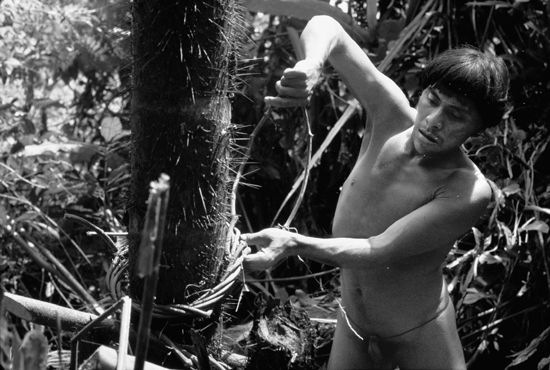
Rerebawä making climbing frames in preparation for climbing a Rasha tree.
Weeks before this raid—and anticipating an inevitable new war—the Monou-teri had already begun clearing new gardens in a more defensible location. They decided to put an obstacle—the Mavaca River—between their new shabono and the Patanowä-teri. They made their new shabono and cleared their new gardens several hours across the Mavaca River from (west of) their existing village site. This would become their new, permanent village site once their gardens began producing.
Clearing new gardens is an extremely labor-intensive undertaking. However, moving meant that any Patanowä-teri raiders would have to cross the Mavaca, a major obstacle. To do so they would expose themselves and would lose the advantage of surprise.
The new gardens were also in the direction of their recently acquired allies—the Shamatari villages of Mömariböwei-teri and Reyaboböwei-teri (the former was the village where I discovered that most of my genealogical information on the residents of Bisaasi-teri was utter nonsense). The close proximity of Monou-teri’s two new allies would most likely further deter a Patanowä-teri raid.
But the Patanowä-teri’s revenge was swift, extraordinary, and lethal. They deliberately targeted Matowä and went after him on their retaliatory raid. They caught Matowä a short distance from the new gardens, searching for honey with two of his wives. It was in late January or early February 1965 . . . just a few weeks after he and his raiders had killed Bosibrei.
Matowä’s older wife related the story to me. Matowä was peering up a tree, looking for the bees’ nest and honey when his assailants found him. He apparently didn’t even see them in the gray shadows of the dim forest. There was a sizable number of raiders. They quietly nocked their arrows and released them simultaneously in a single volley. At least five arrows struck Matowä in his chest and abdomen. Although he was probably mortally wounded, he nocked one of his own arrows, cursed his assailants defiantly, and feebly shot back at them. One of the raiders, a man named Bisheiwä, then nocked a second arrow, resolutely aimed it at Matowä, and released it. It flew true, striking Matowä in the neck, just below his ear. He fell to the ground and died while the raiders solemnly surrounded him and watched. Then they hastily and silently departed, leaving the two frightened women. Taking the two women as captives would have impeded their safe retreat back to Patanowä-teri. They had to cross the Mavaca River again and then travel two full days.
Bisheiwä, who shot the fatal arrow into Matowä’s neck, was one of Bosibrei’s sons. The raiders also included two men who called Matowä by the kinship term meaning brother; they were in his lineage, not brothers, but cousins on the male side of the family. Three of the raiders, including Bisheiwä, were Matowä’s brothers-in-law (shoris ). This underscores the fact that kinship is not an impediment to lethal violence, although the shoriwä relationship is usually a very amicable one. Finally, one of the raiders was a Shamatari who, with his mother, had been abducted many years earlier by the Patanowä-teri from a Shamatari village to their south.
Matowä’s wives fled back to the village and told the others what had happened, which is also how I first learned the details of this raid.
The Monou-teri were shocked and disturbed by the swift and lethal retaliation of the Patanowä-teri. But instead of giving chase, they unraveled in a political sense: they were stunned and thoroughly demoralized by the death of their leader, their waiteri.
They mournfully cremated Matowä’s body the next day and held a small mortuary ceremony in their village, consuming some of Matowä’s ashes in plantain soup. They would hold a larger, more elaborate reahu (mortuary ceremony) later and invite the members of allied villages to a big feast for that purpose.
Matowä’s two wives were taken by his brothers as additional wives, according to Yanomamö custom, the same custom of the Levirate that we know from the Bible. Many tribal peoples all over the world observe this same rule.
The Monou-teri then fled deep into the jungle to hide.
This cowardice disgusted Matowä’s patrilineal relatives in Bisaasi-teri—including Kaobawä, the village headman and a classificatory brother of Matowä. The Bisaasi-teri were furious that the Monou-teri displayed unforgivable cowardice by not pursuing the raiders and trying to kill at least some of them. To show fear and timidity is an invitation to others to further intimidate and exploit your group and it gives all groups related to you the stain of cowardice. The Monou-teri’s decision to flee reflected on Kaobawä.
Kaobawä then assumed the responsibility of organizing a revenge raid against the Patanowä-teri. He did so just as the dry season was at an end, in early April, which would make a counterraid by the Patanowä-teri unlikely: the rainy season would make the two days’ travel through flooding jungle very difficult or even impossible.
Kaobawä invited the Monou-teri to move into his village temporarily, an invitation they gratefully accepted. As mentioned earlier Kaobawä had been attempting to make peace with a major faction of the Patanowä-teri when Matowä initiated all these tragic events. Peace between Kaobawä’s faction of Bisaasi-teri and Patanowä-teri was now a very remote possibility because of Kaobawä’s invitation to the Monou-teri.
Kaobawä had an adult son by a previous marriage, Shinahewä, who lived in Patanowä-teri, and Kaobawä wanted to make it possible for this young man to visit freely between their two estranged villages. Despite the fact that Yanomamö villages at war are like modern nations at war, there is concern for kinsmen when they live in a village that is now a belligerent. The distinction between warrior and civilian is fuzzy in the Stone Age. In most cases, no harm will come to the noncombatant relative, but sometimes a few residents, moved by grief, will try to harm or even kill that person. That is the reason some people choose to flee to a safer (but related) village when hostilities break out. In fact, a sizable faction of the Patanowä-teri did flee to and rejoin the Bisaasi-teri group shortly after this war began.
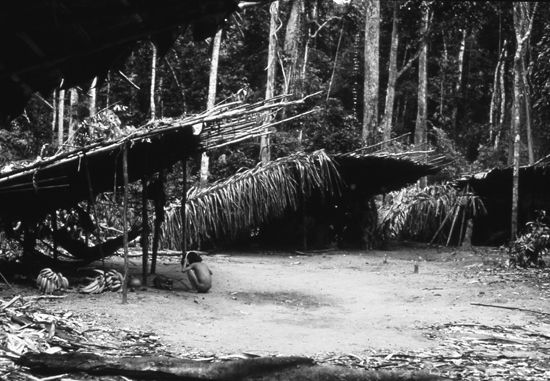
A hunting camp containing several yanos —temporary huts made with poles, vines, and leaves.
The impending war set in motion a number of activities that helped me to understand more fully the histories of the various villages I had become familiar with in the short time I had been living there, as well as their political strategies.
First, Kaobawä took immediate steps to make his village more defensible: the Upper Bisaasi-teri had two shabonos located immediately next to each other, just a few yards apart. They were, as the Yanomamö say, living he borara : “separate, but close to each other.” This phrase kept coming up when I collected accounts from old informants about the various village movements they and their parents had made in the past. To live he borara is pretty good evidence that the two groups were having a local squabble and wanted to have their own, independent, village, but could not move too far away from each other because they were involved in a war with a distant larger village whose leaders would regard them both as enemies—and would more easily kill them if they separated and moved away from each other. The obvious lesson is that there is safety in numbers, so Yanomamö groups conscientiously attempt to maximize the size of their villages and try to quash internal squabbles before they lead to antagonisms that can split the village into two hostile smaller groups. This is why they often choose to live he borara for security and safety reasons.
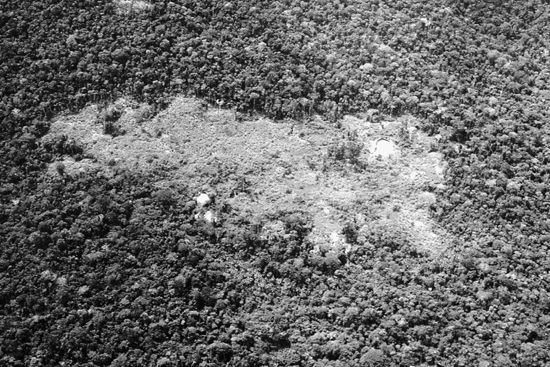
A large Yanomamö garden with two shabonos , indicating that the village is splitting into two separate groups but living he borara —close to each other. When the second and smaller group establishes a producing garden elsewhere, it will move there and make a new shabono.
Kaobawä had to persuade the members of the two he borara groups to consolidate into one larger shabono —a palisaded shabono. Moreover, when the Monou-teri—some sixty people—temporarily moved in with them, the greater village would number over two hundred people and could field a much larger raiding party to deal with enemies. The Monou-teri would help with the construction of the new shabono and palisade, an upright wall of eight-foot-high posts that were buried into the ground a foot or so and then lashed together with strong vines.
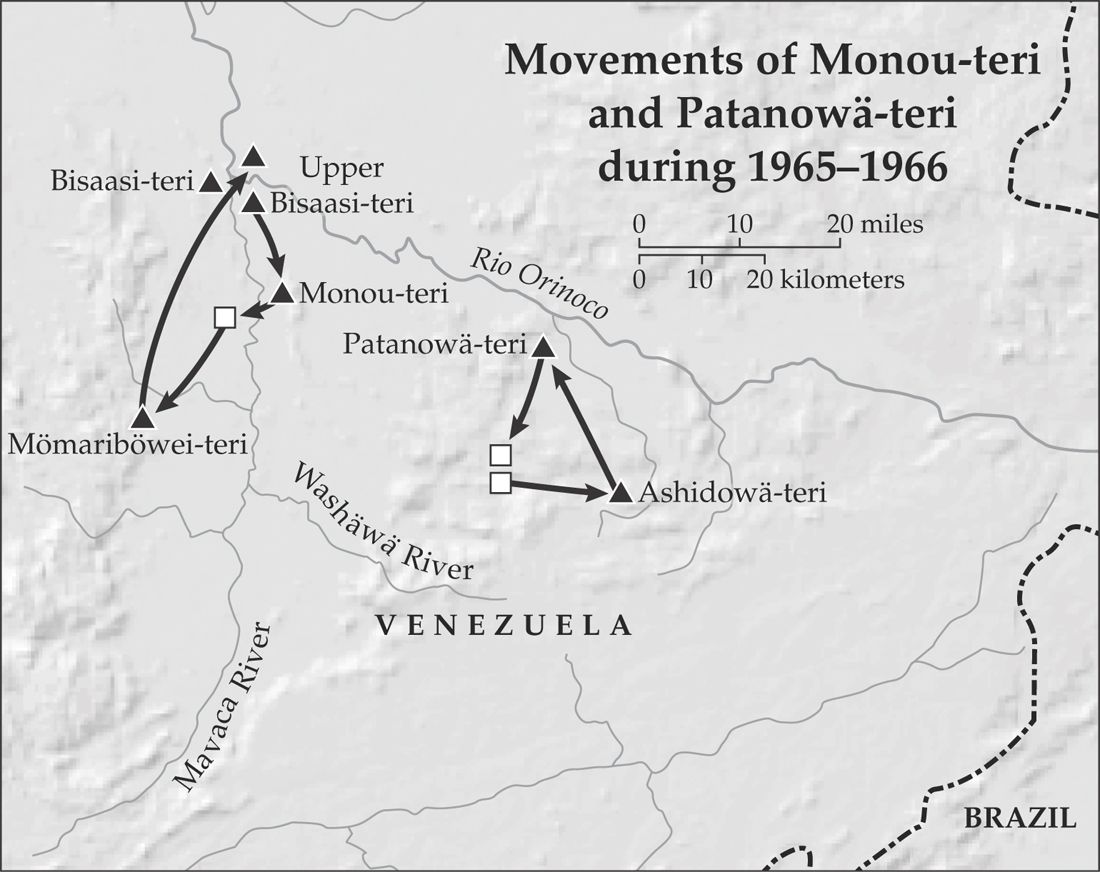
Successive movements of the Monou-teri and Patanowä-teri with respect to their new gardens and allied villages during 1965–66 as they attempted to avoid raids from each other.
The Patanowä-teri had to undertake defensive preparations. The Monou-teri and Bisaasi-teri were now their most active enemy. Thus the Patanowä-teri also abandoned their existing village and gardens and moved to the south to establish new gardens and construct a new, heavily palisaded shabono. They also took enormous numbers of plantain cuttings from their old garden and transplanted them to their new gardens. And, like the Monou-teri, they were now dependent on allies for refuge, food, and a respite from the now-increased number of raids on their group by both their traditional old enemies and their new enemies, the Monou-teri.
Historically powerful groups like the Patanowä-teri have a special kind of problem: they become powerful by intimidating and harassing their neighbors, raiding them, driving them out of the region, abducting women from them, bullying them, and occasionally killing some of them. However, these old enemies never forget and never forgive: they simply feign friendship and trust when they sporadically meet. So, when the powerful groups find themselves embroiled in new wars on a new front, all their previously dormant enemies seize this opportunity to strike at them while they are militarily and politically vulnerable—or perceived to be.
For these reasons, during the first seventeen months of my field research the Patanowä-teri were raided some twenty-five times by their older enemies and by the new enemies such as the Bisaasi-teri and their recently acquired Shamatari allies.
Even though I was living with the Bisaasi-teri, I was politically neutral and could move between the warring factions at will in this particular war. But my visits to the Patanowä-teri during this period were nerve-racking. The Patanowä-teri were always agitated, jumpy, constantly peering into the shadows of the forest for signs of raiders—and grabbing their weapons on hearing any unidentified noise from the forest. Fights and arguments frequently erupted within their large village over trivial things, and the two Patanowä-teri headmen would quickly descend on the troublemakers with clubs, threatening harsh actions if they failed to desist from their squabble.
When I visited, they made me stack up pieces of firewood and my backpacks around my hammock at night to protect myself from arrows that nocturnal assassins might shoot at me. They also insisted that I keep my shotgun loaded and next to my hammock within reach, to shoot at anyone who came into the village after the entrances were blocked shut for the night.
All of this seemed perfectly reasonable and quite logical to me at that time. But I gradually realized that my fieldwork situation had imperceptibly become very different. To a certain extent I was no longer simply an outside observer looking into their culture, as if it existed in some kind of test tube. I had, in a sense, become part of what I was there to observe: I had become an element in their neolithic world. At night, in the dark shadows of a shabono, all men are Yanomamö. In this specific case, all men were Patanowä-teri.
The Patanowä-teri embarked on what I considered to be a brilliant military strategy. Instead of spending time attempting to raid all of the relatively minor groups that were now attacking them with undeserved boldness, they concentrated their efforts on just a few of their more notable adversaries, like the large village of Hasuböwä-teri, just a day and a half to their east. They had previously once rendered the Hasuböwä-teri militarily impotent by systematic raids that targeted their political leaders, their waiteri —men with reputations of ferocity. They boasted to me that they killed most of them and regarded the others there with contempt because they were cowards. When I first met the Patanowä-teri in early 1965, they scoffed at the mere mention of the Hasuböwä-teri; they sardonically dismissed them by saying that they were now “like women” because the Patanowä-teri had killed all their waiteris. Now, with the Bisaasi-teri hostile toward the Patanowä-teri, the Hasuböwä-teri were trying to reassert themselves. To deal with this the Patanowä-teri conducted what contemporary military analysts might call preemptive strikes: they killed the remaining few Hasuböwä-teri waiteris, thus neutralizing, in their view, this possible threat. That enabled them to concentrate on the Bisaasi-teri/Monou-teri/Shamatari alliance to their west because all was now relatively quiet on their eastern front.
The Bisaasi-teri raid against the Patanowä-teri organized by Kaobawä took place in April 1965. Kaobawä expected his two Shamatari allies to the west—the Mömariböwei-teri and Reyaboböwei-teri—to send contingents of warriors to participate in this raid, but it seemed that they were reneging on their promise. In Yanomamö politics, allies often need each other but do not always deliver on their promises of aid and do not often trust each other.
Kaobawä delayed his raid for a few days because he suspected that his Shamatari allies were simply waiting for his raiding party to leave so they could then descend on Bisaasi-teri and steal women. But at the last minute a few men from each of the two allied Shamatari villages finally did show up, and the concern over allied treachery was put to rest, at least on that occasion.
On the afternoon before they left on the raid Kaobawä held a small reahu mortuary feast. Ripe plantains were cooked and mashed into a sweet, thick soup contained in a large bark trough staked to the ground to prevent the soup from leaking out—it was like a massive banana pudding stored in a bark canoe. Although I had been living with them for five months I was still apprehensive about trying to get close to the group of mourners, who seemed to be in an emotionally volatile mood. Thus I remained a comfortable distance away while the women drank gulps from small gourds of plantain soup into which some of Matowä’s ashes had been mixed, and everyone wept loudly, and plaintively called to their fallen kinsman with endearing kinship terms. It was very sad.
Later in the day the raiders conducted a mock raid, a ceremonial rehearsal of what they hoped to do when they reached Patanowä-teri.
They constructed an effigy—a no owa —to represent a specific Patanowä-teri man they intended to kill. In this case the no owa was a pithy log about five feet long with the bark removed. The pale, stripped log was painted with dark red nara pigment—wavy lines to represent maleness—and a few colorful feathers were attached to the head end. It was placed in a hammock, as if the victim were resting and mohode —unaware. Kaobawä then organized the raiders into several groups. Each group slowly crept—duck-waddled—toward the no owa from different directions. When they were close, they silently rose to a shooting position, drew their bows, and on a signal from one of them, simultaneously let their arrows fly. The no owa shuddered and bounced in the hammock as the dozen or so arrows thudded into it. Then the raiders hastily retreated from the shabono and retreated a short distance into the forest. After a few moments, they silently returned to the shabono and retired to their hammocks to wait for nightfall.
The shabono became eerily quiet after dark. I could tell that something was about to happen. The normally crying babies were shushed by the mothers. I could hear people moving around but I could not see them. Their hearth fires had been deliberately allowed to die down to embers and it was very dark inside the shabono.
It is a strange feeling to know that something dramatic is about to happen—something deeply primitive and frightening—but not knowing what it might be. My eyes kept darting around, trying desperately to see what was making the soft, muffled noises. People were moving and almost gliding past me quietly but I couldn’t see them. Maybe they were surrounding me and planned to shoot me for trying to witness some prohibited sacred ceremony that outsiders were not allowed to see?
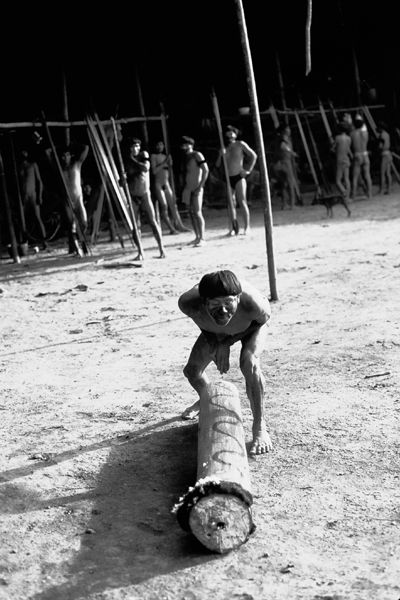
A no owa , or effigy, of some intended male victim. This one is made from a log with the bark removed and painted with a long serpentine design. It has a monkey-tail headband covered with white buzzard down. The man hovering over it is spitting on it to insult the enemy it represents.
The stillness was suddenly shattered by a blood-curdling scream—a man’s voice that sounded like part animal growl and part wail. He emerged from the darkness of the shabono interior to my right, clacking his six-foot-long war arrows against his heavy palm-wood bow stave as he marched slowly out to the dim center of the village clearing, making frightening screams and growls as he mimicked various ferocious carnivorous animals and insects. I could barely make him out as he turned and stood menacingly with his face to the southeast, toward the enemy village of Patanowä-teri—but also toward me! He rested the fletched ends of his arrows on the ground near his feet, next to his stout bow. He then stared silently toward the southeast—over my head. I still thought he was staring at me. I was thinking, You’re next, nabä !
Then the village grew unsettlingly quiet again. Presently another man, from a different part of the village, stepped out of the dark shadows of the shabono roof, noisily clacked his arrows against his bow stave, and, like the first man, proceeded slowly toward the center of the plaza. And like the first man, he uttered piercing, shrill noises mimicking carnivorous animals and biting insects.
I felt goose bumps on my arms. I imagined myself being present at a time ten thousand years in the past and thought about how utterly strange that I was to be one of the last members of my profession to experience an event that had, by the 1960s, become nearly unique. These were the last of the Stone Age warriors assembling to wreak mayhem and death on distant enemies. Their enemies waited anxiously, not knowing when they would come, but anticipating their terrible wrath.
The warriors were painted black but looked in other regards like they did normally, naked with their penises tied to their waist string. Only their bows and arrows proclaimed them as yahi tä rimö —humans who dwelt in houses—and not urihi tä rimö , wild and beastly animals who lived in the forest. Their anger, aggression, and determination were premeditated and resolute, not spontaneous like the sudden, aggressive bite or attack of a feline or canine predator.
Each raider repeated this process until they were all standing in a straight line, facing toward the southeast. It took only some thirty minutes for the lineup to be completed, but it seemed like several hours. I later learned that I was watching a ritual that the Yanomamö call wayu itou, the ritual pre-raid assembly of the raiders. This ritual is conducted only on the eve of a raiding party departing to kill enemies. I have subsequently witnessed several others and all caused goose bumps to appear on my arms and neck.
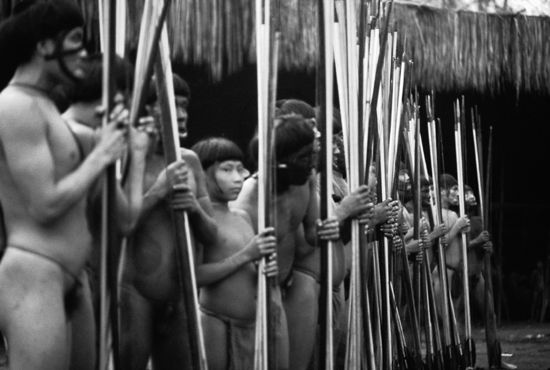
A warrior line-up— wayu itou —just before departing on a raid. The group includes Matarawä, a young boy going on his first raid to avenge his father’s death at the hands of raiders a month earlier.
The murmurs and whispers of the women and children suddenly ceased and the village again became very quiet. I continued to squat at the edge of the plaza, trying to be as inconspicuous and unobtrusive as possible. What I was witnessing clearly provoked awe and powerful emotions among the Yanomamö—but I was worried that it was something that might also provoke anger among them because I was watching and tape-recording it.
Again the silence was suddenly broken, this time by a deep baritone voice slowly singing, “I am meat hungry! I am meat hungry! Like the carrion-eating vulture, I am hungry for flesh!” I recognized the voice as Torokoiwä’s, one of Matowä’s brothers, who was an exceptionally skillful singer and chanter. The stanzas of the Vulture song, as it is called, changed radically from deep, methodical baritone phrases to nearly falsetto ones within a single phrase. I still get chills when I play my tapes of this song—it is truly frightening and has, for want of more precise words, an undeniable primordial quality.
The rest of the raiders repeated the lines of the song, ending the final word with a disturbing high-pitched scream.
Torokoiwä then led a second chorus of the song, varying the words slightly, referring this time to the voracious meat hunger of a type of carnivorous wasp, instead of the vulture in the first chorus. Specific men interjected descriptions of violent deeds they intended to inflict on enemy warriors—bashing their brains out, splattering their blood all over their wives’ possessions, making their children tremble and weep, and other despicable violent things.
When the singing of the last stanza terminated, the entire line of warriors coalesced into a tight formation and shouted three times in unison, getting louder each time: “Whaaaa! WHAAAA ! WHAAAA!” Then suddenly they became silent and listened for the echo of their last shout, which would portend success. When the echo was heard, they became frantic and excited for they knew then that their enemy would be found at home. They hissed, growled, and clacked their weapons together excitedly, dancing in place.
Eventually Kaobawä calmed them down and they reassembled. They repeated the shouting two more times in almost precisely the same fashion. But at the end of the third repetition they scattered and ran back to their respective houses, making a sound like bububububububu as they ran. On reaching their hammocks, they all began to vomit and retch symbolically, making disgusting, loud puking noises. They were vomiting out the “rotten flesh” of the enemy whose body they had symbolically devoured like carrion during the wayu itou.
They then retired for the night. Hearths were given more firewood and the flames danced and flickered as they came back to life. Babies periodically whimpered and cried until their mothers gave them a breast, and a few dogs let out sharp yelps as their owners hit them with pieces of firewood for moving in too close to the hearth to keep warm. The shabono interior described a nearly perfect circle of campfires spaced a few yards apart. Only the first few feet of the roof over the campfires was illuminated, where the roof met the earth, and I could see a hundred or more hammocks, strung low to the ground, some motionless, some swinging gently. Several of Matowä’s brothers murmured and sang sad, melancholy songs, mourning for him deep into the night. The smoke of many campfires lofted slowly upward following the interior of the slanted roof and then silently disappeared into the black sky.
At daybreak it was cold. The women went quietly to the gardens and cut bunches of plantains and tied them into bundles. The men would, in turn, bind them to their vine hammocks and carry them on their backs by a shoulder thong. They would eventually roast them over hot coals and eat them en route to the Patanowä-teri, the enemy.
The Patanowä-teri were at least two days away, but they might be even further: they were in the process of moving to a new, more defensible garden at a place where their enemies would least expect them to be. Thus the raiders were uncertain of their precise location and, therefore, how much food they should bring to sustain themselves.
The raiders repainted their legs, arms, faces, and torsos in black pigment (masticated charcoal) in the dimness of the first light. They inspected their weapons, changed arrow points if necessary or simply out of nervousness, and made sure their bowstrings did not have any weaknesses that might cause them to break at a crucial moment.
At dawn Kaobawä passed the word for them to repeat the wayu itou, but this time it would be in daylight and I could see more clearly what had been so terrifying to me in the dark.
The warriors slowly and with resolute determination marched one at a time to the center of the village and stood in a line, facing southeast as they did the night before. This time they did not sing the Meat Hungry Vulture song, but simply shouted in unison toward their enemy. When they heard their echo, they marched dramatically out of the village single file, picked up their vine hammocks and plantains that were placed on the trail by the women, and silently disappeared into the jungle. Their mothers, sisters, wives, and daughters wept, and as they disappeared they apprehensively enjoined the warriors to be careful, to come back home safely—as women everywhere do when their sons, brothers, husbands, and fathers go off to war.
Kaobawä had not been well for several months prior to this raid. He was suffering from what he kept describing to me as a pain in his lower back, urinary tract, and lower abdominal areas. I could not tell if the pain was inside, perhaps like kidney stones, or outside, caused by some trauma or injury. In any event, he sometimes had difficulty walking long distances. He nevertheless insisted on leading this raid. I suspect that he was worried that if he did not, his enemies would interpret the village’s collective failure to avenge Matowä as cowardice.
Let me emphasize the Yanomamö view that when members of a group acquire a reputation of timidity and cowardice, their neighbors take ruthless advantage of them, push them around, insult them publicly, and take their women. Thus it is strategically important to react decisively to any affront, no matter how trivial. If a group is small, the men try to make up for their numerical disadvantage by acting as if the group is bigger, nastier, more ferocious, and ready to fight on a moment’s notice. Feigning to be “larger than life” is a deception that is widespread in the animal world but is usually a characteristic displayed by individual combatants. The Yanomamö, however, engage in this masquerade as members of social groups. I often deliberately avoided visiting small villages because they were predictably very aggressive and unpleasant to be around in order to compensate for their actual military weaknesses.
The raiders were not gone a half day when a few of them began to return to the village. They complained of pains in their legs, or thorns in their feet. Most of these were younger men of dubious valor, men who enjoyed displaying their alleged ferocity in the safety of their own shabono during the wayu itou and in front of the young women, but who were keenly aware of the risks they would endure when they got close to their enemy’s village and the arrows started flying.
The ones who pushed on to the enemy’s village traveled slowly the first day, looking for signs of recent footprints leading toward or from the southeast. These would be evidence that Patanowä-teri raiders had crossed through the area. They also carried plantains for several days’ meals, which were heavy and slowed them down at first. On this raid they also paced themselves so they would arrive in the general vicinity of Patanowä-teri’s most recent village near or at dusk of the second day. They would camp just an hour or so from the village and reconnoiter the area, hoping to find positive signs of recent local travel along the footpaths. They knew this area well, since they themselves had lived here when they and the Patanowä-teri had been one large village some dozen years earlier.
The raiders later told me they spent the last night close to the village and could not make campfires to keep themselves warm. Every member of the raiding party I spoke to made a point of telling me about how uncomfortable it was sleeping without a campfire. I could empathize with them. When I traveled through the jungle and camped for the night I would change into my sleeping attire: a clean, dry set of clothes that included a T-shirt, dry underpants, socks, long pants, a long-sleeve shirt—and an insulated, lightweight nylon blanket. I always felt very cold whenever the fire went out at any altitude, and it was much worse at higher elevations. The Yanomamö have no clothes or blankets, so they shivered uncomfortably all night long, naked in the damp, cold night air. Yes, I could understand how cold and uncomfortable it must have been without fire. Fire is what makes Yanomamö yahi tä rimö —different from beasts.
The raiding party leaders also confided to me another problem: their concern that the younger men might defect and turn back. The excuses would be fear of a nocturnal jaguar attack without a campfire, the cold, the sore feet—and any other plausible justification, including a bad dream that portends disaster. Most of them were simply frightened, but to show or admit fear is a sure invitation to be branded a coward, an accusation that tends to remain forever in the memories of others. It is acceptable to use as excuses injury, the cold, jaguar threats, sore feet, etc. and not admit you were afraid.
Their plan from the outset was to split up at dawn and approach the village in several small groups of about four men each. They hoped to shoot one or more of the enemy and retreat in a defensive pattern: while two defenders remained on the trail with their weapons ready, the others would hastily retreat past them. Then the first two would retreat while two of the former group would take places down the trail to cover them against any pursuers. They would repeat this pattern until they were at a safe distance from the village and then all would literally run toward home and safety.
If there were any novices on the raid they would make another no owa out of leaves or a log and rehearse the retreat for their benefit.
On this particular raid they brought along a boy of about twelve years. He was Matarawä, Matowä’s oldest son. He was the youngest raider I ever saw on any of the raiding parties I witnessed. This would be his first raid: they wanted him to taste and enjoy the cold dish of revenge for the death of his father. But they protected him, always making sure he had experienced raiders in front of and behind him—and they planned for him to be the first to retreat to safety after they killed an enemy.
While the raiders were gone those who remained behind were tense and nervous, constantly on the lookout for other raiders—especially men from erstwhile friendly villages. Raiders might take this opportunity to visit the village and seize with relative impunity some of the now poorly defended young women and girls.
The women were nervous and irritable, and several bitter arguments broke out among them over trivial issues. One woman became very angry when her sister left her baby with her to babysit for a brief time. When she returned, the babysitter picked up a stout piece of firewood and bashed the mother along the side of her head, knocking her unconscious and causing a bloody scalp wound. The few adult men in the village had difficulty preventing the fight from escalating and involving more of the village women and possibly some of the men.
The raiding party had been gone almost a week when Kaobawä and his youngest brother, Shararaiwä, staggered into the village and collapsed silently into their hammocks. They were exhausted.
Kaobawä’s groin pains had worsened on the trail and he had great difficulty walking: he would have been a liability to the group as they retreated, so he reluctantly dropped out of the raid and planned to head slowly for home. When they turned back they were getting close to Patanowä-teri. Shararaiwä accompanied him to make sure he could make it all the way back. But shortly after they dropped out and were headed home, Shararaiwä stepped on an arowari —a very poisonous snake—and was bitten by it. The rainy season had already begun, and the snakes were concentrating in the higher areas—where the Yanomamö trails usually were. Snakebites are much more common in the rainy season for this reason.
Shararaiwä’s leg began to swell up immediately and he could not walk. Kaobawä, barely able to walk himself, then had to carry his brother on his back—or leave him where he lay, close to the enemy village. Kaobawä carried Shararaiwä for the better part of two days, in great pain, until they finally reached the banks of the Orinoco River. He intended to make a crude bark canoe and float downstream for the remainder of the trip because he could carry Shararaiwä no farther.
But they had the good fortune of discovering a concealed dugout canoe that one of the men from another village had hidden in the brush. The man was on a visit to Bisaasi-teri and had had to cross the Orinoco to get there.
The next morning the main group of raiders marched silently into the village. Word quickly spread that they had reached the Patanowä-teri and succeeded in killing one of them with their arrows. The Patanowä-teri gave chase, managed to get ahead of them as they retreated, and were able to shoot one of the raiders, a Monou-teri man named Konoreiwä.
Two men were carrying Konoreiwä in his vine hammock, strung on a pole between them. He was unconscious and had been for some time. He had been shot with an arrow that was tipped with a lanceolate-shaped rahaka point. It had gone completely through his chest, just above his heart, and the tip of the point had protruded out of his back. They managed to pull it out on the trail, but it was a very bad wound. They told me that one of them was able to bite the end of the protruding arrow point and pull it out with his teeth. They also told me that before they got back Konoreiwä was coughing up blood filled with air bubbles, and he wheezed with each breath. The arrow had torn through a lobe of his lungs—almost always a fatal wound.
When they reached the Bisaasi-teri shabono they transferred Konoreiwä into a more comfortable, larger, cotton hammock that was strung close to and above a fire to keep him warm.
They asked me to “cure” him, that is, “treat” his wound. I thought Konoreiwä’s chances without major surgery were poor. I had learned, on the spot so to speak, how to stitch up injured Yanomamö, mostly head wounds from club fights, but properly treating Konoreiwä’s arrow wound was way out of my league. The crowning achievement of my first-aid skills had been putting about ten stitches into the mangled foot of Shiimima, one of Kaobawä’s brothers. He had wanted to see if there was a caiman in a submerged den he found in the bank of a small stream. He quickly found out that, indeed, there was a caiman in that hole, one who was ferociously protecting her newly hatched eggs.
The Yanomamö believe that when you are wounded with a rahaka -tipped arrow you can drink only minute quantities of water until you recover. Most of their folk beliefs are almost the opposite of what sound medical practice recommends.
Konoreiwä lay silently in his hammock for several days, eating little, and drinking less. He was slowly wasting away, mostly from dehydration. I did what my modest medical knowledge and medical supplies permitted, which was keeping the entry and exit wounds clean and giving him antibiotics in an attempt to prevent infection.
Finally, I could not bear to watch him wasting away and decided to take matters into my own hands, Yanomamö customs and taboos that proscribed water be damned. I made a conscious decision to interfere in their culture—and I do not feel the least bit guilty for doing so. Some anthropologists would say I did something unethical because this act might give them hope and therefore make them dependent on modern medicine and, when I left, my medicine would no longer be available. This would most likely cause them psychological harm. According to such logic it is better not to give them hope and make them dependent on modern medicine, to let them die. I disagree.
I ceremoniously made Konoreiwä a large batch of extremely sweet lemonade, proclaiming loudly that it was mönasönö. The Yanomamö don’t have a word for what we call medicine so I used the Spanish word for it, medicina, which they knew about in Bisaasi-teri. The Yanomamö pronounce it mönasönö and it is usually taken to be something nearly magical that nabäs are able to make to cure themselves and cure the Yanomamö. Mönasönö includes such things as antimalarials, penicillin, anti-worm medicine, aspirin, measles vaccine (after 1968), and so on.
Their taboo did not prohibit a wounded warrior from taking mönasönö for his near-lethal rahaka wounds, even when it came in a watery (and clandestinely sweetened) form.
When my batch of mönasönö was finished, I brought it over to Konoreiwä’s hammock and very publicly announced that I was going to give him some of my mönasönö. Several men who had been on the raid gathered around me. I made a point of holding up several aspirin pills, crushed them in a pair of spoons in front of their eyes, and dropped the powder into the aluminum pot containing the mönasönö and stirred it for a few moments into the liquid, thus increasing its magical potency. I then took a Yanomamö spoon of sorts—a small gourd cut in half along its length—and dipped it into the mönasönö and, lifting Konoreiwä’s head slightly up from his hammock, counseled him to drink the mönasönö. His face lit up as he swallowed it. The others probably assumed that it was some sort of shock reaction he had from the power of the mönasönö. But I had to smother a grin, for now two of us knew that it was very sweet lemonade, masquerading as mönasönö. A knowing glance of acknowledgment and an imperceptible flicker of his eyebrows told me he also knew that this was not ordinary mönasönö.
I admonished the others that this mönasönö was to be drunk only by the victim—it would potentially harm anyone else—and they were to continue giving it to him during the night and into the next day, at which time I would make another batch of it.
Thanks to his inherently superior constitution, and with a generous ration of mönasönö, Konoreiwä slowly recovered. My reputation as a curer increased further. By the time I left for home that year the Bisaasi-teri had a great deal of trust in me and confidence that my mönasönö was tendered in good faith, usually worked, and tasted rather like buu, their word for honey and for sugar water.
—
The raiders who shot fatal arrows into their Patanowä-teri victim were both brothers of Matowä. Since they were now unokai —killers of men—they had to ritually purify themselves by undergoing a special ritual: the unokaimou. Both had undergone this purification before for earlier killings.
It was because of this specific raid that I began to learn about the existence of an important, permanent, and earned status position in Yanomamö society: unokais. It was a high status that did not emerge because of “differential control” over the strategic resources available in Yanomamö culture, nor control over the material means of production. This was the sort of argument textbooks claimed about status positions in “egalitarian” societies, a status that all individuals of the same sex and same age would more or less automatically acquire just by being there. Not all men were willing to endure the risks and expose themselves to the dangers that Yanomamö unokais did—and unokais held a special, earned, and respected status that only some men achieved.
The two unokais were given a special space in Kaobawä’s shabono , where they strung their hammocks. Their space was separated from the adjacent areas with a seven-foot-high wall made of palm fronds. The unokais had their food brought to them for the week they were in ritual confinement. The two men used sharp sticks, not unlike chopsticks, to pierce their food and take it into their mouths: they were not allowed to touch the food lest they contaminate it with the pollution their fingers and bodies exuded. If they did so, this pollution would enter them and cause them to become sick. They also had to be careful to scratch their bodies, when they itched, with similar (maybe even the same) sticks they used to eat with. Their hands and fingers were especially polluted. They had to keep their voices low and speak in whispers. They were also prohibited from cutting their hair and had to let it grow for the better part of the year. And they had to refrain from sex for a lengthy period.
The unokaimou ceremony was, in almost all respects, nearly identical to the ceremony that pubescent girls went through when they had their first menses—the nyöbömou, which marked their transition into womanhood.
After about a week in ritual confinement the two unokais emerged. Their vine hammocks—the ones they were sleeping in and the ones they used on the raid—were then taken down and tied with vines to a specific kind of tree about six feet above the level of the ground. Their vine hammocks were spaced about a foot apart on the trunk of this tree. The tree was on the bank of the Orinoco, perhaps by chance, hidden in the underbrush. Their scratching sticks were also attached to the hammocks and to the tree. When this was done, the two men were free to resume their normal activities—except for cutting their hair and resuming sexual activities. I don’t know how long the sexual abstinence requirement lasted. Most anthropologists, me included, know very little about the sexual lives of the people they study.
Rare photo: the vine hammocks of the unokais
Unokais have an unusual status in their villages. Most outsiders do not know about them, or about the unpretentious and rarely discussed high status they have. Even a diligent, curious anthropologist might not learn about them if he studied a village that has not engaged in warfare or where no individuals in that village had killed another human in the recent past.
Unokais are both respected and somewhat feared because they have demonstrated a willingness to kill people and are likely to kill again. In a political context, the military credibility and strength of a village can be measured by how many unokais it contains—with the caveat that village size is extremely important as well. But, if two equal-sized villages are compared, the one with the largest number of able-bodied unokais will be the stronger, the more feared, and the more formidable opponent.
Many men acquire a reputation for being waiteri , fierce. But someone who is an unokai has demonstrated his willingness to inflict lethal harm on an opponent and to actually behave in an ultimately fierce manner. Publicly and socially, such men can be extremely placid and calm in their outward demeanor, and even very pleasant and charming. By contrast, many men who are not unokais seem to be compelled to behave in such a way as to imply that they are killers of men. Such men can be very obnoxious and unpleasant in their public lives—ordering people around, intimidating them, threatening to hit them with their machetes or axes, even threatening to kill them. But if an unokai threatens to strike or to kill someone, he usually means what he says. When an unokai gives an order to some man in the village, that man had better do what is asked of him. That is how power, authority, and coercive force by leaders emerges, adds to, and goes beyond the kind of solidarity and cohesion that inheres in the lesser cohesiveness associated with kinship amity. This is the quality that leads ultimately to the power behind law: the odiousness of sanctions. Without law, political states cannot exist.
Kaobawä’s raid against the Patanowä-teri achieved several important things in the arena of regional Yanomamö politics. In the first place the killing of Matowä was, in a sense, a Patanowä-teri test of the strength of the blood ties between the Bisaasi-teri and the Monou-teri: they had killed Matowä, a close patrilineal kinsman of Kaobawä, a man whom he called brother. The Patanowä-teri also knew that Kaobawä had many kinsmen in Patanowä-teri as well, but could not accurately predict his actions when they killed Matowä. Would Kaobawä favor his brothers-in-law (shoris ) in Patanowä-teri over members of his patrilineal lineage (mashi )? Kaobawä acted swiftly and unhesitatingly by raiding the Patanowä-teri, perhaps with the larger (and longer-term) military implications in mind: his actions made the Patanowä-teri keenly aware that he would defend and stand up for the Monou-teri—and the Monou-teri members of his own patrilineage, his own mashi. This meant that the Patanowä-teri would not be safe in the Bisaasi-teri area: they would have to approach the Monou-teri by a more circuitous southern route to raid them, a route that would expose their raiding parties to the two Shamatari allies of the Monou-teri and the Bisaasi-teri. Moreover, Kaobawä was previously an unokai —as were a rather large number of other men in both Monou-teri and Bisaasi-teri.
It began to be clearer to me that patrilineal descent—acknowledging membership in a patrilineal descent group called mashi —was important in Yanomamö political relationships. Lineages are an evolutionary step toward greater social complexity in tribal societies, where kinship relationships structure most social interactions. Patrilineages are defined by genealogical relationships up from and down from some male ancestor and including in the group thus defined all males who are related via the male line. For example, my father’s father was also named Napoleon Chagnon. If I consider all males up from and down from him in the male line, they would all be members of my patrilineal lineage—my mashi. In many situations, especially in political and military ones, we would act as a single group because our survival and well-being would depend on it.
Forming and acknowledging the existence of patrilineal descent groups in your society are important steps in the development of political complexity. Patrilineages are not evident in monumental architecture, sophisticated pottery, conspicuous trappings of office like fancy decorations or staffs of authority, but more subtle things that are more difficult to detect—like the numbers and kinds of genetically related kinsmen who will support your decisions and are willing to die doing so. But, as these patrilineal descent groups and the larger societies in which they are found become larger and more complex than the Yanomamö, these descent groups become identified with real property and with material possessions. Among the Yanomamö, this second step has not yet been achieved. The first step—the most important step—emerged independently of control over scarce, strategic material resources.
What these Yanomamö descent groups control and defend are reproductive rights in nubile females and the male kin who give these women to you and take them from you according to rules of incest and marriageability. All additional “functions” of patrilineages are secondary and derived from these initial functions.
The Monou-teri Raid
Just as the rainy season was ending in early 1965—in about late July or early August—the Monou-teri initiated another raid against the Patanowä-teri. The Monou-teri raid occurred several months after Kaobawä’s raid. This was the only raid the Monou-teri went on that year without the help of at least one of their allies.
I was staying with the Monou-teri in the shabono on their lagoon.
On the day before the raid they conducted a very special ceremony, one that I had not seen before and have not seen since. Perhaps it was a ceremony reserved for unokais who have fallen in war.
They assembled in front of the house of Torokoiwä, one of Matowä’s brothers. There they placed several gourds that contained the ashes of Matowä’s cremated body into a shallow basket. They were in an extremely distressed and almost violent mood known as hushuwo.
Matowä’s bamboo arrow point quiver—his tora —was taken down from the rafters of Torokoiwä’s house and placed on the ground next to the gourds. All the adults in the village crowded in close to the artifacts, squatting on their haunches, weeping and singing very sad songs, calling to Matowä by endearing kinship terms. I was gently and gradually pushed out of the crowd to the periphery and had difficulty seeing exactly what they were doing. I dared not stand up to see better because this would be offensive to the Monou-teri and they were in an extremely volatile mood.
Matowä’s adult brothers were each given several of his lanceolate rahaka arrow points. The men fondled them gently and wept aloud. They would put them on their arrows the next day and use them on this raid. They hoped to kill one or more Patanowä-teri with arrow points that had belonged to their beloved kinsman, a victim of the Patanowä-teri.
Then one brother smashed Matowä’s tora by pounding on it with an ax. The shattered pieces of bamboo were put into a small pile and burning coals from the hearth were mixed into the splinters to ignite them. As they burned, the mood of the women turned into a state of frenzy: they pulled their hair, struck their bodies with their hands and fists, and wailed loudly.
One of Matowä’s brothers then filled a snuff tube with ebene and gently blew it into several of the gourds containing his ashes, a postmortem aliquot of hallucinogen—possibly to enable the deceased Matowä to make one last contact with his beloved hekura spirits. Then the snuff tube itself was broken in half, the breaking point being measured off from the end by the length of one of Matowä’s rahaka arrow points. The broken snuff tube and the gourds were gently wrapped in leaves, tied with vines, and placed back into the structural roof poles, presumably for later ceremonies. It was growing dark when this ceremony ended. People slowly returned to their hammocks, added firewood to their hearths, blew on the coals until their fires danced, and retired for the night.
It was one of the saddest ceremonies I ever witnessed, because I knew these people well and I identified with them, and had great empathy for them. I was deeply moved by what they had just done.
Torokoiwä and other men began quietly singing very melancholy songs to their fallen kinsman, softly, sadly, as they sobbed out the words. I lay in my hammock and listened, not bothering to tape-record it, take photos, or write down notes. One of them asked me aloud why I was not making a nuisance of myself as I usually do. I quietly replied by saying, “Ya buhii ahi.” It means something like “my innermost being is cold because I am in mourning and sad.”
My words were whispered around the village, and as each person heard them, he or she looked over knowingly, approvingly at me. The children, who inevitably gather around my hammock, were told to go home and not bother me. The adults told the children that I was hushuwo, in a state of emotional disequilibrium, and that my soul was cold. To them I was finally acting like a human being, like a Yanomamö. The ones whose hammocks were close to mine quietly reached over to me, looked at me, and touched me gently. And we wept together.
The raiders assembled at dawn, performed the wayu itou, shouted toward the direction of Patanowä-teri, and listened for the echo to return. They left the shabono silently, in a single file.
The raiders never reached the village of the Patanowä-teri. All the trails were flooded and they had to make many detours. They eventually gave up and returned to their village after about a week.
During that one year of war the Monou-teri managed to capture just two women from the Patanowä-teri, but at the price of many blows to their heads in a brutal club fight and the killing of their charismatic and audacious headman, Matowä. The Patanowä-teri, in turn, had two men killed by raiders from Monou-teri and their allies, but managed to recover five of the women taken from them by force on that first day.
During that same time period the Patanowä-teri were raided some twenty-five times, mostly by villages other than Monou-teri and Bisaasi-teri.
The incident that took place the day before I arrived had precipitated a set of hostile actions based on smoldering grievances held by other enemies of the Patanowä-teri who then seized the opportunity to settle earlier scores and began raiding them to kill.
In Yanomamö warfare the time to strike a new blow is when an enemy is temporarily down and struggling—and has many new enemies. Machiavelli could have written The Prince about the political strategies of Yanomamö headmen and villages.
But for me, the larger lesson of what I witnessed had to do with what this single war revealed about the unknown history, the social and political dynamics, and the regional geographical movements of the several parties to the conflict. I couldn’t understand this war—or any Yanomamö war—until I knew the details and deep history of the several villages that were the major belligerents.
Again, I realized that my anthropological training was wide of the mark. It was obvious to me that the “field study” of contemporary tribal groups was too narrowly focused on a single village and a time period that was too shallow. The standard anthropological paradigm or model seemed to assume that tribal villages were frozen in time, had no history to speak of, and rarely changed position in a fixed sociopolitical matrix. The standard social anthropology model I grew up with was severely limited and therefore inadequate to explain what I was witnessing and, I would argue, inadequate to explain much of the history and political dynamics of the Paleolithic era, or what has recently come to be called the EEA—the environments of evolutionary adaptedness, the Environments of History, or the ARE, the adaptively relevant environments that humans lived in prior to the political state and civilization.