Chapter 16
G-ZERO WORLD
T he commitment to austerity in 2010 drove critical economists to impatient fury. Why was the world embarked on a course that was so self-evidently counterproductive and so damaging to the prospects of tens of millions of unemployed around the world? Whose interests were being served by preserving this reserve army? Paul Krugman asked in the New York Times . 1 Whose interests were served by a lopsided deficit debate in which minor tax increases were traded for huge cuts in entitlements? What kind of shock would it take to break this impasse? Historical experience was not encouraging. FDR’s New Deal had not been enough. It had been hobbled by its own timidity and by relentless opposition from the Right. 2 To unleash the full capacities of the American state it had taken the national emergency of a war. “The fact is,” Krugman insisted, “the Great Depression ended largely thanks to a guy named Adolf Hitler. He created a human catastrophe, which also led to a lot of government spending.” 3 That didn’t mean that Krugman was hoping for World War III. But he couldn’t resist telling Playboy magazine that “[i]f it were announced that we faced a threat from space aliens and needed to build up to defend ourselves, we’d have full employment in a year and a half.” In light of events in 2011, one can’t help wondering whether Krugman assumed too much coherence in twenty-first-century politics.
The year, in fact, began with a geopolitical earthquake: the Arab Spring. And true to Krugman’s script, this triggered military intervention and calls for a Marshall Plan for the Middle East. 4 But after Afghanistan and Iraq there was no appetite anywhere in the West for nation building in foreign lands. Among conservative commentators, alarm at the overthrow of friendly Arab dictators mixed with the dismayed reaction to Bernanke QE’s to form a heady cocktail. A Wall Street Journal op-ed drew comparisons to the 1970s, when global inflation had helped to trigger the fall of the shah and Khomeini’s revolution in Iran. 5 Now, by “printing money” and driving up commodity prices, it was the Fed’s QE program that was destabilizing the world. As the Tunisian and Egyptian dictatorships toppled, conservative social media activists urged their followers to tweet “Bernanke has blood on his hands.” 6 Meanwhile, the liberal press fired back: It wasn’t monetary policy that was responsible for high commodity prices and food riots, it was global warming. That riposte allowed Paul Krugman to equate conservative opposition to quantitative easing to climate change denial. 7 It wasn’t so much a serious debate about the Arab Spring as indicative of the increasingly unhinged quality of American political discourse.
Europe was closer to the North African drama, but its reaction was hardly more coherent. France, Britain and Germany fell out over the NATO intervention in Libya, with Germany siding, as it had done at the Seoul G20, with China and Russia. Merkel’s government refused to give its vote in the UN Security Council for the aerial campaign against Gaddafi. Meanwhile, the EU squabbled disgracefully about who should accommodate the desperate refugees and migrants who poured through Libya into Italy. It was a dispiriting accompaniment to the rolling crisis in the eurozone. In the summer of 2011 it was not only the stability of Middle Eastern regimes but the creditworthiness of Italy and the United States that would be placed in doubt. Little wonder, perhaps, that two acute observers of the contemporary scene should refer to the world in 2011 as being governed not so much by the G20, G8 or G2 but by G-Zero. 8
I
By the spring of 2011 austerity was biting deep into the social fabric of Europe. Spending cuts and tax increases were slashing demand and squeezing economic activity. Across the eurozone, 10 percent of the workforce were unemployed. But unemployment for those between the ages of fifteen and twenty-four was 20 percent. And on the troubled periphery, the numbers were numbing in scale. In Ireland general unemployment reached 15 percent and youth unemployment 30 percent, in Greece 14 percent and 37 percent, respectively. In Spain 20 percent of all adults and 44 percent of young people were unemployed by the summer of 2011. Half a generation had their launch out of education and into working life aborted. Nevertheless, the demand for further austerity was unrelenting. After Ireland and Greece had subordinated themselves to troika programs, on March 23, 2011, Portugal’s prime minster, José Sócrates, resigned after failing to gain support for budget cuts. A week later, on April 2, Spain’s social democratic prime minister, José Luis Rodríguez Zapatero, announced that he would not run for reelection and would prioritize stabilizing Spain’s finances. On April 7 Portugal became the third country to place itself under a troika program. 9
The sense that Europe’s welfare state was being subjected to a relentless program of rollback driven by the demands of bankers and bond markets provoked outrage. Stéphane Hessel, former French resistance fighter and ecological activist, survivor of Buchenwald, Dora and Bergen-Belsen, became an unlikely bestselling author with his well-timed manifesto Indignez-Vous! (Time for Outrage! ). 10 To oppose the demands of global finance Hessel summoned the spirit of resistance martyr Jean Moulin, who died in 1943 at the hands of the Gestapo. Taking up Hessel’s slogan on May 15, 2011, ahead of local elections, a crowd of twenty thousand Spanish protesters occupied the most symbolic square in Madrid, the Puerta del Sol. The indignados would remain there for a month, defying efforts by the police and courts to evict them. 11 Building a tent city, they declared that “we are not goods in the hands of politicians and bankers.” 12 And the M15 movement continued long after their original camp was dispersed. June 19, 2011, witnessed the largest wave of demonstrations in Spain’s tumultuous modern history, bringing perhaps as many as 3 million people—7 percent of the Spanish population—onto the streets. 13 Scaled to the size of the United States, the equivalent demonstration would have involved 19 million protesters. Among the more humorous Spanish chants was one directed at Greece, their partners in austerity: “Hush! The Greeks are sleeping.” In 2010 Greece had been rocked by massive protests. But since the fall, resistance in Greece had ebbed. On May 28, 2011, Athens answered the Spanish challenge and the latest round of cuts demanded by the troika with the occupation of Syntagma Square. A week later, June 5 saw a gigantic rally, with between 200,000 and 300,000 participants in the capital city. Syntagma would be cleared only after violent clashes on June 28–29 pitting revolutionary militants against riot police, many of whom made no secret of their sympathy for Greece’s neofascist Golden Dawn movement.
A resurgent nationalism, defending sovereignty against the impositions of the crisis, would be one of the most powerful political responses to the crisis. This had both left- and right-wing variants. Both were at their most vocal in Greece, where the diktat of the troika awakened memories of occupation, civil war and dictatorship. On the Left it was commonplace in the demonstrations of 2010 and 2011 to associate Germany’s veto over eurozone economic policy with Nazi imperialism. Meanwhile, Greece’s own fascists paraded openly in the streets. 14 The membership of the Golden Dawn party reveled in torch-lit processions, adorned with runic flags and shielded by heavily muscled storm troopers. Golden Dawners harassed and attacked leftists and non-European immigrants, while laying on soup kitchens, reserved, of course, only for hungry Greeks. In a textbook rerun of the 1930s, a comprehensive social and economic crisis provided the setting for a program of national racial community.
The modes of resistance produced by the crisis were significant in their own right. Marches, demonstrations and strikes were combined with encampments, claiming territory. Public spaces manicured and modernized beyond recognition during the boom years were reclaimed for an alternative mode of life. 15 In Greece, defiance of the troika took the form of the nonpayment of taxes and fines. In Spain, with 500,000 families facing eviction and a life crushed under unpayable debts—there is no bankruptcy protection for mortgage debtors under Spanish law—protesters specialized in new forms of nonviolent, direct confrontation. 16 So-called escraches brought flash mobs together, organized via social media, to “get in the faces of politicians,” forcing the unresponsive elite to acknowledge the scale and intensity of the emergency. 17 If markets were entitled to panic, why should citizens be expected to preserve a proper demeanor? Why was it only the “confidence” of investors that mattered? 18
The new Left that began to take shape in response to the eurozone crisis would in due course shake up European politics. 19 In Greece, the coalition of the radical Left, known as Syriza, a combination of antiglobalization movements and breakaway elements of the Communist Party that had first formed ten years earlier, positioned itself under its charismatic young leader, Alexis Tsipras, as the radical alternative to PASOK, as the party willing to lead the Greek people in their struggle against oligarchs at home and the troika in Brussels. 20 In Spain the ranks of the protesters of 2011 included the articulate professor of political sociology and left-wing talk show host Pablo Iglesias, who would go on to be the main mover behind the Podemos party that was founded in 2014. 21 Like Syriza, Podemos activists freely invoked the language of “the people” to bind together a broad-based coalition against the government’s austerity line. 22 Podemos championed the cause of “la gente ” against “la casta ”—the corrupt clique bent on stealing “democracy from the people.” 23
Greek and Spanish politics would never be the same again. The crisis had leaped from the financial to the political sphere. But in the spring of 2011 the protests were held at arm’s length by the incumbent governments. What forced a change in policy was not protest, however passionate and imaginative, but the inescapable realization that extend-and-pretend, the “fix” cobbled together in 2010, simply did not work.
II
Greece’s situation was deteriorating. It was implementing austerity but the debt to GDP burden was rising, not falling. Cutting government expenditure did not have the energizing effect on private business activity that the advocates of expansionary austerity imagined, but rather the reverse. 24 Consumer spending and investment plummeted. As demand collapsed, this led to further job losses and declining tax revenues. By the early summer of 2011 it was clear that Greece would not be able to access capital markets in 2012, as had been assumed. This meant that the Europeans would have to come up with further loans or find some way of reducing Greece’s obligations ahead of the 2013 deadline. The IMF would not continue to disburse money into a program that was not fully funded. One year on from the crisis of the spring of 2010, patience was running out in Berlin too. At a G7 meeting on April 14, after Strauss-Kahn had set out the IMF’s terms, Schäuble weighed in. “We cannot just buy out the private investors with public money,” he admonished. 25 Merkel’s coalition was fragile. The FDP was, frankly, Eurosceptic. The SPD, if it was to vote with Merkel on Europe, demanded that the bondholders must be burned. But the EU Commission and the French government demurred, and Trichet would stop at nothing to keep restructuring off the agenda. When on April 6 the Greeks formally requested a discussion of reprofiling—restructuring the debt not by reducing the amounts owed but by extending the period of payment and the interest owed—Trichet forced them back into line by threatening to cut off the Greek banks. 26
The ECB’s position was not purely negative. What Trichet wanted was for the national governments to take over the task of bond market stabilization that the ECB had undertaken since May 2010. The European Financial Stability Facility agreed among the European governments on May 10, 2010, had begun operating. It was the vehicle for the bailout loans to Ireland and Portugal. But its legal status was fragile. Its funding was on a voluntary and bilateral basis. And it was to be used only in emergencies to buy up new debt issued by states shut out of the capital markets. It was not authorized to do the job that had been offloaded on the ECB, buying bonds in the secondary market to stabilize prices and yields. For Merkel to designate a common European fund for bond market stabilization was political poison because it smacked of debt mutualization, with all the political and legal ramifications that entailed. The Bundesbank might not like the ECB’s bond buying, but it could be justified as routine central bank intervention. To let Trichet carry the can was the lesser of two evils as far as Merkel was concerned.
This was the basic inconsistency in the German position. Berlin was not just the relentless advocate of austerity. It was also the most consistent and clearheaded on restructuring and PSI. But when it came to its necessary concomitants, starting with backstopping the rest of the bond market, Berlin was inconsistent and incoherent. Nor did Berlin show any particular energy in recapitalizing its banks, allowing Hypo Real Estate and the weaker Landesbanken to become millstones around its neck. Bailing in creditors without backstopping the bond market and strengthening the banks was not so much responsible policy as a high-wire act that the ECB, the French and the Americans all regarded with horror. And this is the most charitable interpretation of Berlin’s motivations. The less charitable reading was that Germany was engaged in a strategy of tension, deliberately fostering market uncertainty to bully the rest of the eurozone into submission. 27 Meanwhile, Germany enjoyed the privileges of a safe haven. While the PIIGS groaned under rising yields, Germany’s interest rates were sliding inexorably toward the zero lower bound. The uncertainty in the eurozone was not good for export business. But Germany’s exports to the rest of the world were booming. Labor markets were tightening. It was a long way from the affluence and complacency of Munich or Frankfurt to the turbulent streets of Madrid and Athens. Berlin could afford to wait it out.
It was Trichet and his colleagues at the ECB who found the status quo unacceptable. As a result of months of bond buying, by the spring of 2011 they found themselves as proud owners of 15 percent of Greece’s junk-rated public debt. When further negotiations about the European Stability Mechanism, the permanent replacement for the EFSF, did not provide for the purchasing of bonds in the secondary market, the ECB’s patience ran out. It was time for Frankfurt to draw the line. The public side of the ECB’s new harder stance was interest rate policy. As the eurozone crisis heated up again in April and July 2011, the ECB, in one of the most misguided decisions in the history of monetary policy, raised rates. 28 In the ECB’s defense, it was true that inflation in Germany and other hotspots of the eurozone economy was picking up. The asymmetry between the relative prosperity of Northern Europe and the rest of Europe was all too real. But the ECB’s move was clearly intended as a political signal. The ECB was asserting its independence. It was putting Europe’s governments on notice. It would be up to them to take responsibility for the debt markets. 29 Nor were interest rates the only way to send the message. Without fanfare, indeed, without public announcement of any kind, in mid-March the European Central Bank stopped purchases of eurozone sovereign bonds and introduced differentiated haircuts on repos for lower-rated bonds. 30
It took a few weeks for the markets to register the serious tightening of credit conditions. Then they sold off. The yield spread between the safest and riskiest eurozone bonds surged. The Greek spread reached 1,200 points and this time the fear was different. In 2010 the markets had moved against individual countries, first Greece, then Ireland. Now a wall of money was moving against the eurozone as a whole. One key indicator was American money market funds, key contributors to the cash pools from which European banks sourced their funding, huge sources of liquidity managed by giant asset managers like BlackRock. Whereas in early 2011 they were still providing as much as $600 billion in funding to European banks, from the spring they drastically curtailed their exposure. 31 Over the course of the year they would reduce their commitment to European banks by 45 percent. French banks were particularly hard-hit. Even giants like BNP were not exempt. On Wall Street large bets were now being placed not just on the default of the weakest borrowers—by the spring S&P was reckoning with a 50–70 percent haircut on Greek debt and a 1-in-3 chance of outright disorderly default—increasingly, investors were betting on the collapse of the euro itself. The most aggressive hedge fund managers swung their money first one way then the other, betting against the dollar on the back of the ECB’s interest rate increase and then the other way, taking huge positions against European sovereigns, banks and other vulnerable stock. 32 Big Wall Street names like bond king Bill Gross at PIMCO and John Paulson, the hedge fund hero of 2008, let it be known that they were bearish on Europe. They had always been skeptical about the eurozone, admittedly, but with the ECB and the national governments at odds, the Europeans seemed bent on self-destruction, and there was money to be made on that too.
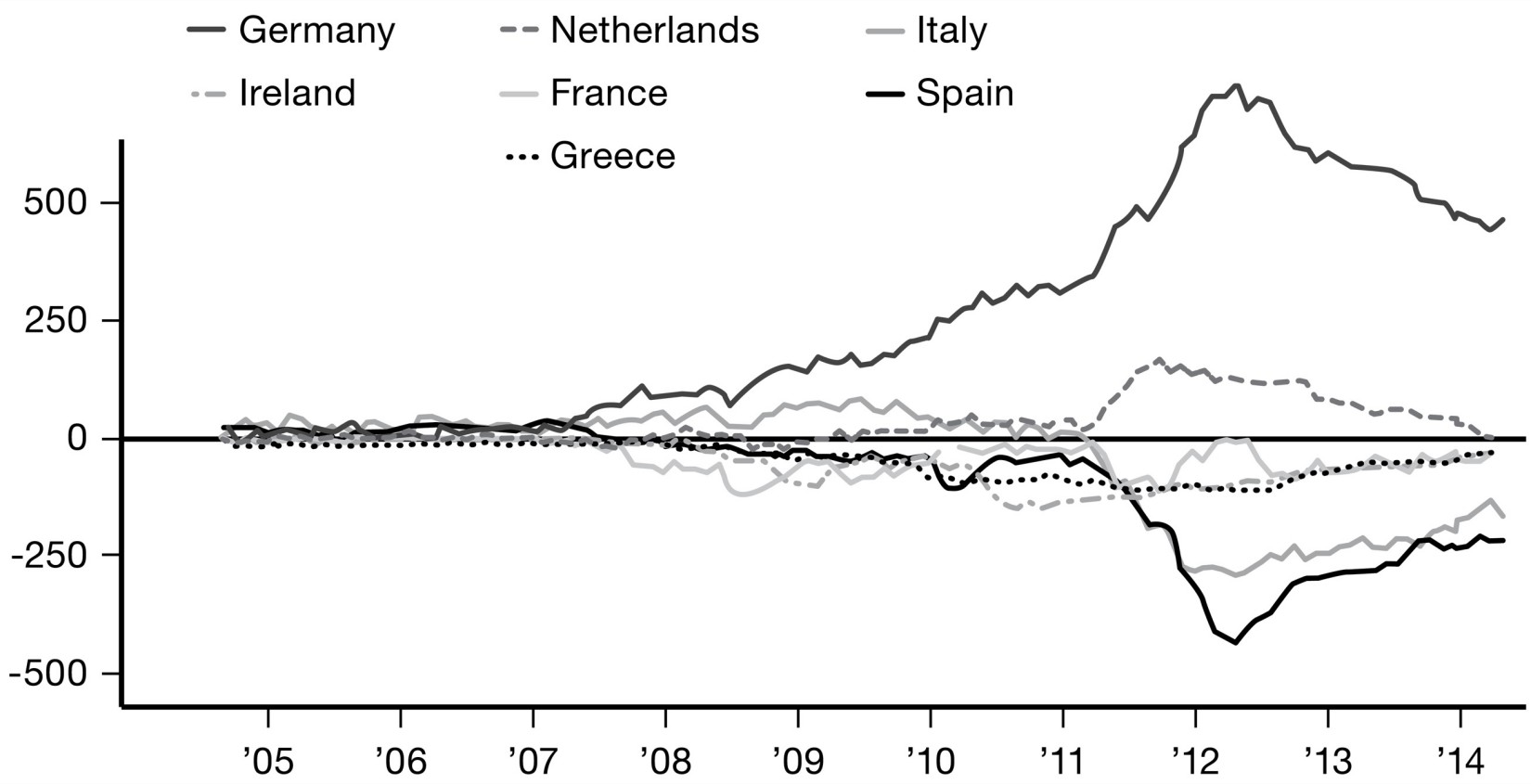
Nor was it only American money that was signaling its lack of confidence. A huge internal movement of funds within the eurozone was afoot. This was registered in a previously obscure but soon to be notorious appendage of the Eurosystem known as the TARGET2 balances. 33 As money flowed out of bank accounts in Greece, Ireland, Spain and Portugal in search of safety, it moved to Germany and elsewhere in the core eurozone. If funding markets had been functioning normally, the stressed peripheral banks would have found replacement funding in interbank markets without troubling their central banks. The recipient banks in the north were, after all, flush with flight money, and their Greek counterparts were willing to offer good rates. But interbank lending in Europe had never recovered from the shocks of 2007 and 2008 and had been dealt a further blow in the panic of April 2010. So instead, peripheral banks drew their funding from their national central banks, which, because they were no longer sovereign issuers of domestic currency, drew their euros from the ECB headquarters in Frankfurt, while at the same time the Bundesbank and other recipients of flight money piled up credits. Suddenly, in the spring of 2011, thanks largely to the journalistic entrepreneurship of the economist professor Hans-Werner Sinn, the German public was alerted to the shocking and quite misleading news that they were secretly providing a huge “credit” to the periphery. 34 Hundreds of billions of euros would be “forfeited” if the currency system collapsed.
This alarmist interpretation of the accounting data should be seen less as a piece of economic analysis than as a symptom of the increasing loss of legitimacy on the part of the euro system. What the TARGET2 balances registered was not a “loan” by Germany to the rest of the system. The TARGET2 balances were the offsetting official counterpart to an enormous movement of private funds into German bank accounts from the eurozone periphery. Some of those moving funds were rich Greek or Spanish businesses. But in large part it was Germany’s own investors bringing their euros home. They were able to do so without risk of currency losses or a massive Deutschmark appreciation, which would have hurt Germany’s exporters, thanks to the monetary union and the ECB’s clearing system. Sinn liked to inflame his readers with dark scenarios in which a breakup of the euro resulted in a loss of Germany’s bookkeeping claims on the ECB. It was a grim and uncertain prospect. But one thing was certain: The funds that anxious investors had already moved to safety in Germany were very unlikely to leave. What Germany was benefiting from was something akin to the exorbitant privilege enjoyed by the United States in the global economy. At times of stress, global money moved into dollars. In the eurozone, money moved to Germany. 35 It was a privilege measured by the yield spread. As the yields on crisis-country bonds soared, those on Bunds eased. It was one of the factors that helped to feed Germany’s prosperity bubble. That a flow of funds into Germany should come to be seen as a burden was symptomatic of the feverish discourse of the crisis.
TARGET2 Balances for Select Eurozone Nations (in billions of euros)
Source: Bruegel, National Central Banks.
III
By May 2011, confidence was so shaky that a secret Eurogroup meeting was hurriedly convened in Luxembourg. Scheduled for Friday, May 6, it was meant to restore unity and coherence. Instead it turned into a PR disaster. When Schäuble insisted that they must start by discussing restructuring and PSI, Trichet stormed out. He wouldn’t countenance such talk. On the other hand, to proceed without him was impractical, as the only thing keeping the Greek banks alive was ECB support. 36 No one fancied the idea of having to restructure them too. When Der Spiegel got wind of the meeting and markets in the United States began to react, the spokesman for Jean-Claude Juncker, the veteran prime minister of Luxembourg and Eurogroup chair, flatly denied that any meeting was taking place. 37 Hours later the same spokesman was forced to admit that the leaders had indeed met. “There was a very good reason to deny that the meeting was taking place,” he told the assembled journalists. “We had Wall Street open at that point in time.” The euro was plunging. Lying was a matter of “self-preservation.” When the Wall Street Journal asked whether such deception might undermine the “market’s confidence in future euro-zone pronouncements,” Juncker’s spokesman retorted that the market already appeared to discount any comments by ECB president Trichet and France’s finance minister, Lagarde. Whatever they said on the subject of Greece’s debt, “nobody seems to believe it.” So what further harm could be done by a convenient lie? Juncker himself had come to similarly stark conclusions: “Monetary policy is a serious issue,” the Eurogroup chair told an audience in April. “We should discuss this in secret, in the Eurogroup. . . . If we indicate possible decisions, we are fueling speculations on the financial markets and we are throwing in misery mainly the people we are trying to safeguard from this. . . . I am for secret, dark debates. . . . I’m ready to be insulted as being insufficiently democratic, but I want to be serious. . . . When it becomes serious, you have to lie.” 38 By May 2011 the effort to defend the indefensible, to uphold extend-and-pretend, had resulted in a complete breakdown of credible and coherent communication about the eurozone’s economic policy. Juncker was unusual only for feeling that he didn’t need to dress it up, which, as far as a tiny bourgeois tax haven like Luxembourg was concerned, might have been true. Projected onto a larger stage of the EU, the implications of Juncker’s “realism” were rather more disconcerting.
With Europe’s credibility draining away, what was needed was a “reset,” a clarifying intervention that would restore credibility and stop the crisis of confidence from widening. That is what Dominique Strauss-Kahn, as head of the IMF, seems to have had in mind when he scheduled meetings, first with Angela Merkel and then with the Eurogroup, for mid-May 2011. Strauss-Kahn “was going to push for a big firewall,” recalled one senior US official. “We were putting a considerable amount of expectation on the outcome of those meetings.” 39 Inside the IMF, a new head of steam of opposition to extend-and-pretend was building. The Fund’s Ireland team had never been satisfied with the inequitable deal forced on Dublin by the ECB and the G7 in November 2010. Ireland’s problems, Ajai Chopra insisted, were not merely Irish in scope, “they are a shared European problem” that required joint European action. 40 What was needed was to beef up the EFSF, giving it more resources and wider authority to intervene. Furthermore, as Ireland showed, Europe’s banks were too big to bail by any but the largest states. So Chopra insisted that if banks could not raise enough capital from private sources, there should be coordinated recapitalization across the EU. 41 Already a year earlier, in March 2010, Strauss-Kahn had challenged the Europeans to establish a jointly funded bank resolution authority. 42 Without that, any steps toward major debt restructuring were dangerous to contemplate.
By May 2011 the IMF had clearly formulated the basic logic of a eurozone fix that went beyond extend-and-pretend, and Strauss-Kahn seems to have been bent on delivering it. But minutes before his departure from JFK on May 14, the managing director of the IMF was hauled off his flight by officers of the NYPD to face charges of sexual assault and unlawful imprisonment. It was a bewildering turn of events. Much of European opinion was in uproar at the spectacle of such a prominent figure being reduced to the indignity of a New York perp walk. Did the presumption of innocence not hold in America? 43 In France those who did not blame the Americans blamed Sarkozy, who was widely suspected of plotting to eliminate Strauss-Kahn as a rival for the presidency. 44
Meanwhile, the hope that the IMF might shake the eurozone out of its paralysis evaporated and the Fund was left without a managing director. The question of succession opened a sore wound. In 2007 the emerging markets had been promised that the next head of the IMF would be one of theirs. Now, faced with the eurozone crisis, it was argued that because the IMF was so deeply engaged in Europe, it was crucial to have a European at the helm. Had Latin Americans, Asians or Africans ever had the temerity to make the analogous case, one can only imagine the reaction. The Europeans didn’t even blink. Their candidate for the job was Christine Lagarde, who had proven both her loyalty and her competence as Sarkozy’s finance minister. She had the backing of Europe, the United States and China. Meanwhile, as the eurozone spiraled toward crisis, the IMF’s push for decisive action was aborted. While Lagarde readied herself for her new role, the helm was taken by John Lipsky, the IMF’s American number two. Lipsky was all for large-scale support actions in the interest of systemic stability. If there were to be private sector involvement, on the other hand, it would have to be voluntary, and modest in scale. The priority of systemic stability and preventing contagion reasserted itself. This was no time for dangerous talk about debt restructuring or bank recapitalization. What mattered was containing the crisis and preventing uncertainty spreading from Europe.
IV
Strauss-Kahn never made it to his discussion with Merkel. But on June 5 the German chancellor headed to Washington. 45 By inclination, Merkel was an Atlanticist. But not since 2003 had relations been so strained. On economic policy Germany and America had been out of step since the crisis began. The storm over QE2 had been embarrassing. And where had Germany been in Libya? What was Berlin’s plan for Europe? The discussions with Obama were intense. Merkel returned home on June 8 with a Presidential Medal of Freedom and a new tune. There would be no more talk of Greek default or Grexit. In exchange for further austerity from Greece, there would be another aid package. Private sector involvement, i.e., debt restructuring, would be part of the bargain, as Germany had wanted from the start. But it would be voluntary. It would be a creditor-led restructuring, with the banks exercising a veto over the manner and scale of the debt write-down. What was still missing from Berlin’s pronouncements was any bold plan for a European bond fund or recapitalization. The net effect, therefore, was to heighten the tension. What the markets heard was that there would be PSI but without an adequate safety net.
On June 29 the battered Greek government pushed the fourth round of austerity through parliament, including privatization, tax increases and pension cuts. It did so in the wake of the violent clearance of Syntagma Square occupation and a two-day general strike. It did so in the face of IMF calculations that suggested that to achieve debt sustainability Greece needed to sell off public assets to the tune of 50 billion euros. Indeed, according to a further IMF assessment released on July 4, even that would not be enough. 46 It would take not only austerity and privatization but a truly heavy bondholder haircut to get Greece to sustainability. The tone of the talks with the International Institute of Finance (IIF), which had begun on June 27, suggested that there was little prospect of that. The banks and other bondholders were making only modest concessions. That suited the ECB, which was desperate that there should be no “default event,” but it stood in jarring contrast to the tens of billions of euros in cuts that Athens was imposing on its citizens. For Greece, the new Merkel-Obama dispensation was revealing itself to be extend-and-pretend in a new guise.
By June, as the S&P ratings agency downgraded Greece to CCC—the lowest score awarded to any sovereign borrower—and spreads surged to 1,300 points, the markets were asking a new question. If the eurozone couldn’t handle Greece, what if it faced more serious trouble? What if it had to deal with a crisis in Spain, or in Italy? Twenty years earlier, in the early 1990s, Italy had been on the rocks. Since then Italy’s debt had stabilized. Rome managed primary surpluses. But its debt was still dangerously high in relation to GDP. And given the size of the Italian economy—the eighth largest in the world by nominal GDP—its debts were enormous: 1.8 trillion euros. Alarmingly, in the last days of June 2011, following the decision to implement PSI in Greece, 100 billion euros of Italian debt had been sold off. European banks were pulling back, with French banks leading the way. The share of foreign holding of Italian debt fell from 50 to 45 percent in a matter of weeks. 47 That was enough to send Italy’s borrowing costs up from 4.25 to 5.54 percent between June and August of 2011. That might not seem like a large number. But given Italy’s huge refinancing needs, it spelled disaster. Between the second half of 2011 and the end of 2014 Rome calculated that it would need to borrow 813 billion euros in refinancing and new loans. A 25 percent increase in the cost of servicing such a huge volume of debt was a serious matter indeed. If a run began on Italy, it might well be game over for the eurozone.
Contrary to North European prejudice, the Italian political class was by no means oblivious to the seriousness of the situation. Italian economists, notably the “Bocconi boys,” named after the preeminent business school in Milan, had contributed as much as anyone to the new consensus of spending cuts and “expansionary austerity.” 48 Faced with the emergency of 2008–2010, Italy had permitted itself virtually no stimulus. The question was whether Rome had the will and capacity to respond to the new panic in the bond market. And, in particular, how Prime Minister Berlusconi would react.
Berlusconi was a figure wreathed in scandal. 49 He had faced allegations for crimes including racketeering, large-scale tax evasion and corruption. But on February 15, 2011, in the most embarrassing charge of all, he had been indicted for paying for sex with a minor and abuse of office in his efforts to cover up his liaison with an exotic dancer and call girl known as “Ruby the Heartstealer.” Rather than resigning, Berlusconi clung to his office. On April 6, 2011, as financial markets watched anxiously, Italy’s prime minister went on trial. The proceedings were immediately adjourned, but hearings would resume at the end of May. Meanwhile, a dark cloud of uncertainty and disrepute hung over the Italian government. Further doubts were raised at the end of May, when Berlusconi’s political alliance between Forza Italia and the Lega Nord lost control of Milan, his personal fiefdom. 50 Even at the best of times, Berlusconi’s instincts were those of a crowd pleaser. Now that he was fighting for his political life, could he be counted on to push through the kind of austerity that his finance minister, Giulio Tremonti, was demanding?
Over the weekend of July 9–10 Merkel intervened personally with Berlusconi to urge on him the seriousness of the situation. Europe’s future hung on Italy. But was it Italy, or was it, in fact, Germany that was the weak link? To many in Europe it was unclear whether Merkel herself was truly committed to holding the euro together. Ugly whispers began to circulate that Germany’s veteran chancellor, Helmut Kohl, father of the euro and German reunification, was questioning whether his European legacy was safe in Merkel’s hands. “This girl [Merkel] is destroying my Europe,” Kohl was reported to have told one journalist. 51 Only reluctantly were Merkel and Schäuble persuaded to defer summer travel plans and call an emergency meeting of the European Council on July 21 to discuss eurozone stabilization. The issues were predictable: fiscal adjustment and austerity, PSI, restructuring and debt sustainability, ECB bond buying. Only Europe-wide bank recapitalization, the final element in a coherent crisis-containment strategy, was not yet on the table. But what was Berlin’s game? Were Merkel and Schäuble engaged in truly hair-raising brinksmanship? Or, cocooned in their relative prosperity, did the German political class simply not understand the pressures the rest of the eurozone was under?
On July 14, 2011, in response to market pressure, the Italian parliament adopted a severe 70 billion euro austerity program, on a par with Germany’s 2010 effort. 52 But doubts remained as long as Berlusconi was at the helm. And the issue of PSI in Greece remained unresolved. Trichet was sticking to his guns. If there was anything approaching full-blown restructuring of Greek debt, the ECB would disallow Greek bonds as eligible collateral. Panic was again spreading through eurozone debt markets. What had originally been a problem of small fry, like Greece and Ireland, was rapidly becoming a comprehensive crisis of Southern Europe, including large economies like Spain and Italy. Whereas in 2007 eurozone bond investors had regarded Greek debt as equivalent to that offered by Germany, by September 2011 the CDS spreads on Italy and Spain were higher than those of Egypt in the throes of revolution. 53 The three countries in the world judged most likely to default were all in the eurozone—Greece, Ireland and Portugal—well ahead of Belarus, Venezuela and Pakistan. 54 The revolutionary mood seemed to have jumped the Mediterranean. The violent scenes in Athens fed fantasies of social disorder spreading across Europe. Supposedly serious financial analysts were talking of “hyperinflation, military coups and possible civil war.” 55 But it wasn’t any longer a matter of individual predatory hedge funds, or one or two overexcited analysts talking the euro down; commercial banks and pension funds from across Europe and the United States were pulling tens of billions of euros out of Italy and the program countries. 56 Once eurozone sovereigns lost their standing as issuers of safe assets, institutional investors had no option but to reallocate their portfolios. And that affected the European banks too. In the summer of 2011 wholesale funding was drying up. 57
With only days to go until the July 21 summit, the possibility dawned on Paris that Merkel might be willing to let the upcoming talks fail. 58 The debt reduction so far agreed with the bank lobbyists was too low to satisfy Berlin. The resources and mandate for the EFSF were insufficient to reassure the French, calm the markets or persuade Trichet to resume bond buying. If the talks failed, no one would be safe, including France. To break the deadlock Sarkozy realized that he would have to deal with Merkel one-on-one. The French president arrived in Berlin on July 20 at 5:30 p.m. and immediately hit a roadblock over the EFSF. It soon became clear that Berlin and Paris could not settle the matter without involving Trichet. He was summoned from Frankfurt, arriving on the last plane into Berlin at 10:00 p.m. The deal had to be done not between Germany and France but between Germany, France and the ECB. In the early hours of July 21 Sarkozy and Merkel took turns on a single cell phone to read out to Van Rompuy, the president of the European Council, the terms of their agreement. That afternoon in Brussels the package was formally presented to and voted on by the other governments.
Greece would receive an additional 109 billion euros, meeting its financing needs through 2014 and enabling the IMF to continue as part of the troika. The interest it paid on its loans would be lowered to 3.5 percent. Maturities would be extended and, through a menu of PSI options, Greece’s creditors would make a contribution, though the precise amount remained to be determined. The ECB would be indemnified for any losses it suffered. If the Greek banks suffered irreparable damage they would be recapitalized out of troika funds. 59 Most important, the governments stated emphatically that PSI applied only to Greece. It was the only insolvent eurozone sovereign. All others would honor their obligations without fail. To contain contagion the EFSF would be beefed up and at the behest of the ECB it would be empowered to enter the secondary market and to establish credit lines for nonprogram countries, such as Spain and Italy. The EFSF would no longer act only as an ultima ratio, as Merkel had insisted since March 2010, but as a preemptive agency, helping to stabilize markets to forestall any threat arising. These, finally, were the elements of a workable solution—buy-in by the Greeks, debt restructuring, further loans, cooperation with the ECB and backstopping by a newly empowered EFSF. There was even partial recognition of the need for bank recapitalization. The general structure was fine. But did the sums add up? And who was to pay?
One neuralgic point was the scale of PSI. The initial figure that had emerged from the polite negotiations with the IIF was only 20 percent. The bankers were not permitted in the intergovernmental meetings on July 21. But they gathered in the corridors outside. When the governments let it be known that 20 percent was insufficient, the IIF offered 21 percent. With this symbolic concession there was general satisfaction that a deal had been done. No one did the math. It was a matter of gestures, not arithmetic. When the IMF’s representative queried Greece’s sustainability under the assumption of such a modest restructuring, the meeting was treated to a “furious denunciation” by Charles Dallara of the IIF. 60 The indignation too was for show. In private Dallara was only too happy to boast of the astonishingly generous deal that his lobbying had secured for his clients, the big banks. 61
The result of this compromise was that Greece would pay the reputational price for having restructured its debts, but it would gain precious little financial relief. It would be left carrying a debt burden of 143 percent of GDP, which was clearly unsustainable. As one Goldman Sachs analyst commented: “This tendency to ‘under-size’ otherwise good policy initiatives has been a recurrent feature of European policies.” A member of the UBS economics team was less polite: “This is fiddling around at the margins. . . . The debt needs to halve.” As to the new support facilities provided by the EFSF, Willem Buiter, chief economist at Citigroup, told Bloomberg Television, “The European Financial Stability Facility has gone from being a single-barreled gun to a Gatling gun, but with the same amount of ammo. . . . It needs to be increased in size urgently.” 62 If Italy went critical, the EFSF would need not 200–400 billion but 1–2 trillion euros. Otherwise, only the ECB, with its bottomless supply of euros, could backstop the system.
In the meantime, investors were on edge. At the end of July it emerged that Deutsche Bank had cut its holdings of Italian debt by 88 percent since the beginning of the year. 63 For Italians in Berlusconi’s camp it was a clear case of blackmail. In the circles around Finance Minister Tremonti there was talk of a stab in the back. 64 Earlier in the year Rome had had the temerity to suggest that any joint European bailout fund ought to be funded in proportion not to GDP but to the size of bank claims that were being rescued. Not surprisingly, this was not a popular idea in Berlin. Tremonti was convinced that the precipitate sales by Deutsche were a message from Merkel and Schäuble. Whatever the truth of the matter, the suspicion was symptomatic. Trust was breaking down.
V
If money was fleeing out of Europe, where was it to go? The answer since the onset of the financial crisis had been, paradoxically, the United States. As US subprime went bad, there had not been the panicked dollar sell-off that many had feared. Instead, investors shifted into US Treasurys, the very top of the global monetary pyramid. In 2008 the dollar surged and US interest rates fell. Successive waves of QE reversed that trend. The dollar slid against its major trading partners. This imposed losses on investors and made US bonds marginally less attractive. By the summer of 2011, however, something far more ominous was on the horizon.
At the start of the year, as the new Republican majority in Congress flexed its muscles, the effort to craft a bipartisan, long-term approach to fiscal consolidation broke down. 65 For want of a budget, in April 2011 the US federal government already came close to a shutdown. On May 16 the permissible ceiling of federal debt was reached, at $14.3 trillion. With tax revenue covering only 60 percent of current spending, Washington had hit the limit of its legal right to borrow. The Treasury was forced to adopt “extraordinary measures,” including borrowing from government cash reserves and selling assets from the civil service retirement fund. 66 This would see the Treasury through until August 2. After that, the US federal government would face a choice between paying salaries or paying its creditors. America was sliding toward something even worse than concerted austerity, a chaotic shutdown risking default on its obligations to both domestic and foreign creditors.
In late July 2011, as Sarkozy, Merkel and Trichet diced with the future of the eurozone, the United States was perilously close to the edge. There was no longer any disagreement in Washington about the need for urgent fiscal consolidation. 67 But there was a huge divide between Democrats insisting on a balanced approach to deficit reduction, involving tax increases as well as entitlement cuts, and Republicans focused exclusively on spending reductions. The Speaker of the House, John Boehner, was looking to assert his control over the Tea Party faction by striking a deal with the White House to achieve deficit cuts of $4 trillion over ten years. But on July 22 the talks between Boehner and the Obama administration broke down over Republican demands for slashing reductions in medical spending and the White House insistence on a $1.2 trillion increase in taxes. 68 Journalists began compiling calendars as to which bills due in August the American government should pay first. Constitutional specialists were debating the pros and cons of executive prerogative, or coining trillion-dollar platinum coins with which to repay the national debt. 69 If Greece was a problem, and Italy was too big to fail, there was simply no reckoning what a US default might do. In August alone, the Treasury had to roll over almost $500 billion in debt. 70 With the eurozone wobbling, the American money market funds that were pulling out of European bank bonds continued to shift into US Treasurys. But appearances were deceptive. Investor demand for US government debt held up, but above all in lower-risk, short maturities. The average maturity of US Treasurys held by the MMFs declined from ninety-five days in January 2010 to only seventy days at the end of July 2011. 71 Meanwhile, financial engineers began to contemplate the need for something no one had contemplated before—credit default swaps against US Treasurys. 72
Prior to 2008 the market for US Treasury CDS had not existed. What would have been the point of insuring the risk-free asset class on which the entire global financial system rested? In the wildly improbable event of a US default, the general destabilization would be such that it was unclear whether any private financial entity would still be in a position to act as a reliable counterparty. Who would be left standing to pay out on insurance against the end of the world? Nevertheless, having first come into existence during the turmoil of 2008, when it seemed that Fannie Mae and Freddie Mac might fail, in the course of 2011 the niche market for CDS on US Treasurys sprang back into life. In the last days of July just over a thousand contracts were outstanding, with spreads running to 82 basis points. It was a fraction of what investors in Greek debt paid, but it was astonishing that the market existed at all.
On July 31, 2011, Washington pulled back from the abyss. A budget compromise was reached that would impose automatic austerity if the two warring parties could not agree on cuts by the end of the year. Reluctantly, sufficient Tea Party radicals were won over to the Republican leadership’s position for the deal to go through. It took heavy lobbying and hours of alarmist lectures by credit-rating experts and former officials from the Bush administration to convince the Republican insurgents of the dramatic consequences of a default. But the damage was done. As Mitch McConnell, the Republicans’ leader in the Senate, blithely informed the media: “I think some of our members may have thought the default issue was a hostage you might take a chance at shooting. Most of us didn’t think that. What we did learn is this—it’s a hostage worth ransoming.” 73 As Jason Chaffetz, one of the hard-line Tea Party newcomers, remarked, the threat had been real. “We weren’t kidding around. . . . We would have taken it down.” 74
On August 3 China’s Dagong ratings agency was the first to draw the obvious conclusion. It downgraded the United States from A+ to A. As Dagong remarked: “[A]t this crucial juncture, neither the Democratic Party nor Republican Party has shown any consideration for the general interest in order to argue for their own partisan interest; they had a hard time making the correct choice in a timely manner leaving the world in terror, which highlights the negative role of the US political system on an economic basis.” 75 The US political system, the Chinese analysts concluded, “cannot resolve the fundamental influence of low economic growth, high deficit and increasingly higher debt to the debt service capability through increasing real wealth creation, with the declining national solvency irreversible. It is natural that QE3 monetary policy will be enabled for the next step, which will throw the world economy into an overall crisis; the status of [the] US dollar will be essentially shaken in this process.” This was the judgment of the G20 at Seoul turned into the language of credit rating. The year ended with a big sell-off of US government debt by Beijing. But there was no rout. The long buildup of Chinese claims on the US taxpayer had ended. But the portfolio stabilized at between $1.2 trillion and $1.3 trillion.
Criticism from China was only to be expected. More surprising was the fallout at home. On August 5 the unthinkable happened. One of America’s own ratings agencies, Standard & Poor’s, downgraded the United States from AAA to AA+. S&P cited the “political brinkmanship of recent months” and the mounting evidence that “America’s governance and policymaking” was “becoming less stable, less effective, and less predictable.” 76 It also pointed to the supposedly unsustainable level of US debt and the speed of its accumulation, which would take it well over 90 percent of GDP by 2021—the notorious Reinhart and Rogoff threshold. But when the US Treasury was handed the explanation for S&P’s decision, it became clear that the ratings agency had committed an elementary mistake. By applying the figures for debt growth to the wrong benchmark scenario, it had wildly overstated the deficit to be expected over the next ten years. Even more surprisingly, when this error was pointed out, S&P did not retreat. It left the downgrade in place as well as the explanatory text—minus the modeling error. This led the Treasury to fire off an official denunciation. “S&P still chose to proceed with their flawed judgment by simply changing their principal rationale for their credit rating decision from an economic one to a political one. . . . The magnitude of this mistake—and the haste with which S&P changed its principal rationale for action . . . raise fundamental questions about the credibility and integrity of S&P’s ratings action.” 77 No one doubted the weakness of the US political system. But S&P had delivered just one more demonstration of how broken the ratings agencies were. It was their AAA certifications, handed out to hundreds of billions of subprime MBS, that had helped to precipitate the crisis in 2008. It was their serial downgrades that were setting the pace of the crisis in the eurozone. But it turned out that they could not even get their sums right on the US budget.
VI
Trillions of dollars of debt were losing their status as safe assets. The US Treasury was accused by the German finance minister of interventionist tendencies akin to communism. NATO was squabbling over Libya. The loose monetary policy of the Federal Reserve was blamed for fomenting revolt in the Middle East. The EU was locked into a self-deceptive nonsolution to the Greek debt crisis, and when it was not engaged in extend-and-pretend it was openly and unabashedly lying. Both Italy’s prime minister and the managing director of the IMF were up on sex charges. Washington was willfully toying with bankruptcy. The ratings agencies could not do their arithmetic. Millions of people were in the streets, protesting, demanding a “rupture,” unable or unwilling to pay debts they had contracted or that had been contracted in their name.
Over the weekend of August 6–7, as the world digested the downgrade of America’s sovereign debt, heads of government, central bankers and Treasury officials interrupted their summer vacations for a frantic round of telephone conferences. But all that emerged were lame communiqués, which did nothing to inspire confidence. On Monday, August 8, rocked by bad news from both sides of the Atlantic, stock markets sold off sharply. President Obama was left to remark: “We now live in a global economy where everything is interconnected, and that means that when you have problems in Europe and in Spain and in Italy and in Greece, those problems wash over into our shores.” 78
In the general crisis of legitimacy in 2010–2011 there was no Archimedean point. There was no place to stand above the fray. Bringing this home was the point of the protesters “getting in the face” of government officials in Spain and Italy. They wanted to break through the invincible authority and distance that separated decision makers from those their decisions impinged upon, to force them to come face-to-face with a different reality. And over the summer of 2011 a small band of US activists determined to do the same at the hub of the world financial economy in New York.
On August 19, 2011, representatives of the New York Stock Exchange met with agents of the FBI for an unusual conference. 79 Trawling the Internet for suspicious activity, the FBI had got wind of an “anarchist” network dubbed “Occupy Wall Street.” Its aim was to spread the protest movement that had gained such scale in Europe to the United States. The occupation of Zuccotti Park right next to Wall Street was scheduled for September 17. The US media at first ignored the story. The first to cover it were Agence France-Presse and the Guardian . 80 But within weeks the tiny encampment that lodged itself within hailing distance of Wall Street would become headline news around the world. 81
Given the scale of the social media storm it unleashed, it is important to put Occupy Wall Street in perspective. It was tiny compared with the gigantic antiausterity mobilizations in Europe. The global Occupy demonstrations that took place on October 15, 2011, attracted perhaps as many as a million demonstrators in Spain, 200,000 to 400,000 in Rome, tens of thousands in Portugal. In New York between 35,000 and 50,000 protesters marched. But the New York occupation had a symbolic significance far in excess of its modest scale. It articulated radical opposition at the very heart of US capitalism. Imitation camps sprang up across the United States, in Philadelphia, Oakland, Boston, Seattle, Atlanta, L.A., Denver, Tucson, New Orleans, Salt Lake City and many other cities. Further afield there were notable solidarity camps in London, Seoul, Rome, Manila, Berlin, Mumbai, Amsterdam, Paris and Hong Kong. Estimates vary, but protesters in at least nine hundred cities around the world staged sympathy demonstrations. 82 Across the United States, wherever they sprouted, the Occupy camps could expect the watchful presence of the FBI and even US counterterrorism authorities. But despite their tiny size and ramshackle appearance, the obvious and unsettling fact was that the anger of the radical minority was shared by a wide swath of US public opinion.
In October 2011 a poll conducted for the New York Times and CBS News found that almost half those questioned felt that the FBI’s “anarchist camp” reflected the views of most Americans. 83 Two-thirds thought wealth should be distributed more evenly—nine out of ten Democrats, two thirds of Independents and even one third of Republicans agreeing with that sentiment. But only 11 percent of Americans trusted their government to do the right thing, 84 percent disapproved of the Congress that had threatened to bring the US federal government to its knees and 74 percent thought their country was on the wrong track. Since January 2009 the Obama administration had been straining every muscle to put the lid on popular discontent. Rather than seeking to mobilize the indignation simmering in American society, it had found one technocratic fix after another. Two years later the result was a spectacular delegitimization from both the Left and the Right.
Chapter 17
DOOM LOOP
O n September 1, 2011, Pedro Passos Coelho, Portugal’s new prime minister, made his first visit to Berlin. His host, Chancellor Merkel, began the joint press conference by announcing how pleased she was to hear that the troika had just submitted its first report on Portugal’s structural adjustment program and had declared itself satisfied with the progress being made. She was delighted also to hear that Coelho saw no obstacle to incorporating a German-style debt brake into Portugal’s constitution. Then, in the question-and-answer session that followed, it seemed that Chancellor Merkel let the cat out of the bag. Asked about the question of parliamentary control over the European Financial Stability Facility, recently mandated by the German constitutional court, Merkel deadpanned: “We do live in a democracy and we are pleased about that. It is a parliamentary democracy. That means that the budget is a key prerogative of parliament. Thus we will find ways to organize parliamentary codetermination in such a way that it is nevertheless market conforming, so that the appropriate signals appear in the markets. I hear from our budget specialists that they are conscious of this responsibility.” 1
Market-conforming codetermination—was this what European democracy had been reduced to by the autumn of 2011? Was this the hidden agenda of the troika programs, imposed not only on the parliaments of Greece, Ireland and Portugal but on the Bundestag as well—to make them market conforming? For many who joined the protests of 2011, Merkel’s words confirmed their jaundiced view of the EU as little more than a container for the rule of the markets, or that new buzzword of the crisis, “neoliberalism.” 2 Merkel did little to clarify the situation. On September 22, a few days ahead of the IMF meeting in Washington, she welcomed the first German pope, Benedict XVI, to the chancellery. Quizzed by curious journalists, Merkel volunteered that the European crisis had been at the heart of their conversation: “We spoke about the financial markets and the fact that politicians should have the power to make policy for the people, and not be driven by the markets. . . . This is a very, very big task in today’s time of globalization.” 3
In their flailing generality, these statements are symptomatic of the depth of the crisis by the autumn of 2011. In the space of barely three weeks, the German chancellor managed to tell the press that politicians should be responsible to markets and to tell the pope that politicians should make policy for “the people” regardless of those markets. Was it a contradiction? Or was she implying some kind of synthesis? If so, was it a matter of finding the market-conforming mode of expression that would allow politicians to slyly exert their power or, more ominously, a matter of hammering democracy into such conformity that no market ever need fear the policy parliament might make? Did anyone in Berlin know? No surprise that Gregor Gysi, the sharp-tongued spokesman of Die Linke, should lash Merkel’s handling of the eurozone crisis as an engine of chaos and confusion. 4
The very least one can deduce is that the optimistic dogma under which democracy and markets were seen as natural and necessary complements—the mantra of the aftermath of the cold war—was dead. 5 In its place the crisis had put a more realistic awareness of the potential tension between the two. But this generalization too has its risks, particularly when it is assumed that it is financial markets, not politics, that force the tension. Certainly in the course of the eurozone crisis that had not been the case. The pressure the more fragile members of the eurozone were under depended not on some inescapable clash of peoples and markets, or global capitalism and democracy. 6 It was dictated, first and foremost, by the willingness, or not, of the ECB to buy bonds. In the markets many banks and traders were not just crying out for the EU to undertake a stabilization effort but betting billions that it ultimately would. What delayed the stabilization and escalated the conflict between democracy and markets to an extraordinary pitch was the struggle among Germany, France and the ECB over the future governance of the eurozone, a question in which politics and economics were inseparably intertwined. Ironically, the result, as in 2010, was to escalate the crisis to the point that European affairs could no longer be safely left to the Europeans.
I
The compromise of July 21 on a new Greek aid package was supposed to be flanked by a new round of bond buying by the ECB. Ireland and Portugal, at least, were judged to be making sufficient progress under their IMF-supervised programs. So on August 4, 2011, the ECB let it be known that it was once again in the market for their bonds. Prices and yields promptly stabilized. This was the cheery backdrop to Coelho’s visit to Berlin. But as far as Italy and Spain were concerned, Trichet did not want to let them off the hook so easily. The ECB needed further proof of conformity. To make the point, on August 5 Trichet dispatched a confidential memo to prime ministers Zapatero and Berlusconi, spelling out what would be necessary for the protection of the ECB’s bond purchases to be extended to them. 7 In the case of Italy, weight was added to the missive by the signature of Mario Draghi, head of the Italian central bank and Trichet’s anointed successor at the ECB.
Neither Spain nor Italy had applied for a troika program, but that did not stop the ECB from demanding huge cuts to government spending and increased taxation. In the Italian case, Trichet and Draghi called for the privatization of local public services, a proposal that had recently been decisively rejected in a nationwide referendum. 8 The ECB also called for dramatic changes to labor market policy, infringing on rights of Italian and Spanish trade unions. Such changes were necessary, the ECB insisted, to cut unemployment and increase growth. It was a blatant attempt to shift the balance of social and political power by means of monetary policy, poorly disguised by the ECB’s proviso that care should be taken to ensure that the social safety net remained intact. In case these unpopular measures encountered opposition, Trichet and Draghi suggested that the Italian government should invoke the decree powers of Article 77 of the Italian constitution, which allowed executive action “in cases of extraordinary need and urgency.” Originally designed to counter the specter of Communist insurrection during the cold war, Article 77 was a legal fig leaf that had been repeatedly invoked since the 1970s to cover “emergency measures.” 9 Its overuse had been criticized by the Italian courts. If Berlusconi was worried about the legality of these proceedings, Trichet and Draghi advised that he should apply retrospectively for parliamentary sanction. Perhaps not surprisingly, legally minded members of Berlusconi’s cabinet wondered whether it was their malodorous prime minister or Draghi and Trichet who posed the greater risk to the rule of law.
The Spanish government chose to keep the ECB’s letter secret. If it was to be humiliated it preferred not to have the fact made public. As a sign of their compliance, Spain’s two largest political parties agreed to amend the Spanish constitution, unchanged in thirty-three years, to provide for a balanced budget amendment. 10 By contrast, Berlusconi accepted Trichet’s terms but under public protest. He would later say that the ECB’s instructions “made us look like an occupied government.” 11 But rather than embarrassing the ECB, the expostulation from Rome served only to enhance Trichet’s reputation as a hard-liner, which, in an ironic twist, freed him to act. On August 7 the ECB began buying Italian and Spanish bonds under the Securities Markets Programme (SMP). 12
This was enough to calm the markets and stave off the immediate risk of a disaster. But Berlusconi’s government was evasive about the full scale of the austerity measures it was willing to adopt. The Italian economy was perched on the edge of a severe recession. Markets remained jumpy. And as everyone realized, things were going to get worse before they got better. The compromise on Greece hammered out on the weekend of July 20–21 had been inadequate from the start. Rather than achieving sustainability, Greece’s consolidation program was falling consistently behind schedule. To escape insolvency Greece needed a haircut far larger than that squeezed out of the bankers over the summer: not 21 percent but something closer to 50 percent. If this was not to cause panic, it would need to be framed by a solid Franco-German agreement on the future governance of the eurozone. France was truly the last line of defense. If the crisis spread by way of Rome to Paris, the game would be up. Ominously, in the fall of 2011, as the ECB intervened to prop up Italian public debt, the spread of the ten-year French bonds relative to bunds nudged upward to 89 basis points. 13 In reaction, Merkel and Sarkozy tightened their alliance. What Sarkozy desperately needed was a wall of money. With the ECB pursuing a strategy of tension, the only way to really calm markets would be to expand the EFSF or to agree to a wholesale mutualization of eurozone public debt. It was Berlin’s agonizingly slow acceptance of these basic facts that set the pace of the crisis.
On September 29 the Bundestag finally voted on the puny expansion of the EFSF bond market stabilization fund agreed on July 21. It was widely seen as a decisive vote for the future of Merkel’s coalition. 14 Though the EFSF was supported by the majority of the Bundestag, on the German right wing the bond buying of the ECB had triggered a furious reaction. At the crucial ECB board meeting in August, Merkel’s hard-line new appointee as head of the German Bundesbank, Jens Weidmann, once a star pupil of Axel Weber and Merkel’s personal economic adviser, not only voted against bond buying but made his opposition public. 15 On September 9 Jürgen Stark, the German member of the ECB board and the bank’s chief economist—the man widely thought to be behind the ECB’s interest rate hikes earlier in the year—resigned in protest. To stop the momentum of the conservative rebellion Merkel needed to win the EFSF vote in the Bundestag, not with the votes of the pro-European SPD opposition but on the basis of her own Kanzlermehrheit —with the votes of her coalition partners. In the event, on September 29 Merkel got the votes, but by a painfully narrow margin. Out of the 330 members of the government coalition, only 315 voted for the motion, 4 more than the 311 needed. Merkel was on top, but she had little room for maneuver.
In any case, as soon as the Bundestag had voted it was clear that it had been overtaken by events. As everyone in the markets realized, the EFSF fund that had been agreed over the summer was too small. The Bundestag vote on September 29 was simply the occasion to start talking about how the fund might be leveraged, something that had been explicitly ruled out by Schäuble ahead of the vote. 16 Unless the markets suddenly calmed, Merkel’s government would soon be rolling the parliamentary dice again.
II
In the summer it had finally been acknowledged that any Greek debt restructuring would require a full-scale bailout of Greece’s own banks. They held so much Greek public debt that their balance sheets would not survive the debt write-down. What the European governments were still struggling to accept was that the problem was far wider than that. The politics of extend-and-pretend might have the benefit of deflecting attention from the creditor banks to the bankrupt government borrowers. It was the citizens of the troika-supervised countries who paid the price. But it also allowed European policy makers to avoid getting to grips with the underlying problems of financial stability. The assumption, presumably, was that given time the banks would take care of themselves. But despite the fairy-tale numbers produced by the European stress tests, it was clear that this was wishful thinking. In fact, Europe’s banks were sliding back toward the cliff edge in the fall of 2011. They were struggling to cope with pressure from six directions at once. The legacy losses from 2007–2008 were still on their books. Their holdings of European sovereign debt were increasingly impaired. The troubles of the eurozone economy were bad for new business. The new capital and liquidity requirements of Basel III required painful balance sheet adjustment. In their most profitable niche markets in the United States, Europe and Asia, the European banks faced fierce competition from the resurgent American and Asian banks. And in light of all this, wholesale money markets were increasingly leery about offering funding. A slow contraction of balance sheets was one thing. If funding markets shut down, Europe would face a repeat of 2008. Given that acute threat it was not without risk to openly address the long-term issues of the sector. But if the problem of recapitalization was not squarely faced, how would the banks ever be made safe?
In August 2011, as she established herself as managing director of the IMF, Christine Lagarde took up the baton that Strauss-Kahn had dropped when he was carted off to Rikers Island jail. Already in 2009 IMF analysts had highlighted the inadequacy of European bank recapitalization. 17 Now, two years later, in light of the escalation of the eurozone sovereign debt crisis, the IMF estimated that the minimum the European banks needed was $267 billion in new capital. 18 It was a daunting challenge, but without it, all other crisis-fighting measures on the side of fiscal and monetary policy would lack a solid foundation. European political obfuscations were obscuring the basic lesson of 2008: Questions of macroeconomic policy and systemic stability could not be hygienically separated from the workings of megabanks, now more politely known as systemically important financial institutions.
The banks, of course, defended what they took to be their own interests. Never one to shrink from alarmism where bank regulations were concerned, the Institute of International Finance estimated that Basel III plus national regulations would force banks worldwide to raise their capital by $1.3 trillion by 2015. 19 It was a huge ask and many banks might simply prefer to shrink their balance sheets, flattening the fragile recovery. At the meeting of the Financial Stability Board on September 23 in Washington, Jamie Dimon of J.P. Morgan counterattacked. He condemned the new capital rules and challenged Mark Carney, the chairman of the Bank of Canada and head of the SFB, so violently that Lloyd Blankfein of Goldman Sachs felt it necessary to personally intercede. 20 Bizarrely, Dimon denounced the Basel III rules as anti-American, whereas, in fact, the pressure they placed on the Europeans was far more severe. Rather than raising capital, like their American counterparts, Europe’s main lenders were deleveraging en masse, cutting the size of their loan business. On the basis of plans published by the banks themselves, analysts predicted a contraction of between 480 billion and 2 trillion euros. From the point of view of the regulators, this was exactly what was intended. The banks needed to “derisk.” But it wasn’t only a matter of corporate strategy. What was driving the contraction as much as anything else was the collapse in demand for loans. That spelled trouble ahead for the eurozone economy and it threatened a vicious circle in which a widening depression forced banks to make ever larger provisions for a new wave of nonperforming loans, further tightening pressure on their balance sheets.
Europe’s Banks Under Pressure: Fall 2011 (in billions of euros)
|
2008 legacy assets |
PIIGS debt |
Expected deleveraging |
|
|
RBS |
79.6 |
10.4 |
93–121 |
|
HSBC |
54.3 |
14.6 |
83 |
|
Deutsche Bank |
51.9 |
12.8 |
30–90 |
|
Crédit Agricole |
28.2 |
16.7 |
17–50 |
|
Sociéte Générale |
27.5 |
18.3 |
70–95 |
|
Commerzbank |
23.8 |
19.8 |
31–188 |
|
Barclays |
20.7 |
20.3 |
20 |
|
BNP Paribas |
12.5 |
41.1 |
50–81 |
Note: PIIGS debt refers to holdings of Portuguese, Italian, Irish, Greek and Spanish sovereign debt.
Sources: Bank of England, Financial Stability Report 30 (December 2011), and http://www.forecastsandtrends.com/article.php/770/ .
It was not the misery of youth unemployment in Spain and Greece that made the eurozone crisis into an object of global concern. The world would wake up late to what would be dubbed the “populist danger.” In 2011 it was the prospect of European banking crisis that seized the attention of policy makers around the world. If the trillion-dollar balance sheets of the French, German, Swiss, Italian and Spanish banks were shaking, then the City of London and Wall Street would not be safe. And, as in 2008, the influence ran both ways. If the withdrawal of funding from American sources put the European banks under excessive pressure, they would drastically curtail their business in the United States. As William Dudley of the New York Fed later explained to Congress: “Money market mutual funds which were providing dollar funding to the European banks during the summer and fall [of 2011] were pulling back. Other lenders, large asset managers, were also pulling back from the European banks. And this was causing those banks to start to get out of their dollar book of business. . . . [T]his was going on at a pretty feverish pitch through the late fall and in through the early winter.” 21 The panic was spreading to the American banks themselves. In the fall of 2011 the premium on American bank credit default swaps began to rise ominously. 22
III
On the morning of September 16, 2011, Treasury Secretary Geithner flew to Warsaw to attend, for the first time, the monthly meeting of European finance ministers and central bankers. In his widely leaked remarks he apparently began on a humble note. 23 “Our politics are terrible, maybe worse than they are in many parts of Europe,” he said. The debt ceiling battle had ended in Congress only six weeks earlier. “Given the damage we caused the world in the early stages of the financial crisis and given the challenges we have, we are not in a particularly strong position to provide advice to all of you, so I come with humility.” But he then went on to insist that the “ongoing conflict” between Europe’s governments and the ECB was “very damaging.” “You have to, governments and the central banks have to, take out the catastrophic risk from markets.” Austria’s outspoken finance minister, Maria Fekter, later commented that the American Treasury secretary’s tone had indeed been “very dramatic.” 24 What Geithner proposed was standard American maximum-force firefighting doctrine. “The firewall you build has to be perceived as larger than the scale of the problem. You can’t succeed by shrinking the problem to fit your current level of financial commitments. . . . It’s more dangerous to escalate gradually and incrementally than with massive preemptive force.” According to the Treasury’s own estimates, the eurozone needed a fund of at least 1 trillion euros and preferably 1.5 trillion. 25 Picking up an idea launched by Mark Carney of the Bank of Canada and Philipp Hildebrand of the Swiss Central Bank, Geithner argued that the European Financial Stability Fund should be leveraged to give it sufficient firepower to act as a firewall. 26 The EFSF could borrow against the capital invested in it by Europe’s governments. It was a neat solution, but controversial in Europe, particularly in Germany, because as it increased the fund’s firepower, it also increased the liability for losses.
It was the Europeans who invited Geithner to Warsaw. But in the wake of the Wall Street crash of 2008 and the congressional budget crisis of July 2011, there was probably no moment in living memory in which Europe was less willing to listen to financial advice from America. Jean-Claude Juncker refused point-blank to discuss Geithner’s bailout fund proposal with a nonmember of the eurozone. Geithner stalked out of the encounter refusing comments to the press. As one New York analyst commented: “I’m not sure it’s productive for Secretary Geithner to have gone to Poland given the European resentment towards the U.S. . . . I fear that it may cause Europeans to cut off their nose to spite their face.” 27 That trivializing diagnosis was telling in its own right. But the rebuff to the United States was undeniable. On Geithner’s return, the New York Times ran an unflattering piece contrasting the reception he had received with the triumphalism of the 1990s, when Time magazine had hailed his mentors—Greenspan, Summers and Rubin—as “The Committee to Save the World.” In September 2011 Sheila C. Bair, Geithner’s longtime nemesis as the chair of the FDIC, commented that the Treasury’s advice might have been more compelling if it had come jointly from the United States and China, a point that the Chinese would make at the next G20 meeting. 28
As the leaders of world finance convened in Washington for the annual IMF meeting at the end of September 2011, the mood was grim. The world’s financial institutions were staring into “the abyss,” they declared. 29 From the sidelines Larry Summers, recently retired from the White House, declared: “Now, when these problems have the potential to disrupt growth around the world, all nations have an obligation to insist that Europe find a viable way forward.” 30 The Europeans could not go on pretending that all that was at stake were matters of eurozone governance. The G20 premeeting issued a communiqué stressing that, in the face of the ongoing eurozone crisis, “[w]e commit to take all necessary actions to preserve the stability of banking systems and financial markets as required.” Geithner and his British counterpart George Osborne combined to demand an end to Europe’s “political crisis.” The emphasis on politics was telling. Canada’s finance minister expressed incredulity that the global gatherings had been talking about Greece since January 2010. 31 Geithner warned of a “cascading default, bank runs and catastrophic risk” if Europe failed to build a big enough firewall. Lagarde, from her new vantage point in Washington, insisted that there was still “a path to recovery,” but “much narrower than before, and getting narrower.” 32 And yet a week after the IMF meeting, the EFSF plan that Merkel would squeeze through the Bundestag was undersized, and Finance Minister Schäuble publicly denied any plan to increase it by means of leverage. The Europeans, and the Germans in particular, still did not “get it.”
In the first week of October, as if to demonstrate that the dark talk in Washington was not merely alarmism, a run began on the Franco-Belgian bank Dexia, one of the casualties of 2008 that was most exposed to peripheral eurozone debt. 33 Once again the European Banking Authority had embarrassed itself. Over the summer Dexia had passed the third European stress test with flying colors. A postmortem revealed that the stress tests had failed to account adequately for losses resulting from a restructuring of Greek debt. Furthermore, they had ignored altogether the issue of liquidity. In 2008 it had been collateral calls that triggered the disaster at Lehman and AIG. In 2011 they did the same to Dexia. 34 The bank had contracted a huge portfolio of interest rate swaps on which it now faced demands for tens of billions of euros in collateral. The Belgian and French governments were forced into an expensive bailout at the worst possible moment. Given the potential impact on French public debt, the governor of the Banque de France, Christian Noyer, was forced to deny claims that France’s credit rating might be in jeopardy. 35
Meanwhile, from the other side of the Atlantic came news of trouble at the high-profile brokerage firm MF Global. American regulators had ordered MF Global to boost its net capital to cover against the multibillion-dollar position it had built in Irish, Spanish, Italian and Portuguese sovereign bonds. Inverting the legendary big short position that speculators had built against mortgage-backed securities in 2007, MF Global had taken a “big long” in eurozone sovereign debt. It was gambling that other investors were underrating the stability of the eurozone and the value of peripheral bonds. As institutional investors like pension and insurance funds and banks offloaded their eurozone securities, it was MF Global that bought them up. As had been true in the case of the big short, there was a race between market sentiment and the ability of the contrarian investor to stay liquid. In October 2011 time ran out on MF Global. The regulator’s call for more capital triggered inquiries into its balance sheets and revealed that to tide it over in the face of huge market pressure it had been dipping into client funds. By the end of October one of the most high-profile investors betting that the eurozone did indeed have a future collapsed. 36
It was a bitter irony that it was precisely as MF Global filed for protection that the eurozone finally began to take steps toward a more decisive resolution of the crisis. On October 23 the European leaders held a gathering to sketch the outlines of yet another stabilization plan. It involved deep debt restructuring, new loans for Greece, an expansion of the EFSF, bank recapitalization—finally, all the elements of a solution were on the table. Indeed, the issues were beginning to be monotonously familiar. That, however, did not mean that the way forward was obvious or politically easy. On October 26 Merkel addressed the Bundestag to tell them that the expansion of the EFSF they had voted to approve a month earlier had not been enough and that the fund might, after all, need to be leveraged. 37 On the promise that under all circumstances Germany’s liability would remain capped at 211 billion euros, Merkel again got the majority she needed. With Germany at least formally on board, European leaders assembled for a second time in Brussels on the afternoon of October 26 to finalize the third rescue package for Greece.
Composition and Estimated Bond Holdings of Creditor Committee (in billions of euros)
|
Steering Committee Members |
Further Members of the Creditor Committee |
||||
|
Allianz (Germany) |
1.3 |
Ageas (Belgium) |
1.2 |
MACSF (France) |
na |
|
Alpha Eurobank (Greece) |
3.7 |
Bank of Cyprus |
1.8 |
Marathon (US) |
na |
|
Axa (France) |
1.9 |
Bayern LB (Germany) |
na |
Marfin (Greece) |
2.3 |
|
BNP Paribas (France) |
5.0 |
BBVA (Spain) |
na |
MetLife (US) |
na |
|
CNP Assurances (France) |
2.0 |
BPCE (France) |
1.2 |
Piraeus (Greece) |
9.4 |
|
Commerzbank (Germany) |
2.9 |
Crédit Agricole (France) |
0.6 |
RBS (UK) |
1.1 |
|
Deutsche Bank (Germany) |
1.6 |
DekaBank (Germany) |
na |
Société Gén. (France) |
2.9 |
|
Greylock Capital (US) |
na |
Dexia (Belg/Lux/Fra) |
3.5 |
UniCredit (Italy) |
0.9 |
|
Intesa San Paolo (Italy) |
0.8 |
Emporiki (Greece) |
na |
||
|
LBB BW (Germany) |
1.4 |
Generali (Italy) |
3.0 |
||
|
ING (France) |
1.4 |
Groupama (France) |
2.0 |
||
|
National Bank of Greece |
13.7 |
HSBC (UK) |
0.8 |
||
Notes: Estimates of bond holdings refer to June 2011, creditor committee composition to December 2011.
Source: Jeromin Zettelmeyer, Christoph Trebesch and Mitu Gulati, “The Greek Debt Restructuring: An Autopsy,” Economic Policy 28, no. 75 (2013): 513–563.
This time PSI would be the cornerstone of the entire deal. The haircut would be deep. Banks and their shareholders would have to recognize tens of billions of euros in losses. Rumor had it that the Germans were pushing for 60 percent. The creditors, negotiating from offices in the basement of the EU’s Justus Lipsius building, held out for less, and they were a powerful group. Despite the ongoing sell-off of peripheral bond assets, in 2011 all the major banks of France, Germany and Italy still held Greek bonds. So too did Greece’s own banks, major insurance funds and American hedge funds.
To shift this weighty coalition of financial interests it took not only financial inducements but also a forceful personal intervention by Merkel and Sarkozy. At 4:04 a.m. on the morning of October 27, a deal on “voluntary bond exchange” at 50 percent was announced. 38 The plan promised to reduce Greece’s debt below 120 percent of GDP. To tide it over Greece was to receive another 130 billion euros in funding, bringing the total in emergency loans it had received since 2010 to 240 billion euros, or more than 100 percent of Greek GDP. To contain the fallout from this momentous decision, all other euro area member states solemnly reaffirmed “their inflexible determination to honour fully their own individual sovereign signature.” The EFSF was to be boosted to close to 1.2 trillion euros by means of leverage or by using its resources not to make loans directly but as an insurance fund to cover losses on private securities. And Europe’s banks were expected to recapitalize to the tune of 106 billion euros, though it was left up to them how they raised the funds. At last, Europe had produced a package that at least in outline recognized the fundamentals of the problem. Debt reduction, recapitalization and backstopping were the keys. The questions of who would pay and how exactly the EFSF would be equipped still had to be settled, but before those essential technical issues could be broached, Europe had to deal with the political fallout.
IV
By the end of October 2011, after two years of economic disaster and financial panic, the Greek political system was coming apart. Unemployment now stood at 19.7 percent, up from 8 percent in 2008. The public mood was ugly. Since the onset of the crisis the Greek opposition—on both the left and right—had consistently refused to join with the government in facing the demand of the foreign creditors. The entire disastrous austerity program had been conducted on the strength of the majority that PASOK had won in October 2009. The party was paying the price. In the third week of October giant demonstrations across Greece challenged the latest round of cuts. The strikes were unprecedentedly wide-ranging. “[T]rash collectors, teachers, retired army officers, lawyers and even judges walked off the job.” 39 A member of the Communist party was killed in clashes with the police. On October 28, the day of commemoration of national resistance, the venerable president of the republic Karolos Papoulias, himself a partisan veteran, was howled down by protesters in Thessaloniki. Seeking to regain the initiative, on the evening of October 31 Prime Minister Papandreou convened a meeting of his party and announced that it was time to call the majority of the Greek people into action and to shame the opposition into supporting the measures dictated by the troika. 40 There would be a referendum—yes/no on the EU’s latest debt restructuring and austerity program.
It was a reasonable political move on Papandreou’s part, but did Greece still have the kind of freedom of maneuver a referendum implied? The complex deal that had been announced in the early hours of October 27 was the result of months of agonizing discussion between Paris and Berlin, Brussels, the ECB and the IIF representing creditors from around the world. Merkel had twice whipped the Bundestag. The July 21 plan had been ratified by every parliament in Europe. Now, without prior warning, the Greek premier was adding a further democratic hurdle. Markets aside, how were the other parliaments to react? What if the Greek voters rejected the proposal? Merkel, at least, had been given some prior intimation of Papandreou’s gamble. But October 31 was the first that Paris had heard of it and Sarkozy was incandescent. The Greeks were putting the entire stabilization package in doubt and France knew that it was no longer safe. On November 2 Papandreou was summoned to the G20 meeting in Cannes, not a forum to which Greece was normally invited, to explain himself. 41
At a press conference in Cannes Sarkozy and Merkel laid down the law: If there was to be a referendum there could be only one question: “in or out” of the eurozone. “Our Greek friends must decide whether they want to continue the journey with us. . . . We want them to stay inside the euro, but they must obey the rules.” Otherwise, they would receive “not a single cent” from French and German taxpayers. In fact, the majority of the Greek political class and Barroso as commission president judged the proposition of a monthlong referendum campaign far too risky. On November 3–4, in side meetings at Cannes, Merkel and Sarkozy maneuvered with the Greek opposition and Papandreou’s ambitious finance minister, Evangelos Venizelos, to abort the referendum proposal and end Papandreou’s premiership. Papandreou was replaced by a safe technocratic pair of hands, Lucas Papademos. The new Greek prime minister was an American-trained economist and central banker, a former vice president at the ECB. 42
But the real stuff of the Cannes meeting, once the Greeks were hammered into line, was the search for a fix for Italy. If the worst came to the worst Greece could be let go. Italy had to be stabilized. In a preemptive move to restore confidence, the IMF had proposed an 80-billion-euro precautionary program that would come with such tight financial provisions that it would rob Berlusconi of any wiggle room. 43 Berlusconi refused the role assigned to him. The only public result that emerged from Cannes was an agreement by Rome to accept IMF monitoring on a voluntary basis, as a matter of pride and self-vindication, but not as the condition on a loan. Indeed, Berlusconi let it be known that he had rejected an offer of IMF money. Italy thus got the worst of all worlds: the stigma of having been considered for an IMF program and the duress of oversight, without access to new money.
This, at the time, appeared to be the dispiriting upshot of the Cannes conference: the removal of the Greek prime minister, deadlocked negotiations, no aid for Italy and a further faux pas by Berlusconi. Three years later it emerged that something far more dramatic had transpired. Lagarde’s Italian proposal was a sideshow. The real news was that Paris and Berlin were maneuvering to unseat the Italian prime minister. As Geithner put it in transcripts compiled for his memoirs: “The Europeans actually approach us softly, indirectly before the thing [Cannes meeting] saying: ‘we basically want you to join us in forcing Berlusconi out.’ They wanted us to basically say that we wouldn’t support IMF money or any further escalation for Italy, if they needed it, if Berlusconi was prime minister. It was cool, interesting.” 44 Geithner could not hide his approval of the basic idea: “I really actually felt, I thought what Sarkozy and Merkel were doing was basically right which is: this wasn’t going to work. Germany, the German public were not going to support, like, a bigger financial firewall, more money for Europe, if Berlusconi was presiding over that country.” Unfortunately, a further page of Geithner’s candid observations was redacted. In his memoirs, Geithner says that he informed the president of this “surprising invitation” from Europe, but concluded, “[W]e couldn’t get involved in a scheme like that. ‘We can’t have [Berlusconi’s] blood on our hands,’” Geithner told the president. 45
But whether the White House accepted the “suprising invitation” or not, Berlusconi’s days in office were numbered. His government was disintegrating from within. The Northern League was refusing to cooperate in the changes to the pension system demanded by the rest of Europe and the IMF. Finance Minister Tremonti was pushing for Berlusconi to resign. 46 Already in mid-October, Angela Merkel had made phone calls directly to the Italian president, Giorgio Napolitano, to explore alternatives. 47 Napolitano, a longtime PCI apparatchik—Henry Kissinger’s favorite Eurocommunist—had agreed that it was “his duty . . . to verify the conditions” of Italy’s “social and political forces.” By November 12, with his coalition crumbling, Berlusconi lost a vote of confidence in parliament and resigned. What the “condition” of Italy’s “social and political forces” apparently demanded was rule by technocrat. The man who recommended himself was Professor Mario Monti. 48 Like the new Greek prime minister, he had a background as an academic economist with exposure to the United States. As European commissioner for internal market and then for competition between 1995 and 2004, he acquired the nickname “the Italian Prussian.” After leaving the commission, Monti served as international adviser to Coca-Cola and Goldman Sachs and founded Bruegel, Europe’s most influential think tank. 49 In 2011 he was summoned from his position as president of Bocconi University to become Italy’s prime minister. To make this elevation to the head of government possible, Monti, who held no elected office, received from Napolitano the honorary position of “life senator.”
In mid-November the governments of two eurozone members were taken over by men without democratic credentials whose main qualification was that they were undeniably market conforming. 50 Critics pounced on the web of connections that tied key eurozone decision makers to Goldman Sachs and its bond market dealings in Europe. 51 It was surely more than coincidence that Monti, Draghi and Otmar Issing, Merkel’s favorite economic adviser, had all worked for Goldman. But to describe this simply as a defeat of democracy at the hands of global markets would be misleading, to say the least. There have been many governments felled by market pressure. But Geithner was right. The driving force in the eurozone in the fall of 2011 was political, not economic. Berlusconi had to go because otherwise there would be no agreement from the “German public,” at least as represented by Merkel’s government, to a bigger European firewall. The gutting of Greek and Italian democracy in 2011 was the result of a toxic combination of massive financial integration with Berlin’s dogged insistence on intergovernmentalism. The lack of overarching structures with which to compensate for the asymmetric effects of the crisis enforced conformity to Berlin’s vision of financial probity, one state at a time. Around the chancellery in Berlin, in the wake of the changes in Greece and Italy they were not bemoaning the oppressive force of markets. Senior officials could be heard boasting: “We do regime change better than the Americans.” 52
But the twisted logic of the crisis was far from fully played out. Installing “Prussians” at the head of two of the most dangerously indebted eurozone countries no doubt made Merkel and Schäuble more comfortable. But as far as the markets were concerned, the character of the national governments in Italy and Greece was a secondary concern. What the markets and the rest of the G20 were waiting for was the next step: a decisive move toward a higher level of European integration. What was needed was a decision on the EFSF, and that depended not on Greece or Italy but on overcoming Germany’s objections to a larger stabilization fund.
No eurozone member could risk a direct showdown with Berlin, and Merkel knew it. So it came as a nasty surprise for the German delegation at Cannes when at 9:30 in the evening on November 4 Sarkozy called the heads of government back for a conference on the Italian question, and it was not the French president but President Obama who was in the chair. As one member of the German delegation commented to the Financial Times : “It was strange. . . . It was . . . a signal that Europe was not able to do that; it was a sign of weakness.” 53 It would have been closer to the truth to say that it was a sign of Germany’s strength and stubbornness. Sarkozy ceded the chairmanship to Obama in the hope that America’s weight and influence would be enough to overcome Germany’s political and legal objections to the solution the eurozone desperately needed. As Obama put it: “Our preference in the US is that the ECB should act a bit like the Federal Reserve.” In other words, the ECB should calm the markets by buying bonds. If that was vetoed by the Bundesbank because it blurred the line between fiscal and monetary policy, what Europe needed was a truly massive government- backed bond-buying fund with in excess of 1 trillion euros in effective purchasing power, ideally in excess of 1.5 trillion. Given the limitations of the existing EFSF, the Americans and the French proposed an improvisation that would involve topping up the fund with SDRs issued by the IMF and then leveraging the enlarged pot. It was a neat technical fix, but the subterfuge was too obvious. The Bundesbank would not agree to a plan that transferred huge influence to the EFSF by way of the IMF, entities over which it had no direct influence. 54 Even Obama’s pressure was not enough. Merkel offered that if Italy agreed to be disciplined by the IMF, she could go back to the Bundestag to get authorization to approve an increase in the eurozone rescue fund. But she could not agree to the leveraged SDR fix. Even if all nineteen other members of the G20 backed by every financial authority in the world insisted that this was the best way forward, if the Bundesbank was against it, Merkel would rather let markets rip.
At the time, the G20 did no more than record the negative result of the meeting. A discreet veil was drawn over the details of the discussions. No one doubted where the obstacle lay. It was only several years later that investigative reporting established how close Merkel had come to a physical collapse under the pressure exerted on her by Obama and Sarkozy. On the verge of tears she blurted out, “That is not fair. I cannot decide in lieu of the Bundesbank: Ich will mich nicht selbst umbringen [I do not want to kill myself]. I am not going to take such a big risk without getting anything from Italy.” 55 Behind closed doors there was no more talk of globalization, democracy and markets, the abstractions that Merkel had bandied about with the pope. What defined the parameters of an acceptable solution to the eurozone crisis was the constitution of the Federal Republic, the autonomy of its central bank and the political interests of the German center-right. If the Americans found this frustrating, Merkel expostulated, they had no one to blame but themselves. It was they who had created the embryo of the Bundesbank in 1948 as the founding institution of West Germany. At Cannes in November 2011, it was as if the entire transatlantic settlement since World War II were being put in play.
Merkel was not playacting. She knew how narrow her coalition’s majority was. If she had returned to Berlin with the Franco-American proposal, she might well have faced a major mutiny on the Right and the need for early elections. Given the opinion polls at the time, that was not an attractive option for Merkel. With support for her FDP coalition partners collapsing, a German election at the end of 2011 might well have yielded a majority for Red-Green. 56 That was not the outcome to the eurozone crisis that Sarkozy wanted. Given the pressure that France was coming under, Paris was in no mood to take risks. The French and Americans backed off.
V
The showdown in Cannes in November 2011 was an indication of how serious the stresses on Europe had become. But it left the eurozone stuck on the German roadblock and divided over its future direction. At the ECB, which the hard-line Bundesbankers had abandoned in protest, the German seat was taken by Jörg Asmussen, a market-orientated but pragmatic civil servant with social democratic leanings, very much in the Rubin-Summers-Orszag mode, one of the architects of German financial globalization under Germany’s Red-Green coalition in the early 2000s. Having witnessed the workings of the ECB and the G20 up close, he commented on the cruel dilemma he faced: “Either you do what is right for Europe and they crucify you in Germany or you are the hero of the FAZ [the conservative Frankfurter Allgemeine Zeitung newspaper] and you ruin Europe.” 57
The tension could be felt even inside such a major financial actor as Deutsche Bank. Among the financial blogging community a PowerPoint deck was circulating that showed Deutsche’s Anglophone and London-based research department worrying that the eurozone had reached a dangerous tipping point, from which only urgent action by the ECB could save it. Without such intervention, Europe might face a doom loop of public and private insolvency and illiquidity. 58 As in Greece, bad sovereign debts would pull down the banks. Or as in Ireland, failed banks would pull down the state’s credit. Only the ECB could break this loop. It was the “missing ingredient” in all European crisis management efforts to date. Meanwhile, from Deutsche Bank’s head office in Frankfurt, Der Spiegel quoted CEO Josef Ackermann toeing the Bundesbank line. 59 “If we start developing the ECB into a bank that performs completely different tasks beyond maintaining price stability,” Deutsche’s boss opined, “we will lose people’s confidence.” He was at odds with his own analysts and those of every other major bank in the Anglosphere, but in Germany it was Ackermann’s line that was the mainstream. The chief economist of insurance giant Allianz advised “strongly against unlimited purchases of government bonds.” If a country was unable to sort out its finances, he said, “we should let the markets speak.” The chief economist of Commerzbank, Jörg Krämer, warned that if “the virus of mistrust spreads to the ECB, it will have serious consequences.” ECB bond purchases permanently transferred wealth from Northern to Southern Europe, “without democratic legitimization and without the debt problems being solved.” Meanwhile, even Germany was no longer immune to the virus of insecurity. On November 23, 2011, the Bund suffered a bond auction that was described by market watchers as a “complete and utter disaster,” with only 3.644 billion out of 6 billion euros’ worth of German ten-year bonds finding buyers. 60
Some direction was clearly needed in the eurozone. And it could only come from Berlin. The point was made with historic force by Poland’s foreign minister, Radek Sikorski, an Oxford-educated former journalist. Speaking on November 28, 2011, choosing as his platform the German Council on Foreign Relations in Berlin, Sikorski demanded “that Germany—read Merkel—step up and lead. If she did so, Poland would be at her side.” 61 In his view the greatest threat to the security and prosperity of Poland today was “not terrorism, it’s not the Taliban, and it’s certainly not German tanks. It’s not even Russian missiles,” which Moscow had just threatened to deploy along the EU’s eastern border. In Sikorski’s view the most ominous scenario was a collapse of the eurozone, which would no doubt take the weaker states on the eurozone’s periphery with it. And Sikorski went on: “I demand of Germany that, for your own sake and for ours, you help it survive and prosper. You know full well that nobody else can do it. I will probably be the first Polish foreign minister in history to say so, but here it is: I fear German power less than I am beginning to fear German inactivity. You have become Europe’s indispensable nation. You may not fail to lead.”
A month on from Cannes, in the first week of December 2011, two visions of Europe’s future were circulating in Brussels. 62 What Merkel and Sarkozy subscribed to was an updated version of the agenda first agreed at Deauville in 2010: fiscal discipline written into domestic law and international agreements. For France it offered the safety of association with Germany. Merkel, for her part, needed Sarkozy to counter allegations of German unilateralism. But in light of the widening and escalation of the crisis in 2011 it could not but appear a minimal and essentially negative agenda. In their joint letter to the European Council in early December, Merkel and Sarkozy made no commitments on bank recapitalization and no mention of the simmering crisis in the sovereign bond market. On the most optimistic reading, the Merkel-Sarkozy fiscal compact was the essential political precondition for Germany to take further steps. But in Brussels the push was now on to actually take those steps. On December 7 Van Rompuy, the president of the European Council, published his “interim report.” Though the European Council was supposed to be the guardian of the minimal intergovernmental vision of the Lisbon Treaty, under the pressure of the crisis Van Rompuy was now calling for bold moves. He proposed a major increase in the financial firepower of the EFSF/ESM. It should be available, in extreme cases, to recapitalize Europe’s ailing banks, thus breaking the doom loop. And to back it up, in a “longer term perspective,” Van Rompuy called for the EU to face the need for debt mutualization. Limited by strict criteria and all necessary European oversight, there should be some pooling of European credit, shielding the weaker members behind the creditworthiness of the stronger borrowers, thus eliminating the element of market panic that was making the situation of Italy untenable. Some version of these steps was what the entire G20 was calling for. It was what progressive voices in Europe were advocating. Indeed, the idea of eurobonds was attracting the cautious backing of the German opposition, the SPD. But for Merkel, and in particular for her coalition partners, the FDP, they were anathema. And to add further to German indignation, whereas Sarkozy and Merkel’s fiscal compact was to be instituted by solemn amendment of EU treaties, Van Rompuy proposed that his more far-reaching measures could be put through by so-called secondary legislation and limited agreement among the eurozone members. For Berlin it was clear. Brussels was up to its usual “tricks.”
At this critical juncture another force came into play to compound the impasse. Aside from Poland, the other major EU member not in the eurozone was the UK. London had watched the eurozone crisis unfold with a mixture of Schadenfreude and frustration. 63 On every possible occasion Prime Minister Cameron lectured the eurozone members on the need for deeper integration, while at the same time exempting London from any commitments. For the good of Europe, Britain and the wider world economy, London demanded that the eurozone move toward full economic union. Meanwhile, for Cameron, struggling to contain an upsurge of Euroscepticism in the Tory party, Europe’s crisis was an opportunity to haggle. By exploiting the divisions within the eurozone, Cameron thought he could obtain explicit opt-outs for the City of London, especially from demands for a tax on financial transactions. But any such concessions were violently opposed by Sarkozy, and Merkel needed France far more than she needed the UK. When he realized that he was isolated, Cameron announced that he would not only veto a collective deal among the twenty-seven EU members. 64 He would exercise his right to block any steps toward deeper integration by the eurozone members within the framework of the EU.
For Britain’s relationship to the EU it was a parting of the ways. It was clear that at least as far as Britain’s conservatives were concerned, a decision would soon be necessary on whether they could continue as cooperative members of the union. For the eurozone what emerged from the clashes of early December 2011 was the lowest common denominator of both options on offer. Germany got its fiscal compact, although it was cast not in the form of the treaty change that Merkel had wanted but in the minimal legal form of an intergovernmental agreement outside the framework of the Lisbon Treaty. 65 The terms of the fiscal compact were draconian. In the future, Europe’s budgets were to be balanced or in surplus. By constitutional amendment or its equivalent, deficits were to be restricted to 0.5 percent of GDP. The European Court of Justice was to oversee the transposition of these rules at a national level. States that had a deficit in excess of 3 percent of GDP would be subject to automatic sanctions unless a qualified majority of states were opposed. Countries with debt levels in excess of 60 percent of GDP were required to embark on debt reduction. It was the German debt brake vision transposed to the European level. On the broader issue of completing the eurozone’s architecture, Merkel conceded nothing. There would be no shared liability for European borrowing, no eurobonds, no bank recapitalization and no increase in the size of the EFSF/ESM. The only concession from Berlin was that as of July 2012 the improvised EFSF would be replaced by a permanent European Stability Mechanism with the power to intervene in secondary bond markets and the adequacy of the EU’s firewall would be reassessed as soon as March 2012. Berlin also agreed to lay the ghosts of Deauville to rest by limiting any future PSI to standards set by the IMF. Despite the intensity of the Italian crisis and the drama at Cannes, it was still Germany that set the pace.
With intergovernmentalism resulting in such minimal and essentially negative solutions, would the one powerful federal agency of the eurozone, the ECB, rise to the challenge? All eyes were on Mario Draghi, who had taken over as president of the ECB on November 1, 2011. At the Treasury in Rome in the 1990s, he had been a crucial member of the team that carried Italy into the euro. Since 2006 he had been in the spotlight as governor of the Bank of Italy. Before that he had served as a vice chairman at Goldman Sachs, following a stint at the World Bank. He had earned his Ph.D. in economics in the cradle of American macroeconomics, MIT, in the 1970s at the same time as Ben Bernanke and Lucas Papademos, who was now serving as Greek prime minister. At MIT, Mervyn King of the Bank of England and Bernanke had been office mates. Between them the central banking fraternity at least had an immediate answer to the problems facing Europe’s financial system. The banks were under enormous pressure from the withdrawal of wholesale funding, and the shortage of dollar funding was particularly acute. It was horribly reminiscent of 2008. To relieve the funding pressures caused by the withdrawal of the American money market funds, the Bank of France, among others, had resorted to emergency measures to make dollars available to French banks. 66 Now, on November 30, all the major central banks of the world—the Fed, the ECB, the Bank of England, the Bank of Japan, the Swiss National Bank and the Bank of Canada—reopened the swap lines put in place in 2008 and reduced the interest rate paid. The global reach of the deal was “theatre”; Japanese and Canadian banks were not under any pressure. It was, once more, the eurozone that needed the dollars. 67
In the summer of 2012 Mario Draghi would emerge as the “savior of the euro.” As such he would be demonized as an Italian inflationist by the German right wing and celebrated by the Anglophone world as a competent central banker. But what this narrative ignores is that Draghi’s ability to change the conversation in the summer of 2012 had one essential precondition: backing from Berlin. Commonly the strength of Draghi’s relationship with Merkel is put down to Draghi’s finesses as a politician. 68 But this passes over the fact that though German hard-liners opposed all activism by Europe’s central bank, for Merkel the ECB had been a useful tool from the start. She had done it quietly, but on several occasions she had effectively distanced herself from the Bundesbank, recognizing that ECB intervention was the necessary complement to the decade-long process of transferring Germany’s vision of “reform” to the rest of Europe. Despite the howls of protest from the German right wing, Merkel knew she could count on Europe’s central bankers. She had nothing to fear from a fiscal and monetary conservative like Trichet. Draghi was suitable as a partner precisely because he showed every sign of agreeing with Germany’s vision of how to revise the European welfare state. 69 Indeed, that was as much part of Draghi’s identity as an American-trained economist and Goldman Sachs alumnus, as was his expansive view of central bank policy.
As Draghi reminded the readers of the Financial Times shortly after taking over at the ECB, he was a veteran of Italy’s tough stabilization efforts of the 1990s. 70 In August 2011 Draghi cosigned Trichet’s ultimatum to Berlusconi demanding changes to Italy’s public services and labor markets. Draghi shared with his predecessor both the frustration over Rome’s evasiveness and the foot dragging of the rest of Europe’s governments. On December 1, 2011, Draghi marked the beginning of his ECB presidency by appearing before the European Parliament to throw his weight behind the Merkel-Sarkozy plan for fiscal discipline. 71 And his sympathy with German demands for “reform” was unfeigned. As Draghi told the Wall Street Journal in February 2012, Europe’s social model that prioritized job security and social welfare was “already gone.” What, after all, did talk of a social model mean when 50 percent of Spanish youth were unemployed? 72 Europe’s labor markets would have to be reinvented, presumably along the lines of Germany’s Hartz IV agenda. In his grad student days at MIT in the 1970s, Draghi recalled, his American professors had marveled at Europe’s willingness to “pay everybody for not working. That’s gone.” For the new head of the ECB there was “no feasible trade-off” between labor market reform and fiscal austerity. “Backtracking on fiscal targets would elicit an immediate reaction by the market,” and Draghi made clear that he had no intention of softening that discipline. In December 2011 in conversation with the Financial Times , he refused to discuss putting the ECB behind the EFSF as the ultimate guarantor of the EU’s firewall. Nor would he countenance talk of QE for Europe. He started his term in office by insisting that Trichet’s bond-buying program, the securities market program, was neither “eternal nor infinite.” 73 Indeed, given Draghi’s subsequent reputation, it bears repeating that as of 2012, his first year in office, bond buying by the ECB ceased. His priority was to restore a “system where the citizens will go back to trusting each other and where governments are trusted on fiscal discipline and structural reforms.”
What Draghi was willing to do immediately was to prop up the banks. 74 The swap lines were one mechanism. Another was to revive the ECB’s familiar device of cheap bank funding. With credit markets spooked, in 2009 and 2010 Europe’s banks had been forced to resort to increasingly short-term funding sources, which now needed to be rolled over. If they could not find new funding the eurozone was threatened by a major credit crunch. 75 Already in October 2011 the ECB had announced that it would be offering liquidity to the European banking system in the form of the long-term refinancing operation (LTRO)—long-term loans at highly favorable interest rates. 76 Draghi opened the spigot, offering financing at favorable rates over the unprecedentedly long term of three years and taking much lower grades of collateral. 77 On December 21, 2011, 523 banks took 489 billion euros in funding. In February there were 800 takers for another 500 billion. Of the first tranche of the LTRO, 65 percent went to banks in the stressed periphery—Italy, Spain, Ireland and Greece.
Though Draghi hastened to explain that this was “obviously not at all an equivalent to the ECB stepping-up bond buying,” in due course the trillion euros in LTRO loans would feed back into bank purchases of sovereign debt. 78 This raised demand in bond markets and lowered yields. It supported the sovereign debt market. It allowed banks to earn easy profits on the spread between the 1 percent charged by the ECB and the 5 percent on offer for those willing to hold Italian government bonds. 79 But as in 2009, it came at a price. Rather than allowing Europe’s fragile banks to unload dubious assets in exchange for safe cash, as QE did in the United States, the ECB’s program added to their holdings of peripheral government debt. 80 Spanish and Italian banks were particularly proactive. Banks and sovereigns were thus tied ever more closely together. And neither side was safe. On January 14 S&P conducted a review of its European sovereign ratings and downgraded seven of them. France and Austria lost their prized AAA rating. Portugal was reduced to “junk.” Within the eurozone only Germany, the Netherlands, Finland and Luxembourg retained their coveted AAA rating. Even the eurozone’s own bailout fund, the EFSF/ESM, was at risk of a downgrade. The Europeans protested, as had Washington following its downgrade by S&P, but this time the ratings agency was firm in its judgment. Months of negotiations had “not produced a breakthrough of sufficient size” to warrant optimism about the eurozone’s future. 81 Despite the Sturm und Drang of the fall of 2011, the political impasse had not been broken. Control of the timeline was everything, and Berlin set the pace. At the G20, outside the Cannes Palais des Festivals on November 5, Merkel had opined: “The debt crisis will not be solved all in one go, [and] it is certain that it will take us a decade to get back to a better position.” 82 That was revealing as to Germany’s time horizon, but the question was, did the rest of Europe have that long?
Chapter 18
WHATEVER IT TAKES
I n the first half of 2012 the rotating presidency of the G20 fell to Mexico. On Friday, January 20, 2012, a week after the S&P downgrade of eurozone sovereigns, finance officials from around the world assembled in Mexico City. On their agenda was a remarkable request. The eurozone members of the G20 were calling on the rest of the world to contribute $300–400 billion in additional funding to enable the IMF to backstop crisis fighting, not in an emerging market or in one of the less-developed countries of sub-Saharan Africa but in Europe. The non-European members of the G20, led by the United States, China and Brazil, considered the European request and turned it down. As Mexico’s deputy finance minister remarked to the press: “There is a recognition of the measures Europe has taken. But it’s also clear that more needs to be done.” 1
Amid the din of world events, the incident barely warranted a headline. But the location of the meeting, the nature of the request and the response by the rest of the G20 add up to a remarkable historical denouement. It was also indicative of the precarious state in which the eurozone was left hanging by the bruising battles of 2011. The G20 and S&P concurred: The Europeans had not done enough. They had not squarely addressed the basic instabilities with regard to the sovereign bond market and bank recapitalization, which had sucked the IMF into its engagement in Europe back in 2010. They had eventually recognized Greece’s insolvency and were on the point of pushing through a debt restructuring. That was essential, but haircutting Greece’s creditors served only to increase pressure in bond markets. In political terms, Europe had satisfied the German insistence on austerity, which Berlin promised would open the door to further steps toward integration. But December 2011 revealed how reluctant Berlin was to actually make the next move. Meanwhile, the consensus that had been built around austerity policies in 2010 was beginning to crumble.
The European fiscal compact of December 2011 was imposed by force of Franco-German cooperation. But Sarkozy was up for reelection in May 2012, and his main rivals for the presidency, the Socialists, were campaigning against the agreement. That was predictable. What was less so was that the IMF itself would be calling for a rethink. In its briefing for the full meeting of finance ministers and central bank governors that would convene in Mexico City on February 25–26, 2012, the IMF’s headline was stark. The “overarching risk” to the world economy was of an intensified global “paradox of thrift.” As households, firms and governments around the world all tried to cut their deficits at once, there was an acute risk of global recession. “This risk is further exacerbated,” the IMF went on, “by fragile financial systems, high public deficits and debt, and already-low interest rates, making the current environment fertile ground for multiple equilibria—self-perpetuating outcomes resulting from pessimism or optimism, notably in the euro area.” 2 The place where the paradoxes of thrift were most visible was Greece.
I
In the protracted struggle to get to the October 2011 debt deal for Greece, the entire discussion had revolved around the Greek budget and concessions to be made by its creditors. The 50 percent haircut had been forced through in the hope of getting Greece to a debt level of 120 percent of GDP. From there, according to the mandatory fiscal adjustment procedure specified in Sarkozy and Merkel’s fiscal compact, it would be possible to get Greece down to a debt ratio of 60 percent of GDP, the target originally specified in the Maastricht Treaty. The fiscal arithmetic was pleasing, but what it ignored were the feedback loops highlighted by the IMF. The problem in achieving debt sustainability was Greece’s collapsing GDP as much as it was its elevated debt level. By the time of the discussions in Mexico in early 2012, it was clear that the deal hammered out three months earlier was no longer viable, not because the Greek government or the creditors were reneging but because the Greek economy was contracting too fast. 3
For many European governments, at this point enough was enough. They could not ask their parliaments to consider yet another Greek rescue. It was time to consider more radical options. Rather than trying to manage a negotiated restructuring, perhaps it would be better to leave Greece to its fate. An outright default might result in Greece tumbling out of the eurozone. But Greece would at least be free of its debts. And if new borrowing was shut off, Athens would be forced to adopt fiscal discipline as a matter of sheer survival. It was in early 2012 that top-secret planning began for the eventuality of a Grexit. 4 Work on the so-called Plan Z would continue until August 2012, when it was finally stopped by Berlin. It was stopped because the upshot of the planning exercises was always the same. It would likely be ruinous for Greece, and the ramifications of Grexit for the rest of Europe were entirely unpredictable. They were unpredictable because Europe still had not built an adequate shield to protect the other fragile eurozone members from the fallout from a Greek bankruptcy. It was to reinforce and extend that inadequate safety net that the Europeans were applying to the G20 to support an expanded IMF facility. But the G20’s answer was clear. The rest of the world would regard Grexit as a failure not just of Greece, but also on the part of the larger European states that pretended to global standing as members of the G20. On February 19, 2012, Japan and China, in a rare show of unity, declared that they were willing to back the appeal for increased IMF funding, but only if the Europeans raised the cap on the ESM stability mechanism, to which the Bundestag was clinging. 5 The Europeans must help themselves first.
The ESM expansion would come at the end of March. 6 Berlin blocked any truly dramatic move. But by counting the money already disbursed to Greece, allowing the EFSF facilities to continue and raising the combined lending limit of EFSF and ESM to 700 billion euros, Europe could claim that it was mobilizing a firewall of 800 billion euros or “more than USD 1 trillion.” It was a fudge that allowed the IMF board to sign off on continued support for Europe’s stabilization efforts. But what no one in Europe wanted to do in early 2012 was to renegotiate the Greek deal of October 2011. 7 The governments had committed 130 billion euros and that was the limit. If Greece was sliding further away from sustainability, it was up to the Greek government to make further savings, and up to the creditors to make further concessions. A new round of negotiations with the IIF began in February, which yielded an increase in the haircut from 50 to 53.5 percent. What was left of the Greek debt would be exchanged for two-year notes backed by the EFSF and long-dated, low-coupon bonds. For this modest advance on the October program to offer any hope of fiscal sustainability, it would take extreme discipline on the part of Athens, and that begged the next question. Having ousted Papandreou as prime minister in a backroom coup after aborting his referendum proposal, the troika had fashioned for themselves a cooperative government in Athens. But by the same token, Papademos, the central banker turned prime minister, lacked legitimacy. Elections were scheduled for April 2012 and he would surely lose. The main opposition party, New Democracy, had presided over the onset of the crisis and had consistently refused to support Papandreou’s government in the negotiations since 2010. So that placed any new agreement with Athens in question from the start. How were the Greeks to be nailed down? With typical forthrightness, German finance minister Wolfgang Schäuble suggested that perhaps it would be better for the Greeks not to hold elections. 8 Suspending Greek democracy would allow the key measures to be put through before the voters were given a chance to have their say. But that suggestion provoked outrage in Athens. So, instead, what the troika managed to extract was a promise from the hitherto evasive leader of New Democracy, Antonis Samaras, that if he were to take office he would abide by any deal negotiated by his predecessors. Whatever happened in the elections, the fiscal program would have priority. On that basis Greece and its creditors engaged in the latest round of extend-and-pretend.
To describe the debt restructuring of 2012 in these terms—as no more than a continuation of the makeshift measures that had characterized the Greek debt crisis from the beginning—may seem unduly dismissive. The restructuring that was forced on the creditors of Greece between February and April of 2012 was the largest and most severe in history, larger in inflation-adjusted terms than the Russian revolutionary default or Germany’s default of the 1930s. 9 By April 26, 2012, 199.2 billion euros in Greek government bonds were converted in exchange for 29.7 billion in short-term cash equivalent notes drawn on the EFSF and 62.4 billion in new long-term bonds at concessionary rates. All told, Greece’s private creditors had conceded a reduction of 107 billion euros. Allowing for the much later repayment of the new long-term bonds, the net present value of claims on Greece was cut by 65 percent. In December 2012 the claims of private creditors were further reduced by a buyback of the recently issued long-dated bonds.
Greek Public Debt Before and After 2012 Restructuring
|
Dec ’09 |
Feb ’12 bn euros |
Dec ’12 |
Feb ’12 % of debt |
Dec ’12 |
|
|
Bonds held by private creditors |
205.6 |
35.1 |
58.7 |
12.2 |
|
|
Treasury bills held by private creditors |
15 |
23.9 |
4.3 |
8.3 |
|
|
EU/EFSF |
52.9 |
161.1 |
15.1 |
56.0 |
|
|
ECB/National Central Banks |
56.7 |
45.3 |
16.2 |
15.8 |
|
|
IMF |
20.1 |
22.1 |
5.7 |
7.7 |
|
|
Total debt |
301 |
350.3 |
287.5 |
100.0 |
100.0 |
Source: Jeromin Zettelmeyer, Christoph Trebesch and Mitu Gulati, “The Greek Debt Restructuring: An Autopsy,” Economic Policy 28, no. 75 (2013): 513–563.
The problem was that the funds to sweeten the deal and induce the creditors to engage in the “voluntary” write-down did not come out of thin air. Nor did the money to pay for recapitalizing the Greek banks in the wake of the restructuring, or to pay for the December 2012 buyback. All this was funded by new borrowing from the troika. Furthermore, the 56 billion euros in Greek bonds held by the ECB were exempt from the 2012 restructuring. So the overall reduction in Greece’s debt burden was far less than advertised. As a result of the debt restructuring of 2012, Greece’s public debt was reduced from 350 billion to 285 billion euros, a 19 percent reduction. The really dramatic transformation was not in the quantity of debt but in who it was owed to: 80 percent was now owed to public creditors—the EFSF, the ECB or the IMF. In effect, Greece swapped a reduction of its obligations to private creditors of 161.6 billion euros for an increase in obligations to public creditors of 98.8 billion euros.
This substitution was the one constant in the endlessly shifting politics of Greek debt: public claims replaced private debts. And this is revealed even more starkly if we look not at stocks of debt but at flows of funds. 10 Of the 226.7 billion euros that Greece was to receive in financing from European sources and the IMF between May 2010 and the summer of 2014, the vast majority flowed straight back out of Greece in debt service and repayment. Creditors in Greece and elsewhere received 81.3 billion euros in repayment of principal. Those creditors lucky enough to have debt maturing before the date of the restructuring were paid in full. It was precisely the arbitrariness of this outcome that led the IMF, under normal circumstances, to oppose emergency lending to insolvent debtors. For Greece they had made an exception on “systemic” grounds. On top of that, 40.6 billion euros were used to make regular interest payments, again to creditors in both Greece and the rest of the world. To sweeten the debt exchange of 2012, 34.6 billion euros were used to provide some incentive to those who had clung to their bonds. Recapitalizing the Greek banks, whose balance sheets were destroyed by the restructuring, took 48.2 billion euros. This meant that altogether, of the 226.7 billion euros in assistance loans received by Greece, only 11 percent went toward meeting the needs of the Greek government deficit and directly to the benefit of the Greek taxpayer.
The bond market was no longer the principal arbiter of Greece’s financial fate. But for that it substituted the full weight of the troika, the IMF, the EU, the ECB and the national governments of Europe. It was now with them that Athens would have to negotiate its financial future. This had two sides. 11 On the one hand, as nonmarket lenders, the Greek Loan Facility and the EFSF could decide on loan terms by political fiat. In 2010 the terms had been punitive. By the spring of 2012 the EFSF was offering Athens long-dated loans on concessionary terms. Though the headline debt figure remained exorbitant, annual debt servicing charges were more modest. On the other hand, without the “private cushion,” the politics of Greek debt were now stark. Concessions to Greece came directly at the expense of the troika, and that meant, above all, the taxpayers of the rest of Europe. Negotiations would be tough and overtly political. And they could not be avoided. The 2012 restructuring had not answered the question of Greece’s solvency. The question of restructuring would return.
In 2009 when the crisis began, Greece’s public debt had stood at c. 299 billion euros. 12 As a result of the crisis it had surged to 350 billion euros. The 2012 deal cut it back to 285 billion euros. But in the interim, as a result of the recession, the eurozone crisis and the policies demanded by the creditors, the Greek economy had crash-landed. Whereas in 2009 Greece’s GDP had stood at roughly 240 billion euros, in the course of 2012 it would slump to 191.1 billion euros. 13 If Greece’s debts had been unsustainable in 2009, in 2012, even allowing for the concessions granted by the official creditors, it clearly still was. In the interim, Greek society had been battered beyond recognition.
In 2008 Greek unemployment had been 8 percent. Four years later it was rising inexorably toward 25 percent. Half of young Greeks were without jobs. In a nation of ten million, a quarter of a million people were fed daily at church-run food banks and soup kitchens. Meanwhile, the Greek parliament had been reduced to a factory for decrees demanded by the troika. In the eighteen months following the May 2010 bailout, the Athens parliament had whipped through 248 laws, one every three days. By 2012 it wasn’t only the trade unionists and the Greek Left who were up in arms. Judges, military officials and civil servants were mounting resistance to the subordination of the Greek state. And there were other ways of expressing dissatisfaction and distrust. In the spring of 2012 the draining of funds from Greek banks accelerated at an alarming rate. As the election now scheduled for May 2012 approached, the euro system was discreetly sluicing billions in cash into Greece to preserve a veneer of normality. In total, 28.5 billion euros were quietly airlifted into Greece to disguise the size of the bank run. 14
On May 6 the population was finally given its say. The result was a spectacular demonstration of quite how deep disillusionment went. 15 PASOK, the party that since the 1970s had been identified more than any other with Greece’s democratic transformation and which had had the misfortune of governing during the worst of the crisis, saw its vote share fall from 43.9 to 13.2 percent. The new left-wing movement, Syriza, together with the Communist KKE, garnered almost twice as many votes as PASOK. On the Right, New Democracy plunged from 34 to 18 percent, while the fascist Golden Dawn scored 7 percent. Even with the fifty-seat parliamentary bonus awarded to New Democracy as the leading party in the polls, no government could be formed. New elections were called for June 17. In the meantime, Greece hung in midair. There was no mandate for a government that was willing to accept responsibility for the measures that the Eurogroup insisted were essential for it to remain in the eurozone. As Schäuble and numerous other European politicians made clear, the Greek vote in June would be a referendum on its continued euro membership. 16
II
The Greeks were not the only voters to deliver their verdict on the track record of Europe on May 6, 2012. That same day, in the second round of the French presidential elections, the voters rejected Sarkozy in favor of the Socialist, François Hollande. 17 Sarkozy’s promise to hold France in line with Germany was not what the voters wanted. Hollande had campaigned on an antiprivilege, antibank platform, proposing taxes on higher earners and on financial transactions. 18 He promised that he would renegotiate Merkozy’s fiscal compact of December 2011. The key to sound finances, as the new French government saw it, was not self-defeating austerity but growth. Crucially, Hollande gained not only the French presidency. The Socialists also won the National Assembly elections in June. 19 There was a solid majority in France, it seemed, not for conformity to the Merkozy vision but for change.
And the mood was shared on the Left in Germany. Though they had coauthored Germany’s own debt brake, the SPD was alarmed by the disastrous development in the eurozone. They were soaring in the polls, and what the SPD demanded in 2012 was a new focus not on debt and fiscal sustainability but on growth. And this appeal received support from an unexpected corner: the IMF. The emphasis on the paradox of thrift in the G20 briefing for Mexico City was the first sign of a major shift in Fund thinking on fiscal policy. 20 In the summer of 2012 its staff revisited the forecasts they had made in the spring of 2010 as the eurozone crisis began and discovered that they had systematically underestimated the negative impact of budget cuts. Whereas they had started the crisis believing that the multiplier was on average around 0.5, they now concluded that from 2010 forward it had been in excess of 1. 21 This meant that cutting government spending by 1 euro, as the austerity programs demanded, would reduce economic activity by more than 1 euro. So the share of the state in economic activity actually increased rather than decreased, as the programs presupposed. It was a staggering admission. Bad economics and faulty empirical assumptions had led the IMF to advocate a policy that destroyed the economic prospects for a generation of young people in Southern Europe.
The conservative coalition in Berlin was losing its grip. In the French presidential election Merkel’s engagement on the side of Sarkozy had been unabashed. She refused to make even a token appearance with Hollande, who was publicly challenging the fiscal compact. It was probably to Hollande’s benefit. Now Berlin would have to hold the line without its major European partner. 22 Nor were Merkel’s problems only across the Rhine. At home, the popularity of the CDU-FDP government was sagging. The coalition had been built on the extraordinary surge in support garnered by the market-liberal Eurosceptic FDP in 2009 in the wake of the first phase of the crisis and the unpopular bank bailouts. By 2012 that support was fading. On May 13 the CDU faced important regional elections in Nordrhein-Westfalen (NRW). 23 With a population of 17 million and a GDP almost three times that of Greece, NRW was the largest state of the Federal Republic. Home to the Ruhr, it was a former heavy industrial area struggling to find a place for itself in a world in which China, not Germany, made the steel. Tellingly, the polls in NRW were triggered early because of the inability of its regional government to draft a budget in conformity with the debt brake that the grand coalition had imposed on Germany in 2009. 24 For Merkel, the result was devastating. The SPD surged. A new protest party, the Pirates, entered the regional parliament, and Merkel’s CDU slumped to 26 percent. It was by far the worst result for her party in this crucial state since the founding of the Federal Republic. 25
And then, as if to compound the political upheavals of May, the last aftershock of the real estate crisis struck, in Spain. Along with Ireland, Spain had the distinction of experiencing one of the most extreme housing bubbles in the world. When that burst, the effect, as in Ireland, was devastating. The difference is that Spain is big—with a population of more than 45 million, compared with Ireland’s 4.5 million. Before the crisis, Spain’s economy was comparable in size to that of the state of Texas. So the bursting of the Spanish bubble was an event of macroscopic proportions. As the housing market collapsed, Spain’s unemployment rate shot up. Of the 6.6 million increase in unemployment in the eurozone between 2007 and 2012, 3.9 million was accounted for by Spain—60 percent of that grim total. As bad as Greece’s situation was, it was small by comparison and accounted for only 12 percent of the increase in eurozone unemployment. Most catastrophic of all was Spain’s youth unemployment rate, which by the summer of 2012 had surged to 55 percent. 26 Even allowing for an extensive black economy, it was a deeply dismaying statistic.
Unlike Dublin, Spain’s social democratic government managed to keep the travails of its mortgage banks—the regional cajas —out of the headlines in the first phase of the global crisis. 27 A bailout fund took many of the worst loans off their books. In 2010 the weakest cajas , many of them entangled with Spain’s two leading political parties, were aggregated in a bad bank, Bankia/BFA. The number of cajas was cut from 45 to 17, but at the price of creating a larger and more dangerous entity. At 328 billion euros, Bankia’s balance sheet ran to 30 percent of Spanish GDP. Not surprisingly, despite endorsement by global investment banks, the attempt to sell Bankia shares to global investors was an embarrassing flop. In November 2011, as the crisis reached its height, the socialists called a snap election, which handed power to a new conservative government headed by the People’s Party of Mariano Rajoy. It is unclear whether Rajoy’s cabinet grasped the severity of the situation. Perhaps Spain’s Christian Democrats hoped for solidarity from Berlin. If so they were disappointed and Madrid’s tone toward the EU became more belligerent. 28 New loss provisions called for from the Spanish banks were inadequate to calm the markets. By the spring of 2012 only huge injections of liquidity from the ECB were keeping Spain’s financial system afloat. But maintaining liquidity was not the same as restoring solvency. On May 9, 2012, Bankia declared that it was on the point of bankruptcy and urgently needed recapitalization. By May 25, with Bankia under new management, the figure had risen to 19 billion euros in new capital. 29 With its economy already depressed, the last thing Spain needed was a new round of banking crises, and it would be even worse if a bank bailout spiraled, Irish style, into a bank-sovereign doom loop. Following the Bankia announcement, yields on Spanish public debt surged to 6 percent and then began to inch up toward 7 percent, above which Spain’s debt burden would begin to snowball as rising debt service costs further inflated the deficit.
By May 2012 it was clear that Europe was once again sliding toward the edge. Bond market yields were rising around the periphery. It was a dire outlook. According to IMF figures, in the course of 2012 alone, Europe’s governments and banks needed to roll over and refinance debts amounting to an impressive 23 percent of GDP. 30 They simply could not afford interest rates to surge out of control as a result of a panic in Spain.
III
It was the looming crisis in Spain that forced the question of comprehensive eurozone reform, which had been blocked by Merkel over the winter of 2011–2012, back onto the agenda. At the end of April, speaking to the European parliament, Draghi called for a political road map to frame further moves toward fiscal union. Meanwhile, France’s new president and Mario Monti’s embattled government in Rome were coordinating their positions. With Italy’s yields inching ominously upward, Monti needed a Europe-wide fix. Would the Spanish crisis result in a basic change in position or simply another iteration of German delaying tactics? If Merkel continued to veto any talk of sovereign debt pooling, would she be more flexible on the issue of bank recapitalization? Would a banking union with collective responsibility for banking supervision and bailouts finally unlock the door to a eurozone solution?
On June 9, 2012, eurozone finance ministers agreed that the situation in Spain was so urgent that Madrid should be provided with 100 billion euros from EU resources to fund recapitalization. 31 To stop the doom loop, however, what was required was a separate Europe-wide bank bailout fund that had the resources to intervene in and recapitalize banks directly. If instead the funds injected into the Spanish banks were booked to the Spanish government’s accounts, it risked amplifying the crisis. As if to prove the point, on June 14, 2012, Moody’s downgraded Spain to a rating of Baa3, one notch above junk. The future of the European Union, Spain’s foreign minister declared, would be played out in the next few days. And, as he reminded Berlin, when the Titanic sinks “it takes everyone with it, even those travelling in first class.” 32 Indeed, the casualties list might stretch beyond Europe. Spain was not in Italy’s league. But from Spain the crisis could easily spread outward. As had repeatedly been the case since 2010, the eurozone’s failure to resolve its internal problems made Europe into the world’s problem.
In May 2012 the telephone log of Tim Geithner at the US Treasury shows an ominous spike, with dozens of calls to Brussels, the IMF and eurozone finance ministers. 33 At the Camp David meeting of the G8 on May 18–19 Obama took Merkel and Monti aside for an eyebrow-raising two-and-a-half-hour side meeting. In November 2011, at the G20 in Cannes, the eurozone had dominated the talks. Nine months later, as the G20 summit convened in the glaring sunlight of the gated Mexican resort of Los Cabos, Europe was still at the top of the agenda. The world’s policy experts, politicians and media had to come to terms with the fact that the eurozone’s problems were not only not fixed but getting worse by the day. The impatience was palpable. At a press conference on June 19 the questions put to commission president Barroso were so aggressive that he lost his cool. In response to a Canadian journalist asking about the risks to North America emanating from the eurozone, Barroso snapped back: “Frankly, we are not here to receive lessons in terms of democracy or in terms of how to handle the economy. . . . This crisis was not originated in Europe. . . . [S]eeing as you mention North America, this crisis originated in North America and much of our financial sector was contaminated by, how can I put it, unorthodox practices, from some sectors of the financial market.” 34 And continuing in this self-righteous vein, Barroso added that Europe was a community of democracies. Finding the right strategy took time. Several of the G20 were not even democracies. What did Europe have to learn from them?
Clearly, old hierarchies died hard. But, equally clearly, Europe needed help. At Cannes, Obama had tried to work through Sarkozy to shift the German position. That had failed. Sarkozy would not risk a breach with Merkel. By the summer of 2012, Washington had more levers to bring to bear. Italy’s premier, Mario Monti, had visited the White House early in 2012 and was hailed by Time magazine as a potential savior of Europe. 35 Though he was the godfather of the Bocconi school of neoclassical economics and a classic Italian free-market liberal, Monti had become convinced that the eurozone bond markets could no longer be trusted. Speculators were pricing into their assessment of Italian and Spanish bonds not the particular fiscal situation in those countries but the probability of a systematic breakdown. The talk was of “redenomination” risk and for that there could only be a collective solution. But to shift the eurozone into action, Monti needed allies. Washington was supportive. But it was the break in the Merkozy front in May 2012 that was decisive. Not only was the newly elected Hollande pressing for a new emphasis on stimulus and growth but officials in the French Treasury were coming around to the idea of a banking union. The speculative pressure they had seen unleashed in the autumn of 2011 when Dexia failed and France’s own credit rating was in doubt had convinced them that without risk pooling no one was safe. 36 As a third, Monti and Hollande could count on Mariano Rajoy, Spain’s Christian democratic prime minister. Rajoy was no visionary. Indeed, he often gave the impression that he barely grasped the extremity of Spain’s situation. But there was no doubt that Madrid desperately needed the talk of a eurozone breakup to end.
On the second day at Los Cabos, Obama and Monti sprang a trap. In a one-on-one meeting with Merkel, the American president presented the German chancellor with a plan that had been drafted by the Italians. 37 The scheme proposed that for states that were running suitably responsible fiscal policies, the ECB or the ESM should put a cap on bond market yields. If yields rose above the threshold of sustainability, this would trigger intervention to restore a more normal level of interest rates. It would be a quasi-automatic mechanism that did not require intrusive inspection or supervision of the troika variety. Merkel indignantly refused even to discuss the idea on the procedural grounds that it had not been cleared in advance with her staff. She would accept no proposal that blurred the line between monetary and fiscal policy from whatever source it came. For the Germans the “autonomy” of the ECB remained sacrosanct. The tone was tense and it was thought that it would be best to cancel the after-dinner plenary that had been scheduled at Obama’s request. Enough had been said in private conversations. No one wanted to repeat the scenes at Cannes.
Once more Merkel had stopped a transatlantic push for emergency action. But pressure was now building on both sides of the Atlantic. On June 17, to general relief, the Greek election had clarified the political scene to the point at which a new government could be formed. PASOK was wiped out. Voters now clustered around New Democracy on the Right and Syriza on the Left. 38 For those opposed to the troika Syriza was now the main choice. Samaras formed a government on June 20. A government was better than no government, but given Samaras’s track record during the crisis to date, it was hard to know what to expect. Would he stick to his commitment to honor the agreements of the Papademos government? The answer was far from obvious, and planning for the possibility of Grexit continued. In any case, by June 2012 Greece was no longer the main concern. If some concerted collective action plan was not put in place, Spain was in mortal danger and Italy would soon follow.
Scrambling for leverage, Monti and Hollande convened a meeting in Rome on June 22 to agree on a Growth Pact for Europe, notionally to be worth 130 billion euros in investments and tax breaks. They knew that Merkel was vulnerable because her FDP coalition partners were trying to save their skins by rallying the Eurosceptic vote and opting out of the chancellor’s European policy. This left Merkel dependent on the opposition SPD, who were coordinating their position with the French Socialists. 39 The SPD demanded German backing for a growth agenda as the price for their votes in the Bundestag. Further multiplying the fronts on which Merkel had to fight, on June 26 the so-called quadriga—European Council president Herman Van Rompuy, European Central Bank head Mario Draghi, European Commission president José Manuel Barroso and Eurogroup chair Jean-Claude Juncker—returned to the vision that Berlin had vetoed in December. They proposed a banking union backed by eurozone-wide deposit insurance and a joint crisis fund. Nor did they shrink from suggesting the need for shared debt issuance. 40 Merkel’s response was not long in coming. Within twenty-four hours she used a meeting of her coalition partners, the FDP, to announce: “There will be no collectivization of debt in the European Union for as long as I live.” 41 In Germany the drumroll against additional eurozone bailouts was mounting. Merkel’s room for maneuver was further tightened on June 21 when the Federal Constitutional Court ruled that in agreeing with France’s demand to bring forward the creation of the ESM to the summer of 2012, the government had violated the Bundestag’s right to prior consultation. The message was clear. There must be no backdoor bailouts.
On June 28, 2012, the European Council convened in Brussels in an atmosphere of “deep crisis.” 42 Spain was clearly sliding toward the abyss. Three days earlier Madrid had formally applied for 100 billion euros in external assistance to recapitalize and restructure its banks. To stop the impending disaster, there was no alternative but for the council to approve the creation of a banking union. This would provide for the direct recapitalization of banks, independent of their home country governments, once an effective overall supervisory regime was established. Finally, a structural solution adequate to the crisis was coming into view. In the short term Germany agreed to an immediate bailout for the Spanish banks, provided a strict stress test was applied. This was a step of enormous significance. Four years on from 2008, what Europe was finally acknowledging was that even more than a fiscal union, what the eurozone needed was joint responsibility for its financial sector.
What this did not resolve, however, was the boiling uncertainty in government debt markets. For Italy and Spain, facing interest rates rising toward 7 percent and beyond, this was a life-or-death issue. They could not hope to stabilize their public finances unless bond markets were calmed. On the evening of June 28 Monti and Rajoy forced a showdown. 43 Just as council president Van Rompuy was about to announce Europe’s crowd-pleasing new Growth Pact to the press, they declared that they would veto the pact unless there was an agreement also to address the new crisis in sovereign bond markets. It was an ambush. For Merkel to have lost the Growth Pact would have left her vulnerable in the Bundestag. But she had also promised to hold the line on bank bailouts and bond buying and now she was at risk of capitulating on both. It took until 4:20 in the morning on June 29 for the chancellor to finally give way. After a negotiating session lasting a total of fifteen hours, Barroso and Van Rompuy went before the press to announce agreement not only on the Growth Pact but also on a plan that would permit support by the ESM for the government debt of all countries that were in compliance with the rules of fiscal governance agreed in December. It would be the entitlement of all eurozone members, not emergency assistance granted by way of a humiliating application to the troika. As he left the meeting, a jubilant Monti exclaimed, Europe’s “mental block” has been broken! 44
It was indeed a breakthrough. But in both political and financial terms, in July 2012 the eurozone was still in flux. Merkel’s retreat did not pacify the German conservatives. The new Greek government was still regarded as a liability. Meanwhile, Spain was spiraling toward disaster. To trigger the bond market support mechanism, a eurozone member had to conform to the 3 percent deficit rule. Spain was a long way from that. In the summer of 2012 it was struggling to slash its budget deficit from 11.2 to 5.4 percent of GDP. The Eurogroup was still working out the details of the Spanish bank recapitalization. As the Spanish banking system suffered a silent bank run and the interbank lending market shut down, Spain’s banks drew a massive 376 billion euros in funding from the ECB. 45 The regional governments across Spain were in trouble. In July Valencia applied to Madrid for aid. Catalonia might be next. On July 23 the Spanish ten-year bond surged to 7.5 percent and its CDS shot up to 633 basis points. That same day the Spanish minister for economic affairs, Luis de Guindos, jetted to Berlin in the hope of obtaining an endorsement from Schäuble that might reassure markets and open the door to ECB bond buying. Spain was facing, De Guindos warned, “an imminent financial collapse.” 46 But Schäuble was grudging in the support he was willing to give his fellow Christian Democrat. For Germany to approve immediate bond buying, Madrid would need to make changes to its pension system and demonstrate its commitment to budget balance. Conformity to Germany’s idea of the European social bargain was the price for backing from Berlin. The eurozone still hung in the balance.
Three days later, on Thursday, July 26, Mario Draghi flew to London ahead of the opening of the Olympic Games to attend a Global Investment Conference designed to promote the UK as a business center. The mood in London was not friendly. 47 Mervyn King, speaking ahead of Draghi on the panel, let it be known that he did not regard European political union as a possible solution. As Draghi later confided to a friend: “I really got fed up! All those stories about the dissolution of the euro really suck.” The expression he used in Italian was apparently rather more colorful. 48 So Draghi decided to change the script. The markets needed to understand the qualitative change that Europe was undergoing. The eurozone might have started life as an ill-shapen construction, but under the pressure of the crisis it was developing fast. Global markets needed to appreciate the fundamental changes that were reshaping Europe. Following the December 2011 fiscal pact, the summit of June 2012 was a turning point because for the first time since 2008 all the leaders had restated with a powerful voice that the “only way out of this present crisis is to have more Europe, not less Europe.” 49 The forward motion of the EU’s integration machine was resumed. The point that Draghi wanted to drive home to global markets was political. “When people talk about the fragility of the euro and the increasing fragility of the euro, and perhaps the crisis of the euro,” he told the skeptical City of London crowd, “very often non-euro area member states or leaders underestimate the amount of political capital that is being invested in the euro.” These were not empty words because “actions have been made, are being made to make it irreversible.” And there was “another message” that Draghi wanted investors to hear: “Within our mandate, the ECB is ready to do whatever it takes to preserve the euro.” Then, pausing for effect, he added: “And believe me, it will be enough.”
IV
In retrospect, Draghi’s “whatever it takes” speech has come to be seen as the turning point of the eurozone crisis. In the aftermath, markets immediately calmed. Yields for the most vulnerable borrowers came down. There was no more talk of a eurozone breakup. It is an explanation with deep appeal. The ECB had held the key to stability all along. Draghi, finally, was the one to turn it. But this is a retrospective construction. The more or less open struggle over the direction of ECB policy that had begun back in 2010 was not ended by Draghi’s speech on July 26. His initial intervention was extremely fragile. It could easily have been undone. It took a lot of help to make Draghi’s speech into a historic turning point, and even then it was painfully incomplete.
Whatever It Takes: Spanish and Italian Sovereign Bond Yields, January–October 2012
Source: Thomson Reuters, from Marcus Miller and Lei Zhang, “Saving the Euro: Self-Fulfilling Crisis and the ‘Draghi Put,’” in Life After Debt (Basingstoken, UK: Palgrave Macmillan, 2014), 227–241.
In the hours that followed Draghi’s address, as its import sank in, there was confusion at ECB headquarters in Frankfurt. As one senior ECB official commented to Reuters: “Nobody knew this was going to happen. Nobody.” 50 The ECB’s media department and the editors of the bank’s Web page did not have an advance copy of the speech to make available to the press. Draghi had vaguely discussed his plan with a few of his fellow executive board members. But given its likely impact, he had clearly felt it was better to hold the decision close and to present the world with a fait accompli. Significantly, Jens Weidmann, president of the Bundesbank, was among those who learned about Draghi’s message through the news. None of Europe’s capitals had received advance warning, nor had Klaus Regling, the head of the EFSF, whose agency would play a key role in Draghi’s plan. Draghi had had “nothing precise in mind,” said an official at the ECB’s headquarters in Frankfurt. “It was a rash remark.” As Reuters put it: Draghi’s “words were a gamble. . . . [T]he speech was just the beginning.”
If Draghi’s speech was a rallying call, what mattered was who followed. Over the weekend, Eurogroup chief Jean-Claude Juncker threw himself behind Draghi: “The world is talking about whether the eurozone will still exist in a few months,” he declaimed. Europe had “arrived at a decisive point.” 51 Juncker warned the German government about allowing itself the luxury of “getting caught up in domestic politics in euro questions.” Meanwhile, Merkel, Monti and Hollande issued joint statements insisting on their determination to hold the euro together. To complete the eurozone quadrilateral, Monti announced that he would shuttle to Madrid to meet with Rajoy.
Washington was quick to jump on Draghi’s bandwagon. On the morning of Monday, July 30, Treasury Secretary Geithner flew to Europe to visit Schäuble at his vacation residence on Sylt. The media were divided over what transpired. Some reported agreement, others a dogged refusal by the German to compromise. 52 Geithner was concerned that Germany was still toying with dumping Greece out of the eurozone. As he wrote in his memoirs: “The argument was that letting Greece burn would make it easier to build a stronger Europe with a more credible firewall. I found the argument terrifying.” Letting Greece go could create “a spectacular crisis of confidence.” The flight from Europe “might be impossible to reverse.” It wasn’t clear to Geithner either “why a German electorate would feel much better about rescuing Spain or Portugal or anyone else.” 53 After seeing Schäuble, Geithner dropped in on Draghi in Frankfurt. As Geithner later recalled, the upshot was far from reassuring. Draghi told Geithner that his remarks in London had been prompted on the spot by the deep skepticism he had sensed in his audience of hedge fund managers. He realized that he would need to shake the markets. As Geithner put it, “[H]e was just, he was alarmed by that and decided to add to his remarks, and off-the-cuff basically made a bunch of statements like ‘we’ll do whatever it takes.’ Ridiculous . . . totally impromptu . . . Draghi at that point, he had no plan. He had made this sort of naked statement.” 54 On his return to Washington Geithner was pessimistic: “I told the President that I was deeply worried and he was, too. . . . [A] European implosion could have knocked us back into recession, or even another financial crisis. As countless pundits noted, we didn’t want that to happen in an election year, but we wouldn’t have wanted that to happen in any year.” 55
In fact, German opposition to Draghi’s initiative was fierce. 56 Some insiders are convinced that it was not until the German government’s joint meeting with its Chinese counterparts on August 30 that Merkel and Schäuble were finally committed to backing the ECB’s initiative and holding Greece in the currency zone. 57 Chinese prime minister Wen Jiabao certainly made clear that he held the major European countries, Germany and France, responsible for the destiny of the eurozone and that continued Chinese purchases of European bonds depended on their taking effective action. 58 Perhaps the position of the Obama administration was too familiar by this point and the battle lines too clearly drawn to carry much additional weight. As usual, the inflation hawks at the Bundesbank were aghast at the idea of ECB bond buying. But for Merkel it was the better of two bad options. For Spain to have been supported out of the funds of the ESM would have raised far more serious political and legal issues. 59 On September 6 the Bundesbank made its displeasure known by casting the lone vote against Draghi’s plan. Indeed, Weidmann was so indignant that he demanded an interview with Draghi to impress upon him that the Bundesbank should not be regarded as just another vote on the ECB’s council. It must have a veto. 60 But with backing from both Merkel and Schäuble the die was cast. The ECB formalized its new role as a conditional lender of last resort, under the title of Outright Monetary Transactions (OMT). 61 But this was a strictly conditional promise. The ECB would go into action only if the country in question had agreed on an austerity and aid program approved by the ESM. It was hedged with far more conditions than the unconditional bond buying in which the ECB had engaged under Trichet.
Even after Draghi’s “whatever it takes” speech, the ECB’s monetary policy was profoundly constrained. The same was not true to the same degree for its counterpart in the United States. In 2012 the pace of the US recovery was flagging. The conservative stampede that had opposed any further expansion of monetary activism in 2011 had run its course. On September 13, 2012, the FOMC voted for QE3. 62 It would be the biggest Fed expansion yet. Initially, the Fed committed to purchasing $40 billion per month in Fannie Mae and Freddie Mac agency bonds. What was different was that it undertook to do so until the Fed saw “substantial improvement in the outlook for the labour market.” Additionally, the FOMC announced that it would likely maintain the federal funds rate near zero as long as unemployment remained above 6.5 percent and the Fed’s inflation forecast did not exceed 2.5 percent. On December 12, 2012, the FOMC announced an increase in the amount of purchases from $40 billion to $85 billion per month. Because of its open-ended nature, QE3 would earn the popular nickname “QE Infinity.”
In his memoirs, Bernanke commented: “Like Mario Draghi, we were declaring we would do whatever it takes.” 63 But this was far too kind to the Europeans. Draghi’s OMT as it emerged by September 2012 was a conditional confidence-building measure. It worked by calming markets and stopping the panic. But beyond that it provided no stimulus to the eurozone economy. In truth, the ECB’s possibilities were limited. QE for Europe with Germany’s conservatives on the warpath was unthinkable. 64 As the eurozone economy stagnated and its banks deleveraged, the LTRO facilities were progressively paid back. Unlike the Fed, whose balance sheet Bernanke was actively expanding, the ECB’s balance sheet contracted back to where it had been in the crisis-ridden fall of 2011. Europe was sliding ever deeper into its second recession.
Fed and ECB Balance Sheets, 2004-2015
Source: Fed, ECB.
V
If one asks how the acute phase of the eurozone crisis was finally halted, Draghi’s July 26 speech offers two answers. One was that given by Draghi himself. The eurozone crisis was halted because of the enormous investment of political capital made by Europe’s governments. It was halted by the construction of a new apparatus of government: the Greek restructuring, the fiscal compact, banking union, ESM, the ECB’s OMT facility. Those who bet against the eurozone’s future misjudged the scale of the investment being made by Europe’s governments. That was the message that Draghi wanted to ram home. As Draghi said, it was a political message about the seriousness of European state building. The delays might come at a huge cost to its citizens. But in its usual crablike fashion, Europe was moving once more toward “ever closer union.”
But the answer extracted from the speech by most of those who heard Draghi that day in the City of London was rather different. They remained skeptical of the EU and uninterested in the details of its politics. What they took from Draghi’s speech was not its specific content or the sea change in eurozone politics that made it possible. They heard one single and simple message. Here was a powerful central banker and he was saying that he would do “whatever it takes.” Finally, a European policy maker had realized what was needed. He was speaking the language of the financial Powell Doctrine, in the City of London, to an audience of investors, in English. What Draghi was signaling was that Europe, finally, “got it.”
Implicit in this rendition of what happened in the summer of 2012 is another narrative, at odds with Draghi’s intended meaning. “Whatever it takes” was, in fact, a form of surrender. The eurozone was finally giving in to what Anglophone economic commentators had been calling for all along. If only the ECB had moved to the Fed model earlier, as Obama had spelled out at Cannes, the worst of the eurozone crisis might have been avoided. What Draghi now promised was what Geithner, Bernanke and Obama had been preaching to the Europeans since 2010: “Do it our way.” Nor was it a coincidence that it was Draghi—an American-trained economist; a Goldman Sachs associate; a paid-up member of the global financial community; a “friend of Ben”; an internationalized, urbane Italian, not a provincial German—who delivered this conclusion to the agonizing story of the eurozone crisis. The Draghi formula—America’s formula—was self-fulfilling. He spoke the magic words. The markets stabilized. The eurozone was saved by its belated Americanization.
Looking back over the course of events since 2007, if one stopped the historical clock in the autumn of 2012, the story of the North Atlantic financial crisis could thus be twisted back into a familiar shape. Faced with a crisis of historic proportions, after its own fashion, the Obama administration had delivered a twenty-first-century demonstration of hegemonic leadership. It lacked the urgency and razzmatazz of the Marshall Plan era, but the upshot was decisive. Not only had America led the way through its own domestic stimulus and monetary policy programs. Through discreet diplomacy and the Fed’s massive liquidity programs, it had helped Europe across its worst crisis since the end of World War II. Americanization was the answer. Nor were the exponents of US economic policy shy about trumpeting their achievements. The Courage to Act would be the title of Bernanke’s memoir. The melodrama caused his more bashful European colleagues to wince. It was not the kind of language one associates with the recollections of an academic economist turned central banker. Other, more academic titles in the wake of the 2012 stabilization echoed the general mood of optimism. In the end, it had turned out to be a Status Quo Crisis . 65 The System Worked . 66 The global economy had survived and America had reasserted a new version of liberal hegemony. Europe resumed the forward march to a United States of Europe it had begun under American guidance in 1947. Among academic commentators, a cottage industry grew up on both sides of the Atlantic benchmarking Europe’s new efforts at integration against American history. Was Europe still at the Philadelphia stage, or was a Hamilton moment on the horizon? 67
It was, one should add, a reasonable assessment, certainly if one stopped the clock in November 2012 and if one skated over America’s unfortunate role in 2010 in endorsing the first round of extend-and-pretend. This narrative was also, in the American context, a thoroughly political one. As Geithner acknowledged, 2012 was an election year. And if the financial crisis and its European aftermath had finally been contained, the Democrats deserved whatever credit was due. Since 2008 the congressional Republicans had been obstructive if not downright dangerous. Campaigning for a second term as president in 2012, Obama cashed in. Gone was the modesty that characterized his speeches in 2008–2009 in the wake of the embarrassment of the Bush presidency. Now Obama trumpeted American exceptionalism without reserve: “I see it everywhere I go, from London and Prague, to Tokyo and Seoul, to Rio and Jakarta,” he declared to a group of air force cadets in the summer of 2012. “There is a new confidence in our leadership. . . . [America remains] the one indispensable nation in world affairs. . . . I see an American century because no other nation seeks the role that we play in global affairs, and no other nation can play the role that we play in global affairs.” 68 As far as international economic policy was concerned, Obama’s victory in November 2012, Bernanke’s QE3 and Draghi’s speech combined to put the seal on the narrative. Centrist liberal crisis management had prevailed. In America’s new century, diversity, world openness and technocratic pragmatism would go hand in hand.
But this reconciled narrative of crisis resolution obscures deep tensions on both sides of the Atlantic. In Europe, the eurozone had survived. Draghi was right. An important phase of state building had emerged from the crisis. But it was at an appalling economic and political cost. The governments of Italy and Greece had been overturned. Ireland and Portugal had been put on troika tutelage and Spain had escaped by the skin of its teeth. And though the acute sovereign bond crisis was over, after two years of nail-biting anxiety, consumer and business confidence were shot. Unemployment took a huge toll on eurozone demand. Fiscal policy was constrained by the German drive to balance budgets. Perversely, Germany’s trade surplus was surging at a time of plunging aggregate demand across the continent. It was a time, if there ever was one, for an active monetary policy. But stopping the bond market panic was one thing, reviving the eurozone economy another. Unlike the Fed, Draghi had no mandate. As social misery deepened, as the sense of humiliation set in, what would be the reaction across Europe? Nor was it only the “victims” who were unsatisfied. German conservatives were indignant at Merkel’s litany of compromises. In the German media, Draghi, the savior of the eurozone, faced hostility and doubt. Unless this German Euroscepticism could be overcome, there was little prospect of actually realizing the agenda of ambitious integration and institution building that Draghi had trumpeted in his London speech.
In the United States, Obama’s reelection might energize his followers. But what exactly did his new American century consist of? What would be its priorities? In his first term Obama had been preoccupied with overcoming the legacy of Bush’s mistakes and coping with the crisis. But was the crisis really over? And even if it was, did that mean that America could face the future unencumbered? Or, having survived the crisis, did America now face the same challenges that had brought Obama as a junior senator to the launch of the Hamilton Project in 2006—challenges that had only amplified and intensified since? In foreign policy circles the beginning of Obama’s second term saw an impassioned argument over American retrenchment and the foundations of its international power. 69 And in economic policy too there were skeptics. Had enough really changed to make another crisis less likely? Had the tensions within the financial system really been resolved, or merely contained? If another Great Depression had been avoided, did that have the perverse effect of removing the spur to truly profound reform? 70 It was not without irony that among the Cassandras one of the loudest and most compelling voices was none other than Larry Summers, Treasury secretary to Clinton and chief economic adviser to Obama until December 2010. Twelve months on from Obama’s second election victory, at an IMF event in November 2013, Summers warned: “[M]y lesson from this crisis, and my overarching lesson, which I have to say I think the world has under-internalized, is that it is not over until it is over, and that time is surely not right now.” 71 He could not have known how right he would turn out to be.
Part IV
AFTERSHOCKS