Chapter 12
STIMULUS
D own a “road to hell” was where the United States was headed. 1 Those were the words of Mirek Topolánek, the lame duck prime minister of the Czech Republic, addressing the European Parliament on March 25, 2009. The embarrassment was that he was not just another Central European conservative. He was speaking in his capacity as president of the European Council just days ahead of the London G20. The economic policies of the Obama administration would destroy confidence, the Czech pressed on. Surging deficits and giant bond sales would “undermine the liquidity of the global financial market.” 2 They were fighting words. Everyone knew that conservatives on both sides of the Atlantic were suspicious of Obama’s administration, but a “road to hell”? Some wondered whether the translators could possibly have got it right. The New York Times reached for history. Perhaps as a survivor of decades of Communist tyranny, Topolánek had a particular allergy to state intervention. President Sarkozy didn’t care. He was furious. How could a jumped-up East European minnow be talking about America that way, and on behalf of Europe, to boot? In London Sarkozy upbraided the Czech about his inappropriate tone. On the back foot Topolánek offered a rather less trite and more disarming explanation. Far from being inspired by the horrors of Stalinism, the phrase had popped into his head after an evening spent listening to the heavy metal classic Meat Loaf’s “Bat Out of Hell.” 3
Whatever the idiom they expressed it with, what stirred conservatives on both sides of the Atlantic in early 2009 was outrage at the first major legislative initiative of the Obama administration: what would become known as the “Obama stimulus,” the American Recovery and Reinvestment Act. Pushed with urgency by the Democrats, it passed the House already on January 28, 2009. At the new president’s insistence it was debated in the Senate in a special weekend session and voted through on February 10. A week later, on February 17, Obama signed the spending package into law. It was the largest measure of fiscal stimulus undertaken in the West in the wake of the crisis and the largest in American history. By the same token, it instantly polarized the economic policy arena on both sides of the Atlantic.
I
Obama’s team never doubted the need to act. Over the winter of 2008–2009 America’s economic situation was deteriorating fast. Jobs were hemorrhaging. Detroit was on its knees. There was a pervasive sense of crisis and a need for renewal. The political stakes were obvious. It was the drama of the financial crisis in September and October 2008 that had broken McCain’s campaign and handed a huge electoral victory to Obama. The atmosphere of hope and expectation that surrounded his inauguration was electrifying. Many projected onto the new president expectations of almost revolutionary change. Not only had Obama brought the advancement of African Americans to a new stage, evoking memories of Martin Luther King Jr. Coming into office in the midst of the financial crisis, he could not escape comparisons to FDR and his famous first “hundred days.” And as if King and FDR were not enough, the newly elected president invoked another era of Democratic Party optimism. He wanted to offer the new generation a Kennedy-style moon-shot mission.
Whatever the Obama administration did, it would have to be huge for the simple reason that the twenty-first-century American economy is huge. GDP in 2008 was c. $14.7 trillion. To have a meaningful impact the stimulus would, therefore, need to be enormous. The problem was that Congress had a hard time dealing with this elementary fact. As the controversy over TARP indicated, a proposal that the federal government should spend a trillion dollars on work creation was likely to cause indignation, panic or both. So the approach the transition team devised was cautious. They would propose $775 billion to the Democratic Party leadership and hope that the notorious log-rolling tendencies of Congress would take the final total close to $1 trillion. 4 If Republican support could be bought with further tax cuts or more spending, the more the better.
Despite the radical expectations projected onto him, Obama was by inclination a bipartisan centrist. What he had not reckoned with was the sheer violence of the conservative hostility toward him. There was no possibility of bipartisanship. Whereas at least a minority of Republicans had voted with the majority of the Democrats to pass the Fannie Mae and Freddie Mac bailouts and TARP, in January 2009 in the House of Representatives not a single Republican voted for the American Recovery and Reinvestment Act, despite the tax cuts with which it was festooned. 5 In the Senate only three did. It was a warning of the depth of partisan hostility the Obama administration would face. From the outset of his presidency, a large section of Republican opinion effectively denied the legitimacy of Obama’s leadership. At the grassroots this expressed itself in the “birther” conspiracy, doubting Obama’s status as a natural-born citizen. In Congress it manifested itself in a stance of absolute opposition. America’s right-wing think tanks mobilized in force to denounce the bailouts and to discredit the stimulus and the financial regulations to come. By the spring the wave of antigovernment indignation that dubbed itself the “Tea Party movement” would roil the base of the Republican Party and hog the television news cycle. In the background, billionaire “dark money” donors, led by the Koch brothers, stirred the pot.
In 2009 the Republicans were in a minority in both the House and the Senate. But their relentless guerrilla war and the drumbeat of their media outlets had real and immediate effects. 6 Above all they shifted the balance within the broad-church coalition of the Democratic Party. The fact that the administration needed the Democrats to vote en bloc in favor of the stimulus gave leverage to so-called moderates—the Blue Dog Coalition and the New Democrat Coalition—free-market, antispending Democrats who were anxious to preserve their hard-won probusiness credentials. 7 As a result, rather than bidding the stimulus up from $775 billion, the congressional “moderates” tended to whittle it down. The result was less substantial than the Obama team had hoped for and less than the US economy needed. The headline for the American Recovery and Reinvestment Act was $820 billion. In actuality it was more like $725 billion in new money, $50 billion less than where the Obama team had started.
Politics dictated not just its size but its shape. The president wanted big-ticket items of innovation. But Obama’s chief of staff, Rahm Emanuel, and his political team were always skeptical that the president’s infatuation with the environmental agenda and green growth would sell. What Capitol Hill wanted were tax cuts and spending programs targeted to please key constituencies. Ultimately, $212 billion of the stimulus went into tax cuts and $296 billion toward improving mandatory programs such as Medicaid (health coverage for lower-income groups) and unemployment relief. This left $279 billion for discretionary spending, of which the president’s priorities of green energy and improvements to broadband received $27 billion and $7 billion, respectively. 8 Altogether, the stimulus would patch up or replace 42,000 miles of road and 2,700 bridges. But unlike in the era of the New Deal, there would be no eye-catching logos, no charismatic monuments like those left by the Works Progress Administration. 9
Nevertheless, it was substantial. In absolute terms it was on a par with the spending of the New Deal. Though it was smaller in relation to a much larger national economy, the Obama stimulus was concentrated over a shorter space of time. 10 In 2009 it placed America alongside the Asian states in the league of activists, outstripping any discretionary fiscal measures taken in Europe. And it worked. Despite the protestations of “freshwater” free-market economists and the complex economic arguments directed against “naïve” Keynesian “pump priming,” every reputable econometric study found that the Obama stimulus had a substantial positive impact on the US economy. 11 Estimates by Obama’s Council of Economic Advisers put the number of jobs created at 1.6 million per year for four years, for a total of 6 million job-years. 12 The multiplier was positive and above 1. This implies that the effect of government spending on the economy was not just positive. More private economic activity was stimulated than the government originally contributed. So the impact of the government’s spending was to shrink the government’s share in overall economic activity.
But if this was the case, if the stimulus worked, why didn’t the Obama administration ask for more? 13 There were political risks in asking for a figure bigger than $1 trillion. But there were risks to undershooting as well. By 2010, America’s unemployment was still stuck above 10 percent. Foreclosures and forced sales were destroying entire communities. Millions of young people left schools and colleges without jobs. Men and women in the prime of life were shut out of the workforce. Many would not return. In the elections of 2010 and 2012 the Democrats fought on the back foot against the backdrop of a limping economy and resurgent Republican activism. They retained the presidency but lost control of Congress. Obama’s administration never built the constituency of Democrats-for-life that was shaped by Roosevelt’s New Deal. Given that they commanded majorities in both the House and the Senate in 2009, why did the Obama team not set the bar higher and pitch for an even larger number? If maximum force was the best approach to financial stabilization, why, when it came to fiscal policy, was the approach so penny-pinching?
Part of the answer is that the transition team did not fully grasp the scale of the tsunami that was descending on the US economy. From preparatory documents circulated within the transition team in early January 2009, we know that the worst-case scenario envisioned by Obama’s staff was for unemployment to reach 9 percent with no stimulus. 14 In fact, even with the largest government-spending program in American history, unemployment topped 10.5 percent. But despite this underestimate, it is clear that the top macroeconomists in the Obama transition team did, in fact, realize that the stimulus ought to be bigger. On December 16, 2008, Christina Romer submitted a report intended for the president-elect arguing that to close the “output gap” by the first quarter of 2011 would require a discretionary stimulus of $1.7–1.8 trillion. Romer’s modeling was conventional. Her figures were sound. Her proposal was a trillion dollars larger than the figure the Obama team ultimately pushed through Congress. What decided the issue was politics, or rather the self-censorship of the economics team in the name of politics. Second-guessing the attitude of Chief of Staff Rahm Emanuel and his political operatives, Larry Summers, as head of the National Economic Council, was convinced that he and Romer would lose all credibility if they suggested anything even close to the figure she thought necessary. The results of Romer’s calculation were, Summers quipped, “nonplanetary.” He did not want to jeopardize the influence of the economics team by appearing naïve and “unsavvy.” The effect was to skew the argument from the start. No figure in excess of $900 billion, half of Romer’s baseline, was ever proposed. A similar deflationary calculus ruled out any dramatic and direct action on home-owner debt.
The great political might-have-been of the early Obama administration is why, alongside TARP and the fiscal stimulus, the White House did not start by pushing a comprehensive relief program for home owners. 15 While the banks and lenders were bailed out, 9.3 million American families lost their homes to foreclosure, surrendered their home to a lender or were forced to resort to a distress sale. 16 The measures that the administration did develop to offer mortgage rescheduling were derisory in their impact. In response to criticism, Larry Summers has subsequently insisted that the question of home-owner relief was a constant subject of debate within the administration. 17 He convened regular monthly meetings with the Treasury and the other key agencies to challenge them to come up with better options. No mechanism that was effective, efficient and politically feasible emerged. There were basic obstacles. A program to help millions of distressed borrowers would have had to have been gigantic in scale. Forgiving loans on a substantial scale would have implied losses for the banking system at a time of financial uncertainty. And it would have caused a huge uproar in Congress, where the administration needed to husband its political capital, not so much with Republicans, from whom nothing was to be expected, but with the moderate congressional Democrats. It was a price that Summers, Emanuel and Treasury Secretary Geithner were not willing to pay.
What became evident in the spring of 2009 was that the historical memory that was most alive in the Obama administration was not that of FDR or JFK but that of the last Democratic administration, under Bill Clinton in the 1990s. It was the Hamilton Project’s vision that prevailed in the Obama camp. In the face of the crisis the Democrats would prove themselves not as bold or imaginative but as sound managers of the economy whose task it was to put right another era of Republican misrule. Though in 2009 no one dissented from the need for an immediate stimulus, the Obama team was profoundly committed to the legacy of their mentor, Robert Rubin. 18 Summers, Geithner and Peter Orszag, Obama’s director of the Office of Management and Budget, were all veterans of the 1990s Treasury. Orszag and Rubin had argued in 2004 that government deficits would not only squeeze private investment but could set up a negative spiral of confidence and expectations and might trigger a sudden panic in financial markets. 19 Faced with the huge deficits produced by the financial crisis of 2008, there was, thus, no contradiction between the maximum-force approach to bank stabilization and the cautious approach to fiscal policy. Concern for confidence in the financial markets was their common denominator.
II
Despite its notable scale, its effectiveness and the political controversy it stirred up, the Obama stimulus was hedged around by political compromise. Furthermore, despite the urgency with which Congress acted, the stimulus was bound to come too late. Spending programs take months, if not years, to be put to work. The discretionary spending component of the Obama stimulus did not begin in earnest until June 2009, at which point the labor market was close to bottoming out. 20 The less commonly noted corollary is that the open-handed fiscal stance of the first year of the Obama administration was in large part an inheritance of decisions and nondecisions made in 2008, while the future president was still in the Senate.
In January 2009, as a result of the standoff between the Bush administration and congressional Democrats, the federal government was operating without a regular budget and was headed toward an unprecedented deficit in excess of $1.3 trillion. It was a political mess and a daunting fiscal hole, but, as far as the economy was concerned, it was precisely what was needed. 21 Part of the reason why Congress had refused to approve the budget presented to it by the Bush administration a year earlier was because it thought it was based on hopelessly unrealistic economic forecasts. Even as the real estate crisis began to make itself felt, the White House projected a deficit of only $407 billion for 2009. The administration called for $3.1 trillion in spending, and at prevailing tax rates assumed that revenue would come to $2.7 trillion. Congress doubted both figures and was proven correct. Thanks to the recession, revenue between September 2008 and September 2009 slumped to $2.1 trillion. Meanwhile, spending soared to $3.5 trillion, including a $151 billion installment for TARP and a first tranche of $225 billion on the Obama stimulus. Fighting over TARP and the Obama stimulus made good political theater for all sides. The programs were significant in their economic impact. But the largest part of the fiscal stimulus of 2009 came as a result of the budget standoff of the preceding year and the collapse in tax revenue due to the recession.
Automatic stabilizers are the unsung heroes of modern fiscal policy. In the United States, no more than one third of federal government spending is discretionary. The rest is made up of mandatory expenditures required by existing “entitlements,” social programs such as unemployment and disability benefits, or retirement pensions. These tend to increase during a recession. Likewise, tax revenue flows into Treasury coffers at preexisting rates of taxation and contribution levels, driven not by political decisions but by the fluctuating fortunes of the economy. Dominated by these nondiscretionary flows, modern state budgets have a powerful stabilizing effect on the economy. As economic activity declines and the economy calls for stimulus, tax revenue falls, entitlement spending increases and the government deficit automatically expands.
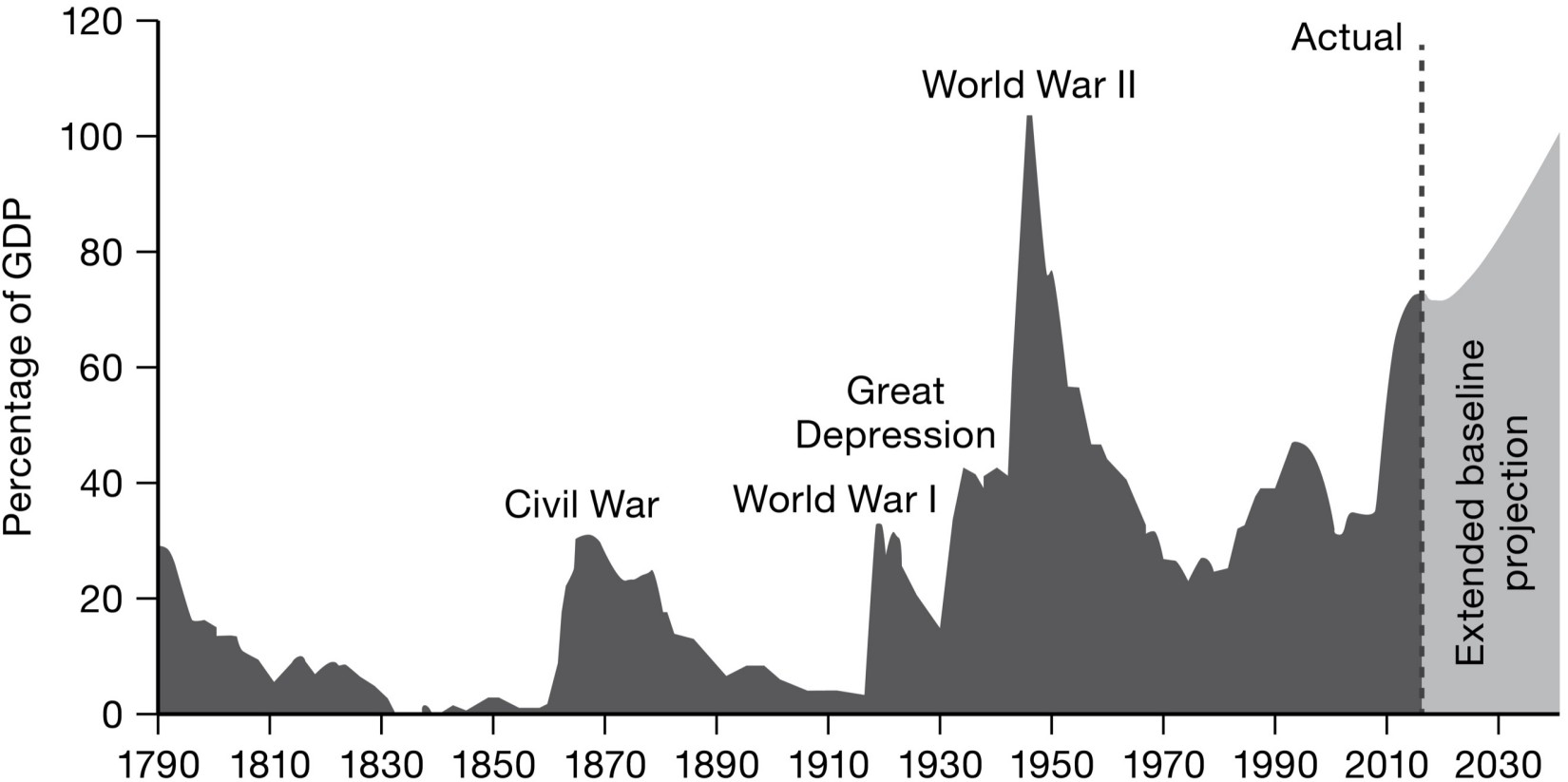
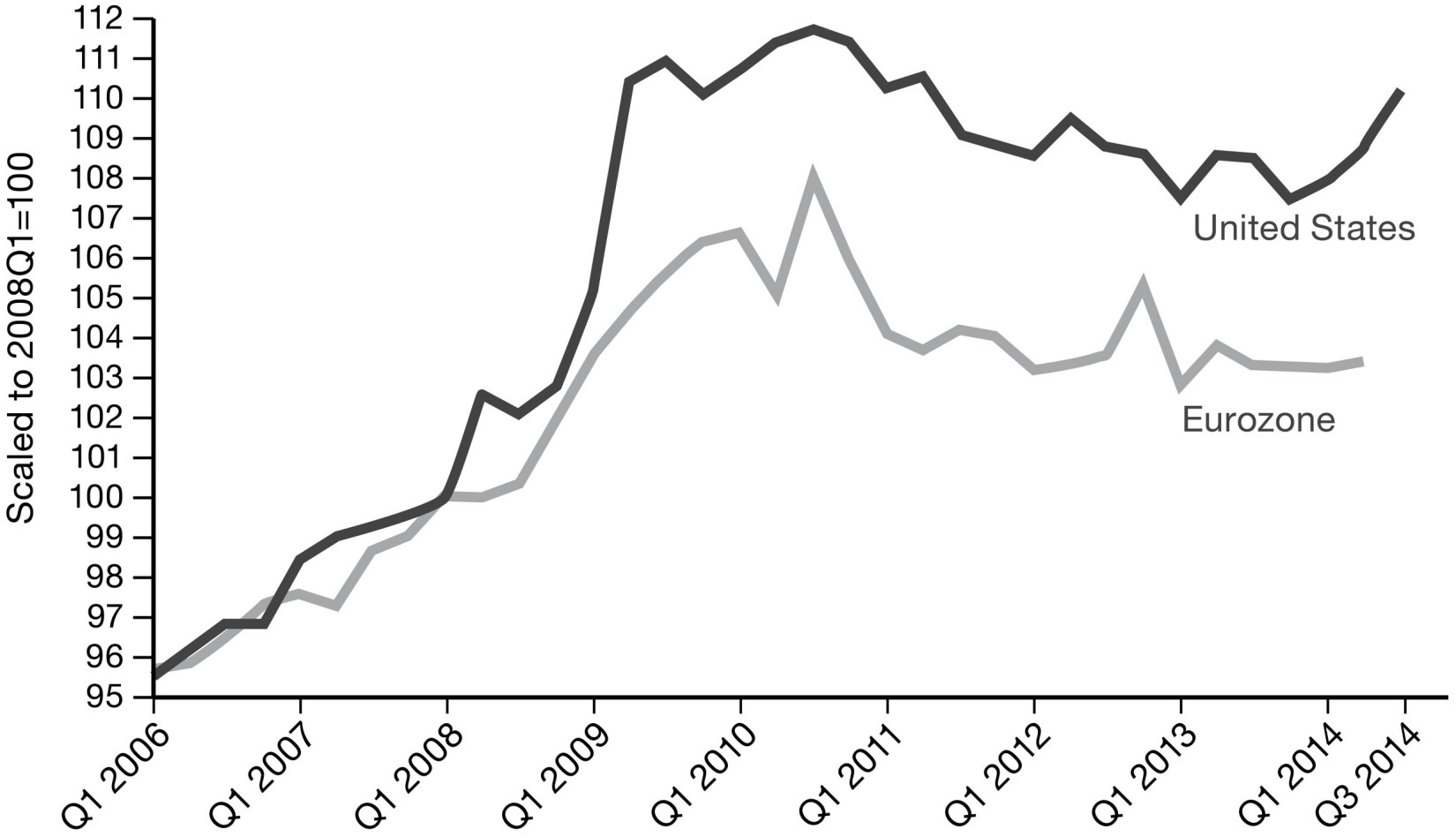
Viewed in these terms, the effect of the crisis of 2007–2009 on the budgets of rich countries was spectacular. Whatever the politics of stimulus spending in Congress, the Bundestag or the House of Commons, the automatic stabilizers delivered a huge and timely stimulus. According to calculations by the IMF, if the US economy had been at full employment in 2009, the crisis-fighting policies adopted by the Bush and Obama administrations would have been enough to produce a deficit of 6.2 percent of GDP—this was the discretionary deficit. The actual general government deficit was 12.5 percent of GDP. 22 More than half the support provided to aggregate demand was automatic or quasi-automatic. And this was typical of all advanced economies. According to the IMF’s calculations, of the vast increase in public debt in the developed world over the course of the crisis, just under half was due simply to the reduction in revenue produced by the contraction of the tax base. As profits, wages and spending all declined, this automatically generated a deficit and thus an offsetting public stimulus. This puts a rather different perspective on the fiscal policy battles at the G20. Though Germany, France and Italy steered clear of the kind of stimulus package launched by the Obama administration, let alone that trumpeted by Beijing, their deficits were widening too. As the private sector deleveraged and cut its spending, they too saw huge nondiscretionary deficits. Indeed, it would have taken a heroic and truly perverse act of austerity to prevent these automatic stabilizers from coming into effect. The net result was dramatic. Between 2007 and 2011, demand in the world economy was stabilized by the largest surge in public debt since World War II.
For macroeconomists this was a cause to celebrate the stabilizing properties of the modern tax and welfare state. For fiscal hawks it was a cause of deep concern. In the long run those debts would require higher taxes to service and repay them. This would pose major political challenges. And how would capital markets react? According to the script set out by conventional fiscal conservatism, one might have expected serious and immediate repercussions. Would the debt shock trigger the loss of confidence that Orszag and Rubin and so many others had warned about? How would savers be induced to hold trillions of dollars in government bonds? Would interest rates have to rise? Would this crowd out private investment? Would bondholders get jumpy? Would the bond vigilantes of the 1990s swing into the saddle, selling government bonds, driving Treasury prices down and yields up? In the spring of 2009, as the scale of the deficit became clear, business media reported that markets were up in arms. In light of “Washington’s astonishing bet on fiscal and monetary reflation,” the Wall Street Journal looked forward to a stern response from bond markets. 23
So serious were the rumblings and so painful were the memories of the Clinton era that in May 2009 Obama asked budget director Orszag to prepare a contingency plan. 24 The budget director’s response was drastic. In the case of a bond market panic, the administration should severely hike taxes. The report was intended to be for the eyes of the president only. When Rahm Emanuel leaked it to Summers it provoked a towering fury. Summers threatened to resign and demanded that in the future he must have complete control of all economic policy input to the president. For all his rumpled, academic persona, Summers had a keen eye for power and could sense a new agenda of fiscal consolidation forming within the administration. This was a threat to his personal position. But it also violated his instincts as a “new Keynesian” economist. Summers might have censored Romer’s stimulus proposal, but he did not believe in the power of the “confidence fairies.” 25 To be talking about budget cuts in the early summer of 2009, when the United States was about to hit the trough of the most severe recession since the early 1930s, was wildly premature. If confidence was the issue, the best way to restore it was to engineer a solid recovery.
In the event, Summers and the other skeptics were proven right. There was no run against Treasurys. The bond vigilantes were a spook. America’s households were rebuilding their savings. Mutual funds were shifting out of risky mortgage bonds. Everyone wanted Treasurys. These were the kinds of systemic macroeconomic and financial mechanics that all too often escape fiscal hawks, who view the public budget like that of a private household. When the private sector is undergoing a shock episode of deleveraging, when the savings rate is surging as it was in 2009, what is needed to preserve the overall financial balance of the national economy is not for the state to cut its deficit too. Everyone cannot save at once without provoking a recession. As the proponents of “functional finance” have argued since the 1940s, the state must act as a borrower of last resort. 26 In so doing it preserves aggregate demand and provides a flow of safe long-term bonds to financial markets. After the shock of 2008 the entire world was keener than ever to hold safe assets. A huge class of AAA-rated private label securities had shown itself to be far from safe, so the demand for Treasurys was huge. It wasn’t only Americans who wanted US government debt. As Treasury debt held by the public increased by $2.9 trillion between the summer of 2007 and the end of 2009, foreign buyers took more than half. Chinese holdings of Treasurys increased by $418 billion.
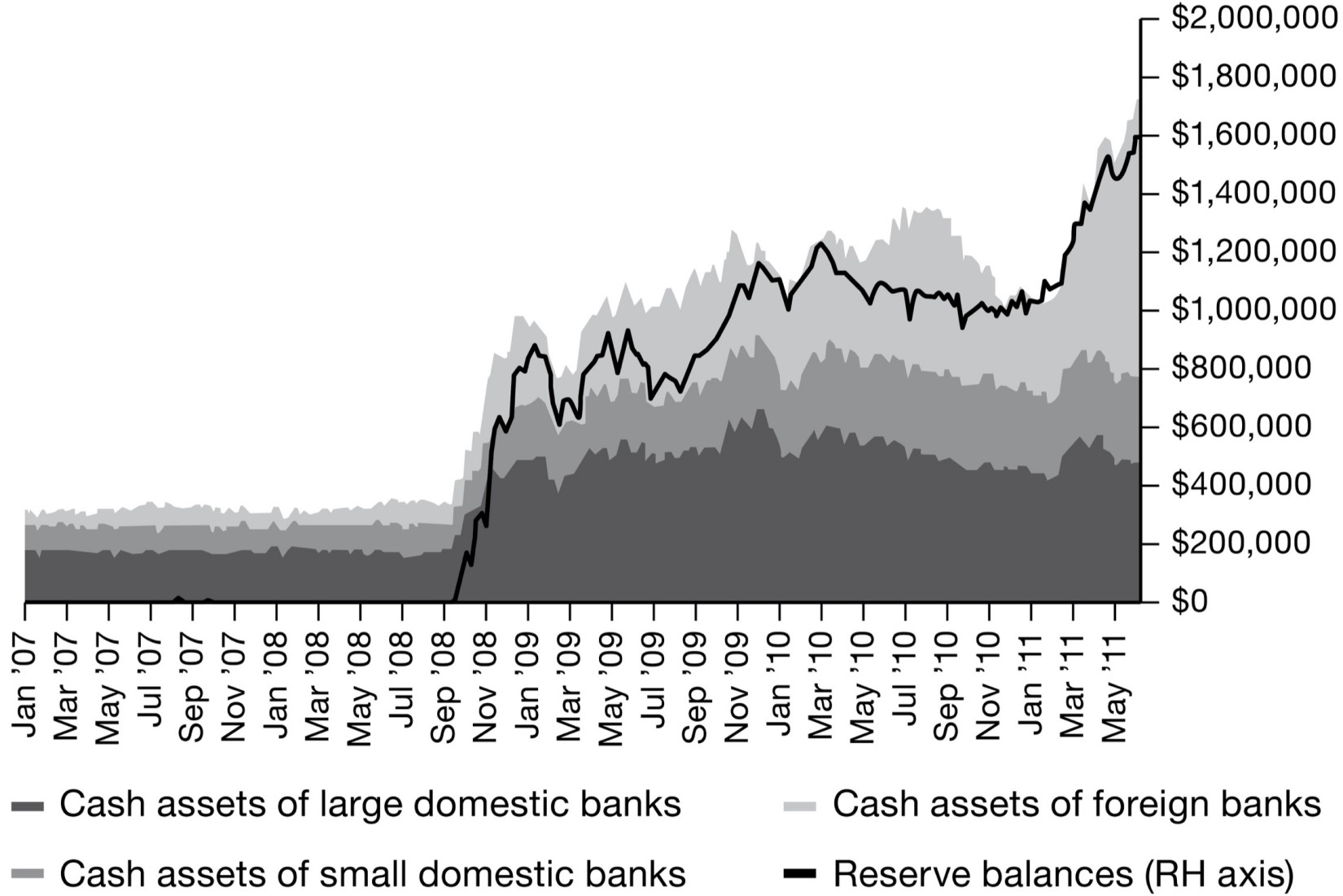
Among those who were selling were some of the hardest-pressed banks. They needed to shrink their balance sheets. But that adjustment was cushioned by the central banks. In the first phase of what became known as QE1, on March 18, 2009, the Fed announced that it would purchase $750 billion in agency MBS and agency debt, as well as $300 billion in Treasury securities. The Bank of England made a similar announcement on March 9, committing to purchasing first £150 billion and then £200 billion of British government bonds, or gilts. So, far from swamping the markets with their debt, in 2009 yields on top-rated government bonds actually fell.
In the eurozone things were more complicated. There too the automatic stabilizers kicked in and deficits ballooned. Debt issuance surged. But unlike in the UK or the United States, the ECB is barred from buying newly issued government securities. After Lehman, however, Trichet was in no mood to take risks. Though the ECB did not purchase newly issued government debt, what it did do was to repo sovereign euro bonds. 27 As the eurozone deficits ballooned, the ECB operated what was known informally as the “grand bargain.” 28 It supplied hundreds of billions of euros in cheap liquidity to Europe’s banks in the form of the so-called Long-Term Refinancing Operation initiated in May 2009. 29 The banks then bought sovereign bonds. On average, the rate Europe’s banks paid to the ECB on the CTRO funding was only a third of the yield they earned on their bond holdings. All told, in the eurozone in 2009 the banks loaded up on 400 billion euros’ worth of sovereign debt. 30 It was easy and apparently safe profit, and it was Europe’s most stressed banks, including Germany’s bankrupt Hypo Real Estate and Franco-Belgian Dexia, that were keenest to take advantage. Seeking to maximize their return, they put the ECB’s funds into the riskier peripheral bonds from Portugal and Greece that were offering a marginally higher yield. As in the UK and the United States, this helped to stabilize the government debt market, but there was a crucial difference. In the United States and the UK the central banks were pushing liquidity into the banking system. By contrast, in the eurozone, it was the balance sheets of the banks that absorbed the sovereign debt.
III
Fiscal stimulus was clearly necessary over the winter of 2008–2009. The automatic stabilizers were a welcome complement. Together they helped to revive the advanced economies in the worst crisis they had experienced since the 1930s. Thanks to general macroeconomic conditions and the intervention of the central banks, there was no run in the bond markets in either Europe or the United States. Nevertheless, already in the spring of 2009, anxieties about excessive deficits and the need for consolidation were to be heard on both sides of the Atlantic, and nowhere more so than in Germany.
At the G20 in London, Merkel and Sarkozy had taken a public stance on the need for financial consolidation. In large measure this was political theater. Given the shock to Germany’s export sector, Merkel’s government could not ignore calls for a stimulus package. Unemployment was surging, and in the coming autumn the CDU and SPD had an election to fight. Early in 2009 Angela Merkel’s grand coalition brokered a deal. Finance Minister Steinbrück reluctantly agreed to a modest emergency package of extra spending and tax cuts. 31 Automatic stabilizers would take care of the rest. But the question of fiscal consolidation that had preoccupied Merkel’s grand coalition since 2005 could no longer be dodged. The SPD and CDU agreed that even as they administered the stimulus, budget balance at both the national and regional levels of government would be enshrined in a constitutional amendment.
This was not a resolution forced on Germany by panic in the bond markets or immediate financial necessity. German government bonds (Bunds) were for the eurozone what US Treasurys were for the dollar world, the safe asset of choice. 32 Despite its gaping deficit in 2009, Germany had no difficulty selling debt. It was not markets but the cross-party consensus on fiscal consolidation that had emerged before the crisis that dictated a decisive and irrevocable turn toward austerity. It was a decision driven by a long-term vision of competitiveness and retrenchment, the lobbying of taxpayer and business advocates and the regional interests of the rich states of western Germany. 33 It was a choice that would change the politics not just of Germany but of the eurozone as a whole.
On Thursday, February 5, 2009, at a spartan Bundeswehr barracks in the precincts of Tegel Airport in the northern suburbs of Berlin, Chancellor Merkel personally brokered the deal. 34 Under pressure from ultraconservative Bavaria, the fiefdom of the CSU, the Länder collectively committed themselves to a constitutional amendment that would end all borrowing by 2020. Until 2019, the stragglers—Bremen, Saarland, Berlin, Sachsen-Anhalt and Schleswig-Holstein—would receive annual subsidies of 800 million euros. In exchange they would submit to the external review of their fiscal policy by a so-called Stability Council (Stabilitätsrat). Länder that refused to respond to the council’s advice would lose federal support. Germany’s federal government, for its part, agreed to bind itself by constitutional amendment to borrow no more than 0.35 percent of GDP under normal circumstances. 35 There would be exceptions in case of cyclical shocks, but the cap was severe. It applied to investment as well as to current expenditure.
No heed was given to the consequences that this draconian new rule would have for one of the largest bond markets in the world. Government bonds were seen only as a liability, not as a safe asset for savers. Austerity rhetoric ruled. Prime Minister Seehofer of Bavaria was jubilant. Chancellor Merkel declared a Weichenstellung (a change in the setting of the points). The debt brake was a demonstration that German federalism worked. 36 On March 27, 2009, in the Bundestag, Steinbrück made a typically vigorous defense of the constitutional amendment. It was a matter not of macroeconomics but of democratic autonomy, of “fiscal room for maneuver.” Since the 1970s, despite notional debt limits, annual deficits had resulted in a budget in which 85 percent of federal spending was consumed by debt service and nondiscretionary spending. Fiscal politics were “petrified and devoid of life” (“versteinert und verkarstet ”). 37 Restraint on debt would give back to voters and parliament the freedom to choose their fiscal priorities. The antidebt consensus did not go entirely unopposed. Peter Bofinger, the maverick Keynesian member of the Wirtschaftsweisen, the official expert advisory committee on the German economy, was scathing in his criticism. If the German federal government was issuing no new bunds, where were German savers to invest the 120 billion euros that they sought to put aside every year? Because the German corporate sector was also generating a financial surplus, they could not on balance invest their funds in German businesses. Rather than funding investment at home, Germany’s savings would out of necessity flow into investments abroad. 38 This was the financial counterpart to Germany’s chronic current account surplus, a symptom as much of repressed domestic consumption and investment as it was of export success. When it came to the Bundestag vote on May 29, 2009, the majority was wafer thin—68.6 percent as compared with the two-thirds required—but the amendment passed. It would take another two-thirds majority to undo it.
It was a domestic matter first and foremost. But even before it had been carried in the Bundestag, the debt brake was being touted in Berlin as a major element in Germany’s foreign economic policy. The strong Deutschmark and the independent Bundesbank had made West Germany a model of conservative economic policy. The tough Hartz IV measures set a standard for “labor market reform” in Europe. Now the Schuldenbremse would become Germany’s latest instrument of conservative economic governance for export. 39 For a politician of Merkel’s ilk, the problem of public debt, like the problem of inflation, was a problem affecting all advanced societies. It went back to the 1960s. It had built up over decades. Now was the time to make a stand. As Merkel headed to the G20 meeting in London she hailed Germany’s debt brake as a great achievement. As she told an audience at the German Chamber of Commerce: “We are going to have to try to transfer this to the whole world.” 40
IV
At the London G20, the clash between Merkel, Brown and Obama had enacted familiar transatlantic stereotypes. The Germans were frugal and skeptical about Anglo-Saxon free-market finance. The Americans and the British were freewheeling advocates of whatever it took to keep the capitalist engine spinning. But this was a distortion on both sides. The Germans had plenty of fiscal problems of their own and bankrupt banks to match. Meanwhile, the Obamians were never the full-blooded high spenders that others painted them as. If Treasury Secretary Geithner urged the rest of the G20 to do more, it was in large part in the hope that America might do less. There were Democrats in Congress who wanted to make a major second effort and to push for another round of stimulus. But they got no help from the White House. 41 Inside the administration, Christina Romer cut an increasingly lonely figure in her demand for a bigger fiscal effort. On occasion she would get the backing of Larry Summers. But when she became outspoken in favor of a second round of stimulus, as she did over the winter of 2009–2010, Romer was brutally silenced by Obama himself. 42
What began to prevail in Washington, DC, as in Europe from the late summer of 2009, were the fiscal politics of the precrisis period. The aim of fiscal “sustainability” returned to the fore. Geithner at the Treasury targeted a deficit of 3 percent by 2012, a huge tightening relative to the deficit of 10 percent of GDP in 2009. Even more aggressive was Orszag at the OMB, who ran in-house competitions for the best cost-saving ideas. 43 All the Obama administration’s medium-term priorities tended to point toward streamlining government and trimming spending. The top political priority was health-care reform. Though this was tarred by Republicans as European-style socialism, given the bloated inefficiency of America’s publicly subsidized, profit-making health-industrial complex—which at 17 percent accounted for twice the share of GDP attributable to the financial services industry—the priority of the Affordable Care Act was to cut costs. Likewise, the thrust of Obama’s foreign policy was retrenchment. In 2009 the White House was persuaded to put more troops into Afghanistan, but only because it was simultaneously running down its Iraq commitment. America’s soldiers didn’t like it, but the age of major spending increases was over. Though the Obama stimulus crested in the second year of his presidency, this was offset in 2010 by cuts to other areas of federal spending and a crushing contraction in state and local spending. Though it suited no one to acknowledge the fact, between 2009 and 2010 Germany’s deficit was actually increasing more rapidly than that of the United States. 44 Though the arguments were apparently more transparent, the politics of fiscal policy in the wake of the crisis were in their own way no less opaque than those that framed monetary policy.
Chapter 13
FIXING FINANCE
“C onfidence” is one of the most quicksilver concepts in economics. In 2007–2008 it had been the collapse in confidence in mortgage securitization, money markets and the banks that brought down the house and necessitated the bailouts. By 2009 confidence was still the problem. But now it was government deficits and the supposed threat of bond vigilantes that seized the headlines. Given actually prevailing conditions in bond markets at the time, the constraints this anxiety placed on fiscal policy were a triumph of precrisis centrist orthodoxy over the facts of the postcrisis situation. While the bond vigilantes never appeared, millons of jobless would pay the price for the failure to sustain fiscal stimulus. And the effects went beyond the labor market. The purpose of restraining fiscal policy was supposedly to maintain confidence and to create space for a private sector recovery. But where was that to come from? The real estate market was still collapsing. Households needed to pay down their debts and restore their overstretched finances. Uplift would have to come from business investment. For that there needed to be financial stability and easy credit, and from there the trail led back to the institutions that had actually been the source of the collapse of confidence in 2008, the banks and their dangerous balance sheets. Having excluded a full-scale fiscal response on grounds of protecting confidence, faute de mieux resurrecting the banks came to seem like the most promising path to recovery.
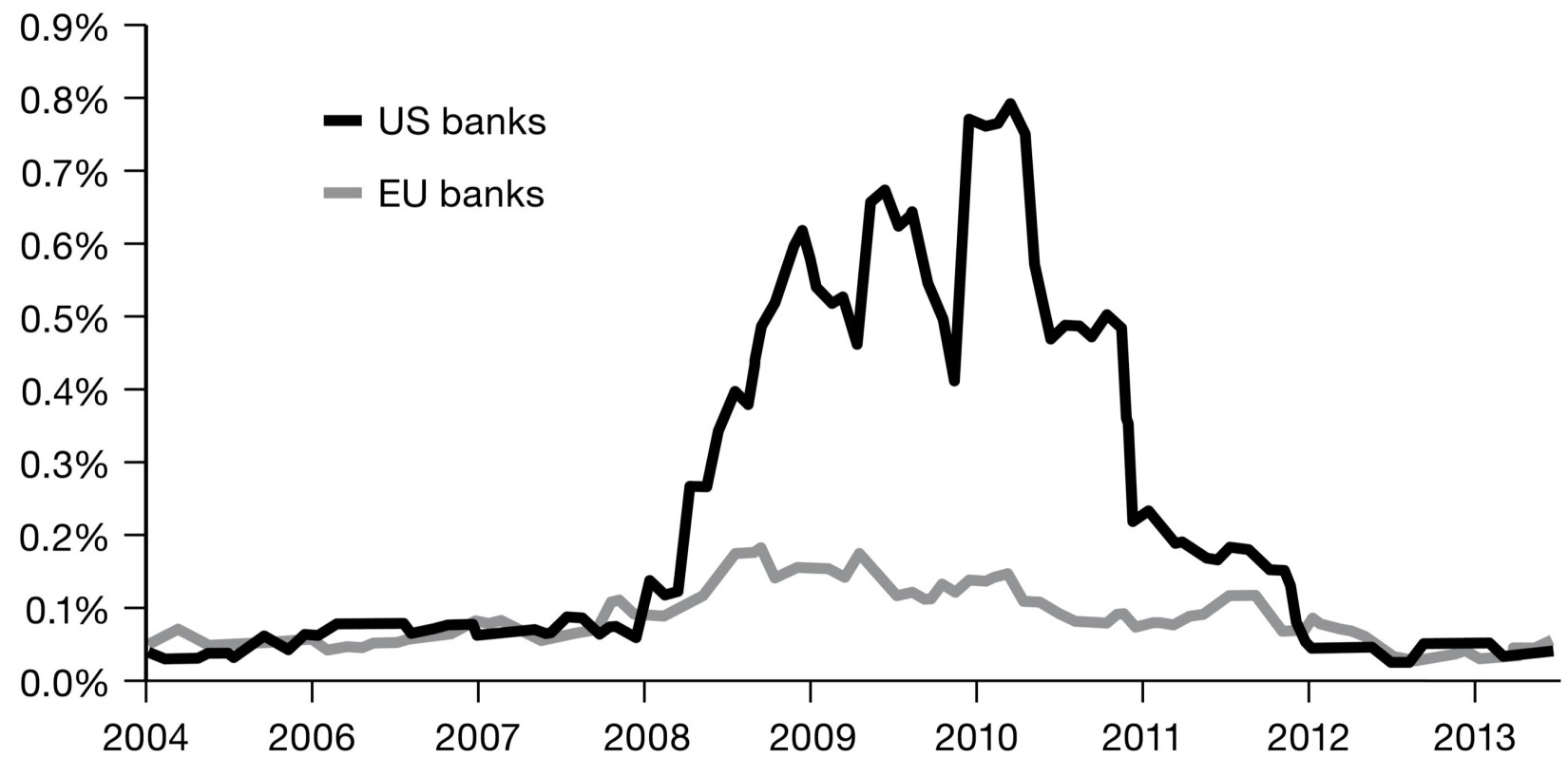
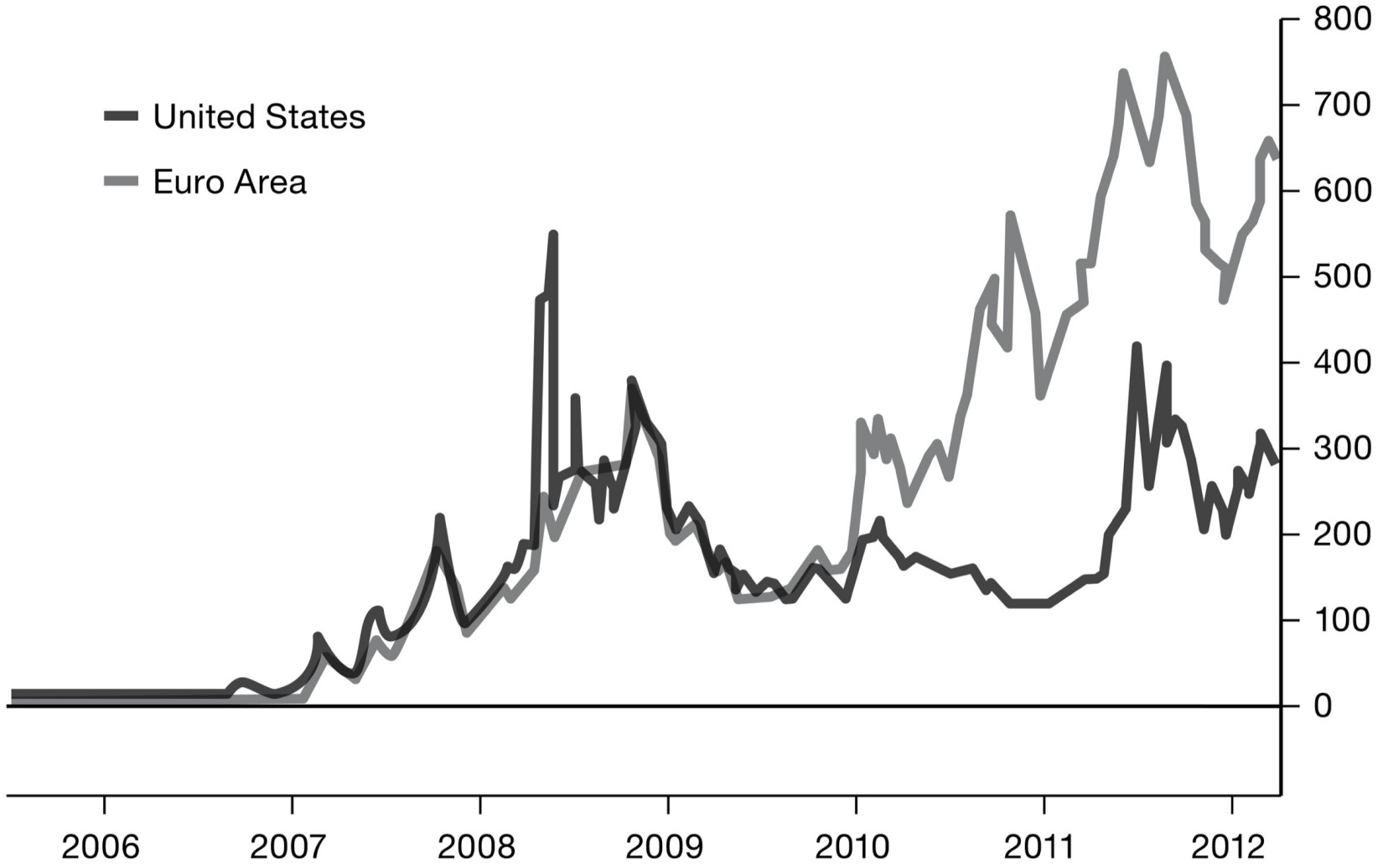
Though the acute general panic of September 2008 had passed, the banks were still very fragile. As the full scale of the losses began to sink in—by May 2009 the IMF was estimating $1.5 trillion in write-downs around the world—default insurance premiums on bank debt surged to 300 basis points in the eurozone and 400 basis points in the United States. 1 At those kinds of rates raising new bank funding was prohibitively expensive. And in the spring of 2009 Bank of America and Citigroup, two of America’s largest commercial banks, were still in danger. 2 Bank of America was digesting the horrors of the Merrill Lynch balance sheet. At Citigroup the situation was even worse. Despite the double capital injection by the Treasury and the ring-fence around $300 billion of its most toxic assets, by May 2009 Citi’s shares were trading at 97 cents. 3 The New York Fed was preparing plans for an all-out rescue effort that would involve guaranteeing all its debt and $500 billion in foreign deposits. Meanwhile, rather than recognizing the political trauma caused by the 2008 bailouts, the bankers in their self-satisfied insulation continued to help themselves to the lion’s share of whatever revenue they generated.
In Britain, the most egregious case was RBS, a now majority state-owned bank that announced in February 2009 that it intended to honor £1 billion in bonus contracts. 4 In the United States the figures were far larger. In the 2008 bonus season, after suffering tens of billions in losses, Wall Street paid out $18.4 billion to its top staff. That was two and a half times the amount that Congress approved for the president’s priority of modernizing America’s broadband infrastructure. Alternatively, if it had been retained by the banks, it would have made a substantial contribution toward their recapitalization. 5 But the investment banks weren’t conventional public companies. They were partnerships run primarily for the benefit of their managerial elite and they expected to be paid, whatever happened. In the 2008 bonus season Merrill Lynch alone was responsible for $4–5 billion in payments. And it made sure to pay out earlier than normal in December 2008, just after the firm revealed a fourth quarter loss of $21.5 billion and days before it collapsed into the reluctant embrace of Bank of America. 6 But of all the bonus scandals, the one that really caught the public’s attention was AIG. It closed its fourth quarter of 2008 with a loss of $61.7 billion, the largest in US corporate history. Nevertheless, on March 16, 2009, the company announced that its Financial Products division, which had been at the heart of the toxic spill, would be awarding $165 million in bonuses, a figure that might rise to as much as $450 million. Even President Obama expressed his “outrage” and demanded redress for America’s taxpayers. 7 What was to be done?
I
One option was nationalization. That is what the British had been forced to do to Lloyds-HBOS and RBS. Germany’s Commerz and Hypo banks were in state hands. Economists pointed out the positive example of Sweden, which when faced with a major banking crisis in the 1990s had taken radical action. After nationalizing and restructuring its banks the economy had bounced back fast. By contrast, Japan had put off restructuring and recapitalizing its banks and had languished ever since. Perhaps the solution was to follow the Swedish example, to break up America’s megabanks, restructure, recapitalize and then return them to the market. What would once have been dismissed as Luddite was now merely common sense. In February 2009, former Fed chair Alan Greenspan, who as a young man had sat at the feet of free-market goddess Ayn Rand, told the Financial Times : “It may be necessary to temporarily nationalise some banks in order to facilitate a swift and orderly restructuring. . . . I understand that once in a hundred years this is what you do.” 8 On network TV news, the Republican senator for South Carolina Lindsey Graham opined that “[t]his idea of nationalizing banks is not comfortable . . . [b]ut I think we’ve got so many toxic assets spread throughout the banking and financial community, throughout the world, that we’re going to have to do something that no one ever envisioned a year ago, no one likes.” 9
The intensity of feeling running against the banks in early 2009 was such that President Obama had to take a stance. At a press conference on February 10, 2009, he took up the international examples that everyone was talking about. He acknowledged the off-putting experience of Japan in the 1990s with its botched bailout and recognized that Sweden had done far better after nationalizing its banks. “So,” Obama continued, “you’d think looking at it, Sweden looks like a good model.” But the president was never comfortable with the comparison: “Here’s the problem,” Obama remarked. “Sweden had like five banks [laughs]. We’ve got thousands of banks. You know, the scale of the US economy and the capital markets are so vast. . . . Our assessment was that it wouldn’t make sense. And we also have different traditions in this country. . . . Obviously, Sweden has a different set of cultures in terms of how the government relates to markets and America’s different. And we want to retain a strong sense of that private capital fulfilling the core—core investment needs of this country. And so, what we’ve tried to do is to apply some of the tough love that’s going to be necessary, but do it in a way that’s also recognizing we’ve got big private capital markets and ultimately that’s going to be the key to getting credit flowing again.” 10
It was not Obama at his most articulate. But it was a clear statement of basic principles. The “core investment needs of the country” were a matter for “private capital.” Government stimulus spending, whether on infrastructure or on education, was incidental. What was crucial was getting the banks back on their feet. It was music to the ears of the man who would deliver the “tough love” that Obama promised—Tim Geithner, his Treasury secretary. For Geithner nationalization was never an option. In 2008 at the New York Fed he had seen the depth of the market panic. He had witnessed the ructions over Bear and Fannie Mae and Freddie Mac. He had been in the room on the afternoon of Monday, October 13, alongside Paulson, Bernanke and Bair when they forced the bankers to take TARP capital. That was enough. As far as Geithner was concerned, to have pushed for further nationalizations in 2009 would have been a “deeply transforming policy mistake.” 11
Despite the united front against the Swedish option that Obama and Geithner presented, given boiling public resentment and the drip of scandalous revelations about the bailouts, the way ahead was far from obvious. Larry Summers and Christina Romer, the leading economists in the administration, were compelled by the Swedish example, as was Paul Volcker. Perhaps a short, sharp restructuring under state ownership was what America’s financial system needed. So intense did the debate become that on the afternoon of March 15, 2008, a summit was convened in the White House to clear the air. 12 With the president looking on, the argument swayed back and forth for several hours before Obama impatiently declared that he had other business to attend to and he expected a conclusion by the end of the night. After the president left the room the issue was decided by his foul-mouthed chief of staff, Rahm Emanuel. If bank restructuring and comprehensive recapitalization along Swedish lines would cost upward of $700 billion, it was not going to “f***ing happen.” After TARP and the stimulus, with health reform in the pipeline, Emanuel could not ask the centrist Democrats in the House to back more spending. The economists would have to come up with another plan.
By 2009 the problem was no longer the investment banks. They were back in profit. The problem was the ailing commercial banks. Citi was the worst. So rather than a comprehensive restructuring of the entire American banking system, the meeting agreed that the remaining TARP funds should be concentrated on backstopping a “resolution” of Citigroup. This gigantic, oversized monolith should be broken up, downsized, restructured and the worst assets hived off to a bad bank. Without alerting Sheila Bair of the FDIC to the intensity of the debate going on inside the administration, Summers had sounded out with her the possibility of creating an $800 billion bad bank for Citi’s worst assets and bailing in its shareholders. 13 The Citi plan was approved by Obama later that evening. The Treasury was charged with working out the details. It ought to have been momentous. Citigroup was huge. Back in 1998 its merger with Travelers Group had sounded the death knell of the old days of “boring” high street banking. By way of Rubin, it was tightly politically connected to the Democratic Party. And the pressure for action was only increased the following day, when the scandal erupted over bonuses paid to AIG’s senior staff. The president was furious. He wanted action. The nation’s top thirteen bank bosses were summoned to a meeting in the White House. 14
At this moment there was a real fear on Wall Street that the Obama administration was about to go to war. Given how unpopular the banks were, it would have made good politics. But it didn’t happen. Despite the decision endorsed by the president on March 15, Geithner never agreed with restructuring Citigroup. No one had ever unraveled a bank of Citigroup’s complexity. It was not clear that the Treasury had the resources and legal authority to carry it through. A protracted restructuring would spook the markets. In the words of a later postmortem compiled by one of Obama’s closest advisers, the Treasury “slow walked” the Citigroup proposal. 15 Though this delaying action bordered on insubordination, Obama showed little inclination to impose his will. As his remarks about the “Swedish case” had suggested, he was far from being a radical on banking issues. When Obama confronted the bank CEOs on March 27 the atmosphere was frosty. But he had summoned them to Washington not to punish them but to remonstrate with them. He appealed to the bankers to show restraint in their compensation and bonuses. “Help me help you,” the president pleaded. When several of the CEOs offered the customary justifications for their exorbitant compensation—their businesses were large and risky; they were competing in an international talent pool—the president interrupted in exasperation: “Be careful how you make those statements, gentlemen. The public isn’t buying that. . . . My administration is the only thing between you and the pitchforks.” 16
In the spring of 2009, rather than going over to the offensive, Obama and Geithner positioned themselves as the last line of defense for America’s financial system. It was their self-appointed mission to calm “the mob.” Of course, playing the good cop is a tried-and-tested negotiating tactic. But it is usually combined with stiff demands. Someone has to play bad cop. What was remarkable in 2009 was how little the Obama administration asked in return for the protection it offered. To the amazement of the hardened Wall Street deal makers, the only item on the table on March 27 was voluntary restraint on compensation. That was even less than Paulson had asked for six months earlier when he foisted TARP on them. In truth, if there were pitchforks being wielded by anyone in the spring of 2009, it was not by the Left against the banks but by the right-wing populists. With the lavish attention of Fox News and subsidies from friendly oligarchs, they were organizing themselves in the Tea Party movement. The target of their anger was not Wall Street but the liberals in the White House. The uncomfortable truth was that the Obamians lacked pitchforks of their own. Reviled by the Right and suspected by the Left of being in the pocket of Wall Street, as Geithner himself admitted, the administration would find itself in political “no-man’s land.” 17
In his early days as Treasury secretary, Geithner was quite commonly described as being formerly of Goldman Sachs. 18 Given the precedent set by Paulson and Rubin, it was only to be expected. Geithner looked the part. He had the precocious youthfulness and pugnacity of a hotshot investment banker. The diary log of the New York Fed revealed that during his time there, Geithner regularly socialized with Citigroup executives, where his mentor Robert Rubin held court. 19 And as Treasury secretary, Geithner continued those habits. 20 But for all his cultivation of Wall Street, Geithner was until 2013 a career public servant, and a proud one at that. In his self-portrayal Geithner was not a banker but a soldier, a man of fortitude, serving in the interest of the national economy and the American people, willing to take upon himself the moral burden of dirty hands, to do what was necessary in the public interest. But how did Geithner define that public interest? First and foremost his commitment was to upholding the stability of “the financial system,” because without that, the entire economy was bound to fail. 21 That was his key article of faith. The interests of America and the financial system were aligned. To explain his actions we do not need to imagine that he was in the pocket of any particular bank. It was his commitment to the system that dictated that Citigroup should not be broken up. Even more important, the key institutions of financial regulation and government must be protected too. When Geithner resisted bank nationalization it was to shield the monetary authorities as much as any individual bank. A comprehensive attack on Wall Street could all too easily spill over into an attack on the agencies that oversaw its business. In 2009 “audit the Fed” was a battle cry on both left and right.
With Geithner at the helm, the Treasury’s response to the crisis was not to tackle “too big to fail” by breaking up the biggest banks. Nor was it to bring the interests of wider society to bear by way of politicized oversight. Instead, the Treasury’s solution was to increase the oversight and managerial capacities of the state’s regulatory agencies—the Treasury itself, the key regulators and the Fed. If capitalist finance was a given, then one would have to accept the necessity of dealing with gigantic banks and complex, fast-moving markets. One had to accept also that this system was crisis prone. Crises, indeed, were inevitable. All one could hope to do was to build a crisis-fighting capacity at the national and international levels that was adequate to cope. In 2008 the Fed and the Treasury had acted on a spectacular scale with effects well beyond the boundaries of the American national economy. At the London G20 the IMF had been given the firepower it needed. What the Treasury aimed to do in 2009 was to continue the consolidation at the national level. As it had done since October 2008, this would revolve around recapitalization. As they recovered from the shock the banks were champing at the bit to repay the TARP funds. To further force the pace the Fed and the Treasury cooperated to introduce a new regime of regulation and oversight known as stress testing. This would be followed by a major political effort to get legislation through Congress that would legitimize and regularize the business of overseeing financial stability. As the acute crisis of 2008 passed into memory, a new relationship between the big banks and the authorities would be given permanent shape.
II
Purely for internal purposes, the New York Fed had for some time been in the habit of conducting crisis simulations with the main banks on Wall Street. 22 In February 2009, in his first major speech as Treasury secretary, Geithner announced that these so-called stress tests would be turned into a comprehensive exercise of public policy. The Fed and the Treasury would inspect and certify the soundness of every major bank operating in America. To do so, all the largest US banks would submit their accounts for inspection. Fed and Treasury officials would then apply to that data a hypothetical scenario of financial disaster, estimating the losses the banks would suffer and the resources they would be able to mobilize to withstand the shock. Effectively, the Treasury and the Fed would make themselves into the credit-rating agencies in chief—the “United States of Moody’s”—official arbiters of private creditworthiness and guardians of confidence in America’s financial system. 23 Those banks that were shown to be at risk would be mandated to raise additional capital. Those that could not do so in the private capital market would be required to take money from the TARP fund.
In rejecting the Swedish option, President Obama had gestured to America’s “thousands of banks.” At the time the president spoke there were, in fact, 6,978 commercial banks operating in the United States. But those never mattered to Geithner or Bernanke. They were the province of the FDIC. What mattered for systemic stability were the nineteen major banks with assets in excess of $100 billion, c. $10 trillion in total. Subjecting those massively complex institutions to thorough scrutiny would have been a labor of Hercules. The stress tests were something more tactical and fast moving. In a crash effort, a scratch team of two hundred bank examiners, supervisors and analysts ran through the books. 24 The disaster scenario they applied was far from apocalyptic. They assumed that GDP would fall by only 2–3 percent, unemployment would rise to 8.5 percent and house prices would fall by between 14 and 22 percent. That turned out to be optimistic. But even starting from those numbers and the default probabilities they implied was enough to generate sobering conclusions. On top of the losses of $350 billion already recognized by the spring of 2009, under the stress test scenario the banks might expect to suffer a further $600 billion in write-downs and charge-offs by the end of 2010. This, then, posed the truly critical question: How much capital would be required to make the banks safe and restore market confidence? This was a matter of judgment. The Treasury and the Fed weighed a range of options from as little as $35 billion to as much as $175 billion. The risk, if they announced a huge capital shortfall, was that it might shake confidence irreversibly. On the other hand, if they announced a figure that was too low, it would undermine confidence in the stress-testing exercise. 25
According to inside reports, the original estimates caused consternation in banking circles. Bank of America faced a call for $50 billion in extra capital. Citigroup was called on to raise $35 billion. Wells Fargo was so dismayed at the initial ask of $17 billion that it threatened a lawsuit. In the end they settled on a bargained compromise. By far the biggest burden was imposed on Bank of America, which was required to raise $33.9 billion to exit the emergency ward. Wells Fargo’s quota was set at $13.7 billion. As its senior financial officer commented: “In the end we agreed with the number. We didn’t necessarily like the number.” 26 Ailing Citigroup had more reason to be satisfied. By allowing for future revenue streams, its capital requirement was massaged down to a modest $5.5 billion, a seventh of the original figure. 27 It was barely more than the bank would pay out in bonuses that year. After weeks of haggling, on May 7, 2009, the public was informed that America’s big banks needed to raise a manageable total of $75 billion.
The stress tests were a balancing act that began with an exercise in accounting precision and ended in a game of bargaining and confidence. 28 Whether they were taken in or simply delighted to discover how helpful the Treasury and the Fed were being, the markets responded well. The spread between very safe AA corporate bonds and the price that banks paid to borrow on their Baa bond rating fell from 6 percent to 3 percent, reducing funding costs. The week following the release saw a sustained 10 percent rally in bank stocks, a high tide on which the strongest banks immediately raised $20 billion in additional capital. On June 19 the first nine banks repaid and exited the TARP program. Over the months that followed, the eight banks still in the program, including the giants Bank of America and Citigroup, used every trick in the accounting book and all the help the highly cooperative IRS, Fed and Treasury could provide to exit TARP. 29 In an extraordinary two-week period in December 2009, Citigroup, Bank of America and Wells Fargo raced one another to raise a total of $49 billion in common equity. Bank of America’s offering of $19.3 billion was the largest offering of common stock in US history. 30 They crowded the market and could probably have raised more capital at lower cost if they had stretched the issuance over several months. But the authorities were in a hurry to wind up TARP, and for the banks time was of the essence. The sooner they could repay the Treasury, the sooner they could escape the limits on compensation imposed on all TARP recipients, thus allowing them to retain and compete for talent. It was, as Bair ruefully remarked, “all about compensation.” 31
This was the script that the administration liked. A light-touch government intervention had enabled private business to take the lead. Nationalization had been avoided. As President Obama had promised, “[P]rivate capital” would be “fulfilling the core—core investment needs of this country.” But what this celebratory narrative glossed over were the more ambiguous implications of the exercise. The stress tests subjected the accounts of the commanding heights of American finance to intrusive scrutiny not by the public and the markets but by select teams of government bank supervisors. By the same token, they placed a seal of official approval on profit-driven private business activity. They were the model of a new regime of comprehensive, anticipatory oversight but also of entanglement between the American state apparatus and the big banks. This might be obtrusive and expensive in bureaucratic terms. It was onerous for those banks subjected to it. But it also conferred privileges, specifically the implicit promise that a bank that passed the stress test was deemed safe by the Fed and the Treasury. If it came to a crisis, a bank that had passed the test could hardly be denied assistance. Among this group of tightly regulated and closely supported entities, there could be no sudden and unforeseen failures. With that risk removed, it was significantly cheaper for such banks to issue shares and borrow money. One study estimated that in the wake of the crisis the advantage in funding costs enjoyed by the larger banks relative to their smaller peers had more than doubled, from 0.29 to 0.78 percent. For the largest eighteen US banks, this implied an annual subsidy of at least $34 billion. 32
III
It was no surprise, therefore, that the markets liked the news. The banks were clearly in safe hands. With the implicit backing of the authorities, the banks finally stabilized. This bought time to think of longer-term solutions. The Obama administration could embark on the huge challenge of financial reform.
The political stakes were high. By the summer of 2009 the White House badly needed a “win.” The stimulus was a dud in political terms. Health-care reform was facing relentless opposition. Financial reform as a political project was defined by the imperative to “get something done.” This forged an unholy alliance between Geithner’s Treasury and the West Wing’s political operatives headed by Rahm Emanuel. Apart from a pugilistic style and a shared fondness for the f-word, Emanuel’s and Geithner’s intensity and single-mindedness bent in opposite, but complementary, directions. For the political fixer Emanuel, all that mattered was getting “points on the board.” The content of financial reform was someone else’s problem. Conversely, for Geithner, with his suspicion of Congress, all that mattered was passing a piece of legislation that gave as little new power as possible to “populist” politicians and maximized the discretion and firepower of the expert regulators. To achieve this goal, however, the Treasury had to work through Congress, and in particular the two key committee chairs, Barney Frank in the House and Chris Dodd in the Senate. They also had to contend with key regulators like Sheila Bair of the FDIC. They had to channel the energy of campaigners, most notably Elizabeth Warren, the Harvard law professor and consumer rights activist, and fend off the ever present banking lobby. 33
The result was a sprawling piece of legislation running to 849 pages. 34 Rather than offering a single coherent thesis, the Wall Street Reform and Consumer Protection Act, commonly known as Dodd-Frank, embodied a compendium of crisis diagnoses. Was the crisis due to mass predation of poorly informed borrowers? In which case what was needed was Elizabeth Warren’s Bureau of Consumer Financial Protection (Title X). Was it opaque over-the-counter derivatives that had blown up the system? In which case the fix was transparent, market-based trading of derivatives (Title VII—Wall Street Transparency and Accountability). Was it the breakdown of responsibility in the extended chains of mortgage securitization that poisoned the well? In which case securitizers should be required to have skin in the game (Title IX—Investor Protections). Was the sheer size of banks at the root of all the problems? Were they simply too big to fail? In which case the answer was to restrict bailouts and to make the industry pay for them (Title II—Orderly Liquidation Authority) and to cap banks’ further growth (Title VI, sections 622 and 623). Had investment banks used client money to gamble? If so, the thing to do was to reinstate 1930s-style divisions between commercial and investment banking by way of the so-called Volcker rule banning “proprietary trading” (Title VI, Volcker rule). All of these theories about the crisis of 2007–2009 had major political resonance. All of them made their way into the meandering text of Dodd-Frank. Many of them were sensible and worthwhile measures that redressed some of the grosser imbalances in the financial services industry. But in general they had little to do with the implosion of the wholesale-funded shadow banking system that actually brought down the house in 2008.
The Treasury had a clearer view of the mechanics of the crisis. It wanted more capital, less leverage, more liquidity. And it wanted centralized powers in the Treasury and the Fed to deal with the next disaster. It spelled out this vision in a blueprint, which it issued in the summer of 2009. 35 This was in many ways quite different from what emerged as Dodd-Frank. But that was not by accident. Many of the omissions were strategic. As Geithner unabashedly remarked, “[W]e didn’t want Congress designing the new capital ratios or leverage restrictions or liquidity requirements. Whatever their flaws, regulators were much better equipped” to decide those technical issues. “History suggested that Capitol Hill would be too easily swayed by the clout of the financial industry and the politics of the moment; we didn’t think that was the place for the intricate work of calibrating the financial system’s shock absorbers.” 36 In other words, what the Treasury and the Fed knew to be the main drivers of the crisis were kept off the legislative agenda. What the Treasury did want Congress to provide were the legal powers that Geithner believed to have been lacking at the crucial moment in September 2008. If the challenge was to structure a more sustainable symbiosis between Washington and Wall Street, that was better done, in the Treasury’s view, by way of the administrative and regulatory state, rather than by way of congressional pitch battles.
Though the Treasury sought to orchestrate a chorus of regulators behind its proposals over the summer of 2009, it soon realized that it would face dogged resistance from the FDIC and from within Congress. They shared a deep suspicion of the complicity of the Fed and the Treasury with Wall Street and the enhanced powers that Geithner was looking for. To ensure collective responsibility, Bair and Frank insisted that oversight over the entire system should be exercised not by the Treasury and the Fed alone but by a Financial Stability Oversight Council chaired by the Treasury but gathering together all the key regulators. The idea of crisis management by committee appalled Geithner. But the council, in fact, was given many of the powers that he wanted. It would have the right to designate systematically important institutions. Those could be placed under a regime of heightened supervision and regulation including regular stress testing. If a large bank was on the point of causing a systemic crisis, the council’s rights of managerial intervention were extensive. Ahead of time, all systemically important institutions would be required to prepare living wills mapping out how they should be resolved in case of bankruptcy. And this oversight and control could be extended to foreign banks operating in the United States.
The Fed was pivotal to Geithner’s vision of future control. But in political terms it was a liability. To say that the crisis dented the Fed’s public standing would be an understatement. It polarized and in due course flipped the politics of the institution. 37 In 2008 Bernanke, like his predecessor, Alan Greenspan, had been significantly more popular with Republicans than with Democrats. By 2010 he was almost equally unpopular with both, and on the right wing the drumbeat of the Tea Party was mounting. Meanwhile, for Obama, Bernanke was a token of the bipartisanship he craved. In August the president announced his nomination for a second term as Fed chair. Time magazine ended 2009 by naming Bernanke its man of the year. 38 But that did nothing to endear him to either the right wing of the Republicans or the left wing of the Democratic Party. 39 December 2009 and January 2010 saw fierce clashes in the Senate over Bernanke’s reappointment. Desperate to rally support, the White House mobilized influential figures such as Warren Buffett to lobby on Bernanke’s behalf. To make matters worse, at the same time Bernanke himself was working the phones, struggling to stop Dodd’s Senate draft of the financial reform legislation from stripping the Fed of oversight over the largest banks. 40
In their effort to retain the Fed’s role at the heart of financial governance, Bernanke and Geithner were forced to make a pawn sacrifice. They conceded the formation of a separate consumer finance agency—Warren’s Consumer Financial Protection Bureau. 41 It allowed the reform campaign to claim a major win. It drew the fire of lobbyists. And it was largely irrelevant to the vision of systemic stabilization that Geithner and Bernanke were pursuing. They could concede regulation of credit cards and consumer loans as long as they retained oversight over the banks with balance sheets greater than $50 billion. Indeed, consumer protection and macroprudential regulation might very well be at odds. As Larry Summers remarked to the president, the “airline safety board shouldn’t be in charge of protecting the financial viability of the airlines.” 42 That was fair but it begged a further observation. Whereas there are plenty of safety agencies, there are, in fact, no agencies responsible for ensuring the financial viability of airlines or any industry other than banks. Airlines are expected to take care of their own finances. But Geithner and Summers preferred to sidestep the ramifications of that thought.
In the wake of Lehman what preoccupied the Treasury most was the question of how a failing megabank could be safely contained. For Geithner there was no substitute for the combination that had finally stabilized the situation in October 2008—wide-ranging guarantee powers by the FDIC ideally in combination with general liquidity support from the Fed and recapitalization and ring fencing of losses orchestrated by the Fed and the Treasury. The crisis had shown the need to add well-resourced resolution authority for those banks that were beyond saving. But the mood in Congress was ugly and Sheila Bair was on the warpath. In the end Dodd-Frank embodied a severe rejection of the practices of 2008. There would be no more taxpayer-funded bailouts. The Fed could offer general liquidity support but was barred from offering facilities tailor-made for specific banks. In consultation with the president and the Fed, the Treasury was required to place failing institutions under the control of the FDIC. It would operate the bank as a going concern with a view to breaking it up and selling off the component parts. The one element of control that the Treasury preserved was that it would be responsible for funding the FDIC’s resolution, with the costs to be recouped after the crisis had passed by a levy on the financial industry. Bernanke and the Fed thought they could live with the deal. The Fed chair had always been unhappy with the ad hoc interventions he had had to make under the terms of section 13(3) emergencies. From Geithner’s point of view it was an alarming restriction. As ever, he turned to his favorite analogy between financial crises and national security: “The president is entrusted with extraordinary powers to protect the country from threats to our national security. These powers come with carefully designed constraints, but they allow the president to act quickly in extremis. Congress should give the president and the financial first responders the powers necessary to protect the country from the devastation of financial crises.” 43
For Geithner the “populist fury” of the “atonement agenda” was a dangerous distraction from the tough-minded technical business of addressing a crisis. 44 But the grief and distress caused by the crisis were forces to be reckoned with. They ran through American society in waves, and early 2010, as Dodd-Frank reached a critical point in its labored passage through Congress, was one such moment. Three years since the real estate bubble burst, the full effects of the credit crunch and mass unemployment were making themselves felt. Between 2007 and 2009, 2.5 million homes had been foreclosed and the crest had not yet been reached. As 2010 began, 3.7 million families were more than ninety days past due on their mortgage payments. Millions more were struggling to make ends meet, one or two months behind on their payments. Over the next twelve months 1.178 million homes would slide into foreclosure, the worst year of the crisis. With prices still falling, ever more properties were sinking into negative equity. As one analyst remarked in early 2010: “We’re now at the point of maximum vulnerability. People’s emotional attachment to their property is melting into air.” 45 In the worst-hit areas, such as Florida, fully 12 percent of properties were given up by their owners or seized by banks for foreclosure. Foreclosure proceedings were operating at such a pace that they were given over to quasi-automated legal processes that turned out to be ruinously flawed. In a nightmarish administrative and legal tangle, ever more victims were sucked into the crisis.
The contrast in fortunes between Wall Street and Main Street was increasingly intolerable. The big banks had been bailed out. Some of the most unscrupulous bosses might face legal action, but they were not facing personal ruin. They retired to lifestyles of wealth and comfort. 46 None had gone to jail. And those at the top of the tree on Wall Street were bouncing back apparently without shame or second thought. The bonus season in 2009 was better than ever, netting $145 billion for the executives at the top investment banks, asset managers and hedge funds, as compared with $117 billion in 2008. 47 Goldman made $13.4 billion in profit for its shareholders and paid its own staff $16.2 billion in compensation and bonuses. 48 Astonishingly, even Citigroup, which had a loss of $1.6 billion in 2009 and survived the year only due to government action, paid out $5 billion in bonuses. The bankers were happy to leave the past behind, but the American public was not. In the spring of 2010 Wall Street’s approval rating with the general public stood at 6 percent. 49 And the regulators and their lawyers were finally catching up with the events of the last three years. On April 16, 2010, the SEC announced that it would be bringing charges against Goldman Sachs for misleading the investors to whom it had sold inferior quality mortgage-backed securities. The announcement unleashed a firestorm of indignation. Finally a really big name was going to have to face the music. To the embarrassment of the administration, Dodd-Frank was carried across the finish line not by the energy of the Treasury or the White House but by a new wave of popular fury.
Emotions ran so high in the spring of 2010 that it took a coalition of Treasury, centrist Democrats and business lobbyists to block a last-minute effort to ban any banks enjoying an FDIC guarantee from engaging in derivatives trading of any kind. For the biggest banks this would have been truly costly. The resulting compromise “pushed out” only 10 percent of the least dangerous derivatives. Similarly, a last-minute proposal to address “too big to fail” by putting a cap on the total size of bank balance sheets was blocked in the banking committee by Chris Dodd and other “moderate” allies. One vital late amendment that did make it into the final law was the Collins Amendment of May 2010. 50 Drafted behind the scenes by the FDIC, it demanded that whatever capital standards the Fed and the regulators set for the biggest banks should at least match the level required of the smaller FDIC-regulated banks. Bair wanted to roll back the favoritism shown to the big banks under the Basel II regime. She also wanted to ensure that capital standards applied to holding companies as well as commercial banking subsidiaries. The Fed and the Treasury resisted. They insisted that setting capital requirements was their regulatory prerogative. The banks screamed that the demanding new capital standards would force them to cut credit by $1.5 trillion. It came down to a struggle in the House and Senate reconciliation process, in which Senator Susan Collins and Bair prevailed with the backing of Dodd.
IV
The Dodd-Frank legislation that Obama signed into law on July 21, 2010, was hailed as the most significant act of regulation since the 1930s. Critics scoffed that it did not set a very high bar. It is easy to be cynical about a messy piece of legislation riddled with compromises and defined as much by what it left out as what it covered. And the incoherence became worse after the passage of the law. While the legislation was in Congress the bank lobbyists—conscious of how high emotions were running—had held back. As they well understood, passing the act was only the first round. Once the law was on the statute books and the argument over implementation began behind closed doors, they swarmed all over the legislation. Amid the inherent complexity of the subject matter, the rivalry between the regulators and the vociferous clamor of the lobbyists, implementing Dodd-Frank became a quagmire.
All told, Dodd-Frank called on regulators and agencies to formulate 398 new rules for the financial sector. Each one became the target for no-holds-barred lobbying by interested parties, who could now operate outside the limelight of congressional debate. By July 2013, three years on from the passage of the law, barely 155 of the 398 required rules had been finalized. 51 The highly controversial Volcker rule was a case in point. 52 How to draw internal divisions inside banks to insulate client money from proprietary trading was a hugely technical and contentious business. Even with the best will in the world it was nearly impossible to draw a line between the actions of a bank in making a market for a client and trading on its own behalf. What emerged was less a “bright” regulatory line than a Rorschach blot. It took until December 2013 for the five agencies involved to agree on a wording of the basic Volcker rule, 1,238 days after Dodd-Frank was passed. 53 The result was a 71-page document with an explanatory addendum that ran to a modest 900 pages. Banks were not so much told what to do as they were invited to demonstrate that they were not in violation of the rule. What exactly would constitute proof of compliance was a matter for further negotiation. 54 The best advice the lawyers could offer was that it was up to banks to decide the level of “regulatory risk tolerance” they were comfortable with. After passing the law in July 2010 and issuing the “final” formulation of the Volcker rule in December 2013, 2014 began with a new round of discussions about the “guidance” that would be issued to explain those regulatory risks. The only thing that was clear was that it would generate enormous demand for compliance officers and corporate lawyers. As Jamie Dimon of J.P. Morgan famously griped, to negotiate the new “system,” a banker needed the services not only of a lawyer but of a psychiatrist too. 55
It wasn’t only the bankers to whom Dodd-Frank caused anxiety. Geithner was worried about how it would work in a crisis. He feared that the formalized process of resolution centered on the FDIC would hobble the crisis response. But that put a premium on crisis prevention, and that points to the truly significant change brought about by Dodd-Frank. It perpetuated and institutionalized the stress-testing regime begun in the spring of 2009, and as such it was one of the pioneers of a new type of governance known as macroprudential regulation. 56 This required banks to be assessed not simply in terms of their business models but with regard to their impact on macroeconomic stability. Conversely, macroeconomic scenarios were evaluated in terms of their impact on the key banks. Henceforth, the risk of financial crisis was no longer a matter for ad hoc intervention in emerging market economies, as it had been in the 1990s. It was to be a permanent preoccupation of governments across the G20. The Financial Stability Council created by Dodd-Frank gave the Fed and the Treasury and the other regulators a standing platform from which to develop this new form of oversight and control. As the government regulators became ever more sophisticated in their understanding of modern finance, the banks built gigantic compliance teams to interact on a daily basis with the regulatory authorities. It was in the interaction between the two that the truly crucial work was done of defining the rules for the three parameters that mattered most for financial stability: capital, leverage and liquidity. It was a deeply incestuous relationship rife with conflicts of interest. For American conservatives it was the moment in which high-minded corporate liberalism shaded into a self-dealing of liberal corporatism. 57 And this went beyond the sociology of bureaucratic interaction and the revolving door that connected regulators, law firms and banks. To see how tightly this logic of entanglement worked, one needed only to go back to the original stress tests of May 2009.
It was clear that accrediting the stability of a core group of systemically important banks conferred a privilege on them. It would reduce their funding costs and that was indeed the point. But this takes the focus of the exercise on capital raising at face value and pays insufficient attention to the details of the tests. If the aim was to restore the financial health of the banks, issuing new shares was not the only option. In fact, of the estimated losses of $600 billion predicted in the 2009 stress-test scenario, 60 percent would be covered by “resources other than capital.” An explanatory note attached to the relevant table explained that the main source of these additional “resources” would be “pre-provision net revenue.” 58 Pre-provision net revenue (PPNR) is defined as net income from interest and noninterest sources minus noninterest expenses. It is not the same as profit because it does not make allowance for loss provisions, but it is a close relation. For the foreseeable future one of the main concerns of Fed and Treasury policy was to ensure that America’s top nineteen banks would earn a sufficiently ample portion of PPNR. The stakes were high. The banks that did not generate enough PPNR would not survive a stress test and would need to go to market or make calls on the TARP fund.
Through the stress tests the Treasury had sidestepped calls for nationalization and the “resolution” of Citigroup. Instead, in the interests of financial stability and minimizing the drain on the TARP fund, the Treasury and the Fed were in effect making it a government objective to restore bank revenue to healthy levels. The logic was inescapable. If financial stability, along with inflation control and employment, was now a key objective of economic policy, then bank profits were one of the key intermediate variables. More profit meant more strength on bank balance sheets and more stability. As part of the stress-testing regime, the Fed compiled statistics on PPNR and developed models with which to predict its likely development according to various macroeconomic scenarios. 59
But the entanglement did not stop there. It was only logical, having targeted banks’ profits, that the regulators should also have a say in what the banks did with them. 60 As a Fed press release spelled out two years later in November 2011 as part of its Comprehensive Capital Analysis and Review:
“[T]he Federal Reserve annually will evaluate institutions’ capital adequacy, internal capital adequacy assessment processes, and their plans to make capital distributions, such as dividend payments or stock repurchases. The Federal Reserve will approve dividend increases or other capital distributions only for companies whose capital plans are approved by supervisors and are able to demonstrate sufficient financial strength to operate as successful financial intermediaries under stressed macroeconomic and financial market scenarios, even after making the desired capital distributions.” 61
Obama and Geithner might have blocked the push toward nationalization, but in a truly ironic historical twist, less than twenty years after the defeat of communism, in the wake of the deepest crisis global capitalism had experienced since the 1930s, the bastions of American finance would be required to negotiate government-approved “capital plans” before paying dividends to shareholders. The imperative of guarding systemic stability required nothing less. It was a dramatic act of intrusive regulation in a sector that had once prided itself as the bulldozer of market freedom. And it was clear from the outset that whatever changes America adopted could not stop at its borders. They would have to be flanked by global measures: first, to ensure that America did not suffer competitive disadvantage; and second, to ensure that dangerous practices were not simply offshored. The G20 finance ministers had resolved during their critical meetings in October 2008 that no systemically important institutions would be allowed to fail. Now the question was how they would be regulated. The Americans had made a start. The wider frame would be set by the Basel Committee.
V
The urgency with which change was begun was striking. To get from the banking crises of the early 1970s to the first Basel regulations in 1988 had taken fourteen years of lackluster negotiations. The formal process of revision that turned Basel I into Basel II began in 1999. Eight years later, as the crisis struck, the new standards had still not been fully implemented. Basel III started off at an altogether different pace. The first call to action came from the G20 in November 2008. A new global Financial Stability Board chaired by the head of the Italian central bank, Mario Draghi, convened in the summer. Draghi had trained alongside Bernanke at MIT in the 1970s and was a fluent exponent of the new hybrid of finance and macroeconomics. By September 2009 technical discussions were ongoing. Within weeks, rumors began to circulate that the Basel Committee, in the manner of the US stress tests, had identified thirty financial groups as “systemically important” at a global level. 62 They would be subject to tougher capital standards and required to draft living wills that would map out in advance how they would be wound up should it come to the worst. The G20 gave the new regulations its imprimatur at the November 2010 Seoul meeting. The first list of the twenty-nine systemically important financial institutions subject to the full Basel III regime was published in November 2011.
Global Systemically Important Financial Institutions: Assets and Tier 1 Capital (end fo 2012)
Source: A. Rostom and M. J. Kim, “Watch Out for SIFIs—One Size Won’t Fit All,” World Bank (blog), July 1, 2013, http://blogs.worldbank.org/psd/watch-out-sifis-one-size-wont-fit-all . Data: The Banker, July 2012, and bank annual reports.
In the wake of the crisis, these twenty-nine institutions, with their headquarters in the United States, Europe, Japan and China, held total assets of $46 trillion. They thus accounted for roughly 22 percent of all financial assets worldwide. Henceforth, they would be subject to a special regime of oversight, not just at the national level through stress tests but at a global level too. Given the mechanics of the 2008 crisis, Basel III focused on new areas of regulation. To give them resilience in the face of a “run on repo,” all SIFI would be required to hold sufficient high-quality liquid assets that could be sold or repoed to cover thirty days of net outflows from their businesses. In addition, to constrain maturity mismatch, banks had to demonstrate that they had sufficient stable long-term funding to match their book of long-term loans. What the Basel III regulations aimed to ensure was that banks could not find themselves in the situation of a Northern Rock, with a giant balance sheet of long-term mortgages funded by unstable short-term wholesale funding. In due course these would emerge as the controversial cutting-edge regulations of Basel III. But in the first phase of the battle over the new regulations it would be the classic issue of capital that was to the fore.
In the aftermath of the crisis, many reform-minded economists were calling for a huge step up in capital. 63 Economists Anat Admati and Martin Hellwig spearheaded a call for banks to be required to hold capital up to 20–30 percent of their balance sheet, the kind of capital ratio that was typical of other businesses and hedge funds. This would have given them huge solidity. And it would have justified much lower rates of return. For the same reason, it was vigorously resisted by the global banks, which had no desire to be turned into boring providers of financial utilities. Leading the charge was the Institute of International Finance. Its members included the entire global banking world, American, European and Asian. Its managing director, Charles Dallara, was a veteran sovereign debt negotiator who had overseen the early steps in Tim Geithner’s career at the US Treasury in the 1980s. The assertive chairman of the group was Josef Ackermann, the Swiss CEO of Deutsche Bank. They argued that aggressive recapitalization would slow down lending and thus economic growth. According to the IIF’s in-house econometric models, a 2 percent increase in capital requirements for the G-SIFI would cut GDP in the United States, Japan and Europe by 3 percent and would reduce annual growth by as much as 0.6 percent. With the recovery struggling to achieve growth of 1 or 2 percent, that was an ominous forecast. 64 It was a tendentious and hypothetical argument that the advocates of capital raising were forced to counter with their own even more elaborate econometrics.
Amid the war of the economic models in Basel, Sheila Bair made herself into the spokesperson for raising capital. The Swiss regulators were pushing in a similar direction. After the near collapse of UBS and the huge losses at Credit Suisse, they clearly understood that they could not afford to have either of their megabanks fail. 65 The rest of the US delegation did not go so far as Bair. The compromise that resulted was a substantial change but by no means radical. The new rules specified 7 percent as the basic minimum requirement for Tier 1 common equity in relation to risk-weighted assets for all banks. However, systemically important banks were required to hold higher amounts, depending on their size and impact on the world economy. Between November 2014 and January 2019, the twenty-nine selected institutions would be required to raise their capital in relation to risk-weighted assets to between 8 and 12.5 percent, depending on their degree of systemic importance. 66 A further 3.5 percent could be added in the form, for instance, of convertible bonds that at moments of stress transformed from bonds to equity. Crucially, unlike under Basel II, leverage was measured two ways. The basic standard was set with regard to risk-weighted assets, which banks could calculate according to arcane in-house formulae. But as a cruder test of solidity, risk-weighted leverage would be checked against a simple ratio of total bank assets to loss-absorbing capital. This was not to fall below a 3 percent “leverage ratio” of equity to assets. This left Bair and her fellow campaigners indignant. In the United States, by way of the Collins Amendment and the standard set by the FDIC, the bar was raised higher. But if more was not done at Basel, it had less to do with the American delegation than with opposition from Europe.
Since the crisis, Berlin and Paris had been talking tough about Anglo-Saxon finance and the EU Commission had finally woken up to the need to create a financial firefighting capacity. The Larosière committee on financial regulation reported in February 2009. 67 It recommended an entirely new structure of Europe-wide banking supervision that by 2011 would result in the formation of four new agencies: the European Banking Authority (EBA), the European Securities and Markets Authority (ESMA) and the European Insurance and Occupational Pensions Authority (EIOPA), as well as a European Systemic Risk Board to oversee macroprudential regulation. In organizational terms it was far more comprehensive than anything attempted by Dodd-Frank. But though the Larosière group acknowledged that giant cross-border banks posed huge problems for national supervisors and though the committee recognized that the federal structures of the United States gave it a distinct advantage in crisis management, it recommended no more than ad hoc burden-sharing agreements and rejected the idea of a common deposit insurance scheme. The vision it offered was of the coordination and harmonization of national measures, not a banking union. 68 Meanwhile, for all the effort put into creating new supervisory agencies, on the question of bank business models and recapitalization, Europe’s progress was painfully slow. 69
With the United States setting the pace, in May 2009 the Committee of European Banking Supervisors announced that it would be conducting a scenario-planning exercise with Europe’s banks. But the committee insisted that these were “not a stress test to identify individual banks” and that “the outcomes [would remain] confidential.” 70 There was reason to fear the results of a more searching investigation. With banks desperate to avoid the stigma of official assistance, the hundreds of billions in public funds that had been allocated across Europe in October 2008 to fund recapitalization had remained largely untapped. Meanwhile, rock-bottom prices for bank shares made it expensive to raise capital through the markets. As a result, already in April 2009, in its first devastating summation of the financial crisis, the IMF estimated that the United States was significantly ahead in the game of bank recapitalization. 71 According to the Fund, Europe’s banks faced at least another trillion dollars in write-downs by 2010 on top of the losses they had already recognized. That was twice as much as was still outstanding in the United States. In local reports from across Europe, even more alarming numbers were circulating. In April 2009 Süddeutsche Zeitung got hold of a leaked paper from Germany’s bank regulator BaFin that seemed to suggest that there were 816 billion euros of assets on the books of Germany’s banks that were either toxic or unsellable under current conditions. 72 In the summer of 2009 Germany introduced new legislation to launch bad banks to absorb this toxic debt. But once again the funds were not taken up. European actions were facilitative, not mandatory. All told, the IMF estimated that to restore something like stability, the European banks would need between $500 billion and $1.25 trillion, either in new capital or in accumulated and retained profits. But far from actively pursuing new funds, over the years that followed, the European banks lagged far behind their American peers.
Racing to Recapitalize: US and EU Bank Equity Issuance (annualized figures as % of total assets)
Source: D. Schoenmaker and T. Peek, “The State of the Banking Sector in Europe,” OECD Economics Department Working Papers 1102 (2014), figure 8, http://dx.doi.org/10.1787/5k3ttg7n4r32-en .
This striking graph, which shows how aggressively America’s banks raised capital relative to their European peers, serves as a fitting conclusion to the first phase of the crisis. TARP, followed by the stress tests, the Dodd-Frank regime and capital planning, put the American banking system on a forced road to recovery. It foreclosed more radical options. The banks remained too big to fail. Far from downsizing or breaking them up, by 2013, J.P. Morgan, Goldman Sachs, Bank of America, Citigroup, Wells Fargo and Morgan Stanley were 37 percent larger than they were in 2008. 73 The resources of the state were put one-sidedly at the service of management and shareholders. But if the aim was to get America’s banks out of the emergency ward, it worked. As Geithner insisted, the ultimate test of his policy of stabilization was the financial health of the banks, and on that score the record was pretty unambiguous. Between 2009 and 2012 the eighteen largest US banks increased their common capital from $400 billion to $800 billion. They reduced their ratio of risky wholesale funding from $1.38 per dollar of FDIC-insured retail deposits to $0.64. At the same time, they raised the share of their assets in cash, Treasurys and highly liquid instruments from 14 to 23 percent. 74 The elite closure and cooperation that the Treasury and the Fed had finally managed to orchestrate in October 2008 was doing its job.
By contrast, the lack of comprehensive recapitalization of Europe’s wounded banking system was an omission that marks one of the fundamental turning points in the crisis. With the help of low-interest loans from Trichet’s ECB, many banks resorted to the makeshift of pumping up their profits by buying higher-yielding government debt. But the failure to build new capital would leave the European banks in no position to absorb any further shocks. While the United States began to stabilize, in Europe the banking crisis of 2008 would merge a year later with a new crisis: a panic in the eurozone public debt market. The connecting thread between the crisis of subprime and the crisis of the eurozone was the fragility of Europe’s bank balance sheets. Back to back, the combination of the two crises would mark one of the most significant inflections in European economic history since 1945. It would shake Europe’s politics to its foundations. It would open a stark divide within the Atlantic economy between Europe and America, and it would pose a profound challenge to transatlantic relations.
Part III
EUROZONE
Chapter 14
GREECE 2010: EXTEND AND PRETEND
I n the summer of 2009, with the acute crisis in the banking sector having been cauterized, both the European and the American economies began to recover. But aftershocks continued. With the insulation provided by the Fed and the Treasury, in the United States these aftershocks no longer manifested as acute stress in the financial system, but in misery spread across millions of households struggling with unaffordable mortgage payments and houses that were no longer worth the debt secured on them. The wave of foreclosures of American homes did not reach high tide until early 2010. Debtors continued to default, in other words, but their disaster did not pose systemic risks. They were the powerless ones who received precious little support from the Obama administration or anyone else. The main props to the economy other than the open-handed liquidity provision of the Fed were the automatic stabilizers of the fiscal apparatus. They left a deep dent in public finances, not just in the United States but across the advanced economies. In 2010 this would trigger a global backlash demanding fiscal consolidation and a return to the agenda of fiscal sustainability that had been so widely touted before the crisis. Controlling the debt-to-GDP ratio would become a mantra. After the largesse of the 2008 bank bailouts came austerity, though not for the same people, of course. But money is fungible. Ultimately, health care, education and local government services were all entries in the same budget that had to accommodate the costs of the crisis.
In the eurozone the switchback from the largesse of the banking crisis to the austerity that followed would take on a particularly dramatic form, because in three of its smaller member states the fiscal impact of the crisis was overwhelming. In the wake of the 2008 crisis, Greece, Ireland and Portugal slid into an increasingly untenable budgetary situation. Of the three, the situations of Greece and Ireland were the most severe. Greece’s public debts were simply too large and needed to be restructured. Ireland was overwhelmed by the consequences of its panic-stricken announcement on September 30, 2008, that it was guaranteeing 440 billion euros of bank liabilities. Given the burdens that Greece and Ireland were under by 2009, the only reasonable way forward was to carry out a debt restructuring, also known as haircutting bondholders, or, more euphemistically, as private sector involvement (PSI). In Greece this would have to involve lenders to the state. In Ireland it was the banks’ creditors whose claims could not reasonably be met. As in any bankruptcy, this involved an infringement of property rights and would create uncertainty. The risk of contagion was serious. If Greece or Ireland restructured, who would be next? Given the weakened state of Europe’s banks, it might be dangerous to inflict further losses on them. And given the degree of their interconnection with the US financial system, that concern would not remain confined to Europe. It is not surprising, therefore, that the Greek and the Irish situations, followed by Portugal’s, should have caused political and financial stress and that this should have spread to both sides of the Atlantic. But what happened in the eurozone from 2010 was extraordinary.
The denial, lack of initiative and coordination that had characterized Europe’s first response to the banking crisis in September and early October 2008 was a harbinger of things to come. In the first phase of the crisis in the autumn of 2008, the stresses could still be contained at the national level. In 2010 they spilled over into a general struggle for the future of Europe. Europe’s single currency almost came apart. Greece, Portugal, Ireland and Spain were driven into depressions the likes of which had not been seen since the 1930s. Italy became collateral damage. France’s sovereign credit was put in jeopardy. Prime ministers were ousted. Political parties collapsed. Nationalist passions were stirred to the boiling point. The Obama administration faced the prospect that Europe’s new crisis might spill back on the United States. In the spring of 2009 France and Germany had lectured the UK and the United States about financial stability. A year later they were reduced to calling on the IMF to help not just Greece but the eurozone as a whole. And it was not enough. Two years later the eurozone crisis was still menacing global financial stability.
I
Viewed against the wider canvas of the global crisis stretching from Wall Street to Seoul, the troubles of Greece and Ireland were not unusual and we do not need to refer to idiosyncratic features of eurozone governance to explain them. 1 Ireland was an overgrown offshore banking hub. The costs of the bailout that Dublin saddled itself with were enough to have put even the most fiscally sound state in danger. It was Lagarde’s nightmare of October 2008 made real: a crisis in Europe’s highly integrated financial system too big for a host country to resolve alone. The politicians in Dublin were driven by panic and their intimate ties to the local banking community, but Merkel’s veto on any collective European solution made Ireland’s situation untenable. When on January 15, 2009, Dublin was forced to nationalize Anglo Irish Bank there were already rumors of an IMF intervention. Ireland’s sovereign bonds sold off and its default risk soared even above that of Greece’s. 2
If Greece had been in Hungary’s situation in 2008, a member of the EU but outside the eurozone, it would in all likelihood have joined the East Europeans in the first round of IMF crisis programs. 3 It was not that Greece was directly caught up in the transatlantic financial crisis. Its banks had regional interests at most. The crisis reached Greece by way of its export and tourism sectors. Then automatic fiscal stabilizers kicked in. Tax revenues slumped. None of this was unusual in 2008–2009. What set Greece apart was the precariousness of its fiscal position when the crisis struck. It bears repeating that Greece had not used eurozone membership to go on an outsized borrowing binge. The bulk of its debts were piled up in the 1980s and 1990s as its two main parties, PASOK (social democrat) and New Democracy (Christian democratic), lured voters with the promise of West European modernity and affluence. 4 In 2006 Greece’s debt level relative to GDP was lower than it had been when it joined the eurozone in 2001. But it was not reduced by much and would have been worse but for fiddling. Athens’s failure was not to have used the exceptional period of rapid growth and low interest rates to substantially reduce its debt burden. Any sudden surge in the deficit, any upward hike in interest rates, was likely to topple it from just about managing to insolvency. That is precisely what happened in 2008. In response to the crisis, the conservative New Democracy government abandoned all fiscal restraint, and at the same time, interest rates for Greece as a weaker sovereign borrower surged.
In July 2009 Athens alerted the Eurogroup to the fact that its deficit might be heading toward 10 percent of GDP or more. But at that point neither side thought it convenient to go public. The break came on October 4, when the Greek electorate turfed out the center-right New Democracy party and gave a large majority to a reform-minded PASOK government. Two weeks later George Papandreou’s administration broke the silence. 5 Athens announced to Eurostat, the European statistical agency, that its deficit would exceed 12.7 percent. At a stroke the budget revisions for 2009 took Greece’s debt burden from 99 to 115 percent of GDP. Deficits running into the tens of billions adding continuously to the existing stock of debt, combined with surging interest rates, would soon make the problem impossible to contain. In 2010 alone Greece was due to make repayments totaling a massive 53 billion euros. That would have placed a strain on any borrower. But Greece’s problems were not due to illiquidity. It was insolvent. To actually stabilize its debts it would, according to one calculation, need to raise tax revenues by 14 percent of GDP and cut expenditure by the same amount. That was politically impossible. What Greece needed to do was to restructure, to agree with its creditors to reduce their claims. To do anything else, to add new loans to an already insupportable debt burden, would postpone the problem but at the price of increasing its scale.
Of course, restructuring was an unpopular option with the creditors. As recently as 2007 Greece’s bonds had traded at virtually the same yield as Germany’s. They were widely held. At the end of 2009, of Greece’s 293 billion euros in public debt outstanding, 206 billion were foreign owned, 90 billion were held by European banks and roughly the same amount by pension and insurance funds. For those claims to be written down would relieve the burden on Greece. But it would also tumble Greece out of the club of respectable European borrowers. At an earlier moment in its history PASOK might have turned a national bankruptcy into a liberating rupture. 6 By 2009 it was no longer that kind of political party. Restructuring would involve Athens in humiliating negotiations with its creditors. It would most likely involve the IMF. Indeed, restructuring was not just unpopular, it was unspeakable. If you hoped somehow to postpone the inevitable and muddle through, the crucial thing was to preserve confidence. Even mentioning the possibility of restructuring was likely to precipitate a panic, shut off short-term funding and make immediate default inevitable. In due course, however, whatever tactic you adopted, the math was inexorable. Greece’s debts were too heavy and growing ever more so. Restructuring was inescapable. But rather than a clean cut, what transpired was a prolonged and agonizing rearguard action clouded by obfuscation and the endlessly repeated tactic of “extend and pretend.”
Where did this twisted path begin? As good a place to start as any is in the spring of 2010, when Greek prime minister Papandreou visited Paris for meetings with President Sarkozy and his government. The French made clear that they did not want a crisis. Nor did they want to hear talk of restructuring. They wanted to mobilize funds to bail out the Greeks. Since the turmoil of the fall of 2008, when Budapest had been driven into the arms of the IMF, a secret committee of the larger European states had been meeting to discuss how the eurozone would respond if one of its members was sucked into a Hungarian-style crisis. 7 Paris and the European Commission were united in wanting a Europe-wide solution. To the Greeks this was no doubt reassuring. As would be true throughout the eurozone crisis, there was little or no anti-bailout hysteria in France. 8 Though the French would contribute almost as much in per capita terms to every eurozone rescue measure as Germany, and only fractionally less in overall terms, the issue was never politicized to the same degree. But that begs the question, why was Paris so willing to consider throwing good money after bad in Greece?
President Sarkozy never missed an opportunity to score points at the expense of Anglo-Saxon finance. All the more embarrassing that in Greece it was France’s banks that were most exposed. Paribas was the largest foreign holder of Greek debt. Credit Agricole had a large exposure through a Greek subsidiary. And the most fragile bank of all was Dexia. 9 But why, we have to ask, was Paris so acutely concerned? The balance sheet of BNP Paribas was solid enough to absorb losses in Greece. Dexia’s direct exposure to Greece came to only 3 billion euros. Under normal conditions, that was hardly a life-threatening amount. The fact that it was a matter of concern was due, first of all, to the dire state of Dexia’s balance sheet. It was truly a weak link and no one in 2010 wanted to fix it. The public would not stand for another bank bailout. And the concerns went far beyond Dexia and its ilk. The entire business model of Europe’s biggest banks, even French national champions like BNP Paribas, was a cause for concern. They continued to rely on wholesale finance. If their credit began to fail, they were at the mercy of commercial paper and repo markets. Confidence in funding markets had not recovered from the shocks they had suffered since 2007. A shock to confidence in the eurozone might lead to a general withdrawal of funding. What was at stake was not just Greece, but the far larger network of cross-border debt, in which France’s stake, like that of other rich country lenders, was truly enormous.
Altogether, foreign bank lending to what became known as the eurozone periphery—Greece, Ireland, Portugal and Spain—topped $2.5 trillion. Of that total, France’s banks had c. $500 billion at stake and Germany’s banks had roughly the same. Most of that lending and borrowing was not to governments. Spain and Ireland had been swept up in the gigantic real estate inflation that was now painfully deflating. In Spain, in particular, there was reason to fear for the stability not of the government’s finances but of local mortgage lenders. Beyond the periphery, what was even more worrying was Italy’s public debt. Italy’s budgetary situation was far more tightly controlled than that of Greece’s. Indeed, prior to the crisis, it had been running primary surpluses (ahead of debt interest payments). But its debt level was worryingly high, and in May 2008 the Italian premiership had been taken by Silvio Berlusconi, who, despite his business credentials and his conservative coalition partners, was regarded as a dangerous opportunist. No one wanted the flames of panic to leap to Italy. Beyond Italy was Belgium and then France itself. It was this three-tiered structure of debt that drove the politics of the eurozone crisis from the French point of view: the small bankrupt sovereign debtors—Greece and Portugal—at the bottom; then the victims of the real estate boom with big liabilities from the banking crisis—Ireland and later Spain; and finally the really big public debtors, led by Italy. As far as Paris was concerned, the long-term sustainability of Greece’s debt was less important than holding this giant pyramid in place.
The Eurozone Debt Pyramid (in $ billions)
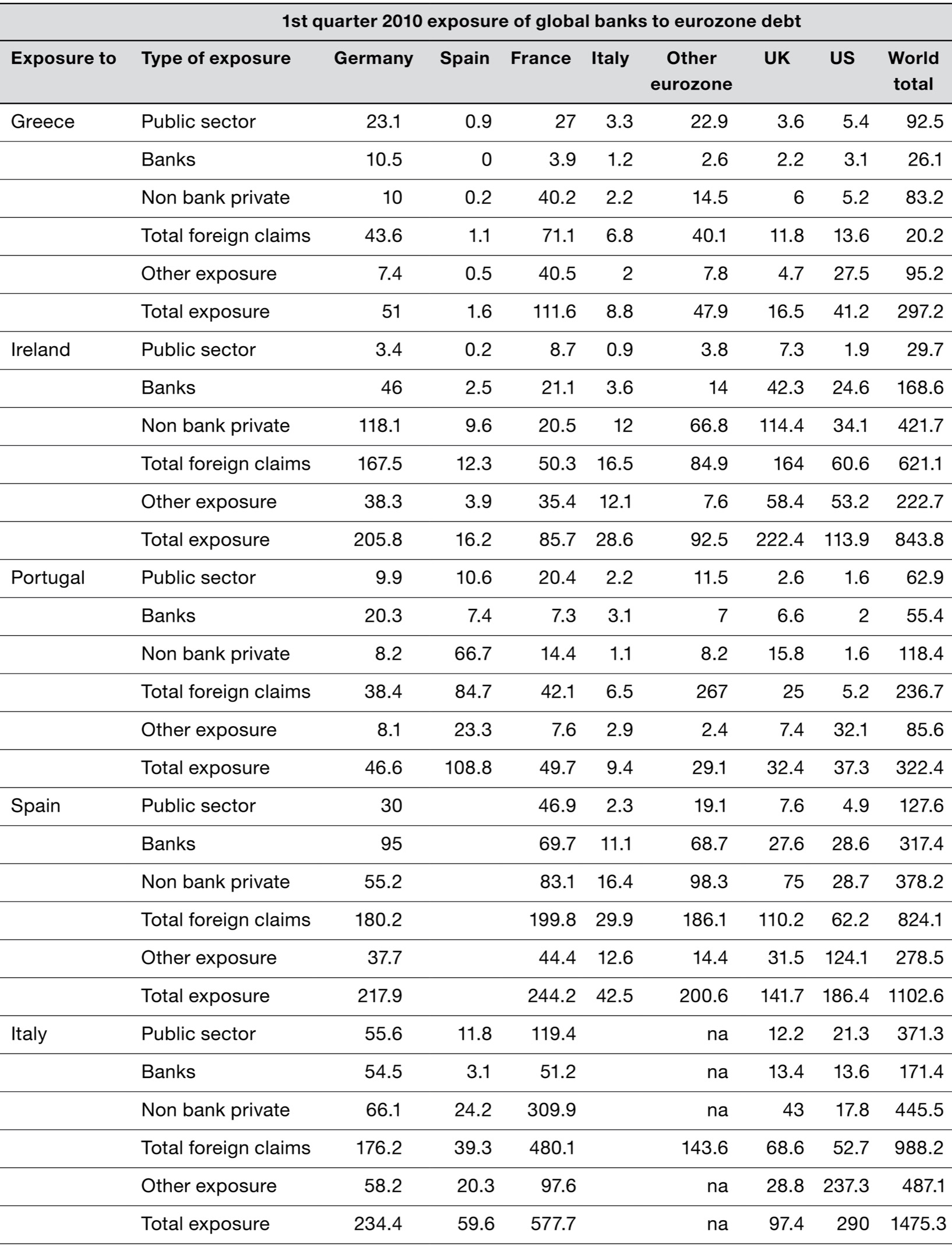
Note:
(1) other exposure includes derivative contracts, guarantees and credit commitments
(2) figures for sectoral exposure for Italy for 1st quarter 2010 calculated by applying proportions reported for Q4 2010
(3) figures for other exposure to Italy for Germany, Spain and France calculated by applying proportions relative to total foreign claims for Q4 2010
Sources: BIS Consolidated Banking Statistics and BIS Quarterly Review, September 2010, http://www.bis.org/publ/qtrpdf/r_qt1009.pdf .
It was no doubt reassuring to Athens to receive such a sympathetic welcome in Paris. But it should have set off alarm bells. Should Greece wish to be the place where France fought its battle for the eurozone’s financial stability? Was a bailout designed to minimize the risk to Europe’s over-expanded banks and to avoid embarrassment for politicians likely to be in the best interests of Greek taxpayers? The risks to Greece were obvious. On the French side too one might wonder whether, if the aim was to solidify the eurozone, the best tactic was to delay a straightforward and thorough resolution of Greece’s huge debt burden. If it was a question of picking a line of defense, was Greece really where one would choose to make one’s stand? To use the ugly metaphor that would soon circulate widely in the eurozone, might it not have been better to amputate the gangrenous limb, to push Greece aggressively toward restructuring? 10 There were risks on both sides. Paris opted for extend-and-pretend.
On the German side it looked, at first, as though a similar attitude might prevail. Germany’s banks, like France’s, were heavily exposed to the weaker eurozone borrowers. The logic of systemic stability was not lost on Berlin. 11 In February 2009, when pressure first built against Greece and Ireland, Finance Minister Peer Steinbrück had calmed markets by announcing: “If one country of the eurozone gets into trouble, then collectively we will have to be helpful. The euro-region treaties don’t foresee any help for insolvent countries, but in reality the other states would have to rescue those running into difficulty.” 12 A year later, when Papandreou’s government was looking for help, Josef Ackermann, the energetic CEO of Deutsche Bank and president of the IIF, was to hand. He traveled to Athens in early 2010 to offer a public-private loan of 30 billion euros. 13 It is conceivable that with both Berlin and Paris on board, applying a sticking plaster might have calmed markets and reduced yields to the point where Greece could limp on. But the debt was piling up inexorably. And what would have happened when the eurozone was hit by the next shock, from Ireland or Portugal? For an insolvent borrower new debt is a makeshift, not a solution.
In any case, by the spring of 2010 the counterfactual was moot. When Germans went to the polls on September 27, 2009, after a bitterly fought campaign, they threw Steinbrück and the SPD out of office. Angela Merkel continued as chancellor, but now in coalition with the free-market, tax-cutting FDP. 14 They were more to the chancellor’s ideological taste, but she was now operating from a far narrower political base and would have to pay even more attention to the home front. To the satisfaction of conservatives, Steinbrück was replaced as finance minister by Wolfgang Schäuble. Schäuble was a committed European integrationist of the 1980s Helmut Kohl generation. As a Christian conservative of the cold war era he had a capacious strategic vision for the EU as an upholder of Western civilization in an age of globalization. 15 For Schäuble, the Rechtsstaat, the legally bound state, was the anchor of his conception of the West, and as finance minister the debt brake anchored in the constitution was his particular legal preoccupation. The CDU’s new coalition partner, the FDP, was a probusiness, tax-cutting party, so that constrained Schäuble on the revenue side. What Germany and Europe needed was fiscal discipline. If Greece could not make the grade, then Schäuble since the 1990s had been an unapologetic advocate of a vision of a multispeed Europe, in which a core group set the pace while less competitive and disciplined nations brought up the rear. On February 11, 2010, the Merkel government shocked markets by agreeing with its partners to take emergency measures to support the euro as such, but vetoing any specific offer of help for Greece. As one EU official told journalists, “Germany is stepping totally on the brakes on financial assistance. On legal grounds, on constitutional grounds and on principle.” 16
Berlin’s refusal to stick to the bailout script was worrying for the French and shocking for the Greeks. But it should have been no surprise. Article 125 of the Maastricht Treaty banned mutual bailouts. The Lisbon Treaty that finally came into operation in December 2009, just as the Greek crisis exploded, had reinforced the primacy of nation-state responsibility. It also barred the route to the mutualization of debt, which might have allowed a European consortium to share the burden of backstopping some portion of Greece’s liabilities. In a crucial judgment on the Lisbon Treaty delivered on June 30, 2009, the German constitutional court had put a further obstacle in the way of any further moves toward EU integration. 17 Karlsruhe insisted on a stiff test of democratic accountability before any further competences could be transferred to Brussels. What Berlin would agree to on February 11, 2010, was last resort, ultima ratio support for the euro as such. What that meant for a “bad apple” like Greece was unclear. Certainly, Greece should slash its deficits and engage in labor market reform to boost growth. But Germany was in no mood for a bailout. The vast majority of German politicians and public opinion appeared to be willing to let the markets have their way with both Greece and its creditors. If a debt write-down was necessary, so be it. If Athens was unable to pay, then there was support in Germany across the entire political spectrum for the debts to be restructured at the expense of the banks. 18 Polls showed that two thirds of those who supported assistance for Greece also demanded that banks must contribute to the package. 19 These calls were reinforced by lobby groups such as the league of German taxpayers that demanded private sector involvement. 20 It was a harsh and high-risk approach, whose appeal to the German public was consistent with the fact that they tended to blame “other people’s” banks and to underestimate the exposure of their own country’s financial institutions.
This was the basic dilemma of the eurozone debt crisis. Greece needed a write-off. The Germans were not opposed and favored haircutting the creditors. But Greece’s PASOK government did not want to pay the price for a problem in large part created by its predecessor. It wasn’t just the state’s debts that would have to be restructured but the Greek banking system too. The entire Greek social and political fabric was at stake. The French opposed a write-off and Paris had backing not just from other European debtor nations but from the ECB as well. The ECB was aghast at the prospect of a sovereign default in the eurozone. What about the risks of contagion? Surely what Greece needed was a healthy dose of financial discipline. That was a popular answer. Austerity was the medicine forced down Greek throats for years to come. But the budget adjustment required was unrealistic and its impact on the Greek economy was devastating. As restructuring was, in the end, inevitable, the question ought to have been how to make it safe, how to build a framework within which debts could be written down and losses inflicted on creditors without unleashing a general panic. The problem was that to even say this out loud was to risk triggering a run before the safety net was ready. While engaging in extend-and-pretend and denying the need for restructuring, it was hard to generate momentum for any collective European effort at institution building. And it could not be done without Germany, which, though it did not shrink from restructuring Greece and its creditors, was anything but enthusiastic about putting in place the mechanisms necessary to make restructuring safe.
The German reluctance was shortsighted but understandable. Already by the spring of 2010 it was clear that a comprehensive solution to the problem of the sovereign debt crisis required (1) an aggressive recapitalization of Europe’s banks to allow them to survive the losses, an undertaking on which Europe was lagging behind the United States already in 2009; (2) a European fund to back this bank recapitalization because otherwise the effort might destabilize the fragile finances of smaller states, a proposal already vetoed by Berlin in October 2008; (3) the ECB would need to stabilize bond markets either by providing liquidity to Europe’s banks or by active purchases along the lines of the Fed’s programs, though outright monetization of debt was barred by the ECB treaty and conservative opinion in Germany abhorred any such intervention; (4) a European TARP, backstopped by the budgets of national governments to buy the sovereign debts of the weakest European states, a proposal blocked by the Lisbon Treaty’s ban on mutualization. It was to make all of this somewhat less inconceivable in political terms that one arrived back at financial discipline (5). Taxpayers in solvent northern counties such as the Netherlands and Finland, but above all Germany, would need to know that they were not being taken advantage of. Before there could be any mutualization of liabilities, there would need to be an agreement on fiscal rules. The bar had been set in May 2009 by Germany’s debt brake constitutional amendment. Anything less was a compromise as far as Berlin was concerned. It was the working through of these interlocking problems that would make the road to containment, let alone resolution of the Greek debt crisis, such an agonizing one. All the while the financial markets looked on with a mixture of anxiety, impatience and an eye to the speculative profits to be made by trading on uncertainty.
II
The search for a solution began in early 2010 in Schäuble’s finance ministry. Apparently without prior coordination with Angela Merkel’s chancellery, Schäuble proposed that the EU should establish a European Monetary Fund (EMF), able to conduct within the eurozone the kind of restructuring, stabilizing and disciplining role that the IMF played on the global stage. 21 One version of the EMF idea, pushed among others by Deutsche Bank’s chief economist, Thomas Mayer, was for the fund to backstop debts up to a limit of 60 percent of a country’s GDP. Above that level debts would undergo restructuring, with bondholders taking a proportional and uniform haircut. 22
It was a strikingly ambitious proposal that reflected Schäuble’s deeply held federalist European commitments. He was keen to use the crisis to push forward the agenda of European integration left unfinished at Maastricht in 1992. If Berlin had thrown its full weight behind the idea of an EMF and if its budget had been set to an appropriate size—what were needed were hundreds of billions of euros—the crisis might have taken another course. If Berlin had risen to the challenge it is hard to see how the rest of the eurozone governments could have resisted. Something very much like this is what they would eagerly settle for in 2012. But this opportunity for German leadership on the crisis went begging. In the spring of 2010, Schäuble’s scheme was shot down, by friendly fire. 23 Chancellor Merkel was no European federalist. She had no desire to reopen the terms of the Lisbon Treaty for which she had fought so hard and which was only just coming into operation. She was not about to endow Brussels with its own monetary fund. She was far too skeptical of Europe’s capacity for self-discipline and she had the German constitutional court’s Lisbon ruling to think about. She understood that radical measures were necessary, but her own proposal, rather than creating an EMF, was simply to involve the IMF in disciplining the eurozone.
Forcing Greece to go to the IMF appealed to German conservatives. 24 The Fund, with its ambitious French managing director, Dominique Strauss-Kahn, was keen to be involved. But there was also hesitation. The IMF had already put tens of billions of euros into Eastern Europe. The eurozone would take even more. In a new age of globalization, was a deep engagement in Europe the right direction for the IMF to be headed? And in dealing with European countries with powerful representation on the Fund’s own board, could the Fund’s economists be certain that their expertise would prevail? Specifically, would the Europeans take the IMF’s advice on the question of restructuring? Did they even understand the policy that the IMF was duty bound to pursue? Following its disastrous experience in Argentina’s financial crisis in 2001, the IMF had established new rules. 25 The Fund would lend only to solvent borrowers, otherwise there must be restructuring. And if it was to lend, it would insist on lending early, before panic set in. Given the scale of speculative firepower that could be mobilized in leveraged financial markets, to lend once a run had started was likely to be both expensive and ineffectual. Given how far the Greek crisis had already progressed by the early months of 2010, it was hard to argue that it met either of these criteria.
Here again one can glimpse the possibility of an alternative path: Could Berlin have backed an IMF demand for immediate Greek restructuring? Certainly the Fund’s own retrospective analysis suggests that this would have been the better path. 26 But Merkel’s veto on the European Monetary Fund idea suggests the main obstacle to any such strategy. She was not willing to contemplate the additional flanking measures that would be necessary to make a restructuring safe. And the proposal to involve the IMF rallied the rest of Europe against her. Indeed, Merkel’s own finance minister, Schäuble, let it be known that he would regard IMF involvement as a “humiliation” for Europe. 27 For Sarkozy it was unthinkable that the IMF should be involved at all: “Forget the IMF. The IMF is not for Europe. It’s for Africa—it’s for Burkina Faso!” he told the Greek government in early March. 28 The ECB, likewise, was absolutely opposed both to anything that entailed debt restructuring and to IMF involvement. It was bad enough for American mortgage-backed bonds to have unleashed the banking crisis. For Trichet it was simply unthinkable that the sovereign signature on eurozone public debt would not be honored in full. And to involve the IMF in Europe’s internal affairs was to add insult to injury. Trichet’s objection was not that the IMF was for Africa, but that it was “American.” 29
Trichet had reason to be worried about the outside world, because when it came to the eurozone, it was to the ECB that all eyes turned. If the ECB was a central bank, like the Fed or the Bank of England, there was no need for there to be a sovereign debt crisis at all. Greece had not borrowed in dollars. It had borrowed in euros and had delegated the sovereign power to print its own currency to the ECB. Its fate and that of the entire rest of the eurozone was in Trichet’s hands. All the ECB had to do to stop the destabilizing surge in Greek interest rates was to do what central banks do all over the world: buy sovereign bonds. Of course, bond buying was no long-term solution. Greece needed restructuring, fiscal discipline and economic growth. But at stake was the financial stability of a vast economic area. The Greek public debt was a tiny part of Europe’s financial system. The treaties that founded the ECB limited its right to buy newly issued Greek debt. But it could buy outstanding bonds as part of a market stabilization effort. If the ECB did not intervene it was a matter not of economics but of politics and over the winter of 2009–2010 it seemed that Europe’s central bankers were determined to take a tough line. Rather than continuing the generous liquidity provision it had offered in 2009, the ECB allowed the LTRO scheme to expire. 30 Then in April 2010 it began to discuss a new regime under which it would apply graduated repo haircuts to lower-rated sovereign bonds, limiting their attractiveness to banks. 31 Trichet was engaged in the high-risk gamble of substituting pressure in the bond markets for the eurozone’s missing federal structures of fiscal and economic governance. With the ECB looking on, surging bond yields would force the Greeks to get serious about fiscal discipline and economic reform. In taking this line, Trichet was not only satisfying his own agenda. He was also appeasing the Bundesbank and its hawkish, monetarist head, Professor Axel Weber. Any kind of bond purchases by the ECB were seen in Germany as an inflationary menace. Furthermore, and more pertinently, they were understood to be a form of debt mutualization by stealth. By way of the balance sheet of the ECB, German taxpayers would end up as creditors to the rest of the eurozone. 32 So too, of course, would all the other shareholders in the ECB. But it was Germany’s portion that German Eurosceptics worried about.
Throughout the early months of 2010 the argument was deadlocked. Market pressure on Greece intensified. Foreign investors were unloading what Greek debt they could sell. Hard-liners in Europe might see this as a legitimate way of imposing discipline, but for investors the lack of resolution was unsettling. Who might be next? Ireland? Italy? For the Greek government it was, frankly, terrifying. On May 19, 2010, Athens was due to make payments of 8.9 billion euros. It was not obvious where they would find the cash. Desperate for a way out, the PASOK government looked for help from across the Atlantic.
In the spring of 2010 visitors from Europe bearing bad news were not welcome in the White House. The Obama administration had been closely following the developing Greek debt crisis and had appealed to the Europeans to act fast. 33 But it was itself mired in domestic political mud. Thanks to the botched Massachusetts special election in January following the death of Teddy Kennedy, the Democrats had lost their filibuster-proof majority in the Senate. The passage of health-care reform had become a grueling war of attrition. Dodd-Frank seemed stranded. The last thing the Treasury and the Fed needed was a new crisis. But by the spring of 2010 it was clear that the failure of the Europeans to deal with Greece was threatening precisely that.
Once before, sixty-three years earlier, a political crisis in Greece had triggered a transformation in US policy. On March 12, 1947, after the British had declared their inability to defeat the Communist insurgency in the Greek civil war, President Truman announced the doctrine of containment, one of the opening moves in the cold war. That summer, Truman’s secretary of state, General George Marshall, would back up containment with his legendary promise of economic aid for Europe. In 2010 there was no antagonist like the Soviet Union to force the Obama administration’s hand. What made Greece into America’s problem was not a global clash of ideologies, but the money coursing through the circulatory system of transatlantic finance. America’s mutual funds had hundreds of billions of dollars at stake in Europe’s banks, above all French banks. It was those same banks that were exposed in Greece. And the US branches of those same European banks were also major lenders to US households and firms. Any eurozone financial crisis would blow back on America.
On March 9, 2010, a month after Germany blocked the push for a quick Greek rescue, President Obama and his top economic advisers, Larry Summers and Tim Geithner, took time to meet with the Greek prime minister and his delegation. Obama’s message was encouraging. Washington would vote its 17 percent share for IMF assistance and would throw its weight behind an approach to Merkel requesting aid from the EU. 34 Opposition to IMF involvement from France and the ECB would be overridden. But the White House made one thing clear. There could be no talk of debt restructuring. “We cannot have another Lehman,” Obama emphasized. Whether Greece’s debts were sustainable was not America’s concern. Washington’s priority was containing financial contagion. Restructuring could not be contemplated until the Europeans had found a way to stabilize bond markets and were ready to push through wholesale recapitalization of Europe’s banks. And given the Franco-German deadlock, no such agreement seemed likely.
It was from this force field of interests that the first iteration of extend-and-pretend emerged. Europe entered an emergency regime defined not by a single sovereign author, but by the absence of any such authority. 35 At an EU summit on March 25, 2010, overriding objections from both the French and the ECB, and with Washington on her side, Merkel forced through the involvement of the IMF. 36 It would be a joint EU-IMF action, as in the Baltics the previous year. But this time the ECB would be fully engaged. A committee of the EU, the ECB and the IMF would make up the soon to be infamous “troika,” dictating policy to Greece and the other “program countries.” What was ruled out was restructuring. On that Washington sided with the French and the ECB. Existing Greek debt would be paid off with new loans from the troika, whether or not the result was sustainable. The IMF would have to bend its operating procedures to the occasion. To satisfy Merkel’s insistence on the Lisbon rules, the “European” component would not consist of measures taken collectively via the central institutions in Brussels or jointly funded by the member states. That would require treaty change and might violate the line drawn by the German constitutional court. Instead, it would consist of individual national credits for Athens on a bilateral and voluntary basis coordinated through the Eurogroup, the powerful but informal meeting of the eurozone finance ministers. To avoid the appearance of a bailout—banned by Maastricht—the loans would not be on concessionary terms. Interest rates would be stiff and there would be a processing fee to compensate the lenders for their trouble. Finally, and most important, the support would not be provided preemptively to forestall a loss of market confidence. It would be offered only as an ultima ratio, if and when Greece lost access to the markets. It would be up to Greece, by means of austerity, to forestall that moment for as long as possible.
For ordinary Greeks this meant pay cuts across the public sector. Contract workers were not renewed. The cap on dismissals from the private sector was lifted. The pension age was raised. VAT and other consumption taxes were hiked. An economy already under pressure was subjected to a further contractionary squeeze. A population that already had one of the lower standards of living in Europe was pushed further down the scale. The Greek labor movement mobilized in furious protest. But it was enough at least to satisfy the bond markets. In the last days of March 2010, Athens was able to issue a final tranche of long-term debt: 5 billion euros for seven years at just under 6 percent. Perhaps not surprisingly, investor demand was lukewarm. 37 Europe was preparing a safety net. The only question was when Greece would tumble off the ledge.
III
On March 30 the markets were rocked by news not from Greece but from Ireland. The bill for recapitalizing Ireland’s bankrupt banks was soaring. For Anglo Irish Bank alone, Dublin was now budgeting 34 billion euros, more than Ireland’s tax revenue in 2010. Soon Ireland’s deficit would be worse than that of Greece’s. 38 In Ireland it was the banks pulling the sovereign down. In Greece the mechanism worked the other way around. Canny depositors in Greek banks were aware that their savings were invested in the government bonds that Athens was struggling to service. In the early months of 2010, 14 billion euros were withdrawn from Greek banks and shifted elsewhere in the eurozone. The first to move were the oligarchs moving huge sums by way of Cyprus, but they were soon followed by middle-class depositors pulling out a few thousand euros at a time. 39 Bereft of sources of funding, the Greek banks turned to the Greek central bank, their local branch of the ECB, where Trichet continued to allow them to repo downgraded Greek government bonds. This was a vital life support system and it gave the central bank a whip hand not just over the Greek government but over Greek society and the economy at large. Without approval from Frankfurt there would be no money in the ATMs, but nor would there be any restructuring of Greece’s insupportable debt.
In April, as the troika argued over who would contribute what and how large the Greek bailout package would be, time ran out. 40 A downgrade by the Fitch credit-rating agency sent Greek government debt yields surging to 7.4 percent. On the morning of April 22, Eurostat announced that its estimate of the Greek deficit in 2009 had now risen to 13.6 percent of GDP. Ireland’s was even larger, at 14.3 percent. Spreads on Greek bonds surged to 600 basis points, raising the borrowing rate to 9 percent, effectively shutting Greece out of the market. The moment had come to reach for the last resort. Urged on by both Schäuble and Geithner, the Greek government triggered the emergency mechanism. Greece needed a lot of money and there was no time to lose.
It was a coincidence but a symbolic one. On the evening of April 22, hours after the Eurostat release had rocked the markets, the world’s financial elite were gathered in Washington, DC, for the spring IMF meeting. The evening’s entertainment was at the Canadian embassy and it was time for some frank talk. The crisis had moved beyond the European arena. The eurozone now posed a threat to global financial stability. Since March China had been demanding action to defend the value of global investments in euro-denominated assets. 41 As Alistair Darling, Britain’s Chancellor of the Exchequer, recalled, the mood was urgent: “You can’t overstate the fact that America, with increasing incredulity and anxiety, was watching Europe’s inability to act. . . . The message was, ‘Why can’t you take action? You know you’ve got to do something.’” 42 As the Financial Times put it, the failure of the eurozone to restore stability on its own terms meant that by April 2010, the “rescue” of the euro, “the ultimate expression of European integration, depended on outsiders in international institutions and the US administration.”
But no deal emerged from Washington. The troika was only beginning to haggle with Athens over the terms of a rescue loan. Markets were left hanging. On April 28, 2010, the bottom fell out. The official chronicle of the German finance ministry is, as one might imagine, a sober document. This is how it describes events in Europe’s sovereign bond and interbank money markets that day:
“The crisis becomes dramatically acute. Risk premiums for government bonds in some Eurozone member states such as Portugal, Ireland and Spain increase rapidly and reach levels equal to that which prevented Greece from accessing the financial markets in April. In an echo of the final dramatic phases of the financial crisis [of 2008], there is virtually no interbank lending between European banks. Within a very short period, there are overall signs of an acute pending systemic crisis.” 43
What this official narrative disguises is Berlin’s own role in precipitating the “acute pending systemic crisis.” Ahead of vital regional elections in early May the public agitation in Germany against assistance for Greece was ferocious. The FDP, Merkel’s coalition partner, which saw its popularity among its free-market nationalist supporters plunging, played the anti-Greek card uninhibitedly, narrowing the chancellor’s room for maneuver. To remind Merkel of the global stakes, on April 28 Dominique Strauss-Kahn and Jean-Claude Trichet both flew into Berlin. 44 But despite the increasing panic, there was no deviation from the minimalist script that Berlin had laid down on March 25. Indeed, Merkel stirred the fires of speculation by reminding the press that admitting Greece to the euro had been a mistake and that Germany’s contribution to whatever relief effort emerged would be a voluntary decision taken on terms decided in Berlin. 45 It was not the kind of talk to calm markets. Greek spreads surged to 1,000 basis points, and by the end of the day Washington was sufficiently alarmed for Obama to place a personal call to the chancellery. 46 Nor was Merkel’s the only phone ringing in Europe. The logs for Geithner and his staff recall almost daily contact between Washington and Berlin, Frankfurt and Paris. 47 Governments from around the world were pressing the EU to act.
Finally, in the first days of May, the deal was done. Greece agreed with the troika not only to slash its deficit but to aim for a surplus. It promised to deliver a turnaround in its budget balance of a staggering 18 percent of GDP. 48 In 2010 alone the reduction of its deficit would be 7.5 percent of GDP. Every area of Greek public life would be touched, from ministerial contract cleaners to privatization of state assets. Everything was up for grabs. In exchange, Greece would receive a bailout far larger than previously conceived: 110 billion euros, of which 80 billion would come from the EU and 30 billion from the IMF, payable in quarterly installments over three years. The loans were at tough rates and it was clear that servicing them would create a repayment shock in 2013. But it was the best that the lending countries were willing to offer. Merkel promised an affirmative Bundestag vote for May 7. The question was whether the markets would give Europe that long.
Merkel presented the rescue package to the German Bundestag on Wednesday, May 5. It was, she declared, “alternativlos ”—without alternative. 49 Merkel’s rewording of Margaret Thatcher’s famous pronouncement—there is no alternative (TINA)—was to become notorious. Meanwhile, that same day Greece was rocked by a general strike that mobilized both main wings of the Greek labor movement and shut down transport and public services. In Athens protesters fought running battles with riot police. As the parliamentarians debated the austerity program in committee, a firebomb crashed through the window of a branch of Marfin Bank, setting the building alight and killing three staff members. Karolos Papoulias, the grizzled president of the Hellenic Republic and veteran of the Greek resistance in World War II, declared: “Our country has reached the edge of the abyss.” 50 On May 6, the Greek parliament convened to vote through what was the most draconian austerity program ever proposed to a modern democracy. That morning, the ECB board was meeting in Lisbon and reporters e-mailed the news that the imperious Jean-Claude Trichet had refused even to discuss the possibility of stepping in to buy Greek bonds. Earlier in the week, on the back of the new fiscal program, the ECB had reluctantly agreed to continue repoing Greek debt, but actively buying bonds was a step too far. 51 It was not what markets needed to hear.
When US trading opened—in the afternoon by European time—prices plunged. By one p.m. the market was down 4 percent. With the ECB refusing support, there was heavy trading in credit default swaps on Greek government debt. In a single day the Volatility Index (VIX), a measure of market uncertainty, surged by 31.7 percent. The euro plunged, losing 2.5 cents by early afternoon. 52 What was going on between terminals on both sides of the Atlantic that afternoon would later become a matter of dispute in American courtrooms. But at 2:32 p.m. the market went into spasm. 53 Half an hour later, by 3:05 p.m., the main American stock markets had given up 6 percent of their value, erasing $1 trillion from portfolios. As panicked traders fled to quality, demand for US Treasurys surged, driving yields down from 3.6 to 3.25 percent in a matter of minutes.
Thanks to the transatlantic time difference, news of the “flash crash” hit the BlackBerrys of the ECB board as they sat down to dinner in Lisbon. Eighteen months on from the Lehman crisis, it seemed that the delay in bailing out Greece was about to precipitate a second financial catastrophe. Even the head of the Bundesbank, the tough-talking Axel Weber, realized that the ECB could not maintain the hard line that Trichet had taken that morning. The “ECB must buy government bonds,” he exclaimed across the dinner table. 54 For the conservative team at the head of the ECB, it was a dramatic moment. They understood that they needed to act. The world was watching. Athens was literally burning. Soon it might be Rome. But the ECB did not want to be the only buyer in the market. It was determined not to let Europe’s governments off the hook. It wanted austerity across the board. Furthermore, though the ECB might buy bonds to provide temporary support, what was needed, sooner rather than later, was a giant state-backed fund to provide confidence to the bond markets. Making European governments and taxpayers responsible for each other’s debts would create a nightmarish political entanglement, but it would at least reinstate the clear line between fiscal and monetary policy, on which the ECB founded its precious claim to independence.
The next day, on May 7, 2010, the tone at the meeting of the European Council was apocalyptic. Commissioner Rehn and President Trichet delivered dire warnings. “It’s Europe. It’s global. It’s a situation that is deteriorating with extreme rapidity and intensity,” Trichet insisted. As the Financial Times reported, it came as a shock to the sometimes provincial European Council: “Leaders of smaller eurozone countries not fully plugged into world financial markets had, until this moment, not appreciated the gravity of the crisis. But even more experienced leaders appeared stunned.” “[Nicolas] Sarkozy was white with shock,” reported one ambassador. “I’ve never seen him so pale.” 55 But despite the sense of crisis, and despite the deal on Greece, there was no agreement on creating a general security umbrella for the eurozone as a whole. Sarkozy pointed the finger back at the ECB. How could Europe’s central bank stand by while the credit of Europe’s governments was ruined? Why was the ECB not acting like the Fed or the Bank of England? “Sarkozy was screaming: ‘Come on, come on, stop hesitating!’” recalled one EU policy maker. Sarkozy was backed by Italy’s Silvio Berlusconi and Portugal’s José Sócrates, both of whom had reason to fear a general sovereign debt crisis. But Merkel, the Dutch and the Finns all pushed back. The ECB was independent. It must be free to act as it saw fit. Friday, May 7, ended without agreement. But after events on Wall Street, it was clear that something big had to be done before trading resumed in Asia on Monday, May 10. The Europeans were going to have to move from the national bailout for Greece toward providing a more comprehensive financial backstop for their entire currency zone. They could not expect to handle their problems state by state through bilateral agreements with the IMF. Whereas a few weeks earlier they had balked at coming up with a few tens of billions of euros, now they were going to have to contemplate far larger numbers.
Under huge pressure from governments around the world, Europe’s leaders reconvened on the afternoon of Sunday, May 9. 56 Obama had worked the phones to Merkel and all the other key European leaders. Ben Bernanke called an impromptu conference call of the FOMC to approve the renewal of the swap lines to the ECB, the Bank of England, the Swiss National Bank and the Bank of Canada. 57 Likewise, the G7 convened a conference call to coincide with the meeting of the European finance ministers. Japan, Canada and the United States were on the line. At this crucial moment Schäuble was hospitalized by an allergic reaction to a medication. So Spain took the chair, and France’s finance minister, Christine Lagarde, found herself as the liaison between the two groups. With two phones on the go at once, she had the EU 27 in one ear and the G7 in the other. The scale of the bailout fund agreed was enormous: 60 billion euros came from the EU Commission funds, 440 billion from the European governments. Dominique Strauss-Kahn offered to use the IMF’s resources to back the fund at the same ratio that had been employed in Latvia the previous summer. But whereas tiny Latvia had needed only a few billion euros, now the IMF pledged 250 billion. It was by far the largest commitment the IMF had ever made to any program. The $1 trillion pledged to the IMF at the London G20 that was supposed to mark the advent of a new age of global firefighting would be deployed to rescue Europe. The figures were impressive, but the all-important question was how the rescue fund would be constituted and financed. Was this a first step toward the mutualization of sovereign debts, and thus a radical step beyond Lisbon? Berlin was not going to concede anything of the sort. 58 The entire deal hung in the balance until a Dutch participant with expertise in shadow banking suggested that the European Financial Stability Facility (EFSF) be incorporated as a private special purpose vehicle registered in the tax haven of Luxembourg. Eurozone governments would contribute capital on a country-by-country basis without assuming any overarching intergovernmental “European” commitment.
Even in this makeshift form, the EFSF would take months to put in place. What was needed when trading resumed on Monday morning was immediate support for Europe’s bond markets. That could come only from the ECB. The EFSF agreement satisfied Trichet. The governments were now serious. The question was whether he could carry the board of the ECB, and specifically whether he could win over the Bundesbank. After coming around to bond buying at the moment of panic on May 6, Axel Weber had subsequently had a change of heart. He did not want to risk breaking ranks with German public opinion and his German colleague on the ECB board, chief economist Jürgen Stark. On his way back to Frankfurt from Portugal, Weber retracted his agreement. Nevertheless, on Sunday, May 9, Trichet put the proposal to the vote and won majority approval. He then waited to make any public announcement until the early morning of May 10, when Europe’s governments were finally ready to present their ramshackle bailout fund. 59 The ECB would not move first.
Over the days that followed, the markets calmed. Despite the opposition from Germany, the ECB’s promise to buy helped. There was less rush to sell if there was a purchaser of last resort. But to make this commitment manageable for the ECB, there was one further, unpublicized facet to the deal. Even if there was no immediate restructuring of Greek debt, the banks should not be permitted to offload their entire holdings of distressed debt. A concomitant of the ECB’s bond buying, insisted on with particular force by Merkel and Schäuble, was that all the eurozone finance ministries would pressure their leading banks to refrain from selling their holdings of Greek and other troubled bonds. The bargain was never complete. In Germany, Deutsche Bank led a group that agreed to hold on to the debt for three years. 60 But many smaller banks refused to take the pledge. And rumors quickly spread that of the first 25 billion euros in bonds bought by the ECB, the vast majority had come from France.
The IMF put its imprimatur on the deal at a meeting of the board on Sunday, May 9, 2010. With Strauss-Kahn on the ground in Europe, the chair in Washington was taken by John Lipsky, a Bush appointee who had alternated time at the IMF with stints at J.P. Morgan. No one around the table at the IMF’s headquarters was pleased with the situation. 61 It was an enormous engagement. It was profoundly disturbing that it was being undertaken to manage a crisis in Greece, a comparatively rich European country, at the behest of the EU. The Greeks were being lent vastly more than their quota, the capital contribution that normally limited a country’s IMF borrowing rights. The Fund was required to share control over the program with the other members of the troika, and its own experts were far from persuaded that Greece’s debts were sustainable. As they put it cagily: It was undeniable that “significant uncertainties around” the program made it “difficult to state categorically” that Greece would ever be able to pay back its debts. Normally this would be a red flag. Who, after all, would benefit from Greece taking on new loans from official lenders to pay off existing private debts it could not service? The outspoken Brazilian board member insisted that the program not be referred to as “a rescue of Greece, which will have to undergo a wrenching adjustment, but as a bailout of Greece’s private debt holders, mainly European financial institutions.” 62
One could hardly ask for a clearer statement of the “bait and switch” substitution, by which a problem of excessive bank lending was turned into a crisis of public borrowing. 63 But this substitution resulted less from a skillful ideological conjuring trick than from a lowest common denominator compromise between the main players in the Greek debt drama—Germany, France, the ECB, the IMF and the Obama administration. Certainly at the IMF there was little illusion about the compromises they were entering into. On May 9 the tone in the room at the IMF board meeting was so negative that Lipsky felt it necessary to put the opposite case. Lipsky was fully committed to the White House line. He was a devotee of Geithner’s logic of maximum force. 64 Indeed, Lipsky liked to embarrass his cosmopolitan IMF colleagues by calling for the Fund to adopt not the Powell Doctrine but “shock and awe,” the title the US military gave to their devastating aerial assault on Baghdad in 2003. 65 From the chair at the crucial meeting in Washington on May 9, Lipsky recognized the concerns and criticism of his colleagues, but pronounced himself “a little disturbed by the suggestion that the Fund program should obviously have involved debt restructuring or even default.” Restructuring “would have had immediate and devastating implications for the Greek banking system, not to mention broader spillover effects.” This was what was ultimately decisive.
The IMF board approved the disproportionate and risky Greek bailout not because it made sense in its own terms, or was good for Greece, but because on the track record to date, Europe’s inability to contain the Greek crisis meant that there was “high risk of international systemic spillover effects.” 66 Instead of restructuring Greek’s unsustainable debts, what would be restructured were its entire public sector and its creaky economy. Heroic assumptions about cost cutting and efficiency gains were the ways in which the IMF squared the Greek program with its conscience. Perhaps if it were shaken thoroughly enough, “sclerotic” and “clientelistic” Greece could be jolted onto a higher growth path that would make its debts sustainable after all. Austerity and “reform” were the only items on the agenda that the otherwise divided parties to the deal could agree on. Whether this was economically effective or politically sustainable and what it would mean for the democratic politics of Europe was another matter altogether.
Chapter 15
A TIME OF DEBT
“W ell, my message, Glenn, is that PI[I]GS are us. . . . [W]e very quickly could find ourselves in a similar situation to Greece.” 1 These were the words of historian Niall Ferguson, then at Harvard, on Glenn Beck’s Fox News TV show on February 11, 2010. The “we” Ferguson invoked were the citizens and taxpayers of the United States. The PIIGS were the eurozone problem cases—Portugal, Ireland, Italy, Greece and Spain. Beck and his guests regaled their audience with scenes of disorder, strikes, riots in the streets, cars burning. As Greece demonstrated, once markets lost confidence there was no easy way out. As Ferguson put it in drastic terms: “You either have to default on a large part of the debt or you have to inflate it away. There really aren’t many other options open to our country that has debts this size. And none of these processes is really much fun.” If interest rates spiked it could happen in the United States within the year. As Ferguson explained: “[T]he lesson of what’s going on in Europe today and what happened to Russia 20 years ago is that collapse can sneak up on you and strike very sudden [sic] indeed.” Given this prospect, Ferguson hailed the populist backlash that was going on in America against big government. That was a healthy sign. But it needed something else: “[U]ntil there’s a political leader that has the courage to spell out to Americans, ‘We need to do this, we need to reform our system, root and branch,’ then I’m afraid we’re going to slide downhill in the direction not just of European economics but of Latin American economics.”
Ferguson was the Ivy League academic. Beck was one of the most excitable drummer boys of American conservatism. But fear of debt and its potentially disastrous implications was everywhere in 2010. It had been there before the crisis, in the Rubinite calls for consolidation and in the campaign for a debt brake in Germany. It was now massively amplified by the shock of 2008–2009. This dealt the most serious blow to government finances that any of the major developed countries had suffered since World War II. The fate of Greece in 2010 seemed to spell out what lay in store for any state that slid over the edge into insolvency. Warnings ranged from outrageous rants and scaremongering from the likes of Beck to ultrarespectable academic research, most notably by two former IMF economists, Carmen Reinhart and Kenneth Rogoff.
Following their surprise bestseller This Time Is Different: Eight Centuries of Financial Folly , in January 2010 Reinhart and Rogoff launched a research paper with the title “Growth in a Time of Debt.” 2 This purported to show that as public debts passed the threshold of 90 percent of GDP, economic growth slowed down sharply. It was a slippery slope that ended in a cliff. Excessive debt weighed on growth, which made the debt even less sustainable, further slowing growth. To avoid this fate, it was crucial to take action sooner rather than later. On closer inspection, Reinhart and Rogoff’s analysis turned out to be riddled with errors. Once their Excel spreadsheet was properly edited, there was no sharp discontinuity at the 90 percent mark and the case for emergency action was far weaker than they made out. 3 But in early 2010 their arguments ruled the roost. In the Financial Times they opined: “[T]he sooner politicians reconcile themselves to accepting adjustment, the lower the risks of truly paralysing debt problems. . . . Although most governments still enjoy strong access to financial markets at very low interest rates, market discipline can come without warning.” Once bond markets realized the full measure of the “fiscal tsunami” unleashed by the banking crisis, their judgment would be merciless. “Countries that have not laid the groundwork for adjustment will regret it.” 4 No one was safe. As Rogoff told Germany’s right-wing Welt am Sonntag , a newspaper that hardly needed encouragement: “Germany’s public finances are not on a sustainable path. . . . There will come a time when Germany will have its own Greece problem. . . . [I]t won’t be as bad as in Greece, but it will be painful.” 5
As commentators as knowledgeable as Ferguson, Reinhart and Rogoff must have been aware, the market discipline on display in the eurozone had not “come without warning.” The ECB and the German government were deliberately courting the bond vigilantes who swarmed over Greece. If they wanted to ease the pressure, all the ECB needed to do was what the Fed, the Bank of England or the Bank of Japan did as a matter of course—buy Greek bonds. But the ECB had no intention of doing that, not, at least, until the very last minute. The ECB meant to send a message: Austerity or else! They must have been delighted by the global reaction. The year 2010 would become a turning point in the recovery. Using Greece as its exemplum, an alliance of convenience among right-wing fearmongers, conservative political entrepreneurs and centrist fiscal hawks shifted the political balance. Though unemployment remained high, though output was limping back, stimulus was abandoned. Earlier and more sharply than in any other recession in recent history, the fiscal screw was turned. On both sides of the Atlantic the result was to stunt the recovery.
I
The most remarkable instance of austerity contagion was the UK. The hotly contested election that would bring an end to the long reign of New Labour concluded on May 6, 2010, the same day that banks burned in Athens and the flash crash sent US financial markets plunging. Fiscal politics were key to both the election and the coalition negotiations that followed. Britain had been among those hardest hit by 2007–2008. Though the Bank of England, unlike the ECB, never let there be any question of official support for UK Treasury debt, and though the UK maintained its credit rating, sterling plummeted against the dollar and the euro. As long as the Bank of England stabilized the bond market, it was not an immediate cause for concern. But it made Governor Mervyn King into a pivotal figure and, as he had demonstrated in the spring of 2009 ahead of the G20 meeting in London, he was not afraid to bring his influence to bear. 6
On December 21, 2009, “shadow” Chancellor George Osborne opened the electoral campaign for the opposition Tory party by claiming that unless Britain put together a credible program of fiscal consolidation, it would soon go the way of Greece. “By testing the patience of international investors,” Osborne declared, “Labour are playing with economic fire.” Countries that wished to retain a AAA rating did “not have the luxury of waiting for the recovery to be secured before announcing credible fiscal consolidation plans.” 7 Osborne bolstered his case with quotes from analysts at Paribas, Deutsche and Barclays. Bill Gross, the star fund manager at bond market giant PIMCO, chimed in to tell the Financial Times that he had now placed UK bonds in the category of “must avoid.” In his characteristically flamboyant style, Gross declared that UK public debt was “resting on a bed of nitroglycerine” and should be placed in a “ring of fire” that included not just the UK, Greece and Ireland, but Spain, France, Italy, Japan and the United States. 8 On February 14, 2010, twenty senior economists, including Ken Rogoff, wrote to the Sunday Times repeating Osborne’s charge that the Labour government was not doing enough to bring the budget under control. 9 They were answered by a letter to the Financial Times from a much longer and no less distinguished list who opposed the call for fiscal retrenchment as premature and pointed out the irony that “[i]n urging a faster pace of deficit reduction to reassure the financial markets, the signatories of the Sunday Times letter implicitly accept as binding the views of the same financial markets whose mistakes precipitated the crisis in the first place!” 10
The result of the May 6 election was a defeat for Labour, but the conservatives failed to win a majority and were left needing the support of the Liberal Democrats. The coalition negotiations became a high-stakes struggle over the future of fiscal policy. 11 “The deficit,” wrote David Laws, a Liberal negotiator, “was the spectre which loomed over our talks.” 12 The conservatives made spending cuts the central issue of the negotiations. And the Tory debt hawks knew that they could count on both the Treasury and the Bank of England. On May 12, 2010, Mervyn King instructed the new government that “[t]he most important thing now is . . . to deal with the challenge of the fiscal deficit. . . . I think we’ve seen in the last two weeks, particularly, but in the case of Greece, over the last three months, that it doesn’t make sense to run the risk of an adverse market reaction.” 13
In what was dubbed an “emergency budget” in June 2010, Chancellor Osborne slashed spending and raised VAT. The aim was to calm markets by committing to close the deficit by 2015. 14 The argument in 2010 was “necessity.” But, as Neil Irwin later commented: “Britain . . . was embarking on something that has rarely been attempted . . . cutting spending and raising taxes in a preemptive strike against the risk of a future debt crisis.” 15 As Paul Krugman remarked from New York: “It’s one thing to be intimidated by bond market vigilantes. It’s another to be intimidated by the fear that bond market vigilantes might show up one of these days.” 16 As the squeeze continued, other motives revealed themselves. Shrinking the state, it turned out, was an aim in itself. The ultimate goal, as David Cameron would put it in his speech to the Lord Mayor’s Banquet three years later, was “something more profound”: to make the state “leaner . . . not just now, but permanently.” 17
By 2015 Chancellor Osborne would claim to have slashed £98 billion in annual spending from the UK budget. From a maximum of 6.44 million public sector employees in September 2009, the UK public sector workforce would be reduced to 5.43 million in July 2016. 18 One million jobs were cut, privatized or outsourced. It was a reduction larger than that imposed by the Thatcher or Major governments of the 1980s and 1990s. Translated to the US public sector payroll, it would be the equivalent of the elimination of 3.3 million positions. Because pension and health spending were ring-fenced, the pain was concentrated above all in local government. As the minister in charge roundly declared: “[L]ocal government is a massive part of public expenditure. It has lived for years on unsustainable growth, unsustainable public finance. . . . People blame the bankers, but I think big government is just as much to blame as the big banks.” 19 Between 2010 and 2016 spending by local councils on everything from elderly day-care centers to bus services, public parks and library facilities fell by more than a third. Britain became a darker, dirtier, more dangerous and less civilized place. Hundreds of thousands of people who were barely coping on disability and unemployment benefits were tipped into true desperation. 20 According to the OECD, only Greece, Ireland and Spain were put through worse contractions than those inflicted on the UK. 21
Federal Deby Held by the Public
Sources: Congressional Budget Office, “Understanding the Long-Term Budget Outlook” (July 2015), and Congressional Budget Office, “Historical Data on Federal Debt Held by the Public” (July 2010), www.cbo.gov/publication/21728 .
The reason why American liberals followed the politics of the UK so closely was not just their partisanship for the defeated Gordon Brown. They feared that events in Britain in 2010 might foreshadow a similar turn at home. Nor did the pressure come only from alarmist experts and the alternate reality of Fox News. It came from inside the Obama administration. As early as February 2009 the president had hosted a Fiscal Responsibility Summit at the White House. A year later, the administration was under pressure from Democratic Party centrists anxious about their fiscal credentials. The administration needed their support in raising the ceiling that limits debt issuance by the federal government. 22 To the horror of Keynesian commentators, on January 27, 2010, in Obama’s second State of the Union address, it was deficit reduction, not jobs, that took priority. 23 Obama promised that as of 2011, all nonmilitary discretionary spending would be frozen at its current levels. “[F]amilies across the country are tightening their belts and making tough decisions,” Obama declared. “The federal government should do the same.” 24 It was the simplistic householder analogy that drove economists to despair. 25 And it was fully in tune with the talk of “fiscal responsibility” that now dominated Washington. As one conservative commentator remarked, “[I]f the arguments in the coming years are between spending freezes and spending cuts, then we’ve already won.” 26 On February 18, 2010, by executive order, the president appointed the National Commission on Fiscal Responsibility and Reform, also known as the Simpson-Bowles Commission. It was to make recommendations designed to achieve primary budget balance by 2015. Simpson-Bowles would not report until December, after the congressional midterms. In the meantime, damaging divisions opened within the Obama administration over the fiscal issue. 27 Hawks like Orszag were pushing for tax hikes even for those earning below $250,000. This would violate a basic Obama campaign pledge, and it was bitterly resisted on political grounds by Emanuel as chief of staff, but also on economic grounds by Larry Summers. Meanwhile, the alternative to debt alarmism was spelled out most cogently by Ben Bernanke, who had recently been reappointed as Fed chair. Bernanke did not deny the scale of the deficits or the serious implications in the long run of a much larger debt burden. But he cautioned against drastic austerity efforts. America’s nascent economic recovery might not withstand a sharp fiscal shock. The crucial thing was to separate the short and medium term. Continued short-term stimulus should be accompanied by a realistic plan as to how to end deficits in the medium term. 28 The combination would provide both an immediate prop to the economy and a comforting lift to investor confidence.
It was not enough for budget hawks like Orszag, who left the administration in the summer of 2010. 29 The judgment of the electorate on Obama’s first two years would be even more devastating. With unemployment stuck just shy of 10 percent, four out of five Americans rated the economic situation as bad or fairly bad. The Tea Party was rallying conservative nationalist opinion against the Washington elite. 30 Even among Democrats, a plurality attributed the bailouts of 2008 to their own side. 31 They were wrong about the president, but given who had supported the measure in Congress, the association was not entirely far-fetched. On November 2 the angry electorate handed a historic victory to the Republicans. The GOP gained sixty-three seats in the House of Representatives, the largest swing since 1948. It was a shift that would redefine American politics.
Desperate not to allow the recovery to grind to a halt, the Obama administration worked feverishly to pass a second round of stimulus in the lame duck session of the old Congress. The Tax Relief, Unemployment Insurance Reauthorization, and Job Creation Act of December 2010 provided, by some estimates, a demand boost of as much as $858 billion. 32 But it was a measure of their political predicament that the stimulus now consisted entirely of tax cuts, including the prolongation of the grossly inequitable giveaways for top income earners inherited from the Bush era. Two years into eight years in office, it would be the last major economic policy bill that the Obama administration would pass. In the New Year, with the new Republican Congress, they would be on the defensive. Because they included modest increases on the revenue side, the centrist recommendations of the Simpson-Bowles committee were dead on arrival, even though they were heavily slanted toward cuts in entitlements. Led by Eric Cantor, the forceful House majority leader, the so-called “Young Gun” Republicans would countenance no tax increases. 33 Their target was immediate spending cuts of $100 billion, which, when concentrated in discretionary spending, would cause havoc across a range of federal programs, including food safety, disaster relief and air traffic control. By “starving the beast,” they would lift the curse of big government and revive the American dream.
II
Both the United States and the UK had suffered severe fiscal damage from the financial crisis. It was not, therefore, surprising that they faced calls for retrenchment. Were there other economies that might take up the slack? Apart from Japan and the emerging market economies, the obvious candidate to serve as a global counterweight was Germany. As Angela Merkel admitted in the summer of 2010, “[O]ther EU members, and the US administration, have urged Germany to spend more to maintain the current economic recovery, and reduce its export surplus.” 34 But that was not how Germany saw its role. The crisis, so the prevalent German interpretation went, was a result of excessive debt. What the world needed to guide its recovery was for Germany not to act as an expansionary counterweight but to lead the way in offering a model of austerity.
Given the prevailing mood, it was easy enough to make the case. Germany’s deficit was running at 50 billion euros per annum. Its debt had surged beyond 80 percent of GDP. The Reinhart and Rogoff meme had reached Europe. Finance Minister Schäuble invoked the menacing 90 percent threshold to argue for the need for immediate countermeasures. 35 Announcing the largest budget cuts in the history of the Federal Republic, on Monday, June 7, Chancellor Merkel declared that restoring Germany’s budget balance would constitute a “unique show of strength. . . . Germany as the largest economy has a duty to set a good example.” 36 , 37 In 2011, 11.2 billion euros ($13.4 billion) were to be cut, and a total of 80 billion euros by 2014. In Germany too this required choices to be made about the future shape of the state. Tellingly, the heaviest cuts proposed by the Merkel government fell on the defense ministry, which was asked to cut by 25 percent by 2014. The strength of the Bundeswehr was to be sliced and conscription to be phased out. For Berlin it was more important to achieve the 3 percent deficit rule specified by the eurozone’s Stability and Growth Pact than it was to honor its commitment to NATO to spend at least 2 percent of GDP on defense. 38
At the G20 in Toronto in June 2010 the scene was set for another round in the transatlantic argument over fiscal policy. Ahead of the meeting Obama published an open letter calling for fiscal consolidation to be staggered so as to avoid jeopardizing recovery. 39 Schäuble took to the pages of the Financial Times to defend his country’s distinctive long-term approach to economic policy against US short-termism. He championed the debt brake as a stability anchor for Europe. 40 He had the backing of Prime Minister Cameron as well as that of the Canadian hosts. At the insistence of the Obama administration the final text of the G20 communiqué referred to the need to sequence fiscal consolidation so that “the momentum of private sector recovery” was not jeopardized. 41 But this was trumped by demands for fiscal consolidation. 42 After the worst economic crisis since the 1930s, at a time when, according to the OECD, 47 million people were unemployed across the rich world, and the total figure for underemployed and discouraged workers was closer to 80 million, the members of the G20 committed themselves to simultaneously halving their deficits over the next three years. 43 It was the householder fallacy expanded to the global scale. It was a recipe for an agonizingly protracted and incomplete recovery.
Total Government Expenditures in Real Terms: Eurozone and US, 2005Q1 to 2014Q2=Q3
Note: Eurostat for Europe, downloaded November 29, 2014. Eurozone Government Expenditures are for the 18 countries that make up the current membership in the eurozone.
Sources: BEA for US, downloaded November 29, 2014.
For Germany even that was not enough. The lesson that Berlin drew from the Greek crisis was that the eurozone’s Stability and Growth Pact had failed. Germany, or rather the Red-Green coalition that had ruled Germany back in 2003, had to accept a measure of responsibility. Now, with Merkel and Schäuble at the helm, Berlin would take the lead in rededicating the eurozone to self-discipline. This was vital not only to restore economic health. It was essential for the politics of the eurozone. The Greek crisis had shown that Europe’s governments would have to work together. Federalists like Schäuble still insisted that the ultimate answer to the crisis would be “more Europe.” But for that to be acceptable to the taxpayers of Northern Europe, they had to be reassured that everyone was playing by the same rules.
As the crisis in the eurozone gathered in intensity and Germany’s pivotal role became ever more pronounced, the rhetoric became more heated. Protesters waved placards showing Merkel’s face graffitied with a Hitler mustache. This was not only offensive and grotesquely unfair. It also represented a fundamental misunderstanding of Germany’s position. When it was accused of imperialism, the German political class could honestly reply that it did not harbor ambitions for continental domination. But Berlin did have a vision of economic and fiscal discipline, which had to be generally accepted before Germany would consent to any further steps toward integration. 44 For reasons of global competitiveness it was essential that government spending and debt be brought under control. Europe’s demographic pressures made the case only more urgent. As for labor markets and unemployment, the rest of Europe had to learn the lessons of Germany’s Hartz IV reforms. When Keynesians worried about domestic demand, the German answer was exports. An aging continent should be exporting to the world and building up a nest egg of financial claims on the fast-growing emerging markets. On this, Merkel’s new coalition with her probusiness FDP partners was clearer than ever. Germany had passed a constitutional amendment in the form of the debt brake. If Germany was to agree to pool financial liabilities with the rest of the eurozone, it must insist on nothing less from its partners. Prosperous as they were and as much as they benefited from European integration, taxpayers and voters in the CDU heartlands would simply not accept the transformation of the EU into a continental “transfer union.” It was only if the rest of Europe could guarantee conformity to a common set of rules that Berlin could contemplate pooling sovereignty. The problem was that those rules had to be decided, upheld and imposed. And that is where things got uncomfortable.
Over the summer of 2010, rival plans for a new regime of European economic governance were being prepared by teams working separately for President Barroso of the EU Commission and Herman Van Rompuy, the first permanent head of the European Council, a position created by the Lisbon Treaty and designed to reinforce the intergovernmental character of EU decision making. 45 Berlin’s ultimate goal was to have constitutional debt brake provisions like the one it had passed in 2009 written into law for all the eurozone members. Those deviating from the rules would be subject to an automatic system of sanctions, including the suspension of voting rights. For those in real financial trouble the sanctions would be even more severe. As Trichet put it, “[W]hen you activate a support mechanism, a country loses de jure or de facto its fiscal autonomy.” 46 France, for its part, resisted automatic sanctions. Not surprisingly, smaller countries that had reason to fear that the rules might be applied more strictly to them opposed any talk of the suspension of voting rights.
These were weighty issues for Europe’s future. But how did they relate to the short-term question of financial stabilization? By the summer it was already clear that the fix devised to contain the Greek crisis in May 2010 was not sustainable. The worst fears of the more pessimistic IMF analysts were rapidly being confirmed. Not only was the PASOK government slow to push through the changes the troika demanded, but when it did, the results were counterproductive. In a classic Keynesian downward spiral, demand fell and unemployment surged further, reducing incomes. In 2010 Greek GDP would fall by 4.5 percent. Worse would follow in 2011. 47 The tax revenues flowing to Athens, which even at the best of times were hardly ample, slowed to a trickle as wages, profits and consumer spending contracted. The May 2010 program had been premised on the assumption that Greece would be able to return to capital markets within two years. But with the deficit expanding and its debt burden rising, there was little chance of that. By the end of August 2010 the yield spread of the Greek ten-year bond relative to Bunds had surged to 937 points, higher than it had been even at the height of the spring crisis. 48 And yet in the face of failure, the troika remained committed to holding Greece to the May 2010 program.
If there was any justification for the protracted torture of Greece, it was the fear that an immediate debt restructuring would unleash contagion to other sovereign debtors across the eurozone and destabilize Europe’s banks, thus causing a far wider crisis. So the immediate priority for European economic policy ought to have been to use the time bought by extend-and-pretend to strengthen the resilience of the eurozone financial system and the health of the banks. If one were to follow the American example, the obvious next step was to conduct a stress test to estimate likely losses, and then to carry out an energetic recapitalization with either public or private funds.
Both in 2009 and 2010 the Europeans conducted stress tests of a sort. The 2010 exercise went further than that in 2009 in naming individual banks. But it too was a farce. The results published on July 23, 2010, proclaimed that of ninety-one leading European banks, only seven would see their primary Tier 1 capital reduced to dangerous levels by a sovereign bond crisis. 49 In total the Committee of European Banking Supervisors estimated that Europe’s banks needed to raise no more than 3.5 billion euros in new capital. But, as was pointed out by skeptical analysts, this optimistic result depended on assuming that the vast majority of the sovereign debt held by banks, had zero risk of default, or was fully protected by the EU’s financial stability facility. 50 According to the reckoning of the OECD, on less rosy assumptions the potential loss to Europe’s banks from a peripheral bond crisis was not the 26.4 billion euros allowed for by the official results, but 165 billion euros. These losses would be concentrated in the national banking systems of the vulnerable countries—Greece, Ireland, Portugal and Spain. They would suffer catastrophic damage. If the crisis were to spread to Spain or Italy, that would put both the German and the French banking systems in jeopardy. As always, the most serious risks were concentrated in the balance sheets of a few dangerous banks. Dexia and Fortis were at the top of the list, as was Germany’s troubled Hypo Real Estate. According to the OECD, Hypo’s capitalization was so inadequate that a sovereign debt crisis in any one of Italy, Spain, Ireland or Greece would put its survival in question.
The European institutions did not have the authority to intervene in national banking policy. The funds for recapitalization that had been created in 2008–2009 were spotty and facultative rather than mandatory in their application. 51 National governments were too complacent and unwilling to disturb the comfortable status quo. Instead, Europe engaged in a double pretense. The troika went on pretending that Greek debt was sustainable, if only Athens adopted enough austerity. This was not true, as was becoming evident month by month: Greece was simply being driven into the ground. Meanwhile, the stress tests purported to show that Europe’s banks were robust, which they clearly were not. Indeed, their weakness ought to have been the best argument for refusing to risk Greek restructuring. This, however, was not an argument that the ECB could make out loud, for fear of triggering panic. Furthermore, it would have necessitated serious action on the recapitalization front, which both the banks and the national governments resisted. Caught in this double bind, the troika was reduced to pretending that all was well on every front. Meanwhile, in Greece unemployment rose from a low of 8 percent in the summer of 2008 to more than 12 percent in 2010. For young people it was already more than 30 percent.
If the Greeks were the victims of extend-and-pretend, who were the beneficiaries? Billions of euros from the first tranche of the May 2010 program were disbursed to Athens, which in turn paid them to its creditors. Those who were lucky enough to hold debt expiring in 2010 or 2011 were paid on time and in full. Those banks that decided to cut their losses and sell out could find buyers among the hedge funds who picked up debt for as little as 36 cents on the euro, gambling that things could only get better and that in the worst case they would get some cut of a final settlement. 52 French and Dutch banks seem to have been most active in breaching the informal embargo on Greek bond sales. French bank holdings of Greek debt fell between March and December 2010 from $27 billion to $15 billion, Dutch from $22.9 billion to $7.7 billion. 53 But the flight out of Greek bonds did not extend to the entire periphery. As they sold off Greek and Irish bonds, Europe’s banks chased yield by rotating their money into Spanish and Italian bonds. 54 In general one might have expected European banks with an interest in their own survival and prosperity to be energetically recapitalizing and reorienting their businesses for a future beyond the crisis. But there was little sign of that. Whereas America’s big banks operated under the discipline of annual “capital plans” and were required to retain whatever profit they didn’t distribute as bonuses so as to rebuild reserves, Europe’s banks were free to do as they saw fit. In a desperate effort to keep their shareholders happy, they paid out what little profit they earned in dividends in the hope that at some point in the future they would be able to raise new capital. 55 But that moment was not now.
III
In the Greek case the question of restructuring debt and forcing the banks to recognize losses had been kept off the agenda. But Ireland forced it back into play. Astonishingly, in the summer of 2010 all of Ireland’s banks were passed as fit by the European stress tests, even Anglo Irish Bank, the most notorious basket case of 2008. At that point Irish bank borrowing from special ECB facilities already came to 60 billion euros and the entire Irish banking system was only weeks away from a “funding cliff,” when the government guarantee issued in September 2008 would expire and they would lose all access to funding markets. Thereafter they would be entirely dependent on the Irish central bank and the ECB. On September 30 the Irish government announced that, given its obligation to backstop the banks, in 2010 Ireland’s public borrowing requirement would surge from 14 percent to a jaw-dropping 32 percent of GDP. This would take Ireland’s public debt from a modest 25 percent of GDP in 2007 to 98.6 percent in 2010. The Irish government, once a paragon of austere public finance, was forced to withdraw from the bond market. 56
If Ireland were to continue to honor the entire debt burden of its banks, owed in large part to foreign investors, the impact would be harrowing. Since the onset of the crisis in 2008, Irish incomes had been subject to emergency levies, young people’s job-seeker allowances had been slashed, health benefits for those over seventy were means-tested, public sector pay was cut between 5 and 10 percent, welfare recipients saw cuts of 4 percent and child benefits were reduced. 57 The bank bailout costs announced in September implied further cuts and tax increases. Informally, with the assistance of the IMF, Dublin began exploring its options. 58 A vocal faction within the IMF had never reconciled themselves to their retreat over Greek debt restructuring. Ireland presented an opportunity to bail in the investors who had profited from Ireland’s financial boom. If only the creditors of the most troubled Anglo Irish Bank took a haircut, the savings were estimated at 2.4 billion euros. If investors in all four of the protected banks were haircut, the budgetary relief might amount to as much as 12.5 billion euros. In relation to total tax revenue of 32 billion euros, these were huge savings. The position of the ECB was well known by this point. It would fight restructuring to the last ditch. But what would be the position of the rest of the eurozone? German public opinion was running ever hotter against any further eurozone programs that did not require the banks and their investors to contribute. 59
On October 18, 2010, Sarkozy and Merkel were hosting President Medvedev of Russia at the Norman seaside resort town of Deauville. Somewhat to the alarm of Washington, the announced agenda of their meeting was to discuss future areas of cooperation for foreign policy, notably in the Middle East. 60 The news from Deauville would make headlines. But it was not the Atlantic alliance that was at stake. It was the eurozone. Without consulting with their eurozone partners, the ECB or the United States, Merkel and Sarkozy—soon to be dubbed “Merkozy”—hammered out a new agenda. It consisted of a blend of French and German ideas. The Stability and Growth Pact first agreed in 1997 would be reinforced with German-style constitutional debt brake rules. But the French got Germany to agree that when it came to disciplinary measures there must be an element of political discretion. Sanctions would be triggered only by a qualified majority vote in cases where governments ran deficits greater than 3 percent of GDP or debts in excess of 60 percent of GDP. Sanctions would be tough—up to and including deprivation of voting rights. But discipline was not all. There would also be an institutionalized version of the European Financial Stability Facility, which would be put on a solid legal footing by 2013 at the latest, by way of treaty change. It would provide emergency loans to any eurozone member in trouble. But there would be no repeat of the Greek deal. Merkel and Sarkozy agreed that as of 2013, in any future crisis, creditors would be bailed in. It would not just be taxpayers who put up new funds. Haircutting the creditors would help to bring debts down. It was equitable. And it would serve a useful disciplining function. Creditors would take their responsibilities more seriously if they knew that they had skin in the game. The package was announced without forewarning in a press release late in the afternoon of October 18, 2010.
To say that Deauville came as a shock would be an understatement. France and Germany had acted alone. It smacked of the old days, of the Europe of the Six, not the new Europe of the post–cold war era. Not only had they acted alone but they had addressed what everyone knew was the hot-button issue of the crisis—PSI and debt restructuring—unilaterally and without preparing either the markets or their partners. For Trichet it was a disaster. The unspeakable contingency of restructuring had been blurted out in public. When the news of Merkel and Sarkozy’s deal reached Luxembourg, where the finance ministers were meeting, the president of the ECB was incandescent. “You’re going to destroy the euro,” Trichet shouted across the conference table at the French delegation. Ten days later Trichet confronted Sarkozy face-to-face. “You don’t realize how serious the situation is,” he belabored the French president, only for Sarkozy to snap back: “Maybe you’re talking to bankers. . . . We are responsible to citizens.” 61 Trichet might have prioritized confidence in financial markets, but Merkel and Sarkozy had to consider the indignation of European voters. In the Bundestag Merkel knew that majorities for her European policy would be fragile, at best, if haircuts were not part of the deal. 62 As Mario Draghi, Trichet’s successor, would later acknowledge, talk of PSI might be premature from the point of view of the markets, but “to be fair again, one has to address another side of this. The lack of fiscal discipline by certain countries was perceived by other countries [i.e., Germany] as a breach of the trust that should underlie the euro. And so PSI was a political answer given with a view to regaining the trust of these countries’ citizens.” 63
How much damage did the Deauville announcement really cause? Advocates of extend-and-pretend would insist forever after that it was Merkel and Sarkozy who tipped Ireland over the edge, that Trichet was right, that this was Europe’s “Lehman moment”: an unforced, politically motivated error. But, as in the case of Lehman, political and technical judgments were mingled. Given its gigantic budget deficit and the expiry of the 2008 guarantee for its banks, Ireland was heading into rough waters in any case, with or without Deauville. Spreads on Irish government debt were already surging before Merkel and Sarkozy’s surprise announcement. Deauville did not help. But it did not cause a market panic. The markets were already reckoning with the risk of a bail-in. 64 The main impact of Deauville was to harden the attitude of the ECB. Trichet was determined that Dublin should not use Merkel and Sarkozy’s announcement as cover to burn the banks’ bondholders. Instead, Ireland must accept a program like that imposed on Greece. And, as in Greece, with Irish banks wholly dependent for their day-to-day survival on ECB funding, Trichet had the whip hand. 65
Dublin did not surrender without a fight. To find itself pushed into the financial emergency ward alongside Greece was a humiliating shock. So the ECB applied main force. On November 12 the ECB Governing Council threatened to withdraw support from the Irish banking system while leaking to the media that Ireland was about to apply for a bailout. On November 18 the Irish central bank chairman, Patrick Honohan, fresh from an ECB meeting in Frankfurt, contacted Irish broadcaster RTÉ to say that a national bailout was only days away. 66 On November 19 Trichet spelled out to the Irish prime minister in a confidential letter the conditions under which the ECB would be willing to extend its assistance to the Irish banks. 67 Dublin must immediately apply for aid and submit to the instructions of the troika. It must agree to an urgent program of further fiscal consolidation, structural reforms and financial sector reorganization. The banks must be fully recapitalized and the repayment of the ECB’s short-term financing for the Irish banking system must be fully guaranteed.
Despite the exorbitant quality of the ECB’s demands, on November 21 Dublin had no option but to comply. The Irish Times responded with a remarkable editorial that captured the mood of national humiliation. It was emblazoned with a line from Yeats’s elegy to romantic Irish nationalism, “September 1913”—“Was it for this?” Was it for this, the paper asked, that Irish nationalists had fought their centuries-long struggle: “a bailout from the German chancellor with a few shillings of sympathy from the British chancellor on the side. There is the shame of it all. Having obtained our political independence from Britain to be the masters of our own affairs, we have now surrendered our sovereignty to the European Commission, the European Central Bank, and the International Monetary Fund.” But rather than lapsing into self-pity, the Irish Times went on: “The true ignominy of our current situation is not that our sovereignty has been taken away from us, it is that we ourselves have squandered it. Let us not seek to assuage our sense of shame in the comforting illusion that powerful nations in Europe are conspiring to become our masters. We are, after all, no great prize for any would-be overlord now. No rational European would willingly take on the task of cleaning up the mess we have made. It is the incompetence of the governments we ourselves elected that has so deeply compromised our capacity to make our own decisions.” 68
For all its brilliance, not the least remarkable thing about this editorial is where it put the blame. “The governments we ourselves elected” bore the historic guilt, not Ireland’s bankers, investors and their business partners across Europe and the wider world, not financial experts, economists and regulators. The loss of political sovereignty was no doubt painful. But who would really pay the price for “cleaning up the mess”? Would it be voters and taxpayers, or those who had profited from inflating the credit bubble? In the Greek case, at least, the debts were public. In Ireland taxpayers were being asked to pay for huge losses incurred by deeply irresponsible banks and their investors all over Europe. On December 7 Dublin announced a budget with a new round of 6 billion euros in cuts, half of what would have been saved if the bank bondholders had been haircut across the board. Instead taxes were raised on low-paid workers. Child-care allowances were cut and college fees were increased. Benefits for the unemployed, caregivers and the disabled were slashed.
Setting aside the gross inequity of the troika’s demands, was it even plausible that Ireland posed risks of contagion comparable to Lehman? As Martin Sandbu of the Financial Times put it with rare force: “Lehman was a global bank.” Its business “was at the heart of the world’s financial plumbing.” Not rescuing it proved to be a disaster. The Irish banks, by contrast, were “a small racket in Europe’s financial periphery, busily and exuberantly losing . . . investors’ money in the time-honoured way of lending more for houses than they were worth.” Nothing “systemic” depended on their creditors being repaid in full. 69 Of course there was some risk of spillovers. But if French and German banks suffered collateral damage, that was because they had participated so enthusiastically and profitably in the Irish boom. Given that responsibility was so widely spread, was it reasonable to impose the entire cost of containing the fallout on Ireland’s taxpayers alone? As Ajai Chopra of the IMF later remarked: “Yes, there would have been spillovers. But . . . the ECB could have stepped in. . . . That’s what a central bank is for, to deal with these sorts of spillovers.” 70
But that was not the kind of central bank the ECB thought itself to be. On November 26 its representatives in Dublin made clear that if haircutting was involved, there would be no bailout. A day later the IMF team in Dublin received direct instructions from Washington to drop any further efforts to enroll the banks. The finance ministers of the G7 had let Dominique Strauss-Kahn know that none of them welcomed talk of haircuts, and this was particularly true of the United States. As Tim Geithner later put it: “I was on the Cape [Cod] for Thanksgiving, and I remember doing a G7 call . . . in my little hotel room. . . . I said, ‘If you guys do that [haircuts], all you will do is accelerate the run from Europe. . . . [U]ntil you have the ability to in effect protect or guarantee the rest of Europe from the ensuing contagion, this is just [a] metaphor for our fall of ’08.’” 71 With the IMF heretics silenced, the Irish were left with no alternative. Prime Minister Lenihan admitted resignedly: “I can’t go against the whole of the G7.” For Ireland to haircut unilaterally would be “politically, internationally, politically inconceivable.” 72 On November 28 Ireland agreed to accept 85 billion euros in emergency loans: 63.5 billion euros from the troika; the rest came in the form of bilateral support from other EU members, notably the UK, whose own financial markets had contributed so much to the debacle.
Band CDS Spreads
Source: William A. Allen and Richhild Moessner, “The Liquidity Consequences of the Euro Area Sovereign Debt Crisis,” World Economics 14, no.1 (2013): 103–126, graph 2.3.
Another deal was sewed up. Debts would be honored. The population of Ireland paid the price. A “Lehman moment” was avoided. But the result was not to restore confidence to the markets. The European financial crisis could not be contained by transferring the costs to taxpayers on a nation-by-nation basis. The resulting bailouts preserved the form of stability, but were not credible in their substance. In two surges, first in the spring and then in the fall of 2010, spreads on European bank credit default swaps—the price of insurance against default on bank bonds—surged above those charged to American banks. The first trigger was Greece, the second was Ireland. Europe’s financial crisis was simply too big and too interconnected to be handled on a national basis. The losses needed either to be pushed down to the investors all across Europe who had profited from the banks’ unsustainable business models or to be raised to the level of a coordinated European bailout. Extend-and-pretend on a national basis merely turned banking crises into fiscal crises, which widened uncertainty while deflecting attention from the real issue.
IV
In their defense, legalists at the ECB would argue that the central bank’s mandate gave it only one objective, price stability. They could derive from that an obligation to maintain the functioning of Europe’s financial markets and Europe’s banks. And Trichet would thus justify his interference in Greek and Irish affairs and more to come. What the ECB did not have was a mandate to concern itself with the economic welfare of the eurozone or its member states in any broader sense. It was a willfully simplistic and conservative interpretation. 73 It was ruinous for the eurozone. The crisis would begin to be overcome only when the ECB began to step beyond it.
The Fed never took such a narrow view. It had a mandate both to preserve price stability and to maximize employment. This was a legacy bequeathed by the more broad-gauge economic policy debate of the 1970s. But it was anchored deep in the Fed’s organizational DNA by the memory of the Great Depression. The deflationary misery of the 1930s was the defining event in the Fed’s history. That was the history that Bernanke had pledged not to repeat. In 2010 the United States had survived the worst of its crisis. But it was far from fully recovered. The housing market was still in shock. The percentage of outstanding mortgages in foreclosure proceedings was heading toward a grim record over the winter of 2010–2011 at 4.64 percent—more than 2 million homes. Since early in 2010 Bernanke had been sounding the alarm about an excessive tightening of fiscal policy. On the afternoon of November 3, the day after the dramatic midterm congressional elections, the Fed announced its response. After an intense internal debate, the Federal Open Market Committee resolved to begin purchasing securities at the rate of $75 billion per month for the next eight months. QE2 had arrived.
How exactly quantitative easing works remains a subject of controversy. 74 Large-scale purchasing of mainly short-term bonds drives up bond prices and thus reduces yields. Reduced short-term rates may help to lever down long-term rates and thus to stimulate investment. But that depends on there being businesses willing to invest, which cannot be taken for granted at a time of crisis. The most direct effect of QE comes via financial markets. As the central bank hoovers up bonds, it drives down yields, forcing asset managers to go in search of yields in other classes of assets. Switching out of bonds into stocks inflates the stock market, increasing the wealth of those with stock portfolios, tending to make them more willing to both invest and consume. This, to say the least, is an uncertain and indirect method of stimulating the economy. By boosting the wealth of already wealthy households, it is predestined to increase inequality. Low-income households have no way of participating in capital gains.
QE was never anything other than an emergency expedient adopted by the Fed in light of the fiscal policy logjam in Congress. But the Fed itself was not insulated from the polarization of American politics. 75 The FOMC vote on QE2 was split three ways. A vocal minority argued that the stimulus should have been much larger. The markets had already priced in a QE2 announcement at $75 billion. To have a substantial impact the Fed needed to deliver a surprise. Bernanke demurred. He did not want to stray too far beyond the sense of “normality” because to do so might in fact stoke a mood of anxiety and thus be counterproductive. 76 As Bernanke put it at the meeting to critics on the board: “There is no safe thing to do. . . . I’d like to frame our decision today as a very conservative, middle-road approach, namely, we recognize that doing nothing carries serious risks of further disinflation and of a failure of the recovery to meet escape velocity.” 77 On the FOMC there were also two votes objecting to QE2 not on the grounds that it was inadequate but because it was too expansionary.
Beyond the Fed’s walls the reactions were more intemperate. In the superheated political climate of the Republican election triumph of November 2010, what hogged the headlines was the news that the Fed was embarking on a plan to “print” tens of billions of dollars every month. On the part of the conspiratorial right wing, Bernanke’s intervention reinforced the conviction that dark forces were at work. Glenn Beck warned his millions of Republican viewers on Fox that they should not be deceived by their congressional victory; the actual reins of power were held by liberal inflationists. What threatened America was a hyperinflationary “Weimar moment.” 78 Meanwhile, a prominent list of conservative intellectuals, including—once again—historian Niall Ferguson and Amity Schlaes of the Council on Foreign Relations, joined Sarah Palin in calling on the Fed to “cease and desist.” 79 Significantly, they pointed out that “[t]he Fed’s purchase program has also met broad opposition from other central banks” across the world. This was no exaggeration. After eighteen months of wrangling at the G20 over fiscal policy, QE2 produced an open rift over monetary policy.
This was predictable, but it was not necessary. The two agenda-setting innovations of October and November of 2010—the Merkozy PSI agenda of Deauville and Bernanke’s QE2—could have been complementary. As Chopra of the IMF had laid out, the ideal accompaniment for aggressive debt restructuring in Ireland would have been an ECB bond-purchasing program designed to insulate the other fragile members of the eurozone from the fallout. The push for PSI and bond market intervention were both responses to the inadequacy of the course embarked upon in Greece in May 2010. But in the eurozone the two never joined hands. Instead, rather than seeing QE as the necessary accompaniment to a more sustainable resolution of the eurozone debt crisis, Berlin’s conservatives led the international front against monetary experiments.
The Fed announced QE 2 only days before President Obama and his team departed for the latest G20 summit, this time in Seoul. There they met unprecedented criticism. In the words of one of the US Treasury officials who ran the gauntlet, Seoul was a “**** show.” The Brazilians, as the putative leaders of the left wing of the emerging markets, inveighed against the risks of hot money and accused Bernanke of a beggar-thy-neighbor devaluation of the dollar. They warned of a “currency war.” 80 For the Chinese, the Fed’s action was a sign that “[t]he United States does not recognize . . . its obligation to stabilize capital markets,” as Zhu Guangyao, China’s vice finance minister, put it. “Nor does it take into consideration the impact of this excessive fluidity on the financial markets of emerging countries.” 81 Wolfgang Schäuble went furthest. Once more America had revealed itself as an agent of global economic disorder. First it had created the fiasco of Lehman. Then it had championed stimulus. Now the Fed was monetizing public debt. As the G20 convened, the German finance minister denounced American economic policy as “clueless” and as likely to “increase the insecurity of the world economy.” 82 The Fed’s policies made “a reasonable balance between industrial and developing countries more difficult and they undermine the credibility of the US in finance policymaking.” Whereas Germany had stuck with its model of export success that did not need “exchange rate tricks,” the “American growth model” was, according to Schäuble, “in a deep crisis. The Americans have lived for too long on credit, overblown their financial sector and neglected their industrial base.” 83
The Americans did not go down without a fight. Tim Geithner countered that the real source of imbalances in the world economy was not US monetary policy but the mercantilist trade policies of China and Germany. The Fed was not deliberately depreciating the dollar. It was targeting domestic conditions, not the exchange rate. 84 If others wanted to prevent their currencies from appreciating, all they had to do was to match the Fed’s low interest rate policy with an expansion of their own. What the critics dubbed a “currency war” could thus have been turned into a comprehensive program of monetary expansion, countering the slide into a double-dip recession not just in the United States but in Europe as well. If they didn’t choose to join the stimulus, then all they had to do was to allow their currencies to appreciate, which, as Washington had been preaching since the early 2000s, would restore balance naturally. It was Germany’s export dependence and China’s determination to peg its currency that put the United States in charge. If they wanted to free ride on American aggregate demand, they should at least have the grace to do so quietly. If there were grievances, Geithner suggested, why not agree to allow the IMF to resume the project begun before the crisis, of monitoring and overseeing international imbalances, not only America’s deficit, but China’s and Germany’s surpluses as well. 85 But that was a nonstarter. Germany would never admit that its trade surplus was anything other than a reward for its competitiveness and productive virtue. The back-and-forth had the effect only of producing a dizzying moment of unreality. While tens of millions were without work and the European welfare state was hollowed out at the behest of the troika, Fox News terrorized its viewers with images of Ben Bernanke as a sorcerer’s apprentice unleashing Weimar-style hyperinflation and Germany’s finance minister denounced a proposal by the US Treasury secretary as reminiscent of the bad old days of Soviet-style “economic planning.” 86
Cash of Small/Large Domestic and Foreign Banks Versus Fed Band Reserves (in $ millions)
Source: Federal Reserve, “Assets and Liabilities of Commercial Banks in the United States—H.8,” https://www.federalreserve.gov/releases/h8/current/default.htm . Accessed 1 March 2018.
While Berlin denounced QE as a source of instability, Europe’s banks took a very different view. For every billion dollars’ worth of securities the Fed purchased, it credited an account with a corresponding amount of dollars. But who was it that held those dollar accounts with the Fed and thus “funded” QE? As the Fed’s statistics show, it was not America’s banks that took advantage of QE to unload large portfolios of bonds or to hold cash, though some American pension funds and mutual funds did sell bonds to the Fed. The banks most actively involved in QE2 were not American but European, running down their US securities portfolios and building up Fed cash balances. 87 From November 2010 there is a near one-for-one identity between the expansion of the Federal Reserve balance sheet and the expansion of dollar cash balances held by non-US banks with the Fed. This would suggest that, far from the Fed increasing the “insecurity of the world economy,” it was, in effect, acting as the world’s piggybank. As the eurozone stumbled back toward crisis, Europe’s banks abandoned the standstill agreement of May 2010. They shifted money out of Europe, shrank their US operations, deleveraged their balance sheets and built up a huge pile of cash. Thanks to QE2 they held that liquidity reserve not with the ECB but with the ultimate guarantor of the global financial system, the Fed. It was not a recipe for economic expansion. But in the absence of any solution to the eurozone crisis, it did at least promise a cushion of stability.