Chapter 6
“THE WORST FINANCIAL CRISIS IN GLOBAL HISTORY”
A merica’s real estate prices peaked in the summer of 2006 and began, slowly at first, to ease. In Ireland the turning point came in March 2007. By the summer construction sites began to close in Spain. October 2007 saw the first dip in UK house prices. Tens of millions of home owners now felt the force of asset valuation go into reverse gear. 1 As house prices fell, equity dwindled, and the hardest hit slid into negative equity. Families scrambled to slash spending and pay down credit card and other short-term debt. The result was a smothering recession in consumer demand. Whatever else happened, a large part of the North Atlantic economy was headed into a downturn. On the face of it, this was precisely the sort of contingency that financial engineering was supposed to deal with. Through securitization, risks were supposed to have been spread so that even severe losses would be absorbed across the broad base of the economy. That was the theory. By the late summer of 2007 it was evident that the reality was different. Though mortgage-backed securities had indeed been sold far and wide, lethal pockets of risk were concentrated in some of the most vulnerable nodes of the shadow banking system.
The first mortgage issuers to die were in the bottom tier. 2 The aptly named Ownit Mortgage Solutions, one of the feeders for Merrill Lynch’s securitization pipeline, was the first to go, on January 3, 2007. On February 8, 2007, the crisis moved up the food chain when HSBC, whose offices spanned Hong Kong, Shanghai and London, announced it was making a $10.6 billion provision for losses on mortgage investments. On March 7, Ben Bernanke was still in a sanguine mood, declaring that he thought the subprime problem was contained. But the bad news kept coming. In April New Century Financial, the largest stand-alone subprime lender, folded. May saw Swiss megabank UBS announce that it was closing its Dillon Read Capital Management hedge fund. 3 On June 22, Bear Stearns was forced to bail out two funds that had made heavy losses on MBS. By then it was clear that the foundations were shaking. It was in the late summer that the full scale of the financial fallout began to become clear. On July 29, 2007, the small German lender IKB had to be bailed out by a consortium of banks with public backing. 4 On August 8, 2007, another of Germany’s overextended regional banks, WestLB, announced outsized losses on a real estate fund and stopped payouts. Within days it was followed by Sachsen LB. But the really decisive break in market confidence came on the morning of August 9, 2007, when BNP Paribas, France’s most prominent bank, announced that it was freezing three of its funds. 5 The explanation Paribas offered marked a decisive moment in the opening of the crisis: “The complete evaporation of liquidity in certain market segments of the U.S. securitisation market has made it impossible to value certain assets fairly regardless of their quality or credit rating.” 6 Without valuation the assets could not be used as collateral. Without collateral there was no funding. And if there was no funding all the banks were in trouble, no matter how large their exposure to real estate. In a general liquidity freeze, the equivalent of a giant bank run, no bank was safe. As the implications of the announcement from Paris sank in, around noon Central European Time on August 9, 2007, the cost of borrowing on European interbank markets surged. 7 As one senior bank executive commented, the event was disorientating: “It was something none of us had experienced. It was as if your entire life you had turned the spigot and water came out. And now there was no water.” 8
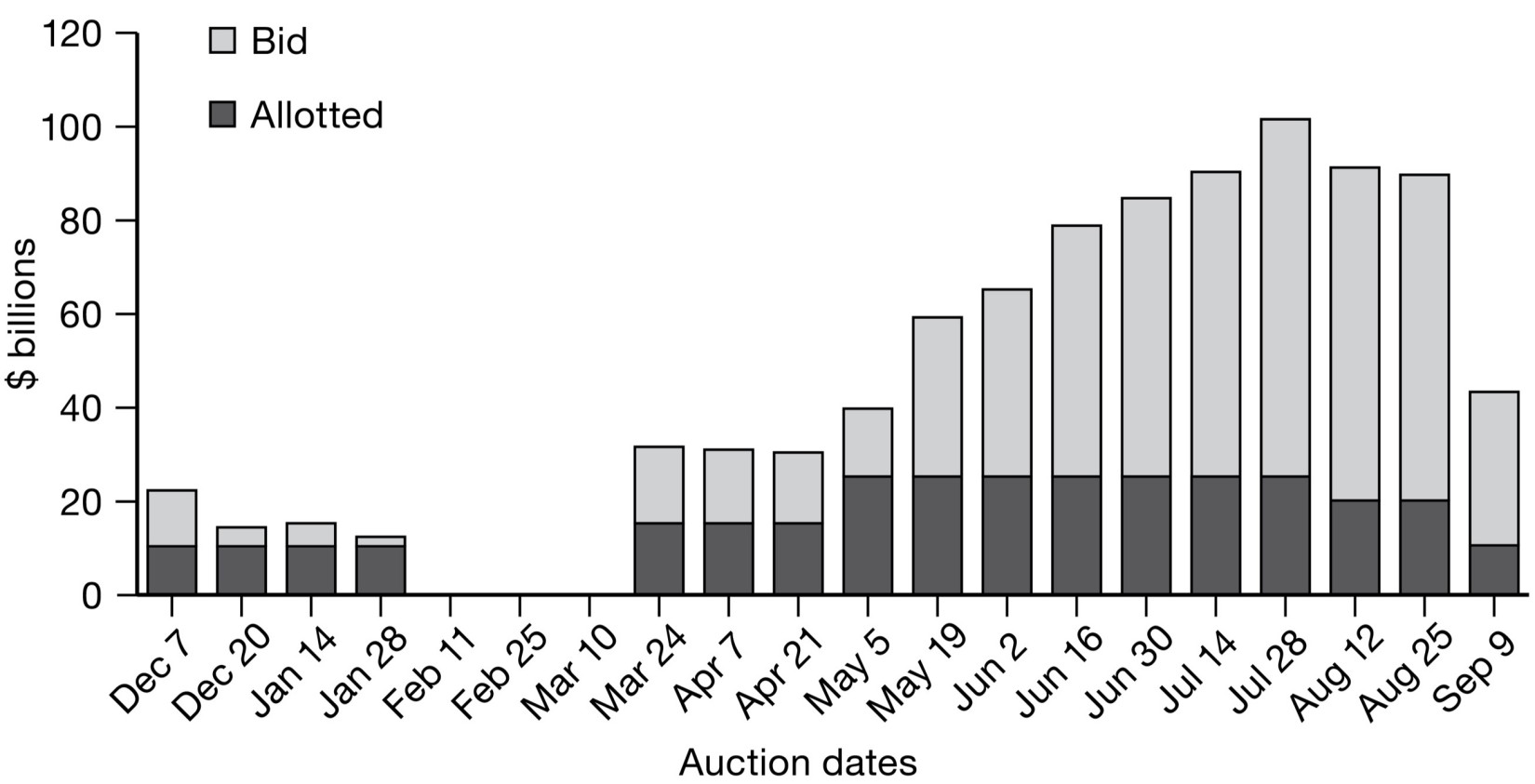
The ECB did not at this point have data on the subprime exposure of Europe’s banks. But the stress in the interbank lending market was all too obvious. In response Jean-Claude Trichet and his colleagues opened the liquidity tap, offering funds at attractive rates in unlimited quantities. By the end of the day on August 9, Europe’s banks had taken 94.8 billion euros, and they took another 50 billion on August 10. It was the scale and urgency of this action that finally brought home to Ben Bernanke and Hank Paulson the true severity of the situation. As Larry Elliott, economics editor of the Guardian, commented: “As far as the financial markets are concerned, August 9 2007 has all the resonance of August 4 1914. It marks the cut-off point between ‘an Edwardian summer’ of prosperity and tranquility and the trench warfare of the credit crunch—the failed banks, the petrified markets, the property markets blown to pieces by a shortage of credit.” 9 Quite how bad things were soon going to get was suggested three weeks later, when on September 14, Northern Rock, one of Britain’s largest mortgage lenders, failed. On TV screens, the Northern Rock panic looked like a classic bank run. Anxious depositors queued up outside beleaguered bank branches to retrieve their funds. News photographers and camera crews had a field day. But off camera something even worse was happening. The trillion-dollar global funding market was shutting down. 10
I
Northern Rock was a product of Britain’s overheated housing bubble. Formed in the 1960s through amalgamation of two nineteenth-century building societies (thrifts) and headquartered in gritty Newcastle, it had by the 1990s acquired fifty-three competitors across the north of England. To create the platform for further growth in October 1997, it converted from thrift status to a public limited company and floated on the London Stock Exchange. Then, between 1998 and 2007, in a gigantic surge of growth, it quintupled its balance sheet. As house prices faltered, some of its more marginal loans were primed to go bad. It was no surprise that “the Rock” got into trouble. But the obviousness of this connection is deceptive. What triggered the collapse in 2007 were not the loans on its balance sheet but the mechanism of their funding. Northern Rock was the model of a modern highly leveraged bank: 80 percent of its funding was sourced not from deposits but wholesale, at the lowest rates global money markets would offer. The bank’s 2006 annual report gives an idea of this far-flung funding operation:
“During the year, we raised £3.2 billion medium term wholesale funds from a variety of globally spread sources, with specific emphasis on the US, Europe, Asia and Australia. This included two transactions sold to domestic US investors totalling US$3.5 billion. In January 2007, we raised a further US$2.0 billion under our US MTN [medium-term notes] programme. Key developments during 2006 included the establishment of an Australian debt programme, raising A$1.2 billion from our inaugural issue. This transaction was the largest debut deal in that market for a single A rated financial institution targeted at both domestic Australian investors and the Far East.” 11
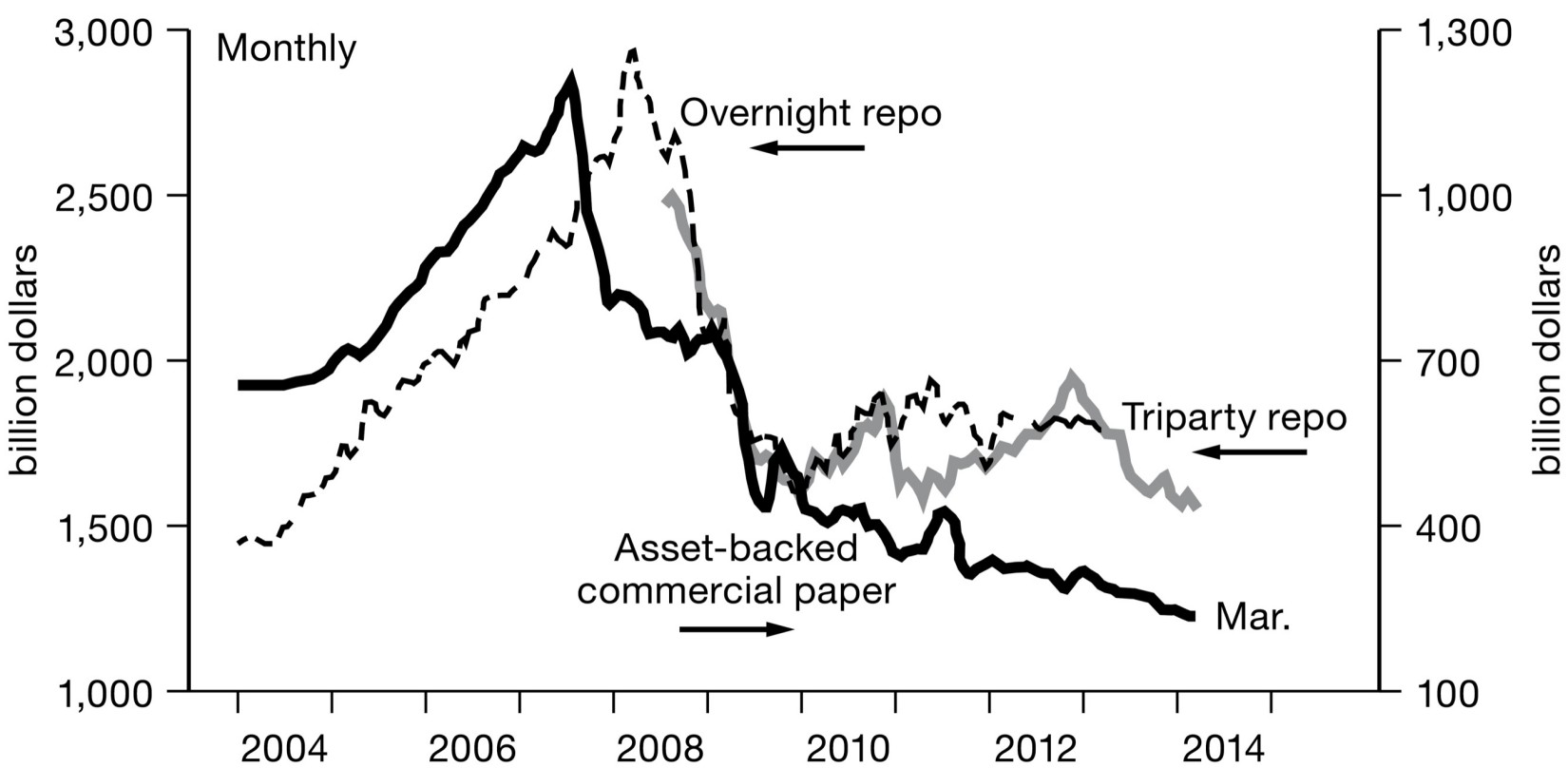
Northern Rock had minimal exposure to US subprime. But that didn’t matter, because it sourced its funding from markets heavily used by banks that did. The bad news from Paribas on August 9 was enough to shut down the interbank lending markets and the market for asset-backed commercial paper. It was the seizure in the funding market that poleaxed the entire securitization business and in particular the European side, which had been most actively involved in the issuance of ABCP. Given Northern Rock’s extreme dependence on wholesale funding, it took only two working days after the markets dried up for the bank to notify the Financial Services Authority of an impending crisis. 12 But the Bank of England was in no mood to help. Governor Mervyn King took the view that the overextended mortgage lender should suffer the consequences of its irresponsible expansion. By the end of August Northern Rock’s liquidity problems had become life threatening. But it wasn’t until September 13, after the BBC reported the story and the government acted to address the crisis by announcing a guarantee, that the retail depositors panicked. After that, the main damage to Northern Rock’s balance sheet was done by online withdrawals. The elderly savers queuing in the streets made for alarming TV footage. But it was not their panic that was bringing down the bank. It was a bank run operating on an altogether different scale at the speed of computer terminals in money markets across the world. It was a bank run without deposit withdrawals. There had been no deposits. There was nothing to withdraw. For banks to find themselves a trillion dollars short, all that needed to happen was for major providers of funding to withdraw from the money markets.
The Rise and Fall of Commercial Paper and Repo Financing, 2004–2014
Source: Tobias Adrian, Daniel Covitz and Nellie Liang, “Financial Stability Monitoring,” Annual Review of Financial Economics 7 (2015): 357–395, chart 15.
ABCP was always the weakest link in the shadow banking chain. Repo, as fully collateralized lending, was supposed to be safe. Initially, that expectation was borne out. Bear Stearns, the smallest of the US investment banks, reported the first loss in the firm’s history in the first quarter of 2007. 13 As was common knowledge, it was heavily involved in mortgage securitization. That was enough to restrict its access to commercial paper markets. The bank’s ABCP issuance plunged from $21 billion at the end of 2006 to $4 billion a year later. Initially, Bear was able to make up for this shortfall by increasing its repo funding from $69 billion to $102 billion. To back this up, as late as Monday, March 10, 2008, Bear still held an $18 billion “pool” of ultraliquid, high-quality securities. But then collateralized borrowing began to fail too.
Unlike the implosion of ABCP, the “run on repo” was a surprise. 14 Under British and American law, the holder of repo collateral is entitled to seize it ahead of any other claimant in the bankruptcy queue. So even allowing for Bear’s large portfolio of toxic mortgage-backed securities, its repo ought to have been good. A Treasury security is a Treasury security. Unfortunately for Bear, given that there were plenty of other counterparties to engage in repo trades with, no one wanted to take the risk of having to seize collateral from a failing bank, even if the collateral was as highly rated and as liquid as US Treasurys. When news of a new round of mortgage failures hit the markets in March 2008 and hedge funds began emptying their prime brokerage accounts, quite suddenly the haircuts Bear Stearns faced in the bilateral repo market steepened and access to trilateral repo funding was shut off. A bank that in early March had easily been able to raise $100 billion overnight in exchange for good collateral could no longer fund itself. On Thursday, March 13, with its liquidity reserve down to only $2 billion, Bear’s directors were told that $14 billion in repos would not “roll” the next day and that they were at imminent risk of running out of cash. This was a modern bank failure. There were no queuing depositors. Bear did not cater to pensioners. It died, because doubts about its business led it to be cut out of wholesale funding markets.
Then something even worse began to happen. The uncertainty spread from individual weak banks to the entire system. First in the spring of 2008 and then in June, the haircuts on bilateral repo took a severe step up across the board, for all asset classes, for all parties. 15 This meant that the amount of capital that was required to hold the outstanding stock of bonds leaped upward, across the entire banking system. Repo in US Treasurys and GSE-backed mortgage-backed securities was the least badly affected. As top-quality collateral they were reserved mainly for use in triparty repo overseen by JPMorgan Chase and Bank of New York Mellon. As long as a counterparty remained in good standing and had top-quality collateral, that repo market remained open and stable. But in the interbank bilateral repo market where private label ABS was used as collateral, funding terms were getting stiffer and stiffer. 16
Haircuts on Repo Agreements (%)
|
Securities |
April ’07 |
August ’08 |
|
US Treasurys |
0.25 |
3 |
|
Investment-grade bonds |
0–3 |
8–12 |
|
High-yield bonds |
10–15 |
25–40 |
|
Equities |
15 |
20 |
|
Senior-leveraged loans |
10–12 |
15–20 |
|
Mezzanine-leveraged loans |
18–25 |
35+ |
|
Prime MBS |
2–4 |
10–20 |
|
ABS |
3–5 |
50–60 |
Source: Tobias Adrian and Hyun Song Shin, “The Shadow Banking System: Implications for Financial Regulation,” Federal Reserve Bank of New York Staff Reports 382, July 2009, table 9. Based on IMF Global Financial Stability Report, October 2008.
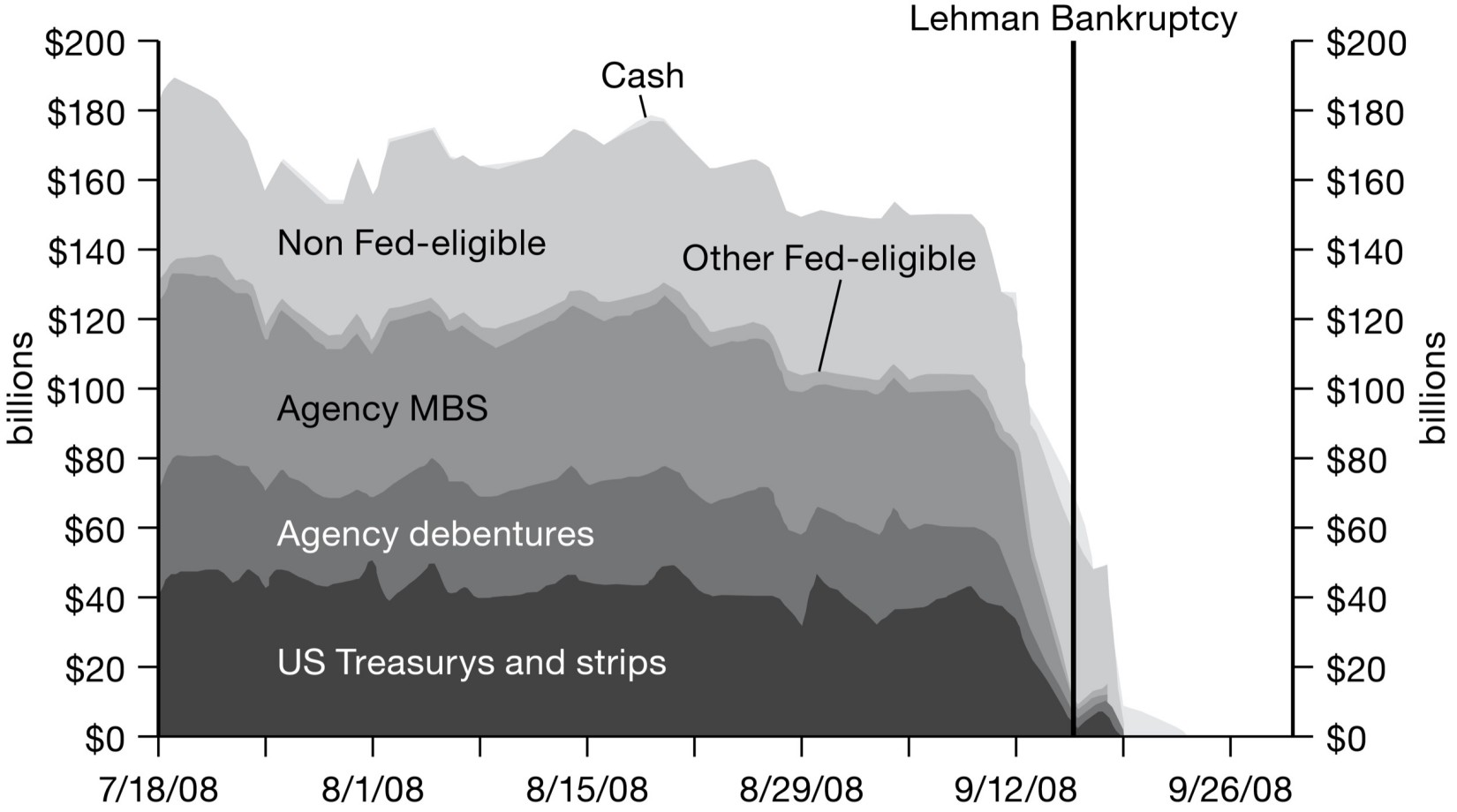
The step up in haircuts would put huge pressure on the investment banks that relied most heavily on short-term funding markets. And it was clear which of those, after Bear, was most vulnerable. The warning signs at Lehman were unmistakable. 17 Like Bear, it was known to have taken huge risks on real estate in the hope of catapulting up the Wall Street league table. It had fully integrated its business with the mortgage securitization pipeline. Since the beginning of 2008, the bank’s stock had lost 73 percent of its value. As at Bear, commercial paper issuance by Lehman fell from $8 billion in 2007 to $4 billion in 2008. Nevertheless, on May 31, 2008, its liquidity pool, which was intended to cover cash outflows over a twelve-month period, was as high as $45 billion. 18 In June 2008 investors were sufficiently confident to commit $6 billion in new share capital. What pushed Lehman over the edge were collateral calls by anxious lenders. Given the falling value of its stock, J.P. Morgan demanded large postings of collateral to back up daytime triparty repo risks. By Tuesday, September 9, allowing for liens on its assets, Lehman’s liquidity pool was down to $22 billion. Two days later, on Thursday, September 11, Lehman was still posting $150 billion as collateral in the repo market. 19 But then confidence broke. S&P, Fitch and Moody’s all downgraded Lehman. Its share price fell and with that went its standing in the repo markets; $20 billion in repo did not roll and J.P. Morgan demanded $5 billion in collateral to sustain even the most essential part of Lehman’s triparty repo business. Within a matter of hours on Friday, September 12, the Lehman liquidity pool was down to $1.4 billion and it was clear that, barring a weekend rescue, it would be forced to file for bankruptcy.
On Monday, September 15, as Lehman’s staff around the world stumbled dazed out onto the pavement, the question was who might be next. Bear and Lehman were badly run. Under intense competitive pressure they made high-risk bets on some of the worst parts of the mortgage securitization business. But they were not exceptional. Merrill Lynch too had huge real estate exposure, and it was funding $194 billion of its balance sheet on a short-term basis in the summer of 2008. 20 In total, prior to the Lehman bankruptcy, $2.5 trillion in collateral was posted in the triparty segment of the repo market alone on a daily basis. This gigantic pile of claims and counterclaims could become destabilized in a matter of hours. Market analysts recognized the bimodal quality of this experience. It was a “massive game theory,” one commented. 21 In trilateral repo, given the unimpeachable quality of the collateral used, there was effectively no price adjustment mechanism. One day the investment banks, dealers and those they borrowed from and lent securities to all functioned as a gigantic trillion-dollar machine based on confidence and widely acceptable collateral. The next day even a very large player in the system could be shut out.
Quantites of Assets of Various Classes Financed by Lehman Brothers Through Tripart Repos
Source: Adam Copeland, Antoine Martin and Michael Walker, “Repo Runs: Evidence from the Tri-Party Repo Market,” Federal Reserve Bank of New York Staff Reports 506, July 2011 (revised August 2014).
After Lehman, the next link in the shadow banking chain to come under acute pressure was AIG, the insurer. In a dramatic burst of expansion from the 1990s onward, the Financial Products division of AIG had developed into a major player in the derivatives markets. In total in 2007 it had a book of $2.7 trillion in derivatives contracts. 22 Of this total, credit default swaps accounted for $527 billion. Of these, $70 billion were on mortgage-backed securities, and of those, $55 billion had exposure to dangerous subprime. Given its inside knowledge of the property market, AIG had stopped writing new CDS already in 2005. But given the relatively small size of the portfolio and the AAA rating of the assets it had written CDS on, it had not thought it necessary to insulate itself against losses. It was a fatal mistake. Out of a total of 44,000 derivatives contracts on the books of AIGFP, there were, it turned out, a cluster of 125 CDS on mortgage-backed securities that were about to go bad in a spectacular way. Those 125 contracts would inflict book value losses on AIG of $11.5 billion, twice what the ill-fated AIGFP unit had earned between 1994 and 2006. This was a heavy blow, but given its enormous global business, AIG could absorb portfolio losses on this scale. In due course the market would bounce back. Nor was AIG facing demands to pay out on MBS that had actually defaulted. As at Bear and Lehman, it was not the slow-moving crisis in real estate markets that threatened AIG. An avalanche of defaults and foreclosures would in due course grind its way through the system. But that would take years. The first credit default event on which AIG had to pay out did not occur until December 2008. The problem was the anticipatory reaction of financial markets and the fast-moving revaluation of securitized mortgages and the derivatives based on them. In the case of AIG, as it lost its top-tier credit rating, this triggered immediate margin calls from the counterparties to AIG’s insurance contracts. They wanted collateral to prove that AIG could meet its obligations if the mortgages did go bad. It was these collateral calls, running into tens of billions, that threatened to tip AIG over the edge.
AIG’s troubles did not end there. It had made life much harder for itself by engaging in the securities lending business. A group within AIG specialized in pooling the high-quality Treasurys and other securities held by AIG’s insurance funds. It lent those assets to other investors in exchange for cash, a trade akin to a repo. AIG’s securities-lending business then looked to maximize returns by investing the cash it received from the securities loan in higher-yielding but more risky mortgage-backed securities. Perversely, the securities lending office of AIG began to take those risky bets in 2005 precisely at the moment that AIG’s own Financial Products division decided it was too risky to continue writing CDS on mortgage-backed securities. By the summer of 2007, AIG’s securities lending program had $45 billion invested in high-yield private label MBS. As the securitization business collapsed, those assets became virtually unsalable, leaving AIG scrambling to find funds with which to repay the securities borrowers who now wanted their cash back. In search of profit, a cash-rich insurance company sitting on a giant portfolio of high-quality securities had turned itself into a dangerously leveraged shadow bank with a serious maturity mismatch. And to make matters worse, it was dealing with some of the most heavy-hitting players in global finance.
Taking the lead in making collateral calls against AIG was Goldman Sachs. 23 It was one of the sharpest operators in the market. But it was also an investment bank with no FDIC-insured deposit base. Like Bear, Lehman and Merrill, Goldman was acutely vulnerable to a loss of confidence. One of the plays that would see Goldman through the crisis was the big short position it had built, betting against mortgage-backed securities. A big piece of that bet was placed by buying CDS from AIG. Already by June 30, 2008, Goldman had called $7.5 billion in collateral. When AIG was downgraded on September 15, there was a new surge in margin calls. Of the total claim against AIG, which now topped $32 billion, Goldman Sachs and its partner Société Générale accounted for $19.8 billion. 24 For AIG the consequences were drastic. It was scrambling for cash at the worst possible moment. With its rating on the downgrade it could not borrow tens of billions through ordinary channels. It could raise the funds only through fire sales, and that meant recognizing the losses on its balance sheet, which would make its position only even more precarious. By the morning of September 16, AIG was hours away from default.
With ABCP, repo and CDS having gone into crisis, the next link to snap in the shadow banking chain was the money market funds. On September 10, ahead of the Lehman failure, MMF collectively administered $3.58 trillion in savings and cash resources for individuals, pension funds and other investors. 25 An essential part of their appeal was that while they offered better returns than ordinary savings accounts, they also promised that the principal invested was safe. They would return a dollar on the dollar whatever happened. The day after Lehman, on September 16, that illusion burst. The Reserve Primary Fund, one of the oldest and most respected in the business, with more than $62 billion under management, alerted the Fed that it was about to “break the buck.” It could no longer guarantee a payout of one dollar for every dollar invested. In August 2007 the Reserve Primary Fund had been under intense competitive pressure. To improve its yield and attract more investors it had committed 60 percent of its funds to buying ABCP just as other investors pulled out. 26 The high yields on offer from desperate borrowers catapulted the fund from the bottom 20 percent to the top 10 percent in the performance league and doubled its assets under management in a single year. But it also exposed its investors to serious risks. In general its managers picked well. But 1.2 percent of its funds were invested in high-yielding Lehman ABCP, and by September those had plunged in value. The eventual losses at Reserve Primary were tiny. By 2014 the fund would pay out 99.1 cents on the dollar, but in the days following September 15, with investors no longer certain that they would get full reimbursement, half a trillion dollars fled out of exposed mutual funds looking for the safety of US Treasurys. 27
The events of September 2008 brought the spectacular contraction of wholesale funding markets that had begun in August 2007 to crisis point. An index of haircuts on lower-quality collateral used in the biparty repo market surged from the elevated level of 25 percent it had reached over the summer of 2008 to 45 percent. 28 This had the effect of doubling the amount of money an investment bank would have to mobilize to hold anything other than top-quality securities on its books. Even at Goldman Sachs, the strongest of the stand-alone investment banks, its vital liquidity reserve, which it had pumped from $60 billion in 2007 to $113 billion by the third quarter of 2008, plunged on September 18 to a nominal total of $66 billion. 29 If that slide continued, the game would soon be up.
Meanwhile, the run for safety contracted balance sheets, which had the effect of withdrawing credit from the rest of the system. Loans by banks, investment banks, hedge funds and mutual funds to big businesses in the United States—so-called syndicated loans—fell from $702 billion in the second quarter of 2007 to as little as $150 billion in the fourth quarter of 2008. Interest rates demanded from high-yield, high-risk corporate borrowers surged to 23 percent, shutting out all but the most desperate borrowers. 30 This put a huge squeeze on all business activities. At the same time, corporations that were finding it hard to gain credit elsewhere increased the draw down on their existing credit lines, putting further pressure on the banks. 31
As money market mutual funds, repo, ABCP and AIG’s credit default swaps all came into question, the shock waves spread far beyond the United States. Among the investments most favored by the money market funds were European bank debts. They were a key source of dollar funding for the European megabanks. 32 With the mutual funds pulling back, how were the European banks to fund their large books of dollar assets? With interbank lending shutting down, the European banks resorted to a variety of roundabout mechanisms to obtain dollar funding. A measure of their desperation was the price that they were willing to pay to borrow in euro, sterling, yen, Swiss francs and Australian dollars, and then to swap those loans into dollars. Normally, since these were close to risk-free transactions, the premium was zero. As dollar funding shut down, it soared to 2–3 percent. Applied to balance sheets running into the trillions of dollars, that spread was enough to threaten an avalanche. If the Europeans couldn’t fund their dollar portfolios at affordable rates, they would be forced to sell. But as the Paribas announcement had made clear already in August 2007, there simply was no market for assets, which once had been valued at hundreds of billions of dollars. On Tuesday, September 16, 2008, the day after Lehman, Europe’s funding issues were judged to be so serious that they were first order of business for the Fed’s Open Market Committee meeting, even before Bernanke and his colleagues turned to the problems of AIG. 33
Nor was it just the Fed that was preparing for the end of the world. By conference call early in the morning on Saturday, September 13, Jamie Dimon of J.P. Morgan commanded his astonished senior staff to prepare for Armageddon. While J.P. Morgan would retreat to the safety of its legendary “fortress balance sheet,” they should brace for the bankruptcy of every investment bank on Wall Street, not just Lehman, but Merrill Lynch, Morgan Stanley and Goldman too. 34 Meanwhile, on the other side of the Atlantic, the impact of the funding crisis on a string of big European lenders was devastating. HBOS and RBS in Britain, Fortis and Dexia in the Benelux, Hypo Real Estate in Munich, Anglo Irish Bank, UBS, Credit Suisse and dozens of others all faced failure. Given that there weren’t any deposits, no one needed to run. You just stopped transacting in money markets and pulled in your horns. The result of the collective flight to safety, not by households but by the largest actors in the global financial system, was a trillion-dollar disaster.
II
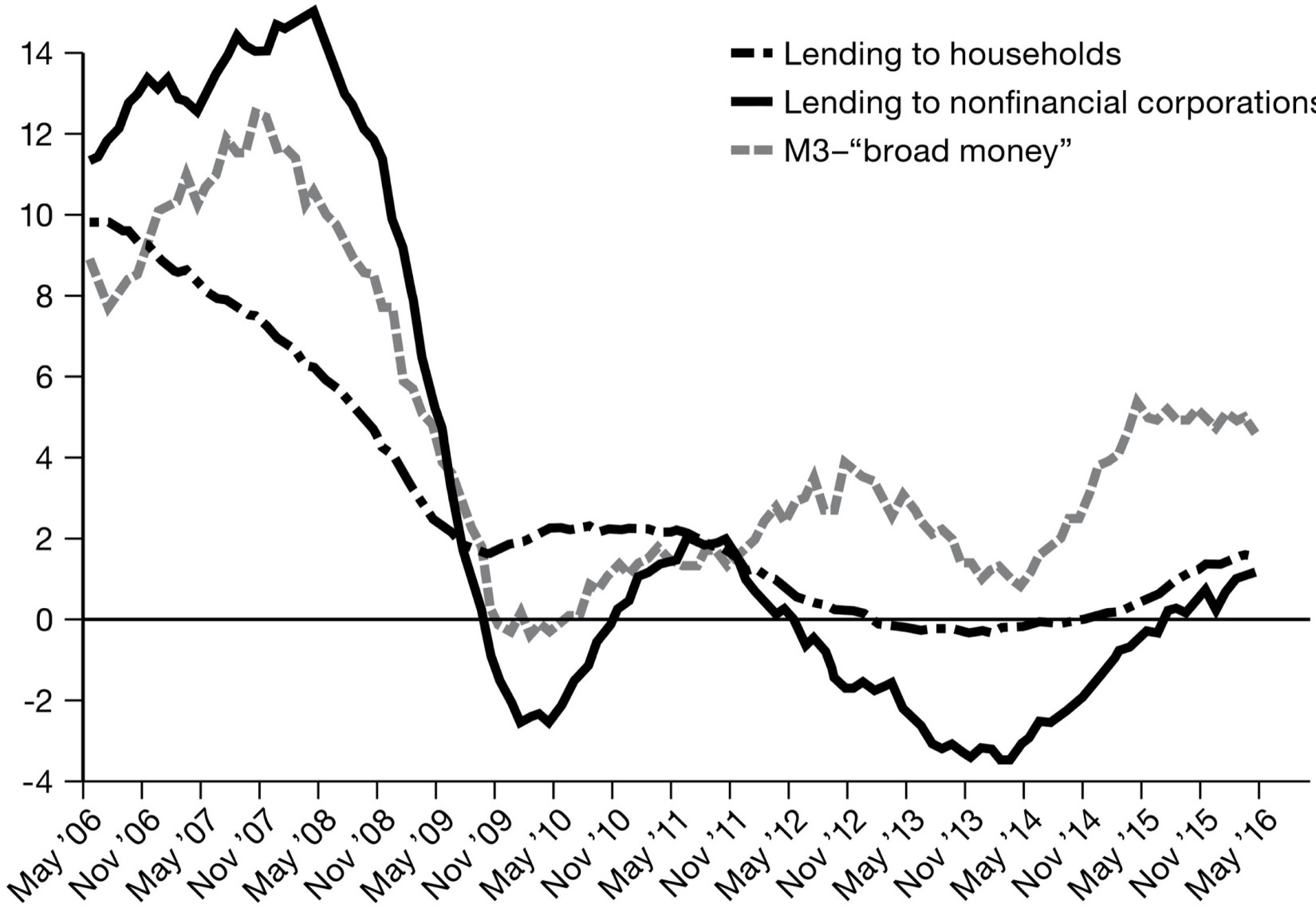
Beyond Manhattan and the City of London, the economic news was devastating. Real business activity was collapsing on both sides of the Atlantic. In Europe no less than in the United States it was the crisis of 2008, not the later eurozone debacle, that marked the decisive break in investment, consumption and unemployment. From the second half of 2007, as banks great and small in Germany, France, Britain, Switzerland, and the Benelux began to acknowledge the scale of their losses, lending collapsed. The banking sector felt the pressure first because it was most dependent on the daily churn of vast volumes of credit. But soon the crunch extended to nonfinancial corporations and households too. In the eurozone, after running at between 10 and 15 percent, growth in new lending plummeted to zero. It wasn’t the sovereign debt crisis of 2010 that halted Europe’s growth, it was the transatlantic banking crisis of 2008.
Lending In Eurozone to Households and Businesses Other Than Banks, Year-on-Year Growth (%)
Source: http://macro-man.blogspot.co.uk/2016/06/a-broad-scan.html .
As new mortgage borrowing contracted, the slide in the housing market accelerated. Falling house prices and collapsing financial markets slashed personal wealth. In Spain net wealth per person fell by at least 10 percent between 2007 and 2009. Within five years personal wealth would plunge by 28 percent, or 1.4 trillion euros, more than a year’s worth of output. 35 In the UK, as the stock market and house prices slumped, household wealth losses in 2008–2009 were estimated by the IMF at $1.5 trillion—50 percent of GDP in a matter of twelve months. Ten percent of home owners found themselves mired in negative equity. 36 In Ireland, house prices, having quadrupled between 1994 and 2007, halved between 2008 and 2012, taking household wealth with them. 37 These were severe shocks, but for sheer scale the US crisis trumped them all. An early IMF estimate in the summer of 2009 put US household wealth losses at $11 trillion. 38 By 2012 the US Treasury would raise that to $19.2 trillion. 39 Independent estimates put the figure closer to $21–22 trillion—$7 trillion from real estate, $11 trillion in the stock market and $3.4–4 trillion in retirement savings. 40 From their peak in 2006, by 2009 US house prices had fallen by a third. At the worst point in the crisis, 10 percent of home loans across the United States would be seriously in arrears and 4.5 percent of all mortgages crashed into foreclosure. More than 9 million families would lose their homes. Millions more suffered years of anxiety as they struggled to make payments on homes that were no longer worth the mortgages secured on them. At the worst point in the crisis more than a quarter of US homes had negative equity. 41
And the pain was compounded by the distribution of losses between wealthier and poorer households. Between 2007 and 2010 the mean wealth of American households fell from $563,000 to $463,000. But those figures are elevated by the huge fortunes of the very wealthy. If we look instead at the median household—the household that sits at the 50 percent mark in the wealth distribution—it saw its net worth halved from $107,000 to $57,800. 42 And as bad as these figures are, the experience of America’s minority populations was worse. The median wealth of the Hispanic population, which had participated particularly actively in the housing boom, plunged by 86.3 percent between 2007 and 2010. 43 The median African American household saw virtually its entire housing wealth wiped out, and African American home owners were twice as likely to suffer foreclosure as white borrowers. 44 It did not produce the memorable imagery of the 1930s Dust Bowl, but the housing crisis that began in 2007 forced the largest mass movement of people in the United States since the Great Depression. And as minority home ownership collapsed, the result was resegregation along racial lines. 45
With households suffering, in America’s economic downswing of 2008 it was consumption that led the way. 46 As demand fell, so did production and employment. In the Central Valley in California, which witnessed a collapse of 50 percent in home values, consumption was cut by 30 percent. 47 Every kind of expenditure that could be postponed was cut back. For America’s long-ailing motor vehicle industry it was the coup de grâce. Car and light vehicle sales plunged from an annual rate of 16 million units in 2007 to as few as 9 million per annum in 2009. By December 2008 it was clear that both Chrysler and General Motors would fail. In the early twenty-first century GM was no longer the national totem that it had once been. Its total worldwide employment in 2007 was 266,000, compared with a peak of 853,000 in 1979. But as 2008 began it was still the largest car company in the world. GM paid $476 million in salaries each month as well as the health-care and pension benefits for 493,000 retired workers. Its production operations generated $50 billion in orders for parts and services supplied by 11,500 vendors. 48 In total, industry lobbyists claimed that c. 4.5 percent of all US jobs were supported by the auto industry, paying more than $500 billion annually in wages and generating more than $70 billion in tax revenues. 49 On November 7, 2008, GM declared that, barring government aid, it would face insolvency by the summer of 2009.
The imminent failure of GM and Chrysler was an exclamation point on the long-running decline of the American auto industry. One version of the American Dream was dying. But Detroit’s crisis sent shock waves around the world. The future of GM’s long-established UK and German divisions, Vauxhall and Opel, was in doubt. 50 So too were Detroit’s operations in Mexico. Under the NAFTA free trade system, interconnected production systems, known as value chains, had been stretched from one end of North America to the other. As a result, Mexico’s dependence on the United States was overwhelming. In 2007, 80 percent of Mexico’s exports were sent to the United States. As the American crisis hit, Mexico’s GDP fell by almost 7 percent, a worse contraction even than during the homegrown financial crisis of 1995—the so-called Tequila Crisis. 51 Mexico’s nonoil exports fell by 28 percent between May 2008 and May 2009. Automotive exports fell by 50 percent. 52 In the northern industrial cities of Ciudad Juárez and Tijuana, the great maquiladora export processing centers, employment in manufacturing fell by more than 20 percent. Together with the surging violence of the drug wars, the recession led more than 100,000 desperate workers and their families to abandon Juárez. As unemployment surged north of the border, remittances dried up and hundreds of thousands of migrants returned home, making the situation of the poorest Mexicans progressively more desperate. Meanwhile, the inflow of new foreign investment in Mexico halved and the peso plunged in value from 11 to 15 to the dollar, driving up the cost of living.
Nor was the pain confined to North America. For decades GM’s great global rival was Toyota, and 2008 would be the year in which Toyota claimed the title of the world’s leading car producer. It paid a heavy price. In 2009 Japan was rocked by a “Toyota shock” as its national champion reported its first loss in seventy years and cut global production by 22 percent. 53 From a profit of $28 billion in 2007–2008, Toyota slid to a loss of $1.7 billion in 2008–2009. In the words of its president, Katsuaki Watanabe, “The change in the world economy is of a magnitude that comes once every hundred years. . . . We are facing an unprecedented emergency.” 54 As inventories of unsold cars piled up in the United States and Europe, Japanese car exports fell by two-thirds. 55 Japan’s investment industries stopped in their tracks. Hitachi, the giant producer of capital goods and electronics, was worst hit, facing a record loss for a Japanese industrial company of $7.87 billion. 56 Consumer electronics icon Sony announced a loss of $2.6 billion. Toshiba expected to lose $2.8 billion, Panasonic $3.8 billion. 57 All in all, in January 2009 Japan’s economy contracted at a rate of 20 percent per annum and exports by 50 percent year on year. 58 The largest part of this was accounted for by a fall in exports to the United States, followed by Japan’s immediate Asian neighbors, China, Taiwan and Korea, all of which were plunged into recession.
As the shock of 2008 revealed, with supply chains synchronized to perfection, “factory Asia” responded within a matter of weeks to any hesitation of demand in Europe and America. Nor were they the only ones to be hit. Germany suffered a 34 percent fall in exports between the second quarter of 2008 and 2009, with its machinery and transport equipment sector taking a deep dive. It was the most severe economic shock suffered by the Federal Republic since its foundation in 1949. As one bank economist remarked: “One has to go back to the 1930s during the Great Depression to find comparably horrible figures.” 59 Meanwhile, emerging markets were hit too. Turkey, which had joined the club of rapidly growing economies after its financial stabilization in 2004, suffered a sudden and jarring stop. By the first quarter of 2009, Turkey’s GDP was falling by 14.7 percent on an annualized basis. Unemployment rocketed from 8.6 percent in the summer of 2008 to 14.6 percent in the first winter of the crisis. It was the worst affected of any of the emerging markets outside Eastern Europe. Turkey had not seen a situation so bad as this since the disastrous financial crisis of 2001. 60 Istanbul’s stock market plunged by 54 percent between December 2007 and November 2008. 61
What made the collapse of 2008 so severe was its extraordinary global synchronization. Of the 104 countries for which the World Trade Organization collects data, every single one experienced a fall in both imports and exports between the second half of 2008 and the first half of 2009. Every country and every type of traded goods, without exception, experienced a decline. 62
If in manufacturing the downturn was in the volume of trade—the number of cars shipped or the number of cell phones exported—in commodities the shock was to prices. In the worst six months of 2008, oil prices fell by more than 76 percent. That in turn wreaked havoc with the budgets of the petrostates. Saudi Arabia swung from a budget surplus of 23 percent of GDP in 2008 to a substantial deficit. 63 Kuwait was rocked by the crisis at Gulf Bank, which faced losses on currency trades. 64 But nowhere was worse affected than the boomtown of Dubai. Driven by surging commodity prices, heavily backed by international banks such as RBS and Standard Chartered, Dubai’s real estate sector had become the center of a global construction frenzy. 65 By 2008 the city bristled with construction cranes. Its palatial malls boasted floor space four times the per capita level in the United States. In the autumn of 2008 the bubble burst. New credit was slashed. By February 2009 Dubai’s rip-roaring six-year construction boom had come to a halt. Half of a portfolio of $1.1 trillion in construction projects being undertaken in the Gulf Cooperation Council was canceled in a matter of months. Luxury cars were abandoned in droves as Western contract workers scuttled to the airport to escape debtor’s prison. An airlift of charter flights repatriated tens of thousands of migrant guest workers to India. 66
As both household consumption and business investment plummeted, of the sixty countries that supply the IMF with quarterly GDP statistics, fifty-two registered a contraction in the second quarter of 2009. 67 Not since records began had there been such a massive synchronized recession. Tens of millions of people were thrown into unemployment. Though it was dazed bankers with boxes of belongings stumbling out of office towers in London and New York that attracted the TV cameras, it was young, unskilled blue-collar workers who suffered the worst. 68 In the United States, the epicenter of the crisis, the month-on-month fall in employment over the winter of 2008–2009 was breathtaking. In the worst period, the monthly rate of job losses topped 800,000. Among the African American population the surge was particularly dramatic, with unemployment rising from 8 percent in 2007 to 16 percent by early 2010. 69 Young black workers were particularly hard hit, with their unemployment rate surging to 32.5 percent by January 2010. At the very bottom of the pile were young African American men with no high school diploma. In New York City in 2009 their unemployment rate was more than 50 percent. 70 Precisely how many people lost their jobs across the global economy depends on our guess as to joblessness among China’s giant migrant workforce. But reasonable estimates range between 27 million and something closer to 40 million unemployed worldwide. 71
III
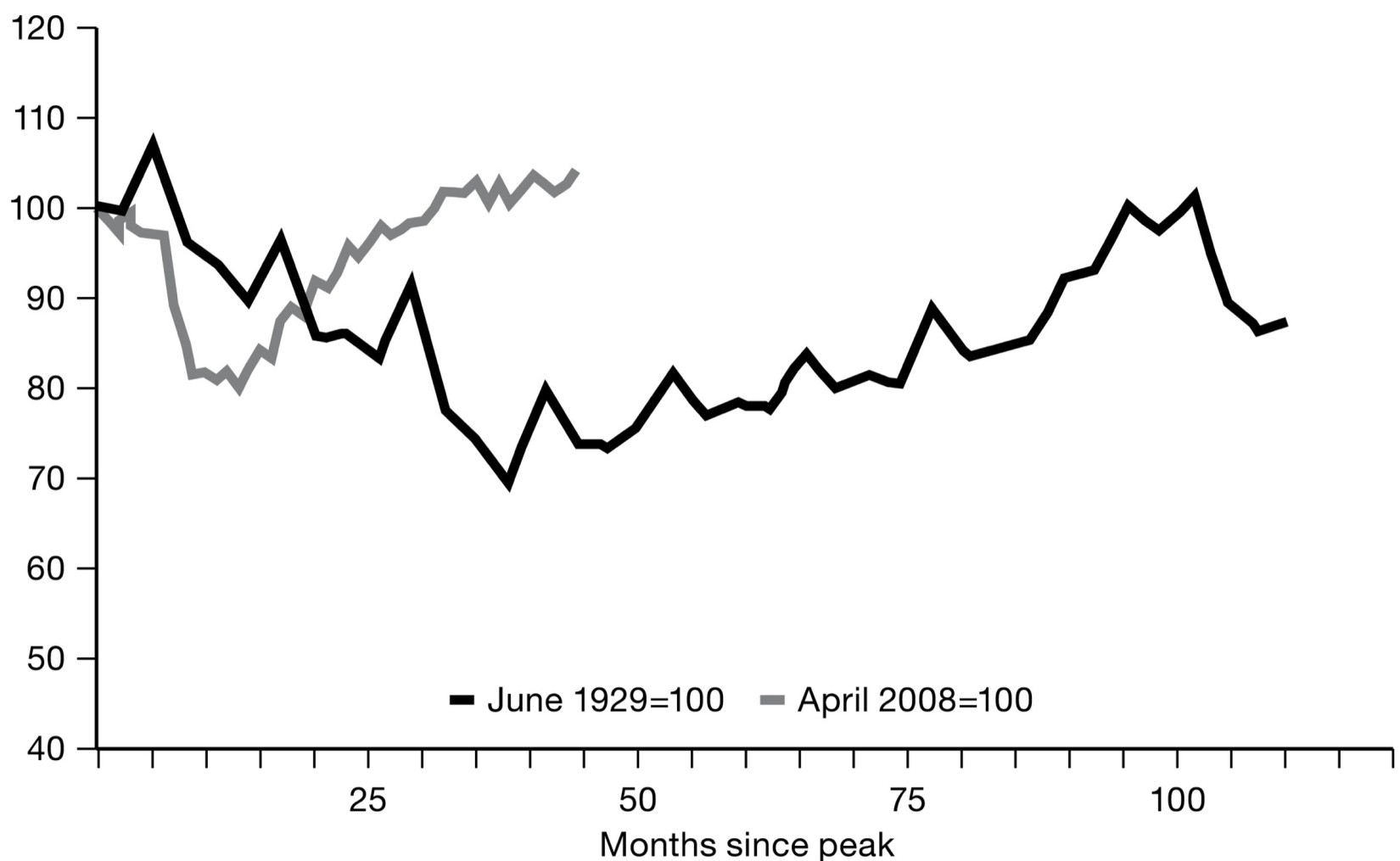
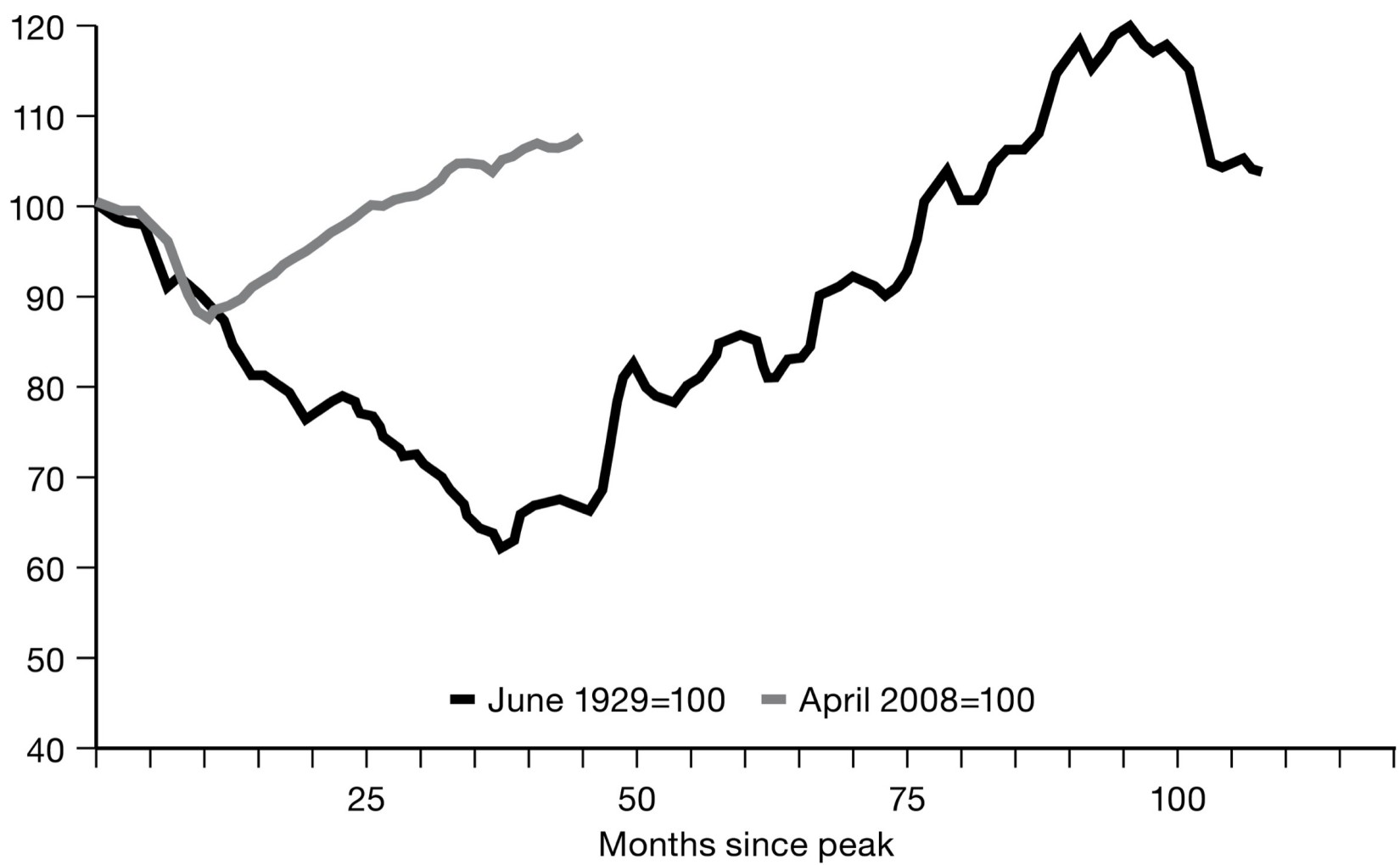
The situation was clearly bad. But in historical terms, how bad was bad? Trying to find his bearings, in the spring of 2009 Paul Krugman concluded that the situation was dire. But at least as far as the industrial economy of the United States was concerned, it was less grim than it had been in the Great Depression of the 1930s. 72 It was, he quipped, only “half a Great Depression.” It was not a judgment that stood for long. As critics scrambled to point out, Krugman’s assessment was deeply parochial. The Great Depression of the 1930s was not confined to the United States, and neither was the crisis that struck in 2008. On a global level, industrial output, stock markets and trade were all falling at least as fast in 2008–2009 as they had in 1929. 73
Volume of World Trade: 1929 and 2008 Compared
Source: Barry Eichengreen and Kevin O’Rourke, “A Tale of Two Depressions Redux,” http://voxeu.org/article/tale-two-depressions-redux .
We now know that urgent and massive countermeasures would forestall the kind of agonizing depression that the world experienced in the early 1930s. But that relatively sanguine perspective depends on the safety of hindsight. In September 2008 the scale of the response was an index of the desperation felt by those at the epicenter of the crisis in the United States. Ben Bernanke at the Fed, Tim Geithner at the New York Fed and Hank Paulson at the Treasury all recounted the experience as traumatic. After Lehman collapsed, Paulson confronted his staff with the prospect of an “economic 9/11.” 74 On the morning of September 20, the US Treasury secretary alerted Congress to the fact that unless they acted fast, $5.5 trillion in wealth would disappear by two p.m. They might be facing the collapse of the world economy “within 24 hours.” 75 In private session with congressional leadership, Bernanke, who is not given to overstatement, warned that unless they authorized immediate action, “we may not have an economy on Monday.” 76
World Industrial Production, Now Versus Then
Source: Barry Eichengreen and Kevin O’Rourke, “A Tale of Two Depressions Redux,” http://voxeu.org/article/tale-two-depressions-redux .
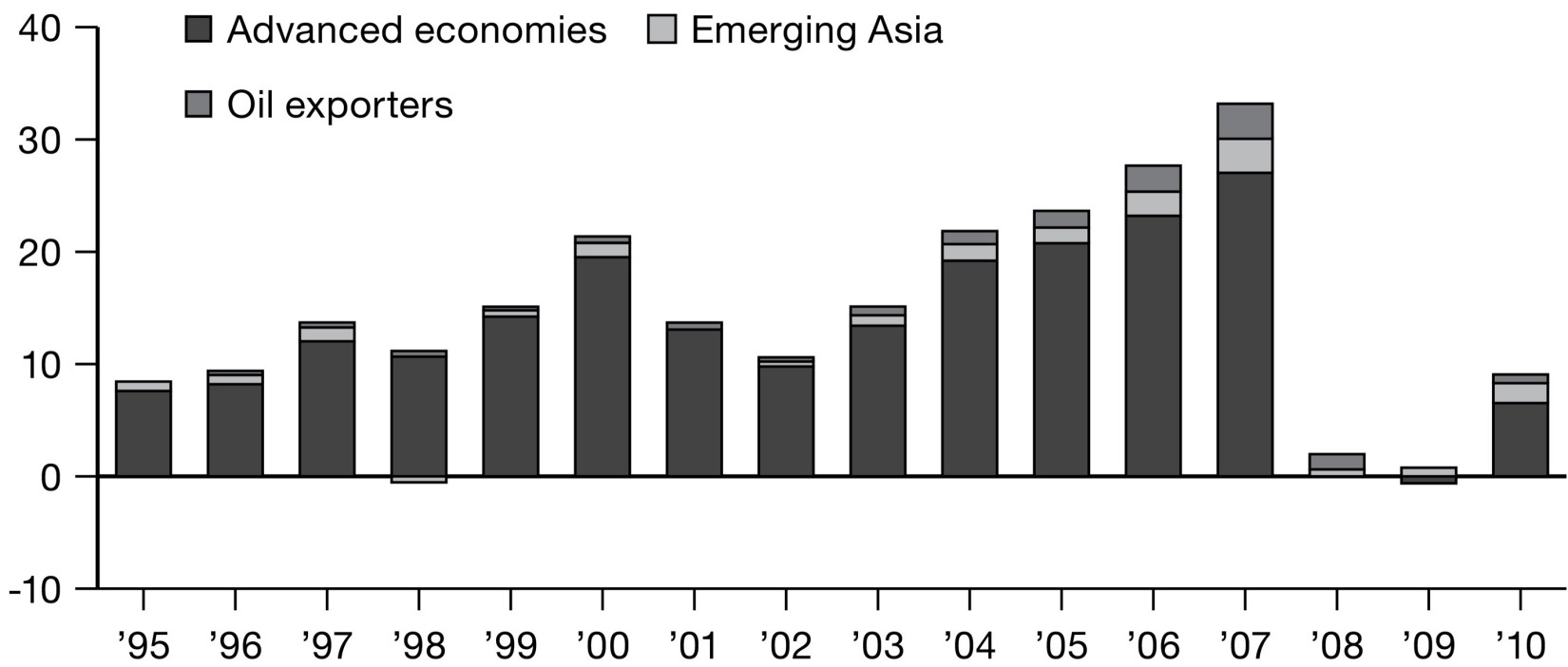
As far as America was concerned, this was clearly an exaggeration. Bernanke was trying to scare Congress into action. But if one looks at data on international investment flows, the picture is truly astonishing. Across the world before the crisis hit, inflows and outflows of capital came to just under 33 percent of world GDP. The vast majority of this was accounted for not by transactions between the advanced world and emerging markets but by flows between advanced economies. At the height of the crisis, between the last quarter of 2008 and the first quarter of 2009, those flows collapsed by 90 percent to less than 3 percent of global GDP. 77 In the second half of 2008 capital flows between rich countries plunged from $17 trillion to barely more than $1.5 trillion. No other aggregate in the global economy was affected on anything like this scale or with this suddenness. It was as though a gigantic stabilizing flywheel suddenly came crashing to a halt, sending a shuddering jolt through the entire financial system.
Gross Capital Flows as a Percentage of World GDP
Source: Claudio Borio and Piti Disyatat, “Global Imbalances and the Financial Crisis: Link or No Link?,” BIS Working Paper 346 (2011), graph 5.
In public, Ben Bernanke knew it was essential for him to keep a straight face: “Financial panics have a substantial psychological component. Projecting calm, rationality, and reassurance is half the battle,” he would later opine. 78 But as an economist and an economic historian, Bernanke understood the scale of what he was up against. What threatened in 2008 wasn’t 1929. What threatened was something even bigger and quite possibly even worse. As he was to affirm on several occasions afterward, for Bernanke, “September and October of 2008” was clearly the “worst financial crisis in global history, including the Great Depression.” 79 In the 1930s there was no moment of such massive synchronization, no moment in which so many of the world’s largest banks threatened to fail simultaneously. The speed and force of the avalanche was unprecedented. As Bernanke later admitted to the readers of his memoirs, “[I]t was overwhelming, even paralyzing, to think too much about the high stakes involved, so I focused as much as I could on the specific task at hand. . . . [A]s events unfolded I repressed my fears and focused on solving problems.” 80 Only as he neared the end of his second term was he ready to unwind. Looking back, it was like being in a car wreck. “You’re mostly involved in trying to avoid going off the bridge; and then later on you say, ‘oh my god!’” 81
Tim Geithner, from his vantage point at the New York Fed, gave a typically hard-boiled insight into his perspective on the struggle to save the financial system: “I didn’t have a way to explain the terror of those days until later, when I saw The Hurt Locker, the Oscar-winning film about a bomb disposal unit in Iraq. What we went through on interminable conference calls in fancy office buildings obviously did not compare with the horrors of war, but ten minutes into the movie I knew I had finally found something that captured what the crisis felt like: the overwhelming burden of responsibility combined with the paralyzing risk of catastrophic failure; the frustration about the stuff out of your control; the uncertainty about what would help; the knowledge that even good decisions might turn out badly; the pain and guilt of neglecting your family; the loneliness and the numbness.” 82
There is no reason to doubt the sincerity of these professions. It was a fearful situation. But the metaphors—terrorist attack, car wrecks and unexploded improvised explosive devices—are telling. They position the crisis-fighting team as first responders facing a compelling emergency. And they place us, their audience, by their side. Who would not root for the fatherly Ben Bernanke trying to keep the family car on the bridge, or Geithner’s heroic bomb disposal team? Politics is set aside as we anxiously watch our heroes struggle to rescue us from disaster. There is no time to ask why this is happening. We are “all in this together.” But it is precisely with that assertion that a political economy of the crisis begins. 83 Which system was it that needed to be saved in the autumn of 2008? Who was being hurt? Who was included in the circle of those who needed to be protected? And who was not?
As the crisis spiraled toward September 2008 the first responders performed a substitution. It had all started with the predictable but devastating bursting of the housing bubble. That crisis was affecting millions of households on both sides of the Atlantic. But starting with the rash of bank failures and fund failures in the late summer of 2007, the real estate crisis was gradually displaced from the center of attention. What now mattered was the possible failure of an investment bank. By September 2008 it was no longer individual banks but the entire financial system that had to be saved at all costs. It was entire markets and sectors—the repo market, ABCP, the mutual funds—that needed life support. It was the implosion of the financial system, imagined as something akin to a massive electrical power failure that threatened the entire economy.
It was crucial to fix Wall Street, so the slogan went, to help Main Street. The mantra was repeated in local idiom all over the world. And for the purposes of ongoing business activity, it clearly was crucial to maintain business credit. In September even blue-chip businesses could not get short-term funding. McDonald’s could no longer get an overdraft from Bank of America. 84 Engineering giant GE and Harvard University were rumored to be having liquidity issues. 85 But beyond such immediate rescue measures, did the all-out focus on the financial system really serve the interests of the real economy? 86 Was the inability to borrow causing a failure of investment and thus the ongoing depression? Or were the collapsed housing market and cash-strapped households curtailing economic activity such that there was no incentive to invest and thus no demand for loans?
These might seem like academic questions. The bomb was ticking. The car was hurtling off the bridge. Amid a global catastrophe, did it really matter which way the arrow of causation was pointing? Amid the intensity of the financial crisis, why should anyone care? Because the decision made by the American crisis fighters to take those questions off the table and to give absolute priority to saving the financial system shaped everything else that followed. It set the stage for a remarkable and bitterly ironic inversion. Whereas since the 1970s the incessant mantra of the spokespeople of the financial industry had been free markets and light touch regulation, what they were now demanding was the mobilization of all of the resources of the state to save society’s financial infrastructure from a threat of systemic implosion, a threat they likened to a military emergency.
Chapter 7
BAILOUTS
T he ferocity of the financial crisis in 2008 was met with a mobilization of state action without precedent in the history of capitalism. Never before outside wartime had states intervened on such a scale and with such speed. It was a devastating blow to the complacent belief in the great moderation, a shocking overturning of prevailing laissez-faire ideology. To mobilize trillions of dollars on the credit of the taxpayer to save banks from the consequences of their own folly and greed violated maxims of fairness and good government. But given the risk of contagion, how could states not act? Having done so, however, how could they ever go back to the idea that markets were efficient, self-regulating and best left to their own devices? It was a profound challenge to the basic idea that had guided economic government since the 1970s. It was all the more significant for the fact that the challenge came not from the outside. It was not motivated by some radical ideological turn to the Left or the Right. There was precious little time for thought or wider consideration. Intervention was driven by the financial system’s own malfunctioning and the impossibility of separating individual business failure from its wider systemic repercussions. Martin Wolf, the Financial Times ’s esteemed chief economic commentator, dubbed March 14, 2008, “the day the dream of global free-market capitalism died.” 1 That was the day the Bear Stearns rescue was announced. It was only the beginning.
I
Bailout battles were fought all along the contours of the integrated Atlantic financial economy—in the United States, Iceland, Ireland, Britain, France, Germany, the Benelux, Switzerland. The financial firepower deployed was immense and accounting for it became a field of political argument in its own right. But whichever metrics we use, it is clear that there had never before been anything so extensive or massive in scale. Commitments were made in excess of $7 trillion.
The main mechanisms for intervention were fourfold: (1) loans to banks; (2) recapitalization; (3) asset purchases; and (4) state guarantees for bank deposits, bank debts or even for the entire balance sheet. Everywhere the crisis struck, states were forced to take some combination of these measures. The agencies involved were central banks, finance ministries and banking regulators. What summary statistics cast as cool enumerations were, in fact, frantic, improvised solutions that emerged from barely coordinated sessions of all-day, all-night problem solving. As the crisis intensified it put the financial and political resilience of states to the test. Broadly speaking, this produced four types of outcome, which reflect the degree of immersion in global finance, the resources of the states at risk, the shape of the governing elite and the balance of power within the financial sector itself. 2
In the most extreme cases the crisis overwhelmed the state. Ireland and Iceland simply did not have the resources, the institutions or the political capacities to deal with the gigantic shock to their overgrown financial sectors. They would suffer a comprehensive crisis, as would the worst-hit emerging market economies of Eastern Europe. Others were better placed. Despite having a grossly overgrown financial sector, Switzerland survived intact. It did so through early, intense and unrelenting attention to its one failing megabank, UBS. 3 Though it was never nationalized, it became in effect a ward of the state. The larger European states and those with less excessive banking systems—the UK, Germany, France, Belgium and the Netherlands—presented a more mixed bag. Despite the scale of the crises they faced, they had the resources to cope. They attempted comprehensive organizational and financial solutions, including abortive proposals to coordinate a common European response to the crisis. But efforts to achieve consistency and coordination were undermined by national political calculation and the uncooperative behavior of leading banks that fancied themselves large enough to survive without the humiliation of taking state aid. There was no spiraling disaster, but containing the crisis was hugely expensive and success was partial at best.
Government Support Measures to Financial Institutions Since October 2008, as of End of May 2010 (in billions of euros unless stated otherwise)
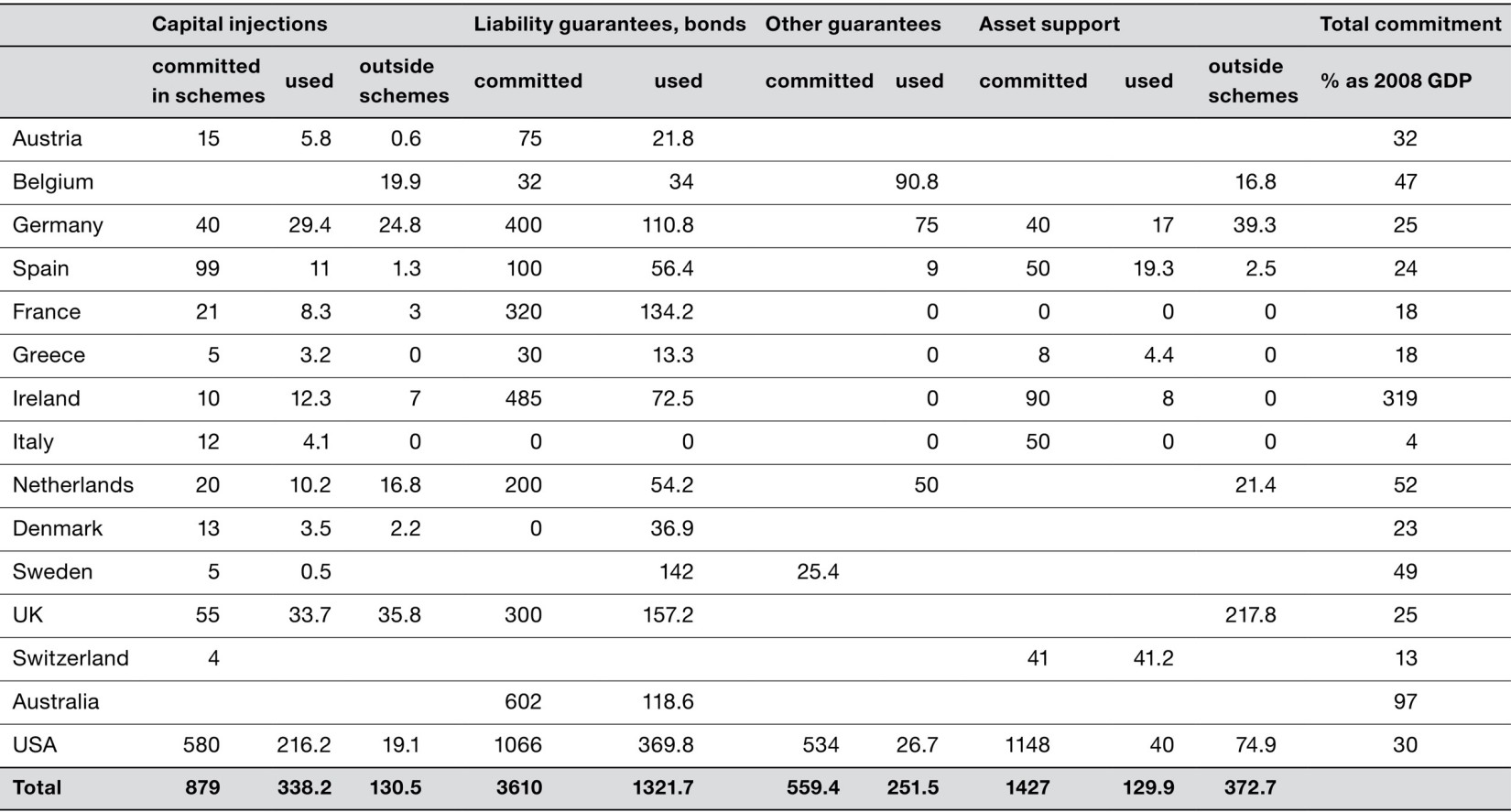
Source: Based on Stéphanie Stolz and Michael Wedow, “Extraordinary Measures in Extraordinary Times: Public Measures in Support of the Financial Sector in the EU and the United States,” Bundesbank Series 1 Discussion Paper 13, 2010.
Out of this trial of strength the United States emerged as the one nation-state with the capacity not only to backstop the biggest financial sector in the world but also to impose a comprehensive solution. Not for nothing, America’s crisis fighters liked to speak in military terms, about “big bazookas” and “shock and awe.” Geithner went furthest in this respect. For inspiration he invoked the war-fighting doctrine developed in the aftermath of the Vietnam debacle by America’s chairman of the Joint Chiefs, Colin Powell: Strike with massive force and plan a clear route out. 4 It was an analogy that had first been invoked by Larry Summers at the time of the Mexico financial crisis in 1994. Now it became Geithner’s mantra. For him, the “Powell Doctrine applied to international finance” meant “the overwhelming use of force, with a clear strategy for resolution.” As Geithner insisted, “There is more risk and greater cost in gradualism than in aggressive action.” For Geithner and his cohorts it was clear that swift and decisive action paid dividends. Compared with the disastrous performance of the European economy, the United States was set back on track. 5 The leadership of American finance renewed itself. Even when viewed narrowly in accounting terms, many of the Treasury and Fed support programs made a profit for the American taxpayer. 6 The benefits of preventing a second Great Depression were vast.
By contrast with the European experience it is not hard to see how this self-congratulatory American narrative gained purchase. But its economic merits are not so obvious as its proponents presume. And it offered no comfort to the advocates of laissez-faire. Gone were the days when economic policy was about shrinking the state to set free the spontaneous order of market liberty. No longer did wisdom lie in devising predictable rules to curtail the arbitrary discretion of policy makers. Economic policy modeled on warfare was a matter of will, vigilance, tactical nous and firepower. And despite the populist appeal of the military rhetoric, there was a political price to pay. 7 The crisis fighting of 2008–2009 scrambled American politics. The Bush administration lost the backing of much of the congressional Republican Party. The crisis snapped the fragile bond between the GOP’s managerial, big-business elite and its right-wing mass base. As the popular wing of the party, backed by maverick oligarch donors, moved increasingly toward indignant antiestablishment opposition, mainline conservatives like Bernanke and Paulson were left to complain that it was not they who left the party, but the party that left them. 8 The Bush administration’s crisis-fighting effort was carried by the Democratic Party’s majorities in Congress. That contradiction would be resolved by Barack Obama’s election victory on November 4, 2008, only weeks after the crisis reached its peak. But the fracture of the American Right would in due course have profound consequences both for America and for the wider world.
II
In 2007 the best hope of the authorities was still that the private sector might rescue itself. J.P. Morgan’s consortium of 1907 was the stuff of Wall Street legend. In late October 2007, with the help of the US Treasury, the three largest banks—Citigroup, Bank of America and JPMorgan Chase—agreed to collaborate in creating a so-called Master Liquidity Enhancement Conduit that would help to stabilize the market for mortgage-backed securities and revive the ABCP market. 9 Not surprisingly, Treasury Secretary Paulson loved the idea. But any private sector arrangement was vulnerable to problems of collective action. Though bankers detested government intervention, they also wanted to avoid the stigma of joining a cartel of ailing firms, especially one including Citigroup, whose balance sheet was particularly toxic. 10 When major global competitor HSBC announced that it would absorb the full amount of $45 billion in losses suffered by its SIVs onto its balance sheets, its largest American rivals could not be seen to be settling for a second-best option. 11 By December 2007 the private bad bank plan had collapsed.
When collective action failed, the state could step in, acting as a matchmaker in chief, brokering takeover deals between individual banks. In Britain in 2008, the Scottish conglomerate HBOS would be sold off to Lloyds Bank with encouragement from Downing Street. 12 Germany’s number two bank, Dresdner, would be amalgamated with Commerzbank, the number three. 13 As both deals would reveal, the risk was that the bank that was in trouble would pull its rescuer down with it. In the United States the amalgamations began in earnest with Bear Stearns, which came to the point of failure on the night of March 13–14, 2008. 14 If it had unloaded its portfolio of $200 billion in asset-backed securities and CDO at fire sale prices, the effect would have been catastrophic. It would have forced all the other banks to recognize crippling losses, spreading the panic. To the relief of the Treasury and the Fed, J.P. Morgan was interested in buying out Bear. Its hard-charging CEO, Jamie Dimon, was confident that his robust balance sheet put him in a position to safely pick over the carcass. But to finalize the deal, Dimon needed the right inducement. Under the emergency powers provided by section 13(3) of the Fed’s statutes, $30 billion in the most toxic assets were taken off Bear’s books by a SIV funded by the New York Fed. 15 Then, at five a.m. on the morning of March 14, with the repo markets closed to Bear, the New York Fed lent $12.9 billion to J.P. Morgan, which J.P. Morgan then lent to Bear. After that, the die was cast. J.P. Morgan initially agreed to pay the laughable price of $2 per share for what was left of Bear. This compared with a valuation of $159 per share only one year earlier. When Bear’s shareholders protested, the price was raised to $10 per share. Whether at $2 or $10, J.P. Morgan was confident it would make a profit.
The Fed’s actions forestalled what might have been a disruptive and chaotic bankruptcy. But the inducements that J.P. Morgan had extracted were debatable, to say the least. Paul Volcker, the legendary ex-chairman of the Fed, would characterize them as extending “to the very edge of its lawful and implied powers.” 16 Strict advocates of moral hazard logic would forever after argue that it was the Bear rescue that set up the Lehman disaster. 17 With one investment bank having been rescued, Lehman’s management felt safe. A solution for their problems would be found too. They could afford to take their time finding the best possible deal, an attitude that would cost them dearly.
Whether it was legal or wise, rescuing investment banks by means of obscure balance sheet transactions was a technical business that could be kept out of the political headlines. That changed with Fannie Mae and Freddie Mac. As the indispensable government-sponsored backdrop to the American housing market, they were at the center of one of the most formidable political networks in Washington. By the summer of 2008, with private securitization stalled, they were also responsible for backstopping 75 percent of new mortgages in the United States. The vast bulk of the Fannie Mae and Freddie Mac balance sheet consisted of top-quality conforming mortgages. If they had had conventional balance sheets, they ought to have been able to ride out the storm. The problem was they did not. In June 2008 Fannie Mae and Freddie Mac held MBS valued at $1.8 trillion and guaranteed another $3.7 trillion on the basis of shareholder equity, which in the case of Fannie Mae came to only $41.2 billion, and in the case of Freddie Mac, to $12.9 billion. 18 It was a leverage ratio that would have made even the boldest investment banker blush. It was conceivable only because Fannie Mae and Freddie Mac were government-sponsored enterprises. In the summer of 2008 the meaning of that term was going to be put to the test. Allowing for only minimal losses, the capital of both Fannie Mae and Freddie Mac would be completely wiped out. If they folded they would take down the last remaining lenders in the mortgage market and put in doubt the credit of the United States. They would put in jeopardy a huge portfolio of securities widely held by foreign investors. In the summer of 2008 foreign investors held $800 billion in debt issued by the GSEs. Fannie Mae and Freddie Mac were, as the influential blogger Brad Setser quipped, “too Chinese to fail.” 19
Desperate to gain a grip on the situation, in the spring of 2008 Hank Paulson’s Treasury began to broker a deal between congressional Democrats and Republicans that would give the federal government the powers necessary to overhaul the mortgage giants. 20 But over the summer Congress dragged its heels. The Republicans were uncooperative and the Democrats insisted that if they were to carry the bill, it must include support for struggling home owners and the transfer of block grants to hard-hit states to buy up foreclosed properties. By mid-July the situation was becoming critical. Given the scale of the crisis and the opacity of the GSEs’ financial situation, the capital injection might need to be huge. 21 The Treasury favored an authorization limited only by the federal government’s borrowing ceiling, putting the full financial clout of the American state behind the GSE. As Paulson famously put it to the Senate Banking Committee, “[I]f you’ve got a squirt gun in your pocket, you may have to take it out. If you’ve got a bazooka, and people know you’ve got it, you may not have to take it out.” 22 Paulson’s request was meant to sound impressive, and his bazooka comment echoed around the world. The US Treasury secretary was desperate to reassure foreign bondholders. Beijing was increasingly alarmed. 23 In his memoirs, Paulson recorded: “I was talking to them [Chinese ministers and officials] regularly because I didn’t want them to dump the securities on the market and precipitate a bigger crisis. . . . And so when I went to Congress and asked for these emergency powers [to stabilize Fannie and Freddie], and I was getting the living daylights beaten out of me by our Congress publicly, I needed to call the Chinese regularly to explain to the People’s Bank of China, ‘listen this is our political system, this is political theatre, we will get this done.’ And I didn’t have quite that much certainty myself but I sure did everything I could to reassure them.” 24
The Chinese might be excused their confusion. The political theater being played in Washington, DC, was new and strange. A conservative, free-market administration led by businessmen was proposing unlimited state spending to nationalize a large part of the housing finance system. The Republican electorate was outraged by the thought of assisting undeserving mortgage borrowers and the New Deal machinery that had aided and abetted their fecklessness. But to Paulson the systemic imperative was obvious. And President Bush stood behind him. “It was a tremendous act of political courage,” Paulson gushed, “It was as if, in the last days of his administration, the president were suddenly switching sides, supporting Democrats and opposing Republicans on matters that went against the basic principles of his administration. But he was determined to do what was best for the country.” 25 Paulson was registering a basic rift within American conservatism. The right wing of the party could not be counted on to give support to measures that were unpopular and distasteful, but were clearly necessary to save “the system.” Paulson recognized that the authorization he was asking for was unprecedented. “I don’t know if any executive branch agency had ever before been given the authority to lend to or invest in an enterprise in an unlimited amount. All I could do was argue that the extraordinary and unpredictable nature of the situation warranted the authority in this case.” 26 He also knew that it was only the Democrats, the party with relatively less inhibition about expanding the scope of government, who were willing to go along with this logic of absolute and unlimited necessity, dictated not by a national security emergency but by a financial crisis.
Paulson’s extraordinary plenipotentiary authorization to rescue Fannie Mae and Freddie Mac passed Congress on July 26, with three quarters of House Republicans voting against. It was signed into law on July 30. The White House thought it best to forgo the usual festive Oval Office ceremony. There was no reason to goad the Republicans and no time to lose. With a team recruited from Morgan Stanley on a pro bono basis, the Treasury plunged into weeks of forensic investigation and negotiations with the GSEs’ failed regulators. The results were dispiriting. Both of the GSEs were insolvent. Liquidity support would not be enough. On Sunday, September 7, 2008, Fannie Mae and Freddie Mac were placed under conservatorship. It was nationalization in all but name. If necessary, the Treasury would replenish their capital to make up any gap between assets and liabilities up to an initial maximum of $100 billion each. The Fed provided credit lines and undertook to buy whatever MBS the ailing GSEs needed to offload. It wasn’t so much a bazooka as the nuclear option.
The crucial effect of this intervention was to reassure bondholders, especially those abroad, that Fannie Mae and Freddie Mac would not fail. Despite the machinations of Russia, the breakdown of America’s government-sponsored mortgage machine did not spill over into a global crisis. But the political fallout was dire and it had serious implications for the future course of the crisis. On the right wing of the Republican Party, fully mobilized for the hotly contested presidential election, the nationalization of Fannie Mae and Freddie Mac unleashed a firestorm. 27 The Treasury did its best to ward off allegations of cronyism by imposing a punitive dividend for the capital it contributed, wiping out the GSEs’ existing shareholders. The American Bankers Association rallied to the administration, calling on Republicans to support the rescue effort. But it was immediately countered by the conservative Club for Growth, a key right-wing lobby group funded by the Koch brothers. House leader John Boehner and former speaker Newt Gingrich spoke out against Paulson’s bailout. John McCain personally was thought to favor a rescue. But on August 29 he nominated the populist Alaskan governor Sarah Palin as his vice-presidential running mate. Palin did not have coherent views on the GSEs or the financial crisis. But her bluff persona fired up the passions of the Republican base. As the crisis deepened, the Bush administration was terrified that they might find themselves facing an insurgency from within their own party led by a presidential candidate on the warpath against bailouts. What made the Republican brush fire so worrying was that by early September it was clear that the rescue of Fannie Mae and Freddie Mac was only the first round, and that the next phase of the battle would be decided not in Washington but on Wall Street.
For months the Treasury had been anxiously watching as Lehman Brothers looked for a buyer. By the second week of September options were running out. Talks with a potential Korean suitor had stalled. In frantic negotiations hosted by Geithner’s New York Federal Reserve and personally overseen by Paulson, the search for a private sector solution failed. The culminating moment came on the weekend of September 13–14. What exactly happened in those forty-eight hours will remain forever a matter of controversy. What is beyond dispute is that Bank of America, the giant commercial bank that had been expected to act as the white knight for Lehman, bought Merrill Lynch instead.
Merrill was bigger than Lehman. It too was heavily exposed to the real estate bust. Like Lehman it was an investment bank that could not function without access to the repo market. After Lehman it would certainly have been the next to fail. 28 But unlike Lehman, Merrill’s management was nimble and saved its bank by pushing for direct talks with Bank of America. It was well known that Bank of America CEO Ken Lewis had long wanted to emulate Citigroup in integrating an investment bank with his commercial banking business. On the desperate weekend of September 13–14, 2008, Bank of America’s hundreds of billions of retail deposits guaranteed by the FDIC were one part of the financial system that was not running. That funding base gave Bank of America the platform to buy out Merrill Lynch. But on what terms? On the face of it Merrill was a prize. One of the biggest names on Wall Street, at the end of 2007 it was valued at $150 billion, with $1.02 trillion in assets and more than sixty thousand employees worldwide. But given the potential losses on its books and its precarious wholesale funding, what was Merrill worth in September 2008? In the event, under huge pressure from Paulson and Bernanke, Bank of America paid $50 billion, $29 per share, a third of what Merrill had recently been worth, but 40 percent more than its market valuation the previous week.
After Bank of America took Merrill, for Lehman, the last remaining hope was a transatlantic deal with the British bank Barclays, where the expat American Bob Diamond, formerly of Morgan Stanley and Credit Suisse, was calling the shots. But Prime Minister Gordon Brown and Chancellor Alistair Darling refused to loosen regulations to allow the takeover to go ahead without full shareholder approval and without commitments of support from the US Treasury. If Bank of America had chosen Merrill, what was wrong with Lehman? They told Paulson that London did not want to “import America’s cancer.” 29
The basic question is why the options for Lehman were so narrow? Why were the Fed and the Treasury unwilling to sweeten the Lehman deal in the way that they had J.P. Morgan’s takeover of Bear Stearns? 30 Why, following the failure of the private option, was some other kind of backstop not worked out, of the kind that they would provide so liberally in the weeks to come? Geithner, Paulson and Bernanke have all insisted that the question is otiose. The problem was not that the Treasury and the Fed lacked the will, but that they lacked the means. The Lehman collapse was not the result of a deliberate intention on the part of the authorities. “We hadn’t done it on purpose,” Geithner insisted. “We had run up against the limits of our authority and the fears of the British regulators.” 31 The Fed could not lend to Lehman, Bernanke maintains, because the Fed lends only against good collateral to solvent banks. 32 Lehman was insolvent and, due to the nature of its investment banking business, its lack of depositor base and alternative income streams, it lacked the collateral. But these are retrospective justifications. At the time Lehman’s failure was seen as the result of a deliberate decision, and a welcome one. On September 17, Democratic congressman Barney Frank declared in a hearing with Treasury officials that Monday, September 15, the day of Lehman’s failure, would long be celebrated as “Free Market Day.” 33 Frank was joking. But others were not. As one of Paulson’s assistants remarked, September 15 felt like a “good day at the Treasury.” They had let markets do their work. 34 A New York Times editorial declared that it was “oddly reassuring” that Lehman had been allowed to fail. 35 The Wall Street Journal congratulated Paulson on not blinking. “[T]he government had to draw a line somewhere.” 36 For Geithner at the New York Fed, this was no comfort: “We hadn’t chosen to draw a line. We had been powerless, not fearless. We had tried but failed to prevent a catastrophic default.” 37
On this interpretation of the crisis, Geithner would go on to base an entire program of state building. If in 2008 what had been missing were adequate state powers of intervention, the answer was to equip the Fed and the Treasury with the right tools. What Geithner could not admit is the possibility that “Hank and Ben” had, in fact, made a mistake. That they might have underestimated the severity of the fallout that Lehman’s failure would cause. Or that Paulson, as a Republican Treasury secretary, might, in fact, have been constrained by politics. But this is what subsequent forensic reconstruction suggests. The best available contemporary evidence, rather than the self-justifications that the actors fashioned for themselves after the catastrophic consequences of Lehman’s failure became apparent, suggests that the basic constraint on the Lehman rescue was Paulson’s refusal, from the outset, to consider another bailout. 38 British chancellor Alistair Darling was in frequent contact with New York throughout the critical weekend. His perspective is telling: “What was worrying was that it was becoming more evident that the US Treasury was reluctant to provide the financial support to make the deal work. I was not entirely surprised. . . . I didn’t think he had enough political capital to persuade the Republicans to nationalize another bank.” 39 It was a judgment that would be borne out two weeks later in the desperate battle to pass the Troubled Asset Relief Program (TARP). Though it was Paulson who took the lead in the Lehman talks in New York, from Washington Bernanke was fully in agreement. The Fed was notably uncooperative in the desperate efforts of Lehman’s management to buy time. Contrary to the impression created by Bernanke’s retrospective testimony, the Fed concertedly pushed Lehman toward bankruptcy. The argument made at the time was that ending uncertainty by means of bankruptcy would help to calm the markets. It is easy to say with hindsight, but it was a spectacular error of judgment.
The scale of that error became clear within hours as the shock wave from the Lehman failure impacted the American and the world economy. A day later, Paulson, Bernanke and Geithner had to face the question of what to do about the insurance giant AIG. 40 Here too their first impulse was to look for a private solution, with J.P. Morgan and Goldman Sachs leading “frenetic” discussions throughout Monday, September 15. But by seven p.m. any hope of a private rescue had evaporated. When the bailout team had reached a similar conclusion about Lehman twenty-four hours earlier, they had started preparing for bankruptcy. This time, the conclusion was the opposite. The financial markets would not withstand a second shock, and AIG’s level of interconnectedness through derivatives, repo and securities lending was even greater than that of Lehman. Letting AIG fail would, in the words of one Wall Street player, have been an “extinction-level” event. Instead, the Fed stepped in. As it had done with Bear Stearns, the Fed declared a section 13(3) emergency. The New York Fed would offer a secured credit facility of up to $85 billion. On the early afternoon of Tuesday, September 16, Fed security personnel rushed to the offices of AIG at 80 Pine Street in Lower Manhattan to gather up tens of billions of dollars of share certificates to serve as collateral. With the deeds to the world’s second-largest insurance company safely stashed in the vaults of the New York Fed, the first phase of the rescue was announced at 3:30 p.m. The Fed backstopped AIG’s credit default swap portfolio and its securities lending business. In exchange it would take stock in AIG and its subsidiaries that would give the US government a 79.9 percent equity stake in AIG’s global insurance business. Following the template established with the Fannie Mae and Freddie Mac nationalization, the deal inflicted a huge loss on AIG’s existing shareholders. The securities lending business was unwound, with the New York Fed purchasing from AIG its depreciated portfolio of MBS, enabling it to pay off its securities-lending counterparties. Most generous of all was the resolution of the CDS portfolio, which was accomplished by buying out the dangerous CDO on which AIG had written insurance. In effect, together with the collateral they had already claimed from AIG, the counterparties received payment at 100 percent of par on $62.2 billion in toxic mortgage-backed securities, the market value of which was closer to $27.2 billion. How little they would have been worth if AIG had been driven into bankruptcy is anyone’s guess. In any case, the subsidy to the counterparties and their clients clearly ran into the billions. Nor was it only the American financial system that benefited. In the course of the bailout, the Fed made sure to leave in place the insurance contracts that AIG had offered to European banks to provide “regulatory relief.” If they had been voided, the Americans estimated that the European banks would have faced calls for at least $16 billion in additional capital. “For fear of shouting ‘Fire!’ in a crowded theater,” the New York Fed later told Congress, it thought it best not even to mention this potential fallout from AIG’s crisis to European regulators.
III
If systemic stability was the goal, the kind of improvisations that had let Lehman fail and rescued AIG would not suffice. Having realized the scale of what they were up against, Bernanke and Paulson decided on September 17 that they must appeal to Congress for additional resources and the authority to use them. 41 Paulson knew it was a serious political risk. But they were now faced with the collapse of the entire Wall Street system, and the resources at their disposal to meet it were stretched to the limit. With money hemorrhaging out of the money market funds, the Treasury made the extraordinary decision on September 19 to offer a guarantee to any fund willing to pay an insurance fee, with the coverage to be backed by $50 billion in the Exchange Stabilization Fund. It was another improvisation. The Exchange Stabilization Fund was a creation of the New Deal era. It was established in 1934 to enable FDR’s Treasury to manage the exchange rate of the dollar after the abandonment of the gold standard. The fund was tiny compared with the scale of the trillion-dollar cash pools that were running in September 2008. But using it to back an insurance fund allowed it to be leveraged, and, more important, it was the only pot of money immediately available to the Treasury.
Meanwhile, Morgan Stanley and Goldman, the two investment banks left standing, were under immense funding pressure. One week after Lehman, they were rescued by the transparent expedient of redesignating them as commercial bank holding companies so that they might benefit from the protection of FDIC deposit insurance. But that only increased the burden on the FDIC, which had problems of its own. On September 25 the FDIC closed, broke up and sold off Washington Mutual. With $244 billion in mortgages on the balance sheet, WaMu was the largest commercial bank in American history to fail. J.P. Morgan promptly snapped up WaMu’s network of 2,239 retail branches and their deposits. 42 Nor was J.P. Morgan the only buyer that could see the prizes on offer in the giant fire sale. The Japanese bank Mitsubishi was poised to rescue Morgan Stanley by taking a 20 percent stake. Warren Buffett was about to prop up Goldman Sachs with a $5 billion capital injection. But both deals were contingent on the promise of a government backstop.
On September 20 the Treasury sent Congress a three-page legislative proposal asking for authority to spend up to $700 billion to stabilize securities markets. After the unlimited bailout authorization for the GSEs, the Treasury was now asking to spend the equivalent of the entire US defense budget on bad mortgage securities. But what was truly audacious about Paulson’s bill was the nature of the power he was asking for.
As the three crucial sentences of the bill read:
“The Secretary is authorized to purchase, and to make and fund commitments to purchase, on such terms and conditions as determined by the Secretary, mortgage-related assets from any financial institution having its headquarters in the United States. . . . The Secretary’s authority to purchase mortgage-related assets under this Act shall be limited to $700,000,000,000 outstanding at any one time. Decisions by the Secretary pursuant to the authority of this Act are non-reviewable and committed to agency discretion, and may not be reviewed by any court of law or any administrative agency.” 43
Paulson was asking for legal carte blanche.
Sketchy though it was, the proposal did not come out of the blue. Already in mid-April 2008 Paulson and a Treasury team had met with Bernanke and his staff to discuss what they called a “Break the Glass” memo outlining different options for emergency action. 44 They had considered large-scale guarantees for mortgages but had shied away because the liability was uncertain and potentially huge. Recapitalization was a more direct way of intervening in a bank. It was also efficient. Every dollar of bank capital was leveraged. So a dollar of government capital would support ten, twenty or thirty times as much in lending. But recapitalization was rejected on political grounds. Paulson had no desire to go down in history as the Treasury secretary who nationalized America’s banking system. And even if Paulson had been willing to pay the personal price, an open call for government recapitalization would never have passed Congress. The Republicans would have voted en bloc against nationalization, and without bipartisan cover the Democrats could not take the risk. 45 Already in the spring of 2008 the Treasury team thus decided that asset purchases were the path of least resistance. Buying debts did not involve ownership of banks. It did not raise issues of control or corporate governance. It could all be done through “the market.” An auction mechanism could be used to determine the price. It was also, admittedly, slow moving and expensive: $700 billion would cover barely more than half the outstanding subprime securitization. It wasn’t the perfect solution. But after Lehman, AIG and WaMu, the Treasury and the Fed were desperate. They needed something that might pass, and pass quickly.
Legislation that would ordinarily spend months in Congress needed to be passed in a matter of days. It was “hyperdrive blitzkrieg,” one lobbyist flippantly remarked, and it ran into trouble from the start. 46 As Geithner recorded in his memoirs: “Congressional leaders, who had seemed shell-shocked but willing to act after Hank and Ben warned them about a second depression . . . now just seemed angry.” “This proposal is stunning and unprecedented in its scope—and lack of detail, I might add,” said Senate Banking Committee chairman Chris Dodd. “I can only conclude that it is not just our economy that is at risk, but our Constitution as well.” 47 Dodd was a Democrat and at least willing to consider the possibility of action. Republicans were less measured. Jim Bunning of Kentucky described the proposal as “un-American financial socialism.” 48 Ted Poe, a Texas Republican, lambasted the plan: “New York City fat cats expect Joe Sixpack to buck up and pay for all of this nonsense. . . . Putting a financial gun to the head of every American is not the answer.” 49
By 2008 the Bush administration had a credibility issue when it came to emergency powers. “This is eerily similar to the rush to war in Iraq,” declared Representative. Mike McNulty, a Democrat from upstate New York. “We have been told repeatedly by this administration that the economy is fundamentally sound, and then all of the sudden they say the economy is going to collapse. That is unacceptable.” 50 Representative Pete Stark (D-CA) recalled how General Colin Powell, Bush’s secretary of state during the Iraq crisis, had “tried to scare us some years ago by saying if we didn’t vote for an ill-conceived war we’d see terrorists on the streets.” 51
In the Financial Times the economist and blogger Willem Buiter remarked that Paulson’s bill read “as though it was personally written by Dick Cheney, the prince of absolute executive authority, no checks and balances, no accountability, no recourse. No administration that brought us WMD in Iraq and the torture camps of Guantanamo Bay and Abu Ghraib should expect anything but hysterical giggles in response to such a request.” 52 The left-wing filmmaker Michael Moore weighed in with an incendiary e-mail to his mass following, entitled “The Rich Are Staging a Coup This Morning.” As the British journalist Paul Mason remarked, Paulson’s cack-handed proposal triggered an “accidental synergy between the right-wing populist opposition to the bailout and the left-liberal stance.” 53 History would prove it to be more than accidental.
In the midst of a presidential election it was explosive stuff. The Democratic candidate Barack Obama was not the problem. Not only was Obama backed by an economics team recruited by way of Robert Rubin and the Hamilton Project but his personal entourage included top bankers from UBS and Merrill Lynch. 54 The problem was John McCain. If McCain threw in his lot with the rebel Republicans, it would not only threaten the proposed legislation, it would force the Democratic presidential campaign into a devastatingly unpopular choice. House Republican leader John Boehner was not helpful. One third of the Republican congressional party was so ideologically opposed to any more bailouts that there was no hope of their support. Another third were in tight races and could not risk alienating their base. “You were being asked to choose between financial meltdown on the one hand and taxpayer bankruptcy and the road to socialism on the other and you were told do it in 24 hours,” Representative Jeb Hensarling of Texas, head of the conservative Republican Study Committee, indignantly told journalists. 55 Rising stars from the right wing of the Republican Party, like Paul Ryan of Wisconsin and Eric Cantor of Virginia, rallied around the resistance to the Bush administration’s “sellout.”
With the Republicans deeply divided, on September 24 McCain suspended his campaign and announced he was returning to Washington to take the lead in “fixing” the crisis. In the Treasury and the White House this caused panic. The markets were in a febrile mood. No one knew what McCain had in mind. What was certain was that it would stir up the Republican base. Startled at the news, Paulson screamed into his Motorola, demanding that the White House get a grip on “their” candidate. 56 Bernanke was so alarmed by the intensity of the political power play that he thought it better to withdraw to the safety of the Fed. In the end it took interventions by the White House chief of staff and major Republican donors, including Henry Kravis, the private equity billionaire, J.P. Morgan vice chair James Lee and John Thain of Merrill Lynch, to hold McCain in line. 57 But this left McCain tongue-tied, torn between the demands of “the system” and the populist groundswell that Palin was rallying to his cause. In the climactic meeting of the two candidates with the Bush administration on September 25, a meeting called at McCain’s request, the Republican candidate literally had nothing to say. 58
By Sunday, September 28, it seemed that Paulson and the congressional Democrats had a deal. Paulson agreed to caps on remuneration, a phased release of the TARP aid, multiple layers of oversight and a commitment that if the taxpayer made a loss, the cost would be covered by a tax on the financial industry. To speed TARP along it was tacked on to House Resolution 3997, also known as the Defenders of Freedom Tax Relief Act, providing tax breaks for members of the armed services, volunteer firefighters and peace corps members. On the morning of the vote, Monday, September 29, the president gave a press conference hailing agreement on the Paulson bill. Later that same day he was hosting embattled President Yushchenko of Ukraine. It was a moment to demonstrate that the leader of the free world was still firmly in charge. Markets needed all the help they could get. The news from Europe was terrible. On Wall Street trading was jittery. All eyes were on the screens, waiting for the news from Capitol Hill.
The scene in the House of Representatives was not reassuring. After a morning of polemical speeches, voting started after lunchtime. On screens around the world one could see the grinding process of congressional democracy in action. At 1:49 p.m., at the end of the normal voting period, the votes stood 228 to 205, against. The party leadership on both sides were staring into the abyss. To give the whips a chance to rally their troops, the voting period was extended and the TV cameras followed “as top lieutenants in both parties clutching lists of votes . . . clustered in the well and made unusual forays into what is normally enemy territory across the aisle.” 59 Five minutes later it was clear that they had come up short. The gavel came down minutes before two p.m. and the bill failed. Tellingly, of the 205 votes in favor of Hank Paulson’s TARP plan, 140 came from the Democrats and only 65 from the Republicans. Of those opposed, 133 were Republicans and 95 Democrats.
After the Fed and the Treasury had allowed Lehman to fail, America’s elected representatives had refused to back their own government’s emergency rescue effort. The reaction in the markets was one of terror. The Dow Jones index plummeted by 778 points, wiping $1.2 trillion off the value of American businesses in a matter of hours. It was the biggest loss on record, worse than on 9/11, when the index had plunged by 684 points. 60 The shock to global confidence was devastating. It produced a terrifying synchronization of the crisis on both sides of the Atlantic.
III
As the Americans were trying and failing to patch together the first TARP deal, in London Gordon Brown’s government was frantically trying to persuade Spain’s Santander to buy out the branch network of mortgage lender Bradford & Bingley and its £22 billion in deposits. That would leave the UK Treasury holding £41 billion in mortgages that no one wanted to touch. 61 When the UK had bailed out Northern Rock a year earlier, it had still seemed as though it might be an isolated incident. Now it was clear that the entire British financial system was at stake. It was lethally dependent on the wholesale funding market and that was shutting down.
The Fragile UK Banking System: Mortgage Exposure and Sources of Funding (figures are % of assets/liabilities)
|
Mortgage |
Deposits |
Wholesale |
Equity |
|
|
Abbey National |
53 |
34 |
21 |
1.7 |
|
Alliance & Leicester |
55 |
45 |
52 |
3.0 |
|
Barclays |
6 |
26 |
19 |
2.5 |
|
Bradford & Bingley |
62 |
51 |
44 |
3.2 |
|
Halifax Bank of Scotland |
37 |
38 |
36 |
3.6 |
|
HSBC |
4 |
48 |
17 |
6.2 |
|
Lloyds TSB |
28 |
42 |
27 |
3.4 |
|
Northern Rock |
77 |
27 |
68 |
3.1 |
|
Royal Bank of Scotland |
8 |
43 |
24 |
4.8 |
|
Standard Chartered |
17 |
58 |
20 |
7.1 |
|
Average |
34.7 |
41.2 |
32.8 |
3.86 |
Source: Tanju Yorulmazer, “Case Studies on Disruptions During the Crisis,” Economic Policy Review 20, no. 1 (February 2014). Available at SSRN: https://ssrn.com/abstract=2403923 .
The fear was that panic would soon spread from specialized mortgage lenders like Northern Rock to bigger banks like HBOS and from there to the commercial bank RBS, whose balance sheet, on paper at least, had recently ranked as the largest of any bank in the world. On the Continent, the Belgian-Dutch-Luxembourgeois giant Fortis was on the point of being shut down. Its balance sheet matched that of Lehman. 62 The French government was struggling to keep the Franco-Belgian lender Dexia alive. Angela Merkel and her finance minister, Peer Steinbrück, were in knife-edge negotiations over Hypo Real Estate, which was being dragged down with Depfa, its adventurous Dublin affiliate. 63 Each rescue involved a combination of writing down losses, recapitalizing with public money, guaranteeing private borrowing, deal making with other banks and emergency liquidity from the central bank.
The Europeans were putting out one fire after another, bank by bank. But on the night of September 29, with the failure of TARP roiling the markets, Dublin cracked. 64 The three main Irish banks—Anglo Irish Bank, Bank of Ireland and Allied Irish Bank—were all on the brink of collapse. 65 The balance sheets of the banks registered in Ireland came to 700 percent of the country’s GDP. The Irish state did not have the financial resources to handle a general bank run. After a panic-stricken night of discussion, early in the morning of September 30 the Dublin government announced that for fear of dying it would commit suicide. As Europe turned on the morning news it learned that the Irish government was fully guaranteeing not just the deposits but all the liabilities of six major Irish banks for a period of two years. No other government had been advised in advance, nor had the ECB, nor had the Irish taxpayers. 66 It stopped the run, but it left Ireland, with a population half the size of New York City, guaranteeing 440 billion euros in bank liabilities. The losses the banks incurred would bankrupt the Irish state. They would become the telltale link connecting the banking crisis of 2008 to the eurozone sovereign debt crises of 2010. But that was music of the future. The issue on September 30 was the immediate impact on the rest of the world. If Ireland was offering a safe haven, would the run now extend to the rest of Europe?
Given how tightly the Irish banks were integrated with the British financial system, it was in London that the pressure was most acute. The UK was forced immediately to raise its deposit insurance limit. London and Paris were conferring urgently, as were the Dutch. The Germans were less cooperative. When the UK Treasury tried to reach Berlin to discuss a common European response, they could not get the German finance minister, Steinbrück, to pick up the phone. So anxious did Chancellor Darling become that he resorted to calling on the foreign office to find out whether the British embassy in Berlin could make contact with the German government. 67 And Berlin was not merely evasive. In the last days of September the Dutch government, reeling from the experience of bailing out Fortis, made a bold proposal. 68 The European states should all establish bank rescue funds on a common basis, each amounting to 3 percent of GDP. In total the fund would come to 300 billion euros. The French government was enthusiastic. To address the crisis Sarkozy invited the G4—France, Germany, Italy and the UK—to Paris. Ahead of the meeting French finance minister Christine Lagarde spoke to the German business daily Handelsblatt about the need for joint measures. 69 After the fraught transnational negotiations to rescue Dexia and Fortis, she was seriously concerned about the ability of small countries to cope with the crisis. “What would happen if a little European Union state confronted a bank collapse?” she asked rhetorically. “Maybe the government would not have the means to save the institution in question. So the question arises of a solution at the European level.” 70 The Italians liked the idea. 71 So too did the influential head of Deutsche Bank, Josef Ackermann. 72 Europe needed something on the scale that Paulson was asking for in the United States. Suddenly, Berlin sprang to life. There must be no talk of joint bailouts, Steinbrück announced. Merkel let it be known that she would not attend the summit in Paris if it was labeled a crisis meeting. As if to bind herself, the chancellor gave an interview to the popular tabloid Bild-Zeitung , soon to become notorious for its nationalist coverage of the crisis, denouncing any blank check for bankers. 73 And Berlin could count on support from Frankfurt. Jean-Claude Trichet of the ECB told journalists that a common European solution was inappropriate because the eurozone wasn’t a fiscal union. Likewise, Jean-Claude Juncker, prime minister of Luxembourg and long-serving chair of the Eurogroup, told German radio: “I see no reason why we should mount a US-style programme in Europe.” The crisis came from the United States. It was deeper there. Europe could get by with national solutions.
Sarkozy retreated, saving face by dismissing the idea as an unauthorized personal initiative on Lagarde’s part. But the French and the Dutch were right. Within twelve months, precisely the scenario that Lagarde had sketched for Handelsblatt would come to haunt the eurozone. Crippled banks and ailing government borrowers would pull one another down. But prescient though the French might have been, nothing could be done without Berlin. On October 4 Sarkozy, Merkel, Brown and Berlusconi convened in Paris. The result was disappointing. Gordon Brown came away impressed by the sense that the Europeans thought the crisis to be an American problem. 74 As one disillusioned British official remarked, the Europeans “didn’t see it coming. They didn’t understand the economics. They didn’t understand how collective action could work.” 75 Sarkozy commented resignedly, “If we cannot cobble together a European solution then it will be a debacle. . . . But it will not be my debacle; it will be Angela’s. You know what she said to me? ‘Chacun sa merde!’ (To each his own shit!).” According to the German side, the chancellor’s language had been less vulgar. “Merkel had quoted a proverb taken from . . . Johann Wolfgang Goethe: ‘Ein jeder kehre vor seiner Tür, und rein ist jedes Stadtquartier’ (Everyone should sweep in front of his door and every city quarter will be clean).” 76
Why were the Germans so resistant? After all, Germany had its fair share of ailing banks that might have benefited from a common fund. But the hard truth was that German taxpayers did not want to pay for other people’s bailouts, inside Germany or out. In a broader sense, the question of national versus federal solutions was for Merkel not just a matter of euros and cents. Since 2005 she had been toiling amid the wreckage of Europe’s failed effort to give itself a constitution. The Lisbon Treaty, enshrining the grand retreat to a nation-state–based vision of the EU, had been signed only in December 2007. In June 2008 it had suffered a serious setback when it was rejected by a referendum in Ireland. As the financial crisis hit, the Lisbon framework was undergoing emergency surgery. A case in the German constitutional court was pending. With the basic political frame of the EU in flux, Berlin was not going to support a huge increase in the powers of the European Commission to enable a bank bailout. 77 Whatever solution was found would be based on intergovernmental agreement, not enhanced federal powers.
The most that the summit on October 4 could agree on was a statement calling for coordinated action, rebuking Ireland for its unilateral action the previous week. All the more shocking was what happened next. As the European heads of government made their way home from Paris, the news broke that the rescue of Hypo Real Estate had broken down. Depfa’s condition was worse than had been realized. An expert team dispatched by Deutsche Bank to Dublin had found that Hypo would need to come up not with 35 billion but with 50 billion euros to fill the gap at Depfa. The banks that Merkel and Steinbrück had enlisted in the bailout to support Hypo immediately reneged. As one German banker later put it to the investigative inquiry of the Bundestag, if Lehman’s failure had been a tsunami, then the bankruptcy of Hypo Real Estate would have been Armageddon for the German economy. Axel Weber, the head of the Bundesbank, spoke of a nuclear meltdown (Kernschmelze). Somewhat melodramatically, Germany’s bank regulator, Jochen Sanio, invoked Apocalypse Now . 78 What really worried Berlin were rumors that German savers were panicking. As cash withdrawals spiked, the Bundesbank registered unprecedented demand for large-denomination euro notes. Abruptly, less than twenty-four hours after returning from Paris, Merkel decided that she must make a statement. It was all Steinbrück could do to persuade her that she should not do it entirely alone. 79 On the afternoon of Sunday, October 5, Merkel and Steinbrück went before the TV cameras. They didn’t have a legislative mandate from the Bundestag. They were deliberately vague about the details. But the leaders of the two political parties that had ruled Germany since 1949 jointly declared that all savings deposits were safe.
This was directed at a German audience. But it had far wider implications. Germany was not Ireland. Even on the most restrictive definition, Merkel and Steinbrück had given a guarantee in the order of at least a trillion euros. Was Germany positioning itself to take advantage of a global bank run? Berlin gave neither London nor Washington prior warning. Within hours of the Merkel-Steinbrück performance, Prime Minister Brown convened an emergency meeting in Downing Street to consider London’s response. British officials “tried frantically to reach the Germans,” but once again Berlin wasn’t answering the phone. 80 In the absence of a clear European policy, smaller countries with big banks, such as Denmark, were forced to make unilateral decisions and to extend guarantees of their own. In Washington, Paulson’s team was also scrambling to establish what Merkel had in mind. Was it a “moral guarantee,” or the kind of binding two-year obligation that Ireland had entered into? It felt as though the US authorities were losing their grip on the situation. “[T]his is going to move quick and force us to do some things we may or may not want to do,” Paulson told his staff. 81 If Germany felt it necessary to issue a guarantee, where was America’s guarantee? On Monday, October 6, equity markets shed $2 trillion in value. With the finance ministers of the world converging on Washington for the autumn meetings of the IMF and the World Bank, the Americans decided to call an impromptu gathering of the G7 and G20 finance ministers at the US Treasury for October 10 and 11.
It was reassuring that the Treasury had realized the need for coordination. But a week was a very long time in a financial crisis and London could not wait. Gordon Brown’s government was facing the collapse of two giant banks—HBOS and RBS. Lloyds had agreed to buy out HBOS already on September 18. But the ailing mortgage lender was losing access to wholesale funding markets. 82 Its credit rating was dropping, and as panic spread, retail and corporate customers withdrew £30 billion. If it failed before the takeover was complete, it would be a catastrophe to dwarf Northern Rock. 83 Given its sheer size, RBS was even more dangerous. Since September 26, separate teams at the UK Treasury and Downing Street had been working on a bailout plan. To coordinate the crisis fighting, on October 3 Brown declared the establishment of a National Economic Council (NEC). The Daily Telegraph immediately dubbed it an “economic war cabinet,” an idea encouraged by the fact that it met in the underground, high-security conference room usually reserved for the government’s COBRA emergency-response committee. 84 Despite the uncomfortable and ominous surroundings, the meetings were productive. Whereas Paulson’s TARP model was based on the idea of buying bad assets, London brought together two ideas: guarantees and recapitalization. Like Ireland and Germany, London would offer guarantees. The Bank of England and the Treasury would underwrite debt issuance by the banks. But these guarantees would be conditional on recapitalization either through market investment or from public funds. The details were worked out in frantic meetings in Whitehall and road tested with focus groups of investment bankers who were sworn to secrecy. On the morning of October 7, while Chancellor Darling was in conference with Europe’s finance ministers trying to hammer out an agreed policy on deposit insurance, the share price of RBS collapsed and trading had to be suspended. The bank that had been touted as the largest in the world as recently as the spring of 2008 was hours away from failure. 85
The UK bank bailout package launched on October 8, 2008, after a night of cliff-edge negotiation with the leading banks, was an accomplished piece of political theater. Compared with Paulson’s struggles with Congress, Brown and Darling had the huge advantage of a solid majority in the House of Commons. Though Brown’s position at the head of the Labour Party was far from secure, he did not have to fear the parliamentary mutiny faced by President Bush. Altogether the commitments by the UK Treasury and the Bank of England matched or even exceeded those of TARP. Relative to the much smaller UK economy they were far larger.
The British scheme consisted of three parts:
The UK’s eight major banks were required to draw up plans for recapitalization. It was left up to them to decide whether they drew on a government fund of £50 billion (i.e., c. $75–85 billion), or raised resources privately.
£250 billion ($374–420 billion) would be used to guarantee new debt issued by participating banks.
A £200 billion ($300–350 billion) extension of the Bank of England’s Special Liquidity Scheme would allow banks to trade unsalable asset-backed securities for Treasurys.
The issue that had kept bankers and Treasury officials up all night was whether the £50 billion recapitalization should be forced through at a stroke, or whether this might spook the markets. Would it be better to proceed in stages? Perversely, the ailing banks resisted to the bitter end. None of them wanted to become a ward of the state. On the brink of failure they were still angling for whatever margin of advantage they could extract. In the end, £15 billion in government funds were put into RBS (a 57.9 percent stake) and £13 billion into Lloyds TSB-HBOS (a 43.4 percent stake). 86 Barclays and HSBC, Britain’s strongest banks, ostentatiously opted out of the schemes. They took neither the capital nor the guarantees. The UK government never mustered the authority or even made the attempt to impose recapitalization on either of them. HSBC, with its large base in Asia, was strong enough to raise funds through the markets. Barclays resorted to a highly irregular deal with a gulf sovereign wealth fund to which it lent the funds to recapitalize itself, a transaction for which it was later to pay a substantial fine and for which its senior management would face criminal charges. 87
Against the backdrop of the TARP debacle and the shambles in Europe, Gordon Brown’s scheme looked like a breakthrough. From New York, Paul Krugman lavished praise on Britain’s Labour government. Britain’s Social Democrats had figured out how to rescue financial capitalism. 88 It certainly helped that the Labour government was less averse to nationalization than Hank Paulson was. Less charitably it might be said that since the 1990s, New Labour, like the Democrats in the United States, had entered into an enthusiastic partnership with the City of London. It was, therefore, no coincidence that it was now Labour in Britain and the Democrats in the United States who were showing such energy in the struggle to fix the banking crisis. It was a monster they had helped to create. In any case, given the enormous burden that UK taxpayers were going to have to bear in supporting HBOS and RBS, it was hard to see that there was ever any alternative to nationalization.
The reaction of investors was not so enthusiastic as that of the pundits. When the G7 finance ministers assembled on Friday, October 10, global markets were in a state of panic. That afternoon in the famous wood-paneled cash room of the US Treasury, the mood was less than amicable. Italy’s finance minister, Giulio Tremonti, and Shōichi Nakagawa for Japan hammered home the damage that had been done by the US decision to let Lehman fail. Steinbrück repeated his line about the end of Anglo-American capitalism. 89 Jean-Claude Trichet indulged in a little theatrics by handing around a single graph showing the surge in the Libor-OIS spread since the Lehman failure. It was a benchmark of the funding pressure the European banks were under. The Americans, seconded by Mervyn King of the Bank of England, held their cool and insisted that though Lehman might be the proximate cause, it was hardly the fundamental source of all the world’s problems. To turn the discussion in a more positive direction they proposed a short five-point plan:
There would be no more failures of systematically important institutions.
There would be measures to assist recapitalization.
They would work to unfreeze liquidity in interbank markets.
They would provide adequate deposit insurance.
They would rebuild markets for securitized assets.
As a surprise treat for the finance ministers, President Bush made an impromptu appearance to add some easy charm to the discussions. Unfortunately, Bush’s remarks were not well calculated to reassure his guests. “You folks don’t need to worry,” he told them. “Hank’s got a handle on this. He’s going to freeze that liquidity.” 90 Given that TARP was still in limbo and that freezing liquidity was the last thing anyone needed, it can hardly have been comforting.
Back in Europe three days later, the agreements in Washington set the tone for a meeting of the eurozone heads of government in Paris. Sarkozy was the host, but the lead part belonged to Gordon Brown. Though the UK was not a eurozone member, the City of London was the financial capital of Europe and the British bank bailout plan was now being touted as the model. Politically, Sarkozy hoped to use Brown’s weight to push the Germans into a more cooperative attitude. 91 Though what emerged from the meeting on October 12 was a huge headline figure for bank guarantees, it was less than a European plan. There was no agreement on a common European response. The European Commission issued a permissive license to member states to issue debt guarantees as long as they were extended to all banks in the country, both domestic and foreign. There must be no discrimination. For the duration of the crisis European states were free to pump capital into the banks. The EU would act as an agency of oversight and try to minimize the extent to which the European common market would be torn apart. But it was not a crisis fighter in its own right. In total, the commission would review and approve twenty schemes for bank-debt guarantee and fifteen for recapitalizations. 92 On top of that came applications for support for individual banks—forty-four from Germany alone. But it was case by case, country by country. Merkel’s veto was decisive. It would be three long years before a common European bailout was back on the agenda.
On Monday, October 13, 2008, the UK nationalized Lloyds-HBOS and RBS. That same day Germany announced that it was putting up 400 billion euros in guarantees and 100 billion euros for recapitalization. France guaranteed 320 billion euros in medium-term bank debt and set up a 40 billion euro capitalization fund. Italy budgeted 40 billion euros for capitalization and “as much as necessary” in guarantees. In the Netherlands the guarantees came to 200 billion euros. Spain and Austria each put up 100 billion euros. 93 In proportion to GDP, the largest program was that in Ireland. But Belgium and the Netherlands also made huge commitments.
Europe’s national programs were defined by the circumstances of the banks and local politics. France’s large banks were in relatively good shape. Société Générale was fortunate that the so-called “Kerviel scandal” involving 50 billion euros in unauthorized positions and losses of almost 5 billion euros, unwound in January 2008, rather than six months later at the height of the crisis. 94 Société Générale managed to recapitalize and avoid a takeover, which might have ended as badly as the other shotgun weddings of the period. In addition, the French bank, which acted as a close partner of Goldman Sachs, was a particular beneficiary of the generous terms of the AIG bailout. But even if the other major French banks were robust, no one was exempt from the loss of confidence in the fall of 2008. On October 16 an emergency recapitalization and refinancing program was ramrodded through the French parliament. The urgency was commonplace. What was different in France was the response of the private sector. All of the major banks, led by BNP Paribas, agreed to take capital from the Société de Prise de Participation de l’État (SPPE). A second tranche followed in January 2009. Again, all the banks took the capital. Even more unusual was the refinancing scheme headed by the Société de Financement de l’Économie Française (SFEF). This entity was legally entitled to issue state-guaranteed bonds on behalf of banks up to a total of 265 billion euros, but 66 percent of its shares were subscribed by the six major French banks. Even HSBC France signed on. It was an elegant construction. With the French state holding only a minority stake, the SFEF’s liabilities were not counted toward the French public debt. At the same time, thanks to a special arrangement with the banking regulators, the SFEF was not required to meet Basel II capital rules, so the actual financial call on the banks was minimal. It was an efficient mechanism for restoring confidence made possible both by the relative lack of pressure on France’s biggest banks and close cooperation within France’s extraordinarily tight-knit elite. 95 Though they work in very different ways, business and government are every bit as interconnected in Paris as they are in New York and Washington, DC, enabling that rarest of things under conditions of market competition—an uncoerced agreement on collective action.
For sheer scale, only Germany’s program rivaled that in Britain. On October 17 the legislation establishing the Sonderfonds Finanzmarktstabilisierung was bounced through the Bundestag. 96 But as in Britain, any possibility of a general solution was spoiled by the power of the dominant player. With the regional Landesbanken ailing and Commerzbank struggling with the ill-advised takeover of Dresdner, Deutsche Bank saw the opportunity to put distance between itself and the rest. In an internal discussion, which was clearly intended to be leaked, CEO Josef Ackermann stigmatized the national bailout package. He would be ashamed, he let it be known, to see his bank requesting help from Berlin. As Barclays was to do in the UK, Deutsche preferred to rely on accounting tricks and investments from gulf state sovereign wealth funds to see it through the crisis. It too would later face legal action over its makeshift crisis management, but in the United States, not in Germany. 97 Meanwhile, Steinbrück was livid. Ackermann, he said, had paved the way “for a two-class society in the banking sector: into those that don’t need help and those that are at risk of relegation. This is dangerous, because the markets respond to it.” 98 It was the same problem that at the same moment was preoccupying Washington.
IV
After the setback in Congress on September 29 there was never any option but for the Treasury to make a second attempt to get the TARP legislation on the books. To get TARP passed, Paulson abandoned his demand for a blank check. The $700 billion in bailout funds were split into three tranches, a first of $250 billion, a second of $100 billion and $350 billion conditional on presidential request and congressional approval. Support for the banks would be balanced by tax breaks for the middle class and support for home owners. Section 109 of the act specifically empowered the Treasury secretary to “facilitate loan modifications to prevent avoidable foreclosures.” 99 Rather than immunity for the Treasury secretary, the law now provided for multiple overlapping layers of oversight. On October 3 TARP passed into law, carried by 74 percent of the Democratic votes in the House, but only 46 percent of the Republicans.
But by the first week of October, with events in the US markets and in Europe moving at a rapid pace, it was clear that TARP as originally conceived would not work. The Treasury faced the sheer impracticality of making markets for hundreds of billions of dollars’ worth of dubious assets at a time of market terror. Either it overpaid and sacrificed the taxpayer interest, or it drove a hard bargain and risked ruining the banks it was trying to help. Meanwhile, the British had tipped the discussion in favor of recapitalization. Rather than buying bad assets or guaranteeing more borrowing by the banks, government should inject share capital. Having obtained the funds from Congress for asset purchases, TARP would now be repurposed as a vehicle for injecting capital. At the same time, events in Ireland, Germany and the UK had changed the conversation about deposit insurance. According to Paulson, it was the risk of a shift in funds from the United States to Europe that led him and Bernanke to converge on the FDIC and to demand that its head, Sheila Bair, should offer even more comprehensive guarantees. 100
The new package was worked out between the Treasury, the Fed and the FDIC over the weekend of October 11–12, in the shadow of the G7/G20 meetings. It was presented to the stunned CEOs of America’s nine largest banks on the afternoon of Monday, October 13, just as the Europeans were rolling out their guarantees. 101 It was a take it or leave it offer. In rations fixed by Tim Geithner as president of the New York Fed, all nine major banks would be required to take slices of government capital. The shares would be preferred shares. The guaranteed dividends that the federal government would require were low, but would escalate after five years to give the banks an incentive to repay early. In exchange for accepting the capital injection, the banks would receive an FDIC guarantee on all business checking accounts and a guarantee on any new debt issued by the summer of 2009, up to a total of 125 percent of the debt maturing by the end of that year. The two were linked. No FDIC guarantee without government capital injection. Characteristically, Ben Bernanke sought to calm the fraying nerves in the room by appealing to everyone to consider their common interests. They were all in it together. “I don’t really understand why this needs to be confrontational,” he said soothingly. 102 The bankers stared at him in disbelief. The core of American financial capitalism was about to be partially nationalized.
Beyond the general sense of shock, the reactions came down to business logic. For the weakest in the group it was evidently a great deal, and Vikram Pandit of Citigroup said so. Given the state of his balance sheet, he couldn’t afford to be fussy. As he blurted out: “This is cheap capital.” Indeed, it was. The yield on Citigroup bonds that day was 22 percent. Paulson was asking for 5 percent. 103 A better-placed bank, like J.P. Morgan, could have got by without the TARP money. But Dimon understood the systemic logic and was among the first to sign, though he made his signature conditional on the rest of the group agreeing. It was California’s Wells Fargo that forced the government side to show its hand. When Wells objected to bailing out New York banks, Paulson coolly pointed out that Wells Fargo was sitting opposite its regulator. If they did not take the capital on offer that afternoon, they would be notified the following morning that they were undercapitalized. They would find themselves locked out of capital markets. When they came back to Paulson for help, the terms would be less attractive than those available that afternoon. The CEOs were then dismissed to call their boards. Within a matter of hours they had all agreed. Under the Capital Purchase Program facility, America’s nine largest banks took $125 billion in preferred stock from the government.
By comparison with the less encompassing effort in Europe, America’s recapitalization would come to look very impressive. And this judgment was reinforced by hindsight. America’s banks recovered from the crisis more quickly and comprehensively than their European counterparts. The meeting of October 13, 2008, it seems, is when the great transatlantic divergence began. 104 Advocates of strong executive branch prerogatives would later celebrate these actions as an essential assertion of sovereign authority. As it had done after 9/11, the American state had declared a state of exception and it had risen to the occasion. 105 But comforting as it may be to invoke sovereign power at moments of great uncertainty, this is a mystification of the events in September and October of 2008. The path from Lehman to TARP was less one of a sovereign state rising to a crisis than of a dysfunctional power struggle within the social and political network that tied Washington, DC, to Wall Street and to the European financial system beyond. In September political and commercial considerations had prevented a deal to save Lehman. It took a month of panic, political confusion and unprecedented financial turmoil to reach the point in mid-October when the barons of Wall Street would listen when Paulson thumped the table and declared that everyone must take the Treasury’s money. Even then, the executive branch had the power that it appeared to do in large part because J.P. Morgan swung behind the Treasury proposal. If this was an act of sovereignty, whose sovereignty was it? The American state’s, or that of the “new Wall Street”—the network personified by figures like Paulson and Geithner who tied the Treasury and the Fed to America’s globalized financial sector? 106
The Treasury’s act of power would have been more impressive if the injection of capital had been on onerous terms. But the opposite was the case. Vikram Pandit was right. The capital the Treasury was “forcing” on the banks was cheap, in every respect. As Phillip Swagel, assistant secretary for economic policy at the Treasury and a key architect of Paulson’s bailout, has described it: “[T]o ensure that the capital injection was widely and rapidly accepted, the terms had to be attractive, not punitive. . . . [T]his had to be the opposite of the ‘Sopranos’ or the ‘Godfather’—not an attempt to intimidate banks, but instead a deal so attractive that banks would be unwise to refuse it.” 107 The Treasury was far from being a difficult shareholder. Designating itself a “reluctant shareholder,” the US government abstained from claiming any voting rights. 108 Whereas in the UK and Germany the nationalization of Lloyds-HBOS, RBS, Hypo and Commerzbank was akin to bankruptcy restructuring and led to wholesale changes in management, America’s more comprehensive approach was necessarily light touch. 109 If robust J.P. Morgan was to participate in the scheme alongside ailing Citigroup, the terms could not be too onerous. The participants in TARP were allowed to go on paying dividends. The dividend to be paid on the capital provided from TARP was no more than 5 percent, half of what Goldman Sachs paid to Warren Buffett when he “rescued” them. The Treasury’s aim was to persuade all banks to participate en masse so as to ensure that state support was not taken as a signal of weakness that would attract the attention of short sellers. As Steinbrück had spelled out in his furious reaction to Deutsche Bank, at a moment of crisis, defense of the system involved both treating everyone as though they were healthy and the healthier banks being willing to play along. They had to recognize that in the event of a truly comprehensive crisis their cherished margin of superiority would not save them from disaster.
The result of the Treasury’s “sovereign” intervention was to extend a huge subsidy to the banks, increasing the value of their businesses by perhaps as much as $131 billion. 110 The biggest beneficiaries were the fragile investment banks and the sprawling colossus of Citigroup. Citigroup received $25 billion from the Treasury in exchange for securities valued at $15.5 billion and soon to be worth much less. In contrast, Wells Fargo, widely regarded as one of the banking industry’s stronger players, gave approximately $23.2 billion worth of securities for its $25 billion in government capital. 111 J.P. Morgan did not need the money, and by agreeing to go along with the government’s efforts to stop the run, Dimon passed up the opportunity to predate any more of his weaker competitors. For critics of the bailout, like Sheila Bair of the FDIC, it seemed that the entire process was a smoke screen put up to hide a bailout of Citigroup. 112 The Clinton-era network was still at work. Citi was not just too big to fail. It was too well connected. Whatever one thinks of this interpretation, it is undeniable that as soon as the extreme panic of early October had passed, the pretense of equal treatment was dropped.
The October stabilization was not enough for Citigroup. In November it disclosed huge losses and announced fifty-two thousand layoffs. By Friday, November 21, 2008, Citi’s market valuation was $20.5 billion, down from $250 billion in 2006. As fear spread, the death knell sounded. Citi was losing access to repo markets. The end, it seemed, was nigh. Given Citi’s immense size and entanglement in global markets, the consequences did not bear contemplating. In an urgent series of negotiations culminating with “Citi weekend” on November 22–23, another deal was patched together. A second capital injection of $20 billion reinforced Citi’s balance sheet while a so-called loss protection plan protected it against losses on $306 billion in toxic assets. In exchange the government received $7 billion in preferred shares paying 8 percent. 113 Bank of America was struggling too and that put Merrill Lynch in jeopardy. As the takeover proceeded, the full scale of Merrill’s mortgage losses was becoming apparent and CEO Ken Lewis and his team at Bank of America were desperate to pull out of the deal that had saved the investment bank on September 14. No one wanted to go back to Lehman weekend. Under heavy pressure from Paulson and Bernanke, Lewis pressed on with the deal, withholding crucial information from Bank of America’s shareholders, but taking another $20 billion in government capital and a “loss-protection arrangement” on $118 billion of Merrill’s troubled assets. 114
The financial crisis was not yet contained. But at least in political terms, Wall Street was reassured. On November 4 Barack Obama won the presidency and the Democrats consolidated their grip on both the House and the Senate. American progressives celebrated a historic victory. Obama appeared as an almost messianic figure and he occupied not just the White House. He had the congressional majority necessary to actually change America. And in a remarkable historical twist, the election of the first African American president on the Democratic Party ticket was good news for Wall Street too. It was Obama and the Democrats who had provided the Bush administration with the political backing they needed for the extraordinary crisis-fighting measures of 2008. And they clearly intended to continue that line. On November 23, the same day that the Treasury announced the latest round of support for Citi, Obama’s team made public their nomination for Treasury secretary. The rumor mill had been churning for weeks. Perhaps not surprisingly given his long-standing connections to Obama, Rubin was on the short list, as was Larry Summers, his coarchitect of Clinton-era deregulation. Paul Volcker, Greenspan’s predecessor as Fed chair, godfather of disinflation in the Carter-Reagan era, was an Obama favorite. But he was too old. The others were too politically toxic. The man picked for the Treasury was none other than the hard-driving head of the New York Fed, Tim Geithner, a protégé of Summers and Rubin. Summers was made head of the National Economic Council while he waited to replace Bernanke as Fed chair. Rubin would serve as an éminence grise behind the scenes—a “Harry Hopkins” role, Rubin liked to call it—while another of his protégés and partners in the Hamilton Project, Peter Orszag, would take the role as director of the budget. The keeper of the lists in the transition team was Michael Froman, Rubin’s former chief of staff at the Treasury. Froman continued to draw a salary as Citigroup’s head of emerging markets strategy while he moonlighted for the Obama campaign. 115 In 2009 he joined the Obama administration as deputy assistant to the president and deputy national security adviser for international economic affairs. The only figure on the Obama economics team who did not belong to the Clinton-era “old boys” networks was Christina Romer, a “new Keynesian” economist from Berkeley and noted expert on the history of the Great Depression, who was appointed to be chair of the Council of Economic Advisers. 116 The market liked the news. As one investment adviser noted, “Geithner assures a smooth transition between the Bush administration and that of Obama, because he’s already co-managing what’s happening now.” 117
Indeed, even to talk in terms of a transition from the Bush administration to Obama is to exaggerate the break. Well before November 4, the baton had already passed. The political party that had demonstrated its willingness to mobilize the full resources of the US government to fight the financial crisis was the Democratic Party. The Republicans weren’t so much a partner in managing the crisis as a symptom of it. In the course of the crisis the GOP had shown itself to be less a party of government than a political vehicle through which conservative, white Americans expressed their alarm at the earthquakes shaking their world.
Chapter 8
“THE BIG THING”: GLOBAL LIQUIDITY
I n retrospect it can seem as though it was the decisions taken in the first weeks of October 2008 that decided the future course of events. The United States moved concertedly toward recapitalizing its banks. In Europe, proposals for a common approach were vetoed by Berlin. From there the crisis unfolded as a series of national struggles that after 2010 became once again entwined in the form of the eurozone crisis. In the end Europe could not escape a common solution, but it would take years of economic uncertainty and distress before it arrived at that point. As the eurozone crisis would reveal, the national approach insisted on by Berlin was fundamentally unfit for purpose. But by focusing attention on the European dimension of interdependence, that judgment in fact understates the case. The banks and the borrowers of Europe were indeed interdependent. But even more basic and far more pressing in the fall of 2008 was their dependence on the United States. The closure of interbank and wholesale funding markets created huge pressures in the dollar-funding markets all over the world, and it was in Europe that the pressure was most acute. This was a shortfall that even the strongest European states were powerless to address. That it did not result in a spectacular transatlantic crisis was decided not in Europe but in the United States, where the Fed, acting in the enlightened self-interest of the US financial system, acknowledged the compelling force of financial interconnectedness and acted on it. At a moment when Paulson and the Treasury were struggling with Congress to mobilize political support for a backstop for the American financial system, the Fed, without public consultation of any kind, made itself into a lender of last resort for the world. When the music in the private money markets stopped, the Fed took up the tune, providing a stopgap of liquidity that, all told, ran into trillions of dollars and was tailored to the needs of banks in the United States, Europe and Asia. It was historically unprecedented, spectacular in scale and almost entirely unheralded. It transformed what we imagine to be the relationship between financial systems and national currencies.
I
The wholesale funding stop had hit the European banks already in August 2007. It was no coincidence, therefore, that it was the ECB that led the way in providing 95 billion euros in liquidity to overnight interbank markets on August 9. 1 Trichet was not the central banker to take such dramatic action without due cause. 2 By the autumn of 2008 both the ECB and the Bank of England were pumping liquidity on a huge scale. This did not involve parliamentary votes or unusual long-term capital investments. These were not bailouts but money market transactions, of the type that central banks routinely conduct to tighten and ease financial conditions, but now on a scale never seen before. As they lent cash or cash equivalents against collateral—good and bad—the balance sheets of all the major central banks began to expand. Potentially, at least, this could be done without limit within a closed national economy, or a large currency zone like that of the euro or the dollar. But what such operations could not conjure up was liquidity in foreign currencies. The Bank of England supplied sterling, the ECB euros. This domestic currency constraint was a crucial limit on the power of central bank operations and particularly so in 2008, because what the European banks desperately needed were dollars. It was into this breach that the Fed stepped with a program of liquidity provision that matched the global reach of the offshore dollar banking system.
Starting from a conventional trade-based view of international economics, it is not easy to see how a shortage of dollars could have been so threatening to Europe. In September 2008 the eurozone as a whole was running a trade surplus with the United States. Germany, in particular, was a champion exporter. Surely, if European banks needed dollars they could buy or borrow them from global exporters like Audi, VW and Mercedes-Benz. But this is where the disparity between the trade-based view of the economy and global financialization becomes starkly evident. In 2007 Germany’s exporters earned a trade surplus with the United States of roughly $5 billion per month. According to calculations by economists at the Bank of International Settlements, what the European banks needed was not $5 billion, or even $10 billion. Prior to the crisis they had funded their dollar operations with c. $1 trillion in commitments from US money market funds. On top of that they had borrowed $432 billion in the interbank market, $315 billion on the foreign exchange swap markets and $386 billion in short-term funding from those monetary authorities that were managing dollar cash pools. In total this added to more than $2 trillion. 3 The precise figure depended on how much of Europe’s gigantic bank balance sheet needed to be refinanced and how quickly.
What the 2008 crisis exposed was a dangerous imbalance in the business model of the European banks. As the American money markets shut down, all the European banks were scrambling for dollar funding. They tried to borrow from one another, which led to a painful surge in short-term funding costs as measured by the so-called Libor-OIS spread. 4 At the same time, the market for currency swaps was becoming dangerously congested, with Europeans bidding for dollar credits and ever fewer counterparties willing to take the other side of the trade. The cross-currency basis swap spread, which measures the interest rate spread that European banks were willing to pay to transfer euro or sterling funding into dollars, became strongly negative, indicating that it was extremely difficult to access dollar funding directly. When markets are functioning normally, this premium should be close to zero. In September 2008 it exceeded 200 basis points. When the FOMC met on September 16, the day after Lehman’s bankruptcy, with AIG teetering on the brink, its first item of business was the funding difficulties not of American but of European banks. As Bill Dudley of the New York Fed put it, “The big thing, where there has probably been the most severe stress in the market, is in dollar liquidity for foreign banks.” 5
Demand for Dollar Funding in the European Central Bank’s One-Month Auctions, December 17, 2007, to September 9, 2008
Source: Michael J. Fleming and Nicholas J. Klagge, “The Federal Reserve’s Foreign Exchange Swap Lines,” Current Issues in Economics and Finance 16, no. 4 (2010): 1.
Where could more dollar funding come from? One might think of central banks as a possible source of foreign exchange. But the dollar reserves of the European central banks were, by themselves, nowhere near large enough to meet the funding needs of the banks. 6 As the crisis worsened in the autumn of 2008 and the City of London convulsed, the Bank of England had as little as $10 billion on hand. 7 Throughout July, in the dollar auctions held regularly by the ECB, the bids exceeded the allotted sums by a factor of four. Little wonder that as the crisis deepened, the dollar was not falling in value, as standard macroeconomic models had predicted, but rising.
Lesser countries in this kind of predicament would be directed to the IMF. And in the fall of 2008, in close dialogue with the US Treasury and the Fed, the Fund was scrambling to devise a new genre of short-term liquidity facility to offer support for countries under acute funding pressure, which did not require a full IMF adjustment program. 8 But for the ECB or the Bank of England to have resorted to the IMF would in 2008 have been a disaster of historic proportions. In any case, the Fund was still defined by the basic rationale of the 1944 moment in which it was born and had the proportions to match. The IMF financed trade deficits and handled public debt crises. It was not in the business of filling gigantic private sector funding gaps. Its programs were denominated in tens of billions of dollars. It was not conceived for an age of trillion-dollar transnational banking.
In the autumn of 2008 the stark truth could no longer be escaped. As Tim Geithner of the New York Fed told the FOMC, the Europeans “ran a banking system that was allowed to get very, very big relative to GDP with huge currency mismatches and with no plans to meet the liquidity needs of their banks in dollars in the event that we face a storm like this.” 9 As Bernanke remarked with typical understatement, the dollar funding needs of Europe’s banking system were “a novel aspect of the current situation.” 10 It was a novel aspect with potentially drastic implications for the United States. If the Fed did not act, what threatened was a transatlantic balance sheet avalanche, with the Europeans running down their lending in the United States and selling off their dollar portfolios in a dangerous fire sale. It was to hold those portfolios of dollar-denominated assets in place that from the end of 2007 the Fed began to provide dollar liquidity in unprecedented abundance not only to the American but to the entire global financial system, and above all to Europe. In 2008 that flow of dollars grew to such proportions that it rendered any effort to write a separate history of the American and European crises anachronistic and profoundly misleading. 11
II
The Fed labeled its liquidity facilities in a bamboozling array of acronyms—among insiders the programs were known collectively as the “hobbits.” But when broken down by function, they mapped directly onto each of the key elements of the shadow banking system: the asset-backed commercial paper market, repo lending, the market for the mortgage-backed securities, currency swaps. As Fed economists observed, this was no longer conventional monetary policy in which the Fed manipulated interest rates to affect market behavior. Instead, the “Federal Reserve’s balance sheet expansion” was an “emergency replacement of lost private sector balance sheet capacity by the public sector.” 12 The Fed was inserting itself into the very mechanisms of the market-based banking model. The relationship between the state, as represented by the central bank, and the financial markets was nakedly revealed. The Fed was not just any branch of government. It was the bankers’ bank, and as the crisis intensified, the money market reorganized itself accordingly, taking on the shape of spokes with the Fed as the hub.
The scale of the Fed’s liquidity actions was so large and varied that it poses problems of accounting. How should one measure the Fed’s huge programs? As a stock at the point of maximum exposure? As a rate of flow over a given period during the crisis? Or should one simply compile the sum total of all lending from the beginning to the end of the crisis? The first measure will tend to minimize the image of intervention. The last measure will yield the largest figure. Each measure has its uses. 13 Thanks to records extracted from the Fed by legal action, we can compile all three numbers. 14
The point where distressed banks normally accessed central bank assistance was the discount window. At the discount window, the central bank bought and sold securities for cash. As a classic sign of stress, it was generally reserved for banks in dire need of emergency liquidity. The list of the largest customers at the discount window in 2008 included all the most prominent American casualties of the crisis—AIG, Lehman, Countrywide, Merrill Lynch, Citigroup. If anything, the stigma of using the discount window was less severe for non-American banks. So alongside the American strugglers, the Fed’s accounts also prominently featured two of the European basket cases: Franco-Belgian bank Dexia and the ill-fated Irish branch of Hypo Real Estate, Depfa. 15
As the ABCP market shut down in the autumn of 2007, the Fed realized that it needed to add new facilities. The first was the Term Auction Facility (TAF), which provided banks with access to short-term funds they could no longer acquire on the ABCP markets. Avoiding stigma was a key concern. A wide range of collateral, including ABS and CDO, were accepted, and the more banks participated, the more popular TAF became. Between December 2007 and March 2010 TAF expanded on a gigantic scale. The maximum outstanding balance in the spring of 2009 was almost $500 billion. If TAF loans of varying duration are converted to a common twenty-eight-day basis, the total sum loaned came to a staggering $6.18 trillion in twenty-eight-day loans. Hundreds of smaller American banks took advantage of TAF, but the biggest beneficiaries were the giant American and European banks with Bank of America, Barclays, Wells Fargo and the Bank of Scotland heading the list. Among the large borrowers the foreign share was well over 50 percent. 16
Following the Bear Stearns crisis, it was not just ABCP but the collateralized repo markets that shut down. In the summer of 2008 the Fed, therefore, stepped into the breach, setting itself up as a repo dealer of last resort, offering twenty-eight-day repo against prime collateral (single-tranche open market operations, or ST OMO). A total of $855 billion were lent by December 2008, of which over 70 percent was taken by foreign banks, with five European banks dominating the entire program. Just one bank, the Swiss giant Credit Suisse, was the recipient of 30 percent of the liquidity the Fed provided.
Because the collateral that was preferred by triparty repo markets was Treasurys, in the spring of 2008 the Fed instituted another program, the Term Securities Lending Facility, under which it lent out top-rated US Treasurys on twenty-eight-day terms in exchange for a variety of mortgage-backed securities, including private label. In total through this mechanism, $2 trillion in superior collateral was flushed into the system, with the program reaching its peak in the wake of Lehman in September and October 2008. Of the collateral provided by the Term Securities Lending Facility, 51 percent was lent to non-American banks, with RBS, Deutsche and Credit Suisse alone taking up more than $800 billion.
The largest backstop for the repo market that the Fed operated during the crisis was the Primary Dealer Credit Facility (PDCF). 17 It was introduced after the run on Bear Stearns under the emergency 13(3) powers of the Fed. The PDCF offered the key operators in the repo market discreet and unlimited access to overnight Fed liquidity in exchange for a wide range of collateral. Not surprisingly, the dealers took ample advantage. Total lending under PDCF came to $8.951 trillion. This was a huge amount, but the loans were made overnight and they should be seen in relation to the daily collateral posting in repo markets that peaked at $4.5 trillion in March 2008. The maximum amount outstanding on the PDCF was on September 26, 2008, at $146.57 billion. PDCF had the distinction of being the only large Fed liquidity program to have supported predominantly American banks. Merrill Lynch, Citigroup, Morgan Stanley and Bank of America were the heaviest users. But appearances were to a degree deceiving because the Fed allowed the London-based subsidiaries of Goldman Sachs, Morgan Stanley, Merrill Lynch and Citigroup to take advantage of the program. The Fed was thus remotely backstopping the City of London repo market.
When the crisis in the money market funds knocked the last remaining support out from under the commercial paper market, the Fed took the unprecedented decision not just to backstop banks and the mutual funds but to enter the lending business directly. It established its own SPV, the Commercial Paper Funding Facility, to buy top-quality short-term commercial paper. In total it provided $737 billion in funding through this facility, with a peak outstanding in January 2009 of $348 billion. The largest user of the system was the troubled Swiss giant UBS, which soaked up 10 percent of the Fed’s funds. Another 7.3 percent went into Dexia, and 5 percent each into Fortis and RBS. Some of the most severely stressed European banks received 27 percent of the entire program. In total, the European share cannot have been much less than 40 percent.
Alongside the mortgage market, the broader market for asset-backed securities had frozen up. To reenergize lending, on November 25, 2008, the Fed introduced the Term Asset-Backed Securities Loan Facility, which became the vehicle for the most mixed bag of lending sponsored by the Fed and the Treasury. It offered five-year nonrecourse loans to a select group of borrowers collateralized through the purchase of highly rated securitizations of consumer credit, such as auto loans, student loans, credit card loans and lending to small businesses for equipment and building construction. It was never the Fed’s largest program. Total lending came to $71.09 billion. But the program accommodated some of the most adventurous support actions undertaken by the Fed. The firms taking advantage were exclusively American, with Morgan Stanley, PIMCO and CalPERS in the lead.
Finally, in early 2009, the Fed began to move from emergency liquidity provision to what would subsequently become known as QE1—the buying up and holding on the Fed balance sheet of large quantities of mortgage-backed securities. For a central bank, buying securities was a conventional mechanism of monetary policy. But it would now be done on a far larger scale than ever before and with a wider array of assets. On top of the conventional purchase of Treasury securities, the Fed bought $1.85 trillion in GSE-backed mortgage-backed securities by July 2010. The busiest week of purchases was the third week of April 2009, and holdings (net of sales) peaked in June 2010 at $1.129 trillion. Crucially, what the Fed was doing was not just pumping liquidity into the system. It was also absorbing onto its balance sheet the maturity mismatch, which had done such damage in markets like ABCP. The Fed took the long-term asset in exchange for immediate liquidity.
Quantitative easing, or QE, is generally thought of as the quintessential “American” policy, the symbol of the Fed’s adventurousness. It would earn Bernanke regular scolding by conservative policy makers in Europe. But after what we have already said, it will come as no surprise that 52 percent of the mortgage-backed securities sold to the Fed under QE were sold by foreign banks, with Europeans far in the lead. Deutsche Bank and Credit Suisse were the two largest sellers, outdoing all their American rivals by a healthy margin. Barclays, UBS and Paribas came in eighth, ninth and tenth. Having kept open the basic institutions of transatlantic shadow banking during the most acute phase of the crisis in 2008, the Fed now worked hand in glove with the European megabanks to unwind the transatlantic balance sheet.
III
Not everyone in the network of Atlantic finance could take advantage of the facilities that the Fed offered to the top tier of international banks in New York. Nor did everyone have the kind of collateral the Fed demanded. To have lent to the most fragile European banks without adequate collateral would have exposed the Fed to serious risk. But to deny the weakest banks liquidity assistance was to court disaster. So from 2007 the Fed repurposed an instrument that was first developed in the age of Bretton Woods. To manage the fixed currency system in the 1960s the central banks had developed a system of so-called currency swap lines that allowed the Fed to lend dollars to the Bank of England against a reverse deposit of sterling in the accounts of the Fed. 18 Having gone out of use in the 1970s, the swap lines had been briefly revived in 2001 to deal with the aftermath of 9/11. In 2007 faced with the implosion of the transatlantic banking system, they were repurposed and expanded on a gigantic scale to meet the funding needs not of sovereign states but of Europe’s megabanks. As Geithner explained to his Fed colleagues:
“We have a bunch of U.S. affiliates of some of the weakest European institutions that have faced very substantial dollar funding needs and have come to us and asked for substantial ongoing access to liquidity. When they have a substantial amount of . . . collateral with substantial market value relative to the needs, we have been comfortable meeting those needs [above all through the TAF program discussed above]. When their needs have substantially exceeded or might potentially exceed the market value of their eligible collateral, then we have talked to the home central bank. We have said that, in effect, if you want us to be able to meet those needs and they have collateral in your market that is substantial relative to those needs, then the better way for us to do this is for the home country central bank to meet their dollar liquidity needs against the collateral there . . . and we provide the dollar’s’ [sic] worth of guarantees from the central bank.” 19
Having reached the limit of the dollars it could provide directly to Europe’s tottering banks, the Fed now lent to the ECB, the Bank of England, the National Bank of Switzerland and the central banks of Scandinavia. They then channeled the precious dollar liquidity to the European megabanks at one remove. 20 The Fed and the central banks it was supporting agreed on an exchange rate. The European central bank needing the dollars deposited the required amount of local currency in an account in the name of the Fed. The Fed credited the European central bank with the equivalent amount in dollars. The two sides agreed to reverse the trade at a future date at the agreed exchange rate. The terms were spelled out with a minimum of fuss in a contract running to no more than seven pages. 21 The Fed received an interest premium that ensured that the swap lines would be used only if market funding was not available. The European central banks passed that cost on to the banks that were the ultimate recipients of the dollars.
The initiative for the swap line program came from the Fed. In the aftermath of the disastrous Paribas announcement in August 2007, the Fed was seeing regular early-morning spikes in European dollar funding costs that were causing disruption when the US markets opened in the middle of the European trading day. Tellingly, the ECB’s initial reaction was skeptical. As one American journalist put it, the Fed’s proposal “ran up against a strong effort,” on the part of the ECB, “to pin the Great Panic on the United States.” The ECB’s reply to the Fed was blunt: “[I]t’s a dollar problem. It’s your problem.” 22 As Bernanke was later to remark, the ECB “had some difficulty coming to the realization that Europe would be under a great deal of stress and was not going to be decoupled from the United States.” 23 With regard to the swap lines, that attitude did not last much beyond 2007. The first agreements were reached with the ECB and the Swiss National Bank in December 2007. 24 As the crisis became critical in September 2008, the swap facilities were rapidly expanded to a total capacity of $620 billion. On October 13, 2008, as the Europeans rolled out their guarantee programs and Paulson, Bernanke and Geithner persuaded America’s bankers to take their dose of TARP capital, even that cap was lifted. Four central banks—the ECB, the Bank of England, the Bank of Japan and the Swiss National Bank—were given unlimited access to dollars.
The swap lines helped to reassure markets. But they also threw a shadow of doubt over those central banks that had not been so favored. The shutdown in the money market was affecting the entire financial system. Where were major emerging market central banks to get their dollars from? For a nation like South Korea to have approached the IMF was out of the question given live memories of the Asian financial crisis of 1997–1998. 25 So on October 29 the Fed’s favor was extended to four key emerging market central banks: Brazil, Korea, Mexico and Singapore. 26 All told, fourteen central banks would be included in the program. 27
The total amount outstanding on the network of dollar swap lines reached its peak in December 2008 at $580 billion. Briefly, the swaps touched 35 percent of the Fed’s balance sheet. But even these gigantic figures do not do justice to the scale of the program. The essence of the swap line was to provide easy access to short-term dollar funding. With the New York Fed and its counterparts across the world working on a hectic schedule, new dollar funding was flushed into the system on a daily basis. In a single week in late October 2008, as dollars previously sourced from American money markets hemorrhaged out of the global banking system, the Fed lent $850 billion through the swap lines. It was this circulation of funds that allowed the Bank of England, the ECB and the Swiss National Bank to meet huge demands for dollars without running down their exchange reserves to even more critical levels. But for the swap facilities, between September 2008 and May 2009, monthly demand for dollars at the auctions organized by the ECB would have wiped out its reserves several times over.
Running Low: Eurosystem Foreign Exchange Reserves and Foreign Currency Provided to Commercial Banks
|
US dollars provided to commercial banks by the ECB ($ billions) |
Swiss francs provided at auctions reported by the ECB ($ billions equivalent) |
Eurosystem foreign exchange reserves ($ billions) |
|
|
End of |
|||
|
Sep ’08 |
150.7 |
0 |
210.3 |
|
Oct ’08 |
271.2 |
17.4 |
210.2 |
|
Nov ’08 |
244.0 |
19.2 |
204.2 |
|
Dec ’08 |
265.7 |
25.8 |
202.0 |
|
Jan ’09 |
187.3 |
27.8 |
191.1 |
|
Feb ’09 |
144.5 |
32.5 |
186.4 |
|
Mar ’09 |
165.7 |
33.1 |
189.2 |
|
Apr ’09 |
130.1 |
33.0 |
187.9 |
|
May ’09 |
99.7 |
35.4 |
191.9 |
|
Jun ’09 |
59.9 |
29.9 |
192.5 |
|
Jul ’09 |
48.3 |
18.6 |
197.9 |
|
Aug ’09 |
46.1 |
15.4 |
197.8 |
|
Sep ’09 |
43.7 |
10.1 |
195.0 |
Source: William A. Allen and Richhild Moessner, “Central Bank Co-operation and International Liquidity in the Financial Crisis of 2008–9,” BIS Working Paper 310 (May 2010), table 12.2.
The absence of a euro-dollar or a sterling-dollar currency crisis was one of the remarkable features of 2008. It was no accident. It was the swap lines that did the trick. What the Fed had done for money markets, the central banks now did for the global provision of dollar bank funding. They absorbed the currency mismatch of the European bank balance sheets directly onto their own accounts. Compensating public action ensured that private imbalances did not spill over into a general crisis.
The scale of the compensating credit flow was staggering. By September 2011 total lending (and repayment) under the terms of the swap facility came to $10 trillion at varying lengths of maturity. Standardized to a twenty-eight-day term, the sum was equivalent to $4.45 trillion in one-month loans. On either measure, by far the largest beneficiary of the swap lines was the ECB. Every cent of this staggering flow of funds was repaid in full. Indeed, the Fed made profits of c. $4 billion on its swap lending in 2008–2009. But this sober accounting understates the drama of this innovation. Responding to the crisis in an improvised fashion, the Fed had reaffirmed the role of the dollar as the world’s reserve currency and established America’s central bank as the indispensable central node in the dollar network. Given the even vaster volume of daily transactions in global financial markets, it is not the sheer size of the effort that mattered. The Fed’s programs were decisive because they assured the key players in the global system—both central banks and large multinational banks—that if private funding were to become unexpectedly difficult, there was one actor in the system that would cover marginal imbalances with an unlimited supply of dollar liquidity. That precisely was the role of the global lender of last resort.
The Fed as Global Lender of Last Resort: Central Bank Liquidity Swap Lines, December 2007 to August 2010 (in $ billions)
|
Raw swap amount |
Standardized to 28-day swap |
|
|
ECB |
8,011 |
2,527 |
|
Bank of Japan |
387 |
727 |
|
Bank of England |
919 |
311 |
|
Swiss National Bank |
466 |
244 |
|
Sveriges Riksbank |
67 |
202 |
|
Bank of Korea |
41 |
124 |
|
Reserve Bank of Australia |
53 |
122 |
|
Danmarks Nationalbank |
73 |
95 |
|
Norges Bank |
30 |
68 |
|
Bank of Mexico |
10 |
30 |
|
Total |
10,057 |
4,450 |
Source: Federal Reserve.
IV
Prior to the crisis, the transatlantic offshore dollar system had lacked a manifest center of leadership. Indeed, it had developed “offshore” so as to avoid national regulation and control. After 2008 it was openly organized around the Fed and its liquidity provision. “In a way,” one European central banker remarked, “we became the thirteenth Federal Reserve district.” 28 But if that was the case, the American public was not informed about the extension of their country’s monetary territory. Not the least remarkable thing about the Fed’s crisis response was its politics, or rather the lack of explicit political legitimation. The emergency liquidity provision to the international economy by the Fed between 2007 and 2009 was shrouded in as much obscurity as possible. In July 2009, when Bernanke was challenged by campaigning Democratic congressman Alan Grayson of Florida to explain “who got” the swap line money, the chairman of the Fed could reply “I don’t know.” 29 The ultimate destination of the trillions of dollars that had flushed back and forth between the central banks of the global system was not under direct American oversight. There was little doubt, of course, that the Swiss National Bank channeled the dollars it received from the Fed to its ailing giants, UBS and Credit Suisse. 30 But from the point of view of the Fed, it was far better that the swap be done with a central bank than with the fragile banks themselves.
As Neil Irwin describes it, “[T]he scale of lending to foreign banks . . . was a closely guarded secret even by standards of the always secretive Fed. . . . During the panic, this information was so closely held—and had it been known publically, so potentially explosive—that only two people at each of the dozen reserve banks were allowed access to it.” 31 The Fed used every legal means at its disposal to prevent detailed information about its support programs to both domestic and foreign banks from leaking to the general public. The vociferous libertarian and gold standard advocate Congressman Ron Paul ran a vigorous campaign for Fed transparency, which Bernanke did his best to ward off. Only in June 2009 did the Fed begin publishing regular reports on the uptake of swap lines. The fuller records of the Fed’s emergency programs, on which this chapter is based, were not opened to the public until December 2010 and March 2011. They were produced as a result of the Dodd-Frank legislation of 2010 and a Freedom of Information suit brought by the Bloomberg news organization and contested by the Fed and the New York Clearing House Association, a banking lobby group, all the way to the Supreme Court. 32 In defense of its secrecy, the Fed argued that revealing the information demanded by Bloomberg would jeopardize its efforts to calm financial markets, because full disclosure would reveal which banks were most in need of its liquidity assistance. The courts ruled in favor of Bloomberg and the Fed grudgingly complied. The forced disclosure offered an unprecedented glimpse into the operations of the world’s key central bank at a moment of maximum stress. The data are a quantified ultrasound of the convulsions of the Atlantic financial system. No such records are available for either the ECB or the Bank of England. Beyond the generalities of “systemic stress and stability,” they reveal the significance of individual banks, the extent of the pressure that they were under and the scale of the relief the Fed provided.
Backing the Banks: Fed Liquidity Facilities and Their Users
Source: Federal Reserve and my own calculations.
At the top of the Fed’s list were Citigroup and Bank of America and the two highly stressed US investment banks, Merrill Lynch and Morgan Stanley, with their respective London operations. Then came a comprehensive list of the big European and American players in the global dollar banking business. Of the liquidity on one-month or three-month terms that the Fed provided to big banks, European banks took the majority. European banks and the London operations of the major US investment banks accounted for 23 percent even of the overnight primary dealer credit facility. When this support is added to the gigantic swap line facilities provided for the European central banks, the conclusion is inescapable. What the Fed was struggling to contain in 2008 were not two separate American and European crises but one gigantic storm in the dollar-based North Atlantic financial system.
These data are explosive not only in revealing what was required by the Fed to keep a globalized financial system on the rails. They are remarkable also for the light that they shed on the politics of the bailouts in Europe. In Europe, the bullish CEOs of Deutsche Bank and Barclays claimed exceptional status because they avoided taking aid from their national governments. What the Fed data reveal is the hollowness of those boasts. The banks might have avoided state-sponsored recapitalization, but every major bank in the entire world was taking liquidity assistance on a grand scale from its local central bank, and either directly or indirectly by way of the swap lines from the Fed. Using the Fed’s records we can track the liquidity support provided to a bank like Barclays on a daily basis, revealing a first hump of Fed borrowing during the Bear Stearns crisis and a second in the aftermath of Lehman.
The anatomy of the Fed’s hidden liquidity support measures also casts in a rather different light the widespread discussion in 2008 about the future of the dollar system. Not surprisingly, in 2008 the United States faced a global chorus of criticism. Advocates of reform argued that at the root of global financial instability was the overreliance on the dollar as a reserve currency. This conferred on America an exorbitant privilege, which it exploited irresponsibly, running up deficits and borrowing abroad. In 2009 the head of China’s central bank and a special commission of the United Nations would advance proposals for a new global currency system. 33 The Russians liked the idea, and so too did the West Europeans. 34 In September, Peer Steinbrück told journalists, “When we look back 10 years from now, we will see 2008 as a fundamental rupture. I am not saying the dollar will lose its reserve currency status, but it will become relative.” 35 Two months later, President Sarkozy declared ahead of the G20 summit, “I am leaving tomorrow for Washington to explain that the dollar—which after the Second World War under Bretton Woods was the only currency in the world—can no longer claim to be the only currency in the world. What was true in 1945 cannot be true today.” 36
Clearly, the dollar-based financial system had experienced an existential crisis. For avowed skeptics and critics of American power it was an unmissable opportunity to score points against Anglo-Saxon finance. But given the extraordinarily heavy dependence of both individual banks, such as Deutsche and Paribas, on Fed support and the huge swap line facility provided to the ECB, it is hard to see how either Steinbrück or Sarkozy could have been more out of touch with reality. By the early twenty-first century, the dollar’s dominance did not rest on the Bretton Woods Agreement of 1944 or the institutions, like the IMF, that issued from it. The foundation of the global dollar was the private banking and financial market network, materialized in the Wall Street–City of London nexus. This was a cocreation of American and European finance, deliberately erected beyond state control. What happened in the fall of 2008 was not the relativization of the dollar, but the reverse, a dramatic reassertion of the pivotal role of America’s central bank. Far from withering away, the Fed’s response gave an entirely new dimension to the global dollar.
Steinbrück and Sarkozy may perhaps be forgiven for failing to recognize the significance of the moment, because the Fed had acted without fanfare and without seeking public legitimacy either at home or abroad. The sporadic global debate about alternatives to the dollar was the price that the Fed paid for keeping its stabilization campaign below the radar. On Capitol Hill, while controversy swirled around TARP, there was silence about the Fed’s gigantic global liquidity effort. As one senior New York Fed official remarked, it was as if a “guardian angel was watching over us.” 37 If some members of Congress understood what was going on, they thought better of discussing the Fed’s actions openly. The reality of global financial policy disappeared in a “spiral of silence,” in which it suited both the Fed and its collaborators to bury the reality of massive and explicitly hierarchical interdependence.