Also by Adam Tooze
The Deluge
The Wages of Destruction
Statistics and the German State
VIKING
An imprint of Penguin Random House LLC
375 Hudson Street
New York, New York 10014
Copyright © 2018 by Adam Tooze
Penguin supports copyright. Copyright fuels creativity, encourages diverse voices, promotes free speech, and creates a vibrant culture. Thank you for buying an authorized edition of this book and for complying with copyright laws by not reproducing, scanning, or distributing any part of it in any form without permission. You are supporting writers and allowing Penguin to continue to publish books for every reader.
LIBRARY OF CONGRESS CATALOGING-IN-PUBLICATION DATA
Names: Tooze, J. Adam, author.
Title: Crashed : how a decade of financial crises changed the world / Adam Tooze.
Description: New York : Viking, [2018] | Includes bibliographical references and index.
Identifiers: LCCN 2018025064 (print) | LCCN 2018026794 (ebook) | ISBN 9780525558804 (ebook) | ISBN 9780670024933 (hardcover)
Subjects: LCSH: Global financial crisis, 2008-2009. | Financial crises--Social aspects--History--21st century.
Classification: LCC HB3717 2008 (ebook) | LCC HB3717 2008 .T625 2018 (print) | DDC 332/.042--dc23
LC record available at https://lccn.loc.gov/2018025064
Graph illustrations by Daniel Lagin
While the author has made every effort to provide accurate telephone numbers, internet addresses, and other contact information at the time of publication, neither the publisher nor the author assumes any responsibility for errors or for changes that occur after publication. Further, the publisher does not have any control over and does not assume any responsibility for author or third-party websites or their content.
Version_1
For Dana
Contents
Also by Alan Tooze
Title Page
Copyright
Dedication
Acknowledgments
Introduction: The First Crisis of a Global Age
1. The “Wrong Crisis”
2. Subprime
3. Transatlantic Finance
4. Eurozone
5. Multipolar World
6. “The Worst Financial Crisis in Global History”
7. Bailouts
8. “The Big Thing”: Global Liquidity
9. Europe’s Forgotten Crisis: Eastern Europe
10. The Wind from the East: China
11. G20
12. Stimulus
13. Fixing Finance
14. Greece 2010: Extend and Pretend
15. A Time of Debt
16. G-Zero World
17. Doom Loop
18. Whatever It Takes
19. American Gothic
20. Taper Tantrum
21. “F*** the EU”: The Ukraine Crisis
22. #Thisisacoup
23. The Fear Projects
24. Trump
25. The Shape of Things to Come
Notes
Index
About the Author
Acknowledgments
This book was written with urgency and I am deeply grateful to those who have made it happen. Working with Sarah Chalfant and the Wylie Agency has been as smooth as ever. My editors Simon Winder and Wendy Wolf collaborated enthusiastically on the project. Melanie Tortoroli gave invaluable advice on early drafts. It is their work and that of the production team at Viking and Penguin that have carried this book across the line.
In getting the manuscript into shape I relied heavily on the careful editorial attention of Nick Monaco, Kevin James Schilling and Ella Plaut Taranto.
The project took shape as an undergraduate course taught at Yale and Columbia, where my teaching fellows included Ted Fertik, Gabe Winnant, Nick Mulder, Madeline Woker, David Lerer and Noelle Tutur. I am enormously grateful to all of them.
In addition, from an early stage, the manuscript was read and commented on by Ted Fertik, Grey Anderson, Stefan Eich, Anusar Farooqui, Nick Mulder, Hans Knundani and Nicholas Monaco. Wolfgang Proissel, Barnaby Raine and Dana Conley added their comments to particular chapters. These friends and interlocutors know individually and collectively how much I owe to them.
Pieces I cowrote with Stefan Eich and Danilo Scholz helped to further sharpen the argument.
In connection with the book I benefited enormously from conversations with an array of colleagues, witnesses and participants in the drama described here.
As part of the research I was privileged to interview Mario Monti, Giuliano Amato, Timothy Geithner and Giulio Tremonti. I am extremely grateful for the time they devoted to our conversations.
Through my role as director of the European Institute at Columbia I have been fortunate to try out arguments with Frans Timmermans, Pierre Moscovici, Pierre Vimont, Marco Buti and Moreno Bertoldi.
François Carrel-Billiard is my indispensable collaborator at the institute. It is a privilege to work with him.
Nathan Sheets and Patricia Mosser, veterans of the Fed, gave generously of their time.
Erik Berglof helped me to think through the East European crisis.
A dinner with Mervyn King arranged by Peter Garber proved very illuminating.
Perry Mehrling, Brad Setser, Mike Pyle, Clara Mattei, Martin Sandbu, Nicolas Véron, Cornel Ban, Gabriella Gabor, Shahin Vallée and Eric Monnet all offered invaluable input.
As ever, my old friends David Edgerton and Chris Clark provided an indispensable sounding board.
I have been fortunate to try the arguments of the book at workshops, conferences and seminars hosted in Berlin courtesy of the Hamburg Stiftung für Sozialgeschichte, at the Heidelberg Center for American Studies, the American Academy Berlin, Brown University, Stanford, the Eisenberg Institute University of Michigan, the European University Institute, NYU Florence, the New School, UCLA, the MaxPo conference, the German Historical Institute Paris, the FPLH workshop in London, as part of the Science Po public debt project and at the NYU Kandersteg workshop. I am grateful both to my hosts and other participants at all these events.
A memorial conference for Francesca Carnevali in Birmingham heard a version of the argument about Europe’s banks.
Presenting to a seminar of the Siemens Stiftung moderated by Knut Borchardt and attended by Jürgen Habermas was a particular honor.
Beyond the formal academy I have been extraordinarily fortunate to fall in with a brilliant and deeply informed crowd on Twitter and Facebook who have changed my understanding of how an intense, real-time debate can develop in the twenty-first century.
In the trajectory of my work this project marks a double departure. I have moved forward in time into the field of contemporary history. At the same time I have moved backward to reengage with a youthful preoccupation with economics. This double movement has reminded me of debts I owe to two teachers.
Alan Milward, my doctoral supervisor, was a brilliant but difficult man. Given my personal makeup, the engagement with him was particularly high risk. But I survived and Alan remains a towering figure in the field of modern European history. I don’t know whether he would have agreed with my take on the eurozone crisis, but I feel Alan’s presence.
Wynne Godley was a mentor and teacher of a very different kind. Spontaneously warm and generous in spirit, he took me under his cape in my first year at King’s and introduced me, and a group of my contemporaries, to what, at the time, was a highly idiosyncratic brand of economics. In so doing he provided a model of intellectual warmth and vitality. And he confirmed doubts that had been gestating in me about the IS-LM model that was my first great love in economics. Wynne introduced me to the importance of looking “beyond the flows” and insisting on stock-flow consistency in macro models. I don’t think this book, written almost thirty years later, would have been the same without his early influence.
Writing a book is an emotional, intellectual and physical task. It is work I do at home and there I owe everything to my partner, Dana Conley, whose love and support energized and sustained this project from start to finish. To have such an engaged, deeply intelligent, courageous, vivacious and loving companion, so open to me and to my world, is a blessing beyond words.
Puppy Ruby—a marvelous gift from Dana—added joy, warmth, walks and endless distraction.
My daughter, Edie, has jolted dinner table conversation with a burst of political radicalism and sharp insights. When current events were robbing me of my senses, she offered precocious wisdom. Her energetic but grounded engagement with the world is a source of both inspiration and encouragement.
There is no doubt that these three forces are the keys to my current emotional stability. The fact that this book has not driven us apart but brought us closer together and given us things to talk about is my greatest personal satisfaction.
The fact that I can say all this is due in large part to the wise counsel of an outstanding psychoanalyst. He shall remain nameless. But everyone should be so lucky.
As Nicolas Véron put it to me one evening in Washington Square Park, making sense of what has happened since 2008 is a collective undertaking. As a historian, it has been an extraordinary privilege to be included in that collective. I hope this book in some small way repays the welcome I have received.
New York City
January 2018
Introduction
THE FIRST CRISIS OF A GLOBAL AGE
T uesday, September 16, 2008, was the “day after Lehman.” It was the day global money markets seized up. At the Federal Reserve Board in Washington, DC, September 16 began with urgent plans to sluice hundreds of billions of dollars into the world’s central banks. On Wall Street all eyes were on AIG. Would the global insurance giant make it through the day, or would it follow the investment bank Lehman into oblivion? A shock wave was rippling outward. Within weeks its impact would be felt on factory floors and in dockyards, financial markets and commodity exchanges around the world. Meanwhile, in Midtown Manhattan, September 16, 2008, was the opening day of the sixty-third meeting of the UN General Assembly.
The UN building, on East Forty-second Street, is not where financial power is located in New York. Nor did the speakers at the plenary session that began on the morning of September 23 dwell on the technicalities of the banking crisis. But what they did insist on talking about was its wider meaning. The first head of government to speak was President Lula of Brazil, who energetically denounced the selfishness and speculative chaos that had triggered the crisis. 1 The contrast with President George W. Bush, who followed him to the rostrum, was alarming. Bush seemed not so much a lame duck as a man out of touch with reality, haunted by the failed agenda of his eight-year presidency. 2 The first half of his address spiraled obsessively around the specter of global terrorism. He then took solace in the favorite neoconservative theme of the advance of democracy, which he saw culminating in the “color revolutions” of Ukraine and Georgia. But that was back in 2003/2004. The devastating financial crisis raging just a short walk away on Wall Street merited only two brief paragraphs at the end of the president’s speech. The “turbulence” was, as far as Bush was concerned, an American challenge to be handled by the American government, not a matter for multilateral action.
Others disagreed. Gloria Macapagal Arroyo, president of the Philippines, spoke of America’s financial crisis as having unleashed a “terrible tsunami” of uncertainty. It was spreading around the globe, “not just here in Manhattan Island.” Since the first tremors had shaken the financial markets in 2007, the world had repeatedly reassured itself that the “worst had passed.” But, again and again, “the light at the end of the tunnel” had revealed itself as “an oncoming train hurtling forward with new shocks to the global financial system.” 3 Whatever America’s efforts at stabilization were, they were not working.
One after another, the speakers at the UN connected the crisis to the question of global governance and ultimately to America’s position as the dominant world power. Speaking on behalf of a country that had recently lived through its own devastating financial crisis, Cristina Fernández de Kirchner of Argentina was not one to hide her Schadenfreude. For once, this was a crisis that could not be blamed on the periphery. This was a crisis that “emanated from the first economy of the world.” For decades, Latin America had been lectured that “the market would solve everything.” Now Wall Street was failing and President Bush was promising that the US Treasury would come to the rescue. But was the United States in a fit state to respond? “[T]he present intervention,” Fernández pointed out, was not just “the largest in memory,” it was being “made by a State with an incredible trade and fiscal deficit.” 4 If this was to stand, then the “Washington Consensus” of fiscal and monetary discipline to which so much of the emerging world had been subjected was clearly dead. “It was a historic opportunity to review behaviour and policies.” Nor was it just Latin American resentment on display. The Europeans joined the chorus. “The world is no longer a unipolar world with one super-Power, nor is it a bipolar world with the East and the West. It’s a multipolar world now,” 5 intoned Nicolas Sarkozy, speaking as both president of France and president of the European Council. “The 21st century world” could not be “governed with the institutions of the 20th century.” The Security Council and the G8 would need to be expanded. The world needed a new structure, a G13 or G14. 6
It was not the first time that the question of global governance and America’s role in it had been posed at the United Nations in the new millennium. When the French president spoke at the UN against American unilateralism, no one could ignore the echoes of 2003, Iraq and the struggles over that disastrous war. It was a moment that had bitterly divided Europe and America, governments and citizens. 7 It had revealed an alarming gulf in political culture between the two continents. Bush and his cohorts on the right wing of the Republican Party were not easy for bien-pensant, twenty-first-century citizens of the world to assimilate. 8 For all their talk of the onward march of democracy, it wasn’t even clear that they had won the election that first gave them power in 2000. In cahoots with Tony Blair, they had misled the world over WMD. With their unabashed appeals to divine inspiration and their crusading zeal they flaunted their disregard for the conception of modernity in which both the EU and the UN liked to dress themselves—enlightened, transparent, liberal, cosmopolitan. That was, of course, its own kind of window dressing, its own kind of symbolic politics. But symbols matter. They are essential ingredients in the construction of both meaning and hegemony.
By 2008 the Bush administration had lost that battle. And the financial crisis clinched the impression of disaster. It was a stark historical denouement. In the space of only five years, both the foreign policy and the economic policy elite of the United States, the most powerful state on earth, had suffered humiliating failure. And, as if to compound the process of delegitimatization, in August 2008 American democracy made a mockery of itself too. As the world faced a financial crisis of global proportions, the Republicans chose as John McCain’s vice presidential running mate the patently unqualified governor of Alaska, Sarah Palin, whose childlike perception of international affairs made her the laughingstock of the world. And the worst of it was that a large part of the American electorate didn’t get the joke. They loved Palin. 9 After years of talk about overthrowing Arab dictators, global opinion was beginning to wonder whose regime it was that was changing. As Bush the younger left the stage, the post–cold war order that his father had crafted was crumbling all around him.
Only weeks before the General Assembly opened in New York, the world had been given two demonstrations of the reality of multipolarity. On the one hand, China’s staggering Olympic display put to shame anything ever seen in the West, notably the dismal Atlanta games of 1996, which had been interrupted, it is worth recalling, by a pipe bombing perpetrated by an alt-right fanatic. 10 If bread and circuses are the foundation of popular legitimacy, the Chinese regime, bolstered by its booming economy, was putting on quite the show. Meanwhile, as the fireworks flared in Beijing, the Russia military had meted out to Georgia, a tiny aspirant to NATO membership, a severe punishment beating. 11 Sarkozy came to New York fresh from cease-fire talks on Europe’s eastern border. It was to be the first of a series of more or less open clashes between Russia and the West that would culminate in the violent dismemberment of Ukraine, another aspiring NATO member, and feverish speculation about Russia’s subversion of America’s 2016 presidential election.
The financial crisis of 2008 appeared as one more sign of America’s fading dominance. And that perspective is all too easily confirmed, when we return to the crisis from the distance of a decade, in the wake of the election of Donald Trump, the heir to Palin, as president. It is hard now to read the UN speeches in 2008 and their critique of American unilateralism without Trump’s truculent inaugural of January 20, 2017, ringing in one’s ears. On that overcast Friday, from the steps of the Capitol, the forty-fifth president summoned the image of America in crisis, its cities in disorder, its international standing in decline. This “carnage,” he declared, must end. How? Trump’s answer boomed out: He and his followers, that day, were issuing a “decree, to be heard in every city, in every foreign capital, and in every hall of power. From this day forward, a new vision will govern our land. From this day forward, it’s going to be only America first, America first . . .” 12 If America was indeed suffering a profound crisis, if it was no longer supreme, if it needed to be made “great again,” truths that for Trump were self-evident, then it would at least “decree” its own terms of engagement. This was the answer that the right wing in American politics would give to the challenges of the twenty-first century.
The events of 2003, 2008 and 2017 are all no doubt defining moments of recent international history. But what is the relationship among them? What is the relationship of the economic crisis of 2008 to the geopolitical disaster of 2003 and to America’s political crisis following the election of November 2016? What arc of historical transition do those three points stake out? What does that arc mean for Europe, for Asia? How does it relate to the minor but no less shattering trajectory traced by the United Kingdom from Iraq to the crisis of the City of London in 2008 and Brexit in 2016?
The contention of this book is that the speakers at the UN in September 2008 were right. The financial crisis and the economic, political and geopolitical responses to that crisis are essential to understanding the changing face of the world today. But to understand their significance we have to do two things. We have to place the banking crisis in its wider political and geopolitical context. And, at the same time, we have to get inside its inner workings. We have to do what the UN General Assembly in September 2008 could not do. We have to grapple with the economics of the financial system. This is a necessarily technical and at times perhaps somewhat coldhearted business. There is a chilly remoteness to much of the material that this book will be dealing with. This is a choice. Tracing the inner workings of the Davos mind-set is not the only way to understand how power and money operated in the course of the crisis. One can try to reconstruct their logic from the boot prints they left on those they impacted or through the conformist and contradictory market-oriented culture that they molded. 13 But the necessary complement to those more tactile renderings is the kind of account offered here, which attempts to show how the circulation of power and money was understood to function—and not to function—from within. And this particular black box is worth prizing open, because, as this book will show, the simple idea, the idea that was so prevalent in 2008, the idea that this was basically an American crisis, or even an Anglo-Saxon crisis, and as such a key moment in the demise of American unipolar power, is in fact deeply misleading.
Eagerly taken up by all sides—by Americans as well as commentators around the world—the idea of an “all-American crisis” obscures the reality of profound interconnection. 14 In so doing, it also misdirects criticism and righteous anger. In fact, the crisis was not merely American but global and, above all, North Atlantic in its genesis. And in a contentious and problematic way it had the effect of recentering the world financial economy on the United States as the only state capable of meeting the challenge it posed. 15 That capacity is an effect of structure—the United States is the only state that can generate dollars. But it is also a matter of action, of policy choices—positive in the American case, disastrously negative in the case of Europe. Clarifying the scale of this interdependence and the ultimate dependence of the global financial system on the dollar is important not just for the sake of getting the history right. It matters also because it throws new light on the perilous situation created by the Trump administration’s declaration of independence from an interconnected and multipolar world.
I
To view the crisis of 2008 as basically an American event was tempting because that is where it had begun. It also pleased people around the world to imagine that the hyperpower was getting its comeuppance. The fact that the City of London was imploding too added to the deliciousness of the moment. It was convenient for the Europeans to shift responsibility across the channel and then across the Atlantic. In fact, it was a script prepared ahead of time. As we will see in the first section of this book, economists inside and outside America critical of the Bush presidency, including many of the leading macroeconomists of our time, had prepared a disaster script. It revolved around America’s twin deficits—its budget deficit and its trade deficit—and their implications for America’s dependence on foreign borrowing. The debts run up by the Bush administration were the bomb that was expected to go off. And the idea of 2008 as a distinctively Anglo-American crisis received a backhanded confirmation eighteen months later when Europe experienced its own crisis, which appeared to follow a rather different script, centered on the politics and the constitution of the eurozone. Thus the historical narrative seemed to neatly arrange itself with a European crisis following an American crisis, each with its own distinct economic and political logic.
The contention of this book is that to view the 2008 crisis and its aftermath chiefly through its impact on America is to fundamentally misunderstand and underestimate its economic and historical significance. Ground zero was America’s housing market, for sure. Millions of American households were among those hit earliest and hardest. But that disaster was not the crisis that had been widely anticipated before 2008, namely, a crisis of the American state and its public finances. The risk of the Chinese-American meltdown, which so many feared, was contained. Instead, it was a financial crisis triggered by the humdrum market for American real estate that threatened the world economy. The crisis spilled far beyond America. It shook the financial systems of some of the most advanced economies in the world—the City of London, East Asia, Eastern Europe and Russia. And it went on doing so. Contrary to the narrative popular on both sides of the Atlantic, the eurozone crisis is not a separate and distinct event, but follows directly from the shock of 2008. The redescription of the crisis as one internal to the eurozone and centered on the politics of public debt was itself an act of politics. In the years after 2010, it would become the object of something akin to a transatlantic culture war in economic policy, a minefield that any history of the epoch must carefully navigate.
If mapping this misunderstanding, charting the global financial crisis outward from its hub in the North Atlantic and presenting the continuity between 2008 and 2012, is the first challenge of this book, the second is to account for the way in which states did and did not react to the turmoil. The impact of the crisis was uneven but global in its reach, and by the vigor of their reactions, emerging market governments spectacularly confirmed the reality of multipolarity. The emerging market crises of the 1990s—Mexico (1995); Korea, Thailand, Indonesia (1997); Russia (1998); and Argentina (2001)—had taught how easily state sovereignty could be lost. That lesson had been learned. After a decade of determined “self-strengthening” in 2008, none of the victims of the 1990s were forced to resort to the International Monetary Fund. China’s response to the financial crisis it imported from the West was of world historic proportions, dramatically accelerating the shift in the global balance of economic activity toward East Asia.
One might be tempted to conclude that the crisis of globalization had brought a reaffirmation of the essential role of the nation-state and the emergence of a new kind of state capitalism. And that is an argument that would gain ever greater force in the years that followed, as the political backlash set in. 16 But if we look closely not at the periphery but at the core of the 2008 crisis, it is clear that this diagnosis is partial at best. Among the emerging markets, the two that struggled most with the crisis of 2008 were Russia and South Korea. What they had in common apart from booming exports was deep financial integration with Europe and the United States. That would prove to be the key. What they experienced was not just a collapse in exports but a “sudden stop” in the funding of their banking sectors. 17 As a result, countries with trade surpluses and huge currency reserves—supposedly the essentials of national economic self-reliance—suffered acute currency crises. Writ spectacularly larger, this was also the story in the North Atlantic between Europe and the United States. Hidden below the radar and barely discussed in public, what threatened the stability of the North Atlantic economy in the fall of 2008 was a huge shortfall in dollar funding for Europe’s oversized banks. And a shortfall in their case meant not tens of billions, or even hundreds of billions, but trillions of dollars. It was the opposite of the crisis that had been forecast. Not a dollar glut but an acute dollar-funding shortage. The dollar did not plunge, it rose.
If we are to grasp the dynamics of this unforecasted storm, we have to move beyond the familiar cognitive frame of macroeconomics that we inherited from the early twentieth century. Forged in the wake of World War I and World War II, the macroeconomic perspective on international economics is organized around nation-states, national productive systems and the trade imbalances they generate. 18 It is a view of the economy that will forever be identified with John Maynard Keynes. Predictably, the onset of the crisis in 2008 evoked memories of the 1930s and triggered calls for a return to “the master.” 19 And Keynesian economics is, indeed, indispensable for grasping the dynamics of collapsing consumption and investment, the surge in unemployment and the options for monetary and fiscal policy after 2009. 20 But when it comes to analyzing the onset of financial crises in an age of deep globalization, the standard macroeconomic approach has its limits. In discussions of international trade it is now commonly accepted that it is no longer national economies that matter. What drives global trade are not the relationships between national economies but multinational corporations coordinating far-flung “value chains.” 21 The same is true for the global business of money. To understand the tensions within the global financial system that exploded in 2008 we have to move beyond Keynesian macroeconomics and its familiar apparatus of national economic statistics. As Hyun Song Shin, chief economist at the Bank for International Settlements and one of the foremost thinkers of the new breed of “macrofinance,” has put it, we need to analyze the global economy not in terms of an “island model” of international economic interaction—national economy to national economy—but through the “interlocking matrix” of corporate balance sheets—bank to bank. 22 As both the global financial crisis of 2007–2009 and the crisis in the eurozone after 2010 would demonstrate, government deficits and current account imbalances are poor predictors of the force and speed with which modern financial crises can strike. 23 This can be grasped only if we focus on the shocking adjustments that can take place within this interlocking matrix of financial accounts. For all the pressure that classic “macroeconomic imbalances”—in budgets and trade—can exert, a modern global bank run moves far more money far more abruptly. 24
What the Europeans, the Americans, the Russians and the South Koreans were experiencing in 2008 and the Europeans would experience again after 2010 was an implosion in interbank credit. As long as your financial sector was modestly proportioned, big national currency reserves could see you through. That is what saved Russia. But South Korea struggled, and in Europe, not only were there no reserves but the scale of the banks and their dollar-denominated business made any attempt at autarkic self-stabilization unthinkable. None of the leading central banks had gauged the risk ahead of time. They did not foresee how globalized finance might be interconnected with the American mortgage boom. The Fed and the Treasury misjudged the scale of the fallout from the bankruptcy of Lehman on September 15. Never before, not even in the 1930s, had such a large and interconnected system come so close to total implosion. But once the scale of the risk became evident, the US authorities scrambled. As we shall see in Part II, not only did the Europeans and Americans bail out their ailing banks at a national level. The US Federal Reserve engaged in a truly spectacular innovation. It established itself as liquidity provider of last resort to the global banking system. It provided dollars to all comers in New York, whether banks were American or not. Through so-called liquidity swap lines, the Fed licensed a hand-picked group of core central banks to issue dollar credits on demand. In a huge burst of transatlantic activity, with the European Central Bank (ECB) in the lead, they pumped trillions of dollars into the European banking system.
This response was surprising not only because of its scale but also because it contradicted the conventional narrative of economic history since the 1970s. The decades prior to the crisis had been dominated by the idea of a “market revolution” and the rollback of state interventionism. 25 Government and regulation continued, of course, but they were delegated to “independent” agencies, emblematically the “independent central banks,” whose job was to ensure discipline, regularity and predictability. Politics and discretionary action were the enemies of good governance. The balance of power was hardwired into the normality of the new regime of deflationary globalization, what Ben Bernanke euphemistically referred to as the “great moderation.” 26 The question that hung over the dispensation of “neoliberalism” was whether the same rules applied to everyone or whether the truth was that there were rules for some and discretion for others. 27 The events of 2008 massively confirmed the suspicion raised by America’s selective interventions in the emerging market crises of the 1990s and following the dot-com crisis of the early 2000s. In fact, neoliberalism’s regime of restraint and discipline operated under a proviso. In the event of a major financial crisis that threatened “systemic” interests, it turned out that we lived in an age not of limited but of big government, of massive executive action, of interventionism that had more in common with military operations or emergency medicine than with law-bound governance. And this revealed an essential but disconcerting truth, the repression of which had shaped the entire development of economic policy since the 1970s. The foundations of the modern monetary system are irreducibly political.
No doubt all commodities have politics. But money and credit and the structure of finance piled on them are constituted by political power, social convention and law in a way that sneakers, smartphones and barrels of oil are not. At the apex of the modern monetary pyramid is fiat money. 28 Called into existence and sanctioned by states, it has no “backing” other than its status as legal tender. That uncanny fact became literally true for the first time in 1971–1973 with the collapse of the Bretton Woods system. Under the Bretton Woods agreement of 1944, the dollar, as the anchor of the global monetary system, was tied to gold. This was itself, of course, no more than a convention. When it became too hard for the United States to live with—upholding it would have required deflation—on August 15, 1971, President Nixon abandoned it. This was a historic caesura. For the first time since the advent of money, no currency in the world any longer operated on a metallic standard. Potentially, this freed monetary policy, regulating the creation of money and credit as never before. But how much freedom would policy makers actually have after throwing off the “golden fetters”? The social and economic forces that had made the gold peg unsustainable even for the United States were powerful—at home the struggle for income shares in an increasingly affluent society, abroad the liberalization of offshore dollar trading in London in the 1960s. When those forces were unleashed in the 1970s without a monetary anchor, the result was to send inflation soaring toward 20 percent in the advanced economies, something unprecedented in peacetime. But rather than retreating from liberalization, by the early 1980s any restriction on global capital flows was lifted. It was precisely to tame the forces of indiscipline unleashed by the end of metallic money that the market revolution and the new neoliberal “logic of discipline” were inaugurated. 29 By the mid-1980s Fed chair Paul Volcker’s dramatic campaign to raise interest rates had curbed inflation. The only prices going up in the age of the great moderation were those for shares and real estate. When that bubble burst in 2008, when the world faced not inflation but deflation, the key central banks threw off their self-imposed shackles. They would do whatever it took to prevent a collapse of credit. They would do whatever it took to keep the financial system afloat. And because the modern banking system is both global and based on dollars, that meant unprecedented transnational action by the American state.
The Fed’s liquidity provision was spectacular. It was of historic and lasting significance. Among technical experts it is commonly agreed that the swap lines with which the Fed pumped dollars into the world economy were perhaps the decisive innovation of the crisis. 30 But in public discourse these actions have remained far below the radar. They have been displaced from discussion by controversies surrounding the bailouts of individual banks and subsequent waves of central bank intervention that went by the name of quantitative easing. Even in the memoirs of Ben Bernanke, for instance, the transatlantic liquidity measures of 2008 receive little more than a passing mention by comparison with the fraught politics of the AIG takeover or mortgage credit relief. 31
The technical and administrative complexities of the Fed’s actions no doubt contribute to their obscurity. But the politics go beyond that. The bank bailouts of 2008 provoked long-running and bitter recrimination and for good reason. Hundreds of billions of taxpayer funds were put in play to rescue greedy banks. Some interventions yielded a return. Others did not. Many of the choices made in the course of the bailouts were highly contentious. In the United States they would exacerbate deep rifts within the Republican Party, with dramatic consequences eight years later. But the problem goes beyond individual decisions and party political programs to the way in which we think and talk about the structure of the modern economy. Indeed, it goes directly back to the analytical agenda of reimagining international economics, forced on us by the crisis and articulated by the proponents of the macrofinancial approach. In the familiar twentieth-century island model of international economic interaction, the basic units were national economies that traded with one another, ran trade surpluses and deficits and accumulated national claims and liabilities. Those entities were made familiar by economists, who gave them an empirical, everyday reality in statistics for unemployment, inflation and GDP. And around them an entire conception of national politics developed. 32 Good economic policy was what was good for GDP growth. Questions of distribution—the politics of “who whom?”—could be weighed up against the general interest in “growing the size of the cake.” By contrast, the new macrofinancial economics, with its relentless focus on the “interlocking matrix” of corporate balance sheets, strips away all the comforting euphemisms. National economic aggregates are replaced by a focus on corporate balance sheets, where the real action in the financial system is. This is hugely illuminating. It gives economic policy a far greater grip. But it exposes something that is deeply indigestible in political terms. The financial system does not, in fact, consist of “national monetary flows.” Nor is it made up of a mass of tiny, anonymous, microscopic firms—the ideal of “perfect competition” and the economic analogue to the individual citizen. The overwhelming majority of private credit creation is done by a tight-knit corporate oligarchy—the key cells in Shin’s interlocking matrix. At a global level twenty to thirty banks matter. Allowing for nationally significant banks, the number worldwide is perhaps a hundred big financial firms. Techniques for identifying and monitoring the so-called systemically important financial institutions (SIFI)—known as macroprudential supervision—are among the major governmental innovations of the crisis and its aftermath. Those banks and the people who run them are also among the key actors in the drama of this book.
The stark truth about Ben Bernanke’s “historic” policy of global liquidity support was that it involved handing trillions of dollars in loans to that coterie of banks, their shareholders and their outrageously remunerated senior staff. Indeed, as we shall see, we can itemize precisely who got what. To compound the embarrassment, though the Fed is a national central bank, at least half the liquidity support it provided went to banks not headquartered in the United States, but located overwhelmingly in Europe. If in intellectual terms the crisis was a crisis of macroeconomics, if in practical terms it was a crisis of the conventional tools of monetary policy, it was by the same token a deep crisis of modern politics. However unprecedented and effective the Fed’s actions might have been, even for those politicians whose support for globalization was unfailing, its practical implications were barely speakable. Though it is hardly a secret that we inhabit a world dominated by business oligopolies, during the crisis and its aftermath this reality and its implications for the priorities of government stood nakedly exposed. It is an unpalatable and explosive truth that democratic politics on both sides of the Atlantic has choked on.
II
It should not be surprising, given what has been said, that the Europeans were only too happy to forget the entanglement of their global banks in the transatlantic crisis. In 2008 the British had their own national catastrophe to digest. In the eurozone, led by France and Germany, the 2008 financial crisis has vanished down a memory hole, closed over by the “sovereign debt crisis” of 2010 and after. 33 There is no appetite for acknowledging the dependence on the US Federal Reserve and little sense of obligation or deference either. In this respect too the Americans have lost their authority. The Europeans all too easily dismissed the American crisis fighting of 2008–2009 as yet another instance of the kind of improvisation and indiscipline that had got the world into trouble in the first place. It became the first stage in a transatlantic culture war over economic policy that culminated in the acrimonious debate about the crisis of the eurozone, which takes center stage in Part III of this book.
Given that they were essentially interrelated crises and that the first was much larger in scale and dramatic in speed, the contrast between the relatively effective containment of the global meltdown in 2008, described in Part II, and the spiraling disaster of the eurozone, narrated in Part III, is painful. Around Greek debt the Europeans constructed their own crisis with its own narrative. It had the politics of sovereign debt at its heart. But, as senior economic officials of the EU will now publicly admit, this had no basis in economics. 34 The sustainability of public debts may be a problem in the long term. Greece was insolvent. But excessive public debt was not the common denominator of the wider eurozone crisis. The common denominator was the dangerous fragility of an overleveraged financial system, excessively reliant on short-term market-based funding. The eurozone crisis was a massive aftershock of the earthquake in the North Atlantic financial system of 2008, working its way out with a time lag through the labyrinthine political framework of the EU. 35 As one leading EU expert closely associated with the EU’s bailout programs has put it: “If we had taken the banks under central supervision then already [in 2008], we would have solved the problem at a stroke.” 36 Instead the eurozone crisis expanded into a doom loop of private and public credit and a crisis of the European project as such.
How do we account for the strange morphing of a crisis of lenders in 2008 into a crisis of borrowers after 2010? It is hard not to suspect sleight of hand. While Europe’s taxpayers were put through the mill, the banks and other lenders got paid out of money pumped into the bailout countries. It is a short step from there to concluding that the hidden logic of the eurozone crisis after 2010 was a repetition of the 2008 bank bailouts, but this time in disguise. For one sharp-tongued critic it was the greatest “bait and switch” in history. 37 But the puzzle is that if this were so, if what was happening in the eurozone was a veiled rerun of 2008, then at least one might have expected to have seen American-style outcomes. As its protagonists were well aware, America’s crisis fighting exhibited massive inequity. 38 People on welfare scraped by while bankers carried on their well-upholstered lives. But though the distribution of costs and benefits was outrageous, at least America’s crisis management worked. Since 2009 the US economy has grown continuously and, at least by the standards set by official statistics, it is now approaching full employment. By contrast, the eurozone, through willful policy choices, drove tens of millions of its citizens into the depths of a 1930s-style depression. It was one of the worst self-inflicted economic disasters on record. That tiny Greece, with an economy that amounts to 1–1.5 percent of EU GDP, should have been made the pivot for this disaster twists European history into the image of bitter caricature.
It is a spectacle that ought to inspire outrage. Millions have suffered for no good reason. But for all our indignation we should give that point its full weight. The crucial words are “for no good reason.” 39 In the response to the financial crisis of 2008–2009 there was a clear logic operating. It was a class logic, admittedly—“Protect Wall Street first, worry about Main Street later”—but at least it had a rationale and one operating on a grand scale. To impute that same logic to the management of the eurozone is to give Europe’s leaders too much credit. The story told here is not that of a successful political conjuring trick, in which EU elites neatly veiled their efforts to protect the interests of European big business. The story told here is of a train wreck, a shambles of conflicting visions, a dispiriting drama of missed opportunities, of failures of leadership and failures of collective action. If there are groups that benefited—a few bondholders who got paid, a bank that escaped painful restructuring—it was on a small scale, totally out of proportion to the enormous costs inflicted. This is not to say that the individual actors in the drama—Germany, France, the IMF—lacked logic. But they had to act together and the collective result was a disaster. They inflicted social and political harm from which the project of the EU may never recover. But amid the outrage this shambles should inspire, we are apt to forget another of its long-term consequences. The botched management of the eurozone crisis coming on the heels of the transatlantic financial crisis of 2008–2009 was damaging not only for millions of Europe’s citizens. It had dramatic consequences for European business too, on whom willy-nilly those same people rely for jobs and wages.
Far from being beneficiaries of EU crisis management, business was one of its casualties, and the European banks above all. Since 2008, it is not just the rise of Asia that is shifting the global corporate hierarchy. It is the decline of Europe. 40 This might ring oddly to Europeans used to hearing boasts of Germany’s trade surplus. But as Germany’s own most perceptive economists point out, those surpluses are as much the result of repressed imports as of roaring export success. 41 The inexorable slide of corporate Europe down the global rankings is clear for all to see. Though we might wish otherwise, the world economy is not run by medium-sized “Mittelstand” entrepreneurs but by a few thousand massive corporations, with interlocking shareholdings controlled by a tiny group of asset managers. In that battlefield of corporate competition, the crises of 2008–2013 brought European capital a historic defeat. No doubt there are many factors contributing to this, but a crucial one is the condition of Europe’s own economy. Exports matter, but, as both China and the United States demonstrate, there is no substitute for a profitable home market. If we take the cynical view that the basic mission of the eurozone was not to serve its citizens but to provide European capital with a field for profitable domestic accumulation, then the conclusion is inescapable: Between 2010 and 2013 it failed spectacularly. And not first and foremost as a result of missing eurozone institutions, but as a result of choices made by business leaders, dogmatic central bankers and conservatively minded politicians.
Of course, we may not welcome a world organized this way. Europeans may warm to the spectacle of the European Commission as a consumer champion taking on global monopolists like Google and challenging Apple’s tax evasion. 42 But the fines levied on Silicon Valley are a tiny portion of those firms’ cash hoards. A rather different vision of the balance of power is suggested by those moments in 2016 when the financial world waited with bated breath to learn the size of the settlement that the US Department of Justice was going to impose on Deutsche Bank for mortgage fraud. Deutsche’s financial condition was understood to be so fragile that the US authorities held its fate in their hands. 43 A bank that for more than a century had been a powerhouse of Germany Inc. was at the mercy of the United States. In the wake of the crisis it was the last European investment bank with any global standing.
Europeans may wish to opt out of the global battle for corporate domination. They may even hope that they may thus achieve a greater degree of freedom for democratic politics. But the risk is that their growing reliance on other people’s technology, the relative stagnation of the eurozone and the consequent dependence of Europe’s growth model on exports to other people’s markets will render those pretensions to autonomy quite empty. Rather than an autonomous actor, Europe risks becoming the object of other people’s capitalist corporatism. Indeed, as far as international finance is concerned, the die has already been cast. In the wake of the double crisis, Europe is out of the race. The future will be decided between the survivors of the crisis in the United States and the newcomers of Asia. 44 They may choose to locate in the City of London, but after Brexit even that cannot be taken for granted. Wall Street, Hong Kong and Shanghai may simply bypass Europe.
If this were simply a drama of Europe’s self-inflicted wounds, it would be bad enough. But to write the history of the eurozone crisis as simply European would be barely less misleading than writing the history of 2008 as all-American. In fact, the eurozone crisis spilled over, repeatedly. At least three times—in the spring of 2010, in the fall of 2011 and then again in the summer of 2012—the eurozone was on the brink of a disorderly breakup with the distinct possibility of the sovereign debt crisis sucking in trillions of dollars of public debt. The idea that Germany or any other country would have been immune was fatuous. The resulting inversion of the fronts was spectacular. In 2008 it had been the worldly Europeans calling on the out-of-touch Bush administration to recognize the reality of globalism. Eighteen months later it was the centrist liberals of the Obama administration pleading for the eurozone to stabilize its financial system in the face of dogged and unheeding resistance from conservatives in Berlin and Frankfurt. Already in April 2010, in the judgment of the rest of the G20 and far beyond, the eurozone crisis was too dangerous and the Europeans too incompetent for them to be left to sort out their own affairs. To prevent Greece from becoming “another Lehman,” the Americans mobilized the IMF, that quintessential creation of mid-twentieth-century globalism, to rescue twenty-first-century Europe. That rescue in May 2010 stopped a further escalation, but it locked Europe, the IMF and the United States as an accessory into a nightmarish entanglement from which they still had not extricated themselves seven years later. Nor did it staunch the panic in bond markets. As late as the summer of 2012 the prospect of a major European sovereign debt crisis threatened the United States and the rest of the world economy. It was not until July 2012, with insistent urging from Washington and the rest of G20, that Europe stabilized, and it did so by means of what was generally taken to be the belated “Americanization” of the ECB. 45
III
If one stopped the clock in the fall of 2012, the difference to the scene four years earlier in New York would have been remarkable. Despite the unpromising start, it would have been churlish to deny that American corporate liberalism, as embodied by the Obama administration, had prevailed once again. Indeed, even today, our sense that the financial crisis had an ending, that at some point in the not too distant past something like normality was restored, depends on looking back to the fall of 2012. At that point the acute threat of a comprehensive crisis was ended. And a sign of that restored normality was the fact that America had not been dethroned. Obama’s reelection in November 2012 clinched it. The Palin tendency had been stopped in its tracks. Internationally, the emerging markets were booming, helped along by the Fed’s generous supply of dollars. The EU was playing catch-up. Whereas in 2008 Obama had put distance between himself and the Bush-Cheney years by adopting a tone of modesty and caution, in 2012 he resumed a classic exceptionalist narrative. America was “indispensable.” The phrase coined in the Clinton era had a new lease on life. 46 There was a revival in big-picture foreign policy thinking. The new frontier was the “trade” treaties of TTIP and TPP, in reality gigantic projects of commercial, financial, technical and legal integration with geopolitical intent. Insofar as the first Obama term had been disappointing, this could be laid at the door of conservative opposition. That was depressing but predictable. Modernity and the global capitalism that gave it so much of its dynamic are demanding pacesetters; foot-dragging from conservatives is only to be expected. But in the end history moves on. Even in Europe, pragmatic managerialism in the end prevailed over conservative dogma.
If we are to understand the last ten years historically, we have to take this moment of renewed complacency seriously. Given subsequent events, our retrospective view is easily clouded by a combination of rage, indignation and fear. But at the time the sense of self-confidence restored was real enough and it left an intellectual legacy. It was the moment when the first surveys of the crisis began to be written. The most optimistic insisted that The System Worked . 47 Another declared that 2008 had turned out to be The Status Quo Crisis . 48 The more pessimistic version argued that we lived in a Hall of Mirrors . 49 Precisely because the crisis had been contained so early and effectively, it had produced a false sense of stability. That in turn had sapped the energy necessary for fundamental reform. And this meant that there was an acute risk of repetition. But repetition is not the same as continuation or extension. What all of these narratives took for granted—both the more and the less pessimistic versions—was the fact that the 2008–2012 crisis was over. That was also the basis on which this book was begun. It was intended to be an anniversary retrospect on a crisis that had reached closure. The tasks that seemed urgent in 2013 were to explain the interconnected history of Wall Street and the eurozone crisis, to do justice to the transnational quality of the crisis—its effects across Eastern and Western Europe and Asia—to highlight the indispensable role of the United States in anchoring the response to the crisis and the novel tools that the Fed had deployed, to chart the painful and protracted inadequacy of the European response and to cast light on an intense but underappreciated period of transatlantic financial diplomacy. All of that is still worth doing. But it has now taken on a new and more ominous meaning. Because it is only if we get to grips with the inner workings of the dollar-based financial system and its fragility that we can understand the risks that lurk in the situation of 2017. If Trump’s presidency marks the nadir of American political authority, that is all the more troubling given the deep functional dependence on the United States revealed not only by 2008 but by the eurozone crisis as well.
What we have to reckon with now is that, contrary to the basic assumption of 2012–2013, the crisis was not in fact over. What we face is not repetition but mutation and metastasis. As Part IV of this book will chart, the financial and economic crisis of 2007–2012 morphed between 2013 and 2017 into a comprehensive political and geopolitical crisis of the post–cold war order. And the obvious political implication should not be dodged. Conservatism might have been disastrous as a crisis-fighting doctrine, but events since 2012 suggest that the triumph of centrist liberalism was false too. 50 As the remarkable escalation of the debate about inequality in the United States has starkly exposed, centrist liberals struggle to give convincing answers for the long-term problems of modern capitalist democracy. The crisis added to those preexisting tensions of increasing inequality and disenfranchisement, and the dramatic crisis-fighting measures adopted since 2008, for all their short-term effectiveness, have their own, negative side effects. On that score the conservatives were right. Meanwhile, the geopolitical challenges thrown up, not by the violent turmoil of the Middle East or “Slavic” backwardness but by the successful advance of globalization, have not gone away. They have intensified. And though the “Western alliance” is still in being, it is increasingly uncoordinated. In 2014 Japan lurched toward confrontation with China. And the EU—the colossus that “does not do geopolitics”—“sleepwalked” into conflict with Russia over Ukraine. Meanwhile, in the wake of the botched handling of the eurozone crisis, Europe witnessed a dramatic mobilization on both Left and Right. But rather than being taken as an expression of the vitality of European democracy in the face of deplorable governmental failure, however disagreeable that expression may in some cases be, the new politics of the postcrisis period were demonized as “populism,” tarred with the brush of the 1930s or attributed to the malign influence of Russia. The forces of the status quo gathered in the Eurogroup set out to contain and then to neutralize the left-wing governments elected in Greece and Portugal in 2015. Backed up by the newly enhanced powers of the fully activated ECB, this left no doubt about the robustness of the eurozone. All the more pressing were the questions about the limits of democracy in the EU and its lopsidedness. Against the Left, preying on its reasonableness, the brutal tactics of containment did their job. Against the Right they did not, as Brexit, Poland and Hungary were to prove.
IV
Distance in time, historians like to tell themselves, is a tonic. It permits the detachment and sense of perspective that are commonly touted as virtues of the discipline. But that depends on where time takes you. History writing does not escape the history it attempts to reconstruct. The more pertinent question to ask is not how much time must pass before history can be written, but what has happened in the interim and what, at the time of writing, is expected to happen next. This book, for one, would have been easier to write and might be clearer in its conclusions if it had been finished even closer to the time of the events it begins by describing. It may be easier to write a book like this ten years from now, though given the current train of events, that may be unduly optimistic. Certainly, the tenth anniversary of 2008 is not a comfortable vantage point for a Left-liberal historian whose personal loyalties are divided among England, Germany, the “Island of Manhattan” and the EU. Things could be worse, of course. A ten-year anniversary of 1929 would have been published in 1939. We are not there, at least not yet. But this is undoubtedly a moment more uncomfortable and disconcerting than could have been imagined before the crisis began.
Among the many symptoms of unease and crisis that have afflicted us in the wake of Donald Trump’s victory is the extraordinary uncouth variety of postfactual politics that he personifies. He doesn’t tell the truth. He doesn’t make sense. He doesn’t speak coherently. Power appears to have become unmoored from the basic values of reason, logical consistency and factual evidence. What has caused this degeneration? One can cite a complex of factors. Certainly unscrupulous political demagoguery, the debasement of popular culture and the self-enclosed world of cable TV and social media are part of the problem, as is Trump’s personality. But to attribute our current state of postfactuality to Trump and his cohorts is to succumb only to further delusion. 51 As this book will show, what the history of the crisis demonstrates are truly deep-seated and persistent difficulties in dealing “factually” with our current situation. It isn’t just those denounced as populists who have a problem with truth. It goes far wider and far deeper and it affects the center as much as the margins of mainstream politics. We do not need to go back to the notoriously misleading and incoherent case made for the war against Iraq and its fawning media coverage. It was the current president of the European Commission who announced in the spring of 2011: “When it becomes serious, you have to lie.” 52 At least, one might say, he knows what he’s doing. If we believe Jean-Claude Juncker, a posttruth approach to public discourse is simply what the governance of capitalism currently demands.
The loss of credibility is flagrant and it is comprehensive. The damage goes deep. To say that liberals should simply “pick yourself up, dust yourself off, and start all over again,” as the Depression-era song goes, that if America has failed we should look for leadership to a fresh-faced president of France or the relentlessly reliable chancellor of Germany, is either simple-minded or disingenuous. It does no justice to the scale of the disasters since 2008, or to the failure of the lopsided politics prevailing in both Europe and America to offer an adequate response to the crisis. It does no justice to the extent of our political impasse, with the center and the Right having failed and the Left massively obstructed and self-obstructing. Nor does it acknowledge that some losses are irreparable and that sometimes the appropriate response is not just to keep on going but, instead, to linger for a while, to pick over the ruin of our expectations, to tally up the broken identifications and disillusionments. There is a certain immobility in such an effort at reconstruction. But even as we look back, we can rely on the restless dynamic of global capitalism to force us onward. It is already tugging. As we shall see in the final chapter, the next moments of economic challenge and crisis are already upon us, not in America or in Europe but in Asia and the emerging markets. Looking back is not an act of refusal. It is simply a contribution to the necessary collective effort of coming to terms with the past, of figuring out what went wrong. To do that there is no substitute for digging into the workings of the financial machine. It is there that we will find both the mechanism that tore the world apart and the reason why that disintegration came as such a surprise.
Part I
GATHERING STORM
Chapter 1
THE “WRONG CRISIS”
O n April 5, 2006, the youthful junior senator from Illinois, Barack Obama, took time out from discussion of an India nuclear deal on Capitol Hill to attend the opening of a new think tank project at Brookings. 1 The Brookings Institution is widely regarded as the most influential social science research center in the world. Obama’s Brookings appearance was an audition that would define his presidency. 2 The keynote he delivered was for a new initiative—the Hamilton Project—launched by Robert Rubin, one of the kingmakers of the Democratic Party. Rubin personified the link forged in the 1990s between centrist Democrats and globally minded bankers that reshaped the American economic policy agenda. In 1993 Rubin had moved from his position at the top of Wall Street, as cochairman at Goldman Sachs, to serve as the first head of the National Economic Council, which Bill Clinton had called into existence as a counterpart to the National Security Council. Two years later Rubin was appointed Treasury secretary. Alongside Rubin presiding over the Brookings meeting in April 2006 was a youthful economist by the name of Peter Orszag, also a veteran of the Clinton administration, who would go on to become Obama’s budget director. It was from among the veterans of Rubin’s Treasury that Obama would recruit virtually his entire economics team in 2008. Twelve months ahead of the financial crisis, two and a half years before Obama took office, the launch of the Hamilton Project presents the worldview of some of his most influential advisers in microcosm. It reveals both what they could see and what they could not.
I
Having returned to the business world in 1999, Rubin was worried about the drift in Washington. Globalization had been the central challenge of the 1990s. In the new millennium it was even more so. But two years into President Bush’s second term, the policies of the Republican administration were putting America at risk. Rather than mitigating the pressures of global competition, they were dividing American society. This risked provoking both an antiglobalization backlash and a catastrophic financial crisis that would call into question America’s monetary stability and the global standing of the dollar.
Not that Rubin and his circle were doing badly out of a world of globalization. After the Treasury, Rubin had retired to an influential sinecure as a nonexecutive chairman of the board at Citigroup. Orszag, who started his career bouncing back and forth among academia, government and consulting, would in due course end up at Citigroup too. But for average Americans the story was different. There had been good moments. The Clintonites still celebrated the 1990s and the twin booms of tech and Wall Street. But since the 1970s wages had not kept up with productivity. For the meritocrats of the Hamilton Project it was clear where the finger of blame pointed. America’s schools were failing to give its young people the education essential to stay ahead of the game. The first reports issued by the Hamilton Project bristled with proposals to improve the recruitment of teachers and make better use of kids’ summer vacations. 3 It was the kind of nuts-and-bolts, “evidence-based,” nonideological approach to productivity improvement that dominated economic policy discussion of the era. Its purpose, however, was eminently political. As Obama put it in his keynote:
“When you invest in education and health care and benefits for working Americans, it pays dividends throughout every level of our economy. . . . I think that if you polled many of the people in this room, most of us are strong free traders and most of us believe in markets. Bob [Rubin] and I have had a running debate now for about a year about how do we, in fact, deal with the losers in a globalized economy. There has been a tendency in the past for us to say, well, look, we have got to grow the pie, and we will retrain those who need retraining. But, in fact, we have never taken that side of the equation as seriously as we need to take it. . . . Just remember . . . [t]here are people in places like Decatur, Illinois, or Galesburg, Illinois, who have seen their jobs eliminated. They have lost their health care. They have lost their retirement security. . . . They believe that this may be the first generation in which their children do worse than they do.” 4
This was a betrayal of the American Dream of endless uplift, and that risked spilling over into a political backlash. As Obama put it: “Some of that, then, will end up manifesting itself in the sort of nativist sentiment, protectionism, and anti-immigration sentiment that we are debating here in Washington. So there are real consequences to the work that is being done here. This is not a bloodless process.” 5
Amid the fears about globalization and the risk of populist revolt already evident in 2006, there was one note of economic nationalism that Obama himself was not afraid to strike: “When you keep the deficit low and our debt out of the hands of foreign nations, then we can all win.” Alongside global competitiveness, the other preoccupation that defined the Hamilton team was the question of debt.
As Clinton’s Treasury secretary, Robert Rubin’s great boast was to have turned the deficits of the Reagan era into substantial budget surpluses. Since then under the Republicans, America was headed fast in the wrong direction. In June 2001, in the wake of the dot-com bust and a disputed election, the Bush administration had delivered a tax cut estimated to cost the federal government $1.35 trillion over ten years. 6 This paid off key constituencies, but it also wiped out Rubin’s surpluses and it did so deliberately. The Republicans had convinced themselves that surpluses tended to encourage more government spending. Their approach was the obverse, what Republican strategists of the Reagan era first dubbed “starving the beast.” 7 By entrenching tax cuts and courting a fiscal crisis they would create an irresistible imperative to slash spending, curb entitlements to social welfare and shrink the footprint of government.
The problem was that the spending cuts that were supposed to follow the tax cuts never happened. The terrorist attack of September 11, 2001, put America on a war footing. The Bush administration responded with a huge surge in defense and security spending. In a manner horribly reminiscent of Vietnam, it then plunged America into the Iraq quagmire. In 2006, as the Hamilton group met, Iraq was on the edge of a bloody sectarian civil war. The question now was how to get out. Iraq was not only demoralizing and humiliating. It was also hugely expensive. The Bush administration did its best to keep the costs of the war off the regular budget. So a cottage industry of Democratic Party experts set itself to doing the sums. By 2008 the bill for Afghanistan and Iraq alone was at least $904 billion. Less conservative estimates put the bill as high as $3 trillion. It was certainly more than the United States had spent on any war since World War II. 8
Of course it could have been paid for. 9 America was far richer than it was at the time of Pearl Harbor. But the Bush administration was not only not going to reverse its tax cuts; in May 2003 it doubled down, introducing a further round of tax relief. Given that the military budget was sacrosanct and the rest of discretionary expenditure was not large enough to make a difference, the Republicans proposed to close the gap with grossly inequitable cuts to welfare “entitlements.” Those, however, could not pass the Senate, where the Republican majority was wafer thin and “moderates” held the balance. It was this logjam that turned Rubin’s budget surplus of $86.4 billion in 2000 into a record deficit of $568 billion in 2004 with no end in sight. 10
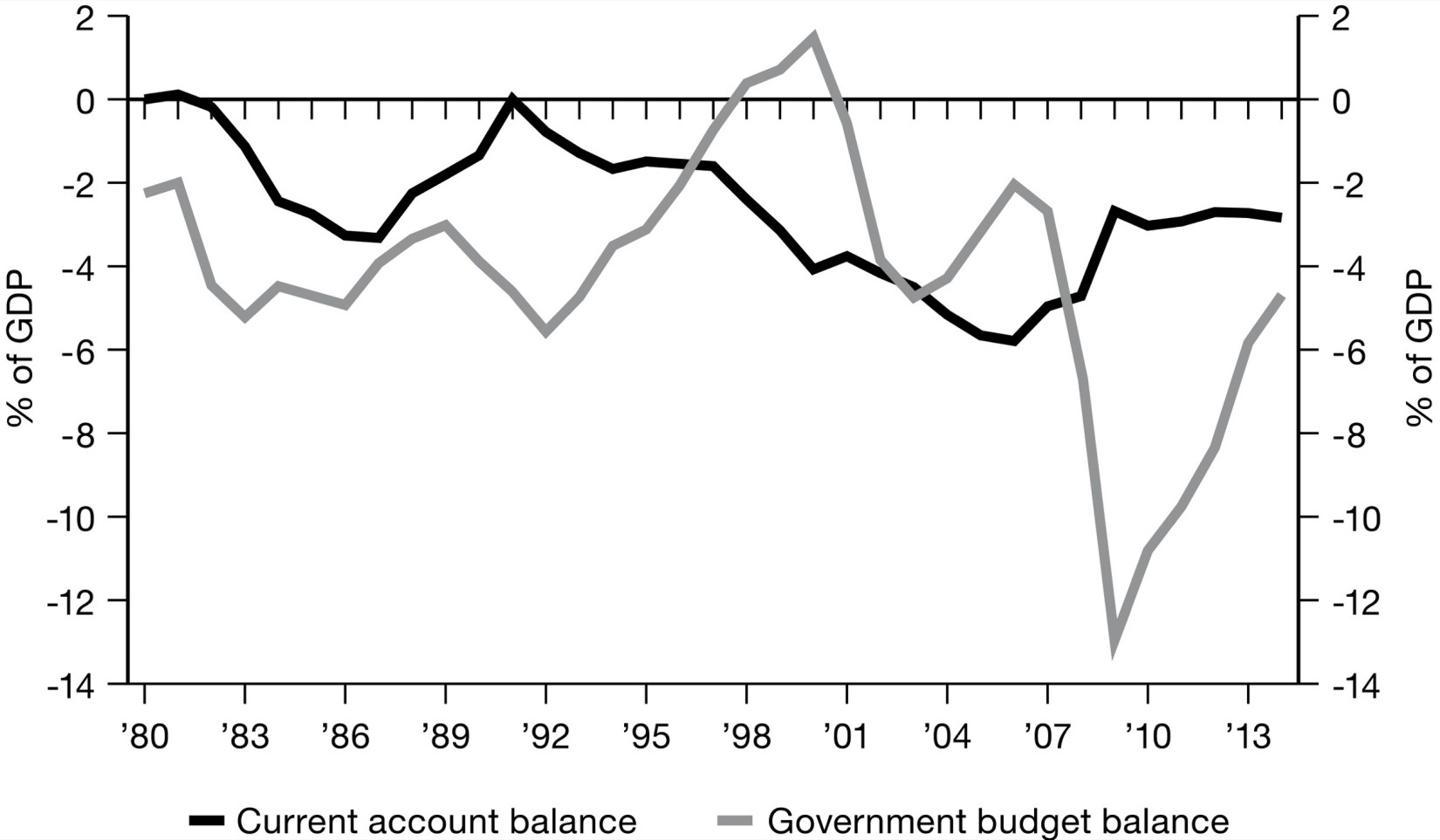
American’s Twin Deficits
Sources: Office of Management and Budget and Bureau of Economic Analysis.
The original inspiration for the Hamilton Project was a paper written in 2004 by Orszag and Rubin sounding the alarm. 11 First, the Bush deficits would drive up interest rates and squeeze private investment. Further down the line lurked a far more serious scenario. “Substantial deficits projected far into the future can cause a fundamental shift in market expectations and a related loss of confidence both at home and abroad,” Rubin and Orszag drily remarked. “The unfavorable dynamic effects that could ensue are largely if not entirely excluded from the conventional analysis of budget deficits. This omission is understandable and appropriate in the context of deficits that are small and temporary; it is increasingly untenable, however, in an environment with deficits that are large and permanent. Substantial ongoing deficits may severely and adversely affect expectations and confidence, which in turn can generate a self-reinforcing negative cycle among the underlying fiscal deficit, financial markets, and the real economy.” Conventional analysis, in short, was not sufficiently alarmist. What it did not “seriously entertain” was the possibility that America was headed toward “fiscal or financial disarray.”
Veterans of the Clinton administration knew what they were talking about when they invoked a “negative cycle” of “underlying fiscal deficit, financial markets, and the real economy.” This, in their view, is what they had inherited from the high-spending Reagan and Bush administrations. In 1993, faced with a bond market sell, Clinton had shelved ambitious plans for a stimulus. 12 Egged on by Rubin and Fed chair Alan Greenspan, deficit reduction became a mantra of the Clinton team. Chief political adviser James Carville was left to ruminate: “I used to think if there was reincarnation, I wanted to come back as the president or the pope or a .400 baseball hitter. But now I want to come back as the bond market. You can intimidate everybody.” 13
In the 1980s and 1990s, the so-called bond vigilantes had their day in the sun. Ten years later they were still in the market. Indeed, the bond funds were bigger than ever. But, as Obama had hinted, domestic investors were not what most worried the Rubinite crowd. Foreign investors were the key concern. The Bush administration’s deficits were financed overwhelmingly by bond buying from abroad. As Orszag and Rubin’s paper remarked, United States Treasurys were still seen as the safest investment in the world. There was no chance of default or a sudden burst of inflation. “But if that expectation were to change and investors had difficulty seeing how the policy process could avoid extreme steps, the consequences could be much more severe than traditional estimates suggest.” Nor was it just the Clinton crowd that worried. In 2003 the nonpartisan Congressional Budget Office saw fit to remind its audience of an extreme scenario in which foreign investors stopped buying US securities, the dollar plunged and interest rates and inflation shot up. “Amid the anticipation of declining profits and rising inflation and interest rates, stock markets could collapse and consumers might suddenly reduce their consumption. Moreover, economic problems in the United States could spill over to the rest of the world and seriously weaken the economies of US trading partners.” 14
The scale of America’s deficits made it vulnerable to bond market pressure. The fact that foreign investors might suddenly turn away from Treasurys evoked the nightmare of a sudden stop to external financing of America’s imbalances. But it was the identity of the foreign investors that infused the scenario with real terror. Until the 1980s the major foreign investors in the United States had been European. Then Japan, with its giant trade surpluses, had taken over. Still, in the new century it was one of America’s largest creditors. But in the 1990s, with a surging yen and a domestic economy crippled by a devastating real estate bust, Japan’s competitive threat had faded. Since the millennium, globalization had acquired a new Asian face. In April 2006, when Obama spoke about keeping our “debt out of the hands of foreign nations,” everyone knew it was China and its Communist regime that he was talking about.
II
Since the 1970s China had been a cornerstone of US geopolitics. Nixon and Kissinger had unhinged the fronts of the cold war by breaking China out of the Soviet embrace. Now the Soviet Union had faded from view, and the European theater of the cold war had faded along with it. The Pacific was the new horizon of American power and China the future rival. For the first time since the rise of Nazi Germany, the United States faced a power that was, at one and the same time, a potential geopolitical competitor, a hostile political regime type and a capitalist economic success story. The fact that Obama came to the Brookings meeting from talks about a nuclear deal with India was a telling coincidence. America was looking for new allies in Asia. But what mattered more than nukes, at least as far as the Hamilton crowd was concerned, was economics.
The Clinton administration had midwifed China into globalization. In November 1995, Washington encouraged Beijing’s application to join the newly founded World Trade Organization (WTO). America had done this before, of course, with Western Europe after 1945, with Japan and East Asia in the 1950s and 1960s and with Eastern Europe in the 1990s. Opening markets was good for American business, for American investors and for American consumers. America’s economic interests were so widespread that they were de facto identical with global capitalism. 15 By the mid-1990s Washington had abandoned any frontal challenge to the Chinese Communist regime over human rights, the rule of law or democracy. Instead, globalists of both the Democratic and Republican parties wagered that the powerful and impersonal force of commercial integration would in due time make China into a biddable and congenial “stakeholder” in the world order. 16
China’s growth was spectacular. Huge profits were to be made for American investors. American manufacturers like GM would stake their future on China. 17 After a brief storm over the Taiwan Strait in 1995–1996, diplomatic relations calmed. But China’s sheer size made it a contender. With the Tiananmen crackdown of 1989, the Communist Party had signaled its intent not to abandon its one-party leadership. Since then it had fashioned a popular ideology that was as much nationalist as Communist. 18 If Washington was betting on international trade and globalization to “Westernize” China, the Chinese Communist Party took the other side of the bet. 19 The party’s leaders wagered that supercharged growth would not weaken them but would consolidate their position as the successful helmsmen of their nation’s spectacular comeback. Beijing took advantage of trading opportunities. But it never subscribed to fully open markets. It decided who would invest and on what terms. It controlled movement of funds in and out. That, in turn, allowed the People’s Bank of China to fix its exchange rate, and since 1994 it had done so by pegging against the dollar.
In choosing a dollar peg, China was far from unique. Despite the reigning narrative of market liberalization, the financial world was not flat. The global monetary system was hierarchical with the key currency, the dollar, at the top of the pyramid. 20 The twenty-first century began with a network of dollar-linked currencies accounting for c. 65 percent of the world economy (weighted by GDP). 21 Those currencies that were not pegged to the dollar tended to be hooked to the euro. Often pegging was a sign of weakness. In many cases the exchange rate was set at an aspirational, overvalued rate. This created short-term advantages. It made imports cheap. Local oligarchs could snap up prestige foreign real estate at a discount. But it also harbored huge risk. The peg could break and frequently it would do so with a bang. The appearance of stability offered by a fixed exchange rate encouraged a large inflow of foreign funds, which helped to stoke up domestic economic activity, creating an unbalanced trade account funded from abroad. Banks that acted as the conduit for foreign funds boomed. This set up the crisis. 22 When international investors lost confidence, the result was a devastating sudden stop. Then the central bank’s foreign exchange reserves would drain and it would have no option but to let the currency peg go. Stability would give way to a disastrous devaluation. Those who got their money out first would be saved. Those who had borrowed in foreign currency would face bankruptcy.
This was the saga of the 1990s: 1994 in Mexico; 1997 in Malaysia, South Korea, Indonesia and Thailand; 1998 in Russia; 1999 in Brazil. It was containing these crises that earned US Federal Reserve chairman Alan Greenspan, Treasury secretary Robert Rubin, and Larry Summers, Rubin’s number two, the accolade of the “Committee to Save the World.” 23 What happened when the American superheroes were not on hand was revealed in 2001. With the Bush administration fully distracted by the terror attack of 9/11, financial speculation built against Argentina. Despite a $22 billion loan from the IMF, without American backing the Argentinian position became untenable; 80 percent of Argentine private debt was in dollars, whereas only 25 percent of Argentina’s economy was export oriented. 24 In December 2001, with dollars draining out of the country, the Argentine government suspended access to bank accounts. Amid rioting that claimed the lives of twenty-four people, the government collapsed. On December 24, 2001, Argentina announced the suspension of payments on $144 billion of public debt, including $93 billion owed to foreign creditors. The peso plunged in value from 1:1 to 3:1 against the dollar, bankrupting the dollar debtors. The economy reeled backward to levels not seen since the early 1980s. As the twenty-first century began, more than half of Argentina’s population fell below the poverty line. 25
China had no intention of becoming either the victim of a sudden stop or the needy recipient of US assistance. 26 To reverse the balance of risk, when Beijing pegged its exchange rate it chose one that was not too high, but too low. This was what Japan and Germany had done in the 1950s and 1960s. 27 It was a recipe for export-led growth, but it created tensions of its own. Undervaluing the currency made imports more expensive than they needed to be, which lowered the Chinese standard of living. When it ran a trade surplus with the United States and bought American government bonds, poor China was exporting capital to rich America, funding American consumers to buy the products of its huge new factories. Moreover, maintaining the artificially low peg was a battle in its own right. With China’s trade surplus with the United States surging from $83 billion in 2000 to $227 billion in 2009, to hold the value of the yuan down the Chinese central bank had to continually buy dollars and sell its own currency. To do so it printed yuan. In the normal course of things this would have unleashed domestic inflation, wiping out any competitive advantage and triggering social unrest. So, to “sterilize” the effects of its own intervention, the People’s Bank of China required all Chinese banks to hold large and growing precautionary reserves, effectively removing the currency from circulation. It was a profoundly unbalanced situation and one that could be sustained only because of the extremely tight relationship between the Chinese regime and the business elite, a relationship built on common affiliation to the Communist Party, coercion and mutual profit. Chinese businesses and their owners, the emerging oligarchs, profited spectacularly from a gigantic export-led development boom. 28 Chinese peasants and workers chased the dream of urban prosperity. Meanwhile, Beijing’s giant foreign currency reserves were the best guarantee an uncertain global economy could offer that in case of a crisis, it would not be China’s sovereignty that was violated.
China’s Foreign Reserve Accumulation (in $ billions)
Note: Estimates adjusted for Belgian holdings and UK flows.
Source: Brad Setser, “How Many Treasuries Does China Still Own?,” Follow the Money (blog), Council on Foreign Relations, June 9, 2016, https://www.cfr.org/blog/how-many-treasuries-does-china-still-own .
With so many currencies fixed against the dollar, without the possibility of adjusting export competitiveness by means of devaluation or appreciation, it was no surprise that the world economy polarized into export surplus and import deficit countries. In the first three months of 2005 alone, the United States ran a current account deficit—an excess of outward payments on trade in goods and services and investment income—of almost $200 billion. For the year it came to $792 billion and was showing signs of further deterioration in 2006. For those on the surplus side of the “global imbalances,” so-called sovereign wealth funds (SWF) became huge repositories of capital. According to estimates by the Peterson Institute for International Economics in Washington, DC, by 2007 emerging market sovereign wealth funds held at least $2 trillion in assets, in addition to the trillions in reserves held by their central banks. 29 The Saudi Arabian Monetary Authority was flush with cash, as were the SWF of Norway and Singapore. Some SWF made adventurous investments in equities. China’s State Administration of Foreign Exchange looked for safe and predictable returns. Its safe assets of choice were long-dated US government debt and securities guaranteed by the US government.
The imbalances were worrying, but, at least as far the surplus countries were concerned, they promised that the first shock in the case of an unwinding would be borne by the other side. It was the United States, the world’s great deficit economy, that would see its currency devalue and its interest rates surge as foreign investors abandoned American assets. It was this scenario that caused Orszag, Rubin and Senator Obama such concern. Nor were they alone. In the prestigious house journal of the Council on Foreign Relations, Foreign Affairs, Peter G. Peterson, chairman of the council, the Institute of International Economics and the Blackstone Private Equity Group, raised the alarm about America’s twin deficits. 30 Economists Nouriel Roubini and Brad Setser warned that if investors were to lose confidence, the United States could face a very sudden depreciation of the dollar and a massive hike in interest rates. 31 It might well turn out to be the worst recession experienced since World War II. 32 And America would not only be depressed. It would be humbled at the hands of the rising power of Asia. Of course, if the United States suffered a crisis, China would be hurt too. 33 Niall Ferguson and Moritz Schularick came up with the term “Chimerica” to describe the Sino-American economic complex. 34 For Larry Summers, who had moved from the Treasury to an ill-fated stint as president of Harvard, it reawakened memories of cold war–era mutually assured destruction. At the heart of the world economy, he told Washington audiences, was a “balance of financial terror.” 35 The difference was that in the cold war the economy had been America’s strong suit. Now America’s trump card consisted of the hope that it was simply “too big” for China to let it fail. It was hardly a reassuring diagnosis.
III
To ease these imbalances, the obvious solution, as the Hamilton Project demanded, was fiscal restraint. Reduce the federal deficit, squeeze domestic demand, reduce the import of Chinese goods and Chinese money. But the Bush administration didn’t seem to care. In 2004 former Treasury secretary Paul O’Neill, fired from the cabinet in 2002, released his revealing exposé of the early Bush administration. It contained a nugget that haunted the economic policy community. In November 2002 O’Neill tried to warn Vice President Dick Cheney that the surging “budget deficits . . . posed a threat to the economy.” Only for Cheney to cut him off with the following remark: “You know . . . Reagan proved deficits don’t matter.” The Republicans had won the congressional midterms; tax cuts were the Republican “due.” Within the month O’Neill was fired. 36 From the perspective of the Rubinite Democrats, this was not just economically illiterate, it was also a political scandal. Following in the footsteps of George Bush senior, they had spent agonizing years working off Reagan’s deficits. If Cheney’s version of Republicanism prevailed, it undermined the basis for turn taking in America’s two-party system. How could the Democrats conduct responsible “national” economic policy if the Republicans viewed the economy as a resource to be milked for the benefit of its privileged constituency? As Brad DeLong, deputy assistant secretary for economic policy in the Clinton-era Treasury, ruefully remarked: “Rubin and us spear carriers moved heaven and earth to restore fiscal balance to the American government in order to raise the rate of economic growth. But what we turned out to have done . . . was to enable George W. Bush’s right-wing class war: his push for greater after-tax income inequality.” 37
The question was pressing because following the momentous November 2006 midterms, control of the House and the Senate changed hands. In a turn of events that can only be described as fateful, it would be the Democrats who held power in Congress during the greatest crisis of American capitalism since the 1930s. But that was in the future. In 2006 the question was whether the Democrats, as the new power on Capitol Hill, should once again take responsibility for cutting the deficit. Many in the party, especially those on the Left, were wondering why they should accept the burden. 38 As one centrist remarked: “On fiscal responsibility, it takes two to tango, and insofar as the GOP doesn’t want to dance, Democrats can’t afford to take sole responsibility.” 39 Perhaps the best way to prevent another “wealth-polarizing offensive” by a Republican Congress would be to spend so much on public works, welfare and job creation that even a Republican would not consider adding tax cuts on top. As DeLong resignedly observed, the “surplus-creating fiscal policies established by Robert Rubin and company in the Clinton administration would have been very good for America had the Clinton administration been followed by a normal successor. But what is the right fiscal policy for a future Democratic administration to follow when there is no guarantee that any Republican successors will ever be ‘normal’ again?” 40
Given this dilemma, the disaster scenarios invoked by Orszag and Rubin take on a different meaning. They were as much about controlling the agenda within the Democratic Party as about winning over Republicans. If all that was at stake in the struggle over the deficit was a percentage point of economic growth here or there, why should the Democrats not put their own partisan priorities first? But if what threatened was a Weimar-style disaster, then, surely, the left wing of the Democrats would fall into line and prioritize budget cutting.
Given the political impasse over fiscal policy and the evident imbalances of the US economy, the other agents that one might have expected to swing into action were the mighty guardians at the Federal Reserve Board. Under the chairmanship of first Paul Volcker (1979–1987) and then Alan Greenspan (1987–2006), the authority of America’s central bank soared to new heights. In terms of its expert authority and unassailable position within the structure of the US government, it came to rival the US security apparatus. 41 The irony, however, was that as the Fed’s reputation and authority grew, its key tool of policy seemed to be losing its effectiveness. The short-term interest rate set by the Fed no longer seemed to be setting the pace for the rest of the economy.
Following the dot-com crash Greenspan had cut rates to 3.5 percent. After the 9/11 attacks there were further cuts, reaching 1 percent in the summer of 2003. Then, from 2004 on, the Fed started raising rates. Faced with America’s trade deficit and its rapid domestic boom, this was the standard prescription. It should increase private saving and restrict investment. 42 But to the Fed’s dismay, the results were feeble. Most strikingly, as the Fed hiked short-term rates, rates in long-term bond markets failed to respond. There were too many buyers of long-term bonds, driving prices up and yields down. Nor should this have been a surprise. 43 By fixing their currencies against the dollar, many of America’s trading partners prevented not only a downward movement of the dollar, which might have restored America’s competitiveness. They also prevented an appreciation of the American currency, which would normally have followed on an interest rate increase. Under de facto fixed exchange rates, an increase in the interest rates would not reduce the supply of credit. It had the opposite effect of making investment in the United States more attractive, drawing in a greater flow of foreign funds.
The Fed found itself boxed in between China’s determination to peg its currency and the refusal of Congress to curb America’s budget deficit. China’s unbalanced growth path created an excess of savings that needed to be invested abroad. AAA-rated US Treasurys were the reserve asset of choice. As a newly appointed member of the Federal Reserve Board, one of the first contributions to the policy debate by the Princeton economist Ben Bernanke was to coin the term “global savings glut” to describe this situation in which the Fed’s principal policy instrument lost its leverage on the economy. 44 The availability of foreign funding negated Fed efforts to raise interest rates. At the same time it reduced the pressure on Congress to tighten fiscal policy. As capital surged in, this pushed down US interest rates, stoking the domestic economic upswing and sucking in imports, above all from China. But barring a change of heart on the part of Congress or a general liberalization of exchange rates, there was little the Fed could do. This was the ambiguous inheritance that Bernanke stepped into on February 1, 2006, as he took up the baton of Fed chair.
Bernanke’s placid and undersized persona would soon come to occupy an outsized space in global economic history. He would turn out to be an unusual but highly significant case of the possibility of “learning lessons from history.” In November 2002 at a birthday celebration for Milton Friedman and Anna Schwartz, Friedman’s coauthor in the monumental Monetary History of the United States , the bible of monetarism, Bernanke promised: “I would like to say to Milton and Anna: Regarding the Great Depression. You’re right, we did it. We’re very sorry. But thanks to you, we won’t do it again.” 45 Given the association forged in the 1970s between monetarism and inflation fighting, one could easily confuse Bernanke’s promise with a conventional central banker’s commitment to price stability. Indeed, Bernanke was making a commitment to price stability, but what he was promising to prevent was deflation, not inflation. The lesson of the 1930s was that the Fed must act promptly not just to prevent the money supply expanding excessively but also to prevent bank failures from causing it to implode. 46 On Bernanke’s watch there would be no deflation. That single-minded determination, embodied by the new Fed chair but shared across the US policy-making establishment, would define the response of monetary policy to the crisis. In the process Bernanke would redefine what a central bank can do as an agency of modern government. Given the weight of this hindsight, it is easy to forget how unremarkable his appointment seemed at the time. He was a safe pair of hands, no outsized ego, a reliable middle-of-the-road Republican. In policy terms he was known, above all, for his belief that the best way to perpetuate the era of the great moderation, in which both unemployment and inflation were fluctuating much less than ever before, was a rules-based approach to policy making he described as “constrained discretion.” 47
As an economist steeped in the disastrous history of the 1920s and 1930s gold-exchange standard, Bernanke knew all too well the perils of a lopsided fixed exchange rate system. He was profoundly critical of China’s currency policy. 48 But relations among central bankers are polite. It was not for the Fed to lecture the Chinese on currency policy. The same rules did not apply to the US Treasury or to Congress. In the early 2000s dozens of bills began to move through Congress accusing China of being a currency manipulator in violation of WTO norms and demanding sanctions. It was those initiatives that raised fears in circles like the Hamilton Project about “populist protectionism.” In July 2005, to relieve pressure on the US economy, China began to allow a slow currency appreciation. In due course this would bring about a 23 percent revaluation. But it was painfully slow.
To speed things up, some in Washington favored activating the IMF. Why was the global monetary watchdog not calling on China to address its lopsided balance of payments? In September 2005, Treasury undersecretary Tim Adams remarked in a widely reported speech that the IMF appeared to be “asleep at the wheel.” 49 But to promote the IMF as an arbiter had serious implications. China could not be expected to take advice from the IMF until it had representation on the IMF’s board that was commensurate with its size. Furthermore, Beijing would expect IMF monitoring to apply to the United States as well. That wasn’t likely to appeal to a Republican White House. 50 Barring market-driven adjustment or international supervision, the balance of “financial terror” was managed by means of summit diplomacy in the manner of the cold war. And it was no coincidence that as his last Treasury secretary President Bush chose Hank Paulson. Paulson, like Rubin, moved to the Treasury from the CEO job at Goldman Sachs. But apart from his investment banking credentials, what recommended Paulson for the job was his reputation as an old China hand. He liked to boast that since the Tiananmen Square massacre, he had visited China seventy times. 51 He had no particular fondness for multilateral institutions like the IMF. Instead he preferred bilateral dialogue—what some had taken to calling the “G2” format. 52 One of Paulson’s first moves was to initiate a US-China Strategic Economic Dialogue and to take personal charge of the US side. 53
IV
In the fall of 2007, even as quite a different crisis loomed on the horizon, it was the dollar that was still at the center of attention. The Economist warned of a “Dollar Panic.” 54 Germany’s Spiegel magazine announced a “Pearl Harbor without a war.” Bill Gross, the kingpin at bond trading giant PIMCO, was reported to be selling dollar assets, as was billionaire investor Warren Buffett. In November 2007 Bloomberg reported that the world’s highest-paid supermodel, the Brazilian Gisele Bündchen, had demanded that Procter & Gamble pay her in euros for endorsing their Pantene brand. With a net worth of more than $300 million, Bündchen could not afford to ignore sentiment in the currency markets. Meanwhile, hip-hop star Jay Z took to thumbing wads of euros on MTV.
If the euro was the new bling, was the dollar really about to go out of style? In the summer of 2007, the year before he was awarded the Nobel Prize, Paul Krugman sketched the logic of what he described as a “Wile E. Coyote moment,” in which foreign investors would suddenly realize that there was nothing holding the dollar up other than their own purchasing of it. 55 Like the cartoon character suspended in midair by the propeller motion of his own legs, the dollar was hanging above a precipice. It was comforting, Krugman reassured his readers, that most of America’s debts were in its own currency, so the impact of the dollar collapse would be cushioned. It wouldn’t be Argentina. But if the Fed was forced suddenly to hike interest rates, the United States would face a severe contraction. “This,” Krugman concluded, “won’t be fun.”
The best and brightest in American economic policy were not wrong to worry about the Sino-American imbalance. If it had blown up, it would have been a disaster. Ten years on, the scenario still hangs over the world economy. The threat of crisis was contained in 2008 because there were deep interests engaged on both sides and because it was handled as a matter of top priority by both Washington and Beijing. From the outset, Sino-American financial relations were explicitly politicized and were understood as a matter of great power diplomacy. No one was under any illusion that it was simply a market relationship, a matter of business as usual. When Paulson was worried about a Chinese dollar sell-off, he knew whom in Beijing to call. Larry Summers’s cold war analogy proved more apt than he realized. The balance of financial terror held. 56 But in the meantime, what became increasingly clear was that the US policy-making elite had been focused, as Bradford DeLong would put it, on the “wrong crisis.” 57 The crisis that will forever be associated with 2008 was not an American sovereign debt crisis driven by a Chinese sell-off but a crisis fully native to Western capitalism—a meltdown on Wall Street driven by toxic securitized subprime mortgages that threatened to take Europe down with it.
Chapter 2
SUBPRIME
W hen the economists linked to the Hamilton Project envisioned disaster, they worried about excessive public debt, underperforming schools and a Chinese sell-off. What they did not put in question was the basic functioning of America’s economy, its banks and financial markets. America’s problems were its people, its society, its politics, not its economy as such. And yet by 2006, if one looked in the right place, it was evident that something was seriously amiss. Since the early 2000s the American economy had been buoyed not only by huge fiscal deficits but by a sustained surge in house prices. Now, in some of the most challenged neighborhoods in the country, tens of thousands of families who had recently taken out home loans were failing to make payments. In marginal ethnic minority communities in cities like Cincinnati and Cleveland, but also in ribbon developments in the sunshine states, mortgages were failing en masse. America’s housing market bull run was about to come to a juddering halt. And as it did so, it would precipitate a global crisis.
For tens of millions of Americans this crisis hit them where it hurt most, at home. But compared with the grand sweep of global economic imbalances and the Sino-American relationship, the mechanics of American mortgage finance cannot but appear a parochial concern. How could this domestic drama shake the world’s financial system and precipitate a global crisis? The simple answer is that real estate may be mundane, and McMansions may be nondescript, but they account for a huge share of total marketable wealth worldwide. By one estimate, the share of American real estate in global wealth is as much as 20 percent. 1 American homes account for 9 percent of the total. At the time of the crisis 70 percent of American households owned their own home—more than 80 million in total. Those same households were the greatest source of demand for the world economy. In 2007 American consumers bought c. 16 percent of global output, and nothing made them feel better than surging real estate prices. As America’s home prices almost doubled in the ten years leading to 2006, this raised household wealth by $6.5 trillion, delivering a giant boost not just to the United States but to the world economy. 2 As US consumer spending surged toward $10 trillion, it added $937 billion to global demand between 2000 and 2007. 3
Fluctuations on such huge scales can clearly help account for a business-cycle downturn in 2007. But to explain how this could trigger a financial crisis, with bank failures spreading panic and a credit crunch across the world, there is one crucial thing to add: Real estate is not only the largest single form of wealth, it is also the most important form of collateral for borrowing. 4 It is mortgage debt that both amplifies the broader economic cycle and links the house price cycle to the financial crisis. 5 Between the 1990s and the outbreak of the crisis in 2007, American housing finance was turned into a dynamic and destabilizing force by a fourfold transformation—the securitization of mortgages, their incorporation into expansive and high-risk strategies of banking growth, the mobilization of new funding sources and internationalization. All four of these changes can be traced back to the transformation in world economic affairs between the late 1970s and the early 1980s in the wake of the collapse of Bretton Woods.
I
On October 6, 1979, after an unscheduled meeting of the Federal Reserve’s key interest-rate-setting committee, the Federal Open Market Committee (FOMC), Paul Volcker, the Fed chair, announced that the Fed would henceforth attempt to tightly regulate bank reserves and that interest rates could be expected to rise. 6 It was the Fed’s response to a wave of inflation that was threatening domestic instability, America’s global standing and the status of the dollar. Since Nixon had unhooked the dollar from gold, the world’s currencies had floated against one another without a metallic anchor. Only political discipline prevented limitless printing of currency. Contrary to some fears, there was no runaway inflation. But with prices accelerating toward annual increases of 14 percent in 1979, Volcker and the Fed decided that it was time to apply the brakes. It was the moment the power of the modern Fed was born. The interest rate was its weapon. As Germany’s outspoken chancellor Helmut Schmidt put it, Volcker pushed real interest rates (interest rates adjusted for inflation) to levels not seen “since the birth of Christ.” 7 He did not exaggerate. In June 1981 the prime lending rate touched 21 percent.
The result was to send a shuddering shock through both the American and the global economies. The dollar surged, as did unemployment. Inflation collapsed from 14.8 percent in March 1980 to 3 percent by 1983. In Britain this was the crisis with which the Thatcher government began. In Germany it would contribute to Schmidt’s unseating and his replacement by the conservative government of Helmut Kohl. 8 France’s Socialist government under President François Mitterrand would be forced into line in 1983. Volcker’s shock set the stage for what Ben Bernanke would later dub the great moderation. 9 It was an end not just to inflation but to a large part of the manufacturing base in the Western economies, and with it the bargaining power of the trade unions. No longer would they be able to drive up wages in line with prices. And there was another part of America’s postwar political economy that did not survive the disinflationary shock of the 1980s: the peculiar system of housing finance that had emerged from the New Deal era.
Since the 1930s, America’s housing finance had been based on commercial banks and local savings banks, so-called savings and loans, making long-term fixed interest loans. By the late 1960s thirty-year fixed interest loans had become normal, with as little as 5 percent in down payment. 10 The funding was provided by depository institutions, which offered government-insured savings accounts with capped interest rates. This was the basis on which home ownership had expanded to almost 66 percent of households by the 1970s. For home owners on fixed interest, long-term mortgages, the inflation of the post–Bretton Woods era was a windfall. The real value of their loans was eaten up while their interest rates remained fixed. For the banks that lent to them it was a disaster. In an era of inflation and fluctuating interest rates, at the capped interest rates inherited from the 1950s they could not retain their depositors, let alone attract new ones. To borrow from money markets or issue bonds, they now faced the withering interest rates set by the Fed. Meanwhile, their portfolios of fixed interest mortgages were devalued as rates on new loans soared. 11 By the early 1980s the vast majority of the almost four thousand savings-and-loan banks still in operation were insolvent. Given the cost of cleaning them up and the prevailing free market ideology of the Reagan era, the path of least resistance was to deregulate and lower capital standards in the hope that they could grow themselves out of trouble. The commercial banks survived this trial by fire; the savings and loans did not. More than a thousand failed. Most of the rest were bailed out, bought up or amalgamated. The resolution costs to the taxpayer were around $124 billion in 1990s dollars. 12
By the late 1980s the macroeconomic picture was stabilizing. Inflation was down and interest rates were falling. Whereas most bond investors did well in the new era, anyone who held mortgage loans had to reckon with another risk. American mortgage borrowers have the right to repay early and refinance at lower rates. This boosts the economy, as borrowers can reduce their mortgage payments and as borrowers they tend to have a higher propensity to consume than those they borrow from. 13 But for the lender it means that the US mortgage contract is highly one-sided. During a period of rising rates their fixed-rate loans will devalue. During a loosening of monetary policy, when rates fall, the borrowers refinance. Lending for thirty-year terms at fixed rates is a viable business proposition only under the kinds of conditions of stability that prevailed under Bretton Woods between 1945 and 1971. In a new age of flexible monetary arrangements it was dangerously one-sided, especially if the risks were concentrated in small mortgage lenders with limited means of funding themselves. The solution was to go for scale, to adopt a new market-based model of financing and to place government institutions at the center of the system.
The basic anchor of America’s mortgage system in the aftermath of the savings-and-loans debacle was the so-called government-sponsored enterprise (GSE). 14 The mother ship of the GSEs was Fannie Mae, founded in 1938 to create a secondary market for lenders who were willing to issue the new type of government-insured Federal Housing Authority mortgages promoted by the New Deal. Fannie Mae did not issue mortgages. It bought them mainly from commercial banks across the United States that specialized in issuing FHA-insured mortgages. By acting as a backstop, Fannie Mae lowered the cost of lending and set a national standard for both lenders and “prime” borrowers. It helped to unify America through mortgage debt. Fannie Mae was able to fund its purchases of these standardized mortgages cheaply because its credit rating was that of a government agency that could not fail. So-called agency debt was equivalent to that of the Treasury. By the same token, the obligations of Fannie Mae featured on the federal government’s balance sheet. To get them off at a time of fiscal stress during the Vietnam War, in 1968 Fannie Mae was privatized. The branch still devoted to making loans to public employees and veterans was split off as Ginnie Mae. “New Fannie Mae” was licensed to buy any mortgages, government guaranteed or not, that conformed to certain quality standards—so-called conforming loans. And in 1970 Congress legislated into existence a third agency, the Federal Home Loan Mortgage Corporation, or Freddie Mac, to level the playing field by buying up mortgage loans issued by savings and loans.
Despite this government guarantee, with their large portfolios of fixed interest loans, the GSEs were hit hard by the Volcker shock of the early 1980s. Fannie Mae came close to failure. But it survived, and as the housing market recovered in the 1990s, the GSEs flourished. Thanks to their residual tie to the federal government, the GSEs continued to enjoy a substantial discount in funding costs. By the end of the century Fannie Mae and Freddie Mac together were backstopping at least 50 percent of the total national mortgage market. Creating conforming loans—loans that qualified for GSE backstop—was the basis of the American home loan business. It is a deep irony that the era in which America is commonly thought of as leading the world in a market revolution saw its housing market become dependent on a government-sponsored mortgage machine descended from the New Deal. It was also the source of deep and irreducible politicization of the mortgage issue in the United States.
American housing policy and mortgage practice since the war had systematically favored home ownership for the white majority. 15 In the 1990s promoting home ownership for lower-income and “underserved” minority communities became a congressional priority. The Federal Housing Enterprises Financial Safety and Soundness Act of 1992 called for lending goals to be set for the GSEs. In December 1995 the government issued targets for underserved areas and low-income housing. Many of the new home owners in the 1990s and 2000s were ethnic minority families who had been denied mortgages for decades under the regime of “redlining” institutionalized by New Deal housing policy. Viewed in this way the real estate boom was part of the rise of the diverse African American and Latino middle class on which the Democrats as a political party had a lot riding. 16 On the back of their influence over the Democratic Party, the GSEs built one of the most powerful lobbies in Washington, DC. Their political firepower was legendary. By the same token, the GSE mortgage regime always attracted the ire of the American Right. Deep down most free market advocates are convinced that the interferences of the GSEs were responsible for the disaster that was beginning to unfold in 2006. The GSEs had political mandates set by progressives to funnel money into underserved communities. They had a market-distorting funding advantage due to their attachment to the federal government. When you distort the market, crises are inevitable. 17 It was this conservative critique of the GSEs that shaped the Republican reaction when the crisis reached fever pitch in 2008. For many in Congress the bailout was not just of the banks—they at least were private businesses trying to make a buck. The bailout was also a desperate effort to make the taxpayer pay for the rescue of a Democrat-controlled parastate housing welfare apparatus designed to serve pampered minorities.
This was powerful mobilizing rhetoric for the Republican base. But as an explanation of the crisis that was brewing in 2006, this political critique is wide of the mark. Fannie Mae and Freddie Mac set a high minimum standard for the quality of loans they would buy. The GSEs didn’t support the kind of low-quality, subprime loans that were beginning to fail in droves in 2005–2006. Those toxic loans were the products of a new system of mortgage finance driven by private lenders that came into full force in the early 2000s. Though the GSEs met their government lending quotas, private lenders driven by the search for profit were far more adventurous in lending to underserved communities. 18 In this sense the GSEs did not create the crisis. But what they did contribute were two innovations without which the crisis is hard to imagine: the originate-to-distribute mortgage lending system and securitization.
From its origins in the 1930s, the GSE model of subsidy separated the origination of a mortgage from its ultimate funding. The commercial banks that issued the original loans to American families were repaid when they sold the mortgages to Fannie Mae. That enabled them to make more loans. It was the debt issued by the GSEs to finance the mortgages they were holding on their balance sheets that ultimately funded the loan. This was the basic structure of what became known as “originate to distribute.” Mortgage lenders no longer needed to hold the mortgages on their balance sheets; they became brokers operating for a fee. The government-backed credit rating of the GSEs backstopped the entire system.
Starting in the 1970s, as they confronted the instability of interest rates and its damaging implications for America’s mortgage model, the GSEs took a further critical step. Working with the help of investment banks, they pioneered securitization. 19 Rather than holding the locally originated mortgages on their own books and financing them by issuing bonds, they would sell the mortgages directly to investors. To do so they packaged the mortgages into pools, in which they sold shares—securities. The idiosyncratic risks of individual loans would be pooled. Investors looking to hold real estate could buy a portfolio of broadly based exposure without having to build a branch network necessary to make loans across the far-flung economy of the United States. They did so fully aware of the risks and returns generated by the fluctuation of interest rates. Rather than having small savings and loans gamble on what was a viable loan, securitization would let the collective process of market haggling determine funding costs.
In 1970 Ginnie Mae carried out the first securitization. It was a simple model—a so-called pass-through—under which the flows of revenue from a pool of mortgages were passed by way of the GSE to investors. Not satisfied that this should remain a public monopoly, Lewis Ranieri and his team at hard-driving investment bank Salomon Brothers put together the first private securitization of mortgages for Bank of America in 1977. 20 But it took a brave investor to buy a package of fixed interest mortgages at that moment. It was in the aftermath of the interest rate shock of the early 1980s that securitization came to the fore. The mortgage lender stranded with portfolios of low-interest mortgages turned to the market to recover whatever value they would yield by securitizing them and selling them off. From the 1980s, the GSEs, working with the investment banks, created not just pass-through mortgage-backed securities (MBS) but so-called collateralized mortgage obligations (CMO) that allowed a pool of MBS to be tranched into separate risk tiers profiles. This was the origin of so-called structured finance. Those with the top-tier first claim on the revenue stream had low risk of both default and early repayment. Tranches lower down the pecking order could be sold off to investors looking for riskier investments. The top-tier senior tranches would pay out except in the highly unlikely event of massive, collective default. Those top tranches, even if they were based on a pool of high-yielding, high-risk debt, could be designated as low risk, and the ratings agencies obliged by classifying them as AAA (80 percent of most securitizations were designated as senior and given the AAA rating).
Not surprisingly, given the very high ratings they handed out for MBS, the role of the ratings agencies would later become highly controversial. By the 1990s, Moody’s Investors Service and Standard & Poor’s divided 80 percent of the global debt-rating business between them. 21 Fitch took another 15 percent of the market. They did not attain that control of the global market by freely handing out top AAA ratings. In 2008 there were only six AAA-rated corporations and no more than a dozen countries enjoying that ranking. This was despite the fact that since the 1980s it was issuers of debt who paid the ratings agencies to make their classifications, not the subscribers to their information services. Payment by the issuer created a conflict of interest. But the agencies had much to lose if they appeared to be selling good ratings and relatively little to gain if they showed favor to a client that was involved in only occasional bond issues. The mortgage securitization business changed that calculus. The sheer volume of mortgage-backed security issuance, involving tens of thousands of tranches, combined with the fact that the flow was concentrated in the hands of a few issuers, gave the ratings agencies a significant incentive to be “helpful.” 22 But even more important was the nature of MBS as such. What made rating MBS different was that the underlying assets were not bonds issued by a company facing the unpredictable force of global competition. The MBS bundled thousands of what were supposed to be predictable assets—regular domestic mortgages. The ratings agencies did not have to calculate the risks of default on the basis of more or less subjective evaluations of a company’s business prospects. Nor did they have to render a judgment on a country’s fiscal policy. Instead, they could apply standardized financial mathematics to a population of mortgages that was assumed to have well-known statistical properties. If you knew default rates and could make assumptions about the degree of correlation between them, once you assembled enough mortgages and tranched them, the likelihood of the top tranches not paying was infinitesimal. Tens of thousands of asset-backed securities thus qualified for ultrasafe AAA ratings. What happened to the tranches lower down the pile was another matter altogether. There the risk of failure was much higher than if one simply held the mortgage pool. But at the right yield they too would find a buyer.
The idea, in the wake of the savings-and-loans disaster, was to spread risk outward from those immediately involved in lending to mortgage borrowers and to attract investors by turning mortgages into securities that offered a wide range of yield-risk profiles. And it worked. In 1980, 67 percent of American mortgages had been held directly on the balance sheets of depository banks. By the end of the 1990s, the risks involved in America’s system of long-term, fixed interest, easy repayment mortgages were securitized and spread across a much wider segment of the financial system than had been the case in 1979 when Volcker made his shock announcement. The GSEs held them. Banks held them. But so too did pension and insurance funds. 23
Compared with the model of the savings and loan, securitization thus did its job in spreading risk. But did it by the same token reduce the incentive to carefully monitor the underlying loans? By splitting origination from funding, had the new system eliminated the incentive to monitor loans carefully? Whereas a local lender that held a mortgage for its entire thirty-year duration had every reason to monitor its customer very carefully, by the 1990s American mortgages were passing through at least five different institutions—originators, wholesalers of packages of mortgages, underwriters who assessed risk, government-sponsored enterprises and servicers who managed the flow of interest income—before being sold to an investor. Along that chain, what confidence could an investor have that the job was being done correctly? At each step of the way the main concerns were volume and fees. Who had an interest in maintaining quality? Perhaps it was not the government subsidy but these perverse incentives that led to the huge boom in bad lending and the crisis of 2007–2008. 24
It is a theory that would have a superficial plausibility if the 1990s model of GSE-centered mortgage finance had still been dominant in the early 2000s. But, in fact, in the early 2000s, when the subprime boom unfolded, the industry had changed again. Securitization was more dominant than ever. The GSEs were still responsible for buying and securitizing the top-tier conforming mortgages. But as a new range of actors entered the mortgage market with a more dynamic and expansive agenda, their principal business model was not to disaggregate and to spread the risk but to integrate every step of the process, including the holding of large quantities of securities on their own balance sheets. 25 It was this growth model, based on integration, not disintegration, that would blow the system up.
II
The path that led to the supercharged private mortgage industry of the early 2000s was twisted, but it too goes back to the breakdown of Bretton Woods in the 1970s and the unfettering of currencies, prices, interest rates and capital movements that followed. It was not just the savings and loans but the entire financial sector that was forced to rethink its business model, and this went for the investment banks of Wall Street as much as for the commercial banks.
It is barely too much to say that the new, deregulated world of national and international finance was made for the investment banks. 26 Through their business of trading on their clients’ behalf and launching debt and other securities, they enjoyed an “edge” over all other participants in the market. 27 In 1975 the abolition of fixed fees charged by Wall Street brokers for trading stocks led to fierce competition, wiped out smaller firms and forced the integration of trading, research and investment banking. In the 1980s, with interest rates coming down and bonds beginning their long bull run, trading in so-called fixed-income securities—as opposed to equities—became ever more important. Drexel Burnham Lambert pioneered the market in high-yield corporate bonds, also known as junk bonds. Meanwhile, Salomon Brothers helped the GSEs devise the securitization model and launch each new batch of mortgage-backed securities. For other clients, the investment bankers were hard at work figuring out how to hedge against fluctuations in currencies and interest rates. They developed swaps, for instance, that allowed clients to trade excessive exposures in currencies. They made instruments that allowed one client to take on the risk of fluctuating interest rates while another client opted for fixed rates. In the 1990s a team at J.P. Morgan devised the credit default swap (CDS), which offered protection against the risk of nonpayment and allowed lenders to fine-tune their lending risk. 28 At the same time, the investment banks progressively increased their own trading activity. They discovered the profits to be made through volume and leverage. The returns were extraordinary. In the early 1980s America’s investment banking elite earned returns of more than 50 percent on equity.
But achieving scale raised the question of funding. Investment banks don’t have deposits. They borrow the money they lend on wholesale markets from other banks or institutional funds. In the aftermath of the inflation and interest rate shocks of the late 1970s and early 1980s, this put them in a sweet spot. If investment banks didn’t have depositors, that suited savers, who, in the wake of the inflation, no longer wanted to put their money in bank deposits either. They opted instead for money market mutual funds (MMF), that characteristic financial institution of the new age. 29 These were highly attractive to affluent households looking for better rates than those on offer from bank deposits. The money market mutual funds offered instantly accessible accounts without official government guarantee, but pledged by their private sector operators to return at least a dollar on the dollar plus an attractive rate of interest on top. Bypassing the bankrupt savings and loans and the struggling commercial banks, cash deposits flowed into huge pools of professionally managed cash looking for good yields on Wall Street.
Nor were the MMFs the only ones. Corporations began to manage their cash pools more professionally. Ultrarich individuals who became more and more numerous from the 1970s onward had billions of dollars that were managed by funds and family offices. By the end of the 1990s perhaps as much as a trillion dollars had accumulated in these institutional cash pools, looking for highly liquid, interest-yielding investment opportunities that were absolutely, or close to absolutely, safe. 30 Lending against security, or buying the commercial paper of well-known investment banks, was precisely the kind of safe short-term asset that the managers of the cash pools wanted. And acting as the banker to the funds, so-called prime brokerage, was ideal business for the investment banks.
These institutional cash pools and the liquidity they brought to wholesale funding markets were the rocket fuel for the rise of the modern investment bank. The more resources they mobilized, either by borrowing in the wholesale market or on deposit, the bigger the turnover, the larger the profits. Until the 1980s, investment banks were relatively small operations, partnerships, well known and respected on Wall Street and the City of London but not household names. The belief in the ability to manage risk inspired by the new derivative instruments, combined with access to the institutional cash pools, enabled them to scale up their size, creating the “New Wall Street.” 31 Firms like Goldman Sachs, Morgan Stanley and Merrill Lynch went from obscurity to star status. Originally built as partnerships, the huge scaling up of trading activity and the derivatives business meant that they needed to issue shares and go public. Merrill Lynch had done so already in 1971. Bear Stearns followed in 1985, Morgan Stanley in 1986. Goldman Sachs was the last to launch its IPO in May 1999. 32 With Robert Rubin a classic exponent of this new Wall Street, the investment banks even had their man in government. Goldman Sachs began to earn its nickname as “government Sachs.”
Since the 1980s the investment banks had built their businesses on navigating uncertainty. As asset market booms they leveraged up. 33 But sometimes uncertainty bites back. Between 1994 in Mexico and 1998 in Russia the globalized American banks faced a series of major crises. In September 1998, but for concerted action by the major Wall Street firms, the implosion of Long-Term Capital Management triggered by the uncertainty spreading from Russia might have brought down the entire hedge fund industry. 34 That was followed by the dot-com boom and bust in 1998–2001—a creation of the new Wall Street as much as of Silicon Valley. Finally there was the spectacular accounting scandal at Enron, which took down once legendary accountants and management consultants Arthur Andersen. By the early 2000s, after two decades of dramatic growth, Wall Street was facing a political and regulatory backlash and urgently needed the “next big thing.” Given the expertise of the investment banks in bond trading and their role in the securitization of mortgages on behalf of the GSEs, it was not hard to foresee where scrappy investment banks like Lehman and Bear Stearns would look next.
For the commercial banks, the post-Volcker age was tougher. They lost deposits. They lost mortgage business. Might they go the way of the savings and loans? 35 To reestablish profitability in the 1990s America’s high street banks underwent spectacular consolidation. The top ten banks increased their share of total assets from 10 to 50 percent between 1990 and 2000. In addition they looked for a new business model. 36 Rather than thinking of themselves as maintaining lifelong relationships with clients and their communities, they repurposed themselves as service providers for a fee. They had always originated mortgages but had generally sold them to the GSEs. Given the pressure that they were now under, the mortgage market, with its multiple layers of origination, securitization, selling and servicing, seemed like a natural bridge between their familiar high street banking business and their aspirations to high finance. But to engage in that full range of activities they needed regulatory relief. The New Deal–era regulations that separated retail from investment banking had to fall. The Clinton Treasury, first under Rubin and then under Larry Summers, gave them what they needed. In 1999 the last remnants of 1930s banking regulations were swept aside. Citigroup and Bank of America rushed through the opening to a new era of American universal banking. Stretching from the high street to Wall Street, it was a model more familiar from Continental Europe now applied to America.
The third group of actors in the mortgage boom of the early 2000s was already in the business in the 1990s. They were banks like Washington Mutual, a survivor of the savings-and-loan disaster, and specialized mortgage lenders like Countrywide. 37 As feeders to the GSEs they were restricted to mortgage origination. But why limit their ambitions? Why not integrate the entire chain? By the late 1990s and early 2000s all three groups of banks—investment banks, commercial banks and mortgage lenders—were following this logic. Rather than organizing their mortgage business around the GSEs, they set out to build integrated mortgage securitization businesses. Countrywide expanded from origination to securitization. A giant bank like Citi could envision itself as a provider at every stage, originating, securitizing, selling, holding and dealing in MBS. Even more remarkable was the evolution of investment banks like Lehman and Bear Stearns that had previously defined themselves through their remoteness from ordinary retail customers. Already in the 1990s Bear added the mortgage originator and servicer EMC to its portfolio and Lehman added four small mortgage lenders to its investment bank.
By the early 2000s the corporate strategies centered on private mortgage securitization were fully in place. But Fannie Mae and Freddie Mac still enjoyed a dominant position in the market thanks to their funding advantage. What gave the private mortgage securitization machine its chance was another interest rate shock combined with a hiccup at the GSE. 38
When the dot-com bubble was followed by the shock of 9/11, the Fed dropped interest rates to 1 percent. As Alan Greenspan clearly intended, this unleashed a scramble among borrowers to refinance as many long-term mortgages as possible at lower rates. This was painful from the point of view of the original lenders. But it triggered an immediate wave of consumer spending, and for the mortgage industry it generated a huge surge in fees. The industry churned as it had never churned before. As compared with $1 trillion in new mortgages issued in 2001, in 2003 mortgage origination soared to $3.8 trillion, of which $2.53 trillion were for refinancing. In this huge boom the GSEs were still the major players. They continued to monopolize the prime mortgage segment. Their share of the market reached its maximum point in 2003 at 57 percent. But at that point it stalled. In the huge surge of business in the early 2000s not everything at the GSEs was aboveboard. Accounting and regulatory irregularities piled up. Fearful of another Enron, regulators subjected first Freddie Mac and then Fannie Mae to capital surcharges. They either had to raise new capital or contract their balance sheets. To make sure it was the latter, caps were imposed on their total balance-sheet size. 39 The door to the private issuers was opened.
During Greenspan’s refinancing boom of 2000–2003, it wasn’t just the GSEs that were busy. The huge surge in issuance meant that there was plenty of unconventional, “nonconforming” business to go around too. But the decisive thing was what happened in early 2004 when interest rates had reached rock bottom, the refinancing boom had run its course and the GSEs were stopped in their tracks. With the pipeline ready and waiting, it was at this point that the private mortgage industry took over. Leaving behind the GSE-centered model of the 1990s, they deprioritized conforming mortgages in favor of private label “unconventional” lending—subprime, slightly better Alt-A and oversized jumbo loans.
What the private issuers discovered was that if scrutinizing conventional mortgages was profitable, subprime was even more so. 40 The financial engineering was more elaborate and one could charge more money for the services. The techniques of the fixed-income investment bankers were now brought fully into play. A surprisingly large share even of nonconforming private label MBS could still attract an AAA rating once combined in structured products. To manage the risks, the production of credit default swaps (CDS), once the preserve of bespoke investment banks, was industrialized. Mainline insurers like AIG offered CDS insurance on exotic securitized products. Given the quality of the underlying mortgages, not all the tranches were good. But that stimulated the investment banks to expand the collateralized debt obligation (CDO) business. CDOs were derivatives based on repackaged middle-ranking “mezzanine” tiers of other securitized mortgage deals. By combining them together and tranching, you could make a large pool of BBB assets yield further tranches of AAA securities. Once you had done that you could then go one step further. You could take the low-rated mezzanine slices of the CDO and pool and tranche them once more to create CDO-squared. And once again by the logic of independent risks and the good graces of the ratings agencies, a portion even of those securities would warrant an AAA rating.
III
By the early 2000s, the private mortgage industry was waiting for the starter’s gun. It had its new raw material—securitized mortgages. It had its mechanics and its engineers at the ready. The end of the refinancing boom of 2003 in conventional mortgages triggered the push into unconventional lending. To unleash the final phase of the boom, it needed one last ingredient. Someone had to be interested in buying the hundreds of billions of dollars in securities that were being produced. If there had been no demand to meet the supply, the price of MBS would have fallen, yields would have surged leading borrowing rates to rise, choking off the mortgage boom. Not only did this not happen, but long-term interest rates remained flat and the spread—the premium that nonconforming borrowers had to pay—declined. This points to the third historic transformation that made possible the 2000s boom, a change not on the supply but on the demand side: the surging demand for safe assets and the mobilization of institutional cash pools for mortgage finance. 41 It is at this point that the technical mechanics of mortgage banking reconnects with the grand theme of the rise of China, the emerging markets and the mounting inequality and wealth polarization in the Western world.
To understand this connection, the best place to start is to go back to the most scandalous thing about MBS, their credit rating. The AAA label was important because it placed them in a class of assets like Treasurys that attracted investors looking for safe assets. 42 AAA was a badge of quality, and, like any certificate of this type, it signaled that if what you were looking for was safety, you had to look no further. Such assets constitute as close as the unstable capitalist economy can offer to a neutral safe position. They are desired and in some cases legally required by all investors with a particular aversion to risk and little capacity for independent research or evaluation—pension funds, cash funds, insurance funds and so on. As one of the key economists in the field has remarked: “[A]lmost all human history can be written as the search for and the production of different forms of safe assets.” 43 This may be true, but it begs the question of what was happening in the late 1990s and early 2000s to drive a huge surge in the demand for safe assets.
The first part of the answer is the development of the emerging market economies from the 1990s. As a result of their trade surpluses and their desire to self-insure against the risk of a repeat of the 1994–1998 crises, they wanted reserve assets that they could liquidate in an emergency. And the assets that best fit that description were US Treasurys, long- and short-dated. In the early 2000s, China and other emerging market sovereigns bought all the Treasurys that even the gaping budget deficits of the first Bush administration could provide. Macroeconomists worried about the current account imbalance that resulted and the possibility of a catastrophic sudden stop unwinding. What they did not pay attention to, because they did not dirty their hands with technicalities like MBS, was the effect the influx of emerging market funds might have in financial markets. Emerging market investors bought first Treasurys and then GSE-issued agency debt. This left other institutional investors looking for alternatives. What filled the gap was financial engineering. If pension funds, life insurers and the managers of the gigantic cash pools accumulated by profitable corporations and the ultrawealthy needed safe assets, AAA-rated securities were a product America’s mortgage machine knew how to synthesize.
Foreign Reserves and Institutional Investors Compete for US Short-Term Safe Assets (in $ billions)
|
Outstanding Amounts: |
2005 |
2006 |
2007 |
2008 |
2009 |
2010 |
|
Short-term Treasury securities* |
1,146 |
1,173 |
1,192 |
1,909 |
2,558 |
2,487 |
|
Short-term agency securities** |
568 |
489 |
560 |
903 |
844 |
618 |
|
Total |
1,714 |
1,662 |
1,752 |
2,812 |
3,402 |
3,105 |
|
(−) Foreign Official Holdings: |
||||||
|
Short-term Treasury securities |
216 |
193 |
181 |
273 |
562 |
na |
|
Short-term agency securities |
112 |
110 |
80 |
130 |
34 |
na |
|
Total |
328 |
303 |
261 |
403 |
596 |
na |
|
(−) Demand from Institutional Cash Pools: |
||||||
|
Institutional cash pools (based on available data) |
1,771 |
2,120 |
2,216 |
1,834 |
2,041 |
1,911 |
|
Institutional cash pools (estimate of total volume) |
3,120 |
3,735 |
3,852 |
3,467 |
3,596 |
3,432 |
|
Average |
2,445 |
2,927 |
3,034 |
2,650 |
2,818 |
2,672 |
|
= Deficit of safe, liquid, short-term products |
(1,059) |
(1,568) |
(1,543) |
(241) |
(12) |
na |
*Includes Treasury bills and Treasury securities with a remaining maturity of one year or less.
**Includes agency discount notes.
Source: Zoltan Pozsar, “Institutional Cash Pools and the Triffin Dilemma of the US Banking System,” Financial Markets, Institutions & Instruments 22, no. 5 (2013): 283–318, figure 5.
But once again we have to be careful. The shuffling of global demand for dollar-denominated safe assets helps to explain why the mortgage pipeline did not result in an oversupply of AAA securities. But to the extent that private label asset-backed securities were actually sold off to investors, little more was heard of them. When the market turned bad, they would sit on balance sheets as an illiquid entry. They were no longer counted as safe assets. There would be lawsuits against investment banks that had knowingly repackaged unsafe mortgages. Certainly the losses would have an impact on investment allocation and on the spending decisions of millions of pensioners. But this would not by itself create a financial crisis, with bank failures rippling out across the world. The comparison with the dot-com bubble is instructive. It created a huge surge in wealth followed by a collapse. It triggered a severe recession. But it did not lead to banking crises. The subprime mortgage boom of the early 2000s led to a financial crisis because, contrary to the professed logic of securitization, hundreds of billions of private label MBS were not spread outside the banking system, but were stockpiled on the balance sheets of the mortgage originators and securitizers themselves. 44
Why did the securitizers end up holding their own product? In part it was a matter of the production system itself. Securitization produced some attractive tranches and some less so. The less attractive tranches needed to be held off the market. Furthermore, the banks operating the pipeline believed their own business proposition. Holding MBS was very profitable at prevailing funding costs. The banks in the mortgage supply chain were at the source of the profit. So why not get rich too? It was a choice. Not every bank did it. Those that took the biggest risks were large mortgage originators and the most aggressively expansive commercial banks—Citigroup, Bank of America and Washington Mutual—and the two smallest and scrappiest investment banks—Lehman and Bear Stearns. By contrast, J.P. Morgan began throttling back its mortgage pipeline already in 2006 and bought as much protection as it could in the CDS market. Goldman Sachs went beyond hedging to place a large bet on an imminent housing market collapse. 45
Their caution was easy to justify given the kind of business that subprime lending involved. But it also reflected a more basic banking consideration. Building a big balance sheet of MBS didn’t just involve risk on the asset side. It also involved expanding the liabilities of the bank on the funding side. And this brings us to the true heart of the 2007–2008 crisis. If the mortgage production line was holding hundreds of billions of private label MBS and ABS on its own balance sheet, how were those holdings funded? Here too it was the new model of investment banking that provided the answer. If an upstart mortgage lender like Countrywide didn’t have depositors, neither did Lehman. Lehman got its funding wholesale by tapping the cash pools and so too would the new mortgage lenders, including Lehman. This was the truly lethal mechanism at the heart of the crisis. Funds from money market cash pools were channeled into financing the holding of large balance sheets of MBS.
The largest mechanism for funding mortgage holdings was asset-backed commercial paper (ABCP). 46 The three biggest American issuers of ABCP were Bank of America, Citigroup and J.P. Morgan. The vehicles for managing this operation were so-called structured investment vehicles (SIV), legal entities provided with a minimum layer of capital by their “sponsors,” but otherwise separate from the balance sheets of their parent banks. Onto these SIVs the parent bank would offload a large portfolio of mortgage bonds, securitized car loans, credit card debt or student debt. The SIV would pay the parent bank for the securities with funds raised by issuing ABCP. These were three-month notes backed by the assets in the SIV and the good name of the parent bank. Though the SIV had no track record, it could issue the commercial paper at competitive rates because of the value of the securities it held and because it was assumed that it enjoyed the backing of the sponsoring bank. Remarkably, under the bank regulations prevailing until the early 2000s, assets parked off balance sheet in the SIV could be backed by a fraction of the capital that would be required if they were on balance sheet. Inflating the balance sheet was risky but it raised rates of return on capital. Further profits were to be made by trading on the spread between long-term returns and short-term funding costs. Typically, an ABCP vehicle would hold a portfolio of securities with maturities of three to five years and would fund those securities by selling commercial paper repayable between three months and as little as a few days. For the managers of cash pools, the commercial paper was more attractive than the underlying securities, because it was very short term and backed by a top-rated commercial bank. For the parent banks, the spread between the return from the high-risk cocktail of assets held in the SIV and the low rate paid on the highly rated ABCP was handsome.
If the SIV-ABCP model involved a degree of maturity mismatch, the investment banks pushed this to extremes. The entire business model of investment banks was based on wholesale funding. The most elastic vehicles for this were so-called repurchase agreements, or repo. In a repo transaction a bank would buy a security and pay for the purchase by immediately reselling it for a period of as little as one night or as long as three months, with a promise to repurchase at a certain price. It was in effect a collateralized short-term funding agreement. The investment bank would buy $100 million in securities and repo them with a mutual fund or another investment bank, with the party repoing the paper paying a small interest charge to the investor it was repoing with. It also accepted a haircut. In exchange for $100 million in Treasurys, it did not receive full value, but only $98 million in cash. It would also repurchase them for $98 million. In the meantime, the haircut determined how much of its own money the investment bank would have to put into holding the securities, and thus the leverage in the deal. 47 A 2 percent haircut meant that to fund the purchase of $100 million of securities and to receive the interest paid on those bonds, a bank would need $2 million of its own money. The rest it could get out of the repo transaction. Using this mechanism, a small amount of capital could support a far bigger balance sheet, provided, of course, that the repo could be repeatedly “rolled” and that the haircut did not suddenly increase.
By the 2000s the collateral posted in repo markets in New York ran to several trillions of dollars a day. It was split into two markets—bilateral and triparty repo. Both were over-the-counter professional markets, which were only loosely monitored by the central banks or regulators. The best data we have is for trilateral repo where the trade was managed by a third party—either JPMorgan Chase or Bank of New York Mellon—which held the collateral for the duration of the repo. 48 In triparty repo the collateral used was of top quality—almost exclusively Treasurys or agency MBS. Given the additional layer of protection, triparty repo was where institutional cash pools like MMFs did their repo. Triparty was not used to fund private label MBS. It was in the bilateral repo market that they could be funded. The best available data suggest that the bilateral repo market was three times larger than the triparty segment. 49 Because the players in the bilateral market tended to be investment banks and hedge funds, the types of assets acceptable as collateral were more wide ranging. It is here, along with ABCP and various types of interbank and unsecured borrowing, that the investment banks financed their holding of private label MBS and CDO portfolios. Given the wide range of collateral, haircuts in the bilateral repo market ranged in the spring of 2007 from 0.25 percent on US Treasurys to 10 percent or more for asset-backed loans of inferior quality.
As in commercial paper, repo was exposed to serious funding risk. You might not be rolled over. Specifically, the risk was that if an investment bank like Lehman or Bear was thought to have suffered major losses on some big part of its portfolio—whether that was funded by commercial paper, bilateral repo or other types of interbank borrowing—it would suffer a general loss of confidence. It would then be considered ineligible as a counterparty in the triparty market and would find itself shut out from critical funding. The scale of the potential risk was huge. At Lehman at the end of fiscal year 2007, of its balance sheet of $691 billion, 50 percent was funded through repo. At Goldman Sachs, Merrill Lynch and Morgan Stanley, the share was 40 percent. 50 If any one of these investment banks was to lose access to the repo markets, at a stroke its business model would collapse, taking its entire balance sheet—not just its MBS business, but its derivatives book, currency and interest swaps—down with it.
IV
With so many interests engaged, the expansion in US mortgage lending in the final burst of the boom was spectacular, not to say grotesque. Between 1999 and 2003, 70 percent of the new mortgages issued in the United States were still conventional GSE-conforming. With the end of the refinancing boom, that balance shifted. By 2006, 70 percent of new mortgages were subprime or other unconventional loans destined for securitization not by the GSE, but as private label MBS. In both 2005 and 2006, $1 trillion in unconventional mortgages were issued, compared with $100 billion in 2001. Fannie Mae and Freddie Mac were scrambling to keep up, purchasing $300 billion in nonagency securitized mortgages to hold in their own portfolios. The GSEs were driven. They were not the drivers. They were competing with upstarts like Countrywide, which in 2006 was responsible for originating 20 percent of all mortgages in the United States. 51 They were competing with an ultrasophisticated investment bank like Lehman Brothers that had assembled an entire pipeline. In 2005 two thirds of the mortgages contained in Lehman’s issuance of $133 billion in MBS/CDO were sourced from its own subprime loan originators. A top Wall Street name was scraping the very bottom of the credit barrel.
The Rise and Fall of Subprime Lending in the United States, 1996-2008 (in $ billions)
Note: Percent securitized is defined as subprime securities issued divided by originations in a given year. In 2007 securities issued exceeded originations.
Source: Inside Mortgage Finance.
The message that this communicated down the food chain was simple: We want more mortgage debt to process, and the worse the quality, the better. By the magic of independent probabilities, the worse the quality of the debt that entered into the tranching and pooling process, the more dramatic the effect. Substantial portions of undocumented, low-rated, high-yield debt emerged as AAA. In any boom, irresponsible, near criminal or outright fraudulent behavior is to be expected. But the mortgage securitization mechanism systematically produced this race to the bottom in mortgage lending quality. It was the difference between the high yield of the underlying securities included in the collateral pool and the low interest that was paid to the investors who bought the AAA-rated asset-backed securities that generated the profit. From 2004, fully half the subprime mortgages being fed into the system had incomplete or zero documentation, and 30 percent were interest-only loans to people who had no prospect of making basic repayment. 52
The ratings agencies would subsequently face penetrating questions about their complicity in this process. It did not help that they were paid by the banks for which they rated the bonds and that the big three ratings agencies competed with one another to offer the most streamlined and cheap route to AAA ratings. In their defense they would argue that they were operating tried-and-tested formulae that had the stamp of approval of the smartest economists in the land. But payment was by results. Fitch, which applied a risk assessment model that generated fewer of the coveted AAA-rated securities, found itself largely cut out of the subprime securitization business. 53 As later congressional inquiries revealed, the ratings agency staff at Moody’s and S&P were clearly aware of the monster they were creating. As one ratings expert remarked to another in an e-mail in December 2006: “Let’s hope we are all wealthy and retired by the time this house of cards falters. :o).” 54
Certainly some people were getting wealthy. The profits of the 1980s and late 1990s had been good in investment banking. Now everyone was making money. In the early 2000s 35 percent of all profits in the US economy were earned by the financial sector. At the very top it was dizzying. Though in the course of the 1990s they had converted to public companies selling shares to investors, the Wall Street firms continued to operate effectively as partnerships. The rule was that half of net revenue after interest costs was reserved for staff payments, the other half being paid to shareholders. The 2006 business year generated $60 billion in bonuses for the finance crowd in New York, and 2007 topped that with $66 billion in bonuses. 55 For senior staff at the investment banks, that translated into payments in the tens of millions of dollars each. Richard Fuld, who drove Lehman’s dramatic growth as CEO from 1994, earned $484.8 million in salary and bonus between 2000 and 2008. That was staggering enough, but to understand the psychology of those operating the system, one has to appreciate that even the top investment bankers knew that they were not the real kings of the money game. Their remuneration paled by comparison with that of the hedge fund managers with whom they dealt in the prime brokerage, repo and ABCP markets. At the hedge funds and private equity groups, individuals could earn hundreds of millions, or even billions, of dollars per annum. In 2007 the six top hedge fund managers earned at least a billion dollars each in compensation.
Nor was the greed confined to the top. No doubt many mortgage borrowers were victimized by a process that systematically misled them and had every interest to do so. But once a real estate market shifts from a state of equilibrium to one of boom, everyone becomes a speculator willy-nilly. As capital appreciation came to be expected, the meaning of home ownership changed. Home owners, whether they liked it or not, were taking a speculative position. At the bottom, those who got on the housing ladder by taking out adjustable-rate, low-credit-score mortgages were speculating that their properties would rise in value so much that their equity would be sufficient to refinance on better terms. Those further up the ladder engaged in a fiesta of real estate speculation. In 2006 fully a third of new mortgages issued in the United States were for second, third or even fourth properties. In what became known as the “bubble states”—Florida, Arizona, California—the percentage was as high as 45 percent. 56 Obviously, these were not the fortunes being made on Wall Street or on the Gold Coast of Connecticut, but real estate speculation had become a mass sport.
Funding of Outstanding US Private-Label ABS and Corporate Bonds in 2007 Q2 (in $ billions)
|
Private-label ABS |
Corporate bonds |
|||
|
Amount |
% |
Amount |
% |
|
Total outstanding |
5,213 |
100% |
5,591 |
100% |
|
Short-term funding |
||||
ABCP |
1,173 |
23% |
||
|
Direct holdings |
||||
MMF |
243 |
5% |
179 |
3% |
Securities lenders |
502 |
10% |
369 |
7% |
|
Repo |
||||
MMF |
31 |
1% |
42 |
1% |
Securities lenders |
165 |
3% |
121 |
2% |
|
Total short term |
2,113 |
41% |
711 |
13% |
Source: Arvind Krishnamurthy, Stefan Nagel and Dmitry Orlov, “Sizing Up Repo,” Journal of Finance 69, no. 6 (2014): 2381–2417, table II.
All told, if we focus on that section of the market that was truly a product of the bubble, by the summer of 2007, $5.213 trillion in private-label asset-backed securities had been issued—that is, MBS generated from unconventional mortgages and credit card, student loan and auto debt. Of this total, the most dangerous mortgage component, subprime mortgage MBS, amounted to $1.3 trillion. Though this was “only” 12 percent of the total American mortgage market, the $1.3 trillion had been produced in a single surge since 2003. Of the total sum of $5.13 trillion, more than $3 trillion had been placed with long-term investors and $700 billion were placed directly with investment funds or investment banks. But $1.173 trillion were held by banks that funded them off balance sheet by issuing ABCP. As a result, ABCP had become the largest short-term money market instrument for investors looking to park cash for less than three months. The market for ABCP was larger even than for the short-term Treasury bills issued by the US government to manage its cash flow. If there was a channel through which the crisis in real estate could ramify outward to unleash the global financial crisis, this was it—ABCP, the place where private label MBS met wholesale funding.
V
Every year in August the elite of the central banking and monetary economics world gathers at a resort in Jackson Hole, Wyoming. In August 2005 the theme of the conference was not the crisis brewing in the US housing market but a celebration in honor of the outgoing Fed chairman, Alan Greenspan. Most of the presentations were appropriately upbeat. But one rang an off note. It was given by Raghuram G. Rajan, an Indian by birth but a fully paid-up member of the American economics elite, professor at the Chicago Booth business school and chief economist at the IMF. His paper bore the heretical title “Has Financial Development Made the World Riskier?” 57 Rajan worried that the dramatic expansion of modern financial intermediation was building up a dangerous new appetite for risk. At Greenspan’s farewell party, the message was not welcome. Rajan was slapped down by Larry Summers. Wielding his full authority as former Treasury secretary, Summers introduced himself as “someone who has learned a great deal about this subject from Alan Greenspan . . . and . . . who finds the basic, slightly Luddite premise of this paper to be largely misguided.” 58 To highlight risks in a complex, modern financial system, as Rajan was tactlessly doing, was to invite “restriction” and other “misguided policy impulses.” It would be like giving up air travel for fear of crashes.
This response from Summers—his warning that even to discuss risks within the system was to incite dangerous political reactions and tantamount to resisting technological progress—was emblematic of the attitudes that had driven a forty-year deregulatory push. The truly decisive early moves went back to the reemergence of a global capital market in the 1960s, the collapse of Bretton Woods, the deregulation of interest rates and capital flows in the early 1980s. 59 It was those moves that unleashed monetary instability and precipitated Volcker’s interest rate shock. It was that turmoil which forced innovation in the housing market and gave rise to the hyperactive new breed of Wall Street investment banks. The competitive flows of capital thus unleashed drove all that followed. Rubin and Summers added a personal touch with the 1999 Financial Services Modernization Act, which released the final restraints on the fusion of commercial and investment banking. Within months of departing the Treasury, Rubin had returned to banking at Citigroup. Summers took slightly longer to join Wall Street, but barely a year after the clash with Rajan at Jackson Hole he had joined hedge fund D. E. Shaw as a part-time managing director.
Summers’s reaction to Rajan is all the more telling because the signs of stress in the world economy were so obvious. At the level of macroeconomic policy, Summers himself was willing to sound the alarm with his talk of a balance of financial terror. The commonplace recommendation to tighten fiscal policy might have helped. But this pointed the finger away from where the stress really was, in the financial system. Indeed, from the point of view of financial stability it might have been desirable if more of the AAA securities in circulation had been genuine US government debt rather than the products of financial engineering. In the final analysis, it was convenient to make the case at the level of macroeconomic aggregates. It was particularly easy to demand that a Republican president change his course. It was far less comfortable to question the house price boom and the giant Wall Street edifice erected on top of it.
The boosters far outnumbered the Cassandras and not just at Jackson Hole. The mortgage industry lobby did its job. David Lereah, the chief economist for the National Association of Realtors, chipped in with a book titled Why the Real Estate Boom Will Not Bust . 60 , 61 Conservative pundits such as Larry Kudlow, economics editor of the National Review, railed against “all the bubbleheads who expect housing-price crashes in Las Vegas or Naples, Florida, to bring down the consumer, the rest of the economy, and the entire stock market.” 62 Kudlow need not have worried. There was little sense of any urgency on the part of the authorities about limiting the boom.
Briefly, following Enron, there was a push for greater regulation. There was talk about requiring the parent sponsors of the off balance sheet SIVs to put more capital behind them. The threat alone was enough to bring growth in the ABCP industry to a halt. Moody’s warned investors that banks might soon face the end of one of their easiest funding sources. But in July 2004, as subprime was really hitting its stride, the regulators agreed to provide a permanent exemption that effectively allowed assets held in SIVs to be backed by only 10 percent of the capital that would have been required if the assets were held on the balance sheets of the banks themselves. This was particularly attractive for big commercial banks, like Citigroup and Bank of America, that were subject to relatively tight capital regulation, putting them at a huge disadvantage to the lightly regulated investment banks. It was following that regulatory shift that the ABCP market exploded from $650 billion to in excess of $1 trillion. 63 By the summer of 2007 Citigroup alone was guaranteeing $92.7 billion in ABCP, enough to wipe out its entire Tier 1 capital.
More than the grand gestures of deregulation, like the 1999 act, it was this kind of apparently small-scale regulatory change that unfettered the growth of shadow banking. The same was true for repo. Traditionally, repo had been limited by the fact that the categories of assets that were exempt from the automatic stay in case of bankruptcy included only US government and agency securities, bank certificates of deposits and bankers’ acceptances. If those classes of security were offered as collateral in repo, in cases of bankruptcy they could be seized without delay and any losses made good. In 2005 the Bankruptcy Abuse Prevention and Consumer Protection Act gave creditors much stronger protection against defaulting borrowers, which ironically increased their willingness to lend. But it also expanded the repo collateral provided with special protection to include mortgage loans and mortgage-related securities. Not surprisingly, in the wake of the act there was a surge in bilateral repo secured on nonstandard assets. 64
Could the Fed have contained the bubble through tougher interest rate policy? Greenspan’s cuts of the early 2000s had triggered the lending surge. Indeed, it had clearly been Greenspan’s intention to unleash a refinancing boom to help the recovery from the dot-com bust and the shock of 9/11. But what the Fed did not appreciate was the structural change in the mortgage machine the refinancing boom would trigger. Certainly by 2004 it was clear that it was time to raise rates. In seventeen tiny steps the Fed inched rates from 1 percent in June 2004 to 5.25 percent in June 2006. It was fine-tuning, not shock and awe. The mortgage boom continued undeterred, as did global demand for American safe assets and the expansion of the shadow banking sector. By the spring of 2006, to the alarm of many commentators, the result was that the yield curve was inverted. Long-term rates were below the short-term interest rates set by the Fed. This was usually a signal for trouble. It meant that the normal bank-funding model of borrowing short to lend long no longer made any sense.
In due course, the inversion of the yield curve might by itself have produced a recession. But it wasn’t Greenspan or Bernanke who killed the mortgage boom. It killed itself. By 2005 at the latest it was clear that low-quality mortgage debt was a ticking bomb. Many of the subprime mortgages were on balloon rates that would rapidly increase after a period of two or three years. In 2007 the typical adjustable-rate mortgage in the United States favored by low-income borrowers was resetting from an annual rate of 7–8 percent to 10–10.5 percent. 65 As traders such as Greg Lippmann at Deutsche Bank realized, between August 2006 and August 2009, $738 billion in mortgages would experience “payment shock.” 66 As the escalated interest payments hit, a wave of defaults was more or less inevitable. Once that began it was only a matter of time before house prices stopped increasing and the market turned. At that point, millions of speculative real estate investments would go bad. Families would lose their homes. Thousands of MBS would suffer default and whoever held insurance would get rich. Nowhere in Lippmann’s extensive document arguing for Deutsche Bank to short MBS was there any mention of Fed tightening. The subprime mortgage machine had a self-tightening timer built in. Unless house prices continued to rise at record rates, it would activate mercilessly and stop the boom in its tracks.
It was the first round of that tightening that was beginning to make itself felt in the most stressed communities across the United States already in 2006. Default rates were rising. It would not be long before the AAA rating granted to the lowest-quality CDO would be in doubt. To take advantage a growing band of contrarian investors began to build the “big short” positions that would make them famous. Those making the play included Lippmann at Deutsche Bank, J.P. Morgan and Goldman Sachs as well as a cluster of hedge funds. To build the position they bought CDS, derivatives designed to provide protection against default. Anticipating shipwreck, the holders of the big short were making advanced bookings in the lifeboat. They could either hold their insurance until the bonds failed and their payouts were due or they could sell their positions at a huge profit to lenders who were desperate for default protection. The question was one of timing and the problem was funding. Going long in CDS when majority opinion was still driving the market up was an expensive and nerve-racking proposition. You were on the other side of the last surge in ABCP and repo deals. At Citigroup in the summer of 2007, CEO Chuck Prince was still telling journalists that “as long as the music is playing, you’ve got to get up and dance. We’re still dancing.” 67 The question was what would happen when the music stopped.